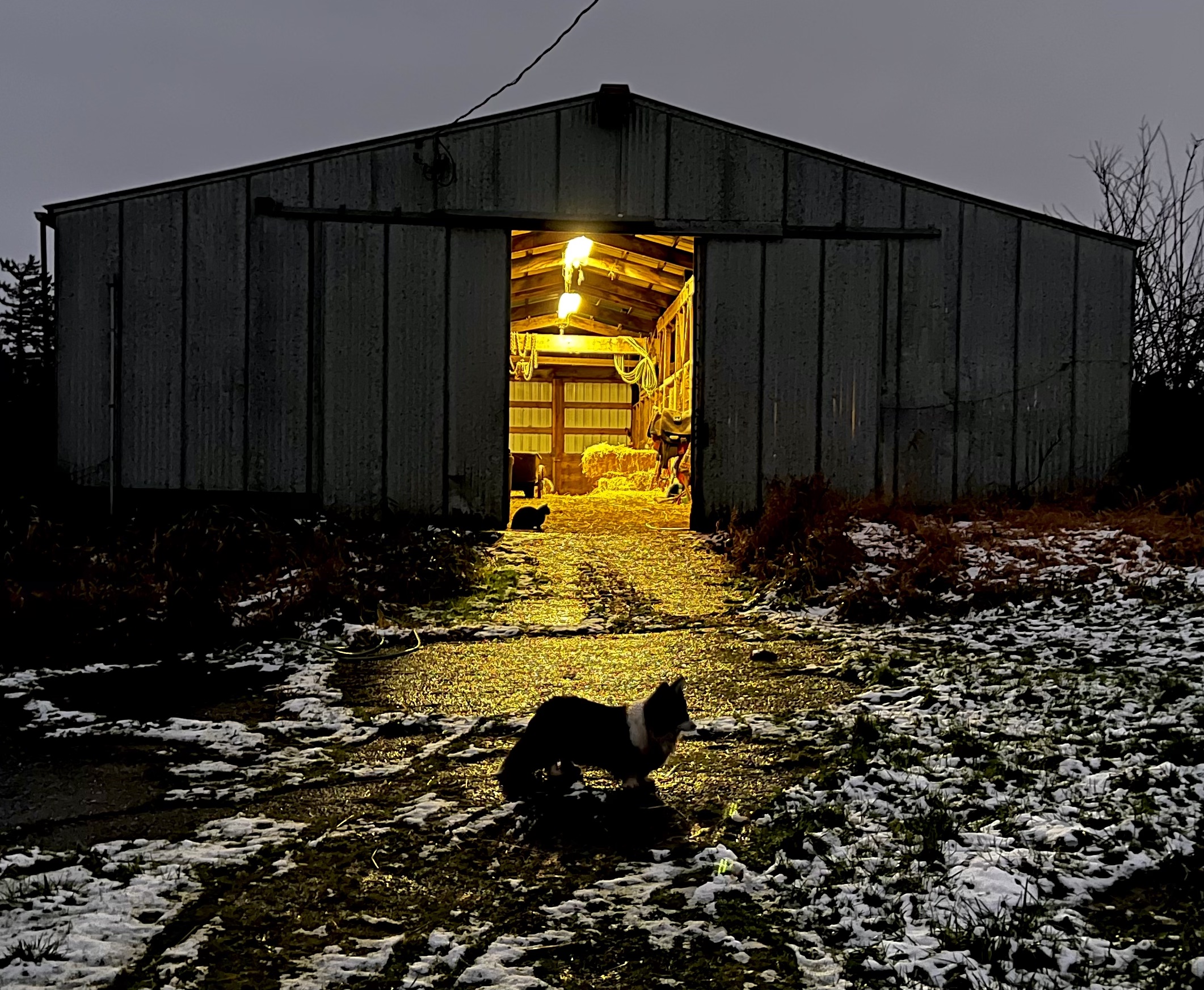
Pull Open the Barn Doors

I like farming.
I like the work.
I like the livestock and the pastures and the woods. 
It’s not necessarily a good living, but it’s a good life. 
I now suspect that if we work with machines
the world will seem to us to be a machine,
but if we work with living creatures
the world will appear to us as a living creature. 
That’s what I’ve spent my life doing,

trying to create an authentic grounds for hope.
~Wendell Berry, horse farmer, essayist, poet, professor
The barn is old, and very old,
But not a place of spectral fear.
Cobwebs and dust and speckling sun
Come to old buildings every one.
Long since they made their dwelling here,
And here you may behold


Nothing but simple wane and change;
Your tread will wake no ghost, your voice
Will fall on silence undeterred.
No phantom wailing will be heard,
Only the farm’s blithe cheerful noise;
The barn is old, not strange.

~Edward Blunden from “The Barn”

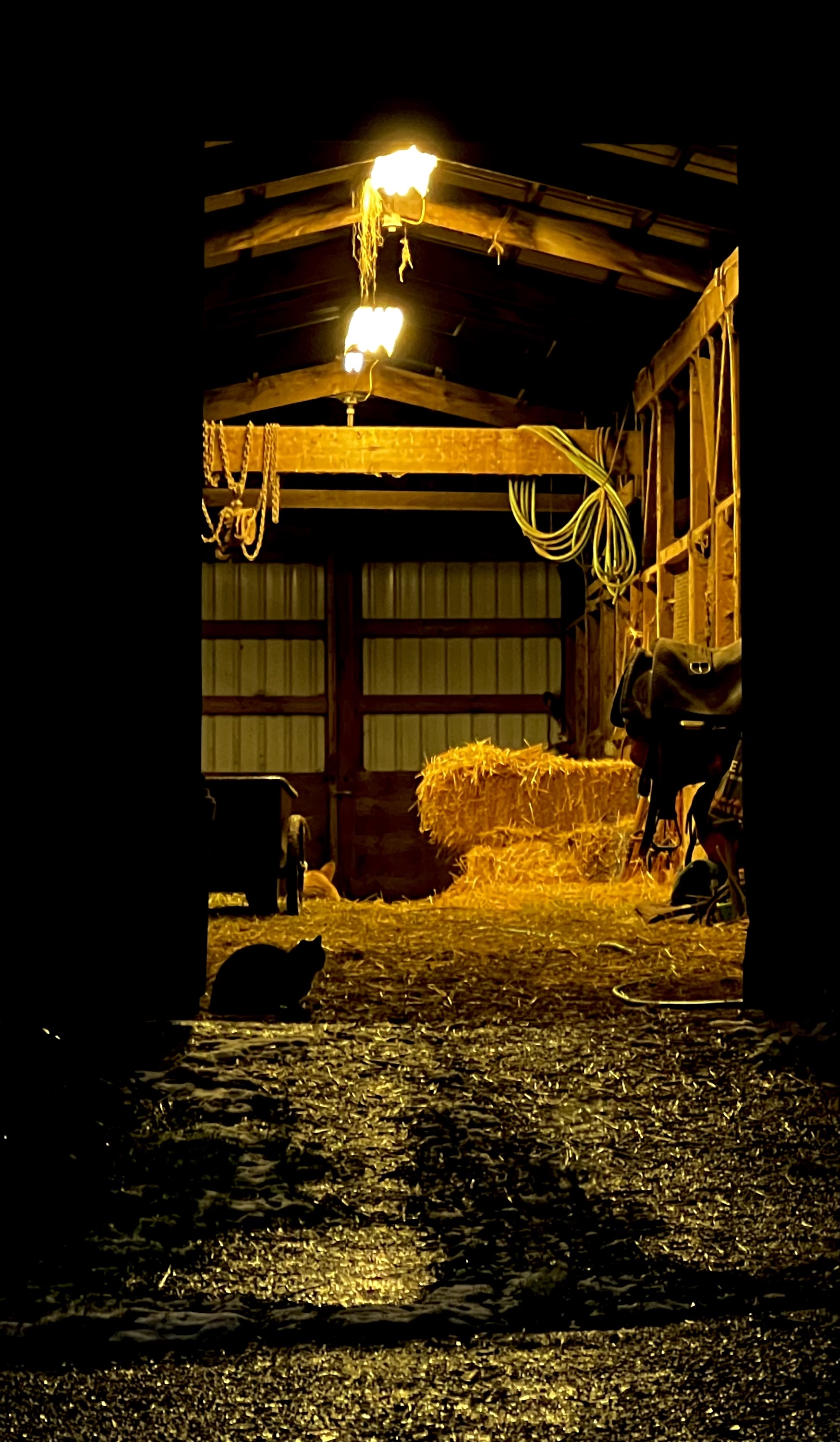
When we pull open the barn doors,
every morning
and each evening,
as our grandfathers did
over a hundred years ago,
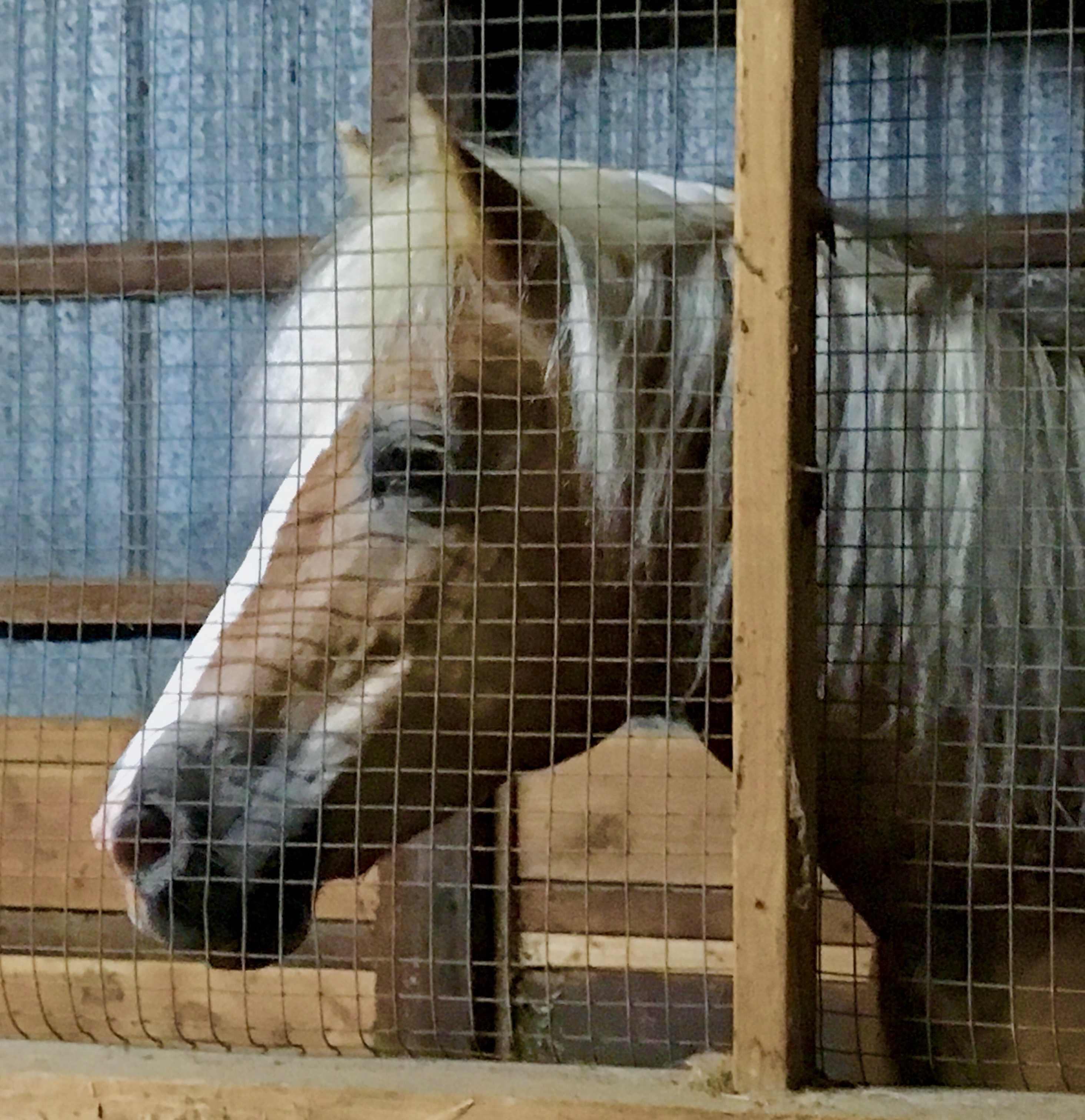
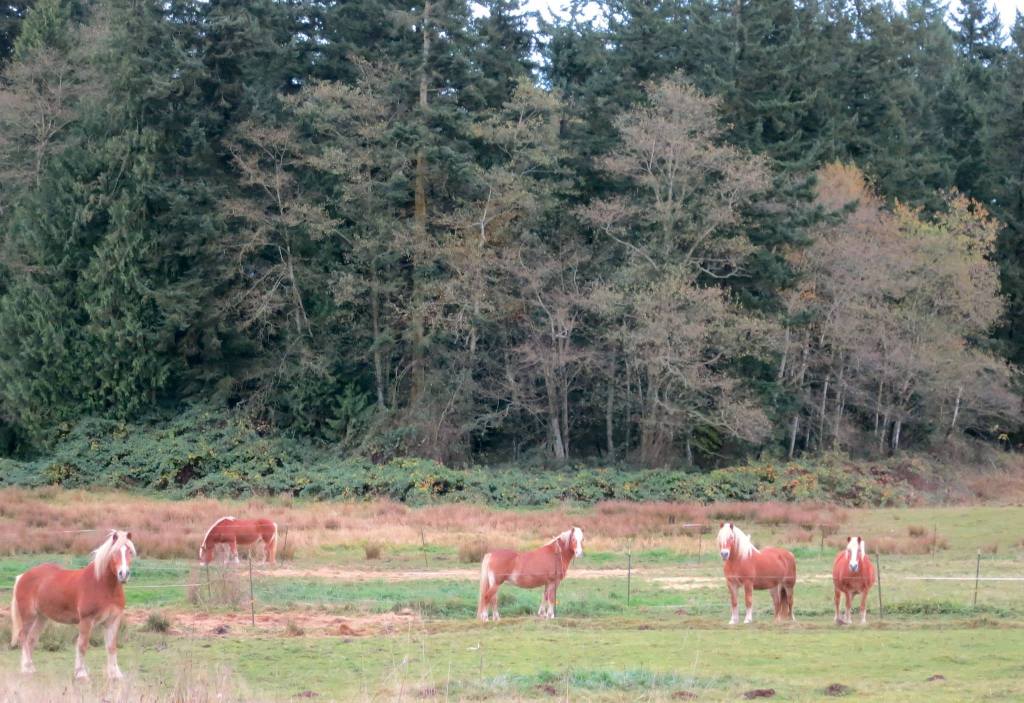
six rumbling voices
rise in greeting.
We exchange scents,
nuzzle each others’ ears.

We do our chores faithfully
as our grandfathers once did–
draw fresh water
into buckets,
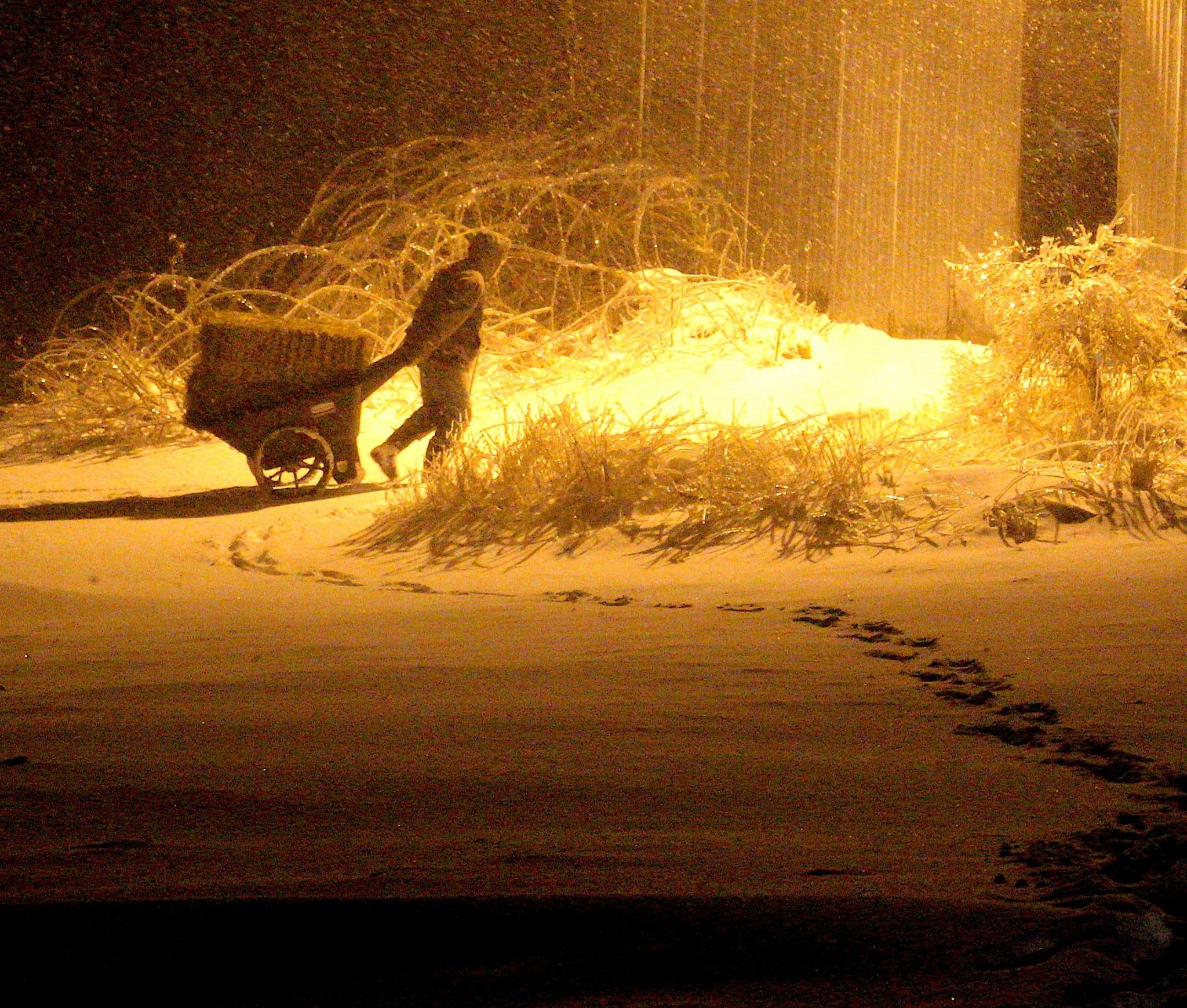
wheel away
the pungent mess underfoot,
release an armful of summer
from the bale,
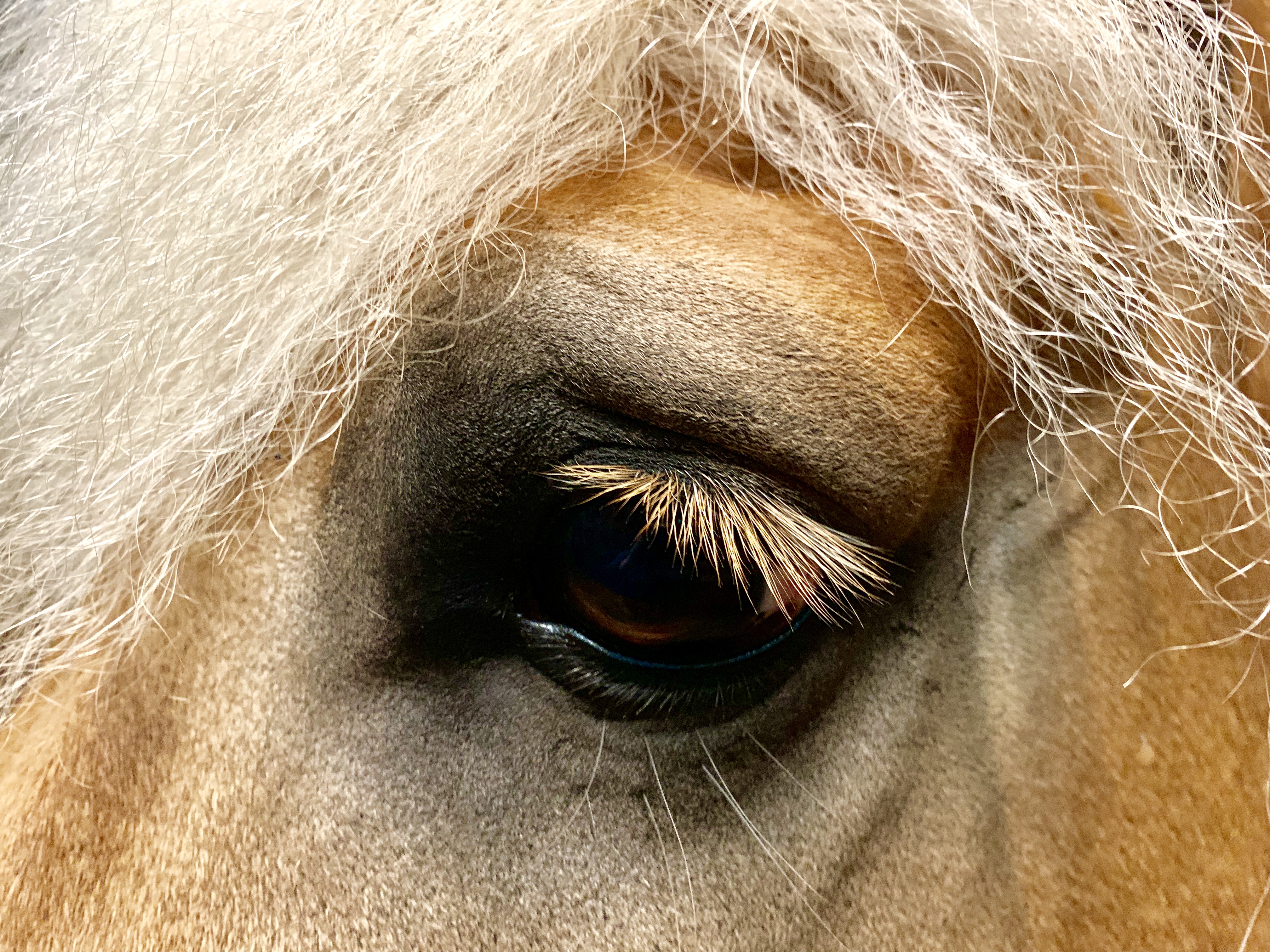
reach under heavy manes
to stroke silken necks.

We don’t depend
on our horses’ strength
and willingness to
don harness
to carry us to town
or move the logs
or till the soil
as our grandfathers did.

Instead,
these soft eyed souls,
some born on this farm
three long decades ago,
are simply grateful
for our constancy
morning and night
to serve their needs
until the day comes
they need no more.

And we depend on them
to depend on us
to be there
to open the doors;
their low whispering welcome
gives voice
to the blessings of
living on a farm
ripe with rhythms and seasons,
as if today and tomorrow are
just like one hundred years ago.

Click on this link for a typical barn moment: https://www.facebook.com/707166118/videos/10156035185231119/

Lyrics:

This is a barn and I know it’s haunted
The corn rattles and the shadows move
It’s just the way, it’s just the way I’m feeling
I want to lie down in a field of rain

This is a river and I pray for the bottom
Some kind of measure of the way things change
I’ve been stuck in the middle of a slow storm, counting the days, love

I know we’re in the dark, and the cold comes
Through the very cracks that let the light through
Bring me something back from that sunny coast, and keep us, moving on

These are the shadowlands, I’ve known them
And I think it’s going to be the long way down
But I’ll be the tiny flame, that you carry around, around, around

I know we’re in the dark, and the cold comes
Through the very cracks that let the light through
Bring me something back from that sunny coast, and keep us, moving on

This is a blessing and I don’t date doubt it
We built a boat out of willow trees
We caught the moonlight, like a mirror
Shine right through to the best of me
We’ve been living in abandoned houses
Sometimes we’re tending to abandoned fields
It’s just the way it’s just the way I’m feeling
I want to wake up with the sun in my head
~Chris Pureka

One-Time
Monthly
Yearly

Make a one-time or recurring donation to support Barnstorming

Make a monthly donation

Make a yearly donation

Choose an amount

¤5.00
¤10.00
¤20.00
¤5.00
¤15.00
¤100.00
¤5.00
¤15.00
¤100.00

Or enter a custom amount

¤

Your contribution is deeply appreciated.

Your contribution is appreciated.

Your contribution is appreciated.

DonateDonate monthlyDonate yearly
Mucking About

I’ve banked nothing, or everything.
Every day
the chores need doing again.
Early in the morning,

I clean the horse barn with a manure fork.
Every morning, it feels as though it could be

the day before or a year ago or a year before that.
With every pass, I give the fork one final upward flick
to keep the manure from falling out, and every day I remember

where I learned to do that and from whom.
Time all but stops.
But then I dump the cart on the compost pile.
I bring out the tractor and turn the pile,

once every three or four days.
The bucket bites and lifts,

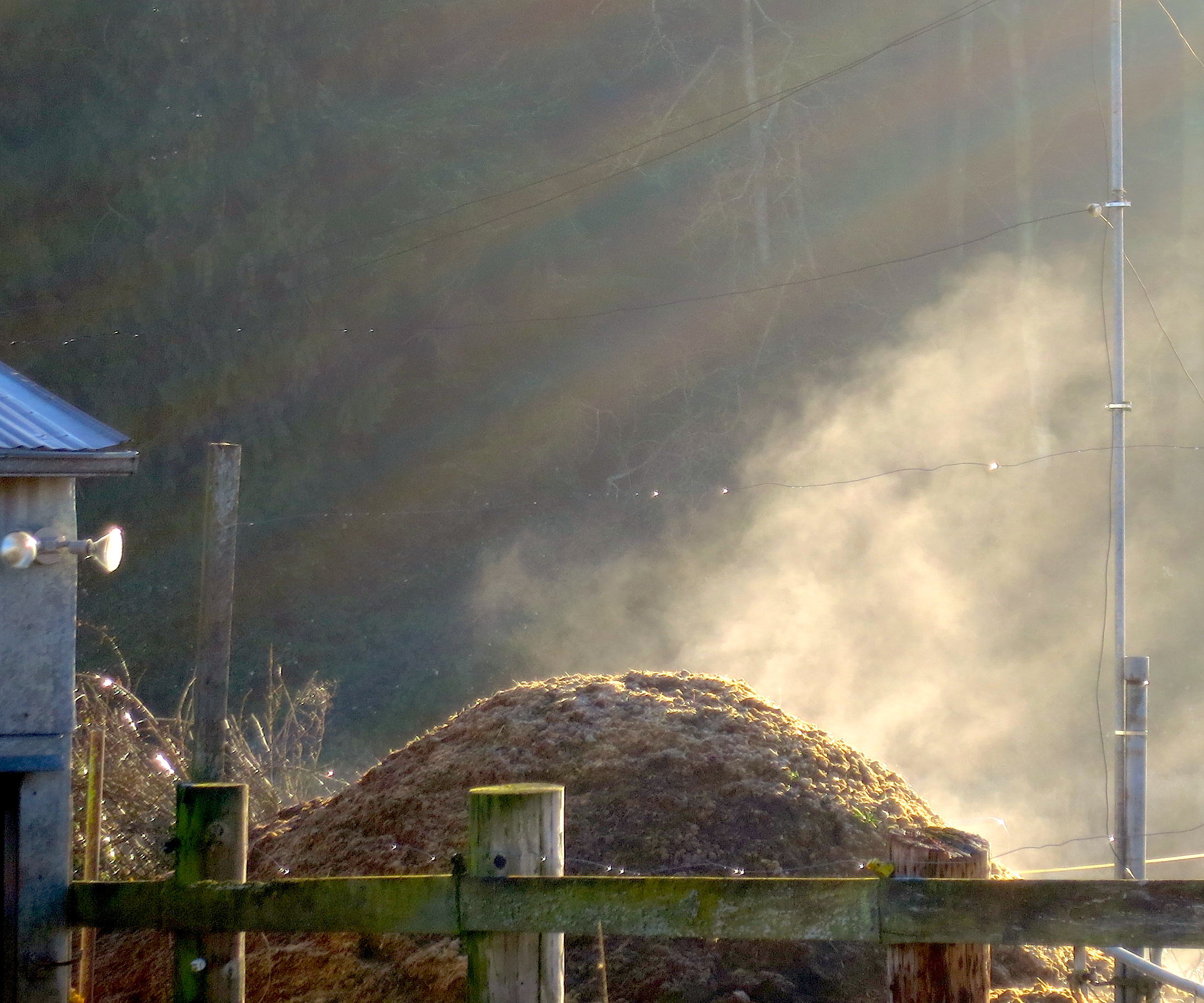
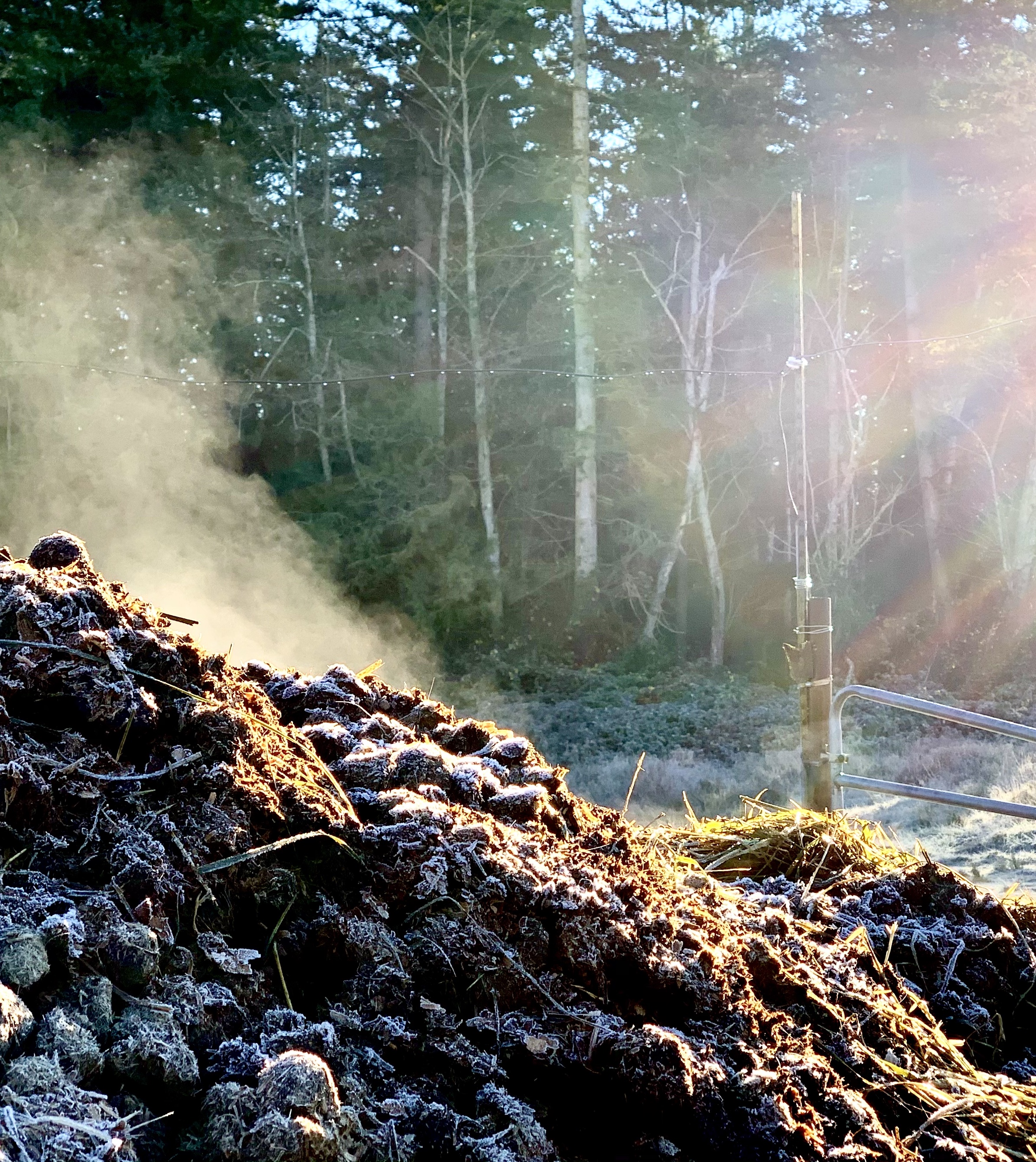
and steam comes billowing out of the heap.
It’s my assurance that time is really moving forward,
decomposing us all in the process.
~Verlyn Klinkenborg from More Scenes from the Rural Life

He <the professor> asked
what I made of the other Oxford students
so I told him:
They were okay, but they were all very similar…
they’d never failed at anything or been nobodies,
and they thought they would always win.
But this isn’t most people’s experience of life.

He asked me what could be done about it.
I told him the answer was to send them all out for a year
to do some dead-end job
like working in a chicken processing plant
or spreading muck with a tractor.
It would do more good than a gap year in Peru. 

He laughed and thought this was tremendously witty.
It wasn’t meant to be funny.

~James Rebanks from The Shepherd’s Life
(how a sheep farmer succeeds at Oxford and then goes back to the farm)

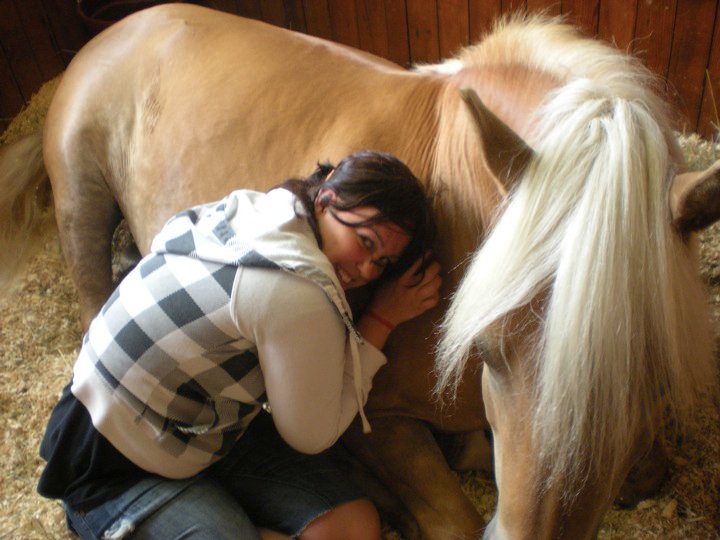
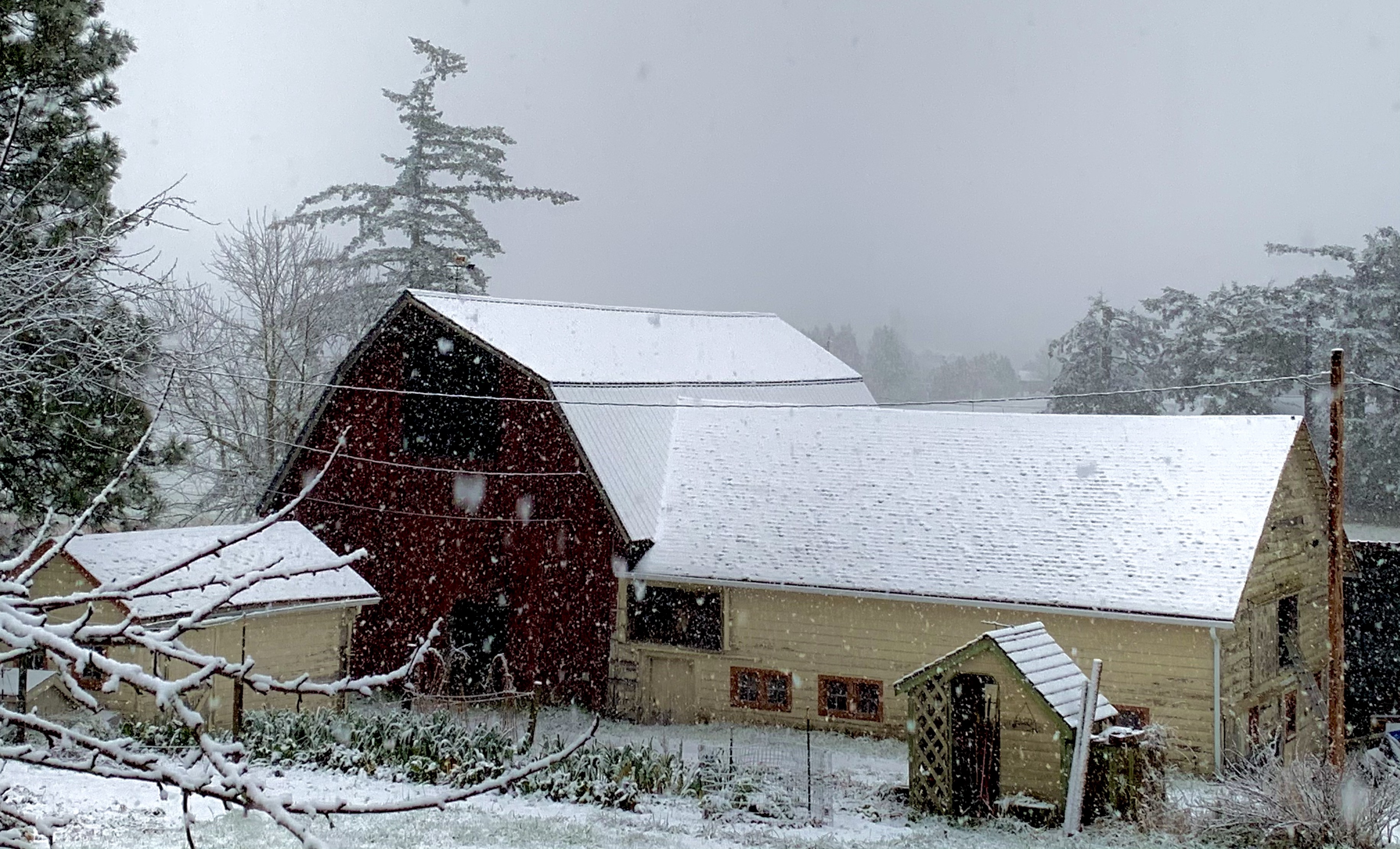
For well over thirty years, my husband and I have spent about an hour a day shoveling manure out of numerous horse stalls and I’m a better person for it. The last few weeks of sub-freezing snow/icy weather while running low on trucked-in supplies of shavings and straw bedding has been a particular character-building experience. It feels like everything, myself included, is in a process of decomposition.

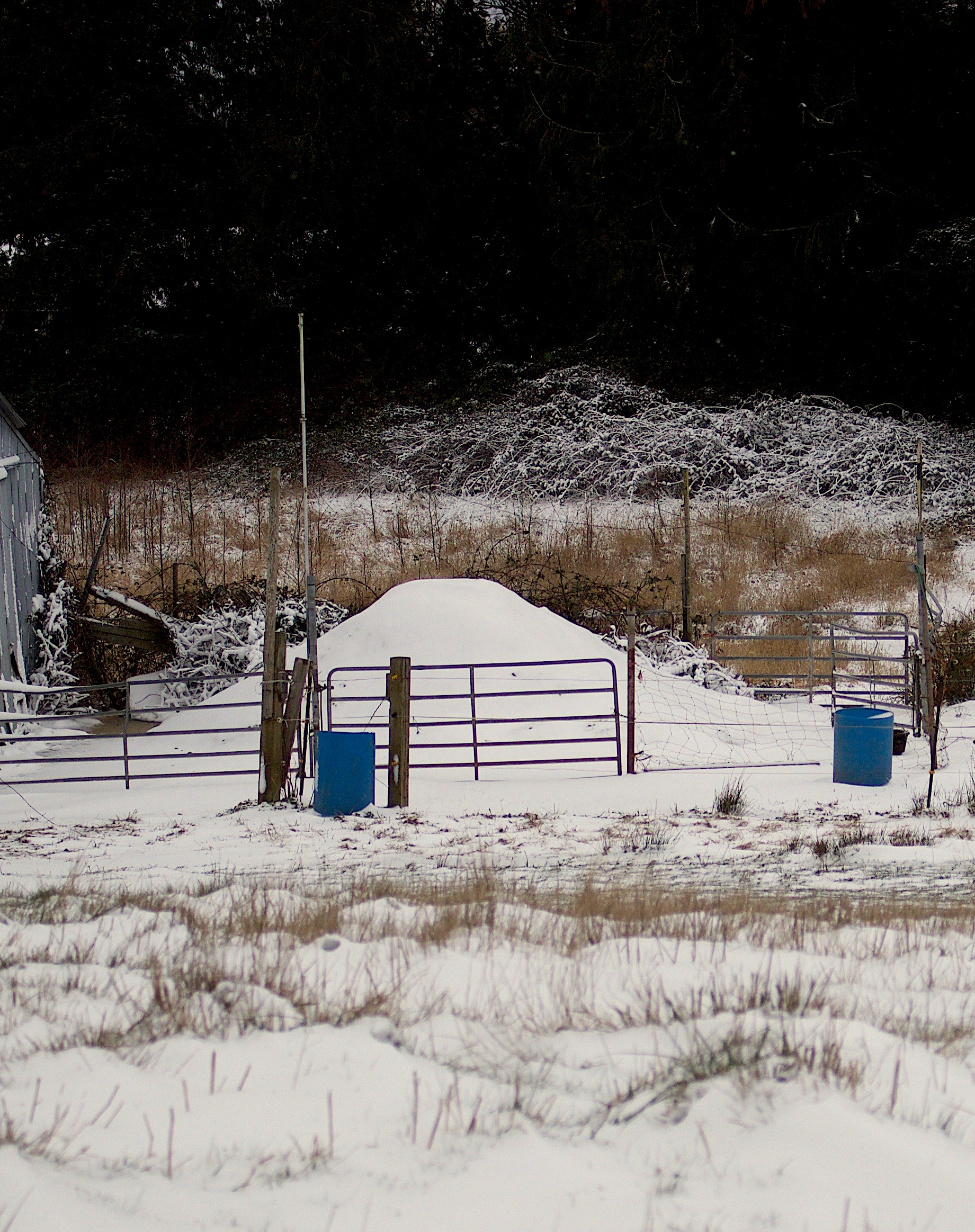
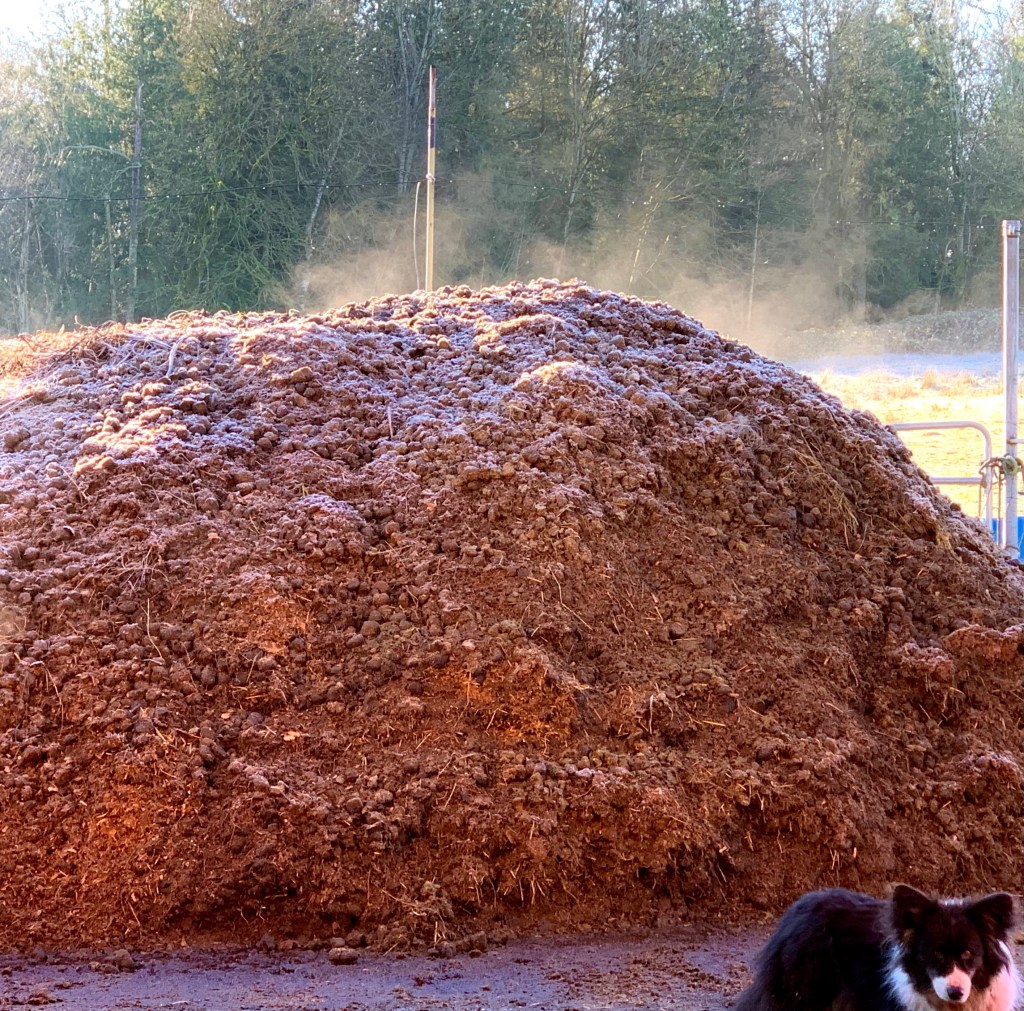
Wheeled to a mountainous pile in our barnyard,  our daily collection of manure happily composts year round, becoming rich fertilizer in a matter of months through a crucible-like heating process of organic chemistry, bacteria and earthworms.  Nothing mankind has achieved quite matches the drama of useless and basically disgusting stuff transforming into the essential elements needed for productive growth and survival.   This is a metaphor I can <ahem> happily muck about in.

I’m in awe, every day, at being part of this process — in many ways a far more tangible improvement to the state of the world than anything else I manage to accomplish every day.  The horses, major contributors that they are, act underwhelmed by my enthusiasm.  I guess some miracles are relative, depending on one’s perspective, but if the horses understood that the grass they contentedly eat in the pasture, or the hay they munch on during the winter months, was grown thanks to their carefully recycled waste products, they might be more impressed.

Their nonchalance about the daily mucking routine is understandable.  If they are outside, they probably don’t notice their beds are clean when they return to the stalls at night.  If they are inside during the heavy rain days, they feel duty-bound to be in our faces as we move about their stall, toting a pitchfork and pushing a wheelbarrow.  I’m a source of constant amusement as they nose my jacket pockets for treats that I never carry, as they beg for scratches on their unreachable itchy spots, and as they attempt to overturn an almost full load, just to see balls of manure roll to all corners of the stall like breaking a rack of billiard balls in a game of pool.

Good thing I’m a patient person always seeking an object lesson in whatever I see or do ~ mucking out stalls every day helps me tolerate the proverbial muck I encounter every day off the farm.  And spending an hour a day getting dirty in the real stuff somehow makes the virtual manure less noxious. 

Everyone should be spending time daily mucking out;
I think the world would generally be a better place.

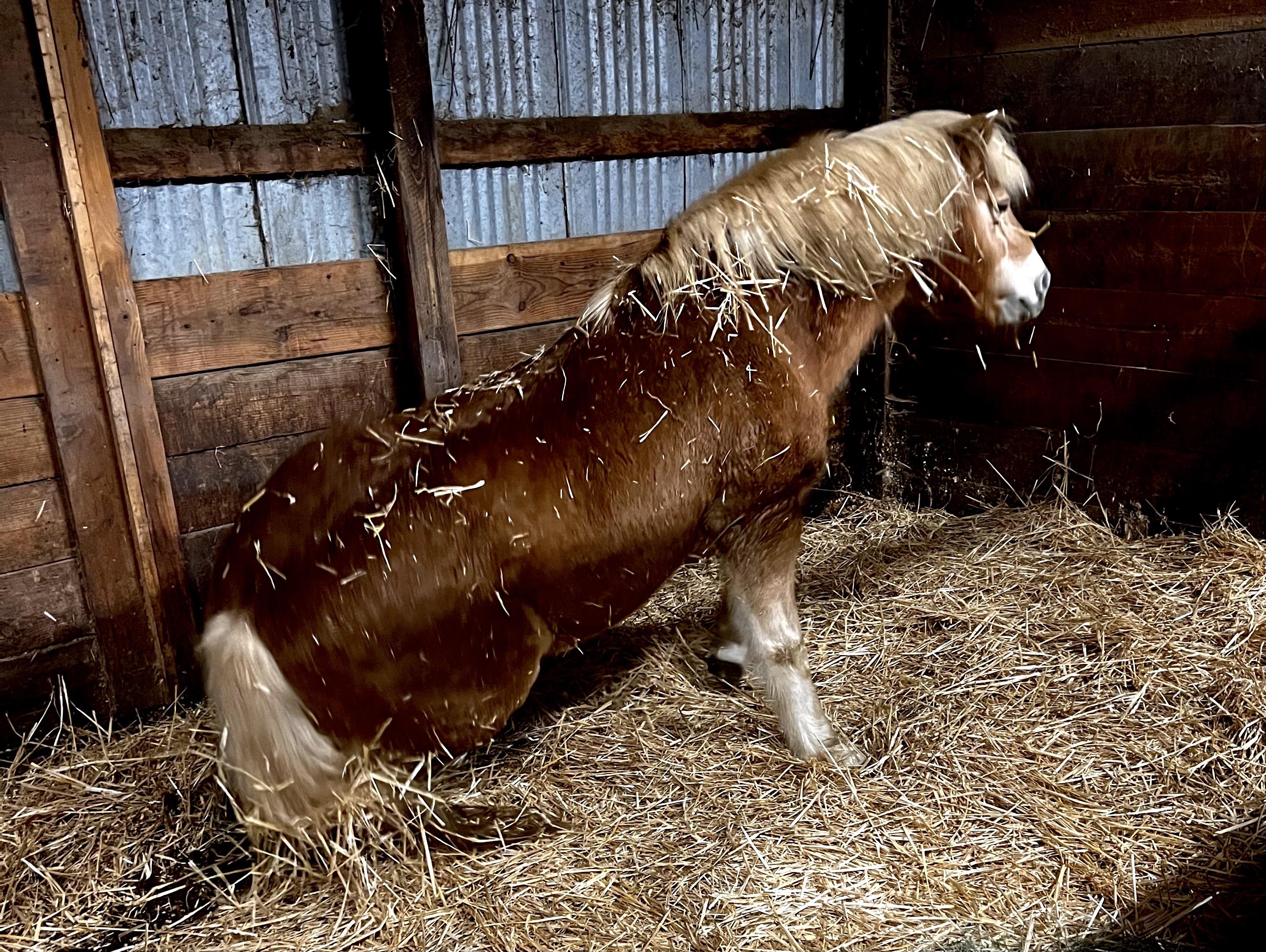
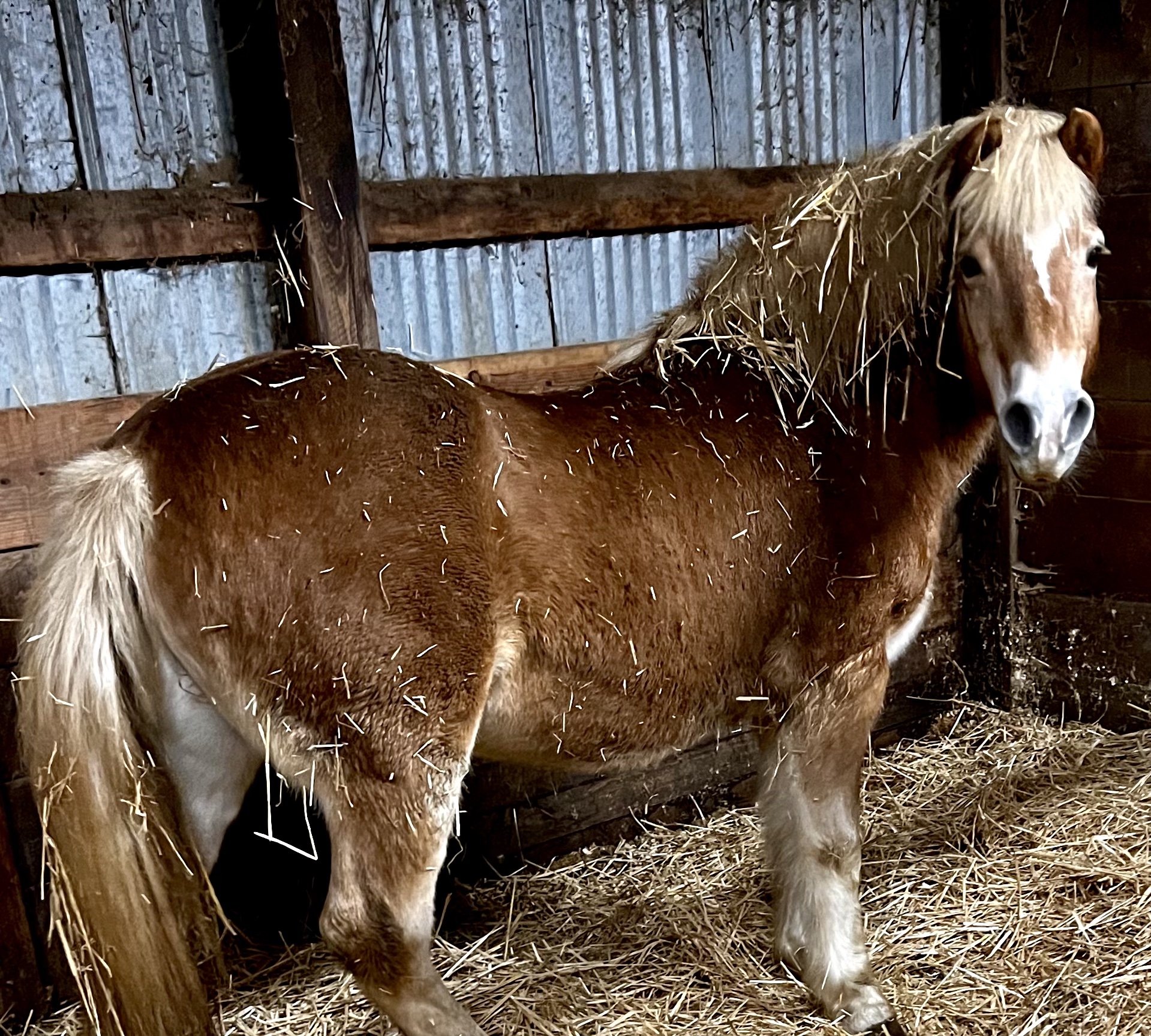
Wally, our former stallion, now gelded, discovered a way to make my life easier rather than complicating it.  He hauled a rubber tub into his stall from his paddock, by tossing it into the air with his teeth and throwing it, and it finally settled against one wall.  Then he began to consistently pile his manure, with precise aim, right in the tub.  I didn’t ask him to do this.  It had never occurred to me.  I hadn’t even thought it was possible for a horse to house train himself.  But there it is, proof that some horses prefer neat and tidy rather than the whirlwind eggbeater approach to manure distribution.  After a day of his manure pile plopping, it is actually too heavy for me to pick up and dump into the wheelbarrow all in one tub load, but it takes 1/4 of the time to clean his stall than the others, and he spares all this bedding.

What a guy.  He provides me unending inspiration in how to keep my own personal muck concentrated rather than spreading it about,  contaminating the rest of the world.

Now, once I teach him to put the seat back down when he’s done, he’s welcome to move into the house…

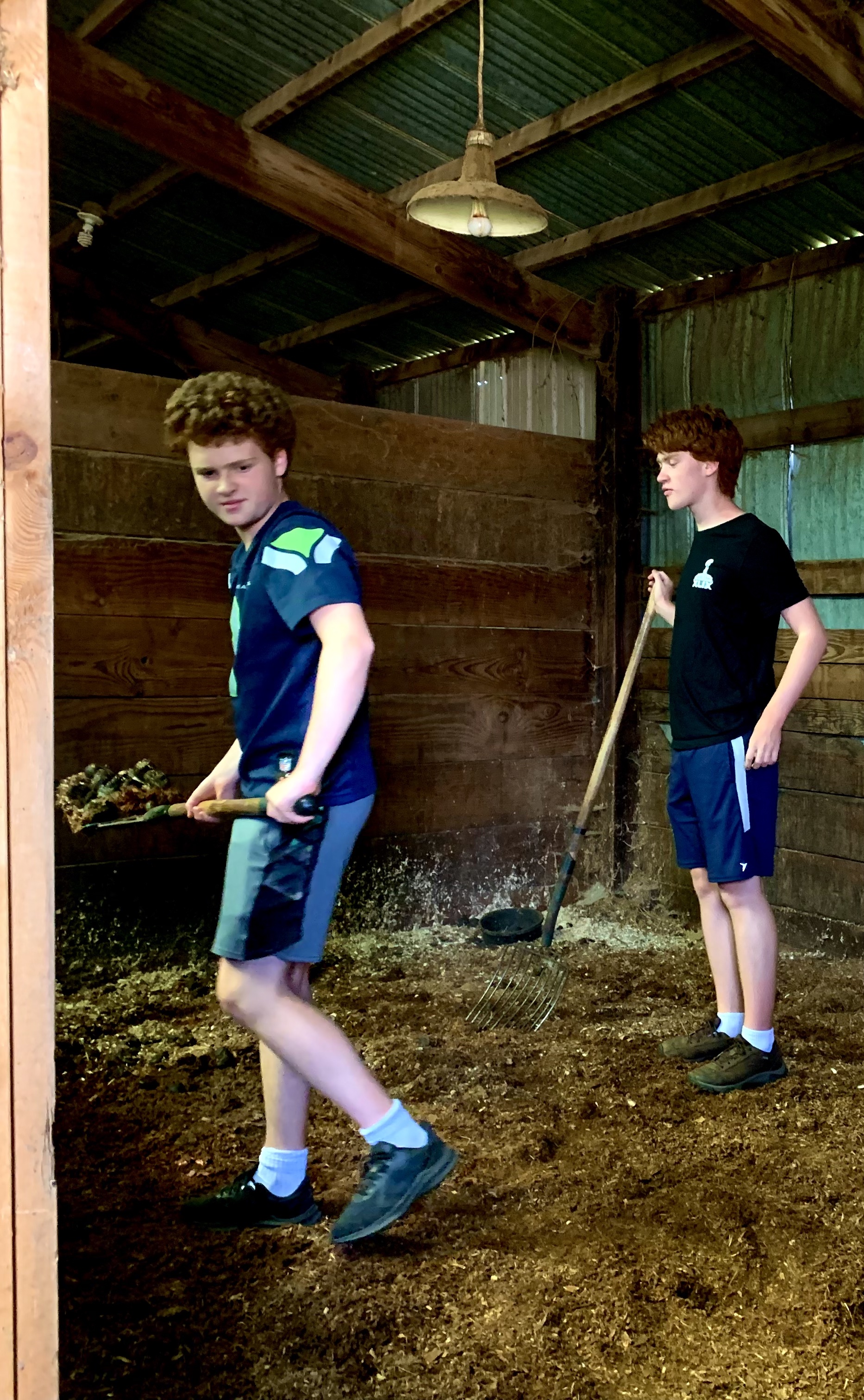
teaching my city nephews how to muck out a stall
Wally’s purposeful pile

One-Time
Monthly
Yearly

Make a one-time or recurring donation to support Barnstorming

Make a monthly donation

Make a yearly donation

Choose an amount

¤5.00
¤10.00
¤20.00
¤5.00
¤15.00
¤100.00
¤5.00
¤15.00
¤100.00

Or enter a custom amount

¤

Your contribution is deeply appreciated.

Your contribution is appreciated.

Your contribution is appreciated.

DonateDonate monthlyDonate yearly
The Beginning Shall Remind Us of the End: O Great Mystery

Christmas Eve, and twelve of the clock.
“Now they are all on their knees,”
An elder said as we sat in a flock
By the embers in hearthside ease.

We pictured the meek mild creatures where
They dwelt in their strawy pen,
Nor did it occur to one of us there
To doubt they were kneeling then.
So fair a fancy few would weave

In these years!

Yet, I feel,If someone said on Christmas Eve,
“Come; see the oxen kneel,“
In the lonely barton by yonder coomb
Our childhood used to know,
”I should go with him in the gloom,
Hoping it might be so.
~Thomas Hardy “The Oxen”

Says a country legend told every year:
Go to the barn on Christmas Eve and see
what the creatures do as that long night tips over.
Down on their knees they will go, the fire
of an old memory whistling through their minds!

So I went. Wrapped to my eyes against the cold
I creaked back the barn door and peered in.
From town the church bells spilled their midnight music,
and the beasts listened – yet they lay in their stalls like stone.

Oh the heretics!
Not to remember Bethlehem,
or the star as bright as a sun,
or the child born on a bed of straw!
To know only of the dissolving Now!

Still they drowsed on –
citizens of the pure, the physical world,
they loomed in the dark: powerful
of body, peaceful of mind, innocent of history.

Brothers! I whispered. It is Christmas!
And you are no heretics, but a miracle,
immaculate still as when you thundered forth
on the morning of creation!
As for Bethlehem, that blazing star

still sailed the dark, but only looked for me.
Caught in its light, listening again to its story,
I curled against some sleepy beast, who nuzzled
my hair as though I were a child, and warmed me
the best it could all night.

~Mary Oliver “Christmas Poem” from Goodness and Light

The winds were scornful,
Passing by;
And gathering Angels
Wondered why

A burdened Mother
Did not mind
That only animals
Were kind.

For who in all the world
Could guess
That God would search out
Loneliness.
~Sr. M. Chrysostom, O.S.B.  “The Stable”

Beholding his glory is only half our job. 
In our souls too the mysteries must be brought forth; 
we are not really Christians till that has been done. 
A mystic says human nature is like a stable inhabited 
by the ox of passion and the ass of prejudice—
animals which take up a lot of room 
and which I suppose most of us are feeding on the quiet. 
And it is there between them, pushing them out, 
that Christ must be born 
and in their very manger he must be laid—
and they will be the first to fall on their knees before him. 
Sometimes Christians seem far nearer to those animals 
than to Christ in his simple poverty, self-abandoned to God.
~Evelyn Underhill
“Light of the World” from Watch for the Light

Growing up on my childhood farm,
remembering the magic of Christmas eve night,
I bundled myself up to stay warm
in our barn, to witness an unbelievable sight.

At midnight we knew the animals knelt down,
speaking words we could all understand,
to worship a Child born in Bethlehem town,
in a barn, long ago in a far away land.

They were there that night, to see and to hear,
the blessings that came from the sky.
They patiently stood watch at the manger near,
in a barn, while shepherds and kings stopped by.

My trips to the barn were always too late,
our cows would be chewing, our chickens asleep,
our horses breathing softly, cats climbing the gate,
in our barn, there was never a neigh, moo or peep.

But I knew they had done it, I just missed it again!
They were plainly so calm, well-fed and at peace
in the sweet smelling straw, all snug in their pens,
in a barn, a mystery, once more, took place.

Even now, I still bundle to go out Christmas eve,
in the hope I’ll catch them just once more this time.
Though I’m older and grayer, I still firmly believe
in the barn, a Birth happened amid cobwebs and grime.

Our horses sigh low as they hear me come near,
that tells me the time I hope for is now,
they will drop to their knees without any fear
in our barn, as worship, all living things bow.

I wonder anew at God’s immense trust
for His creatures so sheltered that darkening night –
the mystery of why of all places, His Son must
begin life in a barn: a welcoming most holy and right.
~Emily Gibson “In the Barn” (written Christmas Eve 1999)

Let it come, as it will, and don’t   
be afraid. God does not leave us   
comfortless, so let evening come.
~Jane Kenyon, from “Let Evening Come”

This year’s Barnstorming Advent theme “… the Beginning shall remind us of the End” is taken from the final lines in T.S. Eliot’s poem “The Cultivation of Christmas Trees”

Latin text
O magnum mysterium,
et admirabile sacramentum,
ut animalia viderent Dominum natum,
iacentem in praesepio!
Beata Virgo, cujus viscera
meruerunt portare
Dominum Iesum Christum.
Alleluia!

English translation
O great mystery,
and wonderful sacrament,
that animals should see the newborn Lord,
lying in a manger!
Blessed is the virgin whose womb
was worthy to bear
the Lord, Jesus Christ.
Alleluia!

Sing O the wild wood, the green holly,
The silent river and barren tree;
The humble creatures that no man sees:
Sing O the wild wood.

A weary journey one winter’s night;
No hope of shelter, no rest in sight.
Who was the creature that bore Mary?
A simple donkey.

And when they came into Beth’lem Town
They found a stable to lay them down;
For their companions that Christmas night,
An ox and an ass.

And then an angel came down to earth
To bear the news of the Saviour’s birth;
The first to marvel were shepherds poor,
And sheep with their lambs.

Sing O the wild wood, the green holly,
The silent river and barren tree;
The humble creatures that no man sees:
Sing O the wild wood.
John Rutter

Jesus our brother, strong and good
Was humbly born in a stable rude
And the friendly beasts around him stood
Jesus our brother, strong and good
“I, ” said the donkey, shaggy and brown
“I carried his mother up hill and down
I carried his mother to Bethlehem town”
“I, ” said the donkey, shaggy and brown
“I, ” said the cow, all white and red
“I gave him my manger for his bed
I gave him my hay to pillow his head”
“I, ” said the cow, all white and red
“I, ” said the sheep with curly horn
“I gave him my wool for his blanket warm
He wore my coat on Christmas morn”
“I, ” said the sheep with curly horn
“I, ” said the dove from the rafters high
“I cooed him to sleep so he would not cry
We cooed him to sleep, my mate and I”
“I, ” said the dove from rafters high
Thus every beast by some good spell
In the stable dark was glad to tell
Of the gifts they gave Emmanuel

The Beginning Shall Remind Us of the End: No Room At All

For outlandish creatures like us,
on our way to a heart, a brain, and courage,
Bethlehem is not the end of our journey but only the beginning – not home but the place through which we must pass
if ever we are to reach home at last.
~Frederick Buechner from The Magnificent Defeat

Into this world, this demented inn,
in which there is absolutely no room for him at all,
Christ has come uninvited.
But because he cannot be at home in it –
because he is out of place in it, and yet must be in it –
his place is with those others who do not belong,
who are rejected because they are regarded as weak…
With those for whom there is no room,
Christ is present in this world.
He is mysteriously present in those for whom
there seems to be nothing but the world at its worst.
~Thomas Merton from Watch for the Light

As a physician, I’ve provided care to many homeless people, but I’ve never known homelessness myself.  However, I have been room-less and those experiences were enough to acquaint me with the dilemma for Joseph and Mary searching for a place to sleep in Bethlehem.

It was my ninth birthday, July 26, 1963, and my family was driving to Washington D.C. for a few days of sightseeing. We had planned to spend the night in a motel somewhere in eastern Ohio or western Pennsylvania but my father, ever the determined traveler, felt we should push on closer to our destination. By the time 11 PM rolled around, we were all tired and not just a little cranky so we started looking for vacancy signs at road-side motels. Most were posted no vacancy by that time of night, and many simply had shut off their lights. We stopped at a few with vacancy still lit, but all they had available would never accommodate a family of five.

We kept driving east, and though I was hungry for sleep, I became ever more anxious that we really would never find a place to lay our heads. My eyes grew wider and I was more awake than ever, having never stayed up beyond 1 AM before and certainly, I’d never had the experience of being awake all night long. It still goes down in my annals as my longest birthday on record.

By 2 AM we arrived in Harrisburg, Pennsylvania and my dad had reached his driving limit and my mom had declared we were not traveling another mile. We headed downtown where the brick Harrisburg Hotel stood some 10 stories high, an old structure in a questionable area of town, but the lights were on and there were signs of life inside.

They did have a room that gave us two saggy double beds to share for eight dollars, with sheets and blankets with dubious laundering history, a bare light bulb that turned on with a chain and a bathroom down the hall. I’m surprised my mother even considered laying down on that bed, but she did. I don’t remember getting much sleep that night, but it was a place to rest, and the sirens and shouts out on the street did make for interesting background noise.

Some 12 years later, I had another experience of finding no room to lay my head after arriving late at night in Dar es Salaam in Tanzania, with supposed reservations at the local YMCA for myself and my three student friends traveling together on our way to Gombe to study wild chimpanzees. We landed at the airport after midnight after a day long flight from Brussels, managed to make it through customs intact and find a taxi, only to arrive at the Y to find it dark and locked. It took some loud knocking to rouse anyone and with our poor Swahili, we were able to explain our dilemma–we were supposed to have two rooms reserved for the four of us. He said clearly “no room, all rooms taken”.

The host was plainly perplexed at what to do with four Americans in the middle of the night. He decided to parse us out one each to occupied rooms and hope that the occupants were willing to share. He looked at me, a skinny white girl with short hair and decided I was some kind of strange looking guy, and tried to stick me in a room with a rather intoxicated French man and I said absolutely not. Instead my female traveling partner and I ended up sharing a cot (sort of) in a room with a German couple who allowed us into their room, which I thought was an amazing act of generosity at 2 AM in the morning. I didn’t sleep a wink, amazed at the magical sounds and smells of my first dawn in Africa, hearing the morning prayers coming from the mosque across the street, only a few hours later.

So I can relate in a small way to what it must have felt like over 2000 years ago to have traveled over hard roads to arrive in a dirty little town temporarily crammed with too many people, and find there were no rooms anywhere to be had. And to have doors shut abruptly on a young woman in obvious full term pregnancy is another matter altogether. They must have felt a growing sense of panic that there would be no safe and clean place to rest and possibly deliver this Child.

Then there came the offer of an animals’ dwelling, with fodder for bedding and some minimal shelter. A stable and its stone manger became sanctuary for the weary and burdened. We are all invited in to rest there, and I never enter a barn without somehow acknowledging that fact and feeling welcomed.

There are so many ways we continue to refuse access and shut the doors in the faces of those two (plus One) weary travelers, forcing them to look elsewhere to stay. We say “no room” dozens of times every day, not realizing who and what we are shutting out.

With all the material distractions of our age, it is small wonder we pay no attention to who is waiting patiently outside the back door of our lives, where it is inhospitable and cold and dank. Few of us would invite our special company into the barn first and foremost. Yet these travelers don’t seek an invitation to come in the front door, with fancy meals and feather beds and fresh flowers on the cupboard. It is the dark and manure strewn parts of our lives where they are needed most. That is where He was born to dwell amid our messiness, and that is where He remains, in the humblest parts of our being, the parts we do not want to show off, and indeed, most often want to hide.

And that is, of course, a place where there is always plenty of room.

This year’s Barnstorming Advent theme “… the Beginning shall remind us of the End” is taken from the final lines in T.S. Eliot’s poem “The Cultivation of Christmas Trees”

Jesus, Jesus, rest your head.
You has got a manger bed.
All the evil folk on earth
Sleep in feathers at their birth.
Jesus, Jesus, rest your head.
You has got a manger bed.

1. Have you heard about our Jesus?
Have you heard about his fate?
How his mammy went to the stable
On that Christmas Eve so late?
Winds were blowing, cows were lowing,
Stars were glowing, glowing, glowing. Refrain

2. To the manger came the Wise Men.
Bringing from hin and yon,
For the mother and the father,
And the blessed little Son.
Milkmaids left their fields and flocks
And sat beside the ass and ox. Refrain

One-Time
Monthly
Yearly

Make a one-time or recurring donation to support Barnstorming

Make a monthly donation

Make a yearly donation

Choose an amount

¤5.00
¤10.00
¤20.00
¤5.00
¤15.00
¤100.00
¤5.00
¤15.00
¤100.00

Or enter a custom amount

¤

Your contribution is deeply appreciated.

Your contribution is appreciated.

Your contribution is appreciated.

DonateDonate monthlyDonate yearly
The Beginning Shall Remind Us of the End: A Bowl of Frozen Tears

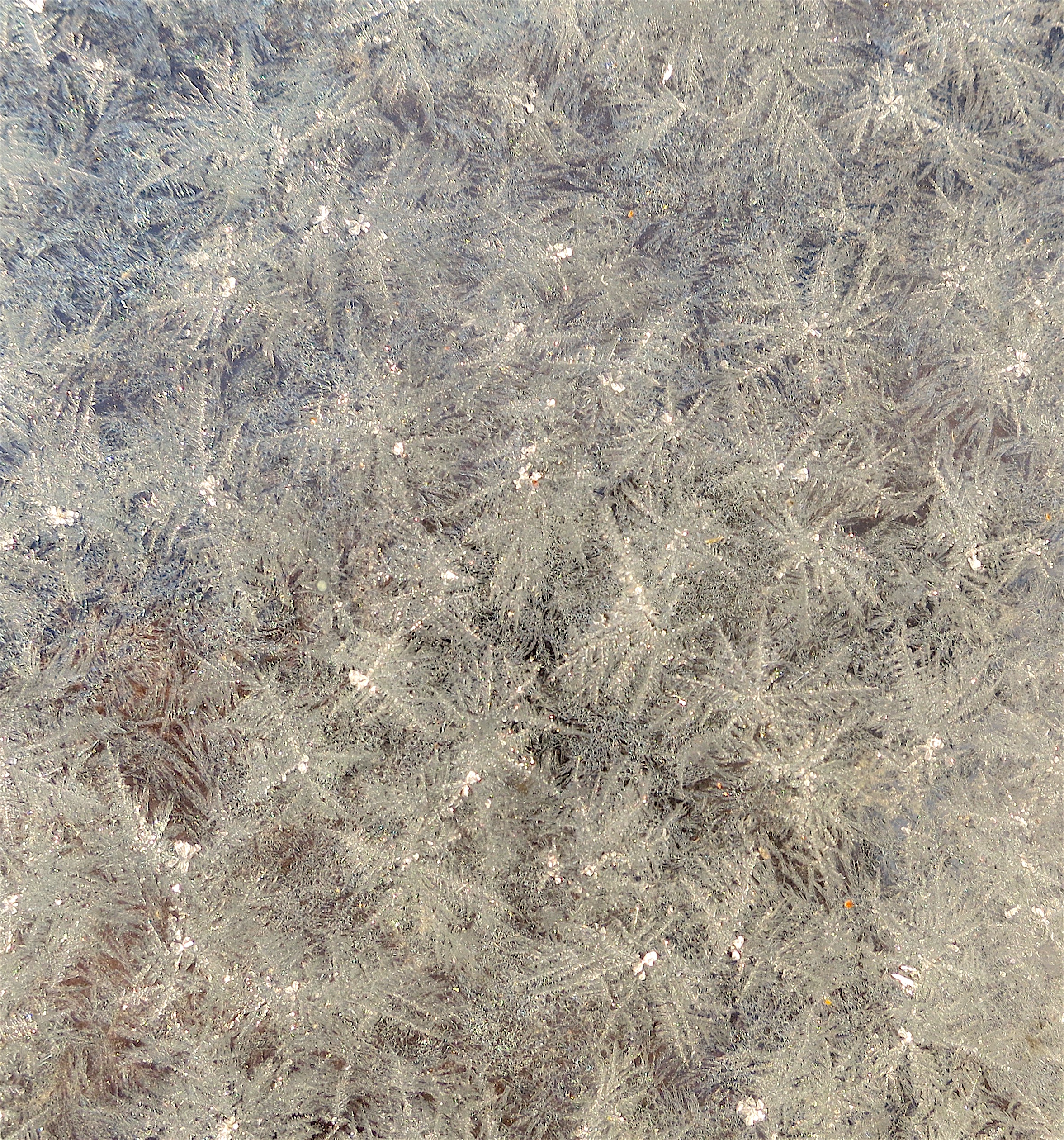
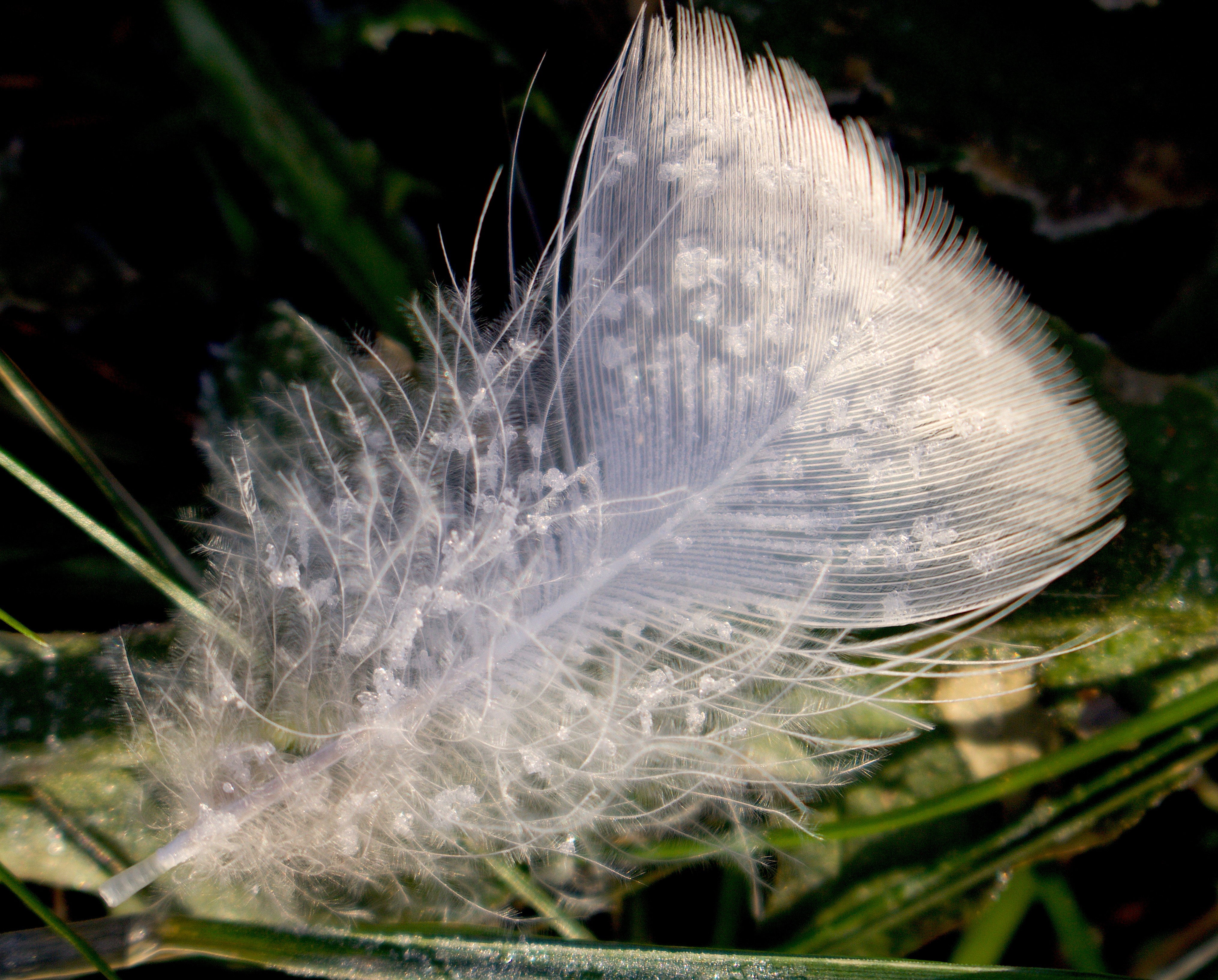
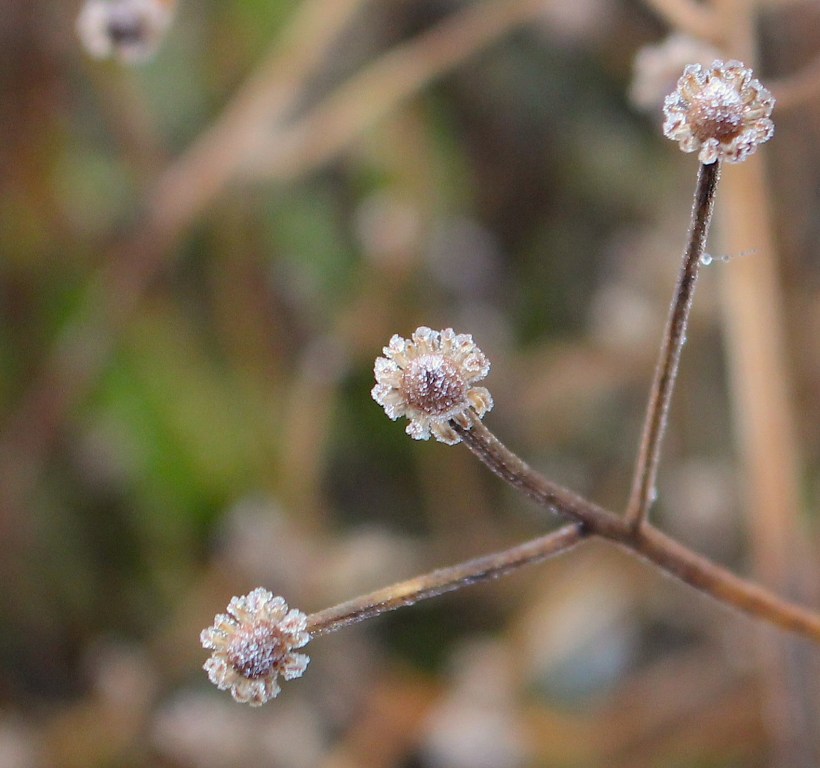
Something has descended
like feathered prophecy.
Someone has offered the world
a bowl of frozen tears,

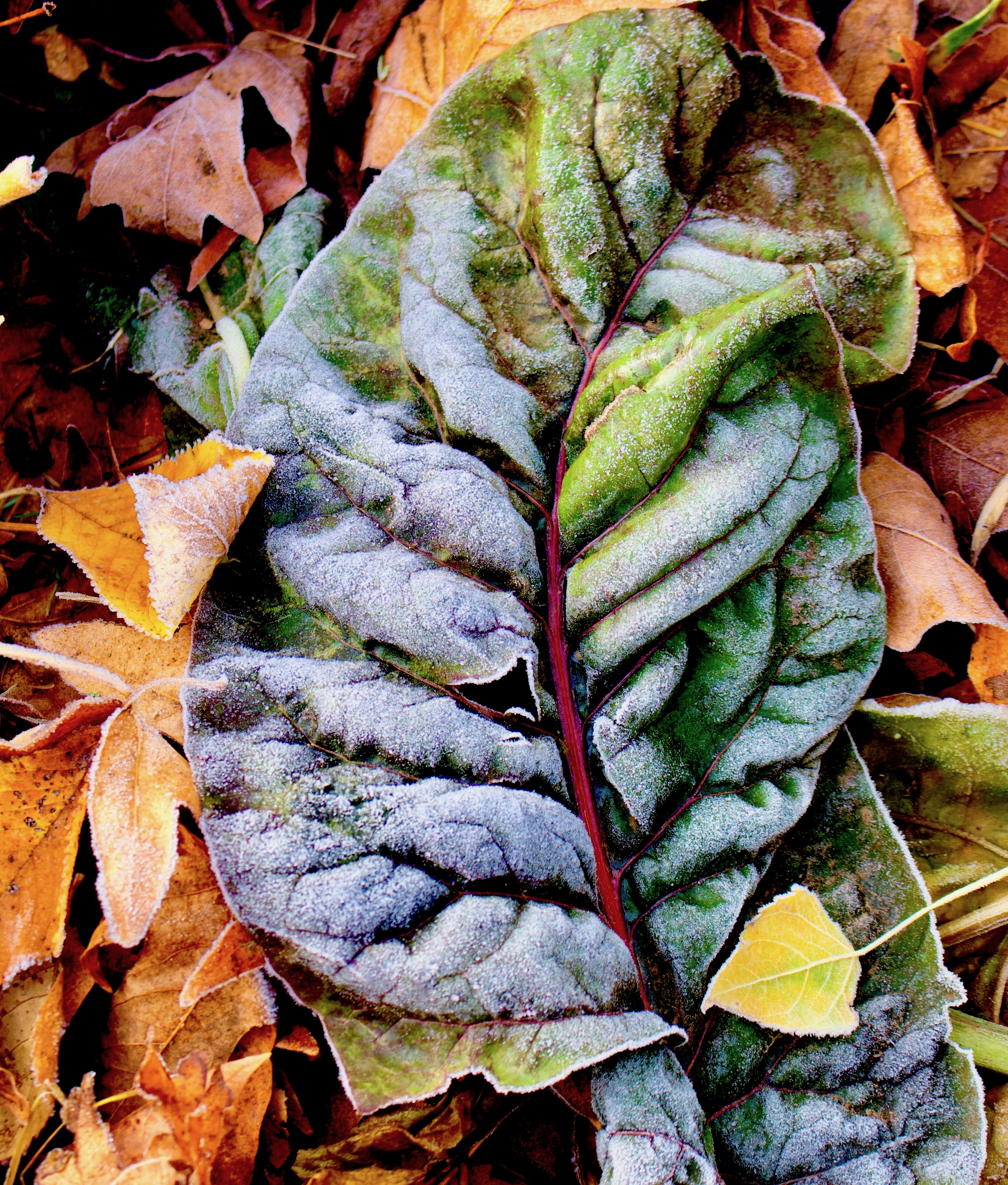
has traced the veins and edges
of leaves with furred ink.
The grass is stiff as the strings
of a lute.

And, day by day, the tiny windows
crack their cardboard frames
seizing the frail light. The sun,
moving through

these waxy squares, undiminished
as a word passing
from mind to speech.
Every breath a birth,

a stir of floating limbs within me.
I stay up late and waken early
to feel beneath my feet
the silence coming.
~Anya Silver “Advent, First Frost”

When I am weary,
putting one foot in front of the other
in the humble chores of the barn,
feeling so cold at times, I no longer
remember this was
once sweaty summer work ~
now my hands ache in an arctic wind
that shows no mercy.

Yet I know respite will come,
refuge is near, salvation is imminent.
Each breath I breathe a cloud of hope.

I will remember what our good God
has prepared for us in such a place as this,
what He has done to come down to dwell with us,
melting our frozen tears,
aching in silence alongside us.

This year’s Barnstorming Advent theme “… the Beginning shall remind us of the End” is taken from the final lines in T.S. Eliot’s poem “The Cultivation of Christmas Trees”

Good people all, this Christmas time,
Consider well and bear in mind
What our good God for us has done
In sending his beloved son
With Mary holy we should pray,
To God with love this Christmas Day

In Bethlehem upon that morn,
There was a blessed Messiah born
The night before that happy tide
The noble Virgin and her guide
Were long time seeking up and down
To find a lodging in the town

But mark right well what came to pass
From every door repelled, alas
As was foretold, their refuge all
Was but a humble ox’s stall
Near Bethlehem did shepherds keep
Their flocks of lambs and feeding sheep

To whom God’s angel did appear
Which put the shepherds in great fear
Arise and go, the angels said
To Bethlehem, be not afraid
For there you’ll find, this happy morn
A princely babe, sweet Jesus, born
With thankful heart and joyful mind

The shepherds went the babe to find
And as God’s angel had foretold
They did our Saviour Christ behold
Within a manger he was laid
And by his side a virgin maid

Attending on the Lord of Life
Who came on earth to end all strife
There were three wise men from afar
Directed by a glorious star
And on they wandered night and day

Until they came where Jesus lay
And when they came unto that place
Where our beloved Messiah lay
They humbly cast them at his feet
With gifts of gold and incense sweet.
~Traditional Irish — the Wexford Carol 12th century

One-Time
Monthly
Yearly

Make a one-time donation to support Barnstorming

Make a monthly donation

Make a yearly donation

Choose an amount

¤5.00
¤10.00
¤20.00
¤5.00
¤15.00
¤100.00
¤5.00
¤15.00
¤100.00

Or enter a custom amount

¤

Your contribution is deeply appreciated.

Your contribution is appreciated.

Your contribution is appreciated.

DonateDonate monthlyDonate yearly
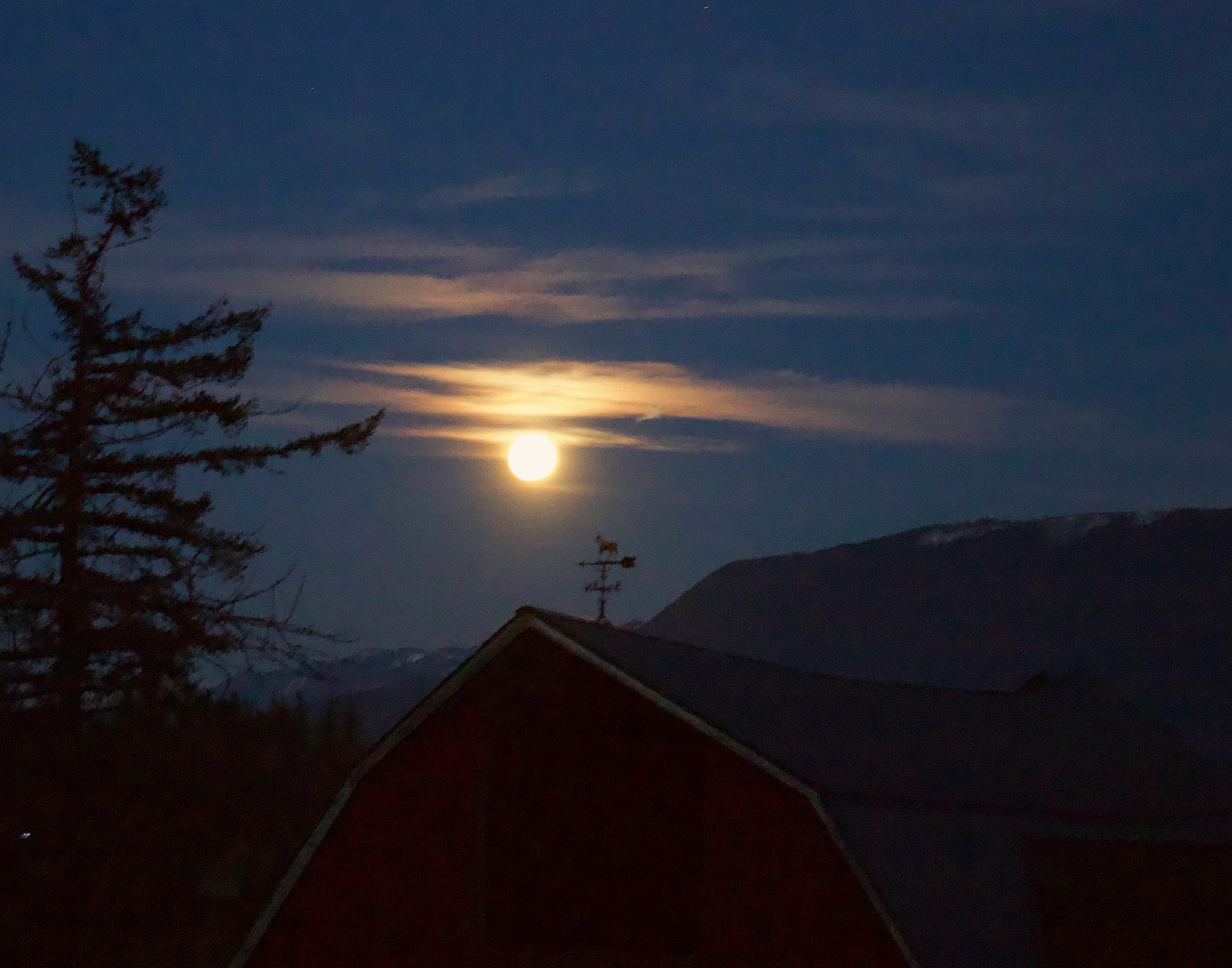
The Barn Serious in the Moonlight

After writing for a week alone in my old shack,
I guide the car through Ortonville around midnight.

The policeman talks intently in his swivel chair.
The light from above shines on his bald head.

Soon the car picks up speed again beside the quarries.
The moonspot on the steel tracks moves so fast!

Thirty or so Black Angus hold down their earth
Among silvery grasses blown back and forth in the wind.

My family is still away; no one is home.
How sweet it is to come back to an empty house—

The windows dark, no lamps lit, trees still,
The barn serious and mature in the moonlight.

~Robert Bly, “Living a Week Alone” from Like the New Moon, I Will Live My Life. 

Being introverted, I would expect to enjoy time alone. But I don’t. A conversation with myself is uninspiring, leading me back into the inner circle of my thoughts when I would much rather explore the unknown of another’s view of the world. Alone, I feel exceptionally unexceptional and extraordinarily ordinary. Quite simply, without others around me, I’m empty.

At night, when I drive up to our farm and see both house and barn glowing with lights and life rather than still and dark, it is a warm blessing to return home. Someone left the lights on for me.

I’ll leave the lights on for you as well.

One-Time
Monthly
Yearly

Make a one-time donation to support Barnstorming

Make a monthly donation

Make a yearly donation

Choose an amount

¤5.00
¤10.00
¤20.00
¤5.00
¤15.00
¤100.00
¤5.00
¤15.00
¤100.00

Or enter a custom amount

¤

Your contribution is deeply appreciated.

Your contribution is appreciated.

Your contribution is appreciated.

DonateDonate monthlyDonate yearly
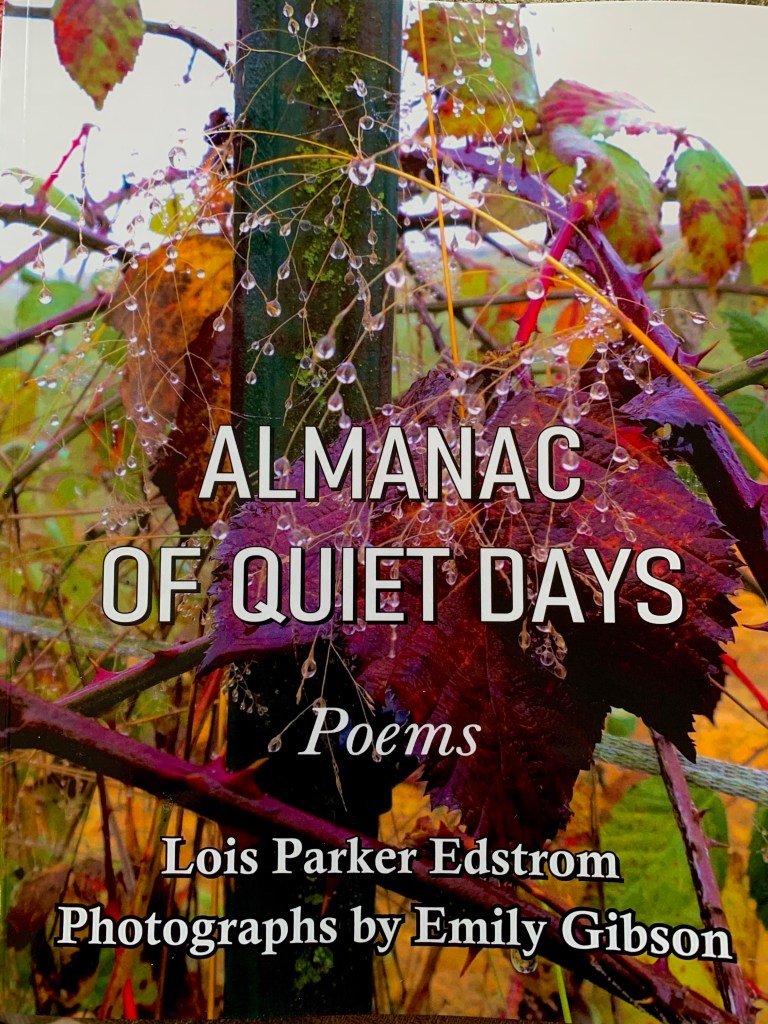
A book of beauty in words and photography – available for order here:

Never Enough Light in November

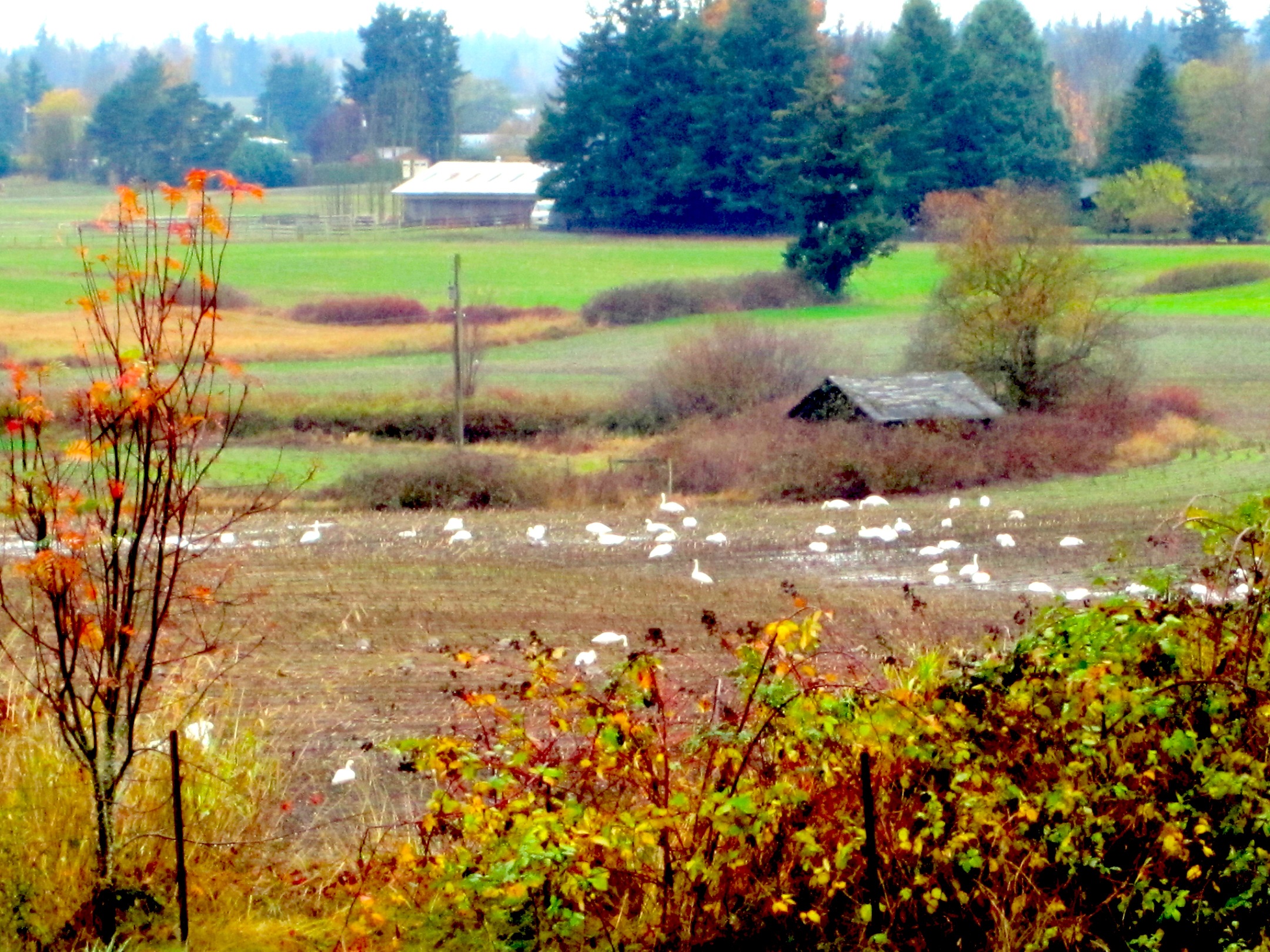
Taken from our farm–cornfield stubble and feeding swans

That country where it is always turning late in the year.
That country where the hills are fog and the rivers are mist;
where noons go quickly,
dusks and twilights linger,
and midnights stay.
That country composed in the main of cellars, sub-cellars, coal-bins, closets, attics, and pantries faced away from the sun.
That country whose people are autumn people,
thinking only autumn thoughts.
Whose people passing at night on the empty walks sound like rain.

~Ray Bradbury from The October Country

Just as a painter needs light
in order to put the finishing touches to his picture,
so I need an inner light,
which I feel I never have enough of in the autumn.
~Leo Tolstoy

A few days of heavy rain in November transforms our farm to mush. Puddles are everywhere, the ground is saturated and mushrooms are sprouting in the most unlikely places. It’s ideal weather for the trumpeter swans and snow geese who glean in the nearby harvested cornfields, filling up on dropped corn kernels. They fly overhead to head out to the fields, noisily honking, their wings swooshing the air as they pass over.

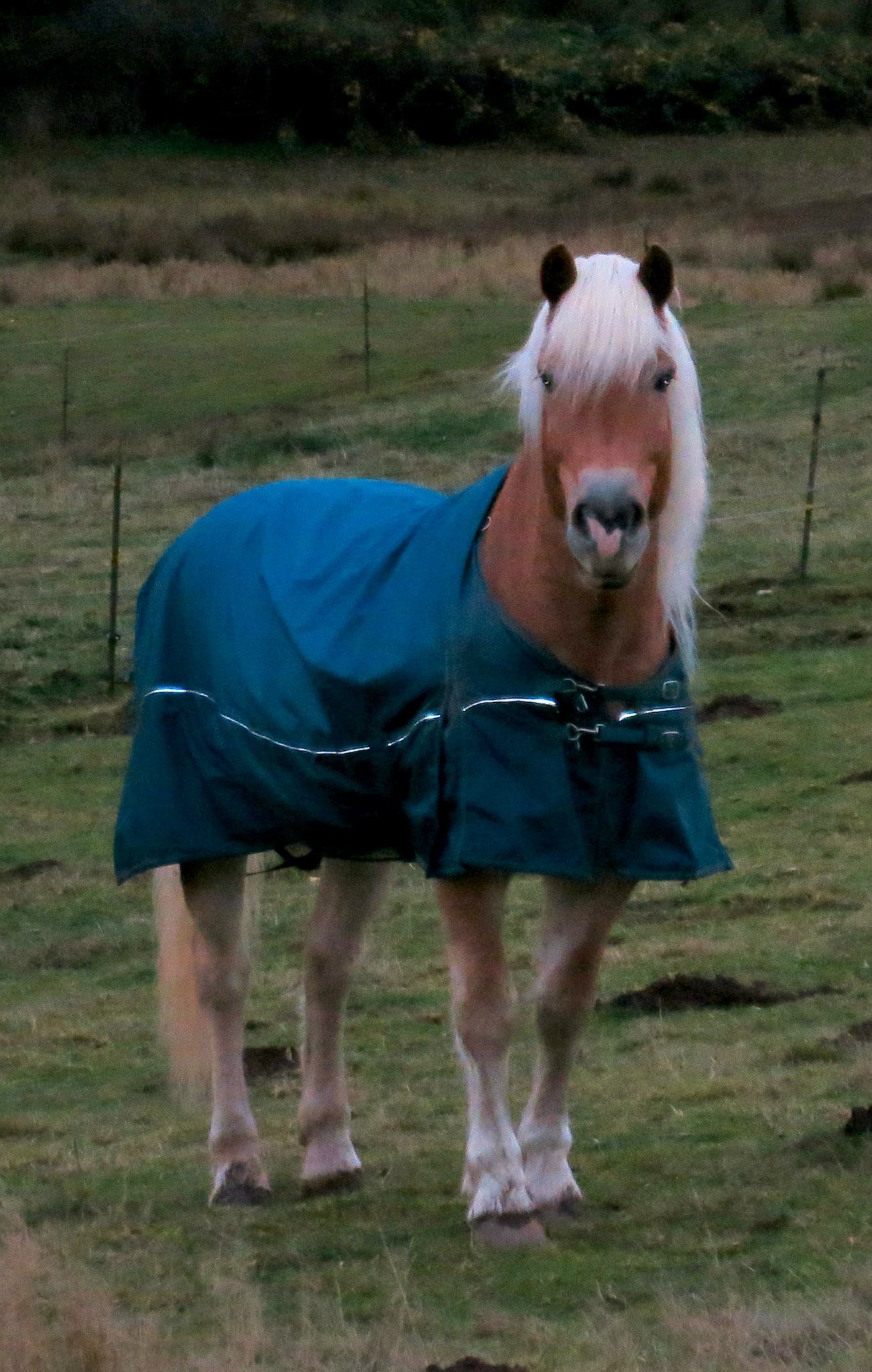
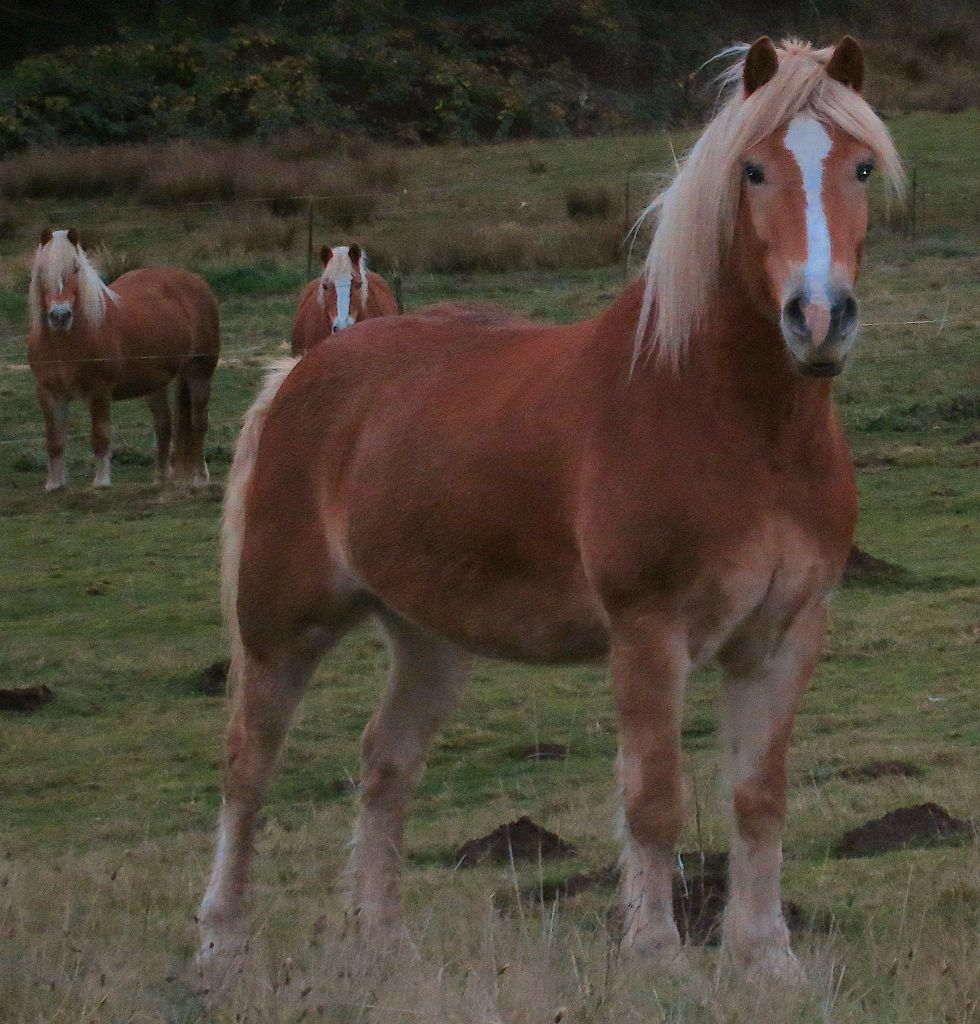
The wet weather means chores are more challenging on our farm. Some of the stalls in the barn have started to get moist from the rising ground water, so the Haflingers appreciate diving into fresh shavings for a good roll and shake. I can appreciate the relief they feel as I like getting back to solid footing too at the end of the day. Much of my day also seems to be spent navigating slippery slopes and muddy terrain, both real and figurative.

It isn’t always apparent what ground is treacherous from appearance alone. The grassy slope heading down to the barn from the house looks pretty benign until I start navigating in a driving rainstorm in the dark, and suddenly the turf becomes a skating rink and I’m finding I’m picking my way carefully with a flashlight. The path I seek is to find the patches of moss, which happily soak up the water like a sponge carpet-like, so not slick to walk on. Even if moss ordinarily is not a welcome addition to lawn or pasture–I appreciate it this time of year.

Another challenge is pushing a wheelbarrow with two 60 pound bales of hay back up that slope to the stalls for the day’s feeding. There is no traction underneath to help my feet stick to the ground for the push uphill. I can feel particularly foolish at this futile effort–my feet sometimes slide out beneath me, landing me on my knees down on the ground, soaked and humiliated, and the wheelbarrow goes skidding right back down to the barn door where it started.

Trusting the footing underneath my feet is crucial day to day. If I am to get work done most efficiently and make progress, I must have solid ground to tread. But the stuff of real life, like our farm’s ground, doesn’t come made to order that way. Some days are slick and treacherous, unpredictable and ready to throw me to my knees, while other days are simple, easy, and smooth sailing. Waking in the morning, I cannot know what I will face that day–whether I need my highest hip boots to wade through the muck or whether I can dash about in comfy house slippers. My attitude has something to do with it too–sometimes my “internal” footing is loose and slippery, tripping up those around me as well as myself. That is when I need most to plant myself in the solid foundation that I know will support me during those treacherous times. I need my faith, my need to forgive and experience forgiveness, my family holding me as I fall, and to help pick them up when they are down. Without those footings every day, I’m nothing more than a muddy soiled mess lying face down on the ground wondering if I’ll ever walk again.

There is good reason I end up on my knees at times. It is the best reminder of where I would be full time if it were not for stronger Hands that lift me up, clean me up and guide my footsteps all my days.

A book of beauty in words and photography, available for order here:

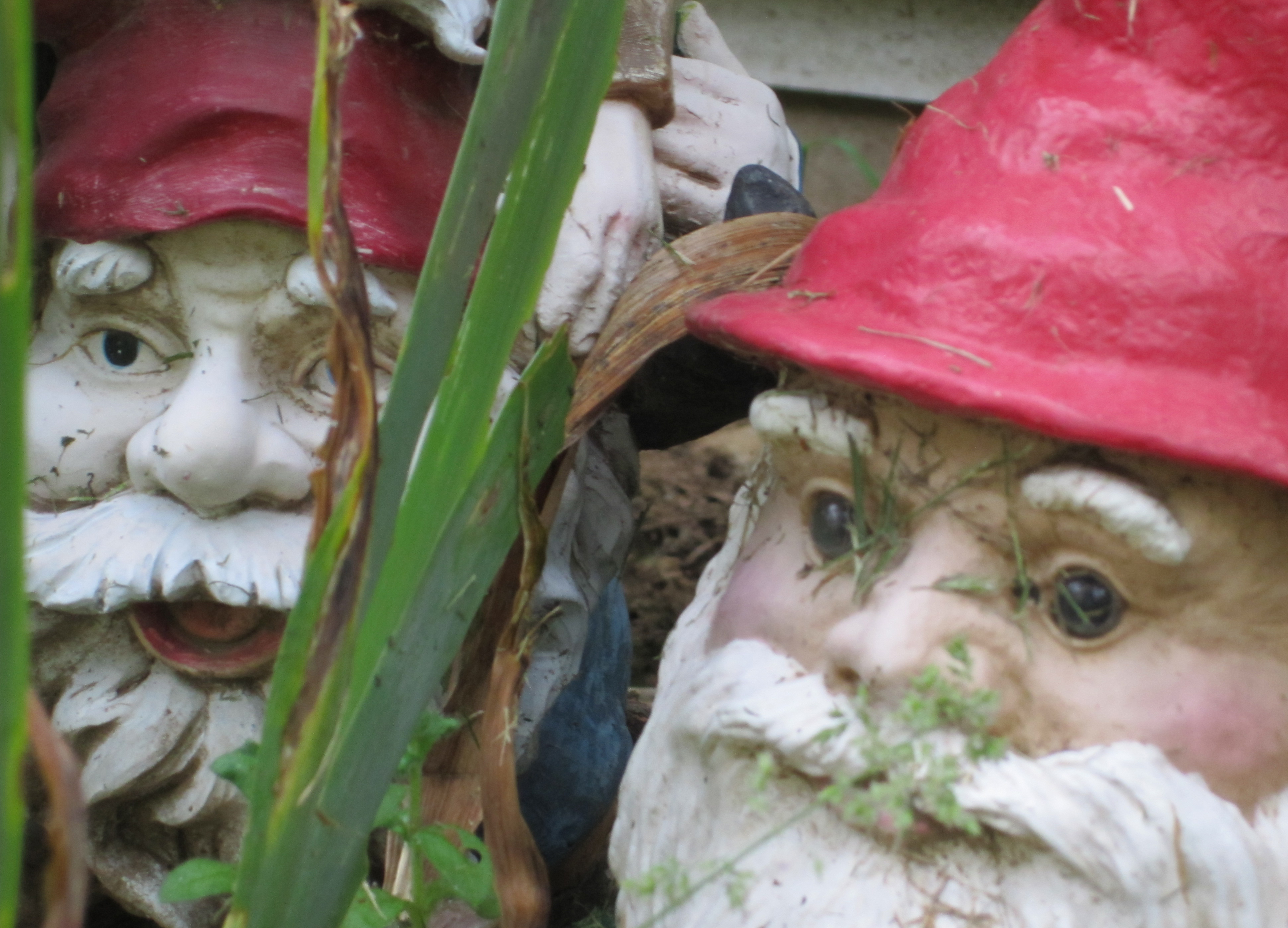
There Goes the Neighborhood

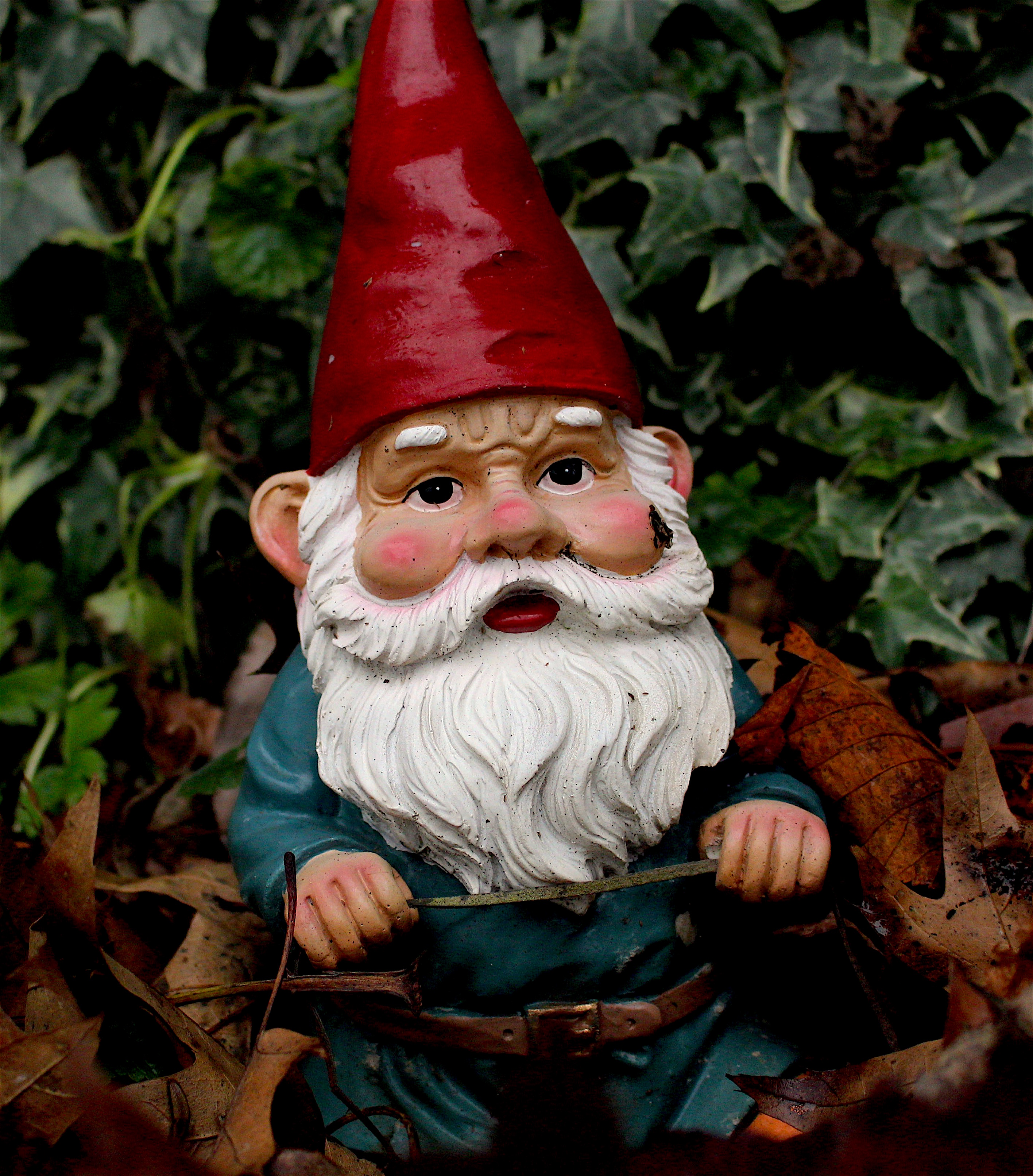
She lingered in that charming little garden to say hello to the gnomes,
such a glorious infestation!
How few wizards realize just how much we can learn
from the wise little gnomes-
or, to give them their correct names, the Gernumbli gardensi.
‘Ours do know a lot of excellent swear words,’ said Ron…
J.K. Rowling in Harry Potter and the Deathly Hallows

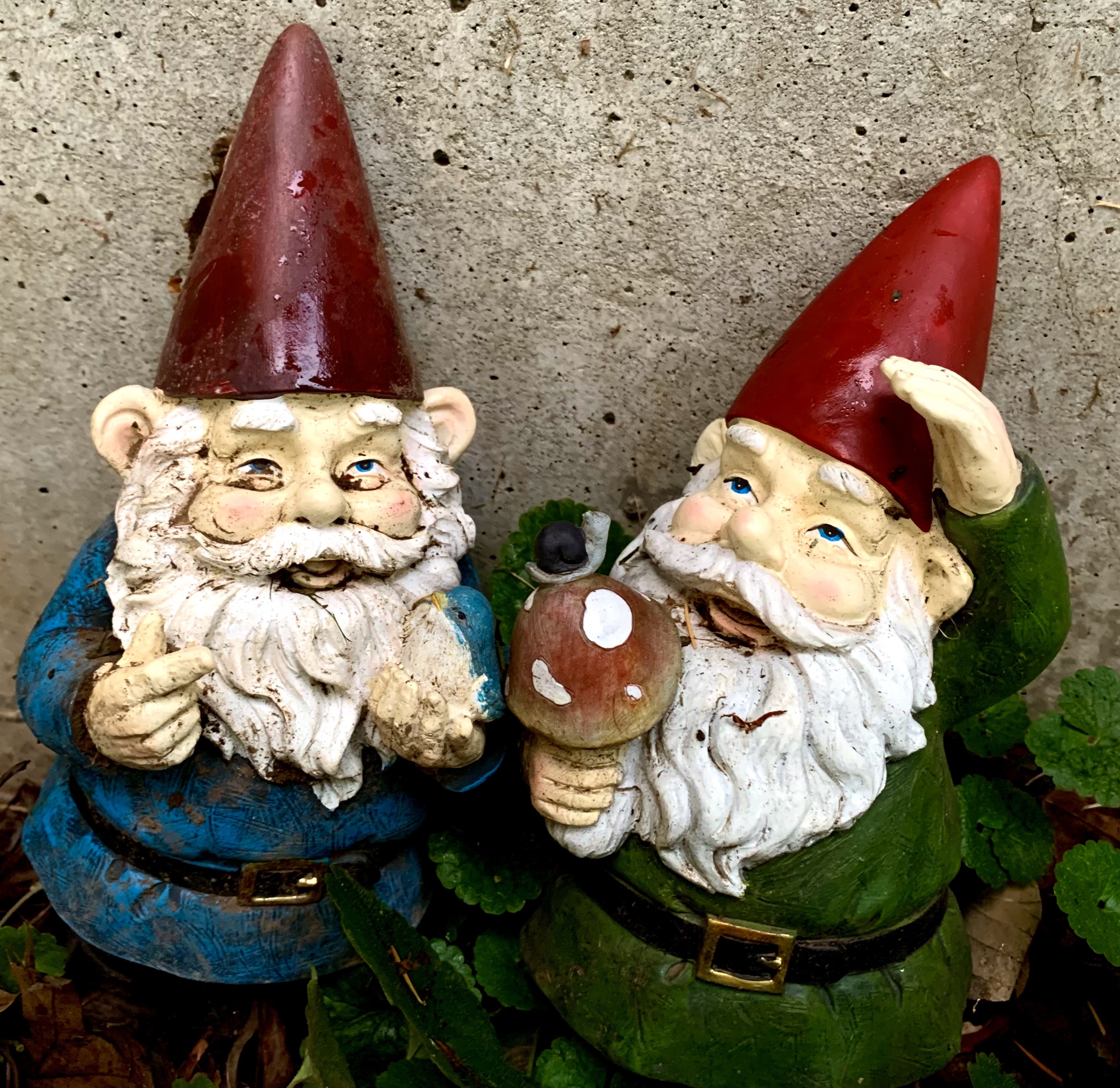
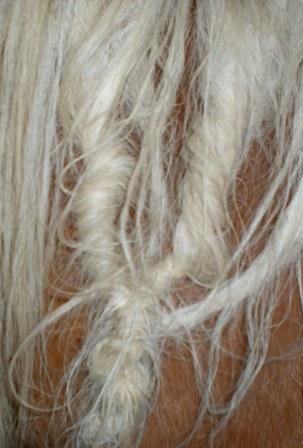
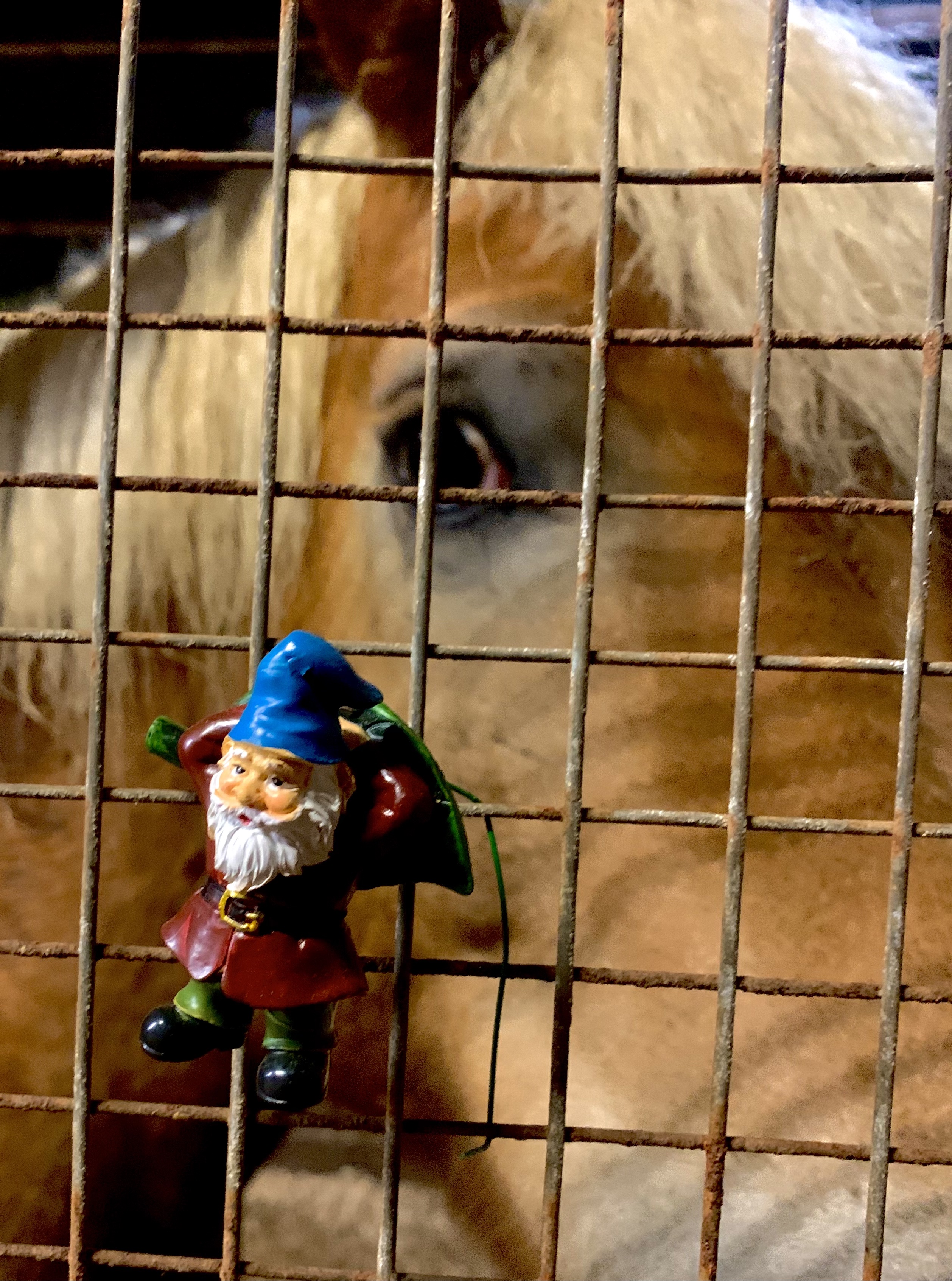
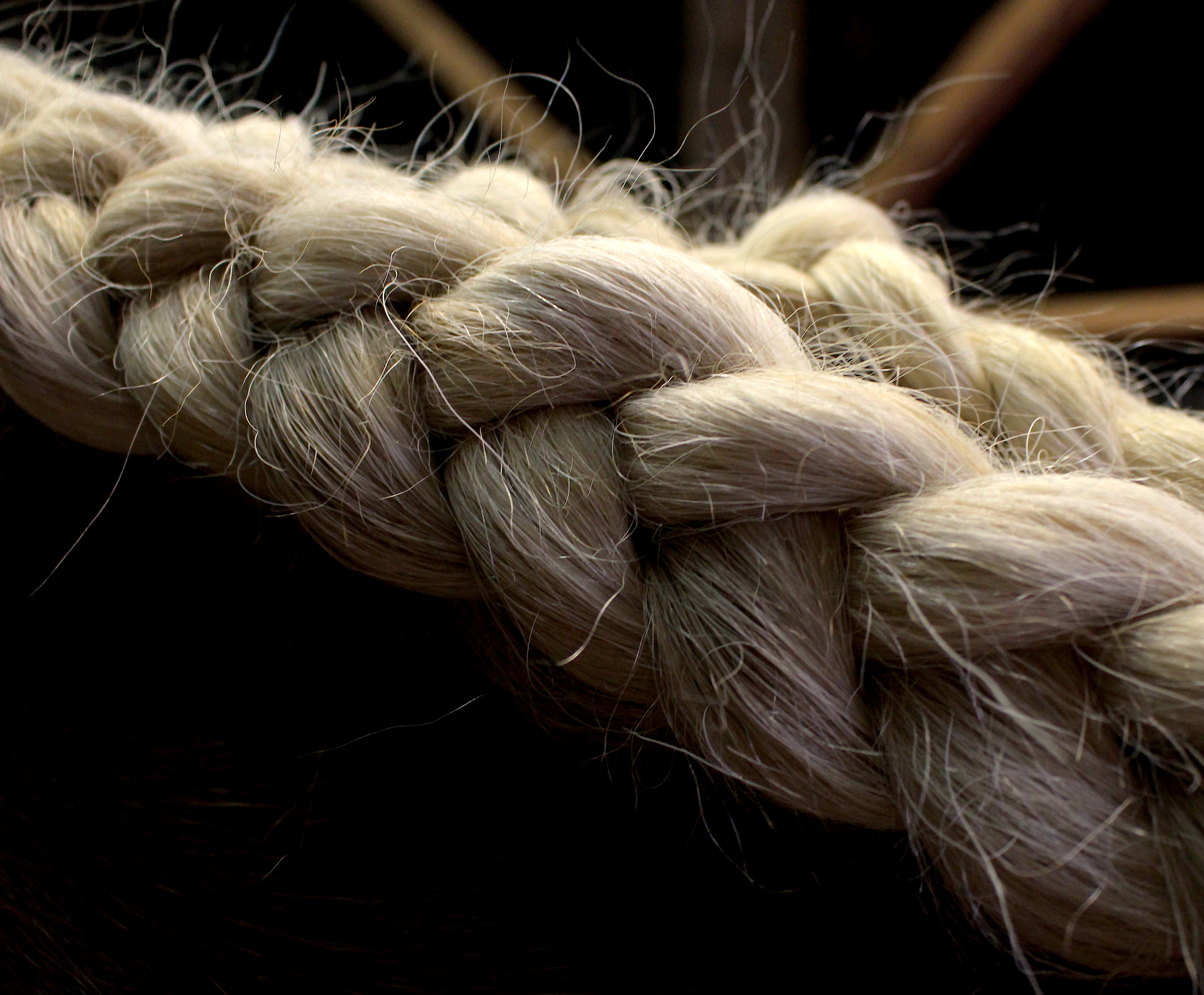
It is hard to say exactly when the first one moved in.  This farm was distinctly gnome-less when we bought it over thirty years ago, largely due to twenty-seven hungry barn cats residing here at the time in various stages of pregnancy, growth, development and aging.  It took awhile for the feline numbers to whittle down to an equilibrium that matched the rodent population.  In the mean time, our horse numbers increased from three to seven to over fifteen with a resultant exponential increase in barn chores.   One spring twenty years ago,  I was surprised to walk in the barn one morning to find numerous complex knots tied in the Haflingers’ manes.  Puzzling as I took precious time to undo them, literally adding hours to my chores, I knew I needed to find the cause or culprit.

It took some research to determine the probable origin of these tight tangles.  Based on everything I researched, they appeared to be the work of Gernumbli faenilesi, a usually transient species of gnome preferring to live in barns and haylofts in close proximity to heavy maned ponies.  In this case, as the tangles persisted for months, they clearly had moved in, lock, stock and barrel.   The complicated knots were their signature pride and joy, their artistic way of showing their devotion to a happy farm.
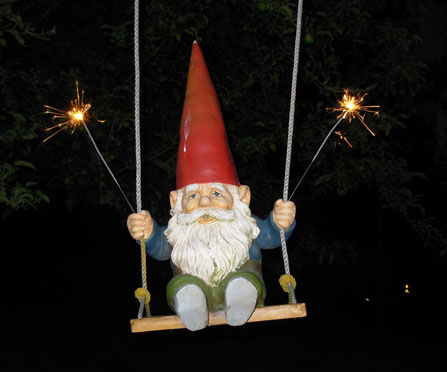
All well and good, but the extra work was killing my fingers and thinning my horses’ hair.  I plotted ways to get them to cease and desist.

I set live traps of cheese and peanut butter cracker sandwiches, hoping to lure them into cages for a “catch and release”. Hoping to drive them away, I played polka music on the radio in the barn at night.  Hoping to be preemptive, I braided the manes up to be less tempting but even those got twisted and jumbled.  Just as I was becoming ever more desperate and about to round up more feral cats, the tangling stopped.

It appeared the gnomes had moved on to a more hospitable habitat.  Apparently I had succeeded in my gnome eradication plan. 

Or so I thought.

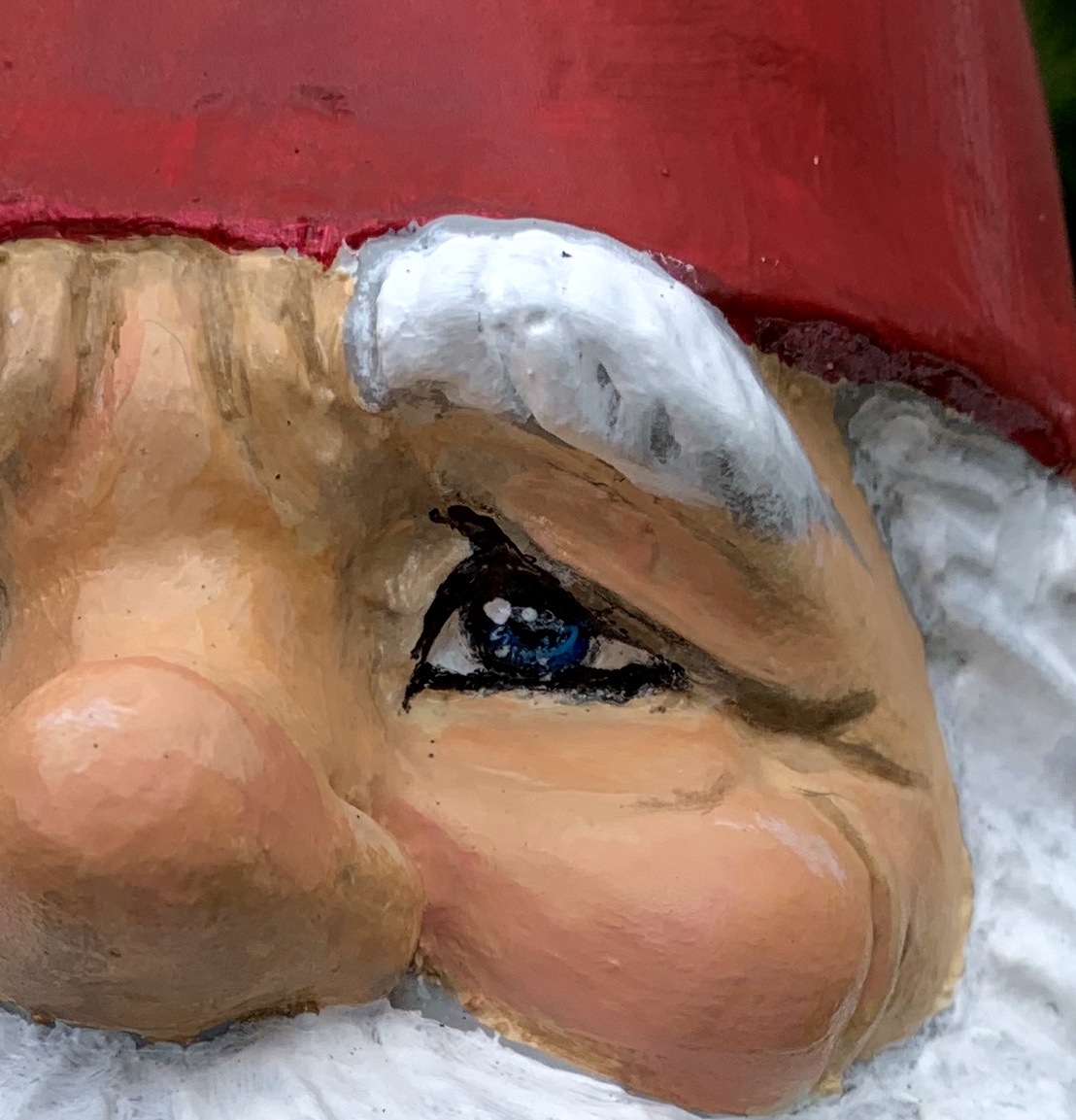
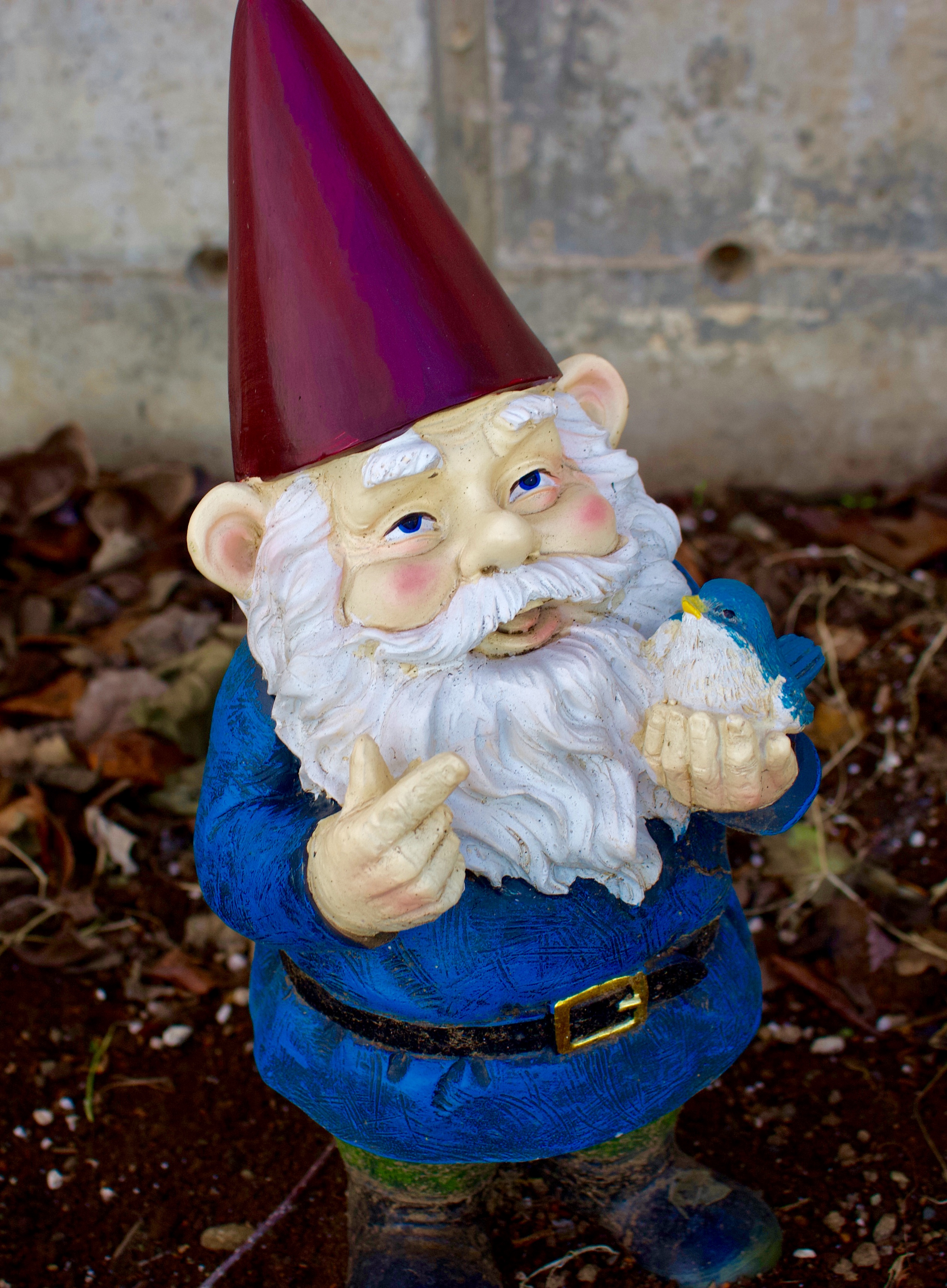
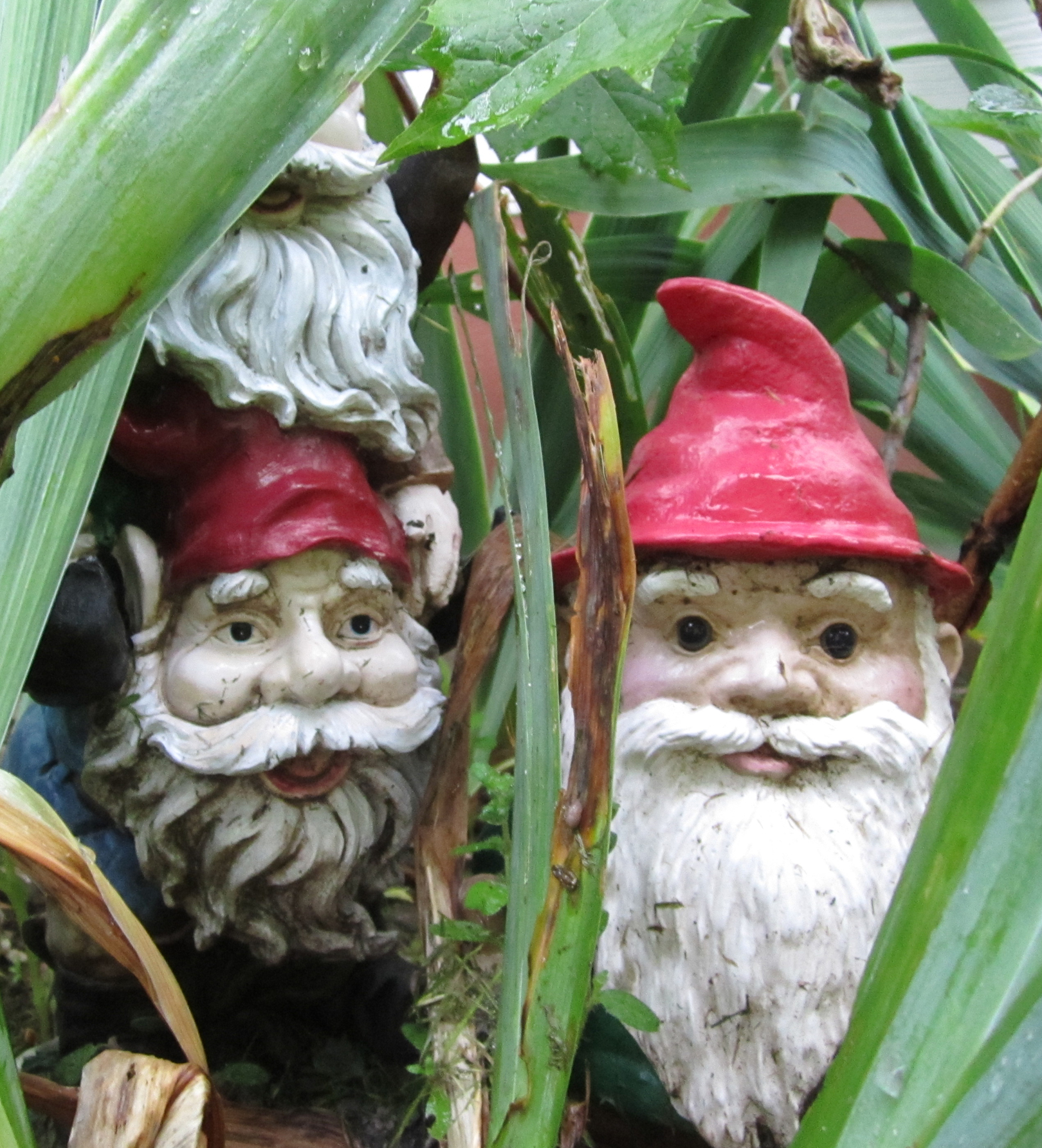
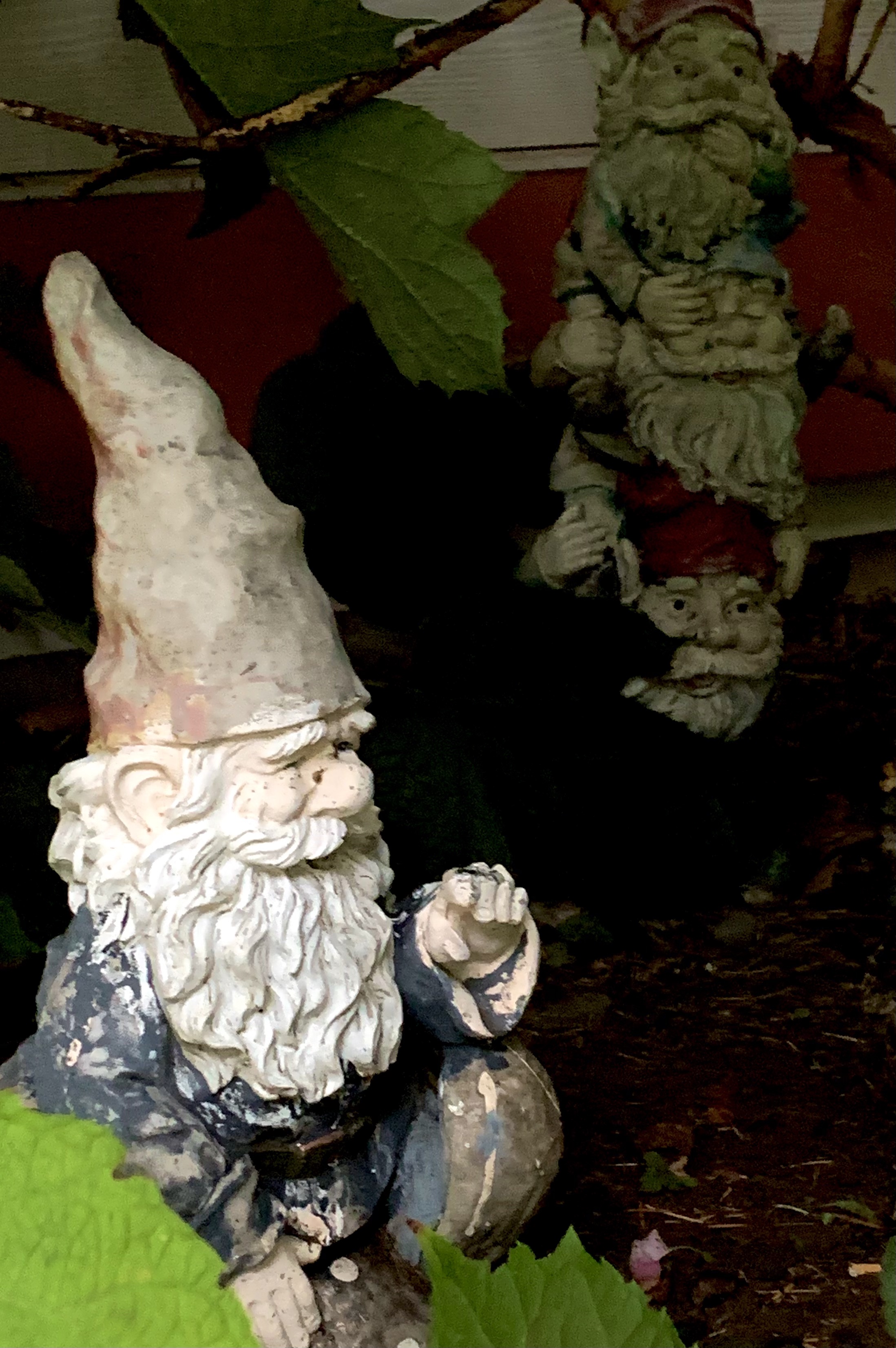
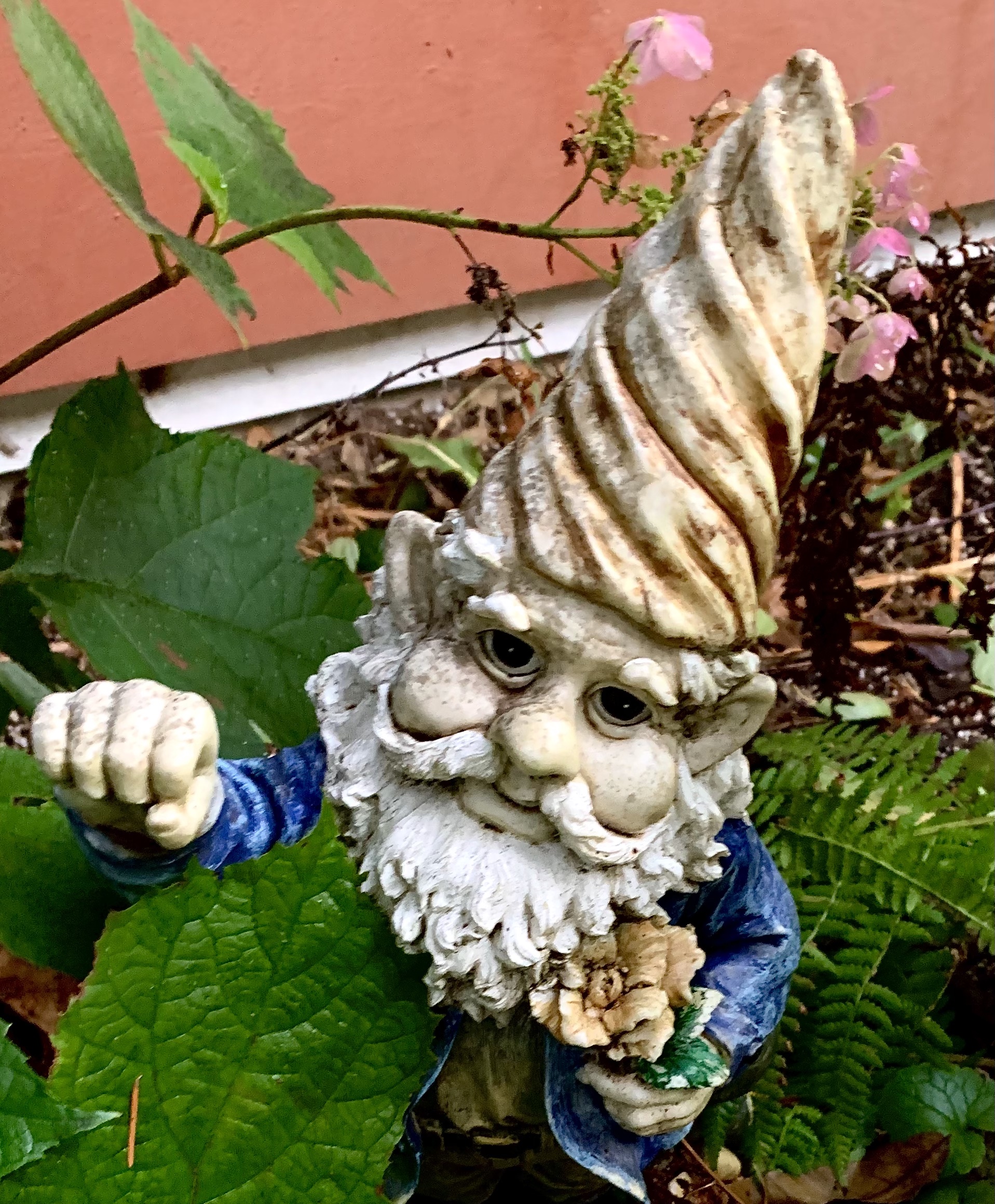
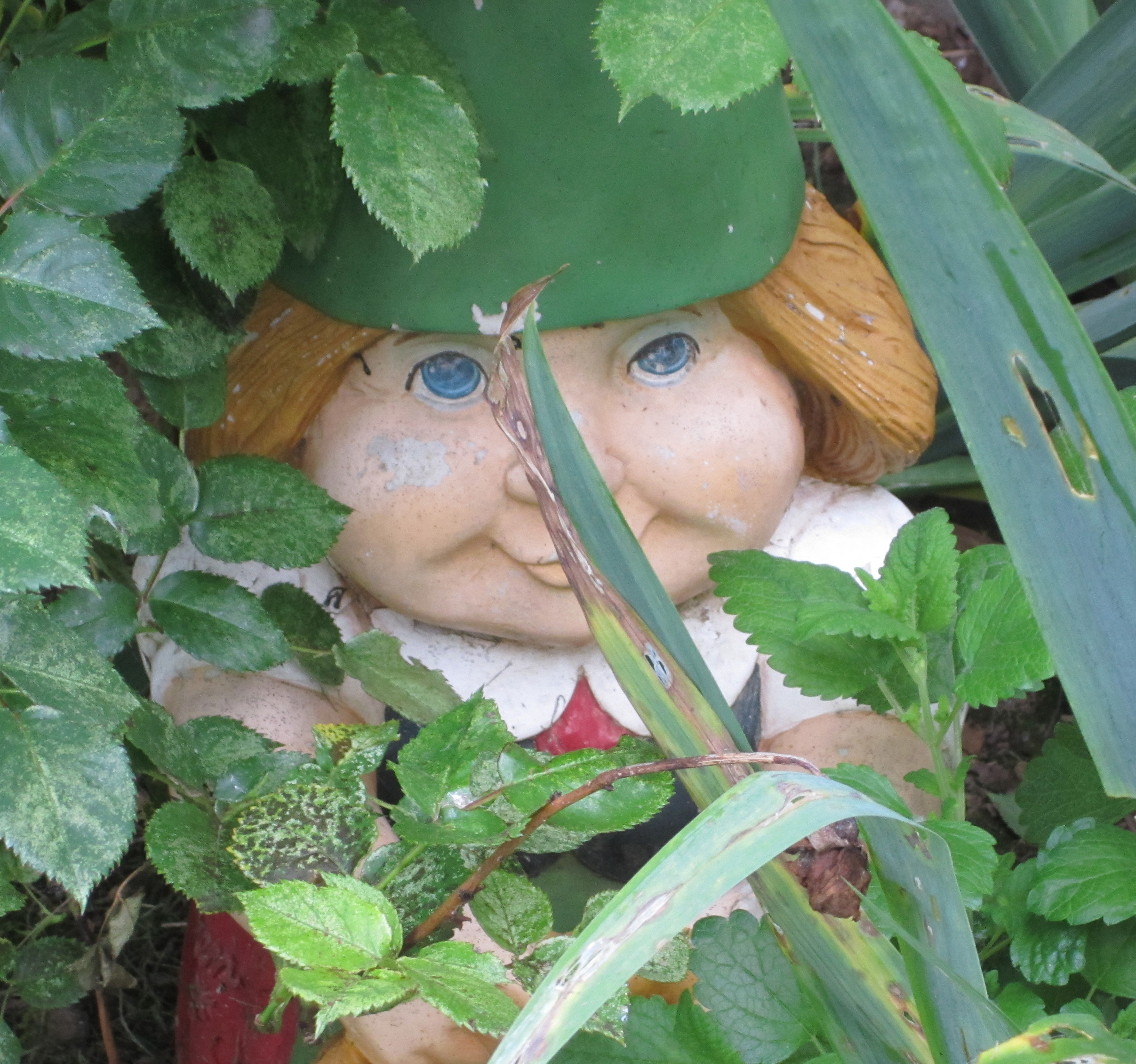
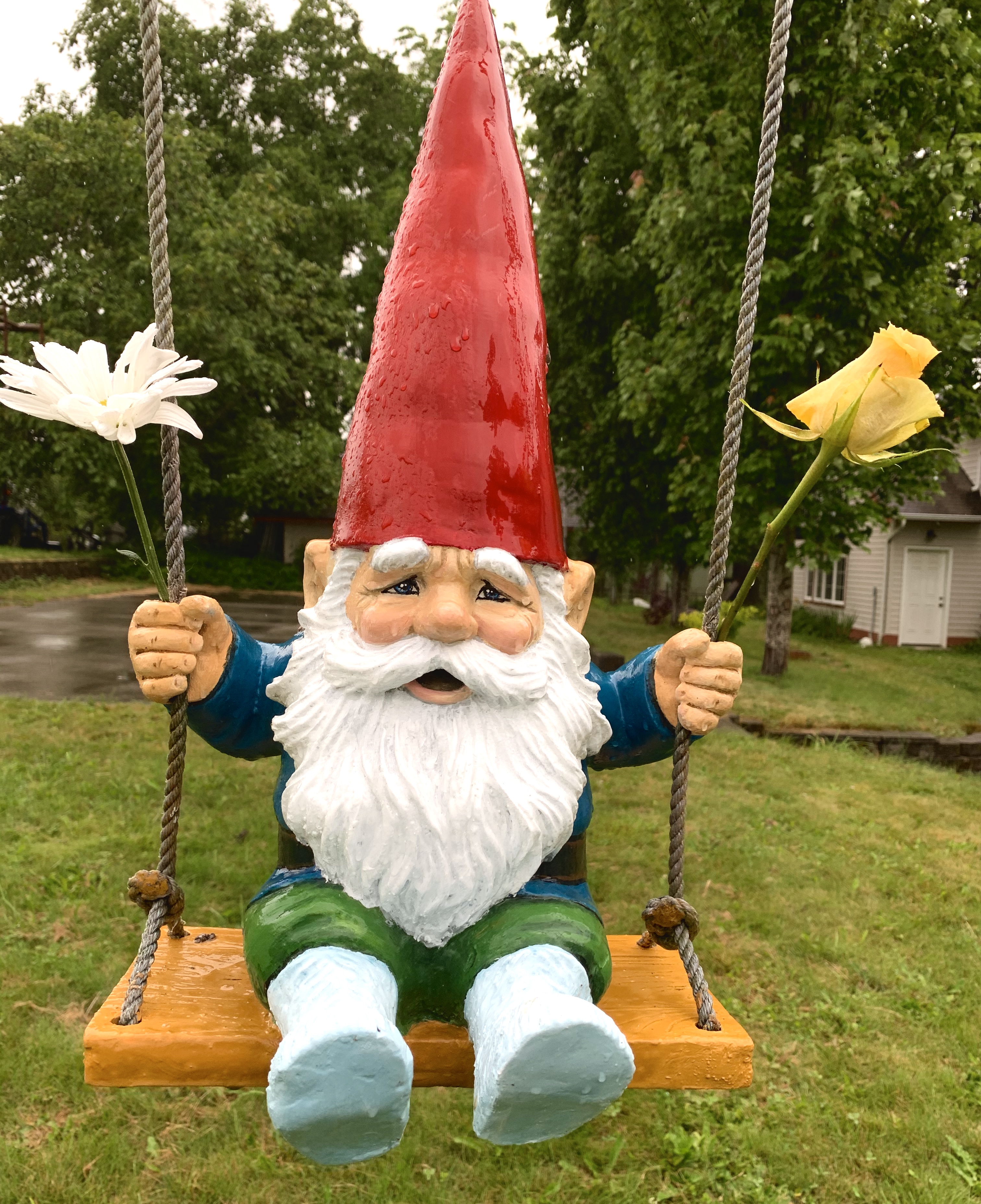
Not long after, I had the distinct feeling of being watched as I walked past some rose bushes in the yard.  I stopped to take a look, expecting to spy the shining eyes of one of the pesky raccoons that frequents our yard to steal from the cats’ food dish.  Instead, beneath the thorny foliage, I saw two round blue eyes peering at me serenely.   This little gal was not at all intimidated by me, and made no move to escape.   She was an ideal example of Gernumbli gardensi, a garden gnome known for their ability to keep varmints and vermin away from plants and flowers.  They also happen to actively feud with Gernumbli Faenilesi so that explained the sudden disappearance of my little knot-tying pests in the barn.

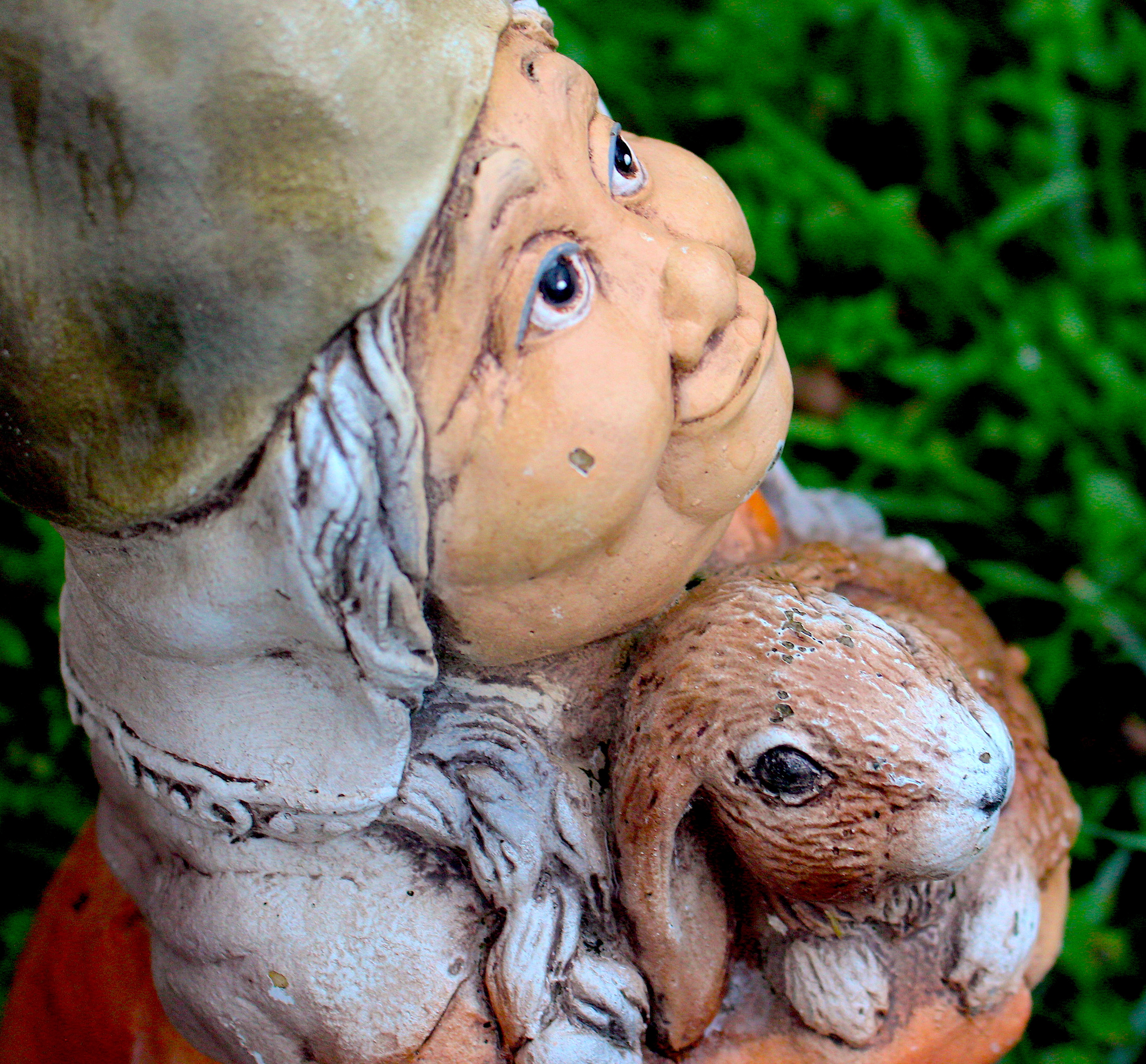
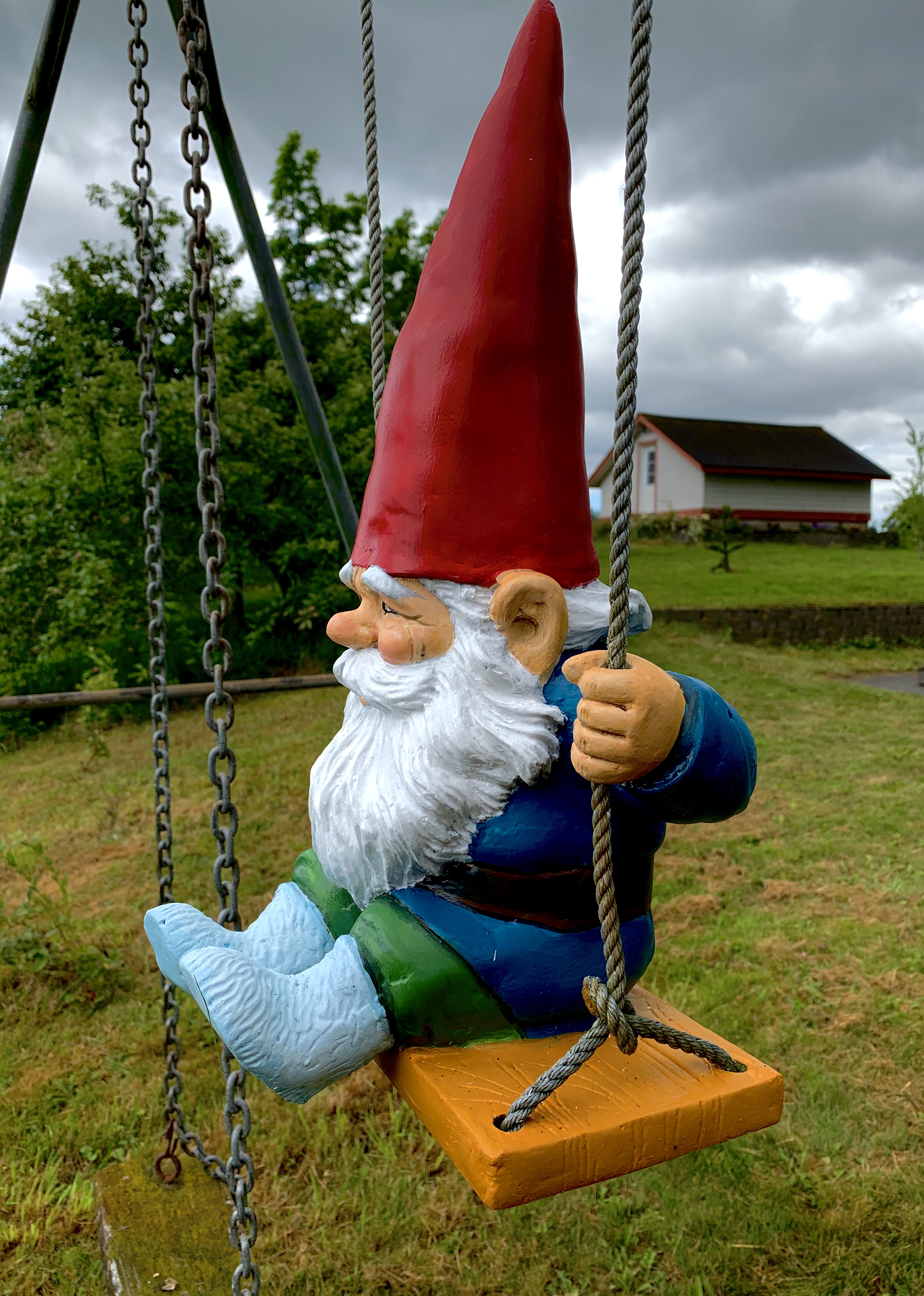
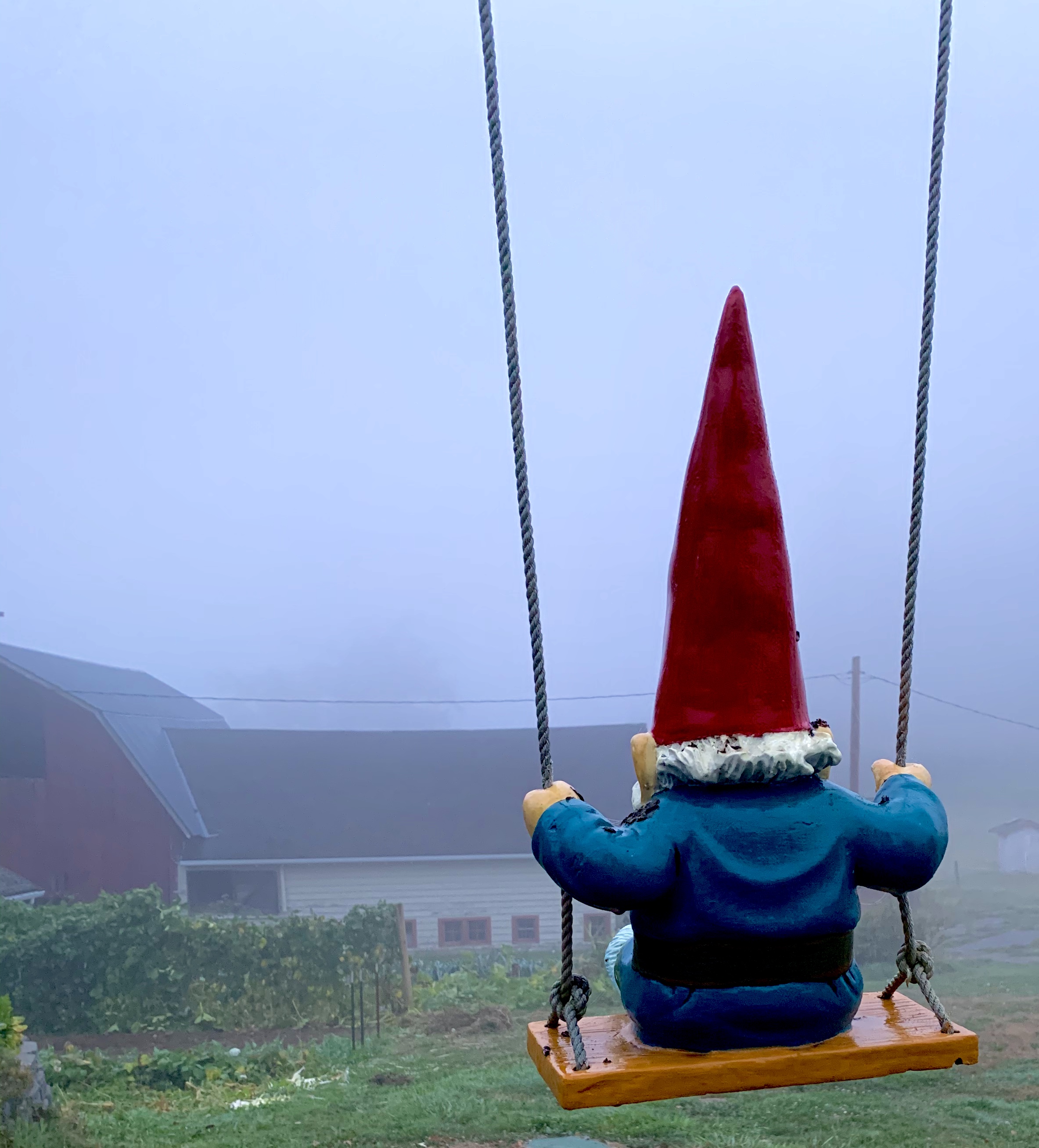
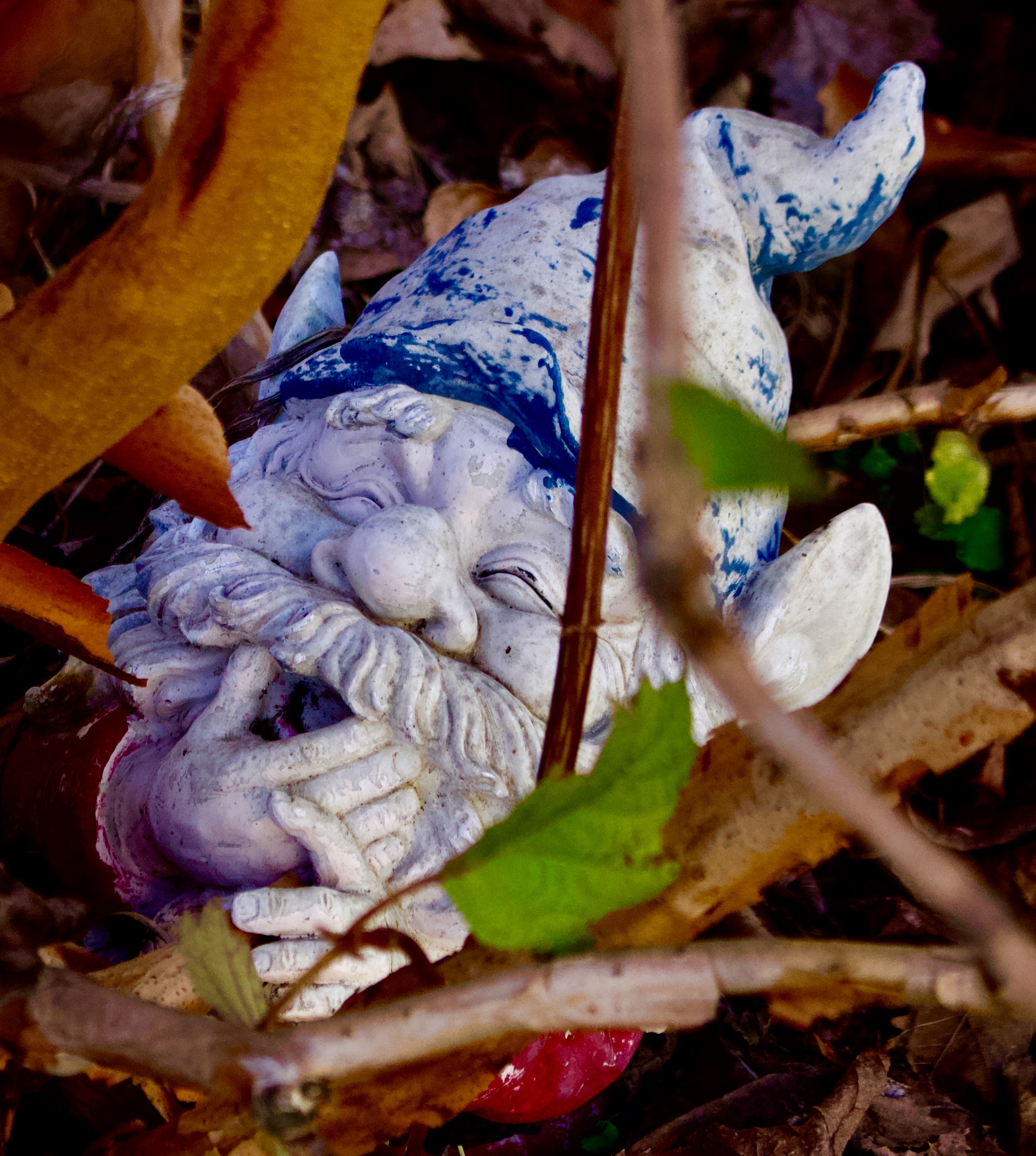
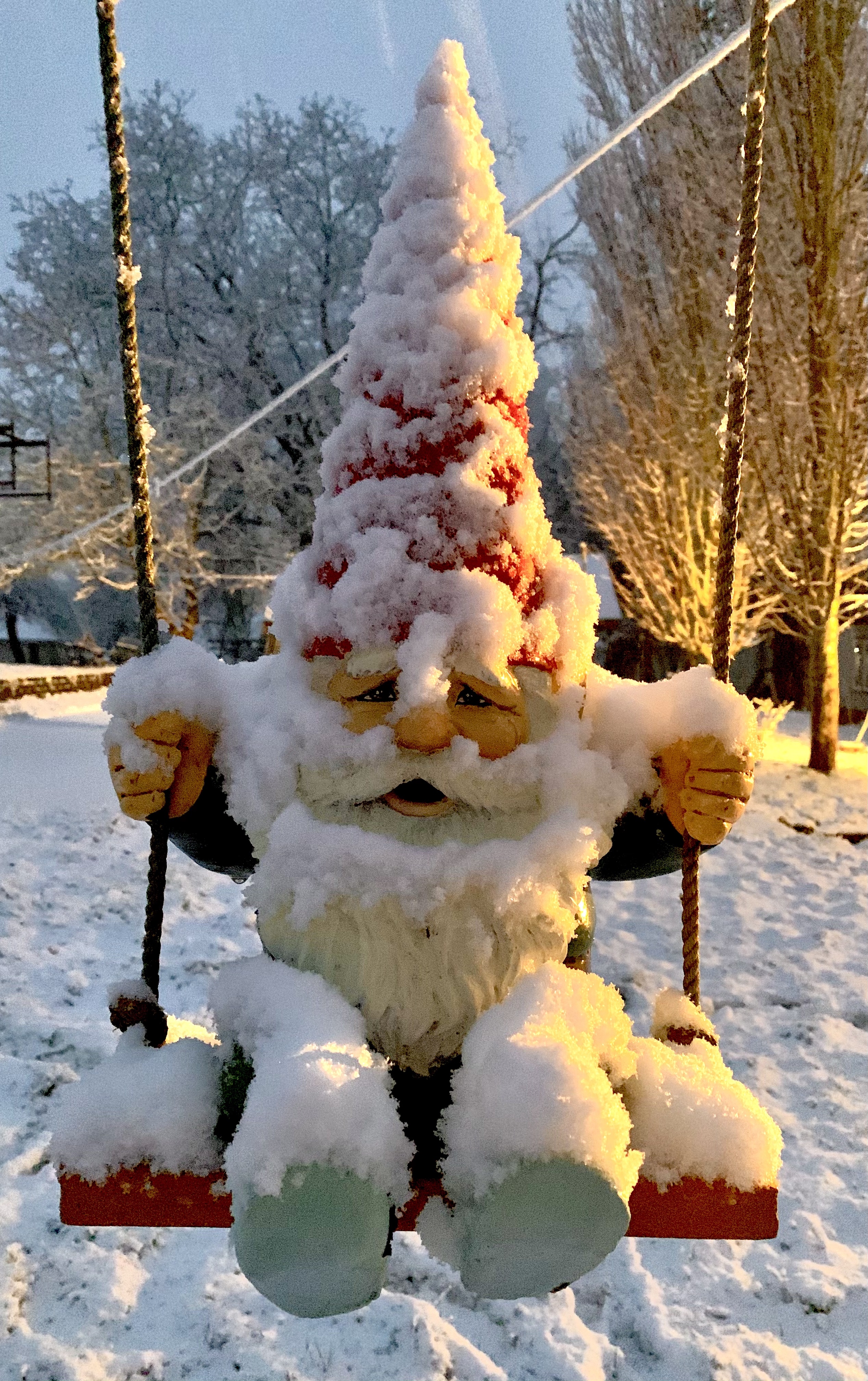
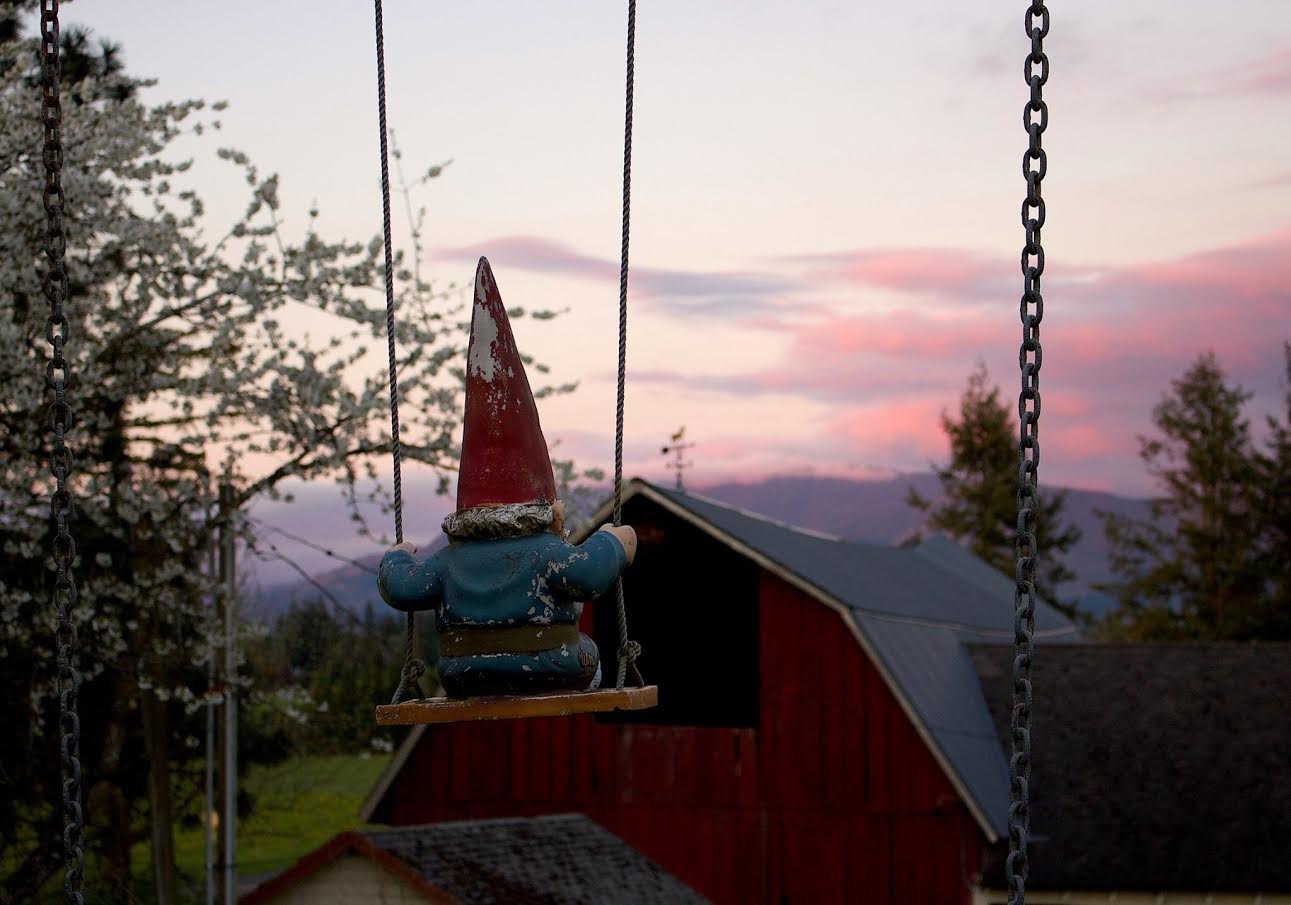
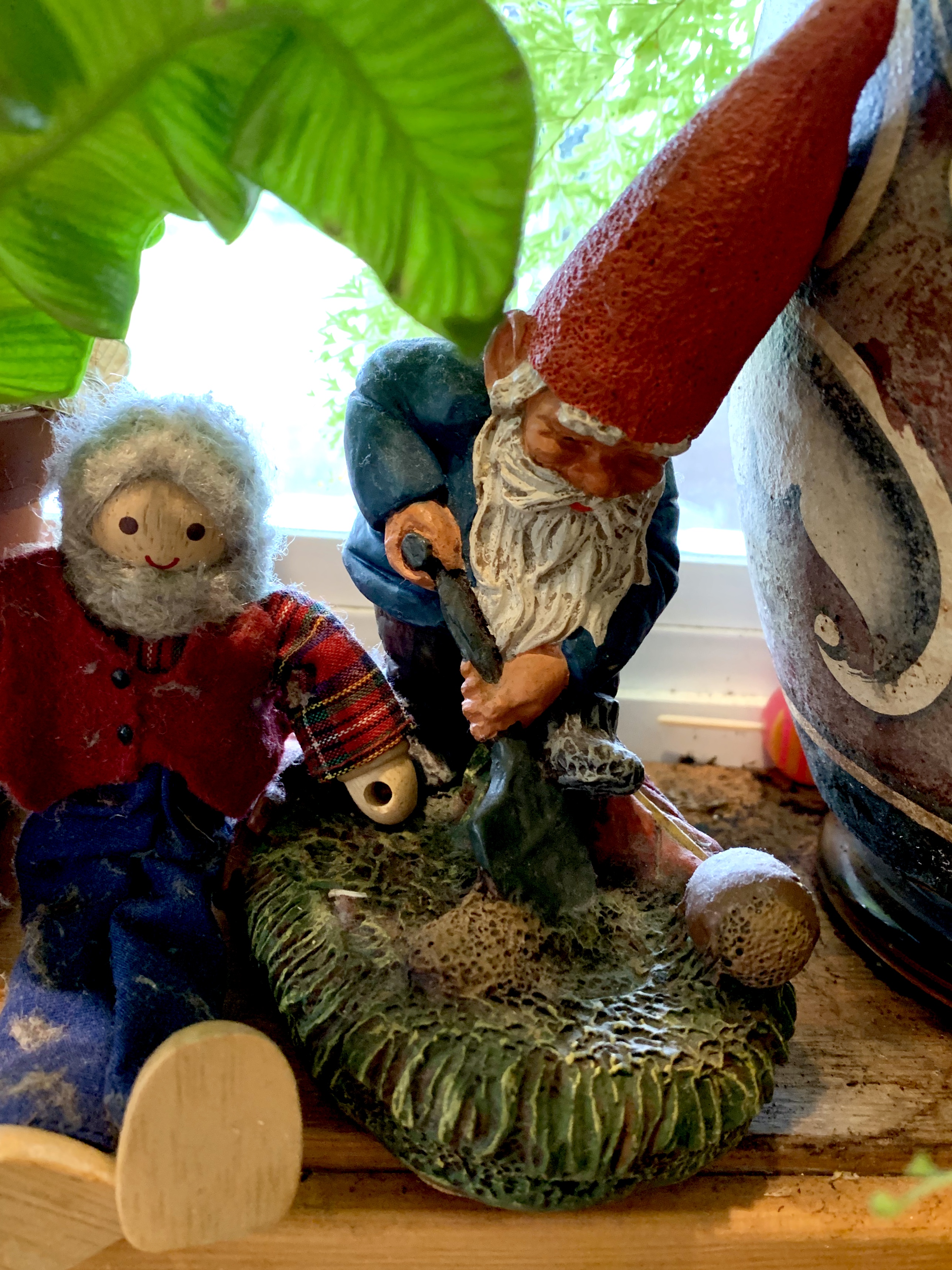
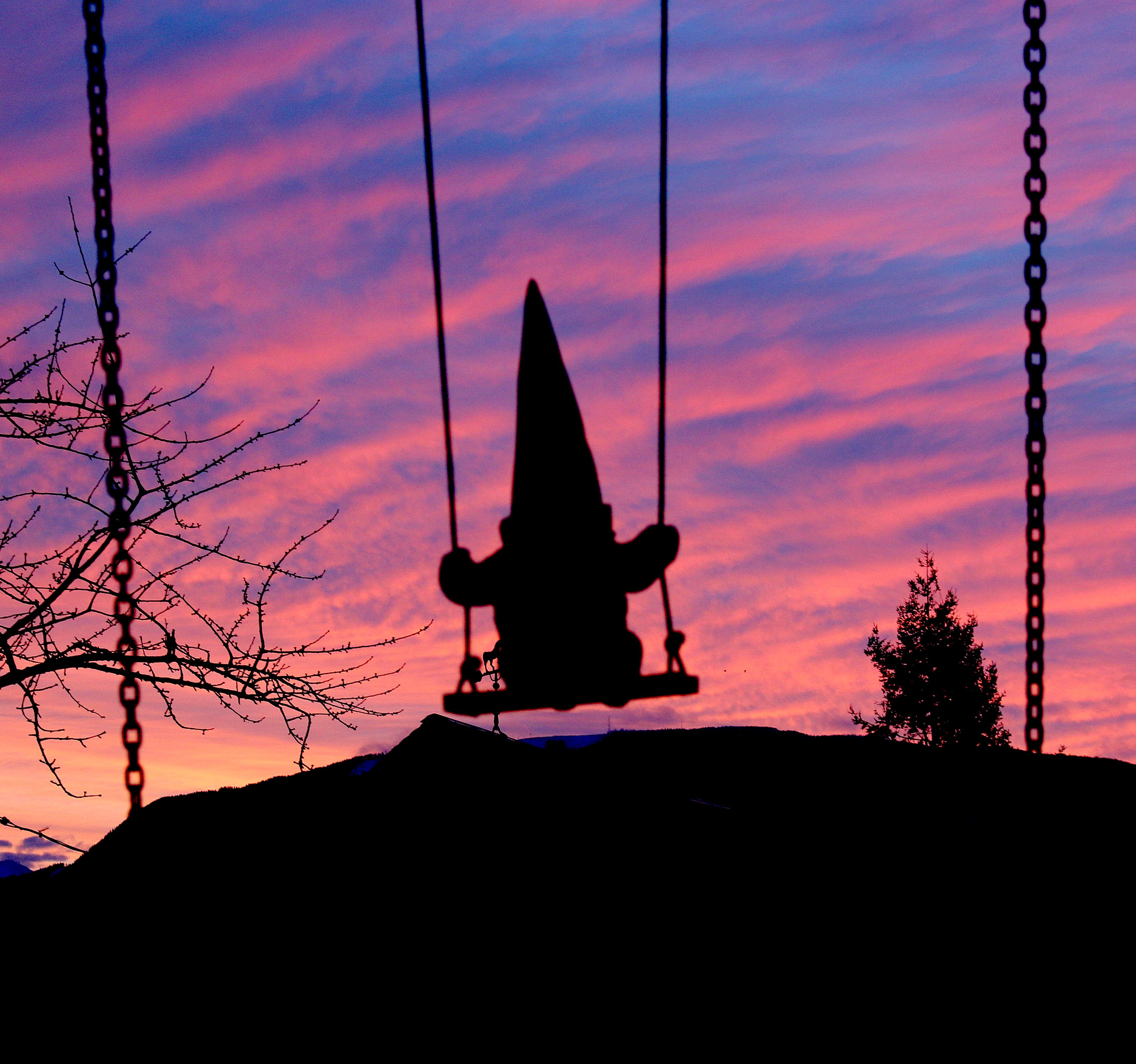
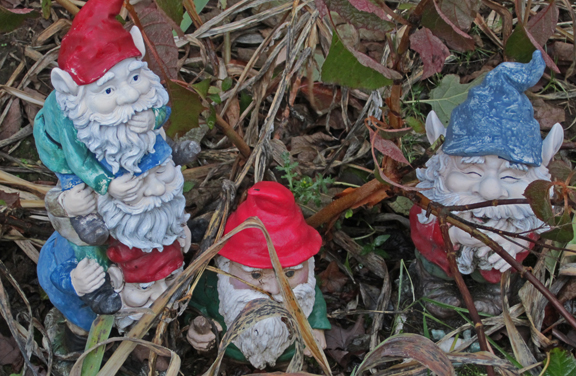
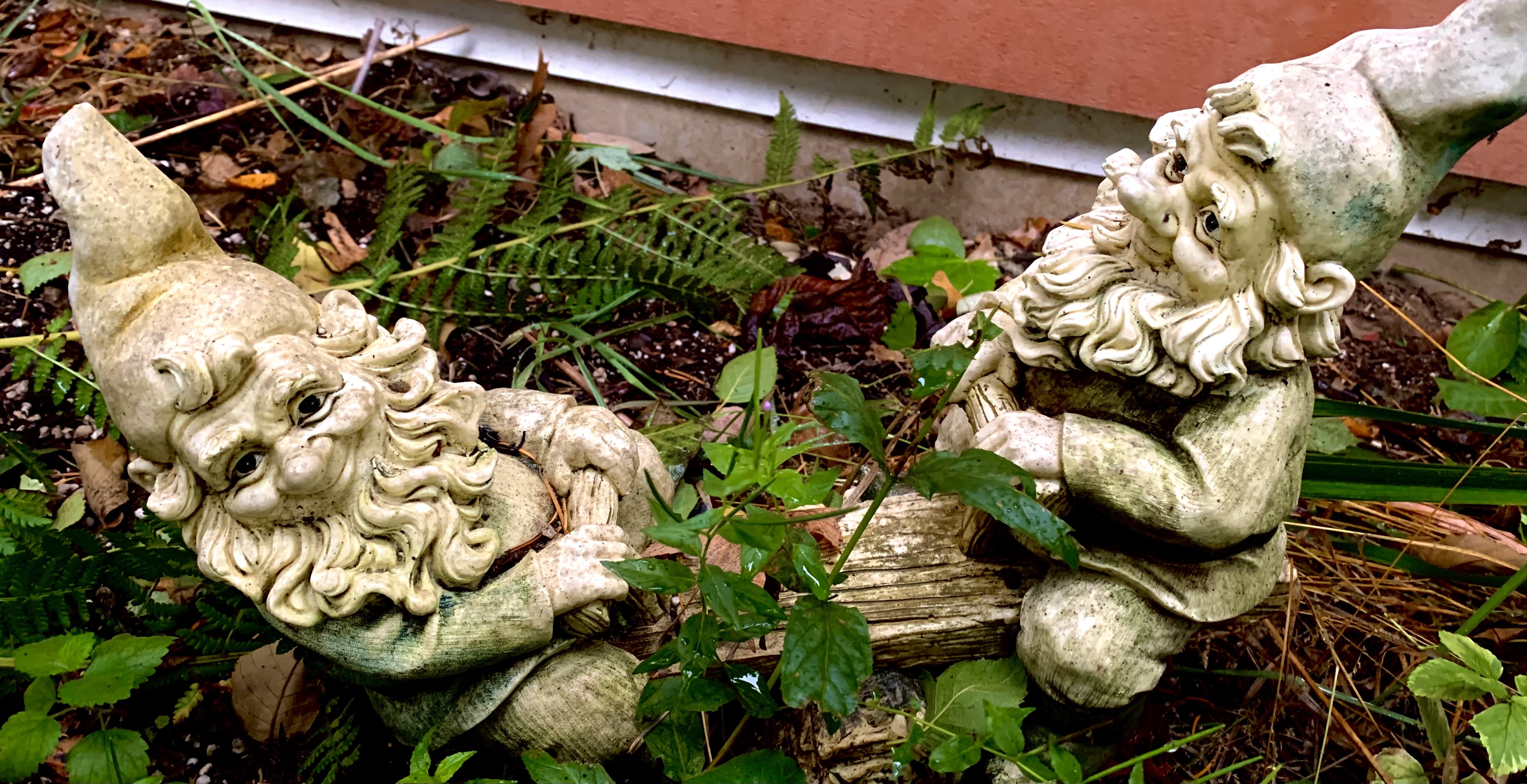
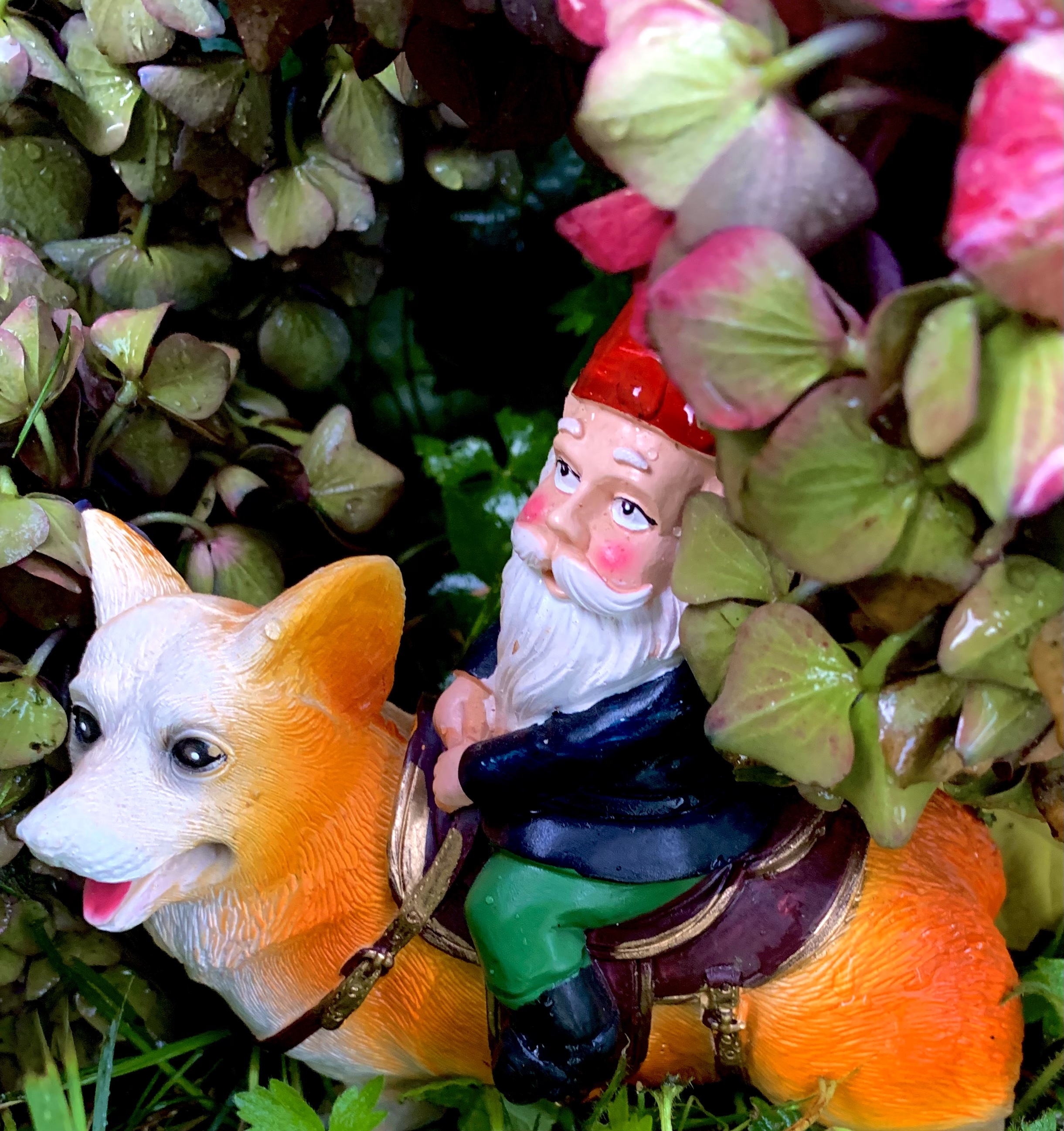
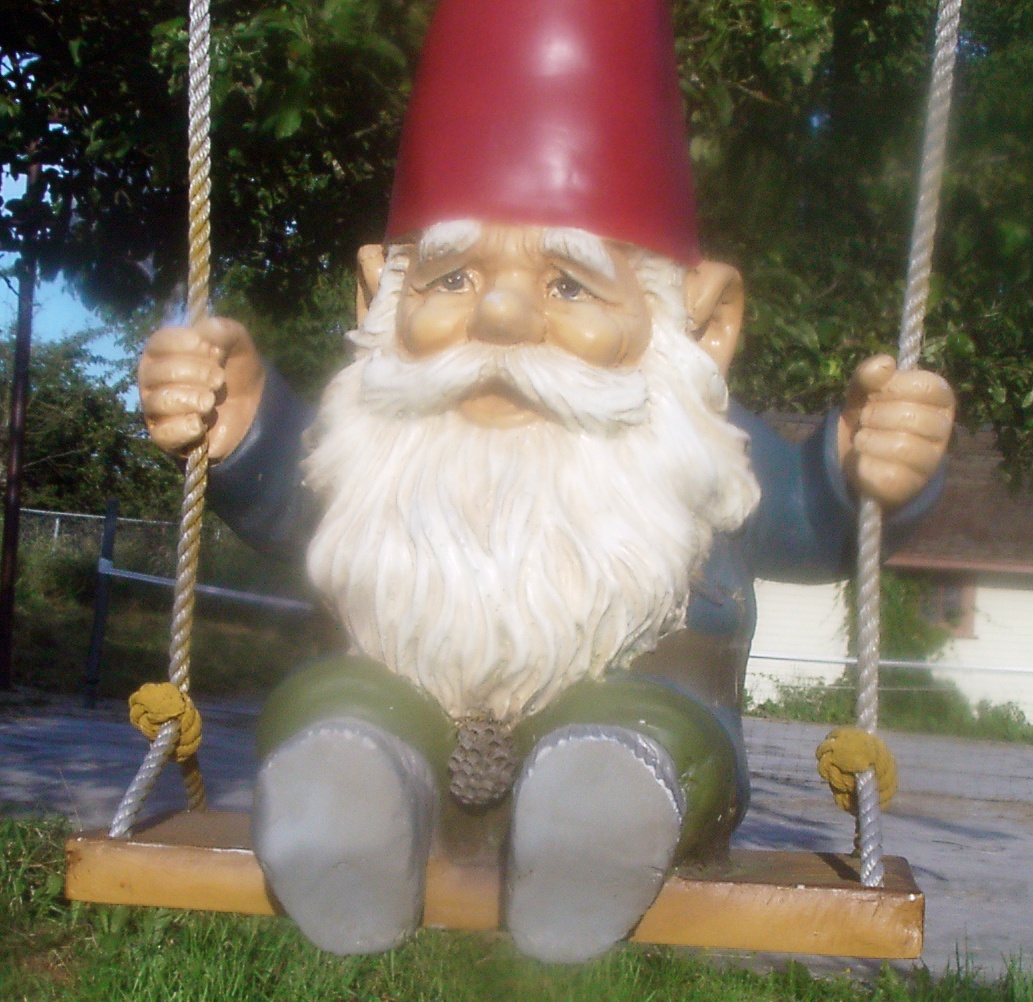
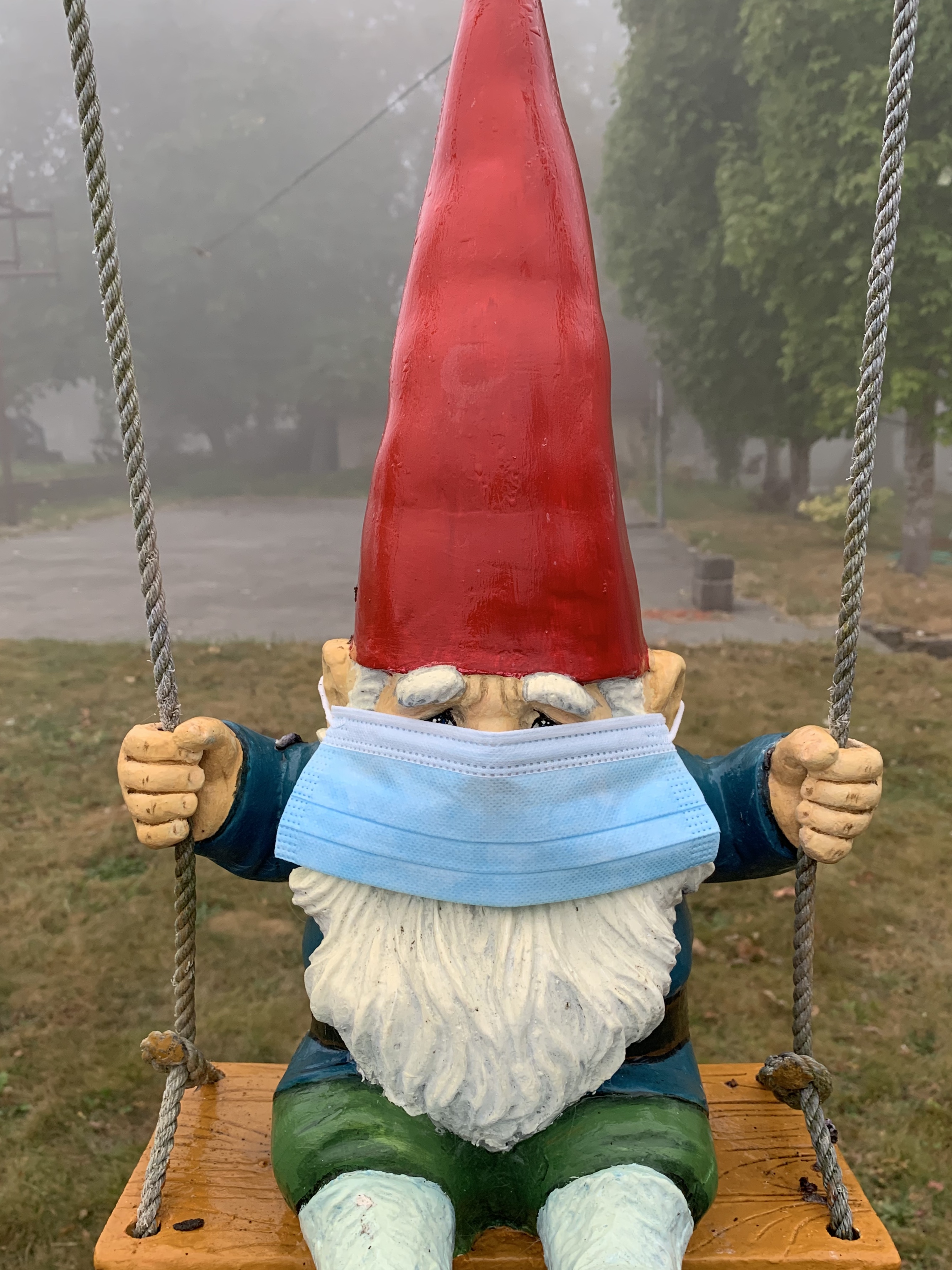
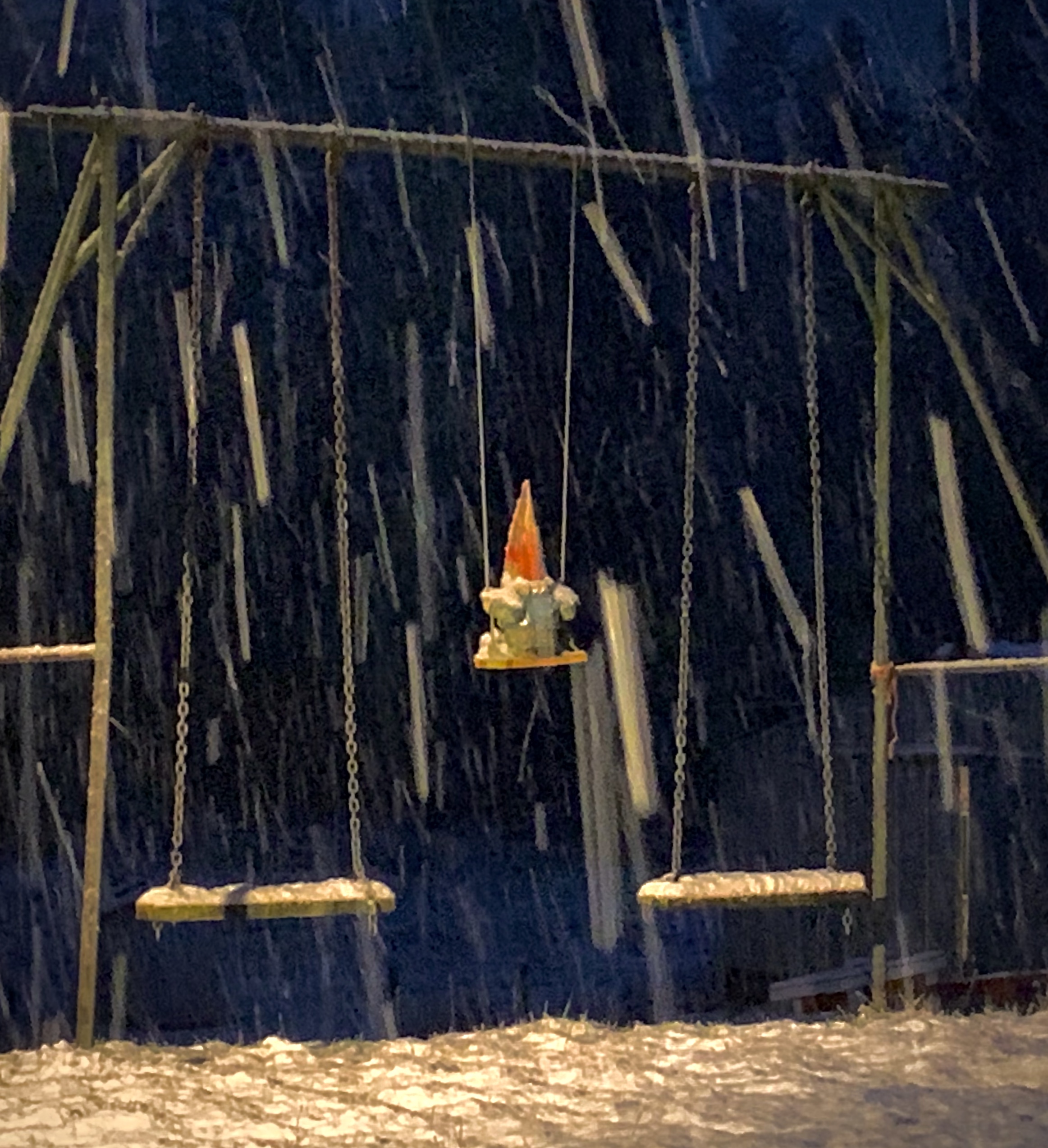
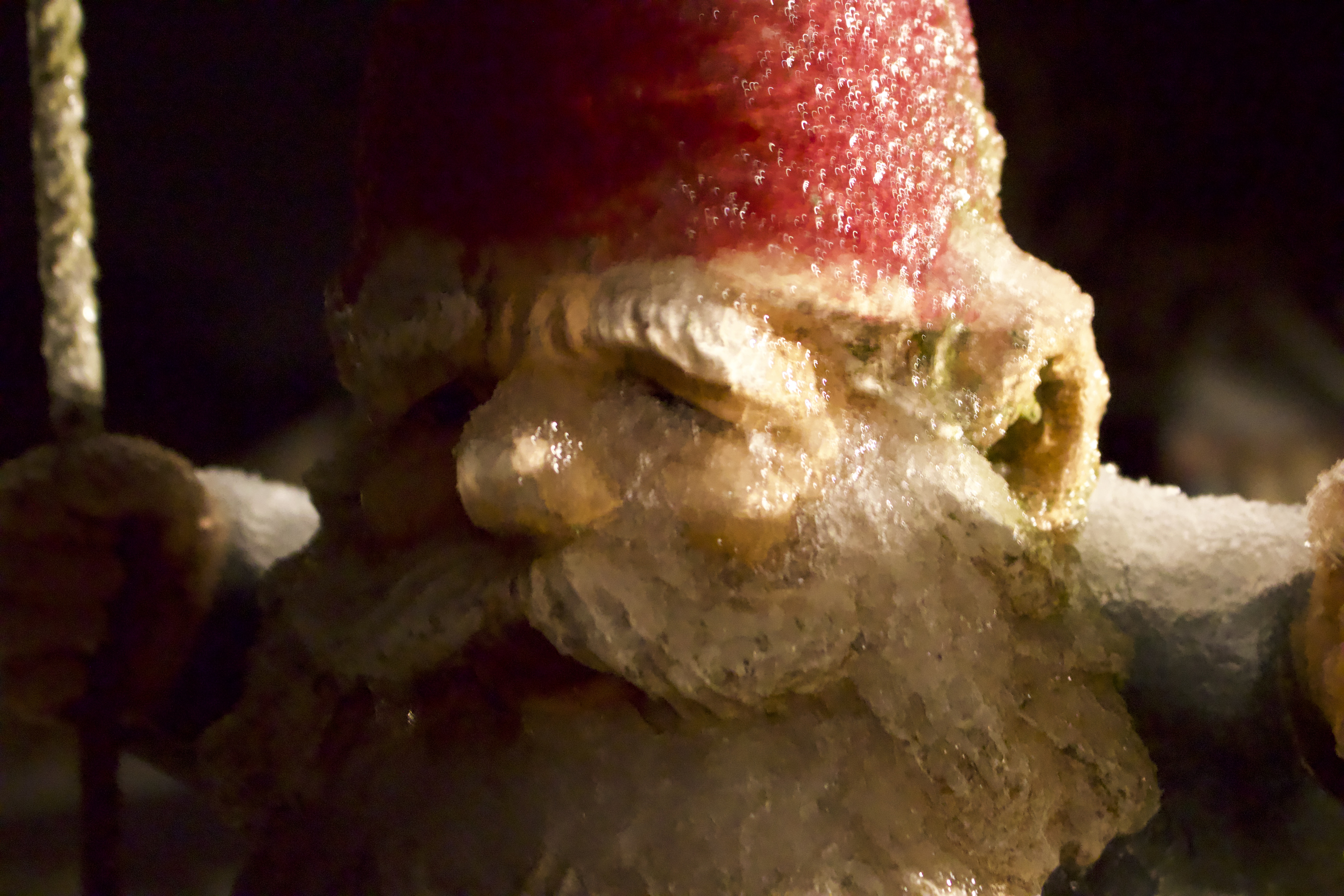
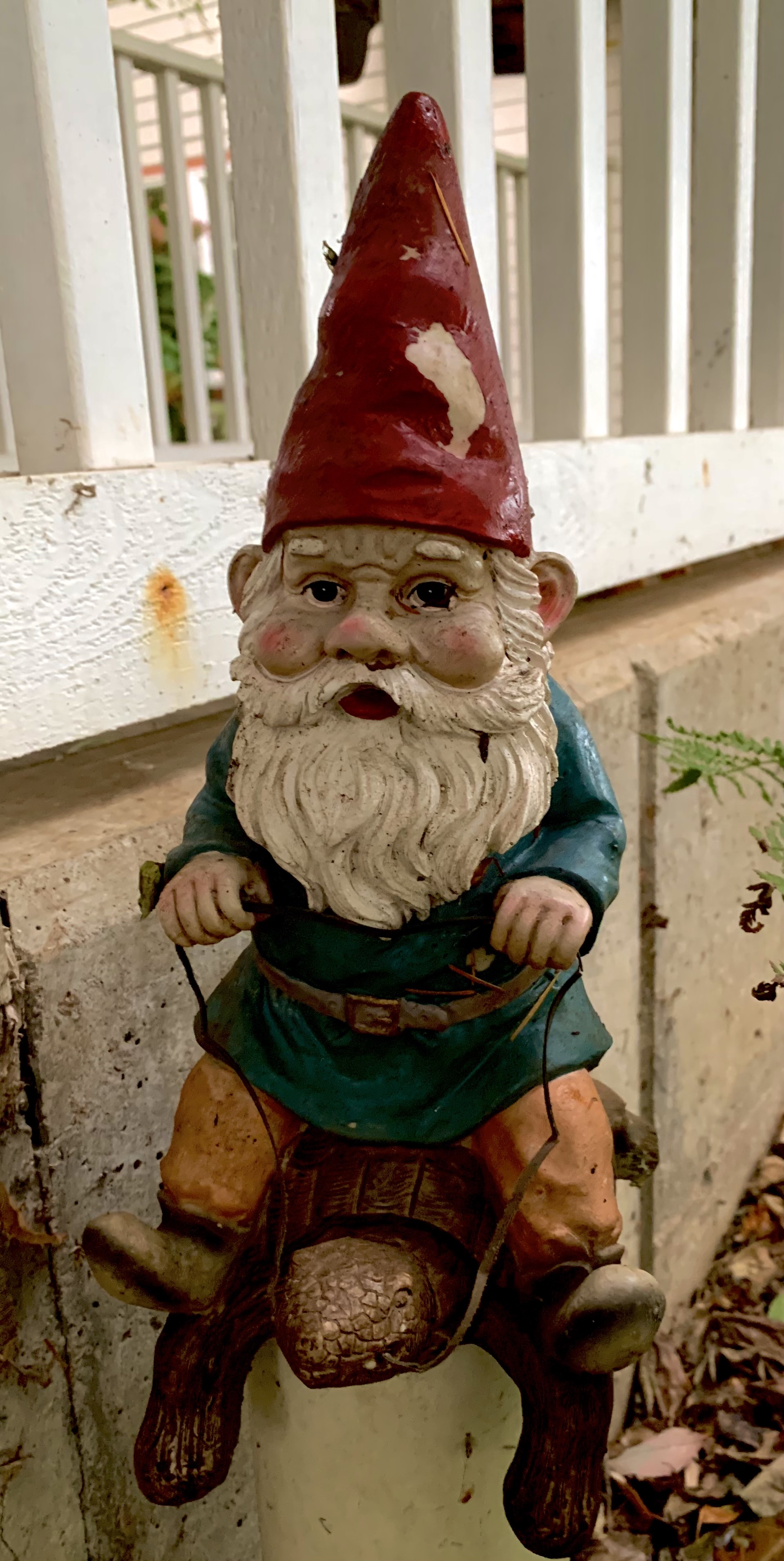
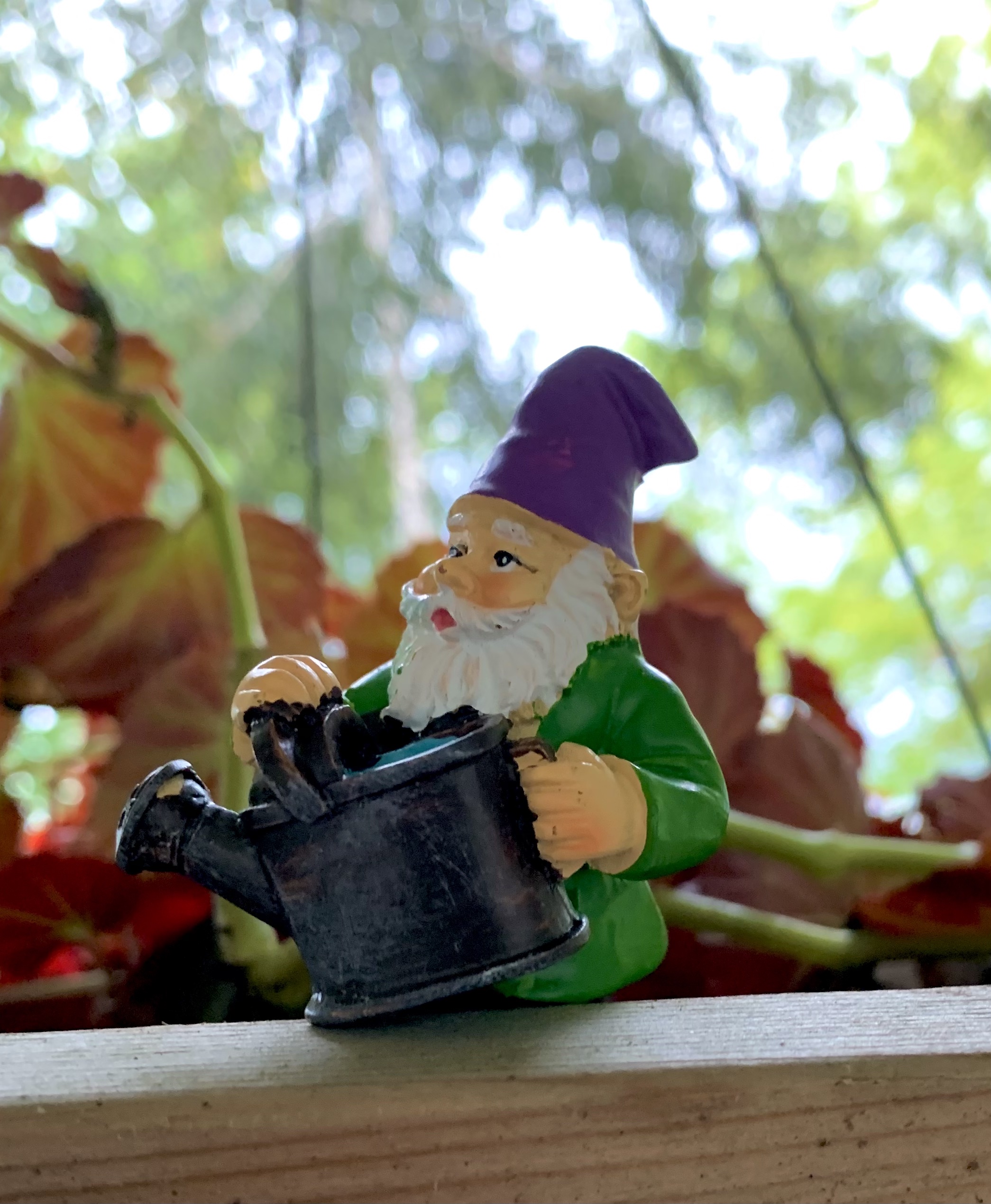
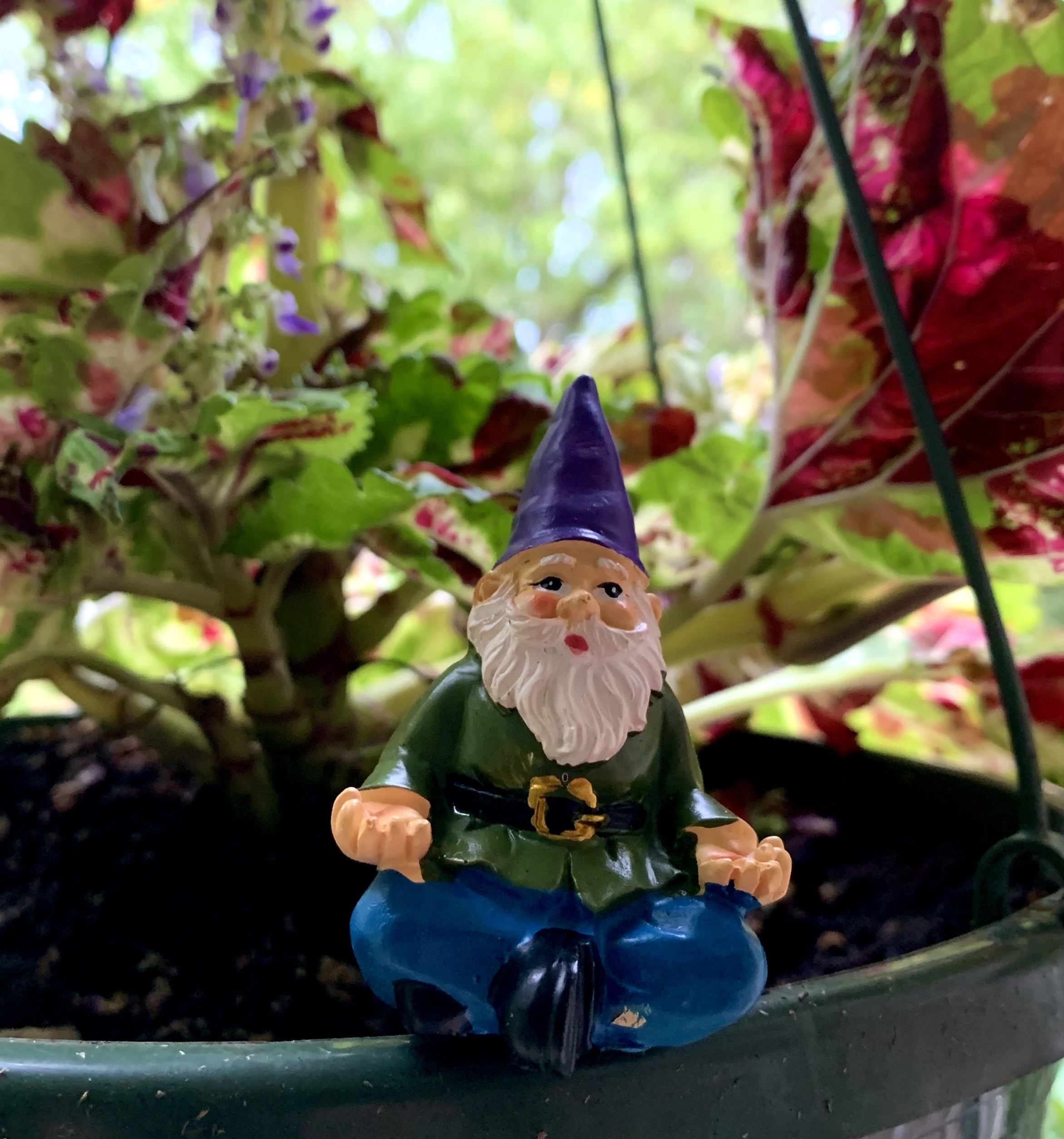
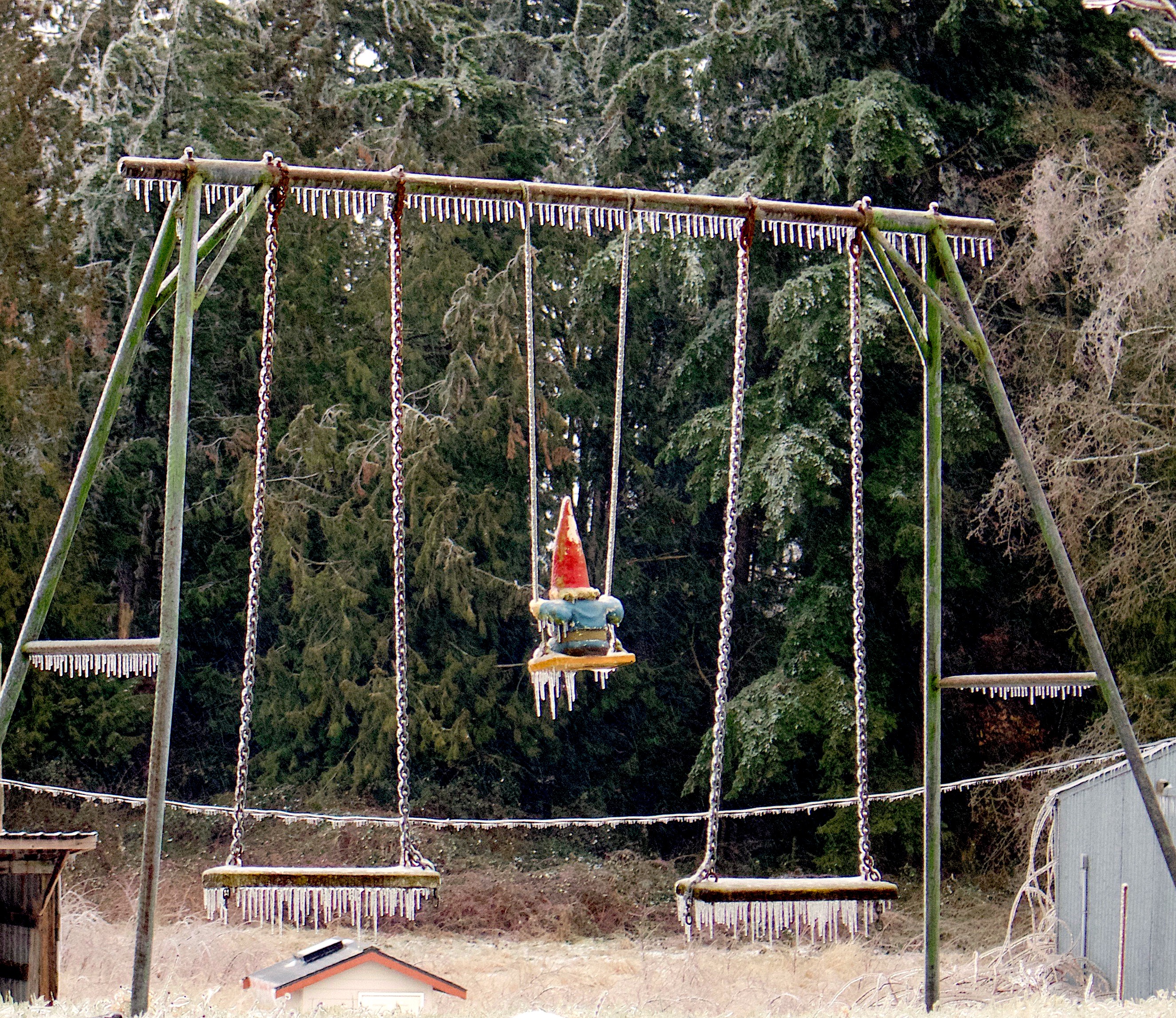
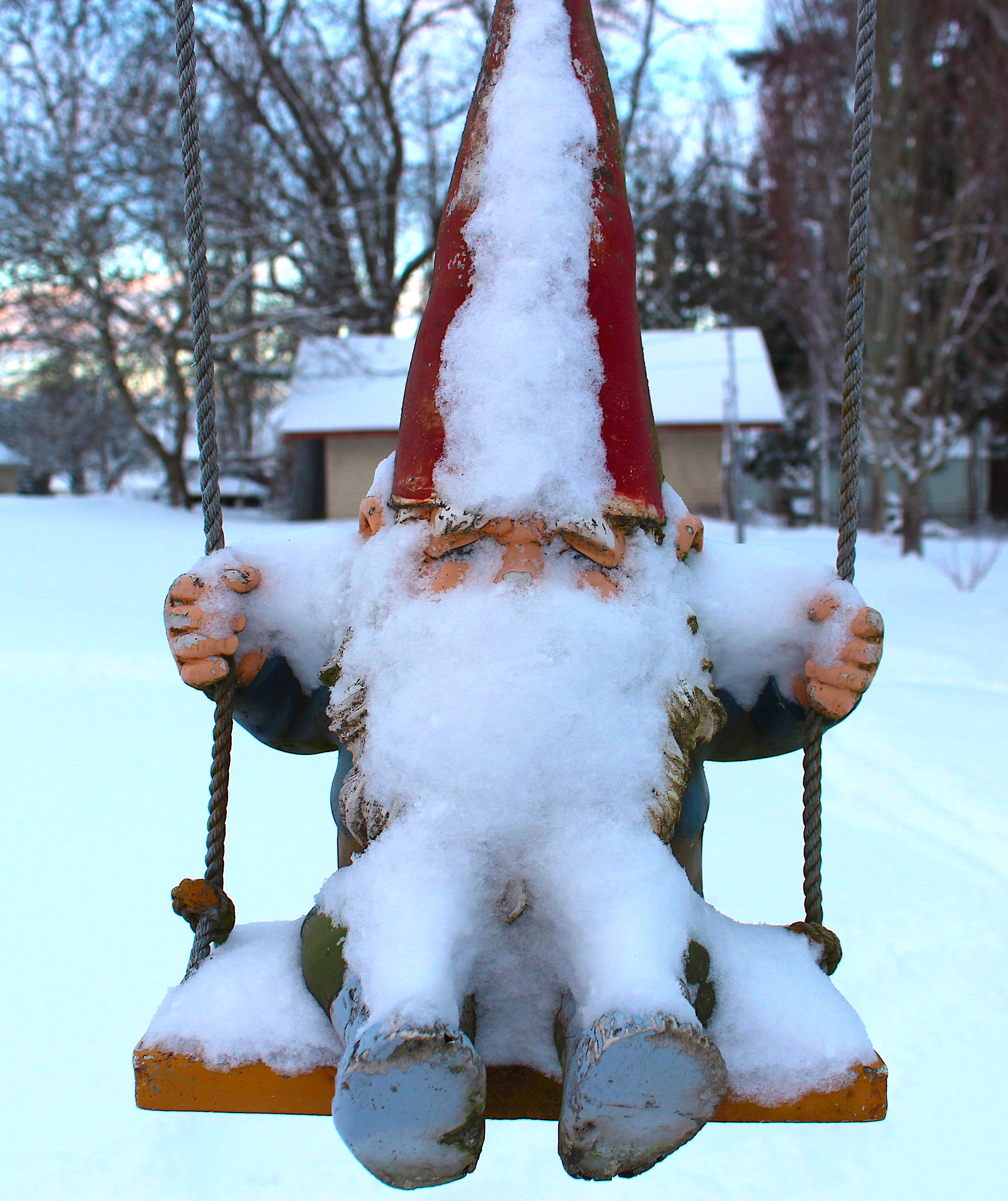
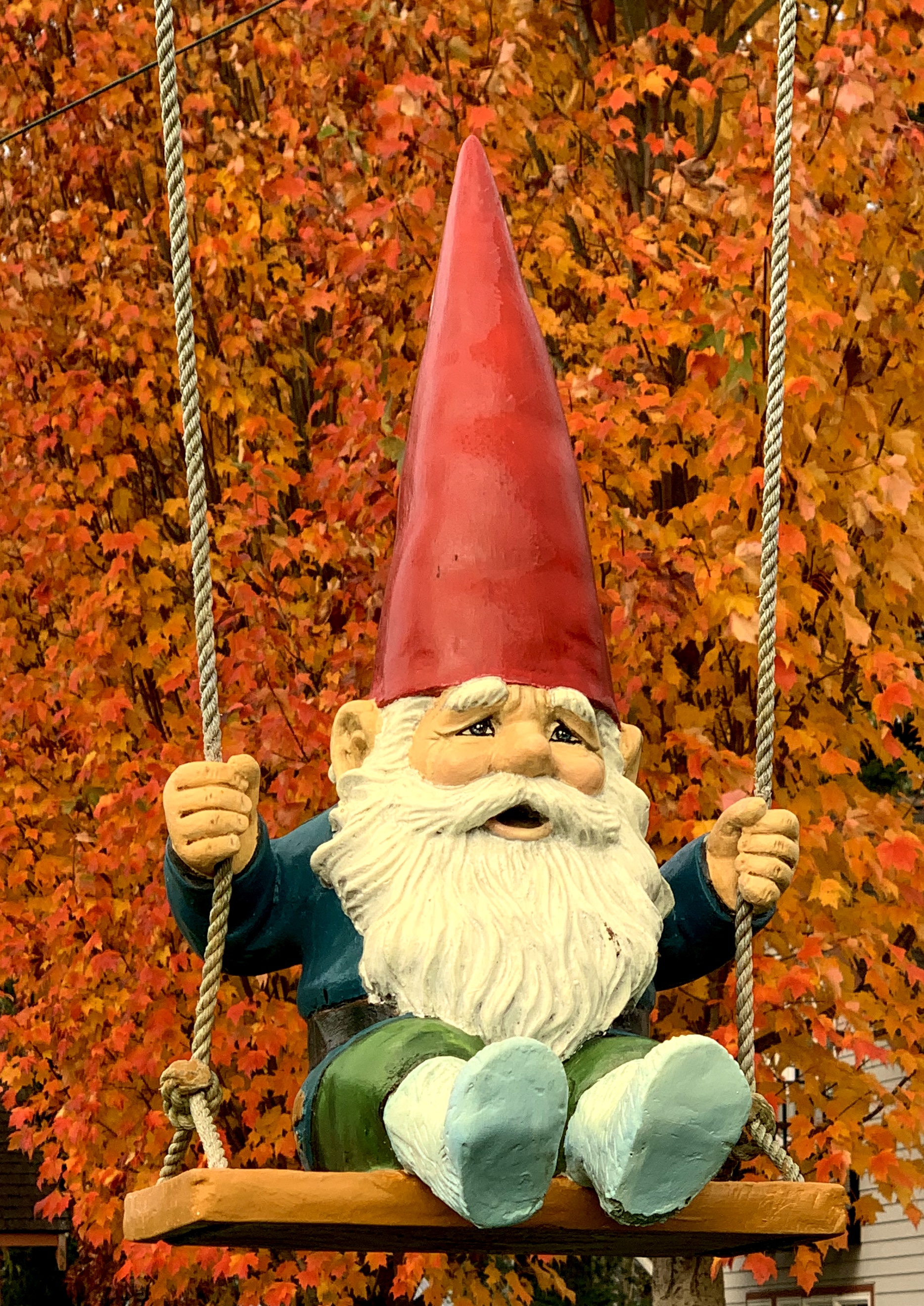
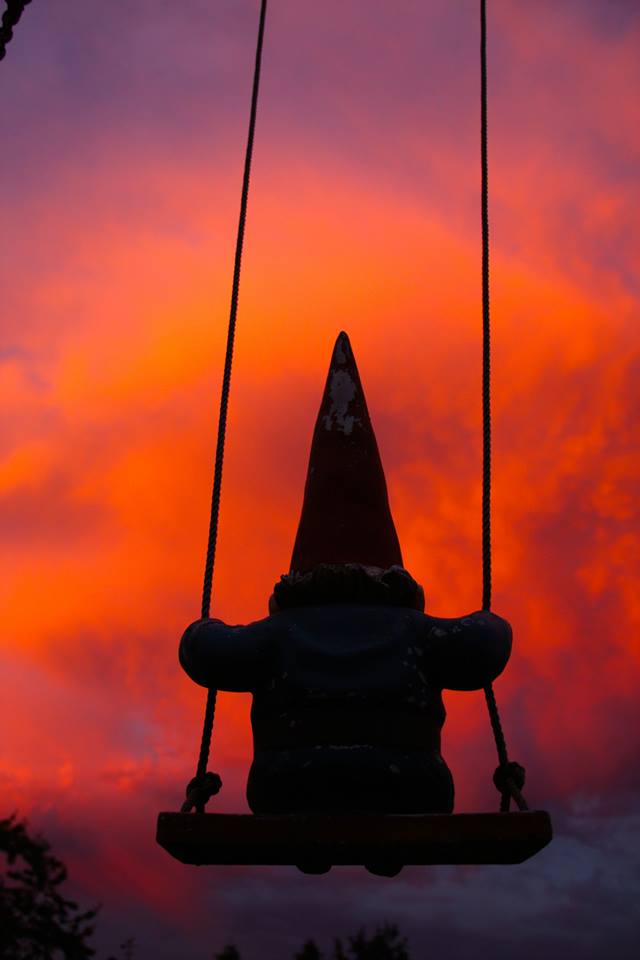
It wasn’t long before more Gardensi moved in, a gnomey infestation.  They tend to arrive in pairs and bunches, bringing their turtles and dogs with them, like to play music, smoke pipes, play on a teeter totter, work with garden tools, take naps on sun-warmed rocks and one even prefers a swing, day and night through all four seasons.  They are a bit of a rowdy bunch and always up for a party, but I enjoy their happy presence and jovial demeanor.   I haven’t yet heard any bad language as we have a “keep it clean” policy about bad words around here.  They seem quite hardy, stoically withstand extremes in weather, wear masks when asked and only seem fearful when hornets build a nest right in their lap.

As long as they continue to coexist peaceably with us and each other, keep the varmints and their knot tying cousins away,  and avoid bad habits and swear words, I’m quite happy they are here.  Actually, I’ve given them the run of the place.  I’ve been told to be cautious as there are now news reports of an even more invasive species of gnome, Gernumbli kitschsi, that could move in and take over if I’m not careful. In fact, several new little fellows moved into my hanging baskets and back into the barn this week – someone obviously had put the word out this is a great place to winter over. Now I need to watch for more mane tangles again.

A gnome explosion.

I shudder to think.  There goes the neighborhood.

photo by Tomomi Gibson

I promise – not a single photo of a gnome in this book – available for order here:

Starting the Day

My father taught me how to eat breakfast
those mornings when it was my turn to help
him milk the cows. I loved rising up from

the darkness and coming quietly down
the stairs while the others were still sleeping.
I’d take a bowl from the cupboard, a spoon

from the drawer, and slip into the pantry
where he was already eating spoonfuls
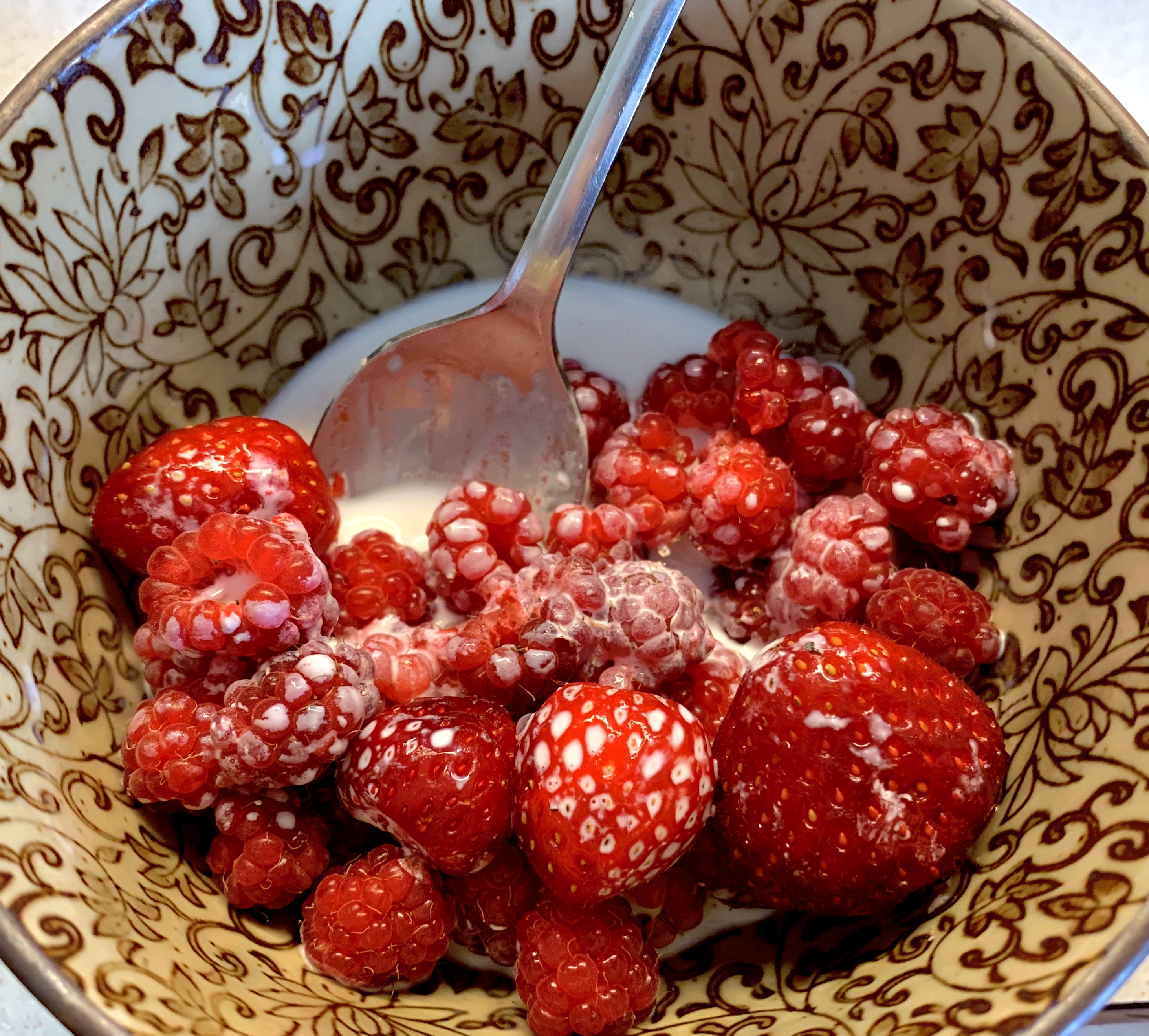
of cornflakes covered with mashed strawberries

from our own strawberry fields forever.
Didn’t talk much—except to mention how
good the strawberries tasted or the way

those clouds hung over the hay barn roof.
Simple—that’s how we started up the day.

~Joyce Sutphen, “Breakfast” from First Words, Red Dragonfly.

By the time I was four years old, my family owned several Guernsey and Jersey dairy cows who my father milked by hand twice a day. My mother pasteurized the milk on our wood stove and we grew up drinking the best milk on earth, as well as enjoying home-made butter and ice cream.

One of my fondest memories is getting up early with my dad, before he needed to be at school teaching FFA agriculture students (Future Farmers of America). I would eat breakfast with him and then walk out into the foggy fall mornings with our dog to bring in the cows for milking. He would boost me up on top of a very bony-backed chestnut and white patchwork cow while he washed her udder and set to work milking.

I would sometimes sing songs from up there on my perch and my dad would whistle since he didn’t sing.

I can still hear the rhythmic sound of the milk squirting into the stainless steel bucket – the high-pitched metallic whoosh initially and then a more gurgling low wet sound as the bucket filled up. I can see my dad’s capped forehead resting against the flank of the cow as he leaned into the muscular work of squeezing the udder teats, each in turn. I can hear the cow’s chewing her breakfast of alfalfa and grain as I balanced on her prominent spine feeling her smooth hair over her ribs. The barn cats circulated around us, mewing, attracted by the warm milky fragrance in the air.
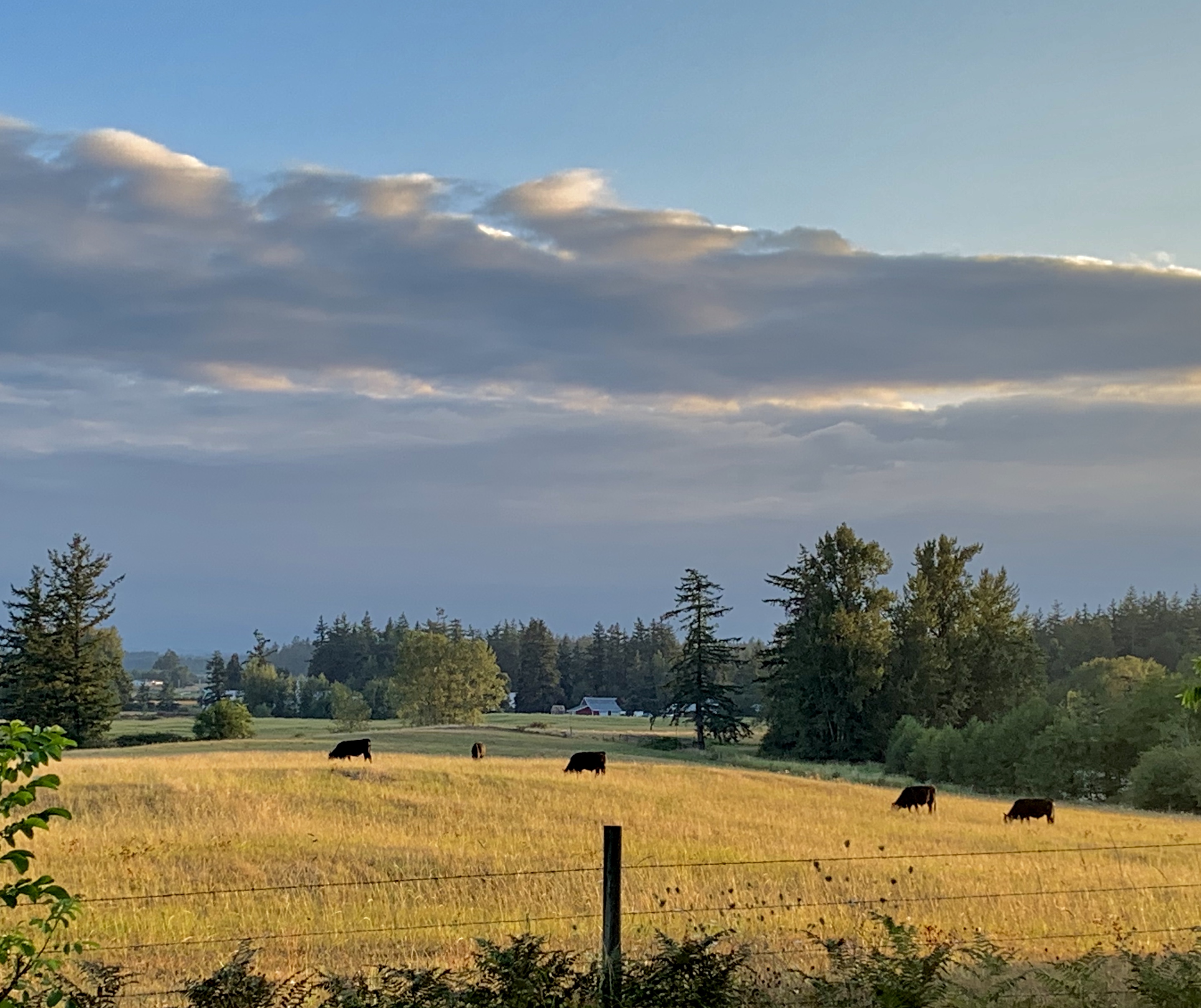
Those were preciously simple starts to the day for me and my father, whose thoughts he didn’t articulate nor I could ever quite discern. But I did know I wasn’t only his daughter on mornings like that – I was one of his future farmers of America he dedicated his life to teaching.
Dad, even without you saying much, those were mornings when my every sense was awakened. I’ve never forgotten that- the best start to the day.

A new shipment of this book is arriving soon – you can order here:

We May Or Might Never, Meet Here Again

My great grandfather had some fields in North Carolina
and he willed those fields to his sons and his sons
willed them to their sons so there is a two-hundred-year-old
farm house on that land where several generations
of my family fried chicken and laughed and hung

their laundry beneath the trees. There are things you
know when your family has lived close to the earth:
things that make magic seem likely. Dig a hole on the new
of the moon and you will have dirt to throw away
but dig one on the old of the moon and you won’t have

enough to fill it back up again: I learned this trick
in the backyard of childhood with my hands. If you know
the way the moon pulls at everything then you can feel
it on the streets of a city where you cannot see the sky.

I may walk the streets
of this century and make my living in an office
but my blood is old farming blood and my true
self is underground like a potato.

I have taken root in my grandfather’s
fields: I am hanging my laundry beneath his trees.
~Faith Shearin from “Fields”

It just isn’t possible to completely take me off the farm – I have generations of farmers extending back on both sides of my family, so I have dug myself a hole here, resting easy in the soil like a potato and ventured out only as I needed to in order to actually make a living.

A gathering of all my vaccinated clinic colleagues came to our farm yesterday to help me celebrate my retiring from office life. They brought beautiful flowers, plentiful food, kind and restoring words, thirty year old photos and lovely parting gifts, as well as my singing doctor buddy sharing a sea shanty about bittersweet parting. It is helping ease my sorrow at leaving regular doctoring behind, knowing there are more days to come, more time to grow things in the ground, more blissing out over sunrises and sunsets and more hanging laundry on the clothesline.

My dear friends know where they can find me – on the hill above our farm – we may or might never, meet here again but it was such a fine time together yesterday, thank you!

Kind Friend and Companions, Come join me in rhyme,
Come lift up your voices, In chorus with mine,
Come lift up your voices, all grief to refrain,
For we may or might never, all meet here again
Here’s a health to the company and one to my lass,
Let us drink and be merry, all out of one glass,
Let us drink and be merry, all grief to refrain
For we may or might never, all meet here again
Here’s a health to the dear lass, that I love so well,
For her style and her beauty, sure none can excel,
There’s a smile on her countenance, as she sits on my knee,
There’s no man in this wide world, as happy as me,
Here’s a health to the company, and one to my lass
Let us drink and be merry, all out of one glass,
Let us drink and be merry, all grief to refrain
For we may or might never, all meet here again,
Our ship lies at anchor, she’s ready to dock,
I wish her safe landing, without any shock,
If ever I should meet you, by land or by sea,
I will always remember, your kindness to me,
Here’s a health to the company and one to my lass,
Let us drink and be merry, all out of one glass,
Let us drink and be merry, all grief to refrain
For we may or might never, all meet here again
Here’s a health to the company and one to my lass,
Let us drink and be merry, all out of one glass,
Let us drink and be merry, all grief to refrain
For we may or might never, all meet here again

You may well love this book of Barnstorming photos, available to order here: