You can die for it- an idea, or the world. People have done so, brilliantly, letting their small bodies be bound to the stake, creating an unforgettable fury of light. But this morning, climbing the familiar hills in the familiar fabric of dawn, I thought of China, and India and Europe, and I thought how the sun blazes for everyone just so joyfully as it rises under the lashes of my own eyes, and I thought I am so many! What is my name? What is the name of the deep breath I would take over and over for all of us? Call it whatever you want, it is happiness, it is another one of the ways to enter fire. ~Mary Oliver “Sunrise”
Over the years, I have not missed many early autumn sunrises – most I have not recorded as they are often gray and rainy.
This particular day of September – the 24th – has been a treasure trove of color and cloud patterns and light for the last 12 years. Today I share these with you in their variety and beauty.
Every day, let us watch the sun rise with its light under our eyelashes – the fire of happiness illuminating us all as morning breaks open, like the First Day.
9/24/17 9/24/169/24/159/24/149/24/26 6:53 AM
One-Time
Monthly
Yearly
Make a one-time or recurring donation to support daily Barnstorming posts
The songs of small birds fade away into the bushes after sundown, the air dry, sweet with goldenrod. Beside the path, suddenly, bright asters flare in the dusk. The aged voices of a few crickets thread the silence. It is a quiet I love, though my life too often drives me through it deaf. Busy with costs and losses, I waste the time I have to be here—a time blessed beyond my deserts, as I know, if only I would keep aware. The leaves rest in the air, perfectly still. I would like them to rest in my mind as still, as simply spaced. As I approach, the sorrel filly looks up from her grazing, poised there, light on the slope as a young apple tree. A week ago I took her away to sell, and failed to get my price, and brought her home again. Now in the quiet I stand and look at her a long time, glad to have recovered what is lost in the exchange of something for money. ~Wendell Berry “The Sorrel Filly”
I am reminded at summer’s end — when it is already dark and chores not done yet, and horses waiting to be fed — of the value of decades of moments spent with long-lashed eyes, wind-swept manes, and velvet muzzles.
True, it appears to others to be time and money wasted. But for a farmer like me, sometimes deaf and blind to what is in front of me every day, not all valuables are preserved in a lock box or a bank account.
Golden treasure can have four hooves, a tail, a rumbling greeting asking if I’d somehow gotten lost since I’m a little later than usual and they were a bit concerned I’d forgotten them.
If only I would keep aware, remember where my home is, how easy it is to wander from the path that somehow always leads me back here.
One-Time
Monthly
Yearly
Make a one-time or recurring donation to support daily Barnstorming posts
The meaning of marriage begins in the giving of words. We cannot join ourselves to one another without giving our word. And this must be an unconditional giving, for in joining ourselves to one another we join ourselves to the unknown. ~Wendell Berry from “Poetry and Marriage” in Standing By Words
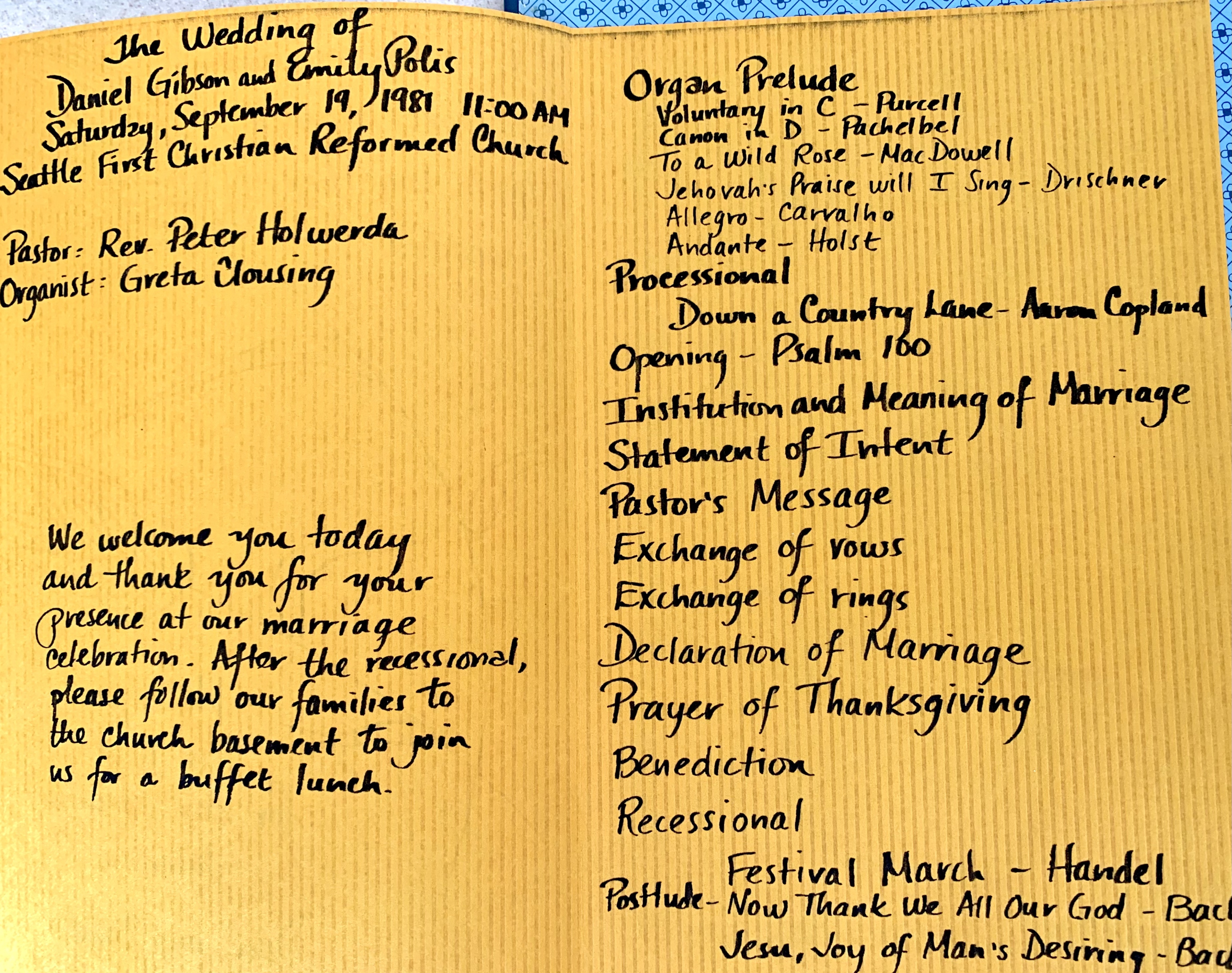
Our vows to one another forty-five years ago today:
Before God and this gathering, I vow from my heart and spirit that I will be your wife/husband for as long as we both shall live.
I will love you with faithfulness, knowing its importance in sustaining us through good times and bad.
I will love you with respect, serving your greatest good and supporting your continued growth.
I will love you with compassion, knowing the strength and power of forgiveness.
I will love you with hope, remembering our shared belief in the grace of God and His guidance of our marriage.
“And at home, by the fire, whenever you look up, there I shall be–and whenever I look up, there will be you.”
(our wedding vows for our September 19, 1981 wedding at First Seattle Christian Reformed Church — the last line adapted from Thomas Hardy’s “Far From the Madding Crowd”)
Sometimes our life reminds me of a forest in which there is a graceful clearing and in that opening a house, an orchard and garden, comfortable shades, and flowers red and yellow in the sun, a pattern made in the light for the light to return to. The forest is mostly dark, its ways to be made anew day after day, the dark richer than the light and more blessed, provided we stay brave enough to keep on going in.
We enter, willing to die, into the commonwealth of its joy. ~Wendell Berry from “A Country of Marriage”
…Marriage… joins two living souls as closely as, in this world, they can be joined. This joining of two who know, love, and trust one another brings them in the same breath into the freedom of sexual consent and into the fullest earthly realization of the image of God. From their joining, other living souls come into being, and with them great responsibilities that are unending, fearful, and joyful. The marriage of two lovers joins them to one another, to forebears, to descendants, to the community, to heaven and earth. It is the fundamental connection without which nothing holds, and trust is its necessity. ~Wendell Berry from Sex, Economy, Freedom and Community
We married forty-five years ago today in our Seattle church with Pastor Peter Holwerda officiating, with a small group of family and friends as witnesses.
It was a wedding of two frugal people with little to spend – I sewed my dress and Dan’s shirt from muslin, we grew our own flowers, our families helped potluck the lunch afterward and our tiered carrot cake was made by a friend.
Yet our vows to one another were not frugal and held nothing back. They were extravagant and comprehensive, coming from our hearts and spirits. The music we asked our amazing organist to play (versions below) inspired us by its simplicity and complexity – very much like the families that raised us and the God we worship.
Our vows have taken us from the city to the countryside, to the raising and rejoicing in three amazing children and now soon to be seven grandchildren. We served more than forty years as a public-employed attorney and physician. We have laid down those responsibilities, and picked up the tools of farm and garden along with church and community service for as long as we are able.
We treasure each day of living together in faithfulness, respect, compassion and hope – knowing that how we love and find joy in one another mirrors how God loves and revels in His people.
We pray for many more days to fill us with what endures.
I want to remember us this way— late September sun streaming through the window, bread loaves and golden bunches of grapes on the table, spoonfuls of hot soup rising to our lips, filling us with what endures. ~Peter Pereira from “A Pot of Red Lentils”
Here are versions of the organ music we selected for prelude, processional, recessional and postlude
Not just the first crocus bulb poking from the ground, but its pollen shining saffronly on the legs of a bee.
The reverberations of a hammered dulcimer or the puff of sweetness escaping between peel and pith of a ripe tangelo.
It’s riding the elevator after the doctor tells you, we can’t say why the scans are suddenly clear, or, if you’re exhausted from trying, time to surround yourself with people you love. It’s waking
in the middle of the night, looking out at the silhouettes of trees and realizing there is nothing lonely about silence. It’s cruising a wide-open Montana highway
or swinging your hips to the rhythm of a street-corner bucket drummer and daring the stares. It’s not the cicada blooming from its shell as much
as the shell itself, balanced on the finger of a little girl, then tumbling along the grass tips among the unkillable dandelions. ~Tania Runyan from “What It’s Like to Rise Again”
We’re each given a fresh start each day; even when it was a fitful sleep, and we’re fearful about what comes next, or if there will even be a “next”…
Jesus explains what it is like to rise above the darkness; bold, unafraid, leaving behind, neatly folded, the vestiges of death.
He gives us each reason to get up every morning, surrounded by those who love us.
Even when crushed and broken, He rose up so we can follow.
Everything’s going to be all right…
One-Time
Monthly
Yearly
Make a one-time or recurring donation to support daily Barnstorming posts
Stand still. The trees ahead and bushes beside you Are not lost. Wherever you are is called Here, And you must treat it as a powerful stranger, Must ask permission to know it and be known. The forest breathes. Listen. It answers, I have made this place around you. If you leave it, you may come back again, saying Here. No two trees are the same to Raven. No two branches are the same to Wren. If what a tree or a bush does is lost on you, You are surely lost. Stand still. The forest knows Where you are. You must let it find you. ~David Wagoner “Lost”
Our grandchildren — born in Tokyo, adapting to a rural life here — bring within them the serenity of the gardens they visited there, finding respite from worldly worries and sorrows.
We remind them to love such stillness: there is rest after busyness, there is light beyond darkness, there is peace amid chaos, there are smiles after tears, there is quiet within noisiness, there is grace and mercy forever…
…as we who are older give way to the new.
One-Time
Monthly
Yearly
Make a one-time or recurring donation to support daily Barnstorming posts
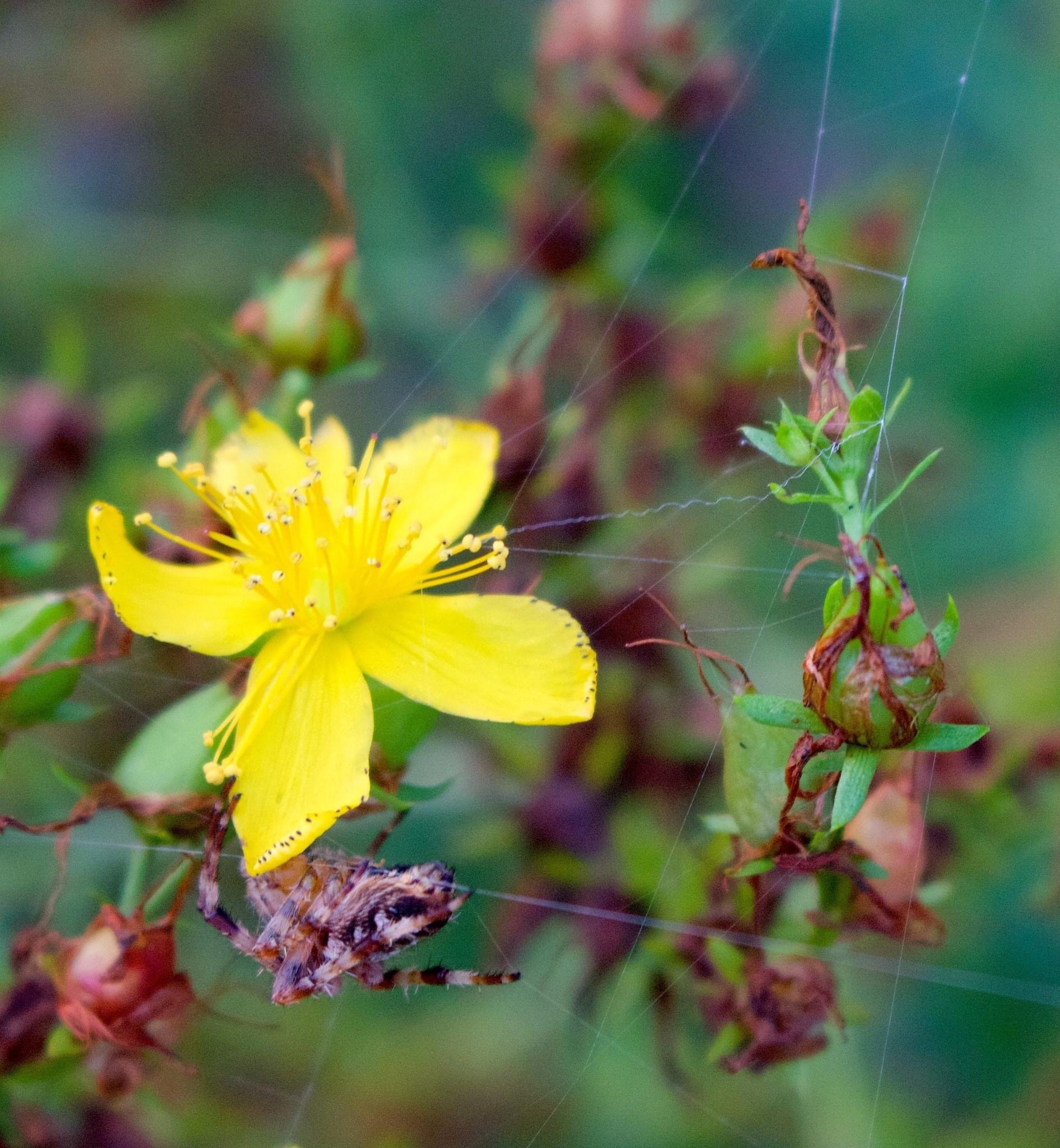
Silk-thin silver strings woven cleverly into a lair, An intricate entwining of divinest thread… Like strands of magic worked upon the air, The spider spins his enchanted web – His home so eerily, spiraling spreads.
His gossamer so rigid, yet lighter than mist, And like an eight-legged sorcerer – a wizard blest, His lace, like a spell, he conjures and knits; I witnessed such wild ingenuity wrought and finessed, Watching the spider weave a dream from his web. ~Jonathan Platt“A Spider’s Web”
I believed only air stretched between the dogwood
and the barberry: another thoughtless human assumption
sidetracking the best story this furrow spider knew to spin.
And, trying to get the sticky filament off my face, I must look,
to the neighbors, like someone being attacked by his own nervous
system, a man conducting an orchestra of bees. Or maybe it’s only the dance
of human history I’m reenacting: caught in his own careless wreckage,
Not everyone is taking a holiday today on Labor Day. Some are busier than ever, creating a masterpiece nightly, then waiting in hope for that labor to be rewarded.
I too spin elaborate dreams at night: some remembered, some bare fragments, some shattered, some potentially yield a meal.
We work because we are hungry. We work because someone we love is hungry and needs feeding.
Yet the best work is the work of weaving dreams ~out of thin air and gossamer strands~ where nothing existed before, not as a trap or lure or lair but as a work of beauty- a gift as welcome as a breath of fresh air.
Lyrics from E.B.White poem “Natural History” The spider, dropping down from twig Unfolds a plan of her devising A thin premeditated rig To use in rising
And all that journey down through space In cool descent and loyal hearted She spins a ladder to the place From where she started
Thus I, gone forth as spiders do In spider’s web a truth discerning Attach one silken thread to you For my returning
Lyrics
Take the silver thread of a spider’s web And spin, spin, spin Silver wings to fly and sing Upon the wind High above the trees, across the seas And through the sky To the rainbow’s bend, where stories never end And dreams never die
One-Time
Monthly
Yearly
Make a one-time or recurring donation to support daily Barnstorming posts
A writer should concern himself with whatever absorbs his fancy, stirs his heart, and unlimbers his typewriter. I feel no obligation to deal with politics. I do feel a responsibility to society. A writer has the duty to be good, not lousy; true, not false; lively, not dull; accurate, not full of error. He should tend to lift people up, not lower them down.
A writer must reflect and interpret his society, his world; he must also provide inspiration and guidance and challenge. Much writing today strikes me as deprecating, destructive, and angry. There are good reasons for anger, and I have nothing against anger. But I think some writers have lost their sense of proportion, their sense of humor, and their sense of appreciation.
I am often mad, but I would hate to be nothing but mad: one role of the writer today is to sound the alarm. The environment is disintegrating, the hour is late, and not much is being done. Instead of carting rocks from the moon, we should be carting the feces out of Lake Erie. …I think I would lose what little value I may have as a writer if I were to refuse, as a matter of principle, to accept the warming rays of the sun, and to report them, whenever, and if ever, they happen to strike me. ~E.B. White 1969 (on writing)
It is tiresome always feeling angry about what it is happening in the world, feeling that everything has become political.
I’m tired of reading (and writing) words of frustration, but want to rail against the meanness that surrounds us, and push back the bully to seek out a balance of kindness, perspective and insight.
When I need to feel something other than mad, I walk as far as I can go, look up, revel in the gift of rays of light and bask in their warmth and promise.
I will accept what the Sun has to offer and tell about it so that my anger drains away like so much waste flushed down a pipe, never to be seen again.
Lyrics: Even before we call on Your name To ask You, O God, When we seek for the words to glorify You, You hear our prayer; Unceasing love, O unceasing love, Surpassing all we know.
Glory to the Father, and to the Son, and to the Holy Spirit.
Even with darkness sealing us in, We breathe Your name, And through all the days that follow so fast, We trust in You; Endless Your grace, O endless Your grace, Beyond all mortal dream.
Both now and forever, And unto ages and ages, Amen.
One-Time
Monthly
Yearly
Make a one-time or recurring donation to support daily Barnstorming posts
In the evening there were flocks of nighthawks passing southward over the valley. The tall sunflowers stood, burning on their stalks to cold seed, by the still river. And high up the birds rose into sight against the darkening clouds. They tossed themselves among the fading landscapes of the sky like rags, as in abandonment to the summons their blood knew. And in my mind, where had stood a garden straining to the light, there grew an acceptance of decline. Having worked, I would sleep, my leaves all dissolved in flight. ~Wendell Berry “September 2”
And when I rise, let me rise Like a bird, joyfully. And when I fall, let me fall, Like a leaf, gracefully, without regret. And when I stand, let me stand, Like a tree, strong and tall. And when I lie, let me lie, Like a lake, peacefully, calm and still. And when I work, let me work, Like a bee, wholeheartedly. And when I play, let me play, Like a breeze, fresh and cool, light and clear. ~adapted from Wendell Berry’s “When I Rise” in The Mad Farmer Poems
The thistles, rooted out, throng in again; The single regal rose is mobbed by weeds; The plums, the pears, the ripening apples, rain In the sun; and past summer plants new seeds.
Here, or there, these common yearly things Repeat, repeat, and gardens do not range: Yet thistles, roses, fruit trees, birds, and stings Come to an end, and the church bells sound a change.
These many soft declensions of the day, So hard to take to heart, bear life away. ~Dunstan Thompson from “Passage”from Here At Last Is Love
This end-of-summer winding down, a descent into shorter days and longer nights, this preparation for autumn austerity, reminds me to accept my own slow decline ~ an emptying husk once so full of fruit and seed, now clinging to what is left of me ~ still filled with the joys, the tears, the eyes of a brimming-over heart.
One-Time
Monthly
Yearly
Make a one-time or recurring donation to support daily Barnstorming posts
Theirs is a perfection of pure form. Nobody but has his proper place and knows it. Everything they do is functional. Each foray in a zigzag line Each prodigious lifting Of thirty-two times their own weight Each excavation into the earth’s core Each erection Of a crumbly parapetted tower —
None of these feats is a private pleasure, None of them done For the sake of the skill alone —
They’ve got a going concern down there, A full egg-hatchery A wet-nursery of aphids A trained troop of maintenance engineers Sanitation experts A corps of hunters And butchers An army
A queen Each Is nothing without the others, each being a part Of something greater than all of them put together A purpose which none of them knows Since each is only The one thing that he does. There is A true consistency Toward which their actions tend. The ants have bred and inbred to perfection. The strains of their genes that survive survive. Every possible contingency Has been foreseen and written into the plan.
The ant in the shadow of this blade of grass Is indifferent to my presence, to the action Of the day, to the creaking of the limbs Of the sycamore, to the sun lowering itself Slowly from the scaffolding of the sky…
The ant has not moved. It is deep in meditation.
…Ants understand The principle of undefiled silence. My ant glows Like charcoal now in the lengthening rays of the sun. I kneel and whisper, “Look up at me. I’m here.” ~John Gilgun from “The Ant in the Shadow of This Blade of Grass”
Today, when I could do nothing, I saved an ant...
Small black ant, alone, crossing a navy cushion, moving steadily because that is what it could do.
Set outside in the sun, it could not have found again its nest. What then did I save?
It did not move as if it was frightened, even while walking my hand, which moved it through swiftness and air.
Ant, alone, without companions, whose ant-heart I could not fathom— how is your life, I wanted to ask. I lifted it, took it outside.
This first day when I could do nothing, contribute nothing…
The other day, as I sat down in the grass to take pictures, I felt a tickle at the nape of my neck. I reached up, felt something, and when I looked to see what it was, I found a tiny ant crushed in my fingers.
Suddenly it felt like things were crawling everywhere on me, especially my scalp. I shook out my hair and clothes and found there weren’t any more ants. It was only one unfortunate, defenseless victim who chose the wrong place and time to inhabit me.
As a child, I was fascinated by the ant hills in the woods and fields of our small farm. I would track yards and yards of ant trails from the busy mounded colonies to tree trunks and other sources of food, watching the single-file, single-minded insects heading through all sorts of terrain to sustain their community. Having ants crawling on me wasn’t a problem then – they were part of my exploration of creation … sometimes they explored me. So I’m sympathetic to a solitary ant’s curiosity.
When we share the same few square inches of landscape, we want to ask one another: How is your life? hoping to fathom each other’s heart. We are each of us a part of something greater than all of us put together.
In this small corner of the internet, I share words or pictures I hope might bring a smile, a nod of recognition, or a moistened eye, wanting to find common ground with people I likely will never meet in the chaos of existence.
So I ask you every now and again because I want to know: how is your life?
Though I may do nothing else of import in this scatter-mess of life’s anthill, I can do this: I’m here, exploring and caring, listening for your comments, feedback and messages. Nothing you say will be wrong…
One-Time
Monthly
Yearly
Make a one-time or recurring donation to support daily Barnstorming posts
Last night we were laying in bed when my husband rolled over and said, “Do you hear birds?” I said I heard the laundry dragging itself along the inside of the dryer as it turned.
My grandparents’ neighbor, Doris, once said she heard birds in the chimney. Her in-home helper confessed they weren’t birds— she’d had a baby in the night without knowing she was pregnant.
Poems are like that, insisting on being born, heard, making themselves known as soon as we’re quiet and still. We hear birdsong in the ordinary, and it sings us awake in the dark until the mundane becomes miraculous. ~Elizabeth Wickland “Do You Hear Birds?”
Like people or dogs, each day is unique and has its own personality quirks which can easily be seen if you look closely. But there are so few days as compared to people, not to mention dogs, that it would be surprising if a day were not a hundred times more interesting than most people.
But usually they just pass, mostly unnoticed, unless they are wildly nice, like autumn ones full of red maple trees and hazy sunlight, or if they are grimly awful ones in a winter blizzard that kills the lost traveler and bunches of cattle.
For some reason we like to see days pass, even though most of us claim we don’t want to reach our last one for a long time.
We examine each day before us with barely a glance and say,no,this isn’t one I’ve been looking for, and wait in a bored sort of way for the next, when we are convinced, our lives will start for real.
Meanwhile, this day is going by perfectly well-adjusted, as some days are, with the right amounts of sunlight and shade, and a light breeze scented with a perfume made from the mixture of fallen apples, corn stubble, dry oak leaves, and the faint odor of last night’s meandering skunk. ~Tom Hennen“The Life of a Day”
Age concentrates the mind. The moment you realize you will no longer do something you’ve done all your life. The moment you realize that you will now need to do something you’ve never had to do before. The moment you realize that what used to be will never be the same. Some of this could lend itself to melancholy. But there is also a bigness to such moments that allows for wonder. A sense that you can’t quite comprehend it all.
Like any life, mine has had its pain, yet from the outset it seems to have been graced by unbelievable people and events.
I am ashamed to admit I squander time shamelessly, blind and deaf to what is happening around me, waiting for that particularly special day I always dreamed of, tossing off mundane yet irreplaceable moments as somehow not measuring up nor exciting enough.
The shock is: there have been nearly 40 years of such ordinary days on this farm, one passing by after another, emerging fresh each morning from the mundane duff and stuff of life, and wouldn’t you know… every single one has ended up being exactly what I’m looking for.
One-Time
Monthly
Yearly
Make a one-time or recurring donation to support daily Barnstorming posts