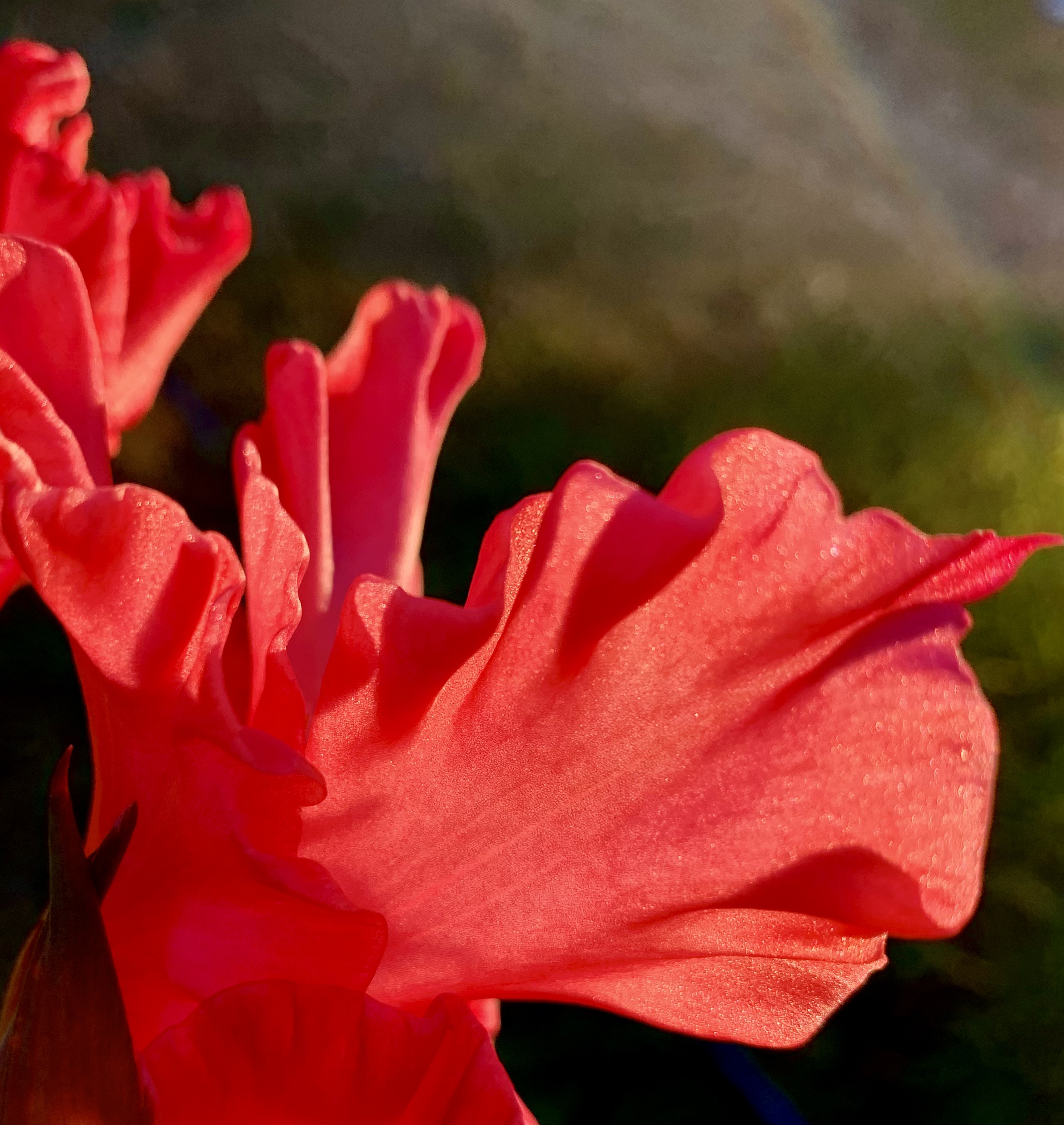
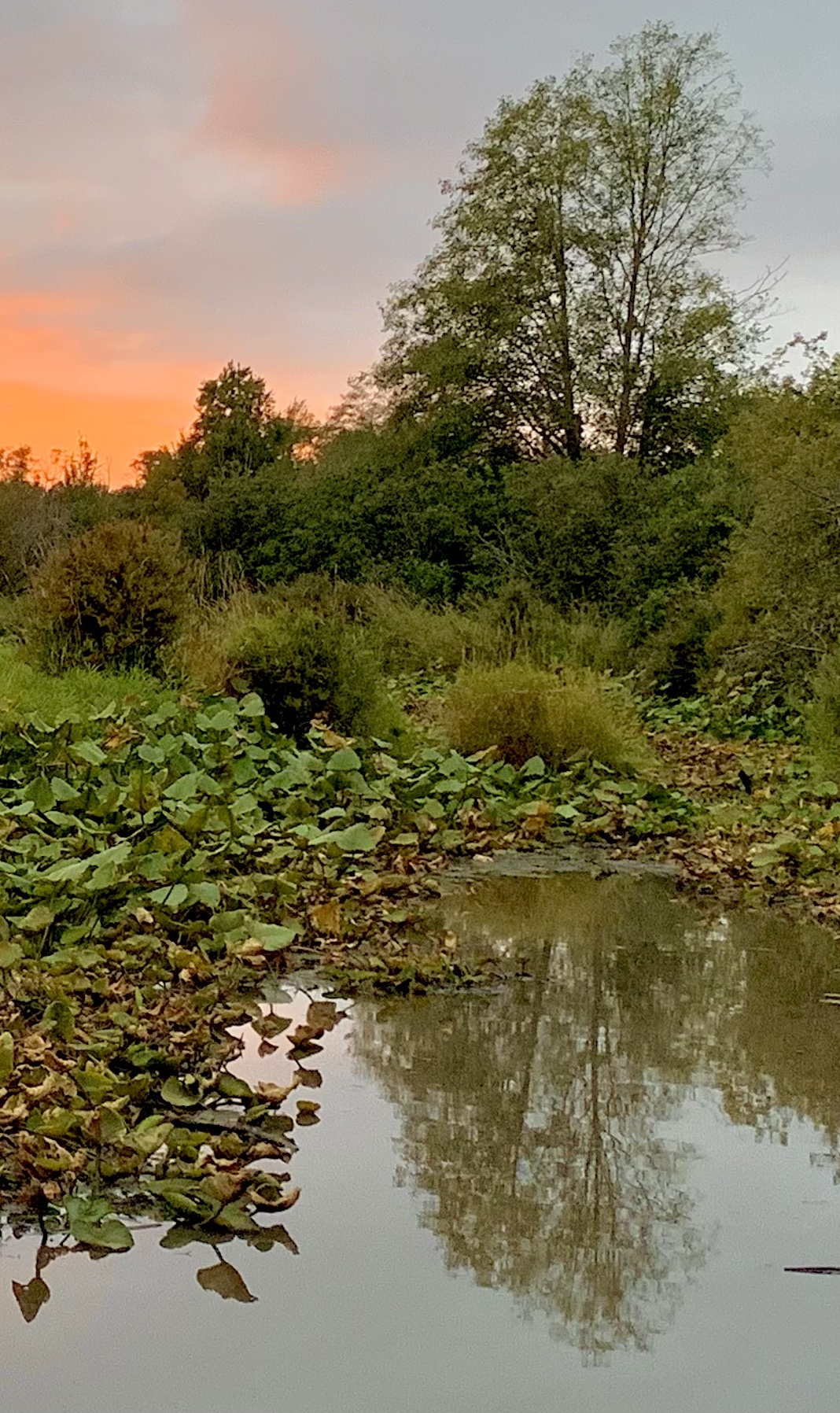
I go to nature not because its flowers and sunsets speak to me (though they do) or listen to me inquire but because I have filled it with unintentionality, so that I can miss anything personal in the roar of sunset, so that I can in beds of flowers hold my head up too. ~A.R. Ammons from The Ridge Farm from Complete Poems
Take the tangle instead of the trouble it causes. Take the world inside as seriously as any other. Take your elderly mother and father at face value as they have to. Take the mirror of the sky mirrored in the bay. Take the swell of new-mown hay and the river conversing where the valley opens its mouth and the land begins to creak less as the evening steals light away— Take the wick in the far hills and take the sun and the wind and the look of nothing for granted. Take a little less, all right and try not to take fright. Take the end in mind instead of the end in sight. ~Brian Turner “Take This” from Taking Off
God speaks to each of us as he makes us, then walks with us silently out of the night.
These are the words we dimly hear:
You, sent out beyond your recall, go to the limits of your longing. Embody me.
Flare up like a flame and make big shadows I can move in.
Let everything happen to you: beauty and terror. Just keep going. No feeling is final. Don’t let yourself lose me.
Nearby is the country they call life. You will know it by its seriousness.
Each of us, intentionally made by our Creator in His image, yet we discover the beauty and terror of living in His shadow.
So much happens which we don’t intend but there is nothing unintentional with God.
Books and lectures tell us to live intentionally while each day contains something that brings us to our knees.
I tell myself: even though I don’t know what tomorrow will be, I will not take fright Like a flower, I’ll hold my head up I’ll just keep going while taking His Hand and following wherever He intends to take me.
One-Time
Monthly
Yearly
Make a one-time or recurring donation to support daily Barnstorming posts
Then Jesus, deeply moved again, came to the tomb. It was a cave, and a stone lay against it.
Jesus said, “Take away the stone.”
Martha, the sister of the dead man, said to him, “Lord, by this time there will be an odor, for he has been dead four days.”
Jesus said to her, “Did I not tell you that if you believed you would see the glory of God?” So they took away the stone.
And Jesus lifted up his eyes and said, “Father, I thank you that you have heard me.I knew that you always hear me, but I said this on account of the people standing around, that they may believe that you sent me.”
When he had said these things, he cried out with a loud voice, “Lazarus, come out.”
The man who had died came out, his hands and feet bound with linen strips, and his face wrapped with a cloth.
Jesus said to them, “Unbind him, and let him go.” John 11:38-44
The man was wholly raised, but not wholly freed. See, here is a living man in the garments of death! That napkin and other grave-clothes were altogether congruous with death, but they were much out of place when Lazarus began again to live. It is a wretched sight to see a living man wearing his shroud.
If the Lord Jesus Christ employed the disciples in relieving Lazarus of his grave-clothes, do you not think he would employ us if we were ready for such work? Innumerable are the instances of souls blessed by human instrumentality… ~Charles Spurgeon from “Unbinding Lazarus”
When the Lord speaks, it will usually produce something that needs to be unwrapped. God’s words are powerful. They create, heal, and restore. They change things in both the visible and invisible realms.
…as we become committed to the discipline of unwrapping, like the bystanders Jesus invited into Lazarus’ miracle story, we’ll be better positioned to participate in the wondrous things Jesus is always doing in the lives of others and the world around us. ~Randy Boldt from “The Discipline of Unwrapping”
After one moment when I bowed my head And the whole world turned over and came upright, And I came out where the old road shone white. I walked the ways and heard what all men said, Forests of tongues, like autumn leaves unshed, Being not unlovable but strange and light; Old riddles and new creeds, not in despite But softly, as men smile about the dead
The sages have a hundred maps to give That trace their crawling cosmos like a tree, They rattle reason out through many a sieve That stores the sand and lets the gold go free: And all these things are less than dust to me Because my name is Lazarus and I live. ~Gilbert Chesterton “The Convert”
Love, take my hand and lead me like the blind, Unbandage me, unwrap me from my fear, Open my eyes, my heart, my soul, my mind. I struggle with these grave clothes, this dark earth, But you are calling ‘Lazarus come forth!’ ~Malcolm Guite from “He who has ears to hear let him hear’
The witnesses were marveling over the miracle of a living, breathing Lazarus, four days dead, stumbling out of the tomb, still wrapped in his graveclothes, in response to Jesus’ shout “Lazarus, come out.”
The next command, spoken to those standing there with their mouths agape, was just as consequential: “Unbind him, and let him go.”
Jesus’ message was clear. This miracle doesn’t end with a stilled heart beating again. It is an ongoing resurrected transformation for the witnesses as well.
What the Lord raises up, the community must unwrap, helping Lazarus move back into life, with support.
We are surrounded every day by those who, like Lazarus, are metaphorically walking in their graveclothes, spiritually dead or dying. They may be a family member or neighbor, they may be living unhoused in the woods down the road, they may be lying overdosed in a city alley. When called back to life, their next step can’t happen until they are unbound from the death-wraps that smother and blind them.
The rest is up to us, their community. Jesus, with only His words, gives new life to the dead. Jesus, with only His words, commands us to make it possible for the living to thrive, unshackled from paralyzing sin, and freed to new life.
I am reading slowly through the words in the Book of John over the next year alongside my church family. Once a week, I will invite you to “come and see” what those words might mean as we explore His promises together.
One-Time
Monthly
Yearly
Make a one-time or recurring donation to support daily Barnstorming posts
Be patient toward all that is unsolved in your heart and try to love the questions themselves, like locked rooms and like books that are now written in a very foreign tongue.
Do not now seek the answers, which cannot be given you because you would not be able to live them. And the point is, to live everything.
Live the questions now. Perhaps you will then gradually, without noticing it, live along some distant day into the answer.
Be patient and without bitterness, and realize that the least we can do is to make coming into existence no more difficult for Him than the earth does for spring when it wants to come. ~Rainier Marie Rilkefrom Letters to a Young Poet
We feel the twinges of struggling to live broken in difficult times; indeed, all our days are difficult times.
We won’t get out of this predicament alive, yet we are loved.
Whether we care or not about what happens after our last breath does not alter the fact Christ dwells alongside us; our heavy heads bow as we turn to face the compelling Light.
Like Mary, we must say: “Let it be,” – not “no, not me, not now.”
We are transformed by accepting He has come on our behalf: an oh-so-difficult faith connecting us like a slender filament to heaven: like the bird greeting the morning with songs that weep, like the butterfly emerging from its cracked chrysalis to try its wings, like the cracked snail shell abandoned because we no longer fit inside its broken confinement.
One-Time
Monthly
Yearly
Make a one-time or recurring donation to support daily Barnstorming posts
It’s ripe, the melon by our sink. Yellow, bee-bitten, soft, it perfumes the house too sweetly. At five I wake, the air mournful in its quiet. My wife’s eyes swim calmly under their lids, her mouth and jaw relaxed, different. What is happening in the silence of this house? Curtains hang heavily from their rods. Ficus leaves tremble at my footsteps. Yet the colors outside are perfect– orange geranium, blue lobelia. I wander from room to room like a man in a museum: wife, children, books, flowers, melon. Such still air. Soon the mid-morning breeze will float in like tepid water, then hot. How do I start this day, I who am unsure of how my life has happened or how to proceed amid this warm and steady sweetness? ~Albert Garcia “August Morning” from Skunk Talk
I know I am getting old and I say so, but I don’t think of myself as an old man. I think of myself as a young man with unforeseen debilities. Time is neither young nor old, but simply new, always counting, the only apocalypse. And the clouds —no mere measure or geometry, no cubism, can account for clouds or, satisfactorily, for bodies. There is no science for this, or art either. Even the old body is new—who has known it before?—and no sooner new than gone, to be replaced by a body yet older and again new. The clouds are rarely absent from our sky over this humid valley, and there is a sycamore that I watch as, growing on the riverbank, it forecloses the horizon, like the years of an old man. And you, who are as old almost as I am, I love as I loved you young, except that, old, I am astonished at such a possibility, and am duly grateful. ~ Wendell Berry “VII.” from Leavings.
…today, the unseen was everything. The unknown, the only real fact of life. All this he saw, for one moment breathless and intense, vivid on the morning sky; and still, as he looked, he lived; and still, as he lived, he wondered. ~Kenneth Grahame, The Wind in the Willows
How do I start this day when I am unsure of the immense unknown?
I begin by looking. I live with wonder and astonishment; yet another morning has been gifted to me.
Even if sleep proved elusive, the air through the windows still warm at midnight. When even a melon-colored sky looks dry along with everything beneath it.
When wildfire smoke still drifts in on waves from the north and east, both obscuring and rounding the sharp edges of mountain peaks.
I wonder, grateful, for the sweetness on this tepid summer morning offering itself to me.
I’m here. I look, I live, I wonder. Let the day begin, opening up into the immense unknown.
One-Time
Monthly
Yearly
Make a one-time or recurring donation to support Barnstorming daily posts
To look into the eye of a horse is to see a reflection of yourself that you might’ve forgotten. No grief was big enough not to be washed clean in your horse’s eye. ~Gillian Mears from Foal’s Bread
(i do not know what it is about you that closes and opens; only something in me understands
…whenever you mark a horse, or a dog, with a peculiarly mild, calm, deep-seated eye, be sure he is an Aristotle or a Kant, tranquilly speculating upon the mysteries in man. No philosophers so thoroughly comprehend us as dogs and horses. They see through us at a glance. But there is a touch of divinity …. and a special halo about a horse… ~Herman Melville from Redburn: His First Voyage
Two whistles, one for each, and familiar sounds draw close in darkness— cadence of hoof on hardened bottomland, twinned blowing of air through nostrils curious, flared. They come deepened and muscular movements conjured out of sleep: each small noise and scent heavy with earth, simple beyond communion…
…and in the night, their mares’ eyes shine, reflecting stars, the entire, outer light of the world here. ~Jane Hirschfield from “After Work”
There is a moment after you move your eye away when you forget where you are because you’ve been living, it seems, somewhere else, in the silence of the night sky.
You’ve stopped being here in the world. You’re in a different place, a place where human life has no meaning.
You’re not a creature in a body. You exist as the stars exist, participating in their stillness, their immensity. ~Louise Glück from “Telescope” in Averno
It’s tempting to fall headfirst into each eye’s fathomless well – These eyes rivet me as they search my own: a retinal magnet drawing me into such incalculable depths.
Yet I am merely reflected like starlight; only dancing on this shining mirrored surface when I long to dive deep to understand what they see in me: so lost I long to be found.
This world, after all our science and sciences, is still a miracle; wonderful, inscrutable, magical, and more, to whosoever will think of it.
To awaken each morning with a smile brightening my face; to greet the day with reverence for the opportunities it contains; to approach my work with a clean mind; to hold ever before me, even in the doing of little things, the ultimate purpose toward which I am working; to meet men and women with laughter on my lips and love in my heart; to be gentle, kind, and courteous through all the hours; to approach the night with weariness that ever woos sleep and the joy that comes from work well done – this is how I desire to waste wisely my days. ~Thomas Dekker, 16th century British playwright
I work hard at wasting my days wisely.
Summers are a classic opportunity to waste time and I do – happily – yet there is always a hint of regret: I could have made more of a dewy bright morning, an afternoon of cooling shadows, or a full-moon twilight.
Or perhaps I could have made this day better for someone else to waste.
How better to waste my days: to find ways for my interactions to be more joyous, if only through a smile, a shared chuckle, a kind word, a generous gesture.
Waste away, dear days. What a wonderful world this could be.
The world, after all, is a miracle and needs us to notice.
One-Time
Monthly
Yearly
Make a one-time or recurring donation to support daily Barnstorming posts
Still, what I want in my life Is to be willing To be dazzled- To cast aside the weight of facts
And maybe even To float a little Above this difficult world. I want to believe I am looking
Into the white fire of a great mystery. I want to believe that the imperfectionsare nothing — that the light is everything — that it is more than the sum of each flawed blossom rising and fading. And I do. ~Mary Oliver from “The Ponds”from House of Light
Tell all the truth but tell it slant — Success in Circuit lies Too bright for our infirm Delight The Truth’s superb surprise As Lightning to the Children eased With explanation kind The Truth must dazzle gradually Or every man be blind — ~Emily Dickinson 1263
Who would have thought it possible that a tiny little flower could preoccupy a person so completely that there simply wasn’t room for any other thought? ~ Sophie Scholl from At the Heart of the White Rose
There are days we live as if death were nowhere in the background; from joy to joy to joy, from wing to wing, from blossom to blossom to impossible blossom, to sweet impossible blossom. ~Li-Young Lee from “From Blossoms”
I can’t always handle all the truth all at once, especially when it hurts.
It is best if truth coaxes me slowly out of the shadows where I like to hunker down, preoccupied, like a tight little bud refusing to open.
Truth told slant is an illuminating back drop, encouraging me to peek out from the darkness, open up, dazzled by the light.
And then, perhaps, ~just maybe~ I too may become almost dazzling to behold.
One-Time
Monthly
Yearly
Make a one-time or recurring donation to support daily Barnstorming posts
How did I come to be this particular version of me, and not some other, this morning of purple delphiniums blooming like royalty, destined to meet these three dogs asleep at my feet, and not others— this soft summer morning, sitting on her screened porch become ours, our wind chime singing of wind and time, yellow-white digitalis feeding bees and filling me— and more abundance to come: basil, tomatoes, zucchini. What luck or fate, instinct, or grace brought me here— in shade, beneath hidden stars, a soft, summer morning, seeing with my whole being, love made visible. ~Laura Foley “The Once Invisible Garden” from Sledding in the Valley of the Shadow
Suddenly it is August again, so hot, breathless heat. I sit on the ground in the garden of Carmel, picking ripe cherry tomatoes and eating them. They are so ripe that the skin is split, so warm and sweet from the attentions of the sun, the juice bursts in my mouth, an ecstatic taste, and I feel that I am in the mouth of summer, sloshing in the saliva of August. Hummingbirds halo me there, in the great green silence, and my own bursting heart splits me with life. ~Anne Higgins “Cherry Tomatoes” from At the Year’s Elbow
Such still air. Soon the mid-morning breeze will float in like tepid water, then hot.
How do I start this day, I who am unsure of how my life has happened or how to proceed amid this warm and steady sweetness? ~Albert Garcia from “August Morning” from Skunk Talk
Write it in your heart that every day is the best day of the year. Live in the sunshine, swim in the sea, breathe the wild air. Finish each day and be done with it. You have done what you could. Some blunders and absurdities no doubt crept in; forget them as soon as you can. Tomorrow is a new day. You shall begin it serenely and with too high a spirit to be encumbered with your old nonsense. ~Ralph Waldo Emerson from Collected Poems and Translations
She has done what she could… ~Mark 14:8
How do I start this gift of a new August summer day?
When sleep is elusive, the air too still and warm at midnight When even a cloud-strewn sky looks dry When wildfire smoke drifts in on waves from north and east, obscuring, rounding out the sharp edges
Yet I taste the sweetness offered this tepid summer morning, unencumbered by my old over-thinking nonsense.
I’m here, present and accounted for, blessed by all I see. I am doing what I can. Let the day begin.
Even After All this time The sun never says to the earth,
“You owe Me.”
Look What happens With a love like that, It lights the Whole Sky. ~Daniel Ladinsky, from “The Gift”
One-Time
Monthly
Yearly
Make a one-time or recurring donation to support daily Barnstorming posts
How easily happiness begins by dicing onions. A lump of sweet butter slithers and swirls across the floor of the sauté pan, especially if its errant path crosses a tiny slick of olive oil. Then a tumble of onions.
This could mean soup or risotto or chutney (from the Sanskrit chatni, to lick). Slowly the onions go limp and then nacreous and then what cookbooks call clear, though if they were eyes you could see
clearly the cataracts in them. It’s true it can make you weep to peel them, to unfurl and to tease from the taut ball first the brittle, caramel-colored and decrepit papery outside layer, the least
recent the reticent onion wrapped around its growing body, for there’s nothing to an onion but skin, and it’s true you can go on weeping as you go on in, through the moist middle skins, the sweetest
and thickest, and you can go on in to the core, to the bud-like, acrid, fibrous skins densely clustered there, stalky and in- complete, and these are the most pungent, like the nuggets of nightmare
and rage and murmury animal comfort that infant humans secrete. This is the best domestic perfume. You sit down to eat with a rumor of onions still on your twice-washed hands and lift to your mouth a hint
of a story about loam and usual endurance. It’s there when you clean up and rinse the wine glasses and make a joke, and you leave the minutest whiff of it on the light switch, later, when you climb the stairs. ~William Matthews “Onions”
I don’t mean to make you cry. I mean nothing, but this has not kept you From peeling away my body, layer by layer,
The tears clouding your eyes as the table fills With husks, cut flesh, all the debris of pursuit. Poor deluded human: you seek my heart.
Hunt all you want. Beneath each skin of mine Lies another skin: I am pure onion–pure union Of outside and in, surface and secret core.
…It’s true it can make you weep to peel them, to unfurl and to tease from the taut ball first the brittle, caramel-colored and decrepit papery outside layer, the least
recent the reticent onion wrapped around its growing body, for there’s nothing to an onion but skin, and it’s true you can go on weeping as you go on in, through the moist middle skins, the sweetest
and thickest, and you can go on in to the core, to the bud-like, acrid, fibrous skins densely clustered there, stalky and in- complete, and these are the most pungent… ~William Matthews from “Onions”
…I would never scold the onion for causing tears. It is right that tears fall for something small and forgotten. How at meal, we sit to eat, commenting on texture of meat or herbal aroma but never on the translucence of onion, now limp, now divided, or its traditionally honorable career: For the sake of others, disappear. ~Naomi Shihab Nye from “The Traveling Onion” from Words Under the Words: Selected Poems.
Onion, luminous flask, your beauty formed petal by petal, crystal scales expanded you and in the secrecy of the dark earth your belly grew round with dew. Under the earth the miracle happened and when your clumsy green stem appeared, and your leaves were born like swords in the garden, the earth heaped up her power showing your naked transparency…
…You make us cry without hurting us. I have praised everything that exists, but to me, onion, you are more beautiful than a bird of dazzling feathers, heavenly globe, platinum goblet, unmoving dance of the snowy anemone
and the fragrance of the earth lives in your crystalline nature. ~Pablo Neruda from “Ode to the Onion”
Everything smells of “eau de onion” here in the kitchen when the onions are brought in from our garden to be stored or dehydrated and frozen for winter soups and stews.
This is weepy business, but these are good tears like I spill over the whistled Greensleeves theme from the old “Lassie” TV show, or during any childrens’ choir song, or by simply watching videos of our grandchildren who live too far away to visit every day.
It takes almost nothing these days to make me weep, so onions are a handy excuse, allowing my tears to flow without explanation:
I weep over the headlines.
I weep over how messy things can get between people who don’t listen to one another or who misinterpret what they think they hear.
I weep knowing we all have layers and layers of skin that appear tough on the outside, but as you peel gently or even ruthlessly cut them away, the layers get more and more tender until you reach the throbbing heart of us.
We tend to hide our hearts out of fear of being hurt, crying out in pain.
Like an onion, each one of us exists to make the day a bit better, the meal more savory, to enhance the flavors of all who are mixed into this melting pot together, trying to make sad things new.
We aren’t meant to stand alone, but to disappear into the stew, and be sorely missed if we are absent.
So very dish needs an onion, and for the sake of the dish, every onion vanishes in the process.
No, I don’t mean to make you cry as you peel my layers away, gently, one by one, each more tender until you reach my heart. Chop away at me if you must but weep the good tears, the ones that mean we weep for the sake of our meal together: you eating and drinking, and me – consumed.
Lyrics: When the dark wood fell before me And all the paths were overgrown When the priests of pride say there is no other way I tilled the sorrows of stone
I did not believe because I could not see Though you came to me in the night When the dawn seemed forever lost You showed me your love in the light of the stars
Chorus: Cast your eyes on the ocean Cast your soul to the sea When the dark night seems endless Please remember me
Then the mountain rose before me By the deep well of desire From the fountain of forgiveness Beyond the ice and fire
Though we share this humble path, alone How fragile is the heart Oh, give these clay feet wings to fly To touch the face of the stars
Breathe life into this feeble heart Lift this mortal veil of fear Take these crumbled hopes, etched with tears We’ll rise above these earthly cares
Lyrics: Light after darkness, gain after loss Strength after weakness, crown after cross; Sweet after bitter, hope after fears Home after wandering, praise after tears
Alpha and Omega Beginning and the end He is making all things new Springs of living water Shall wash away each tear He is making all things new Sight after mystery, sun after rain Joy after sorrow, peace after pain; Near after distant, gleam after gloom Love aftеr wandering, life after tomb
One-Time
Monthly
Yearly
Make a one-time or recurring donation to support daily Barnstorming posts
The first week of August hangs at the very top of summer, the top of the live-long year, like the highest seat of a Ferris wheel when it pauses in its turning.
The weeks that come before are only a climb from balmy spring, and those that follow a drop to the chill of autumn, but the first week of August is motionless, and hot.
It is curiously silent, too, with blank white dawns and glaring noons, and sunsets smeared with too much color. ~Natalie Babbitt from Tuck Everlasting
After an early summer of moderate temperatures and occasional rains, we’re adjusting to temperatures in the nineties. No one asked me if enduring heat, humidity, and smoky skies was a reasonable way to conclude the first week of August.
So I sit silently rocking and sweating in the highest vantage point of this summer’s ferris wheel ride so far, hanging breathlessly mid-air, a brief pause in the endless cycle of sunny days.
Having just arrived at the top, I venture to look down, knowing I am simply along for the ride, and Someone else is at the controls. I might as well enjoy the view of all that is behind, alongside and in front of me, but especially what is below, holding me up in thin air.
All too quickly will come the rapid descent into autumn, my stomach leaping into my chest with the lurch forward into the unknown. As the climb to get here took so long, I am not quite ready for this inevitable drop back into the chill.
Hot or not, it’s best to celebrate August for all it’s splashiness and shining illumination necessitating sunglasses. At least I’m swinging in what little breeze there is, endeavoring to capture this moment, and every moment, forever.
Lyrics from poem by James Agee: Sure on this shining night Of starmade shadows round Kindness must watch for me This side the ground On this shining night This shining night
Sure on this shining night Of starmade shadows round Kindness must watch for me This side the ground On this shining night This shining night
The late year lies down the north All is healed, all is health High summer holds the earth Hearts all whole
The late year lies down the north All is healed, all is health High summer holds the earth Hearts all whole
Sure on this shining night Sure on this shining night
Sure on this shining night I weep for wonder Wandering far alone Of shadows on the stars
Sure on this shining night Of starmade shadows round Kindness must watch for me This side the ground
Oh, this shining night This shining night The shining night Sure on this shining night
One-Time
Monthly
Yearly
Make a one-time or recurring donation to support daily Barnstorming posts