O child, Creator of all! How humbly you lie in the manger. You who rule powerfully in heaven!
There the heaven of heavens cannot contain you; here, however, you are held in the narrowest manger.
There, in the beginning of the world, you decorated the earth with green grasses that produced seed, with fruit-bearing trees that produced fruit, you ornamented the heavens with the sun, the moon, and the stars, the sky with winged birds, the waters with fish, you filled the land with reptiles, draft animals, and beasts; here, however, in the end of the world, you are wrapped in swaddling clothes!
O majesty! O lowness!
O sublimity! O humility!
O immense, eternal, and Ancient of Days!
O small, temporal infant whose life is not yet one day upon the earth!
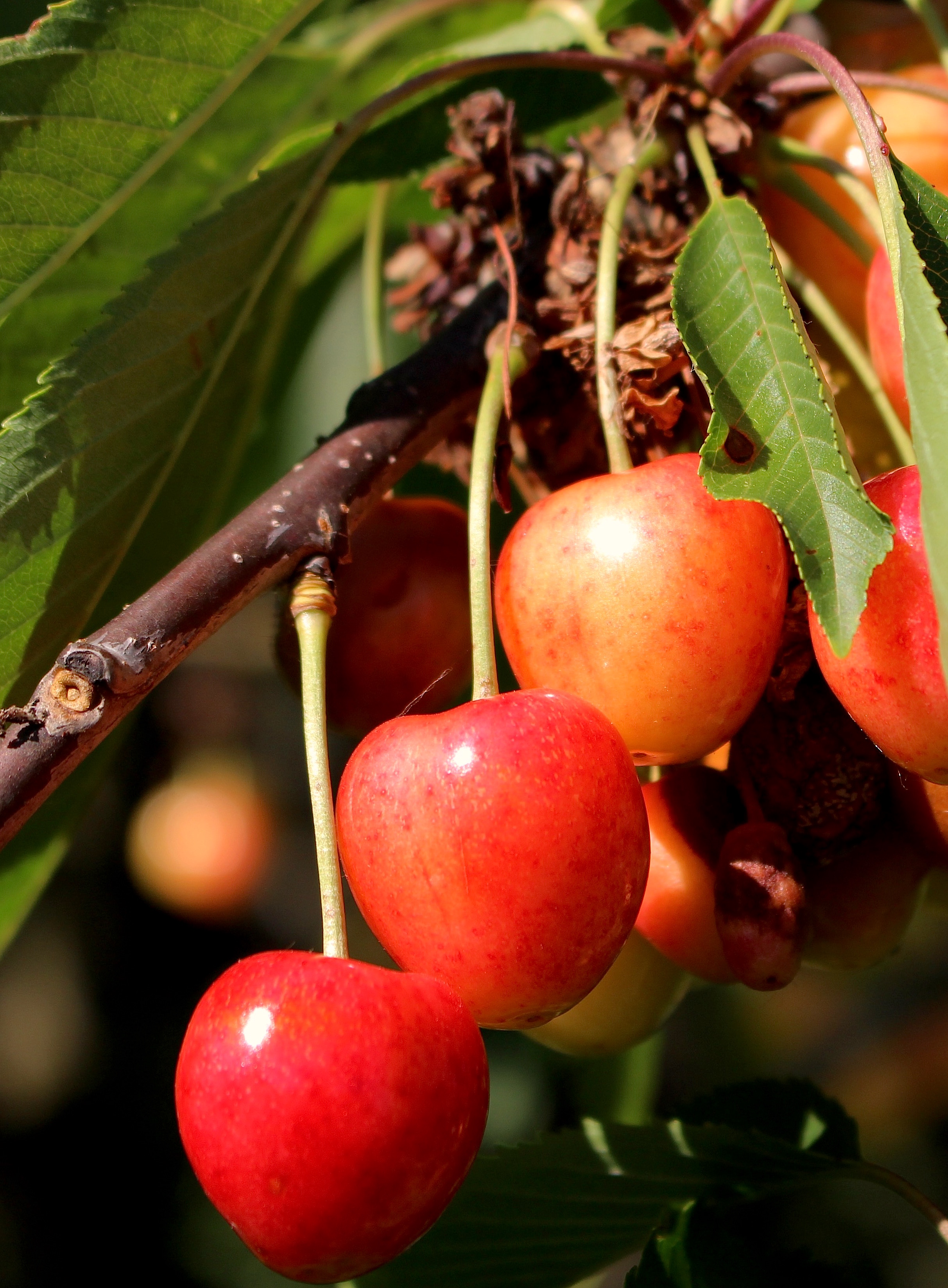
There is not one blade of grass, there is no color in this world that is not intended to make us rejoice. John Calvin
We are blinded to the Glory given to us in a narrow manger if we allow ourselves to perceive it as something routine and commonplace. There is nothing commonplace about the gifts of Creation or the gift of His Son as Savior.
I can’t remember the last time I celebrated even a blade of grass, given how focused I am in mowing it into conformity and submission. Or the fruit of the trees, the birds of the air, the fish of the seas, the beasts of burden who work for us. Too often I’m not up early enough to witness the pink sunrise or I’m too busy to take time to watch the sun paint the sky red as it sets.
I miss opportunities to rejoice innumerable times a day. It takes only a moment of recognition and appreciation to feel joy, and for that moment time stands still. Life stretches a little longer when I stop to acknowledge the intention of creation and sending the Son of God to earth as an endless reservoir of rejoicing.
If a blade of grass, if a palette of color, if all this is made for joy, then the coming of Jesus into the world means I was made for joy as well.
The poor, old stable of Christ’s old, poor country is only four rough walls, a dirty pavement, a roof of beams and slate. It is dark, reeking. The only clean thing in it is the manger where the owner piles the hay and fodder.
Fresh in the clear morning, waving in the wind, sunny, lush, sweet-scented, the spring meadow was mown. The green grass, the long, slim blades, were cut down by the scythe; and with the grass the beautiful flowers in full bloom – white, red, yellow, blue. They withered and dried and took on the one dull color of hay. Oxen dragged back to the barn the dead plunder of May and June. And now that grass has become dry hay and those flowers, still smelling sweet, are there in the manger to feed the slaves of man.
The animals take it slowly with their great black lips, and later the flowering fields, changed into moist dung, return to light on the litter which serves as bedding.
This is the real stable where Jesus was born. The filthiest place in the world was the first room of the only pure man ever born of woman. The Son of Man, who was to be devoured by wild beasts calling themselves men, had as his first cradle the manger where the animals chewed the cud of the miraculous flowers of spring. ~Giovanni Papini from “The Real Stable”
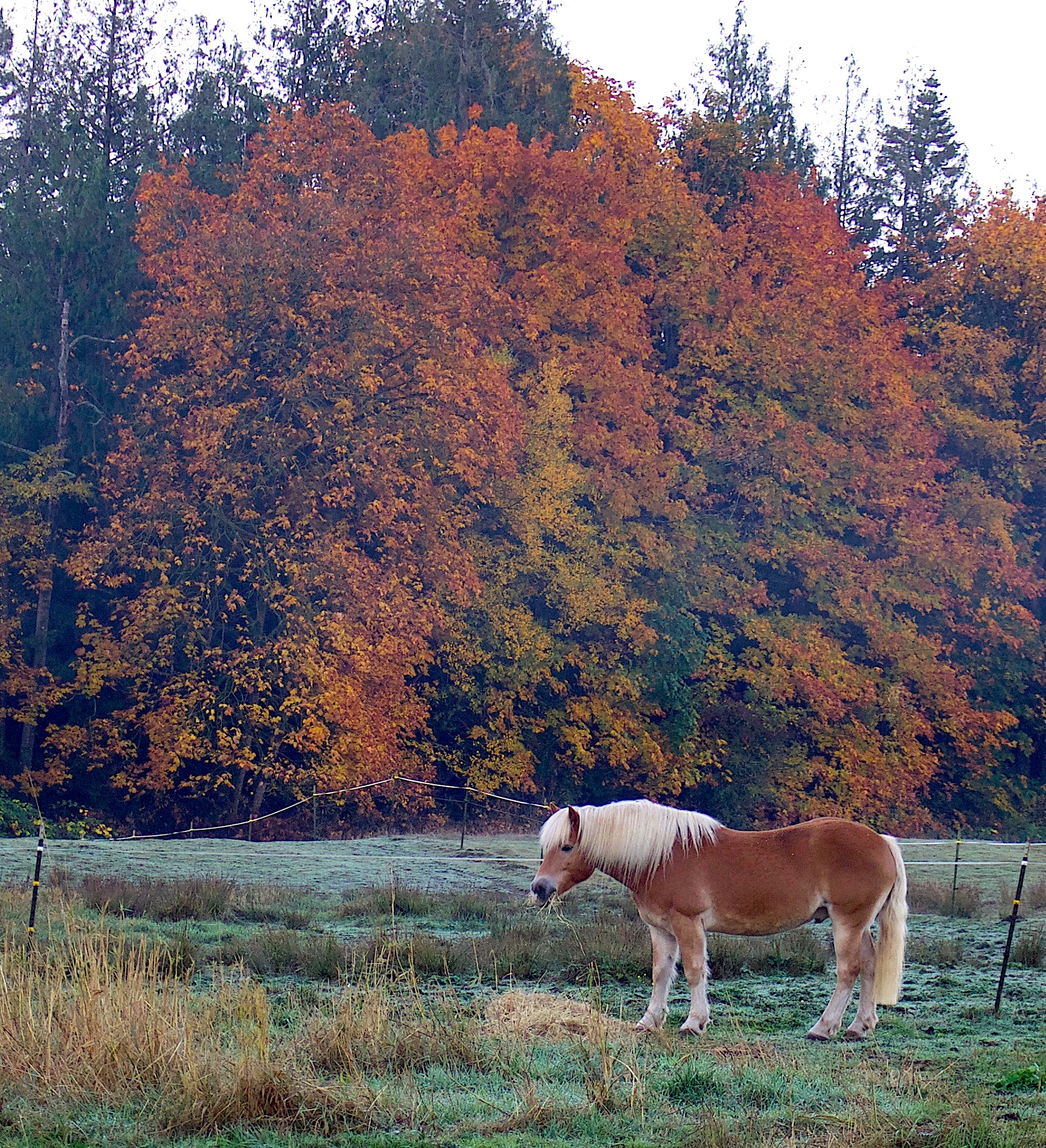
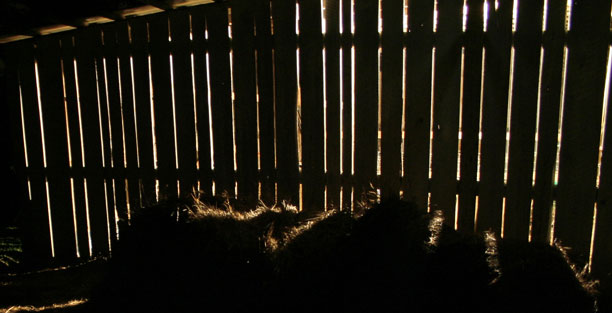
As is my routine on Saturdays, I spent the day in the barn, breaking ice and refilling water buckets, then going from stall to stall to clean out the manure and wet spots, and finally adding fresh bedding. Then I climbed high in the hay stack in the barn and rolled hay bales down to load into the wheel barrow to push into the stable for Sunday Sabbath, a day of rest. There are always chores to do every day, but they can be abbreviated on Sunday thanks to the work accomplished the previous day. This is the nature of farming– preparing and readying for what is to come.
Farmers, by nature, are a hopeful lot. We plan ahead, plot out our next year’s crop, choose our seed in advance and plant it with anticipation. We prune and we plow and we store up mountains of feed far in advance. We evaluate pedigrees and scrutinize genetics carefully. And we wait patiently. As I clean their stalls, I watch my mares’ bellies roll with the movement of their unborn foals and I picture the new life in my mind’s eye. There is a harvest of hope in those bellies.
Unlike many modern horse barns, our decades old stable is a particularly plain and humble place with dirt floors, and as the support beams have settled over the years the door hinges don’t hang balanced and true any longer, so the stall doors are sticky and sometimes hard to open in the winter weather. Despite the lack of fancy design though, I haven’t heard the horses complain–their meals taste as good, they are warm and dry in the cold windy weather and cool in the hot weather. Their needs are met there and amazingly, so are mine.
Christmas began in a stable–probably a dark cave that served the purpose of housing animals. It most assuredly was plain and humble, smelling of manure and urine, and animal fur. Yet it also would have smelled of the sweetness of stored forage, and there would have been the reassuring sounds of animals chewing and breathing deeply. It was truly the only place a group of scruffy shepherds could have felt welcomed without being tossed out as unsuitable visitors– they undoubtedly arrived at the threshold in bad need of a bath, smelly, dirty and terrified and yet left transformed, returning to their fields full of praise and wonder, telling all they met what they had seen. No bath could scrub so clean as the sight of what that stable contained.
There could not have been a more suitable place for this birth that was to change the world: the promise of cleansing hope and peace in the midst of our knee deep filth. Despite our sorry state, we are welcomed into the sanctuary of the stable, sown, grown, pruned and harvested to become seed and food for others.
If even the shepherds became a harvest of hope, the flowers of the future, then surely so can we.
Jesus our brother, kind and good Was humbly born in a stable rude And the friendly beasts around Him stood, Jesus our brother, kind and good.
Thus every beast by some good spell, In the stable dark was glad to tell Of the gift he gave Immanuel, The gift he gave Immanuel.
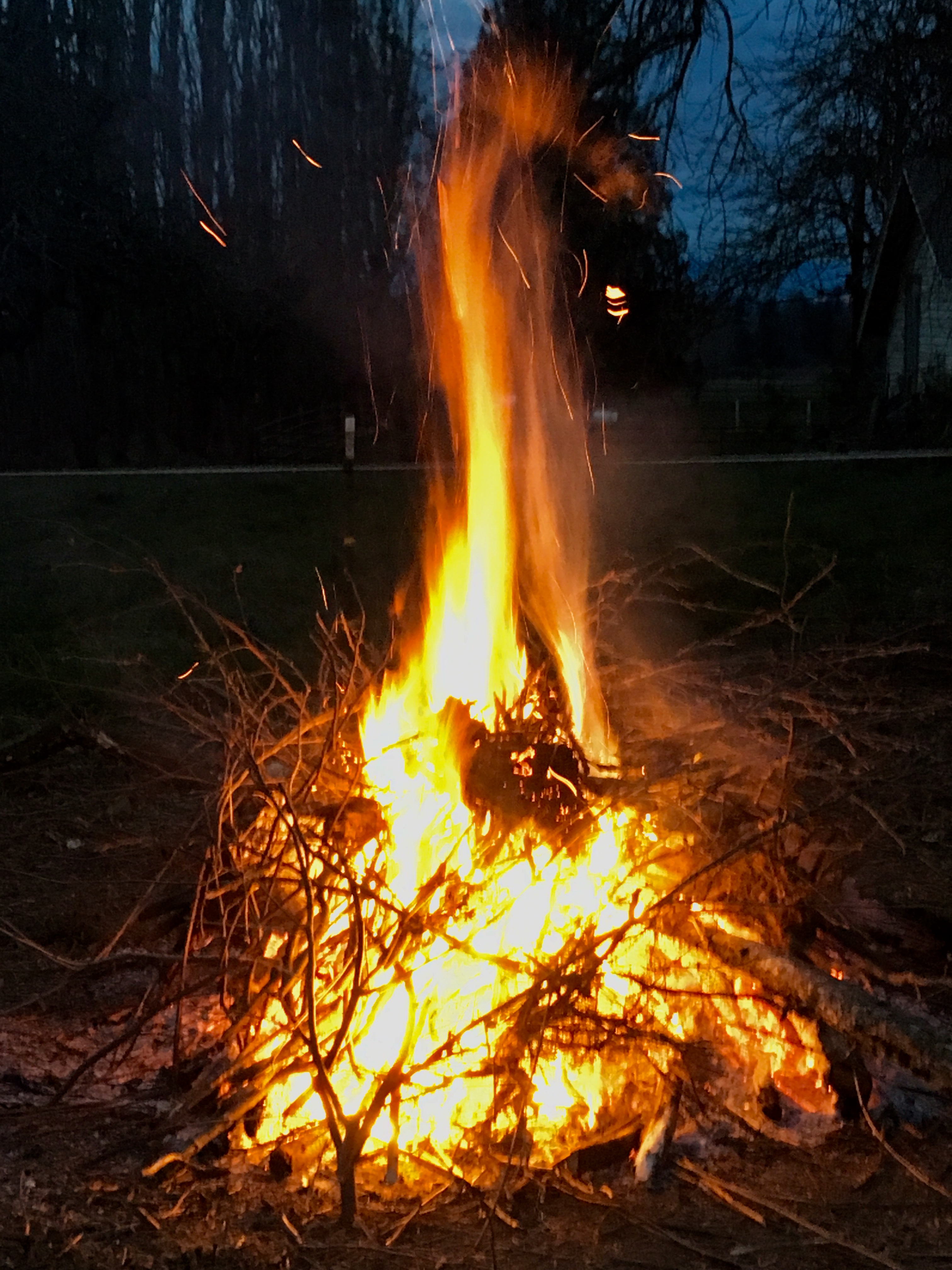
(Jesus said) I have come to bring fire on the earth, and how I wish it were already kindled!
Luke 12:49
Earth’s crammed with heaven,
and every common bush afire with God
~Elizabeth Barrett Browning from “Aurora Leigh”
It is difficult to undo our own damage…
It is hard to desecrate a grove and change your mind.
The very holy mountains are keeping mum.
We doused the burning bush and cannot rekindle it;
we are lighting matches in vain under every green tree. ~Annie Dillard from Teaching a Stone to Talk
I need to turn aside and look,
to see, as if for the first and last time,
the kindled fire that illuminates even the darkest day and never dies away.
We are invited, by no less than God Himself,
through the original burning bush that is never consumed
to shed our shoes, to walk barefoot and vulnerable,
and approach the bright and burning dawn,
even when it is the darkest midnight,
even when it is a babe in a manger who lights a fire in each one of us.
Only then, only then
can I say:
“Here I am! Consume me!”
Within our darkest night, you kindle the fire that never dies away, that never dies away. Within our darkest night, you kindle the fire that never dies away, that never dies away.
~Taize
God is not dead, nor does he sleep.
~Henry Wadsworth Longfellow
Unexpected God, your advent alarms us. Wake us from drowsy worship, from the sleep that neglects love, and the sedative of misdirected frenzy. Awaken us now to your coming, and bend our angers into your peace. Amen. ~Revised Common Lectionary First Sunday of Advent
Does anyone have the foggiest idea of what sort of power we so blithely invoke? Or, as I suspect, does no one believe a word of it? The churches are children playing on the floor with their chemistry sets, mixing up a batch of TNT to kill a Sunday morning. It is madness to wear ladies’ straw hats and velvet hats to church; we should all be wearing crash helmets. Ushers should issue life preservers and signal flares; they should lash us to our pews. ~Annie Dillard from Teaching a Stone to Talk
During Advent there are times when I am very guilty of blithely invoking the gentle bedtime story of that silent night, the infant napping away in a manger, the devoted parents hovering, the humble shepherds peering in the stable door. All is calm. All is bright.
I’m dozing if I think that is all there was to it.
The reality is God Himself never sleeps.
This is no gentle bedtime story: a teenage mother giving birth in a stable, laying her baby in a feed trough–I’m sure there were times when Mary could have used a life preserver. This is no gentle bedtime story: the heavenly host appearing to the shepherds, shouting and singing the glories and leaving them “sore afraid.” The shepherds needed crash helmets. This is no gentle bedtime story: Herod’s response to the news that a Messiah had been born–he swept overboard a legion of male children whose parents undoubtedly begged for mercy, clinging to their children about to be murdered. This is no gentle bedtime story: a family’s flight to Egypt, immigrants seeking asylum, fleeing that fate for their only Son. This is no gentle bedtime story: the life Jesus eventually led during his ministry: itinerant and homeless, tempted and fasting in the wilderness for forty days, owning nothing, rejected by his own people, betrayed by his disciples, sentenced to death by acclamation before Pilate, tortured, hung on a cross until he gave up his spirit.
Yet he understood the power that originally brought him to earth as a helpless infant to be sacrificed, to die and rise again, to return again as King of all nations. No signal flares needed.
When I hear skeptics scoff at Christianity as a “crutch for the weak”, they underestimate the courage it takes to walk into church each week as a desperate person who can never save oneself. We cling to the life preserver found in the Word, lashed to our seats and hanging on. It is only because of grace that we survive the tempests of temptation, guilt and self-doubt to let go of our own anger in order to confront the reality of the wrath of God who is not dead and never sleeps.
This bedtime story is not for the faint of heart — we are “sore afraid” and should “bend our anger” into His peace.
And not forget our crash helmets.
I heard the bells on Christmas day Their old familiar carols play And mild and sweet their songs repeat Of peace on earth good will to men
And the bells are ringing (peace on earth) Like a choir they’re singing (peace on earth) In my heart I hear them (peace on earth) Peace on earth, good will to men
And in despair I bowed my head There is no peace on earth I said For hate is strong and mocks the song Of peace on earth, good will to men
But the bells are ringing (peace on earth) Like a choir singing (peace on earth) Does anybody hear them? (peace on earth) Peace on earth, good will to men
Then rang the bells more loud and deep God is not dead, nor does he sleep (peace on earth, peace on earth) The wrong shall fail, the right prevail With peace…
~Henry Wadsworth Longfellow
O day of peace that dimly shines through all our hopes and prayers and dreams, guide us to justice, truth, and love, delivered from our selfish schemes. May the swords of hate fall from our hands, our hearts from envy find release, till by God’s grace our warring world shall see Christ’s promised reign of peace.
Then shall the wolf dwell with the lamb, nor shall the fierce devour the small; as beasts and cattle calmly graze, a little child shall lead them all. Then enemies shall learn to love, all creatures find their true accord; the hope of peace shall be fulfilled, for all the earth shall know the Lord. Words: Carl P. Daw, Jr.
What next, she wonders, with the angel disappearing, and her room suddenly gone dark.
The loneliness of her news possesses her. She ponders how to tell her mother.
Still, the secret at her heart burns like a sun rising. How to hold it in— that which cannot be contained.
She nestles into herself, half-convinced it was some kind of good dream, she its visionary.
But then, part dazzled, part prescient— she hugs her body, a pod with a seed that will split her. ~Luci Shaw “Mary Considers Her Situation”
Advent is blessed with God’s promises, which constitute the hidden happiness of this time. These promises kindle the light in our hearts.
Being shattered, being awakened – these are necessary for Advent.
In the bitterness of awakening,
in the helplessness of “coming to,”
in the wretchedness of realizing our limitations,
the golden threads that pass between heaven and earth reach us.
These threads give the world a taste of the abundance it can have. ~Alfred Delp
A seed contains all the life and loveliness of the flower, but it contains it in a little hard black pip of a thing which even the glorious sun will not enliven unless it is buried under the earth. There must be a period of gestation before anything can flower.
If only those who suffer would be patient with their earthly humiliations and realize that Advent is not only the time of growth but also of darkness and hiding and waiting, they would trust, and trust rightly, that Christ is growing in their sorrow, and in due season all the fret and strain and tension of it will give place to a splendor of peace.
~Caryll Houselander, from The Reed of God
Sometimes
for the light to replace
where darkness thrives,
there must be wounding
that tears us open,
cleaving us in half
so joy can enter into
where we hurt the most.
.
Christmas comes anew, O let us sing Noel!
Glory to God! Now let your praises swell!
Sing we Noel for Christ, the newborn King,
Christmas comes anew, O let us sing Noel!
2.
Angels did say, “O shepherds come and see,
Born in Bethlehem, a blessed Lamb for thee.”
Sing we Noel for Christ, the newborn King,
Christmas comes anew, O let us sing Noel!
3.
In the manger bed, the shepherds found the child;
Joseph was there, and the Mother Mary mild.
Sing we Noel for Christ, the newborn King,
Christmas comes anew, O let us sing Noel!
4.
Soon came the kings from following the star,
Bearing costly gifts from Eastern lands afar.
Sing we Noel for Christ, the newborn King,
Christmas comes anew, O let us sing Noel!
5.
Brought to Him gold and incense of great price;
Then the stable bare resembled Paradise.
Sing we Noel for Christ, the newborn King,
Christmas comes anew, O let us sing Noel!
1 Now the green blade riseth, from the buried grain,
Wheat that in dark earth many days has lain;
Love lives again, that with the dead has been:
Love is come again like wheat that springeth green.
2 In the grave they laid Him, Love who had been slain,
Thinking that He never would awake again,
Laid in the earth like grain that sleeps unseen:
Love is come again like wheat that springeth green.
3 Forth He came at Easter, like the risen grain,
Jesus who for three days in the grave had lain;
Quick from the dead the risen One is seen:
Love is come again like wheat that springeth green.
4 When our hearts are wintry, grieving, or in pain,
Jesus’ touch can call us back to life again,
Fields of our hearts that dead and bare have been:
Love is come again like wheat that springeth green.
There fared a mother driven forth Out of an inn to roam; In the place where she was homeless All men are at home.
A Child in a foul stable, Where the beasts feed and foam, Only where He was homeless Are you and I at home;
To an open house in the evening Home shall men come, To the end of the way of the wandering star, To the things that cannot be and that are, To the place where God was homeless And all men are at home. ~G.K. Chesterton from “The House of Christmas” (1915)
If I recall correctly, the first catalog with holiday theme items arrived in our mailbox in late July. The “BEST CHRISTMAS ISSUE EVER!” magazines hit the grocery store check-out racks in September. Then, with the chill in the air in October and Halloween just past, the stores put out the Santa decorations and red and white candy, instead of the orange and black candy of the previous 6 weeks. We have been inundated with commercial “Christmas” for months now and I don’t know about you, but I’m exhausted, beaten to a “best ever holiday” pulp.
All of this has little to do with the original gift given that first Christmas night, lying helpless and homeless in a barn feed trough. I know a fair amount about feed troughs, having daily encounters with them in our barn, and there is no fanfare there and no grandiosity. Just basic sustenance– every day needs fulfilled in the most simple and plain way. Our wooden troughs are so old, they have been filled with fodder thousands of times over the decades. The wood has been worn smooth and shiny from years of being sanded by cows’ rough tongues, and over the last two decades, our horses’ smoother tongues, as they lick up every last morsel, extracting every bit of flavor and nourishment from what has been offered there. No matter how tired, how hungry, there is comfort offered at those troughs – it is home for them. The horses know it, anticipate it, depend on it, thrive because of it.
The shepherds in the hills that night were starving and homeless too. They had so little, yet became the first invited to the feast at the trough. They must have been overwhelmed, having never known such plenty before. Overcome with the immensity of what was laid before them and the invitation to “home”, they certainly could not contain themselves, and told everyone they could about what they had seen.
His mother listened to the excitement of the visiting shepherds and that she “treasured up all these things and pondered them in her heart”.
Whenever I’m getting caught up in the frenetic overblown commercialism of modern Christmas, I go out to the barn and look at our rough hewn feed troughs and think about what courage it took to entrust an infant to such a bed. She knew in her heart, indeed she had been told, that her son was to feed the hungry souls of human kind and He became fodder Himself.
Now I too am at the trough, starving, sometimes stamping in impatience, often anxious and weary, at times homeless, hopeless and helpless. He was placed there for good reason: He offers us a home within his homelessness, a treasure to be shared plain and simple, and nurture without end.
Who needs Christmas cookies, fancy toys and the latest fads to fill the empty spot deep inside?
Instead, you are invited home to eat your fill – just look to the manger.
O magnum mysterium et admirabile sacramentum, ut animalia viderent Dominum natum, jacentem in præsepio.
I wait for the Lord, my soul waits, and in his word I put my hope. My soul waits for the Lord more than watchmen wait for the morning, more than watchmen wait for the morning. Psalm 130: 5-6 from a Song of Ascents
Waiting is essential to the spiritual life. But waiting as a disciple of Jesus is not an empty waiting. It is a waiting with a promise in our hearts that makes already present what we are waiting for. We wait during Advent for the birth of Jesus. We wait after Easter for the coming of the Spirit, and after the ascension of Jesus we wait for his coming again in glory. We are always waiting, but it is a waiting in the conviction that we have already seen God’s footsteps. — Henri Nouwen from Bread For The Journey: A Daybook of Wisdom and Faith
To wait is hard when we know the value of the gift that awaits us. We know exactly what is in the package since we have watched it being carefully chosen, wrapped and presented to us to open.
Not yet though, not quite yet. So we wait.
Even more so, we wait and hope for what we do not see but know is coming, like a groaning in the labor of childbirth.
The waiting is never easy; it is painful to be patient, staying alert to possibility and hope when we are exhausted, barely able to function. Others won’t understand why we wait, nor do they comprehend what we could possibly be waiting for when it remains unseen.
Yet we persevere together, with patience, watching and hoping, like Mary and Joseph, like Elizabeth and Zechariah, like the shepherds, like the Magi of the east, like Simeon and Anna in the temple.
This is the meaning of Advent:
we are a community groaning together in sweet anticipation and expectation of the gift of Morning to come.
For in this hope we were saved. But hope that is seen is no hope at all. Who hopes for what they already have? But if we hope for what we do not yet have, we wait for it patiently. Romans 8:24-25
We are waiting, we are trusting
We are longing for Your blessings,
Lord And our faith is firmly anchored On Your never-changing Word Spirit fall down, fill our souls now
Lord, we gather in Your name Your power All Your promises we claim Together bind us with grace The body of Christ All for Your presence we wait
We are waiting we are trusting We are longing, Lord descend Let a flame of love be kindled While before Your throne we bend Spirit fall down, fill our souls now
Lord, we gather in Your name Your power All Your promises we claim Together bind us with grace The body of Christ All for Your presence we wait
We are waiting, we are trusting We are longing, Lord revive Death is fading, hope is rising In Your Spirit we’re alive
Lord, we gather in Your name Your power All Your promises we claim Together bind us with grace The body of Christ All for Your presence we wait
Lord, we gather in Your name Your power All Your promises we claim Together bind us with grace The body of Christ
All for Your presence we wait All for Your presence we wait All for Your presence we wait ~All Sons & Daughters
Down he came from up, and in from out, and here from there. A long leap, an incandescent fall from magnificent to naked, frail, small, through space, between stars, into our chill night air, shrunk, in infant grace, to our damp, cramped earthy place among all the shivering sheep.
And now, after all, there he lies, fast asleep. ~Luci Shaw “Descent” from Accompanied By Angels
The Lord brings death and makes alive; he brings down to the grave and raises up. ~1 Samuel 2: 6 from the Song of Hannah
Hannah’s prayer describes the Lord in all His paradox of reversals:
the strong are broken
those who stumble strengthened,
the satisfied end up working for food
the hungry become filled,
the barren woman bears children
the mother of many pines away,
the poor and needy are lifted up to sit with princes.
He humbles and exalts–we have read the stories of how the Lord uses such reversals to instruct and inspire His people.
Yet nothing Hannah says is as radical and unprecedented as being brought down to the grave and then raised up, the Lord causing death and making alive. This makes no sense. Once in the grave, there is no escape. Death cannot be reversed like the weak becoming strong, the hungry filled, the barren fertile, the poor enriched.
Hannah sings that this will indeed happen, just as the other reversals happened. It would take centuries, but her prayer is fulfilled in the child born to Mary, who lives and dies and lives again in the greatest reversal of all.
There can be no greater mystery than a God who chooses to walk the earth as a man among the poor, the needy, the helpless, the sick, the blind, the lame, the wicked, the barren, the hungry, the weak.
There can be no greater reversal than God Himself dying–put away down into the grave– and then rising up, glorious, in the ultimate defeat of darkness and death.
Hannah already knew this as a barren woman made full through the blessing of the Lord, choosing to empty herself by giving her son back to God.
Mary knew this as a virgin overshadowed by the Holy Spirit, choosing to empty herself by bearing, raising and giving her Son back to the Father.
The angels knew this, welcoming the Son of God to a throne in a manger as He is born to bring light to the darkness, and peace to a torn and ruptured world.
We know this too. We are the weak, the hungry, the poor, the dying filled completely through the love and sacrifice of the Triune God, and so give ourselves up to Him.
In from out, from down to up. It can be done. And He has done it.
Have you heard the sound of the angel voices ringing out so sweetly, ringing out so clear? Have you seen the star shining out so brightly as a sign from God that Christ the Lord is here?
Have you heard the news that they bring from heaven to the humble shepherds who have waited long? Gloria in excelsis Deo! Gloria in excelsis Deo! Hear the angels sing their joyful song.
He is come in peace in the winter’s stillness, like a gentle snowfall in the gentle night. He is come in joy, like the sun at morning, filling all the world with radiance and with light.
He is come in love as the child of Mary. In a simple stable we have seen his birth. Gloria in excelsis Deo! Gloria in excelsis Deo! Hear the angels singing ‘Peace on earth’.
He will bring new light to a world in darkness, like a bright star shining in the skies above. He will bring new hope to the waiting nations, when he comes to reign in purity and love.
Let the earth rejoice at the Saviour’s coming. Let the heavens answer with a joyful morn: Gloria in excelsis Deo! Gloria in excelsis Deo! Hear the angels singing, ‘christ is born’ Hear the angels singing, ‘christ is born’
~John Rutter “Angels’ Carol”
“I am the Lord’s servant,” Mary answered. “May it be as you have said.” Luke 1: 38
…to bear in her womb Infinite weight and lightness; to carry in hidden, finite inwardness, nine months of Eternity; to contain in slender vase of being, the sum of power – in narrow flesh, the sum of light.
Then bring to birth, push out into air, a Man-child needing, like any other, milk and love –
but who was God. ~Denise Levertov, from “Annunciation”
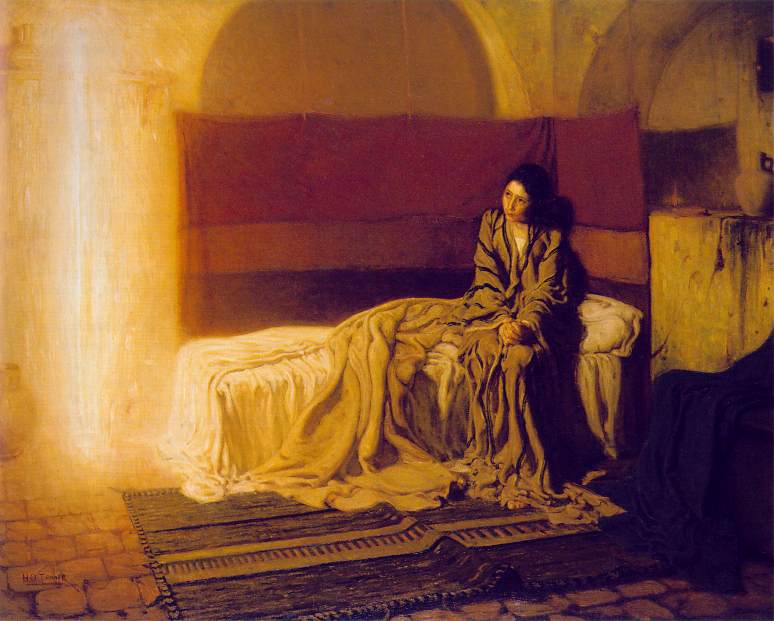
The Annunciation by Henry Tanner, Philadelphia Museum of Art
I want it to be the way I want it: my plans, my timing, my hopes and dreams first and foremost.
And then life happens and suddenly nothing looks the way it was supposed to be. I feel abandoned and completely emptied.
Yet only then, as an empty vessel, can I be filled. How am I to respond to such a paradox?
In my work in a University Health Center, I see this struggle in the lives of young adults: a tremendous lack of resiliency, an inability to ride the waves that crash and overwhelm. One of the most common responses to the unexpected is to panic, facing uncontrollable anxiety that interferes with eating, sleeping, working, studying. A common response to anxiety is to self-medicate in any way easily accessible: alcohol, marijuana, nicotine, sex, a friend’s prescription drugs. A little isn’t working so a lot might be better. The anxiety is compounded and descends into deepening depression.
The sadness and hopelessness, even anger –is a discouragement stemming from the lack of control of circumstances, feeling there is no way out, being unable to find another path to a different future. This leads too frequently to thoughts of ending one’s life as it seems too painful and pointless to continue, and more rarely, taking others’ lives at the same time in an attempt to make sure everyone else knows the depth of the pain.
There is an epidemic of hopelessness among our society’s young people that I’ve never before seen to this extent in my forty years of clinical work. To them, their debts seem too great, their reserves too limited, their foundations too shaky, their hope nonexistent, their future too dim. They cannot ride the waves without feeling they are drowning. So they look for any way out.
In the annunciation of the angel approaching a young woman out of the blue, Mary’s response to this overwhelming circumstance is a model for us all when we are hit by a wave we didn’t expect and had not prepared for.
She is prepared; she has studied and knows God’s Word and His promise to His people, even in the midst of trouble. She is able to articulate it beautifully in the song she sings as her response. She gives up her so-carefully-planned-out life to give life to God within her.
Her resilience sings through the ages and to each one of us in our troubles: may it be to me as you say.
May it be.
Your plans, Your purpose, Your promise.
Let it be.
Even if it may pierce my soul as with a sword so that I leak out to empty.
You are there to plug the bleeding hole and fill me.
So I sing through my fear, through my weariness, through my tears.
“Like Mary, we have no way of knowing… We can ask for courage, however, and trust that God has not led us into this new land only to abandon us there.” ~Kathleen Norrisfrom God With Us
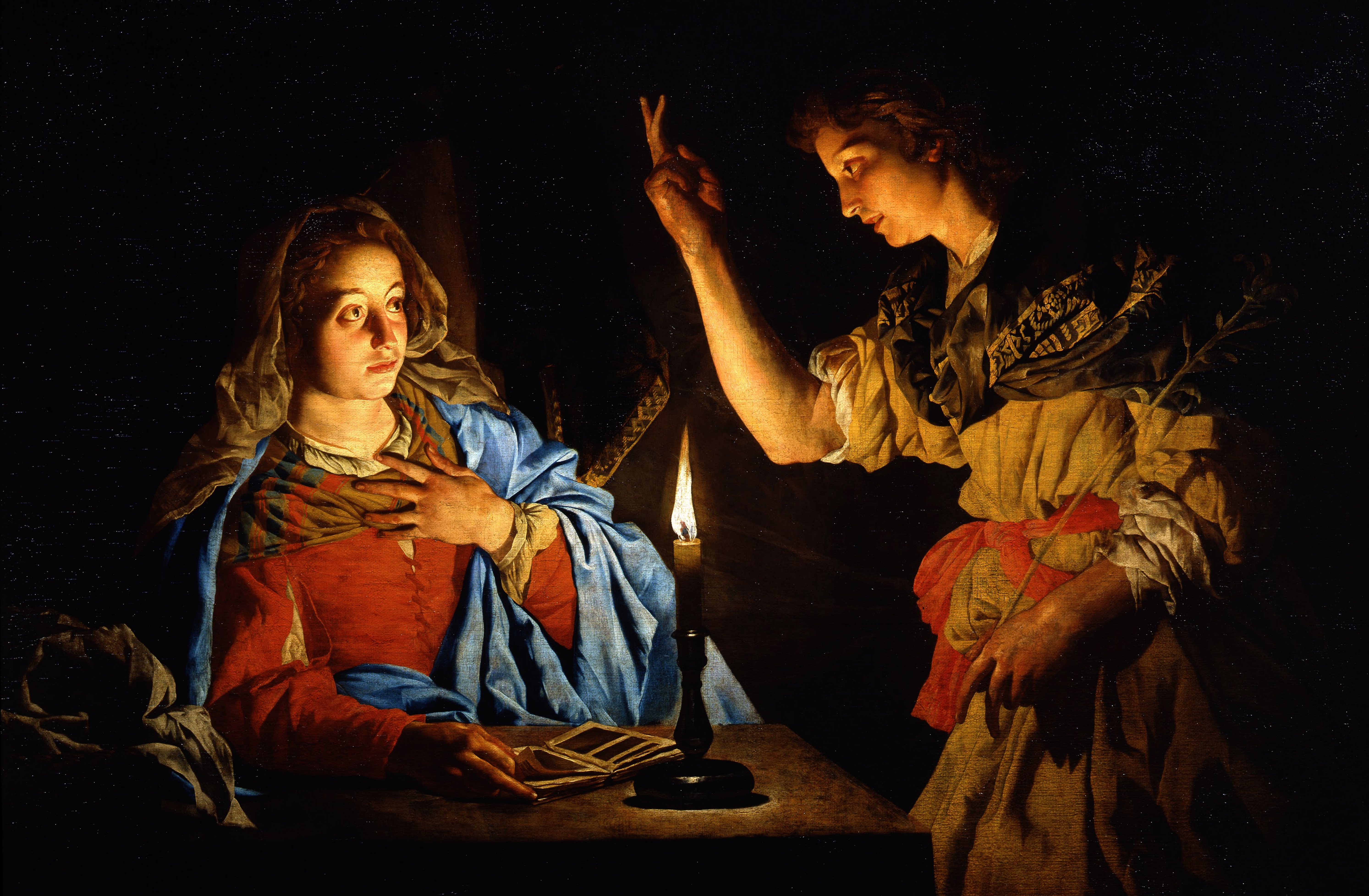
Matthias Stomer’s Annunciation
Everything inside me cries for order Everything inside me wants to hide Is this shadow an angel or a warrior? If God is pleased with me, why am I so terrified? Someone tell me I am only dreaming Somehow help me see with Heaven’s eyes And before my head agrees, My heart is on its knees Holy is He. Blessed am I.
Be born in me Be born in me Trembling heart, somehow I believe That You chose me I’ll hold you in the beginning You will hold me in the end Every moment in the middle, Make my heart your Bethlehem Be born in me
All this time we’ve waited for the promise All this time You’ve waited for my arms Did You wrap yourself inside the unexpected So we might know that Love would go that far?
Be born in me Be born in me Trembling heart, somehow I believe That You chose me I’ll hold you in the beginning You will hold me in the end Every moment in the middle, Make my heart your Bethlehem Be born in me
I am not brave I’ll never be The only thing my heart can offer is a vacancy I’m just a girl Nothing more But I am willing, I am Yours Be born in me Be born in me Trembling heart, somehow I believe That You chose me I’ll hold you in the beginning You will hold me in the end Every moment in the middle, Make my heart your Bethlehem Be born in me
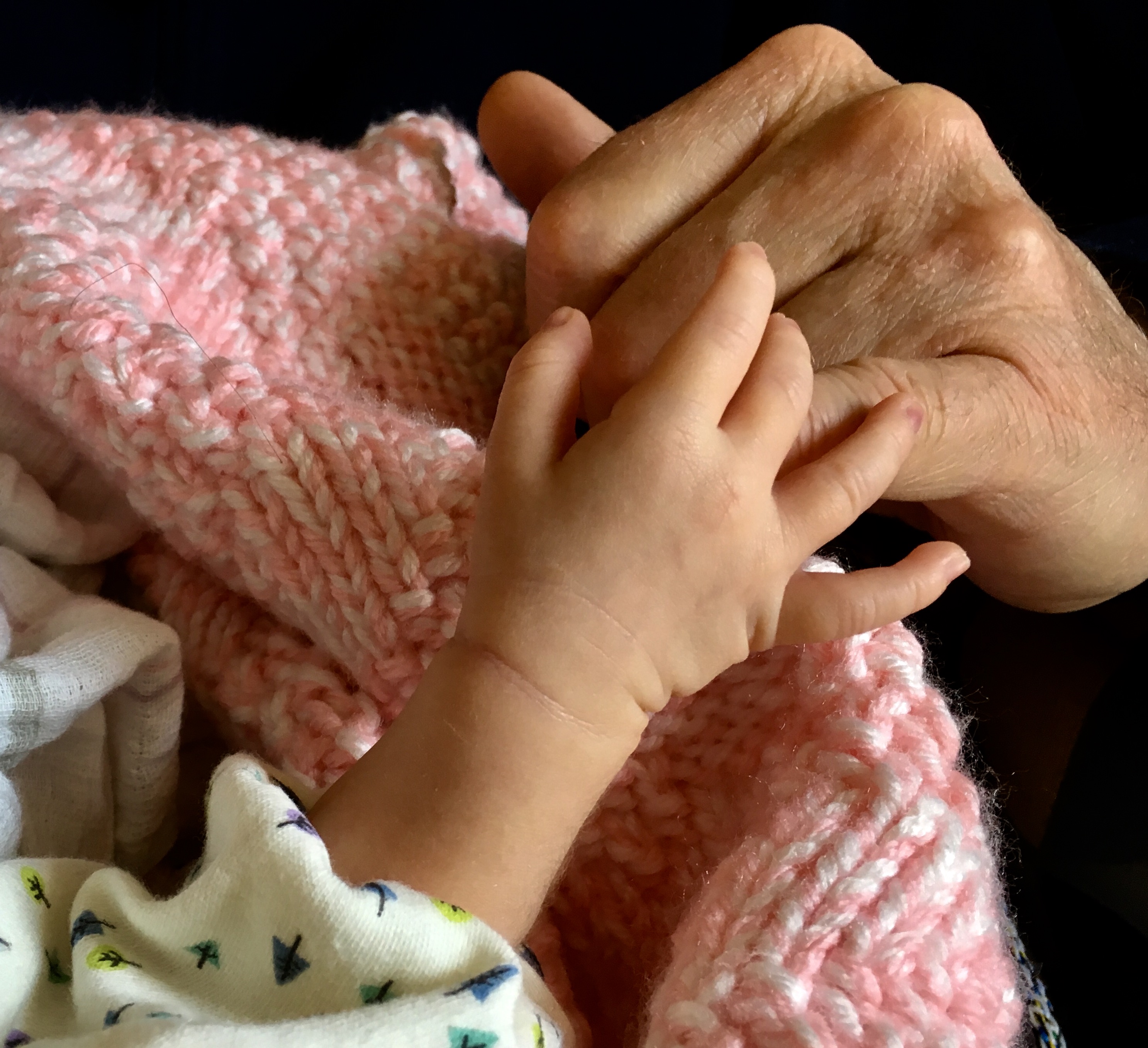
As the universe expands around us, our faith, in response, spirals inward.
The Hands that flung the stars and planets into their places now reach inside us to grip and hold our hearts.
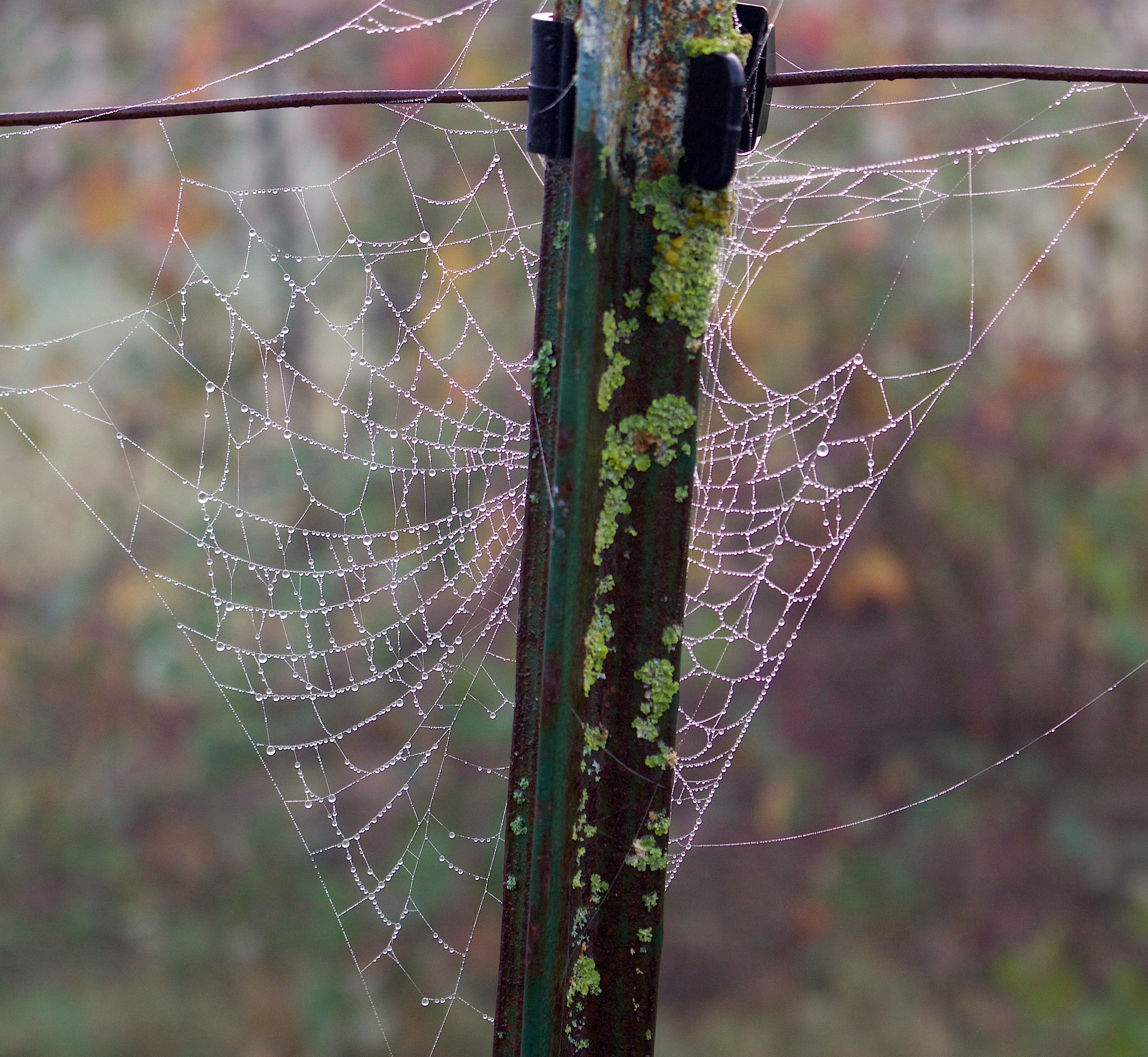
It’s the little things that feed our faith:
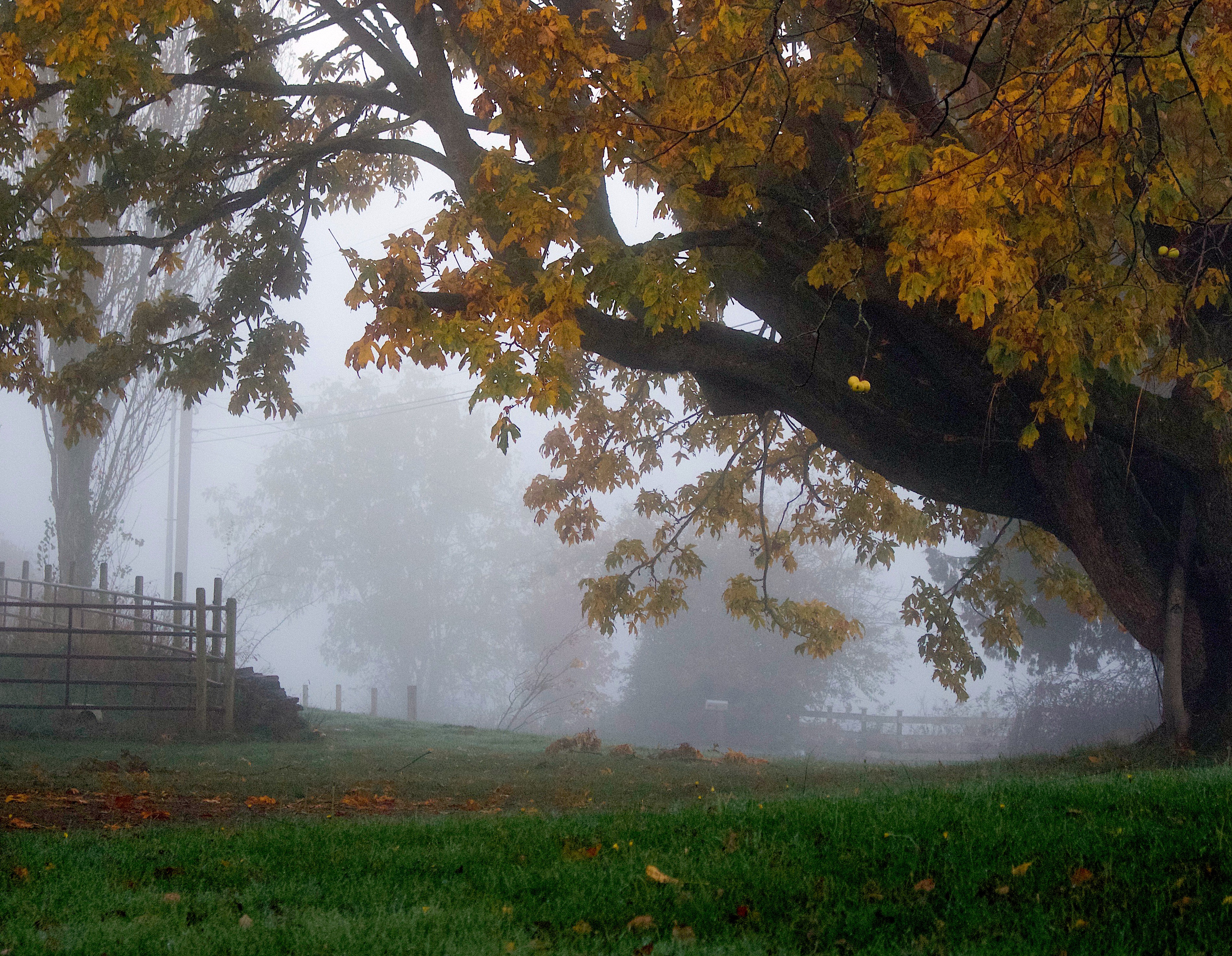
there are so many to remember during this month of waiting.































 Barnstorming