And that is just the point… how the world, moist and beautiful, calls to each of us to make a new and serious response.
That’s the big question, the one the world throws at you every morning. “Here you are, alive. Would you like to make a comment?” ~Mary Oliver
The last few days, it has been impossible to stay a silent observer of the world when one awakes, still alive on a morning moist and beautiful, while on the other side of the earth, innocents have been brutally butchered in their beds, whole families murdered, bodies desecrated and dragged into the street.
It demands a response.
I cannot remain speechless in the face of evil. Such violence, fed by generations of hatred, begets more hatred and violence, on and on. It festers, blusters, rips apart, tortures, buries. And so it goes, an ongoing human history of wars and more wars.
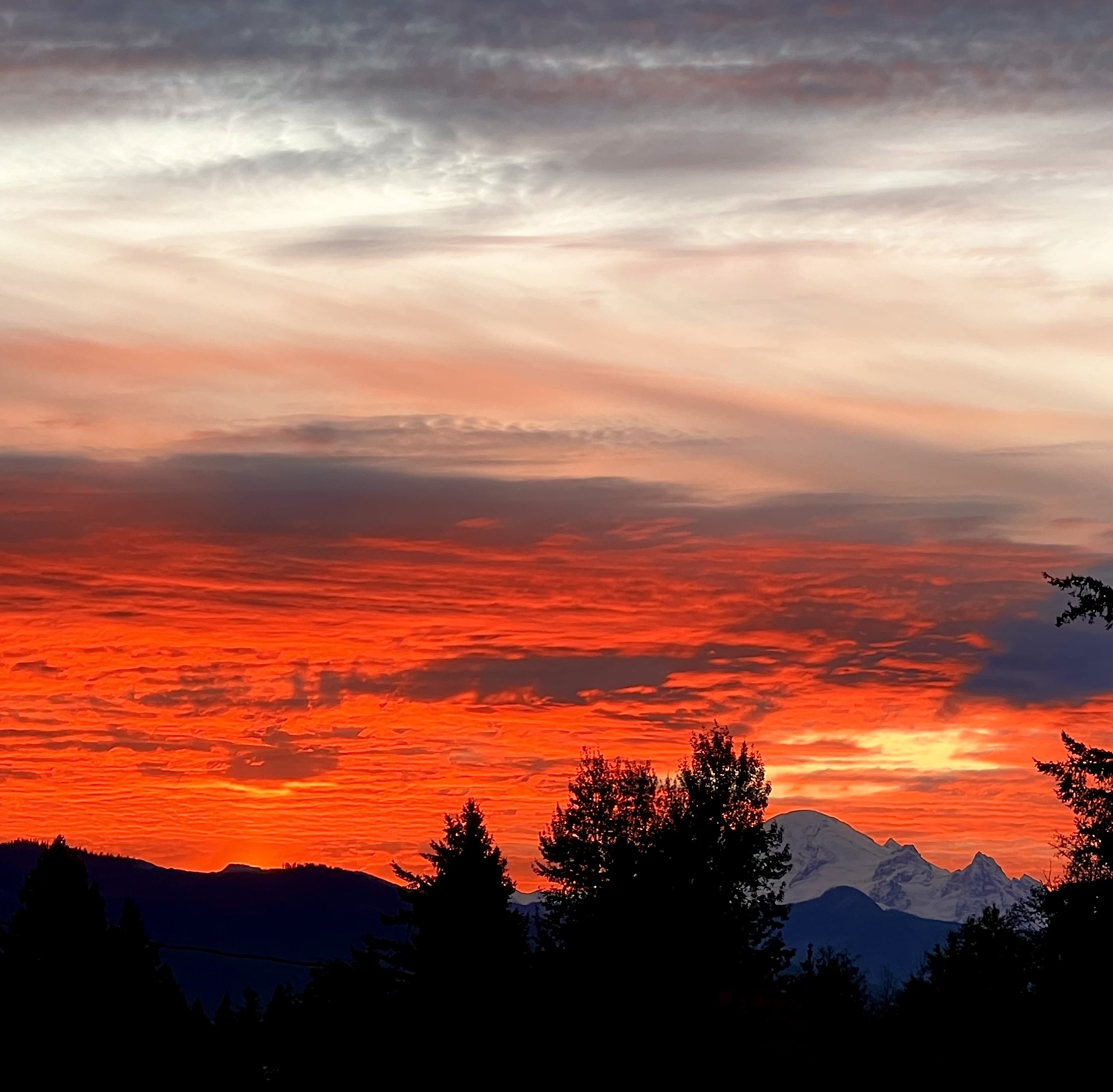
And here I am, alive on a brilliant autumn morning, while others immeasurably suffer.
Called to make a new and serious response. Called to comment, as I do every day. Knowing my voice is only one in a vast wilderness of voices, crying out in lament over the dead and dying.
He loved to ask his mother questions. It was the pleasantest thing for him to ask a question and then to hear what answer his mother would give. Bambi was never surprised that question after question should come into his mind continually and without effort.
Sometimes he felt very sure that his mother was not giving him a complete answer, was intentionally not telling him all she knew. For then there would remain in him such a lively curiosity, such suspicion, mysteriously and joyously flashing through him, such anticipation, that he would become anxious and happy at the same time, and grow silent. ~Felix Salten from Bambi
A Wounded Deer—leaps highest— I’ve heard the Hunter tell— ‘Tis but the Ecstasy of death— And then the Brake is still! ~Emily Dickinson “165″
As the house of a person in age sometimes grows cluttered with what is too loved or too heavy to part with, the heart may grow cluttered. And still the house will be emptied, and still the heart.
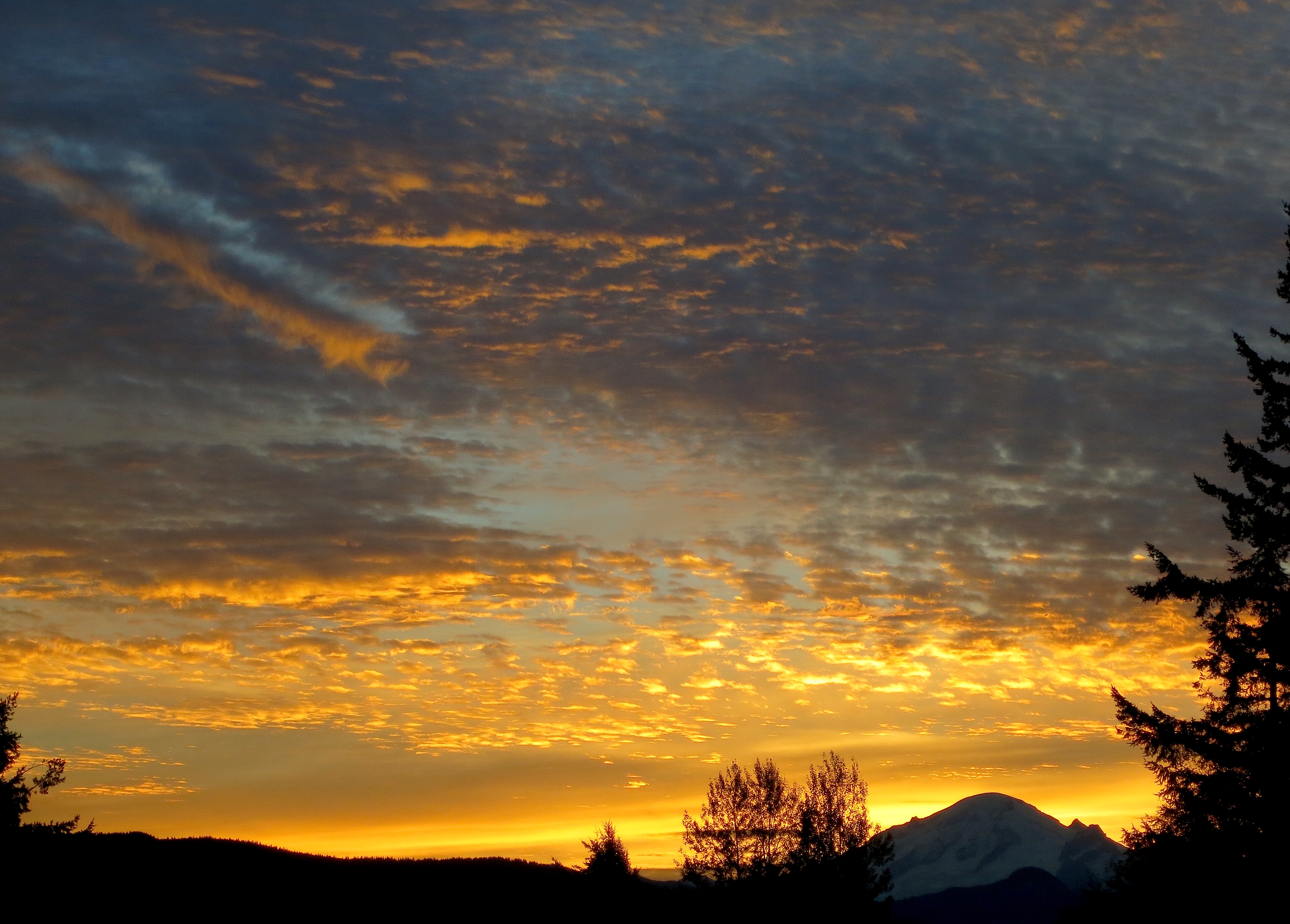
Empty and filled, like the curling half-light of morning, in which everything is still possible and so why not.
Filled and empty, like the curling half-light of evening, in which everything now is finished and so why not.
Beloved, what can be, what was, will be taken from us. I have disappointed. I am sorry. I knew no better.
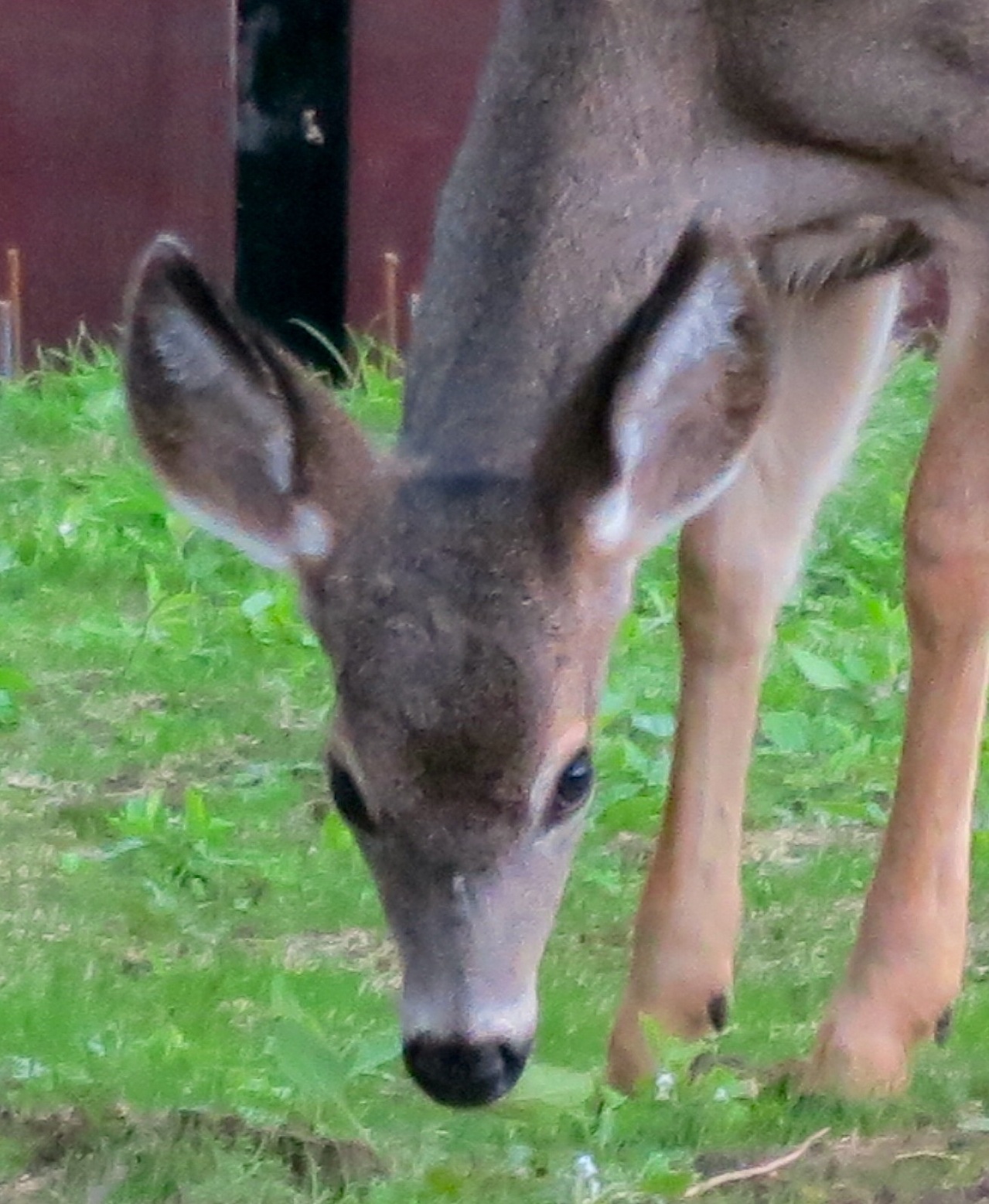
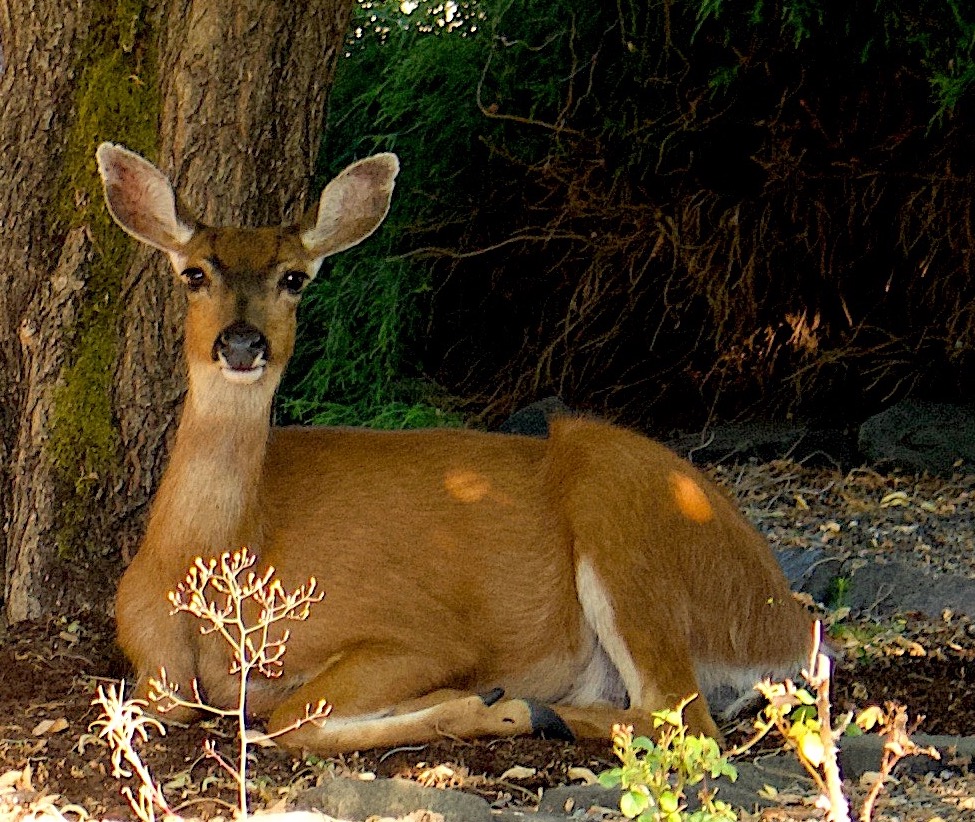
A root seeks water. Tenderness only breaks open the earth. This morning, out the window, the deer stood like a blessing, then vanished. ~Jane Hirschfield from “The Standing Deer”
My first time ever seated next to my mother in a movie theater, just a skinny four year old girl practically folded in half by a large padded chair whose seat won’t stay down, bursting with anticipation to see Disney’s Bambi.
Enthralled with so much color, motion, music, songs and fun characters, I am wholly lost in this new world of animated reality when suddenly Bambi’s mother looks up, alarmed, from eating a new clump of spring grass growing in the snow.
My heart leaps with worry. She tells him to run quickly for the thicket – find the safest place where she has always kept him warm next to her.
She follows behind, urges him to run faster, not to look back, don’t ever look back.
Then the gun shot hits my belly too.
My stomach twists as he cries out for his mother, pleading for her. I know in my heart she is lost forever, sacrificed to save him.
I sob as my mother reaches out to me, telling me not to look. I bury my face inside her hug, knowing Bambi is cold and alone with no mother any more.
My mama took me home before the end. I could not bear to watch the rest of the movie for years.
Those cries still echo in my ears any time someone hunts and shoots to kill the innocent.
Now, my own three children are grown, they have babies of their own, my mom is gone from this earth. I can even keep the seat from folding me in half in a movie theater.
I am nearing my eighth decade, and there are still places in this world where mothers and fathers sons and daughters grandmothers and grandfathers sisters and brothers and babies are hunted down despite the supposed safety of the thicket~ the sanctuary, the school, the grocery store, the home, places where we believe we are shielded from violence.
There can be no innocence when any of us may be hunted.
One-Time
Monthly
Yearly
Make a one-time or recurring donation to support daily Barnstorming posts
The soul’s sap quivers. There is no earth smell Or smell of living thing. This is the spring time But not in time’s covenant. Now the hedgerow Is blanched for an hour with transitory blossom Of snow, a bloom more sudden Than that of summer, neither budding nor fading, Not in the scheme of generation. Where is the summer, the unimaginable Zero summer?
We shall not cease from exploration And the end of all our exploring Will be to arrive where we started And know the place for the first time. Through the unknown, unremembered gate When the last of earth left to discover Is that which was the beginning;
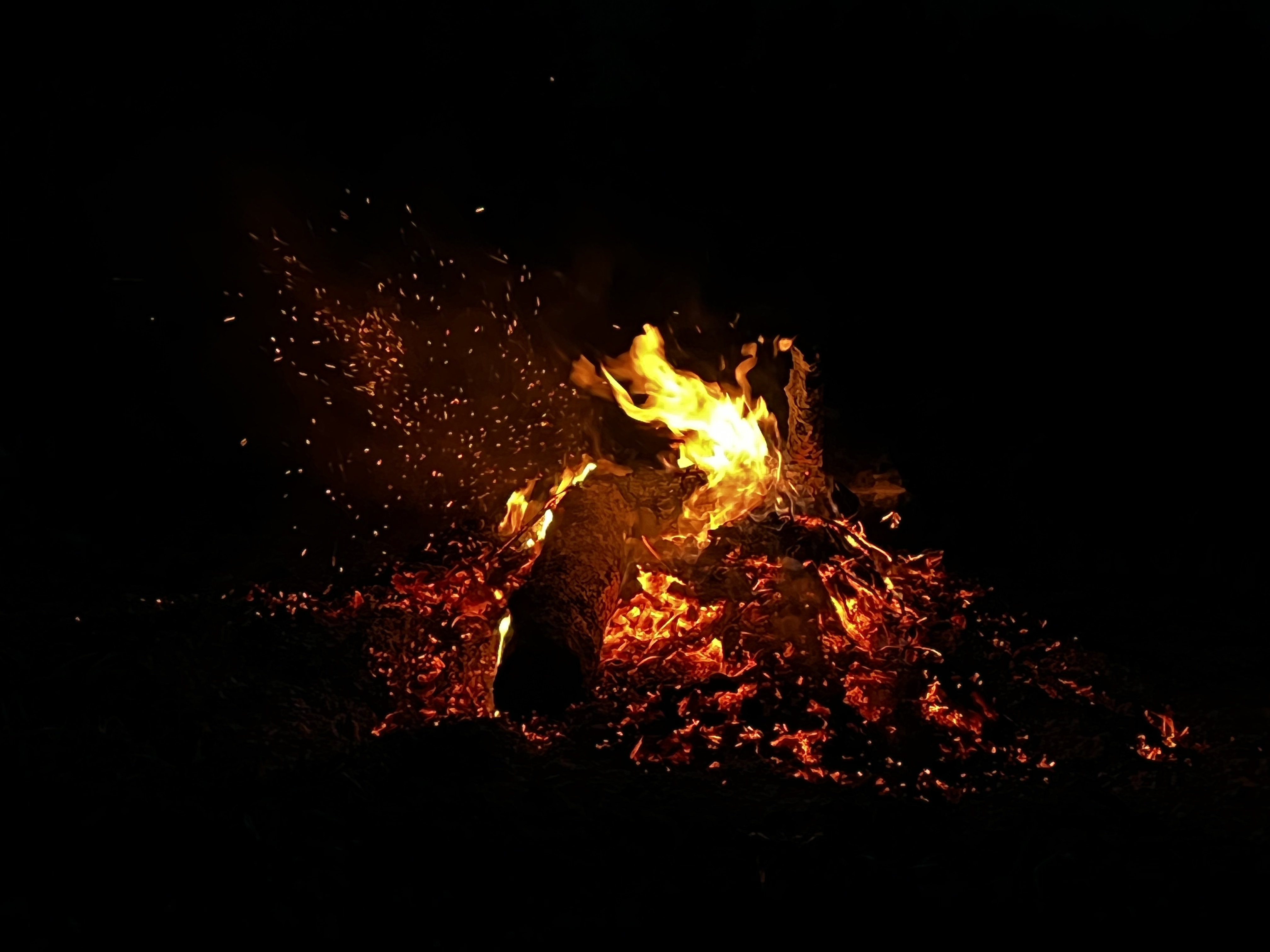
And all shall be well and All manner of thing shall be well When the tongues of flames are in-folded Into the crowned knot of fire And the fire and the rose are one. ~T.S. Eliot – from “Little Gidding”from the Four Quartets
To think that this meaningless thing was ever a rose, Scentless, colourless, this! Will it ever be thus (who knows?) Thus with our bliss, If we wait till the close?
Though we care not to wait for the end, there comes the end Sooner, later, at last, Which nothing can mar, nothing mend:
An end locked fast, Bent we cannot re-bend. ~Christina Rossetti “Summer is Ended”
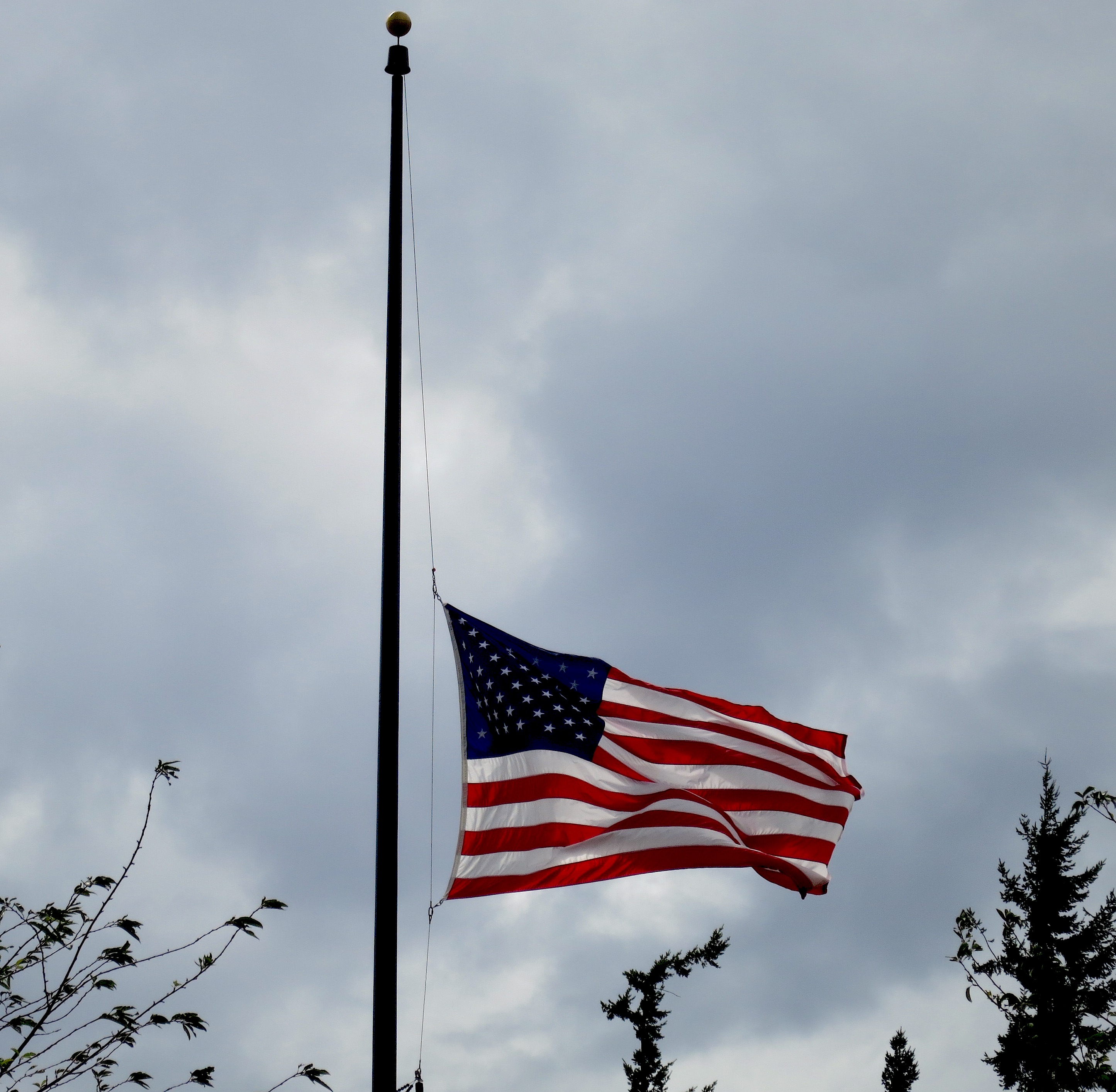
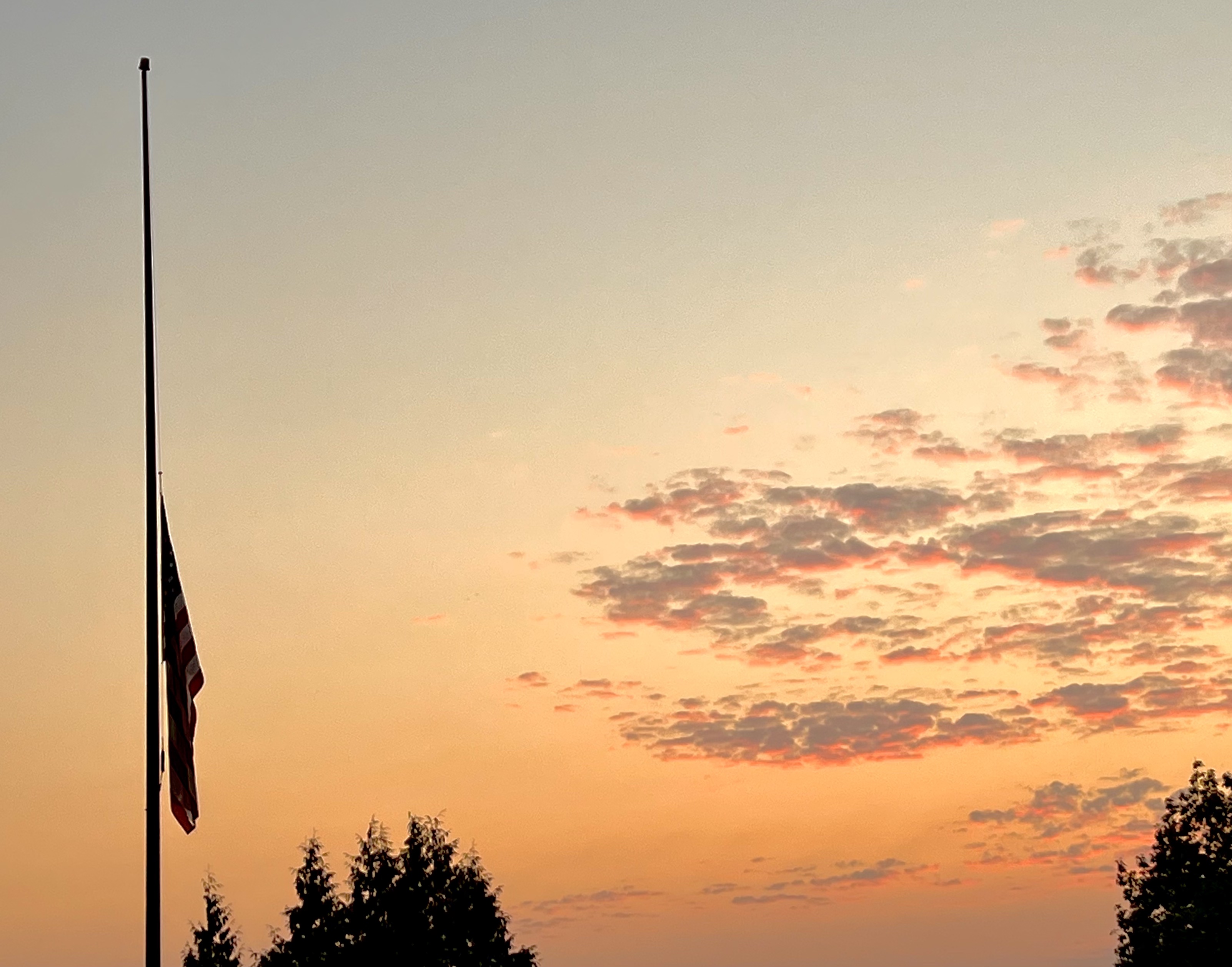
As a 3rd grader in November 1963, I learned the import of the U.S. flag being lowered to half mast in response to the shocking and violent death of our President. The lowering of the flag was so rare when I was growing up, it had dramatic effect on all who passed by —
our soul’s sap quivers
— something very sad had happened to our country, something or someone had tragically ended, warranting our silence, our stillness, and our grief.
For the twenty-two years since 9/11/01, our flag has spent significant time at half mast, most often due to our own home-grown mass shooting terrorism. When I see it flying low, I’m befuddled instead of contemplative, puzzling over what the latest loss might be as there are so many, sometimes all happening in the same time frame. We no longer are silenced by this gesture of honor and respect; we certainly are not stilled when personally and corporately instigating and suffering the same mistakes against humanity over and over again.
We are so bent. Will we ever be mended again?
Eliot wrote these prescient words of the Four Quartets in the midst of the WWII German bombing raids that destroyed so many people and neighborhoods. Perhaps he sensed the destruction he witnessed would not be the last time in history that evil visits the innocent, leaving them in ashes. There would be so many more losses to come, not least being the horror of 9/11/01.
There remains so much more sadness to be borne, such abundance of grief. Our world has become overwhelmed and stricken. Yet Eliot was right: we have yet to live in a Zero summer of endless hope and fruitfulness, of spiritual awakening and understanding. Where is it indeed? When will the summer Rose of beauty and fragrance rise again?
We must return, as people of faith to Eliot’s still point to which we are called on a remembrance day such as today. We must be stilled; we must be silenced. We must grieve the losses of this turning world and pray for release from the suffering we cause and we endure. Only in the asking, only in the kneeling down and pleading, are we surrounded by God’s unbounded grace.
Only then will His Rose bloom, once again recognizable.
“Zero Summer” imagines the unimaginable horror of Hiroshima and Nagasaki, and yet points to epiphanic awakening that transcend human imagination at the same time. T.S. Eliot, who coined this term in his “Four Quartets,” longed for that eternal summer, birthed out of the “still point,” where imagination is met with grace and truth. ~Makoto Fujimura
“There Are No Words” written on 9/11/2001 by Kitty Donohoe
there are no words there is no song is there a balm that can heal these wounds that will last a lifetime long and when the stars have burned to dust hand in hand we still will stand because we must
in one single hour in one single day we were changed forever something taken away and there is no fire that can melt this heavy stone that can bring back the voices and the spirits of our own
all the brothers, sisters and lovers all the friends that are gone all the chairs that will be empty in the lives that will go on can we ever forgive though we never will forget can we believe in the milk of human goodness yet
we were forged in freedom we were born in liberty we came here to stop the twisted arrows cast by tyranny and we won’t bow down we are strong of heart we are a chain together that won’t be pulled apart
One-Time
Monthly
Yearly
Make a one-time or recurring donation to support daily Barnstorming posts
I saw a deer skeleton gracing the roadside and didn’t stop to wonder where the flesh had gone, why just a tuft of fur clung, a bit of tail. Didn’t pause to ponder its change from leaping-warmth to cold, clean bones. Didn’t stop but glimpsed crisp, dark lines against snow, rib cage, long legs, perfect spine— what we with mounded dirt, neat lawn, and flowered stones seek so hard to hide— I drove quickly by. ~Laura Foley, “Intuition” from It’s This
I drive a night-darkened country road, white lines sweeping past, aware of advancing frost in the evening haze, anxious to return home to fireplace light.
Nearing a familiar corner, a stop sign looms, to the right, a rural cemetery sits silently expectant.
Open iron gates and tenebrous headstones, in the middle path, incongruous, a car’s headlights beam bright. I slow, thinking: lovers or vandals might seek inky cover of night.
Instead, these lights illuminate a lone figure, kneeling graveside, one hand resting heavily on a stone, head bowed in prayer.
A stark moment of solitary sorrow, invisible grieving of the heart focused in twin beams, impossible to hide.
A benediction of mourning; light piercing the heart’s blackness, as gentle fingertips trace the engraved letters of a beloved name.
As an uneasy witness, I withdraw as if touched myself and drive on into the night, struggling to see through the thickening mist of my eyes and the road.
One-Time
Monthly
Yearly
Make a one-time or recurring donation to support daily Barnstorming posts
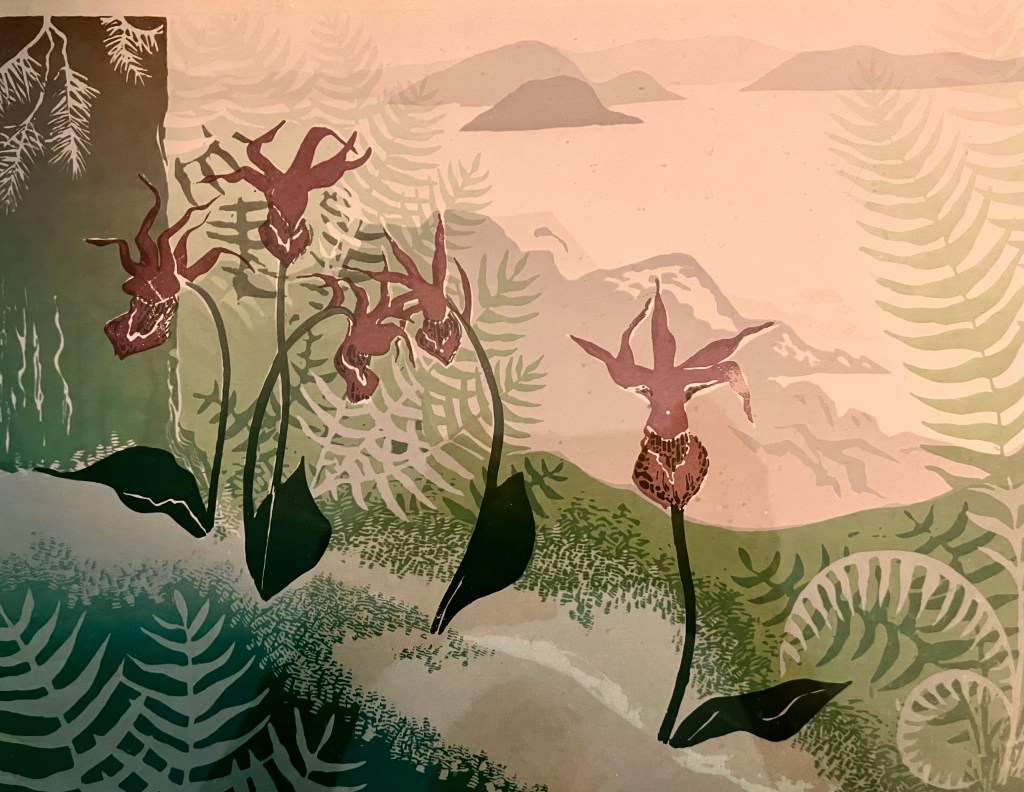
Though I know well enough To hunt the Lady’s Slipper now Is playing blindman’s-buff, For it was June She put it on And grey with mist the spider’s lace Swings in the autumn wind, Yet through this hill-wood, high and low, I peer in every place; Seeking for what I cannot find I do as I have often done And shall do while I stay beneath the sun. ~Andrew Young “Lady’s Slipper Orchid”
How strange to find you where I did along a path beside a road, your legs in graceful green dancing to music made by wind and woods.
Like ladies from a bygone age, you left your slippers there to air in dappled shade, while you, barefoot, relaxed your stays, let loose your hair.
The treasures of this world might be as simple as an orchid’s bloom; how sad that so much time is spent in filling coffers for the tomb.
If only life could be so fresh and free as you in serenade, we might learn we value most those things found lost in woodland shade. ~Mike Orlock “Lady Slipper Serenade (in 4/4 time)”
My grandmother’s house where my father was born had been torn down. She sold her property on Fidalgo Island near Anacortes, Washington to a lumber company – this was the house where all four of her babies were born, where she and my grandfather loved and fought and separated and finally loved again, and where we spent chaotic and memorable Thanksgiving and Christmas meals. After Grandpa died, Grandma took on boarders, trying to afford to remain there on the homesteaded wooded acreage on Similk Bay, fronted by meadows where her Scottish Highland cattle grazed. Her own health was suffering and she reached a point when it was no longer possible to make it work. A deal was struck with the lumber company and she moved to a small apartment for the few years left to her, remaining bruised by leaving her farm.
My father realized what her selling to a lumber company meant and it was a crushing thought. The old growth woods would soon be stumps on the rocky hill above the bay, opening a view to Mt. Baker to the east, to the San Juan Islands to the north, and presenting an opportunity for development into a subdivision. He woke my brother and me early one Saturday in May and told us we were driving the 120 miles to Anacortes. He was on a mission.
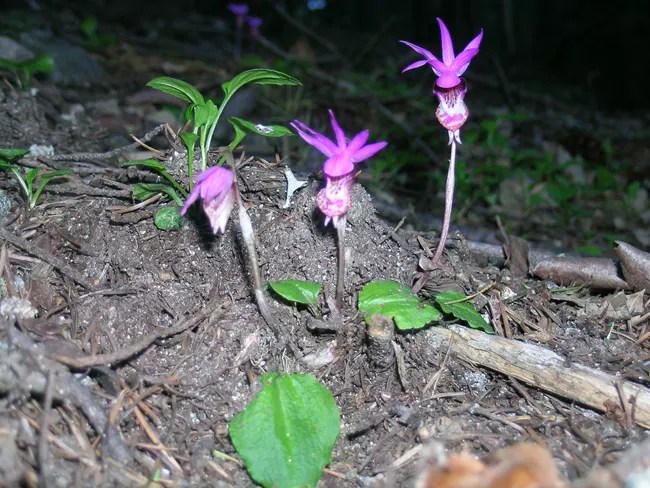
As a boy growing up on that land, he had wandered the woods, explored the hill, and helped his dad farm the rocky soil. There was only one thing he felt he needed from that farm and he had decided to take us with him, to trespass where he had been born and raised to bring home a most prized treasure–his beloved lady slippers (Calypso bulbosa) from the woods.
These dainty flowers enjoy a spring display known for its brevity–a week or two at the most–and they tend to bloom in small little clusters in the leafy duff mulch of the deep woods, preferring only a little indirect sunlight part of the day. They are not easy to find unless you know where to look.
My father remembered exactly where to look.
We hauled buckets up the hill along with spades, looking as if we were about to dig for clams at the ocean. Dad led us up a trail into the thickening foliage, until we had to bushwhack our way into the taller trees where the ground was less brush and more hospitable ground cover. He would stop occasionally to get his bearings as things were overgrown. We reached a small clearing and he knew we were near. He went straight to a copse of fir trees standing guard over a garden of lady slippers.
There were almost thirty of them blooming, scattered about in an area the size of my small bedroom. Each orchid-like pink and lavender blossom had a straight backed stem that held it with sturdy confidence. To me, they looked like they could be little shoes for fairies who may have hung them up while they danced about barefoot. To my father, they represented the last redeeming vestiges of his often traumatic childhood, and were about to be trammeled by bulldozers. We set to work gently digging them out of their soft bedding, carefully keeping their bulb-like corms from losing a protective covering of soil and leafy mulch. Carrying them in the buckets back to the car, we felt some vindication that even if the trees were to be lost to the saws, these precious flowers would survive.
When we got home, Dad set to work creating a spot where he felt they could thrive in our own woods. He found a place with the ideal amount of shade and light, with the protection of towering trees and the right depth of undisturbed leaf mulch. We carefully placed the lady slippers in their new home, scattered in a pattern similar to how we found them. Then Dad built a four foot split rail fence in an octagon around them, as a protection from our cattle and a horse who wandered the woods, and as a way to demarcate that something special was contained inside.
The next spring, only six lady slippers bloomed from the original thirty. Dad was disappointed but hoped another year might bring a resurgence as the flowers established themselves in their new home. The following year there were only three. A decade later, my father left our farm and family, not looking back.
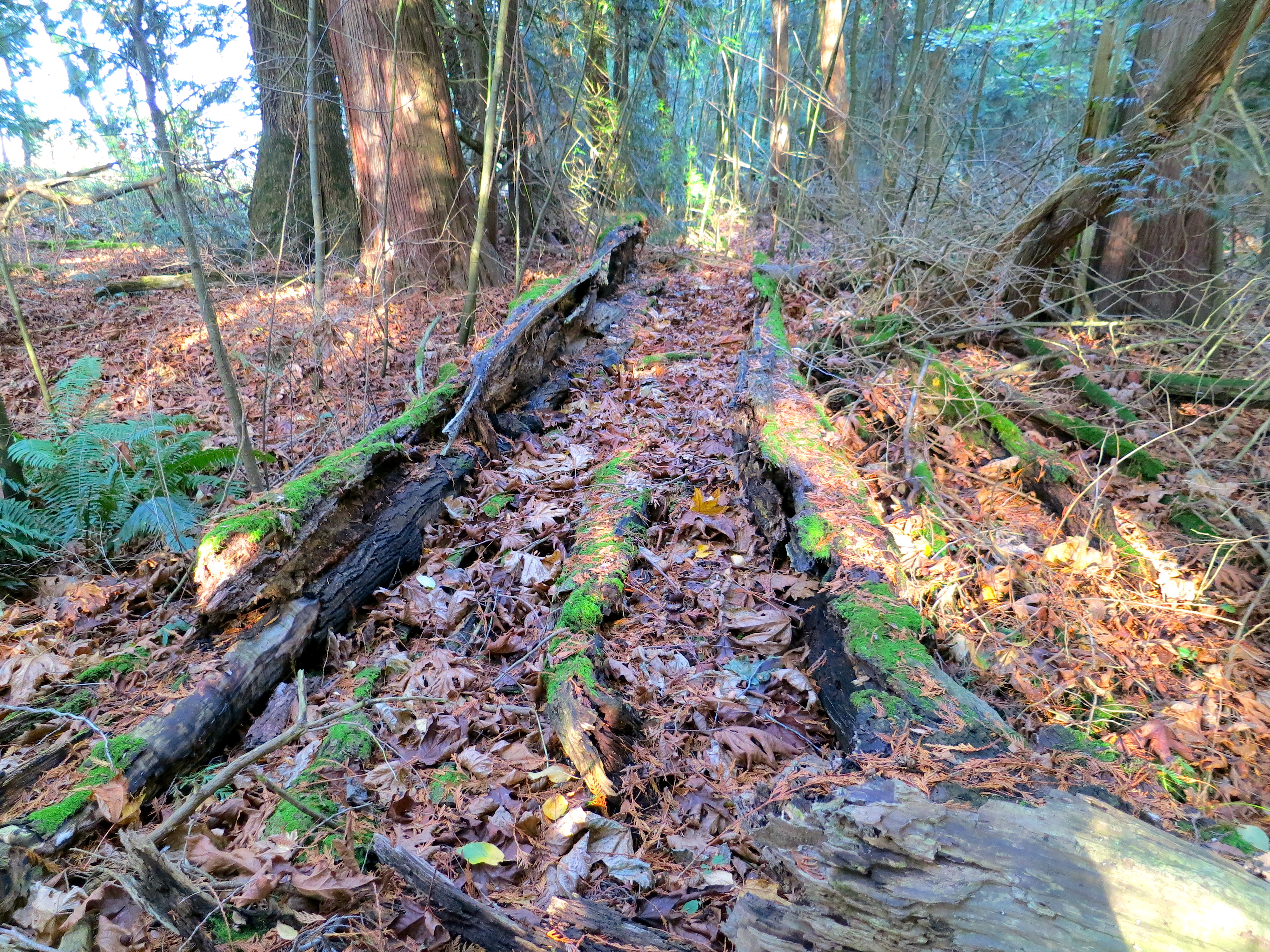
Sometime after the divorce, when my mother had to sell the farm, I visited our lady slipper sanctuary in the woods for the last time in the middle of May, seeking what I hoped might still be there, but I knew was no longer. The split rail fence still stood, guarding nothing but old memories. No lady slippers bloomed. There was not a trace they had ever been there. They had given up and disappeared.
The new owners of the farm surely puzzled over the significance of the small fenced-in area in the middle of our woods. They probably thought it surrounded a graveyard of some sort.
And they would be right – it did.
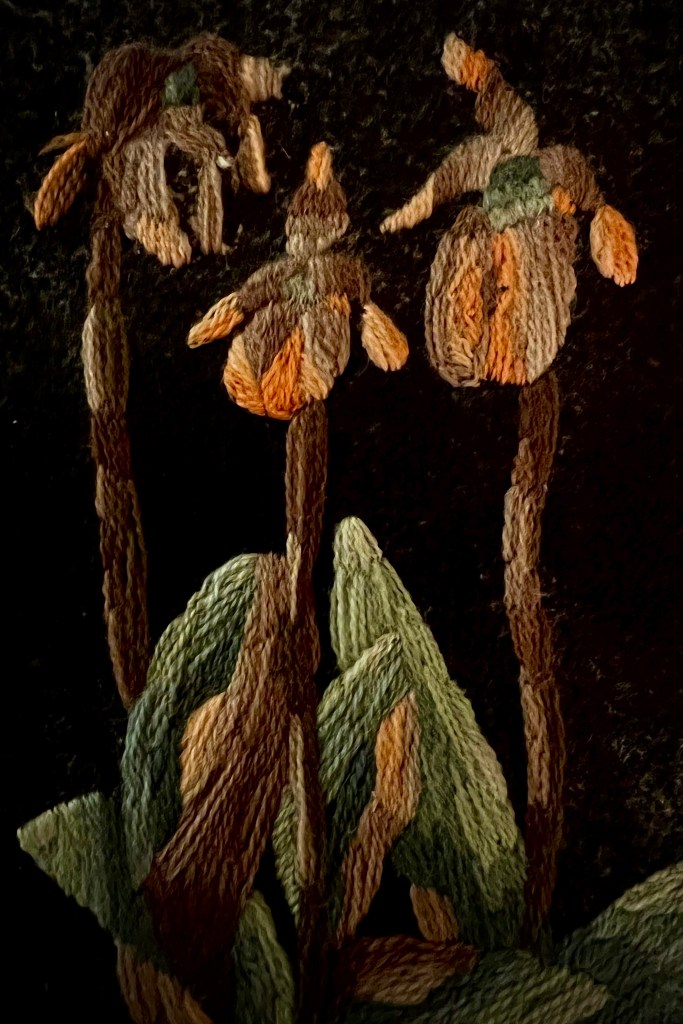
An embroidery I made for my father after he replanted the lady slippers — on the back I wrote “The miracle of creation recurs each spring in the delicate beauty of the lady slipper – may we ourselves be recreated as well…”
One-Time
Monthly
Yearly
Make a one-time or recurring donation to support daily Barnstorming posts
No, I will never know what you saw or what you felt, thrust into the maw of Eternity,
watching the mortars nightly greedily making their rounds, hearing the soft damp hiss
of men’s souls like helium escaping their collapsing torn bodies, or lying alone, feeling the great roar
of your own heart. But I know: there is a bitter knowledge
of death I have not achieved. Thus in thankful ignorance, and especially for my son
and for all who benefit so easily at so unthinkable a price, I thank you. ~Michael Burch “Privilege”
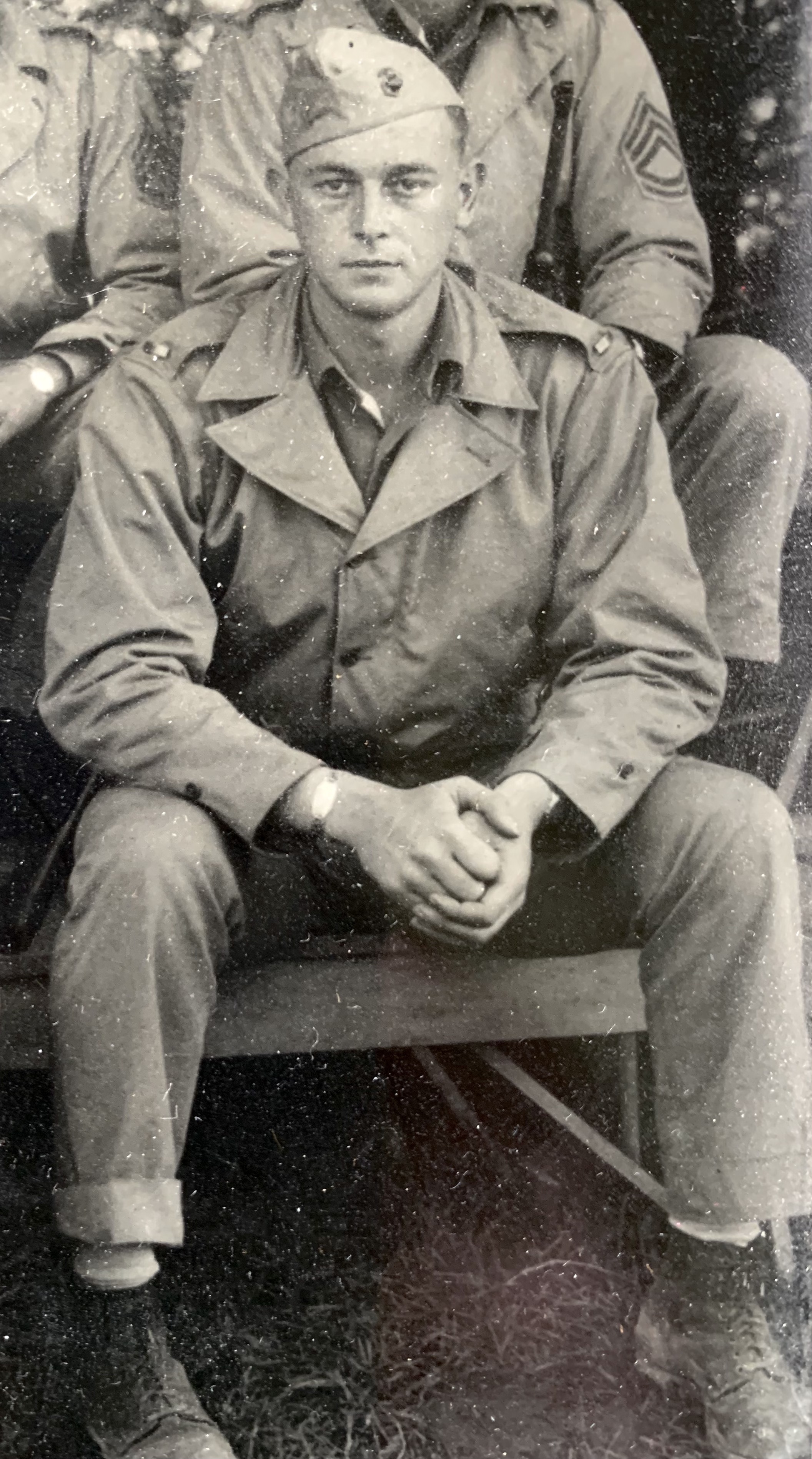
(for my father on Memorial Day)
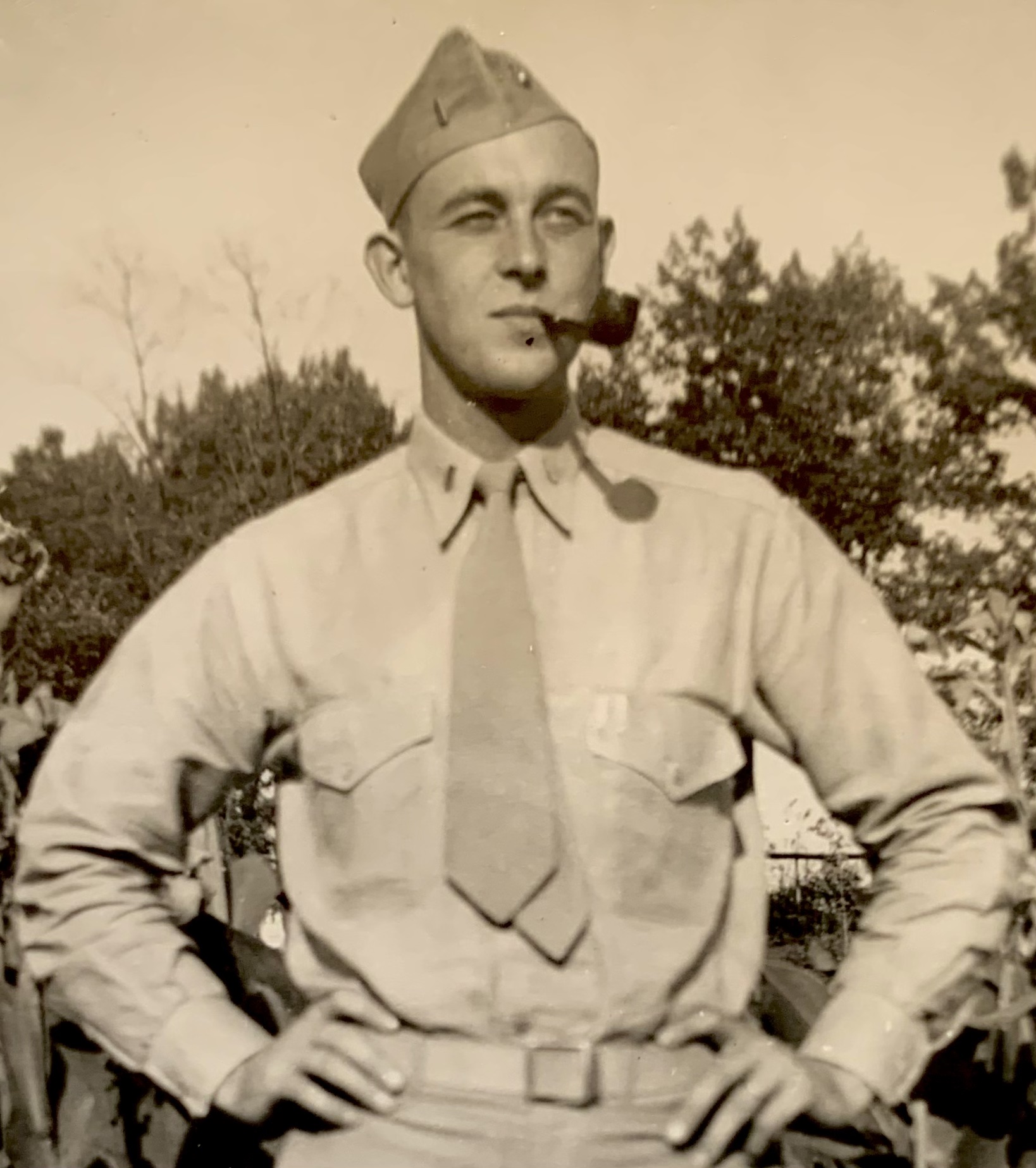
It was only a part of what we knew about you- serving three long years in the South Pacific, spoken of obliquely only if asked about, but never really answered.
We knew you were a Marine battalion leader, knew you spent too many nights without sleep, unsure if you’d see the dawn only to dread what the next day would bring.
We knew you lost friends and your innocence; found unaccustomed strength inside a mama’s boy who once cried too easily and later almost never.
Somehow life had prepared you for this: pulling your daddy out of bars when you were ten watching him beat your mama until finally getting big enough to stand in the way.
Then Tarawa, Saipan, Tinian beaches bitterly bloodsoaked battles won, to be restored and renewed as vacation resorts.
We let you go without knowing your full story– even Mom didn’t ask. You could not share the depth of horror and fear you felt.
It was not shame that kept you silent; simply no need to revisit the pain of remembrance. It was done, finished, you had done your duty.
So as we again set flowers and flag on your grave, reunited with Mom after years apart, I regret so many questions unasked of a sacrifice beyond imagining, you having paid an unthinkable price.
Sleep well, Dad, with Mom now by your side. I rejoice you finally wakened to a renewed dawn.
One-Time
Monthly
Yearly
Make a one-time or recurring donation to support daily Barnstorming posts
…to break through earth and stone of the faithless world back to the cold sepulchre, tearstained stifling shroud; to break from them back into breath and heartbeat, and walk the world again, closed into days and weeks again, wounds of His anguish open, and Spirit streaming through every cell of flesh so that if mortal sight could bear to perceive it, it would be seen His mortal flesh was lit from within, now, and aching for home. He must return, first, In Divine patience, and know hunger again, and give to humble friends the joy of giving Him food – fish and a honeycomb. ~Denise Levertov “Ikon: The Harrowing of Hell” from A Door in the Hive
The Holy Saturday of our life must be the preparation for Easter, the persistent hope for the final glory of God. The virtue of our daily life is the hope which does what is possible and expects God to do the impossible. To express it somewhat paradoxically, but nevertheless seriously: the worst has actually already happened; we exist, and even death cannot deprive us of this. Now is the Holy Saturday of our ordinary life, but there will also be Easter, our true and eternal life. ~Karl Rahner “Holy Saturday” in The Great Church Year
This is the day in between when nothing makes sense: we are lost, hopeless, grieving,aching.
We are brought to our senses by this one Death, this premeditated killing, this senseless act that darkened the skies, shook the earth and tore down the curtained barriers to the Living Eternal God.
The worst has already happened, despite how horrific are the constant tragic events filling our headlines.
Today, this Holy Saturday we are in between, stumbling in the darkness but aware of hints of light, of buds, of life, of promised fruit to come.
The best has already happened; it happened even as we remained oblivious to its impossibility.
We move through this Saturday, doing what is possible even when it feels senseless, even as we feel split apart, torn and sundered.
Tomorrow it will all make sense: our hope brings us face to face with our God who is and was and does the impossible.
This year’s Lenten theme: So we fix our eyes not on what is seen, but on what is unseen, since what is seen is temporary, but what is unseen is eternal. 2 Corinthians 4: 18
He will wipe away every tear from their eyes, and death shall be no more, neither shall there be mourning, nor crying, nor pain anymore, for the former things have passed away. And he who was seated on the throne said, “Behold, I am making all things new.” Also he said, “Write this down, for these words are trustworthy and true. Revelation 21: 4-5
“Gandalf! I thought you were dead! But then I thought I was dead! Is everything sad going to come untrue?” ~J.R.R. Tolkien as Samwise Gamgee wakes to find his friends all around him in The Lord of the Rings
“The answer is yes. And the answer of the Bible is yes. If the resurrection is true, then the answer is yes. Everything sad is going to come untrue.” ~Pastor Tim Keller’s response in a sermon given in an ecumenical prayer service memorial in Lower Manhattan on the fifth anniversary of Sept. 11.
photo by Joel De Waard
In our minds, we want to rewind and replay the sad events of this week in a way that would prevent them from happening in the first place.
We want those in a broken relationship to come back together, hug and forgive. The devastating diagnosis would be proven an error and, in reality, only a transient illness. When a terrible tragedy happens, we want the dead and injured to rise up again. The destructive earthquake becomes a mere tremor, the flooding tsunami is only one foot, not over thirty feet tall, the hijackers are prevented from ever boarding a plane, the shooter changes her mind at the last minute and lays down her arms, the terrorist disables his suicide bombs and walks away from his training and misguided mission.
We want so badly for it all to be untrue. The bitter reality of horrendous suffering and sadness daily all over the earth is too much for us to absorb. We plead for relief and beg for a better day.
Our minds may play mental tricks like this, but God does not play tricks. He knows and feels what we do. He too wants to see it rewound and replayed differently. He has known grief and sadness, He has wept, He has suffered, He too has died in terrible humiliating and painful circumstances.
And because of this, because of a God who came to dwell with us, was broken, died and then rose again whole and holy, we are assured, in His time, everything sad is going to come untrue.
Our tears will be dried, our grief turned to joy, our pain nonexistent, not even a memory. It will be a new day, a better day–as it is written, trustworthy and true.
May it come.
Quickly.
photo by Nate Gibson
This year’s Lenten theme: So we fix our eyes not on what is seen, but on what is unseen, since what is seen is temporary, but what is unseen is eternal. 2 Corinthians 4: 18
“I wish it need not have happened in my time,” said Frodo. “So do I,” said Gandalf, “and so do all who live to see such times. But that is not for them to decide. All we have to decide is what to do with the time that is given us.”
The world is indeed full of peril, and in it there are many dark places; but still there is much that is fair, and though in all lands love is now mingled with grief, it grows perhaps the greater. ― J.R.R. Tolkien, from The Fellowship of the Ring
God is not only the God of the sufferers but the God who suffers. … It is said of God that no one can behold his face and live. I always thought this meant that no one could see his splendor and live. A friend said perhaps it meant that no one could see his sorrow and live. Or perhaps his sorrow is splendor. …
Instead of explaining our suffering God shares it.
How is faith to endure, O God, when you allow all this scraping and tearing on us? You have allowed rivers of blood to flow, mountains of suffering to pile up, sobs to become humanity’s song–all without lifting a finger that we could see. You have allowed bonds of love beyond number to be painfully snapped. If you have not abandoned us, explain yourself.
We strain to hear. But instead of hearing an answer we catch sight of God himself scraped and torn. Through our tears we see the tears of God. ~Nicholas Wolterstorffin Lament for a Son
“My God, My God,” goes the Psalm 22, “hear me, why have you forsaken me?” This is the anguish all we of Godforsaken heart know well. But hear the revelation to which Christ directs us, further in the same psalm:
For He has not despised nor scorned the beggar’s supplication, Nor has He turned away His face from me; And when I cried out to Him, He heard me.
He hears us, and he knows, because he has suffered as one Godforsaken. Which means that you and I, even in our darkest hours, are not forsaken. Though we may hear nothing, feel nothing, believe nothing, we are not forsaken, and so we need not despair. And that is everything. That is Good Friday and it is hope, it is life in this darkened age, and it is the life of the world to come. ~Tony Woodlief from “We are Not Forsaken”
Scratch the surface of a human being and the demons of hate and revenge … and sheer destructiveness break forth.
Again and again we read the stories of violence in our daily papers, of the mass murders and ethnic wars still occurring in numerous parts of our world. But how often do we say to ourselves: “What seizes people like that, even young people, to make them forget family and friends, and suddenly kill other human beings?” We don’t always ask the question in that manner. Sometimes we are likely to think, almost smugly: “How different those horrible creatures are from the rest of us. How fortunate I am that I could never kill or hurt other people like they did.”
I do not like to stop and, in the silence, look within, but when I do I hear a pounding on the floor of my soul. When I open the trap door into the deep darkness I see the monsters emerge for me to deal with. How painful it is to bear all this, but it is there to bear in all of us. Freud called it the death wish, Jung the demonic darkness. If I do not deal with it, it deals with me. The cross reminds me of all this.
This inhumanity of human to human is tamed most of the time by law and order in most of our communities, but there are not laws strong enough to make men and women simply cease their cruelty and bitterness. This destructiveness within us can seldom be transformed until we squarely face it in ourselves. This confrontation often leads us into the pit. The empty cross is planted there to remind us that suffering is real but not the end, that victory still is possible… ~Morton Kelsey from “The Cross and the Cellar”
I’m depending on others’ words right now. The maelstrom of emotions following this week’s latest school shooting silences everything but my tears.
Have mercy, Holy God, on your people.
This year’s Lenten theme: So we fix our eyes not on what is seen, but on what is unseen, since what is seen is temporary, but what is unseen is eternal. 2 Corinthians 4: 18
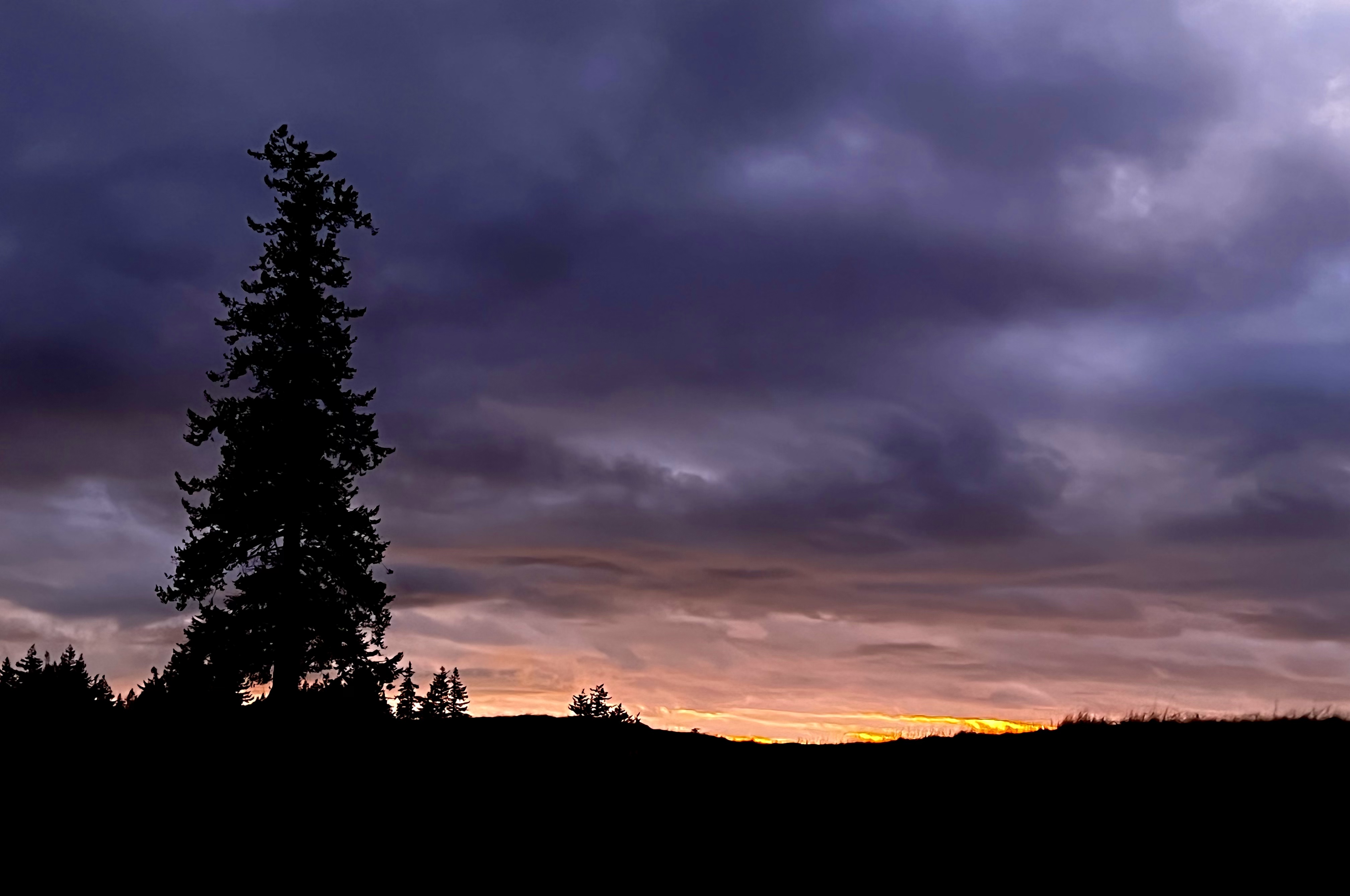
Always at dusk, the same tearless experience, The same dragging of feet up the same well-worn path To the same well-worn rock; The same crimson or gold dropping away of the sun The same tints—rose, saffron, violet, lavender, grey Meeting, mingling, mixing mistily; Before me the same blue black cedar rising jaggedly to a point; Over it, the same slow unlidding of twin stars, Two eyes, unfathomable, soul-searing, Watching, watching—watching me; The same two eyes that draw me forth, against my will dusk after dusk; The same two eyes that keep me sitting late into the night, chin on knees Keep me there lonely, rigid, tearless, numbly miserable, —The eyes of my Regret. ~Angelina Weld Grimké “The Eyes of My Regret”
How granular they feel—grief and regret, arriving, as they do, in the sharp particularities of distress. Inserting themselves— cunning, intricate, subversive—into our discourse.
In the long night, grievances seem to multiply. Old dreams mingling with new. Disappointment and regret bludgeon the soul, your best imaginings bruised, your hopes ragged.
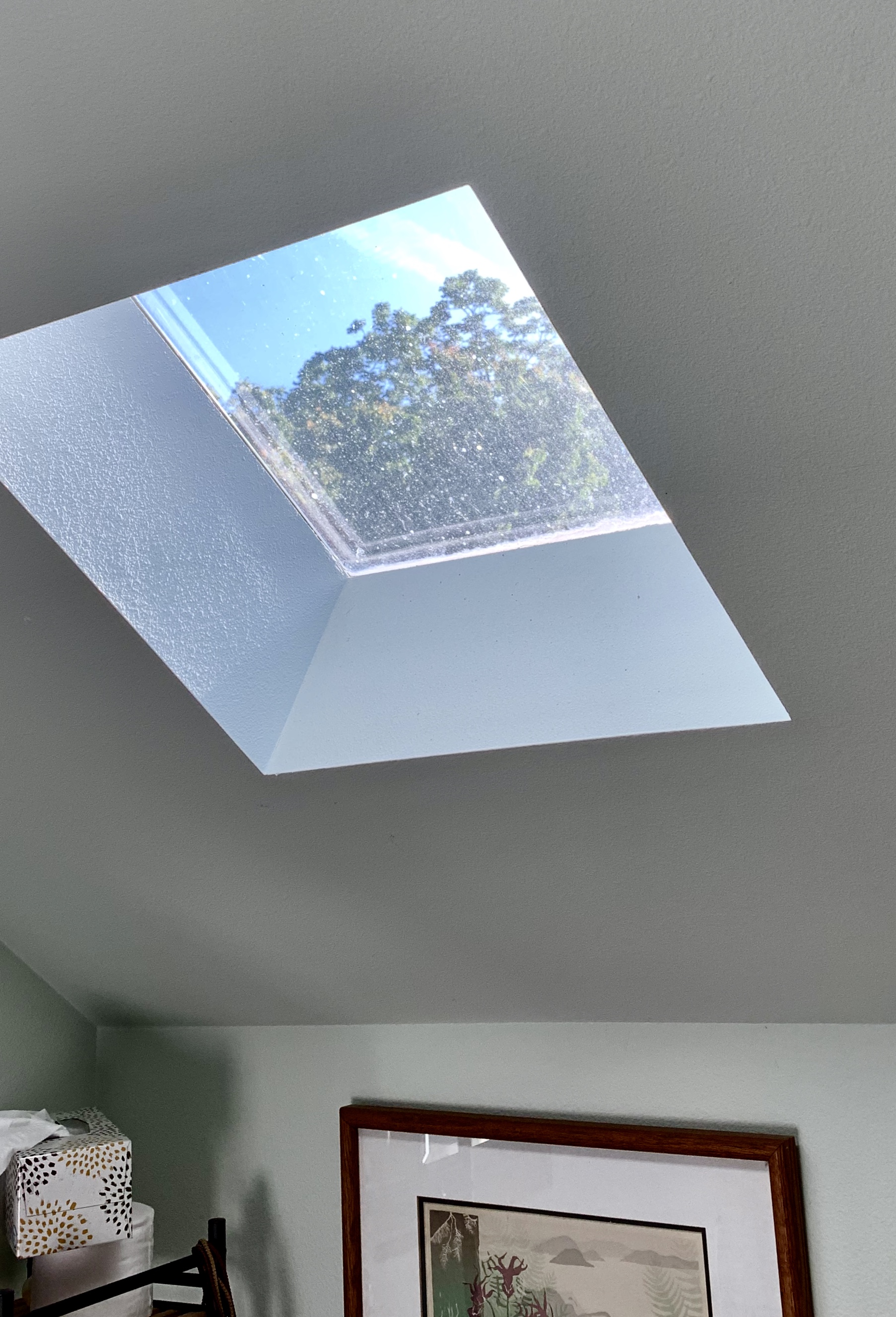
Yet wait, watch. From the skylight the room is filling with soft early sun, slowly sifting its light on the bed, on your head, a shower of fine particles. How welcome. And how reliable. ~Luci Shaw“Sorrow”
It’s now been a interminably long three years: millions of people sickened by a virus that could kill within days or simply be spread by those unwitting and asymptomatic. We’ve lived through shut down of businesses and schools, hospitals and clinics being overwhelmed, and hoarding behavior resulting in shortages of products addressing basic needs.
Now that I can look back with a bit more perspective, I know my first reaction was fear for myself and those I love. My words flew out too quickly, my anxiety mixed with frustration and anger, my tears spilling too easily. Like so many others, my work life forever changed.
I ended up lying awake many nights with regrets, wondering if I should be doing more than just telemedicine from home, yet wanting to hide myself and my M.D. degree under a rock until the unending viral scourge blew over.
Yet amazingly, miracles of grace in many places: generous people full of courage made a difference in small and large ways all around the world. Some took enormous personal risks to take care of strangers and loved ones. Some worked endless hours and when they came home, they remained isolated to avoid infecting their families.
Such grace happens when hardship is confronted head on by the brilliant light of sacrifice. I am deeply grateful to those who have worked tirelessly providing care and compassion to the ill. Their work is never done.
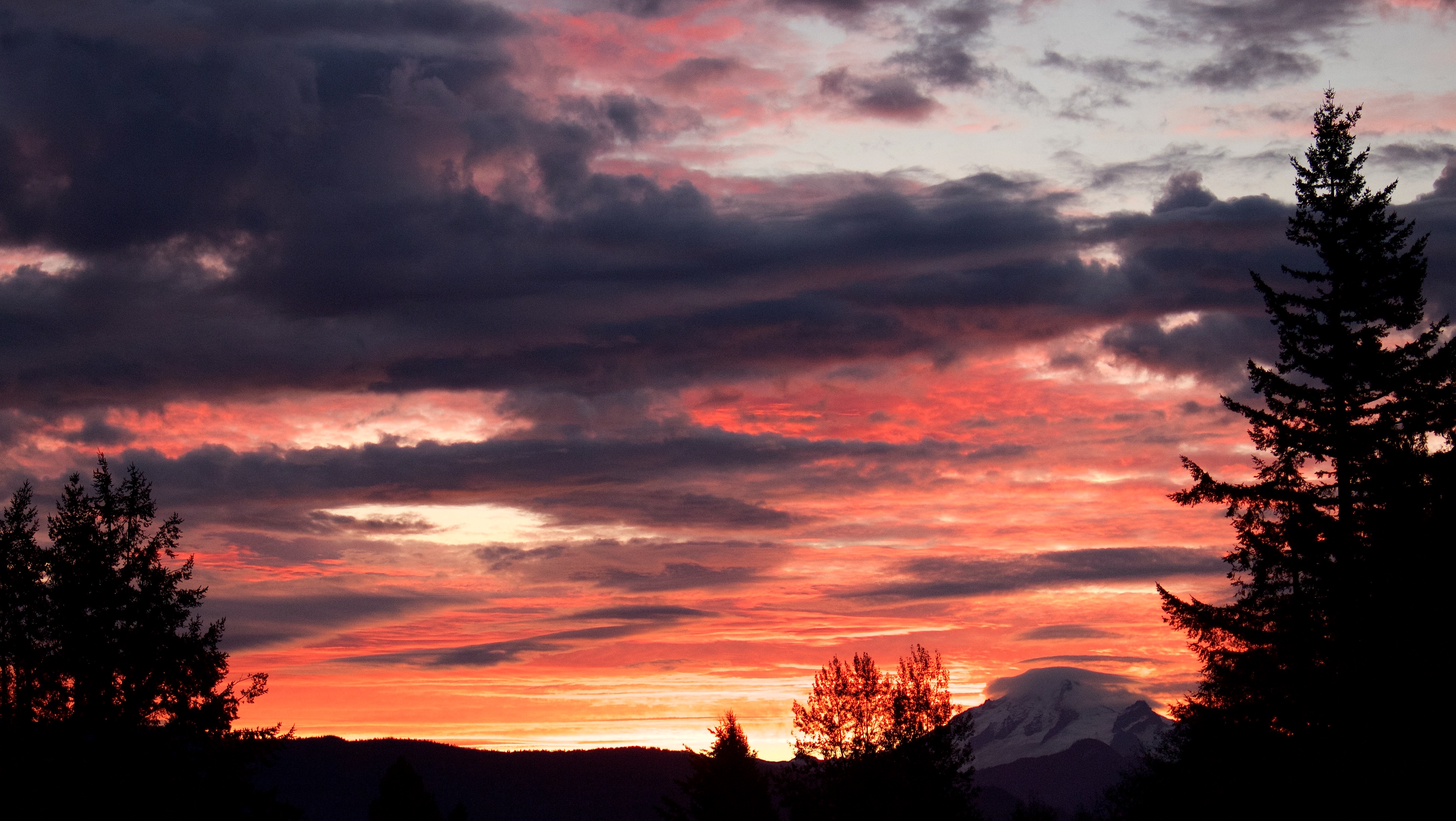
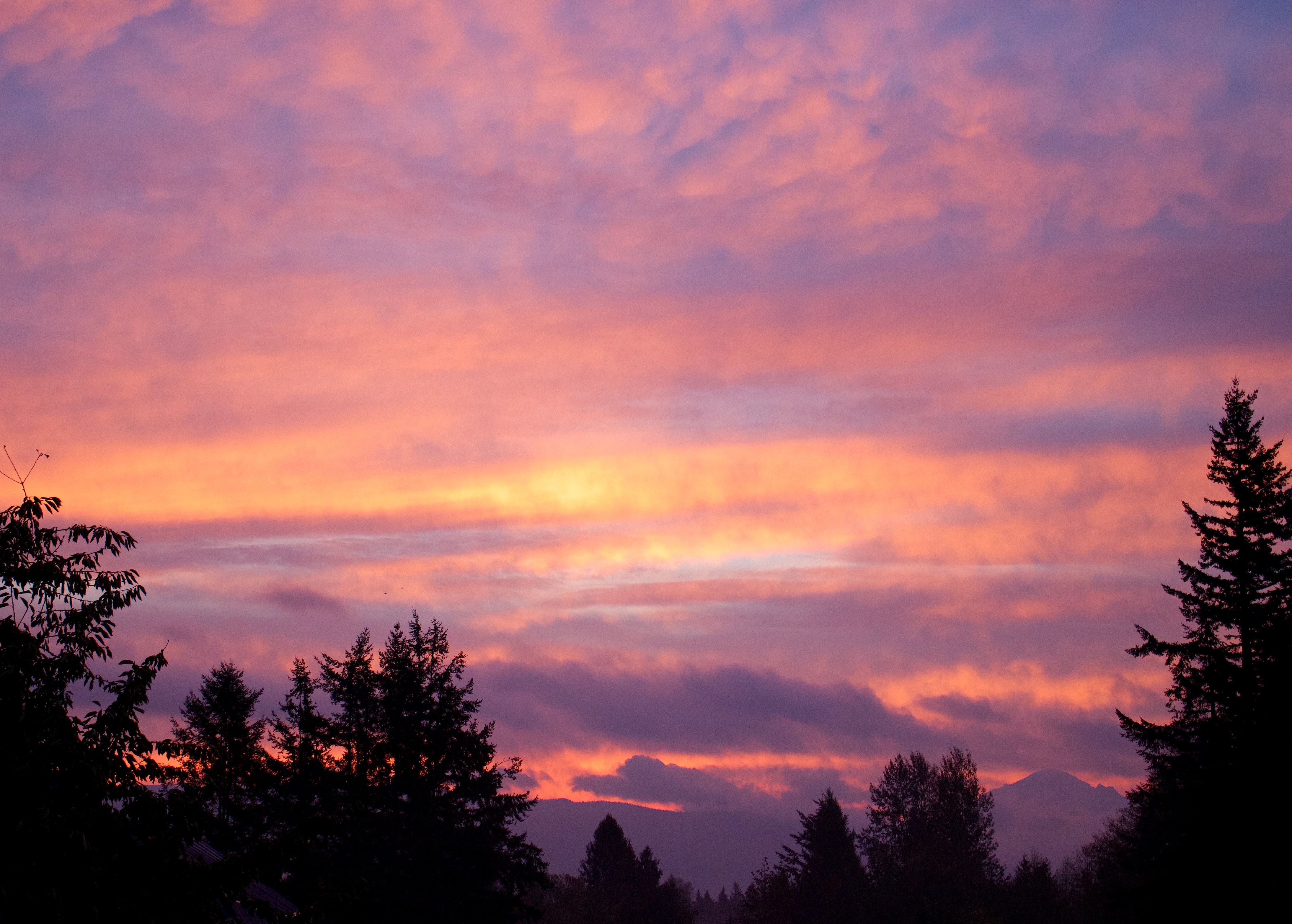
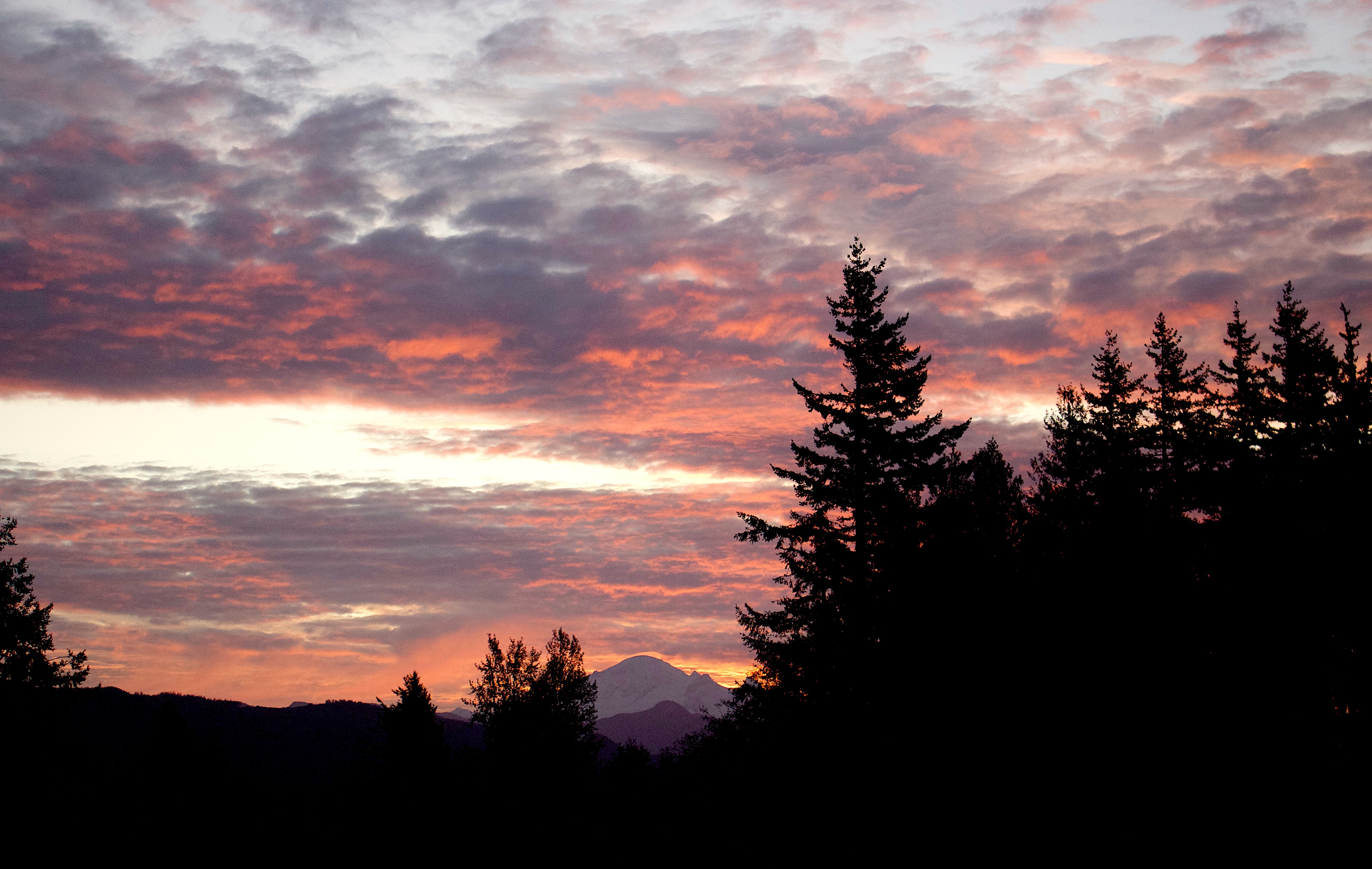
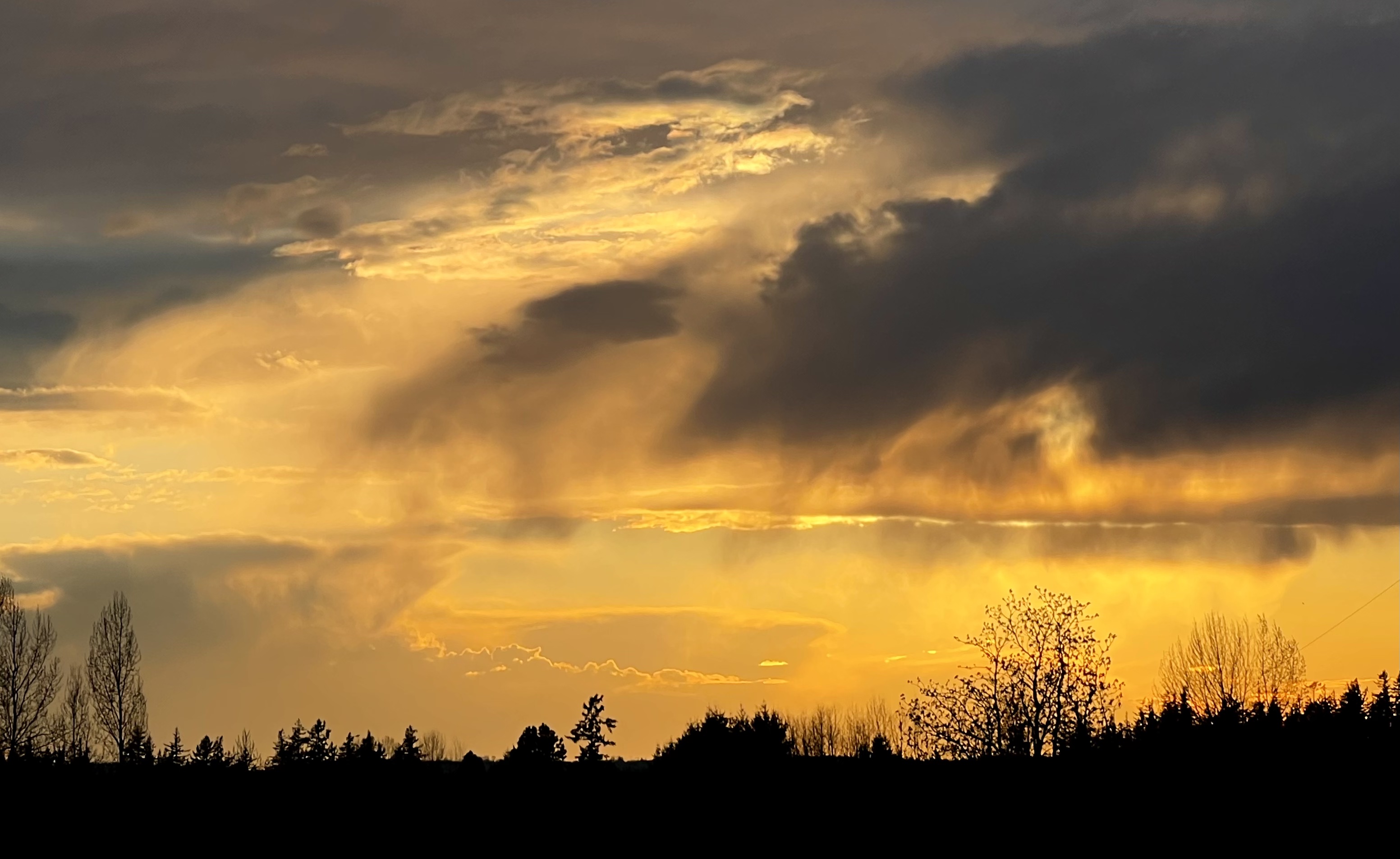
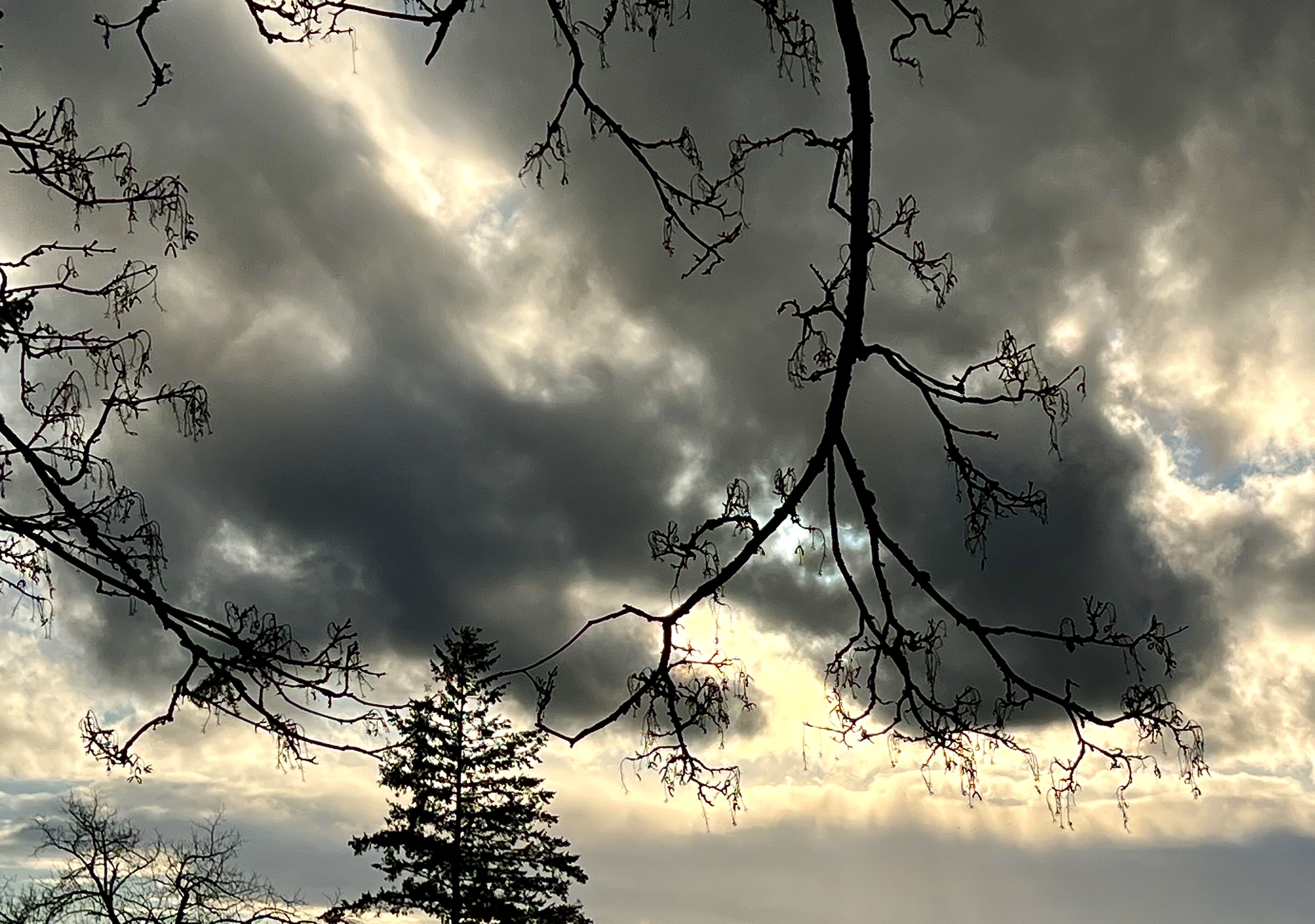
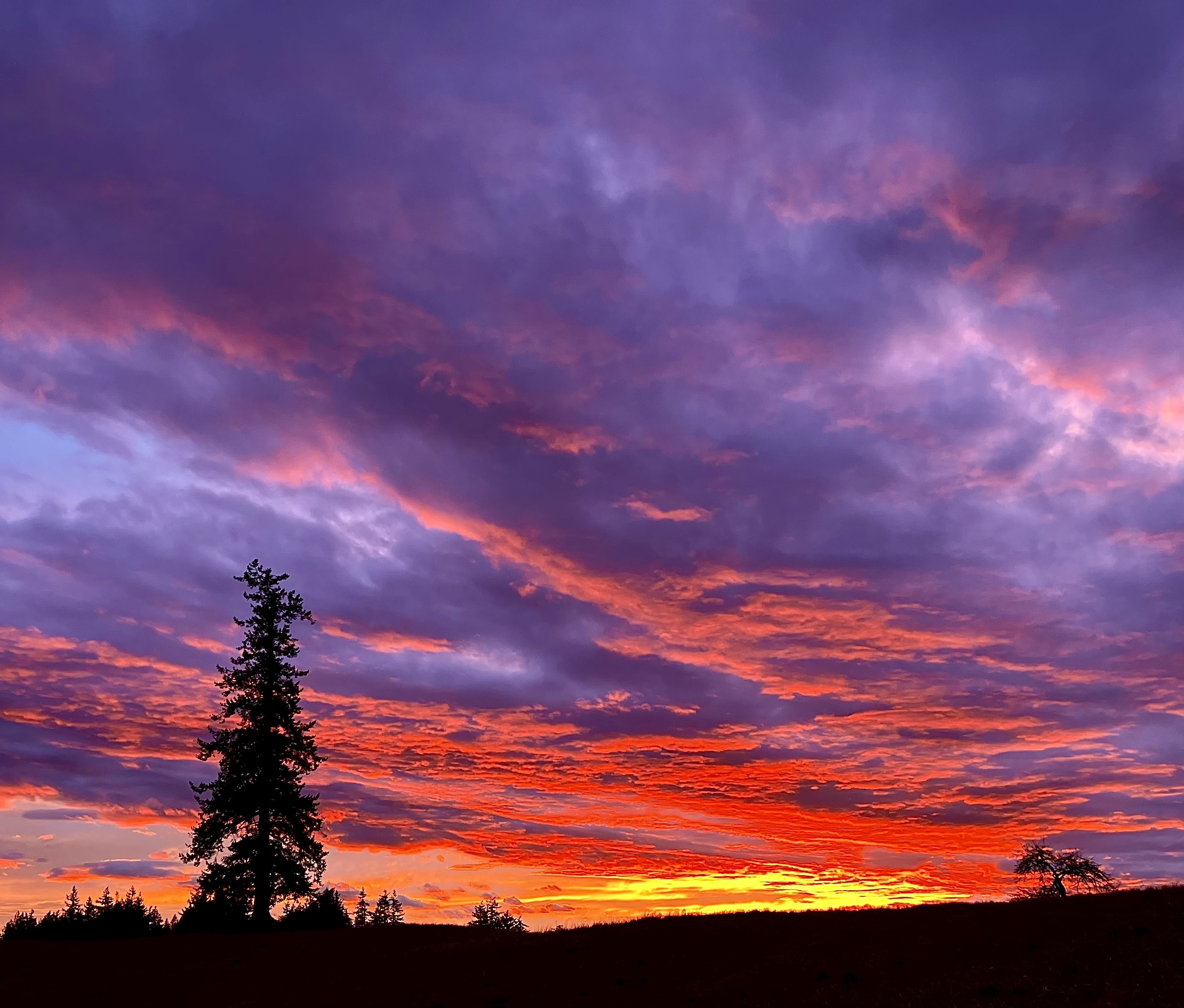
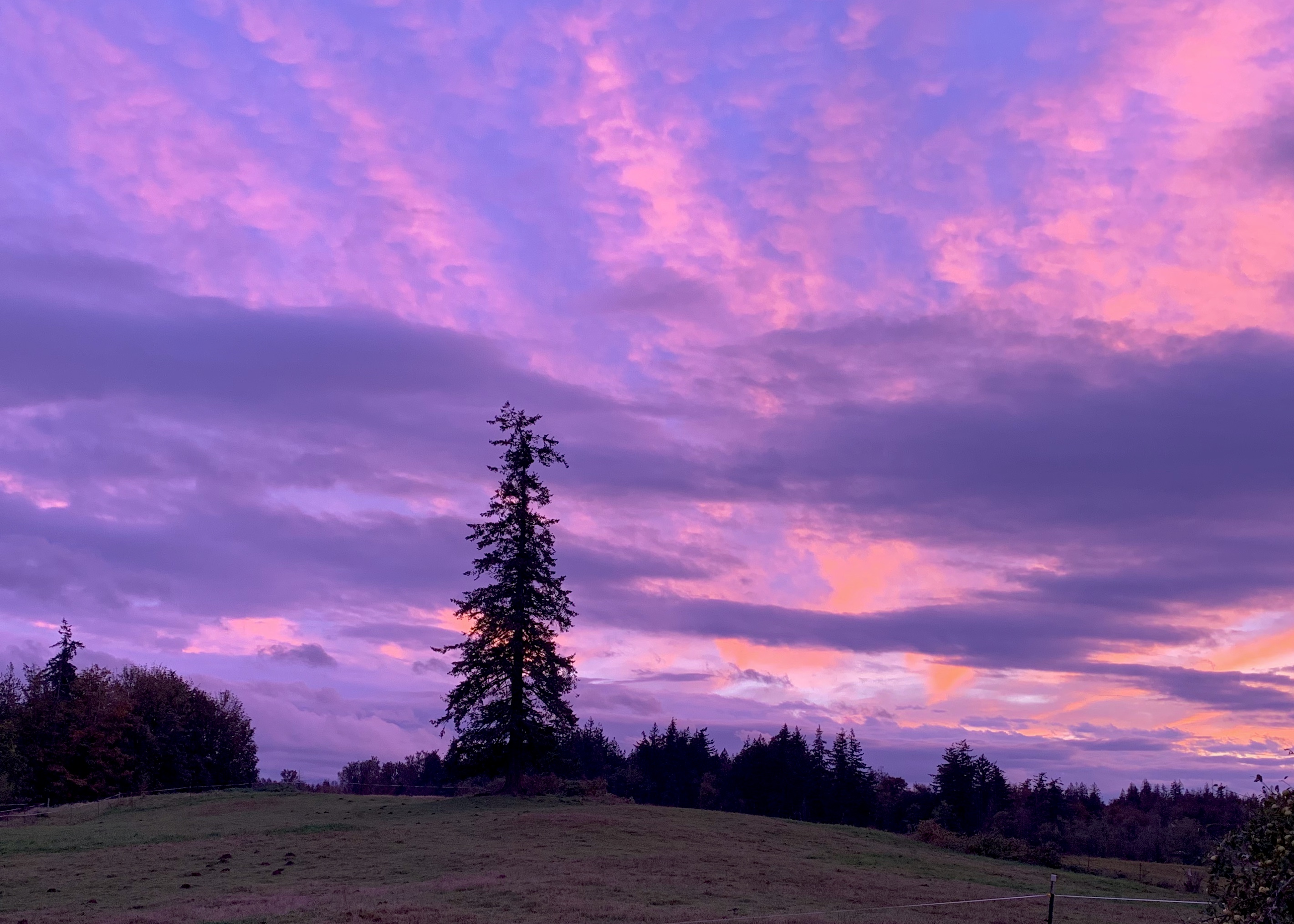
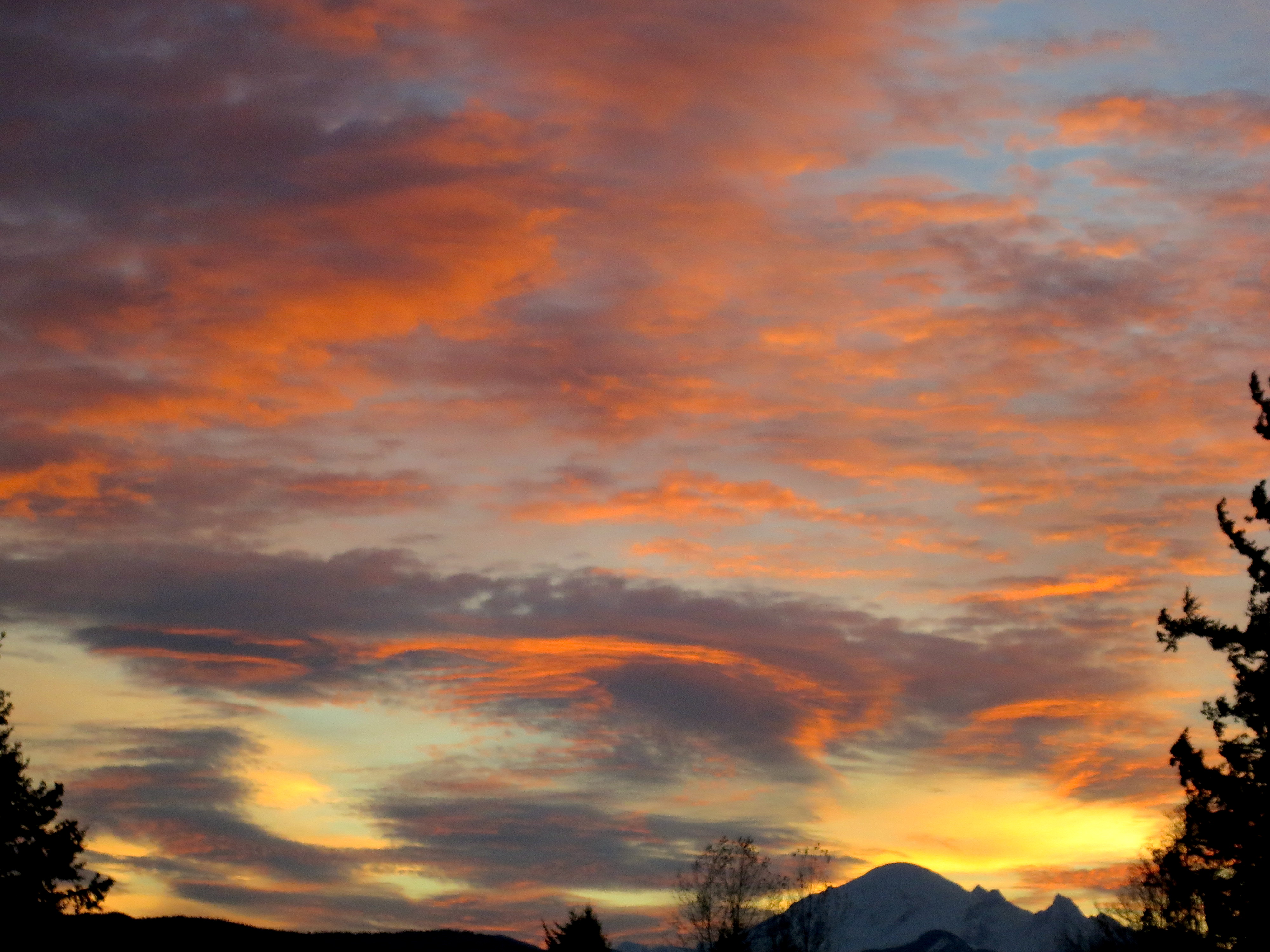
We know, in His humanity, Jesus wept, in frustration, in worry for His people, in grief. His tears still light the sky with a promise of salvation as He assures He won’t leave us alone in darkness – our regret dissipates with the dawn.
This year’s Barnstorming Lenten theme is taken from 2 Corinthians 4: 18: So we fix our eyes not on what is seen, but on what is unseen, since what is seen is temporary, but what is unseen is eternal.





















 Barnstorming