All winter the blue heron slept among the horses. I do not know the custom of herons, do not know if the solitary habit is their way, or if he listened for some missing one— not knowing even that was what he did— in the blowing sounds in the dark, I know that hope is the hardest love we carry. He slept with his long neck folded, like a letter put away. ~Jane Hirshfield “Hope and Love” from The Lives of the Heart
Whenever we noticed her standing in the stream, still as a branch in dead air, we would grab our binoculars, watch her watching, her eye fixed on the water slowly making its own way around stumps, over a boulder, under some leaves matted against a fallen log. She seemed to appear, stand, peer, then lift one leg, stretch it, let a foot quietly settle into the mud then pull up her other foot, settle it, and stare again, each step tendered, an ideogram at the end of a calligrapher’s brush. Every time she arrived, we watched until, as if she had suddenly heard a call in the sky, she would bend her knees, raise her wide wings, and lift into the welcome grace of the air, her legs extending back behind her, wings rising and falling elegant under the clouds: For more than a week now we have not seen her. We watch the sky, hoping to catch her great feathered cross moving above the trees. ~Jack Ridl “The Heron” from Practicing to Walk like a Heron
Things: simply lasting, then failing to last: water, a blue heron’s eye, and the light passing between them: into light all things must fall, glad at last to have fallen. ~Jane Kenyon, from “Things”in Collected Poems
I know what it is like to feel out of step with those around me, an alien in my own land – like a heron among Haflinger horses.
At times I wonder if I belong at all as I watch the choices others make.
I grew up this way, missing a connection I found only rarely, never quite fitting in, a solitary kid becoming a solitary adult. The aloneness bothered me, but not in a “I’ve-got-to-become-like-them” kind of way.
I went my own way, never losing hope.
Somehow misfits find each other. Through the grace and acceptance of others, I found a soul mate and community. Even so, there are times when the old feeling of not-quite-belonging creeps in and I wonder whether I’ll be a misfit all the way to the cemetery, placed in the wrong plot in the wrong graveyard, forgotten altogether.
We disparate creatures are made to be connected, sometimes with those who look and think and act like us, or more often with those who are something completely different. I’ll keep on the lookout for my fellow misfits, just in case there are others out there looking for company along this journey of grace we’re on.
photo by Josh ScholtenAI image created for this post
One-Time
Monthly
Yearly
Make a one-time or recurring donation to support daily Barnstorming posts
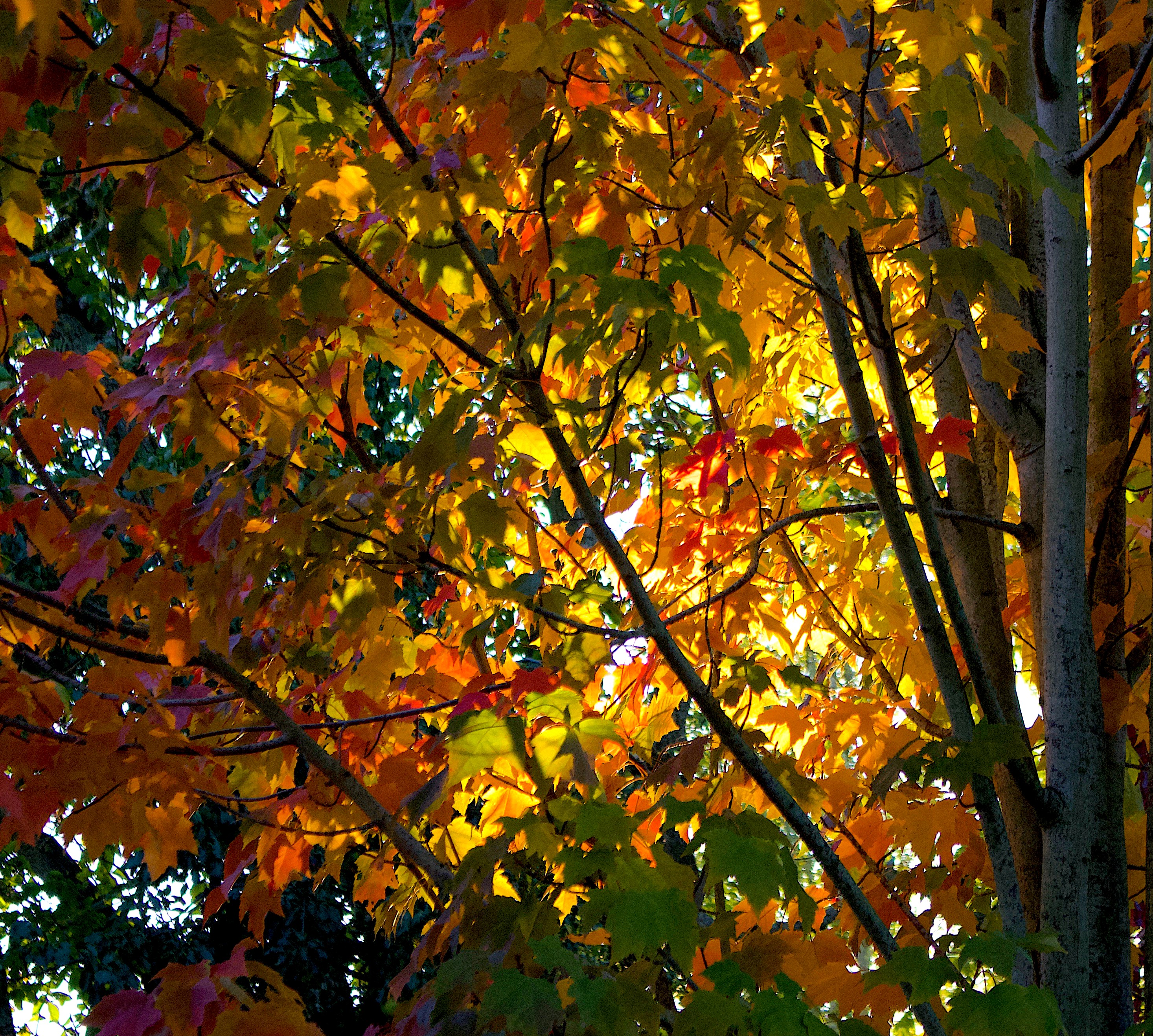
The maple leaves abscond with summer’s green rain on such little stems connecting to spring’s essence, summer twigs’ foliage, the company of the living.
But now they shrug off their red-gold existence as if they’d never inhabited the verdure of the undead, drifting to a ground hardened by sudden frost. ~Donna Pucciani “One Minute”
I was standing lost, sunk, my hands in my pockets, gazing toward Tinker Mountain and feeling the earth reel down. All at once, I saw what looked like a Martian spaceship whirling towards me in the air. It flashed borrowed light like a propeller. Its forward motion greatly outran its fall. As I watched, transfixed, it rose, just before it would have touched a thistle, and hovered pirouetting in one spot, then twirled on and finally came to rest. I found it in the grass; it was a maple key…Hullo. I threw it into the wind and it flew off again, bristling with animate purpose, not like a thing dropped or windblown, pushed by the witless winds of convection currents hauling round the world’s rondure where they must, but like a creature muscled and vigorous, or a creature spread thin to that other wind, the wind of the spirit that bloweth where it listeth, lighting, and raising up, and easing down. O maple key, I thought, I must confess I thought, o welcome, cheers.
And the bell under my ribs rang a true note, a flourish of blended horns, clarion, sweet, and making a long dim sense I will try at length to explain. Flung is too harsh a word for the rush of the world. Blown is more like it, but blown by a generous, unending breath. That breath never ceases to kindle, exuberant, abandoned; frayed splinters spatter in every direction and burgeon into flame. And now when I sway to a fitful wind, alone and listing, I will think, maple key. When I see a photograph of earth from outer space, the planet so startlingly painterly and hung, I will think, maple key. When I shake your hand or meet your eyes, I will think two maple keys. If I am maple key falling, at least I can twirl. ~Annie Dillard from Pilgrim at Tinker Creek
If only there were living words as plentiful as the maple keys that twirl from each branch, words that release us from our dry roots, ready to unlock life’s secrets, unlatch and push ajar the doors to heavy hearts.
Who can ever be ready to go from vibrant and alive, colorful and mobile, to dropped and still?
The reality of another spent season is a slug to the gut. Time is passing. I’m wasting time. There is no stopping it without stopping me.
Let’s dwell in the company of the living until we fall away together.
Live well, fellow leaves and we’ll let go together: swaying to a fitful wind, giving a gentle shrug and drifting, easing into settling down when the time comes.
One-Time
Monthly
Yearly
Make a one-time or recurring donation to support daily Barnstorming posts
I was sad one day and went for a walk; I sat in a field. A rabbit noticed my condition and came near.
It often does not take more than that to help at times— to just be close to creatures who are so full of knowing so full of love that they don’t chat, they just gaze with their marvelous understanding. ~St. John of the Cross, in Love Poems From God: Twelve Sacred Voices from the East and West, trans. Daniel Ladinsky
How wonderful it would be to have an understanding that helps people feel better just by being near.
…knowing you can be comforting without words, simply by being who you are in that moment…
even when you are a little afraid to be there…
“Hello, Rabbit,” he said, “is that you?” “Let’s pretend it isn’t,” said Rabbit, “and see what happens.” ~A.A. Milne from Winnie the Pooh
AI image created for this post
When the load is hard to bear, And the fog of fear envelops you, Let me be the friend to share In the pain that you are walking through.
When you stumble on this narrow road And it feels like you’re forsaken, There is one thing that is sure to hold – I am here for you.
Curse the pride and burn the shame When it chokes the voice inside of you; Nothing is too dark to name When you know that I am broken too.
When the cries of hurt rage in your head And they goad you to destruction, I can be the voice of calm that says, I am here for you.
There’s a greater Love than mine, That is closer than a brother; Power to break the chains that bind, And to comfort like no other.
He has walked this desperate road before And He’s walking here beside you, For through every drought and every storm He is here for you. I am here for you. ~Emma and Stuart Townend
One-Time
Monthly
Yearly
Make a one-time or recurring donation to support daily Barnstorming posts
Now I become myself. It’s taken Time, many years and places; I have been dissolved and shaken, Worn other people’s faces, Now to stand still, to be here, Feel my own weight and density!
All fuses now, falls into place From wish to action, word to silence, My work, my love, my time, my face Gathered into one intense Gesture of growing like a plant. Now there is time and Time is young. Stand still, stand still, and stop the sun! ~May Sarton from “Now I Become Myself”
My grade school took part in an educational experiment in the early 1960’s. It was one of the first schools to mainstream special needs children into “regular” classrooms. At that time, the usual approach was to put kids with disabilities in separate rooms, if not entirely separate schools.
During those years, the average class size for a grade school teacher was 32-35 kids, with no teacher’s aides, rare parent volunteers, (except for field trips and room mothers who threw the holiday parties) and no medications or special accommodations for ADHD or dyslexia. I’m not sure how teachers coped with nearly three dozen noisy disruptive kids, but somehow they managed to teach in spite of the obstacles. Adding in children with mental and physical challenges without additional adult help must have been very difficult.
So some kids got recruited to help out the kids with disabilities. It helped the teacher by creating a buddy system for the special needs kids who might need help with class work or who might have difficulty getting around.
I was assigned to Michael so our desks were side by side for the year. He was a thin little boy with cerebral palsy and hearing aids, thick glasses hooked with a wide band around the back of his head, and spastic muscles never going where he wanted them to go. He could not remain still, try as he might. He walked independently with some difficulty, mostly on his tiptoes because of his shortened leg tendons, frequently falling when he got going too quickly. His thick orthopedic shoes with leg braces would trip him up. His hands were intermittently in a grip of contracted muscles, and his face was always contorting and grimacing. He drooled a lot, so perpetually carried a Kleenex in his hand to catch the drips of spit that ran out of his mouth and dropped on his desk, threatening to spoil his coloring and writing papers.
His speech consisted of all vowels, as his tongue couldn’t quite connect with his teeth or palate to sound out the consonants, so it took some time and patience to understand what he said. He could write with great effort, gripping the pencil awkwardly in his tight palm and found he could communicate better at times on paper than by talking.
I made sure he had help to finish assignments if his muscles were too tight to write, and I learned his speech so I could interpret for the teacher. He was brave and bright, with a finer mind than most of the kids in our class. He loved a good joke and his little body would shudder as he roared his appreciation. I was always impressed at how he expressed himself and how little bitterness he had about his limitations. He was the most articulate inarticulate person I had ever met.
As Michael appeared around the corner of the grade school building every morning, he would walk quickly in his careful tip-toe cadence, arms flailing, shoes scuffing, raising up dust with each step. He would wave at me and call out my name in his indecipherable voice.
Once, as he approached, a group of kids playing tag swooped past him, purposely a little too close, spinning him off his feet like a top and onto the ground. Glasses askew, he lay momentarily still, and realizing I was needed, I ran to help him up. Despite all he endured, I never saw Michael cry, not even once, not even when he fell down hard. When he got angry or frustrated, he’d get very quiet. His muscles would tense up so much he would go into even greater spasms.
I had no tolerance for anyone who bullied him. I could see the pain in his grimacing face. Although he would give me a huge toothy smile of thanks, his eyes, as usual, said what his mouth could not. Michael knew I needed him as much as he needed me. I relished my new role as the life preserver thrown to him as he struggled to stay afloat in a sea of classroom hostility.
There were many times when I resented being teased by other students about Michael being my boyfriend. Although he would blush bright red when he heard that, Michael really had become a good friend, who just happened to be a boy.
The following academic year, he moved to another school district, so I never saw Michael again. However, I heard him on local radio six years later, reading an essay he’d written for the county Voice of Democracy contest on what it meant to be a free citizen. His essay was one of the top three award winners that year. I was amazed at how understandable his speaking voice had become.
Years later, I went on to medical school, learning from patients who lived with even far greater limitations than Michael. I realized that my initial training in compassionate care had been as I sat by his side helping him navigate 5th grade. He showed me how important it was to take the time to understand his voice and his heart when others would or could not.
I didn’t appreciate it then as I do now, but he taught me far more than I ever taught him: patience, perseverance and respect for the journey through obstacles rather than focusing just on the destination.
He helped me surpass my own less visible limitations. I was his special friend – one who just happened to be a girl.
So let’s not get tired of doing what is good. At just the right time we will reap a harvest of blessing if we don’t give up. Galatians 6:9
This Lenten season I reflect on the words of the 19th century southern spiritual hymn “What Wondrous Love is This”
One-Time
Monthly
Yearly
Make a one-time or recurring donation to support daily Barnstorming blog posts
Suddenly I knew, when we stood in a circle holding hands; suddenly I knew, that because of the circle, because of friendship, because of love— yes, and because of the brokenness, and the need— I have been in heaven all my life. ~Carol Bialock “I Used to Think Heaven was Future” from Coral Castles
The church, I think, is God’s way of saying, “What I have in the pot is yours, and what I have is a group of misfits whom you need more than you know and who need you more than they know.”
“Take, and eat,” he says, “and take, and eat, until the day, and it is coming, that you knock on my door. I will open it, and you will see me face to face.”
He is preparing a table. He will welcome us in. Jesus will be there, smiling and holy, holding out a green bean casserole. And at that moment, what we say, what we think, and what we believe will be the same: “I didn’t know how badly I needed this.” ~Jeremy Clive Huggins from “The Church Potluck”
…when I experienced the warm, unpretentious reception of those who have nothing to boast about, and experienced a loving embrace from people who didn’t ask any questions, I began to discover that a true spiritual homecoming means a return to the poor in spirit to whom the kingdom of heaven belongs. ~Henri Nouwen from The Return of the Prodigal Son
The journey begins when Christians leave their homes and beds. They leave, indeed, their life in this present and concrete world, and whether they have to drive 15 miles or walk a few blocks, a sacramental act is already taking place…
For they are now on their way to constitute the Church, or to be more exact, to be transformed into the Church of God. They have been individuals, some white, some black, some poor, some rich, they have been the ‘natural’ world and a natural community. And now they have been called to “come together in one place,” to bring their lives, their very world with them and to be more than what they were: a new community with a new life.
We are already far beyond the categories of common worship and prayer. The purpose of this ‘coming together’ is not simply to add a religious dimension to the natural community, to make it ‘better’ – more responsible, more Christian. The purpose is to fulfill the Church, and that means to make present the One in whom all things are at their end, and all things are at their beginning. ~ Father Alexander Schmemann from For the Life of the World
We’ve been through fire, we’ve been through pain We’ve been refined by the power of Your name We’ve fallen deeper in love with You You’ve burned the truth on our lips
Rise up church with broken wings Fill this place with songs again Of our God who reigns on high By his grace again we’ll fly ~Robin Mark from “Shout to the North and the South”
photo by Barb Hoelle
There is so much wrong with the modern church, comprised as it is of fallen people with broken wings determined to find flaws in each other in doctrine, tradition, beliefs.
What is right with the church today, is when it offers a taste of heaven for hopeful people who come together in sanctuary, barn and field, eucharist table and potluck, to hold each other up in prayer and to sing in worship to the Three in One, who is why we sing, whose body we are part of and who, in our need, loves and forgives us despite our motley messiness: Our Lord of Heaven and Earth.
I appeal to you, brothers and sisters, in the name of our Lord Jesus Christ, that all of you agree with one another in what you say and that there be no divisions among you, but that you be perfectly united in mind and thought. 1 Corinthians 1:9-10
This Lenten season I reflect on the words of the 19th century southern spiritual hymn “What Wondrous Love is This”
One-Time
Monthly
Yearly
Make a one-time or recurring donation to support daily Barnstorming posts
one small crystal that gleams clear colours out of transparency.
I need more.
I break off a fragment to send to you.
Please take this grain of a grain of hope so that mine won’t shrink.
Please share your fragment so that yours will grow.
Only so, by division, will hope increase,
like a clump of irises, which will cease to flower unless you distribute the clustered roots, unlikely source– clumsy and earth-covered– of grace. ~Denise Levertov “For the New Year, 1981”
As this year draws to its end, We give thanks for the gifts it brought And how they became inlaid within Where neither time nor tide can touch them.
The days when the veil lifted And the soul could see delight; When a quiver caressed the heart In the sheer exuberance of being here.
Surprises that came awake In forgotten corners of old fields Where expectation seemed to have quenched.
The slow, brooding times When all was awkward And the wave in the mind Pierced every sore with salt.
The darkened days that stopped The confidence of the dawn.
Days when beloved faces shone brighter With light from beyond themselves; And from the granite of some secret sorrow A stream of buried tears loosened.
We bless this year for all we learned, For all we loved and lost And for the quiet way it brought us Nearer to our invisible destination. ~John O’Donohue “At the End of the Year” from To Bless The Space Between
Sculpture by Artist Albert Gyorgy
Truly, we live with mysteries too marvelous to be understood.
How grass can be nourishing in the mouths of the lambs.
How rivers and stones are forever in allegiance with gravity, while we ourselves dream of rising.
How two hands touch and the bonds will never be broken.
How people come, from delight or the scars of damage, to the comfort of a poem.
Let me keep my distance, always, from those who think they have the answers.
Let me keep company always with those who say “Look!” And laugh in astonishment and bow their heads. ~Mary Oliver “Mysteries, Yes”from Evidence: Poems
photo by Nate Gibson
Each day, for nearly twenty years, I break off a grain of hope from these dirt-covered, humble roots I have dug up to share.
I hand off a grain of hope to you here, as it will grow through your nurture, a tiny marvel you break off someday to hand on to someone else.
A life should leave deep tracks: ruts where she went out and back to get the mail or move the hose around the yard; where she used to stand before the sink, a worn-out place; beneath her hand the china knobs rubbed down to white pastilles; the switch she used to feel for in the dark almost erased. Her things should keep her marks. The passage of a life should show; it should abrade. And when life stops, a certain space— however small— should be left scarred by the grand and damaging parade. Things shouldn’t be so hard. ~Kay Ryan “Things Shouldn’t Be So Hard” from The Niagra River
“The passage of a life should show…”
Since losing my friend Sara unexpectedly a month ago, I’ve thought a lot about the deep tracks she left behind. Traces of her life will forever mark her husband and children and grandchildren. They follow her pathways in her large farmhouse kitchen from sink to stove to cupboard to table. Her garden and orchard display her obvious affection for things that bloom and fruit while her wrap-around porch mirrors her love of sitting and witnessing it all.
Most of all her tracks are showing up on so many broken hearts, where we still feel her presence. Although I realize she is truly gone from this world, it is as if the season suddenly changed in response to her leaving. The misty mornings seem weary, the trees are now bare, the frost has been thick and a north wind has started to blow. Before too long, we’ll be remembering her boot steps in the barnyard snow.
No one Sara touched has been left abraded or scarred from her use. She was far too gentle in her touch; she worked hard not to leave traces of where she had been, as determined as she was to avoid attention. Her intention was to always remain in the background so others could shine. Now that she is gone, the background itself has been changed. The passage of her life will not dim the light she focused on her family and friends and the patients who loved her.
She wouldn’t want it to be this hard without her here. But it is.
Man is born broken. He lives by mending. The grace of God is glue. ~Eugene O’Neill
One day you finally knew what you had to do, and began, though the voices around you kept shouting their bad advice – – – though the whole house began to tremble and you felt the old tug at your ankles. ‘Mend my life!’ each voice cried. But you didn’t stop.
You knew what you had to do, though the wind pried with its stiff fingers at the very foundations – – – though their melancholy was terrible. It was already late enough, and a wild night, and the road full of fallen branches and stones.
But little by little, as you left their voices behind, the stars began to burn through the sheets of clouds, and there was a new voice, which you slowly recognized as your own, that kept you company as you strode deeper and deeper into the world, determined to do the only thing you could do – – – determined to save the only life you could save. ~Mary Oliver “The Journey”
When I first read <Mary’s poem> years ago, I had trouble with it. It seemed to advocate the kind of self-centered life that’s one of the core pathologies of modern culture.
But life experience—hard experience—has led me to see the wisdom here.None of us can “mend” another person’s life, no matter how much the other may need it, no matter how much we may want to do it.
Mending is inner work that everyone must do for him or herself. When we fail to embrace that truth the result is heartbreak for all concerned.
What we can do is walk alongside the people we care about, offering simple companionship and compassion. And if we want to do that, we must save the only life we can save, our own.
Only when I’m in possession of my own heart can I be present for another in a healing, encouraging, empowering way. Then I have a gift to offer, the best gift I possess—the gift of a self that is whole, that stands in the world on its own two feet.
…anything one can do on behalf of true self is done ultimately in the service of others. ~Parker Palmer writing about Mary Oliver’s poem “The Journey”
We are born hollering, so abruptly separated from warmth and comfort. Broken in emptiness from the first breath, every alveoli fills up with the air of a fallen world.
Yet air is never enough for us.
The rest of our days are spent filling up our empty spaces whether lungs or stomach or starving synapses, still hollering in our loneliness and heart- broken.
I spent over forty years devoted to the mending business, patching up the breaking and broken.
Yet I know I was never enough.
We heal best through our walk with others who are also broken. We bridge the gaps by knitting together scraggly fragments of each other’s shattered lives.
The crucial glue is boiled from gifted Grace – our filled holes miraculously made holy.
So it is – Immanuel, God with us, is always enough.
The Mending Song – lyrics from Arnold Lobel’s poem below
There was an old woman of long ago who went about her mending; She sewed the wind against the clouds to stop the trees from bending; She stitched the sun to the highest hill, to hold the day from ending.
Her thimbles and threads were close at hand for needlework and quilting, For sewing gardens to the sky to keep the blooms from wilting, For lacing the land to the crescent moon, to save the world from tilting.
One-Time
Monthly
Yearly
Make a one-time or recurring donation to support daily Barnstorming posts
I’ve fallen many times: the usual stumbles over secret schoolgirl crushes, head-over-heels for teen heartthrobs. I loved them all.
I’ve fallen so many times: tripped down the aisle over husband, daughter, son. Madly and deeply, I love them all.
I’ve fallen again and again: new friends, a mentor, a muse, numerous books, a few authors, four dear pups and a stranger, or two. I loved them all.
I’ve fallen farther, fallen faster, now captivated, I tumble— enthralled with my grandchildren. I love them each, ever and all. ~Jane Attanucci, “Falling” from First Mud
Six grandchildren in less than seven years brings a bounty of baby hugs and snuggles.
With each one, I fall farther and faster than ever before.
In a lifetime of falling head over heels for those most precious to me, a loving husband, two sons and a daughter, dear friends and mentors, numerous pups and ponies…
still none could prepare me for this ~
the blessing of loving our children’s children, their smiles and giggles and arms wrapped around us
these have become most cherished each, ever and all.
I spent this morning adjusting to this change in season by occupying myself with the familiar task of moving manure. Cleaning barn is a comforting chore, allowing me to transform tangible benefit from something objectionable and just plain stinky to the nurturing fertilizer of the future. It feels like I’ve actually accomplished something.
As I scooped and pushed the wheelbarrow, I remembered another barn cleaning over twenty years ago, when I was one of three or four friends left cleaning over ninety stalls after a Haflinger horse event that I had organized at our local fairgrounds. Some people had brought their horses from over 1000 miles away to participate for several days. Whenever horse people gather, there were personality clashes and harsh words among some participants along with criticism directed at me that I had taken very personally. As I struggled with the umpteenth wheelbarrow load of manure, tears stung my eyes and my heart. I was miserable with regrets over people not getting along. After going without sleep and making personal sacrifices over many months planning and preparing for the benefit of our group, my work did not feel worth the pain I was feeling.
My friend Jenny Rausch had stayed behind with her family to help clean up the large facility and she could see I was struggling to keep my composure. Jenny put herself right in front of my wheelbarrow and looked me in the eye, insisting I stop for a moment and listen.
“You know, none of these troubles and conflicts will amount to a hill of beans years from now. People will remember a fun event in a beautiful part of the country, a wonderful time with their horses, their friends and family, and they’ll be all nostalgic about it, not giving a thought to the infighting or the sour attitudes or who said what to whom. So don’t make this about you and whether you did or didn’t make everyone happy. You loved us all enough to make it possible to meet here and the rest was up to us. So quit being upset about what you can’t change. There’s too much you can still do for us.”
And then she gave me a hug that I will always cherish.
During tough times which have come often in my professional life, including the difficult and controversial decisions I had to make during the COVID pandemic, Jenny’s advice replays in my mind, reminding me to stop seeking appreciation from others, or feeling hurt when harsh words come my way. She was right about the balm found in the tincture of time. She was right about giving up being upset in order to die to myself and my self-absorption, to keep focusing outward rather than inward.
Jenny, I have remembered what you said even though at times I emotionally relapse and forget.
A few years after that day in the barn, Jenny herself spent six years slowly dying, while still vigorously living her life every day treating a relentless cancer. The tumor spread was initially slowed in the face of her faith and intense drive to live. Over time though, she became a rusting leaf, fading imperceptibly, crumbling at the edges until she finally let go. Her dying on this day twelve years ago did not flash brilliance, nor draw attention at the end. Her intense focus during the years of her illness had always been outward to others, to her family and friends, to the numerous healers she spent so much time with in medical offices, to her belief in the plan God had written for her and others.
Despite her intense love for her husband and young children, she let go her hold on life here. And we all had to let her go.
Brilliance cloaks you as your focus is now on things eternal.
You were so right, Jenny. Conflicts from over twenty years ago haven’t amounted to a hill of beans; all is remembered fondly by those who were part of the gathering. I especially treasure the words you wisely spoke to me as they have helped me through other tough times when I tend to inwardly focus on my own hurt feelings.
And I’m no longer upset that I can’t change the fact that you have left us. There is still so much you continue to do for us by staying alive in our memories.
I know we’ll catch up later.
For some of the wit and wisdom of Jenny’s writings about her horses and life – go here
Jenny R –photo by Ginger Kathleen Coombs
One-Time
Monthly
Yearly
Make a one-time or recurring donation to support daily Barnstorming posts