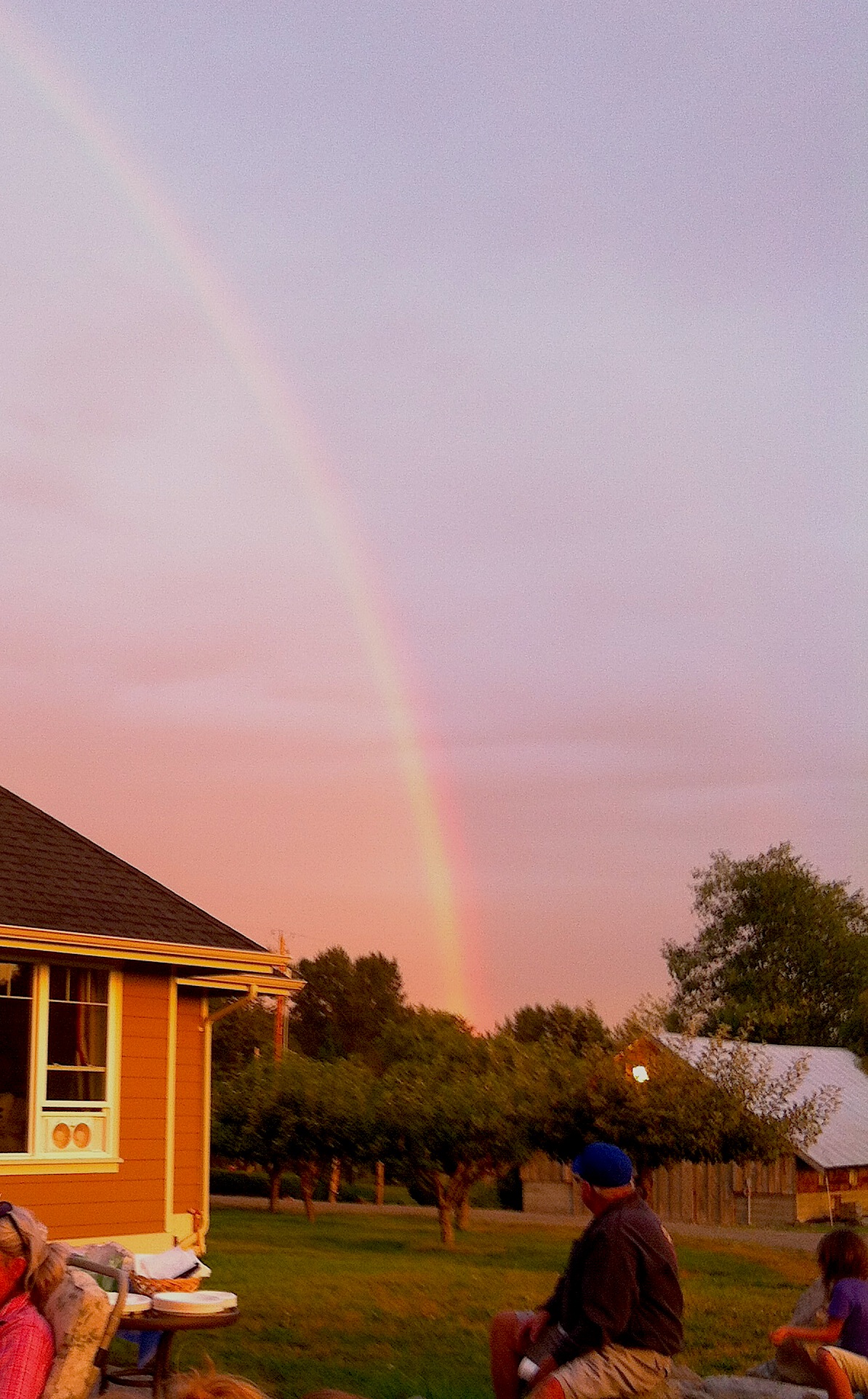
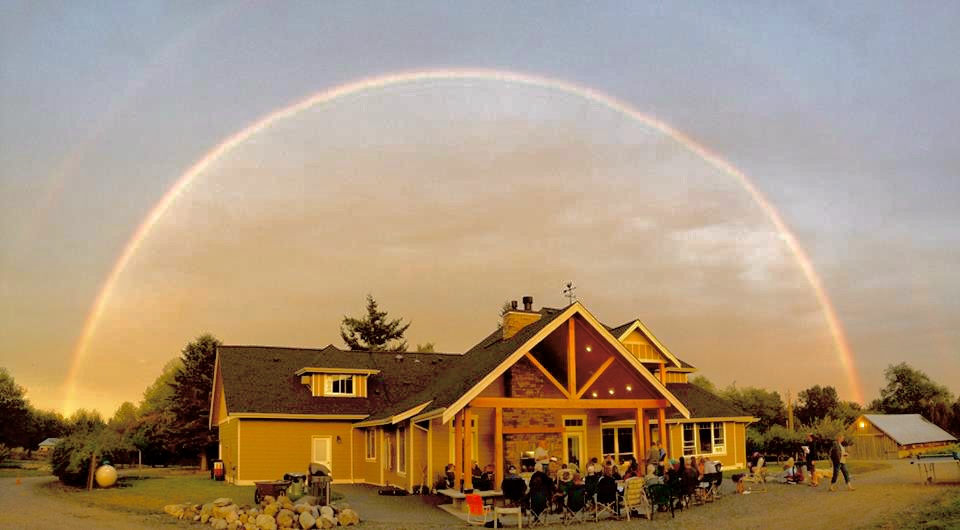
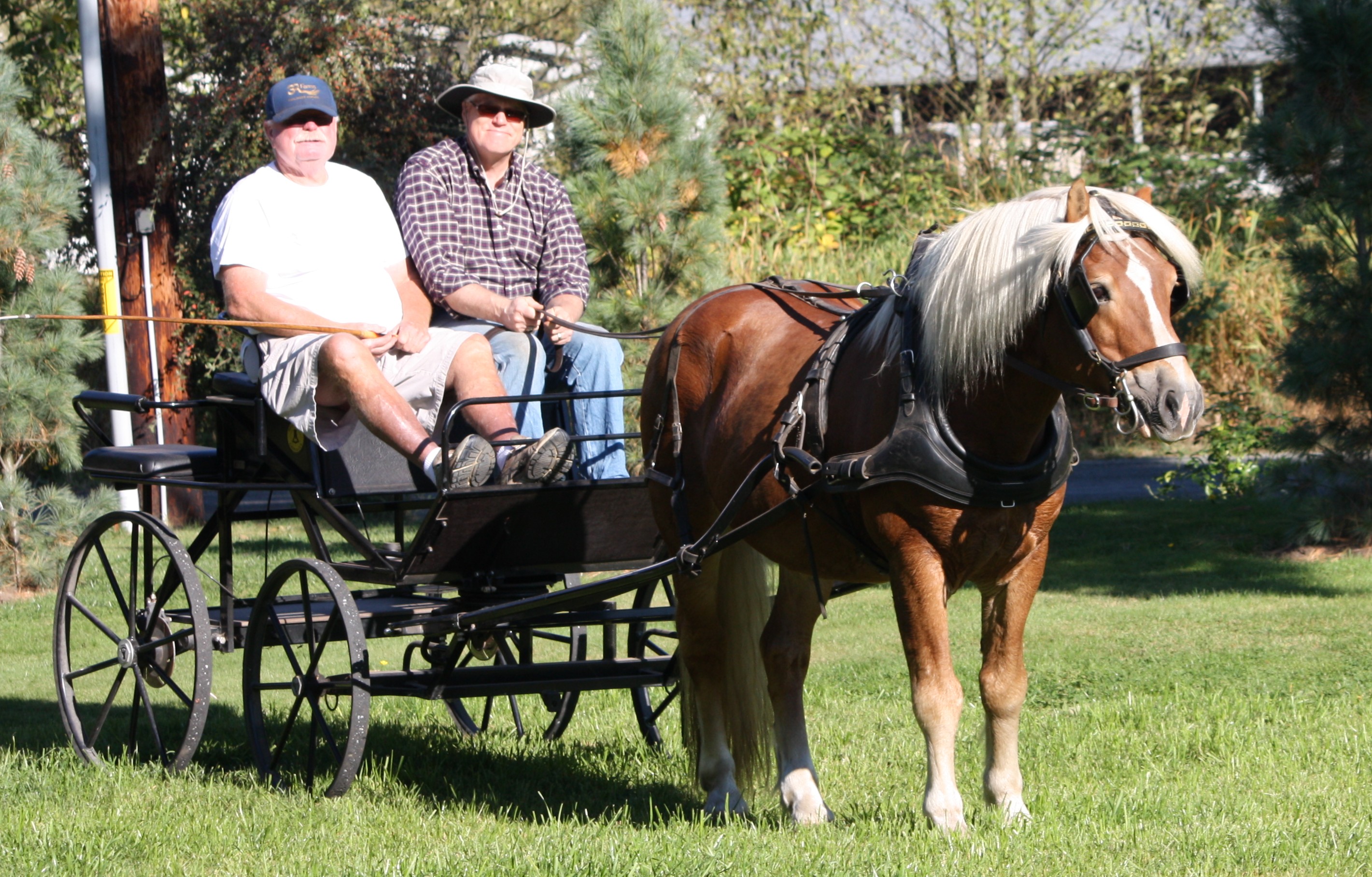
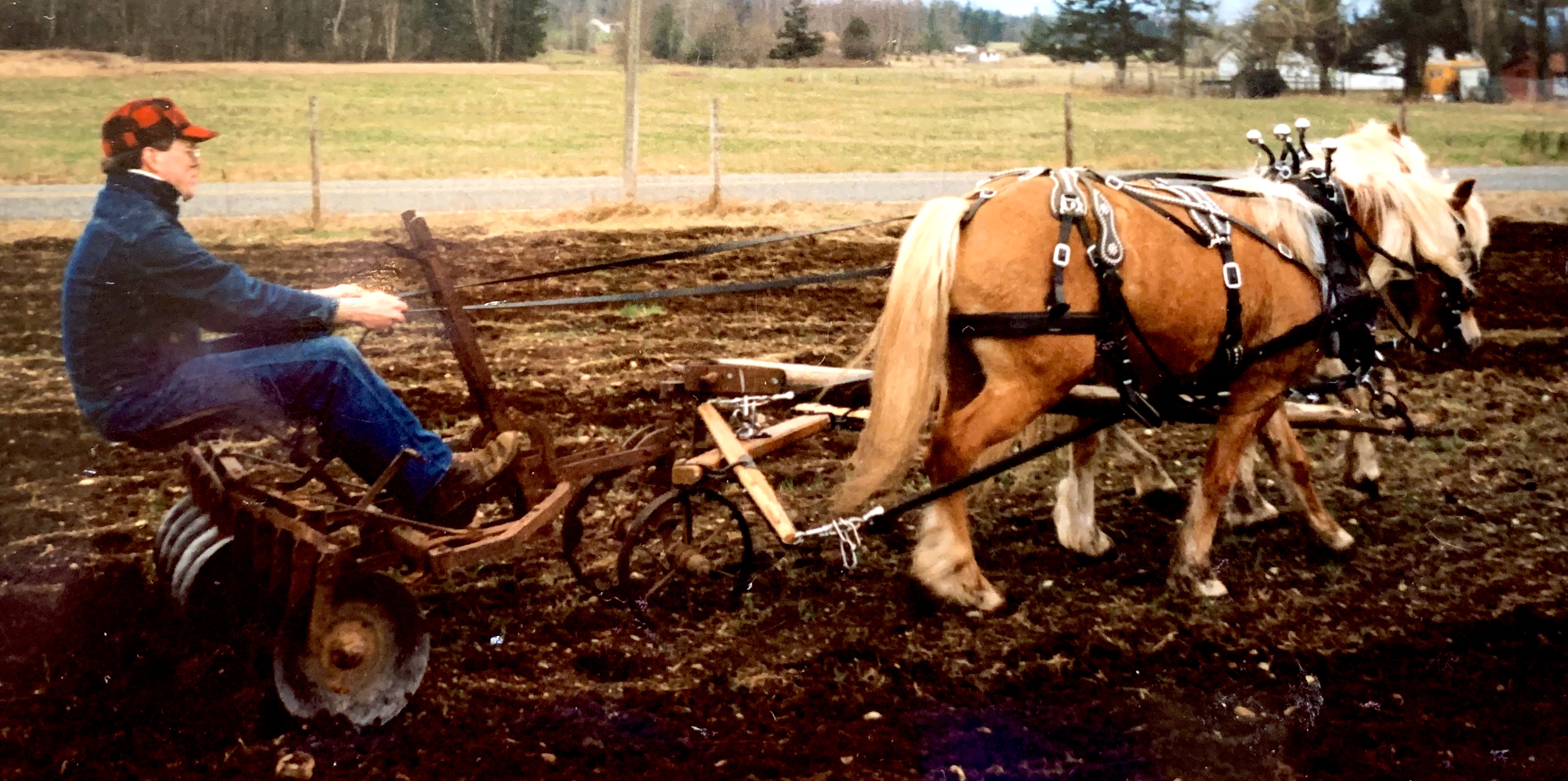
Harry in his backyard, admiring a rainbow he never forgotRainbow at 3R FarmsHarry (L) giving my husband Dan a driving lesson with stallion Midnight van de Edelweissphoto by Harry Rodenbergerphoto by Harry Rodenberger
Harry was at home in the house he and his wife Terry had built for his final retirement years, a house that had been encircled by a remarkable rainbow soon after they moved in. They both knew he lived on borrowed time thanks to a defibrillator in his chest that brought him back from the brink of death more times than his doctors could count. The rainbow brought a promise that Harry had not yet finished with his work here.
He was in that house last night when the Lord called him home, after so many near misses. Harry liked to say, “The Lord keeps taking the hook out and throwing me back in.”
This time the Lord kept hold and cradled him.
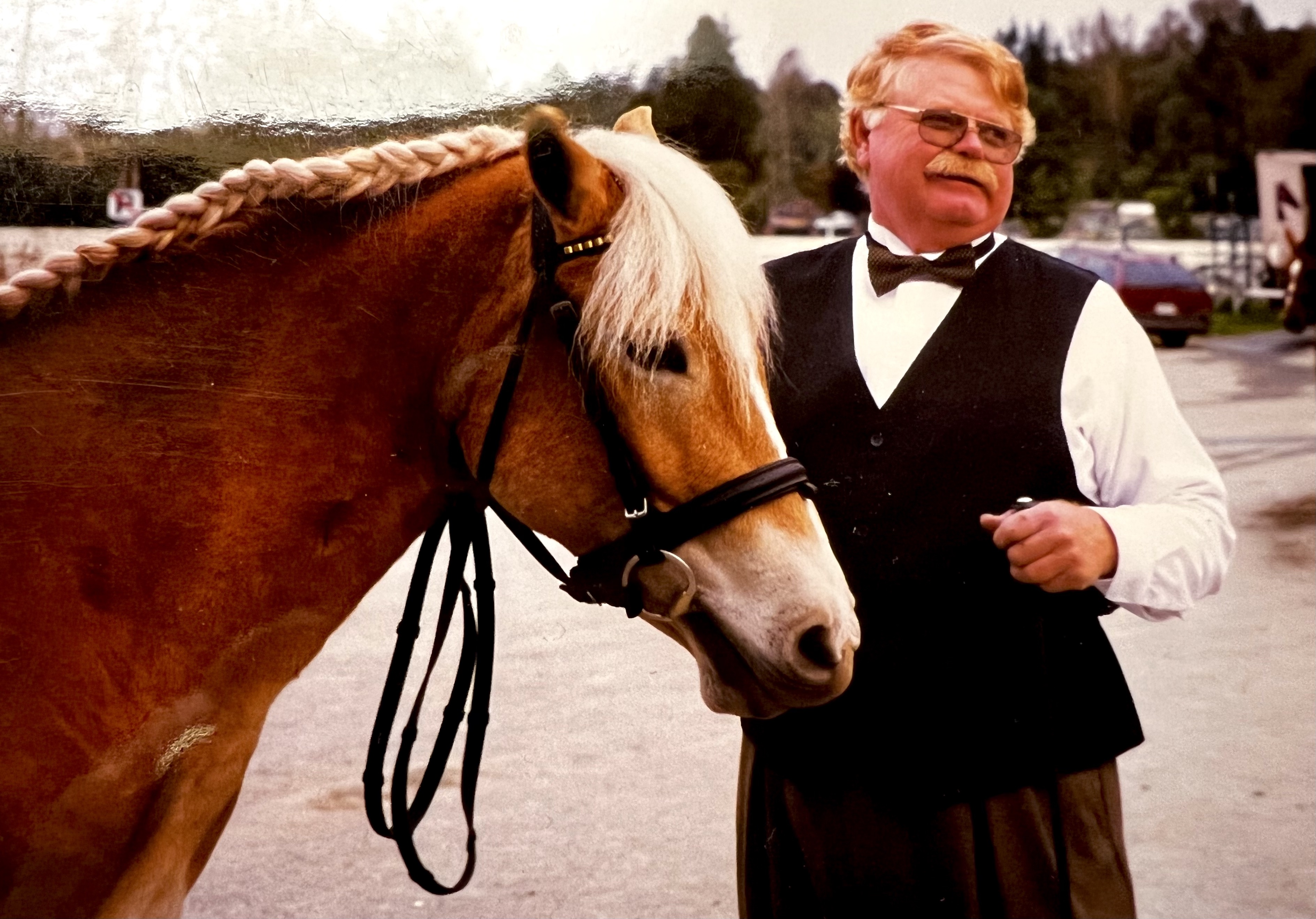
There is so much to say about a man who was a retired firefighter, a horse and beef farmer, a brother, a friend to scores of people, a father, grandfather and great-grandfather, and a husband to a loving and determined RN wife who single-handedly helped him reach nearly 82 years old.
Harry was always looking for the beautiful and the unusual in his field and garden and would send me photos to use on my blog – I gratefully have used his contributions many times and share them here with my deep appreciation for his eye for wonder in the ordinary. He also took great joy in being someone who would find faces in every-day objects – a skill called “facial pareidolia.”
I always wondered whose face he was seeking.
Now I know. Today he sees the face of God in all His glory, no longer hidden in common objects and no longer mysterious.
You no longer have to keep looking, dear friend. Fulfilling His rainbow promise of a few more years of life and love for you, God has brought you back home.
photo by Harry Rodenberger
photo by Harry Rodenbergerphoto by Harry Rodenbergerphoto of supermoon by Harry Rodenbergerphoto by Harry Rodenbergerphoto by Harry Rodenbergerphoto by Harry Rodenbergerphoto by Harry Rodenbergerphoto by Harry Rodenbergerphoto by Harry Rodenberger
video by Harry Rodenberger
“To love another person is to see the face of God…”
Because I know tomorrow his faithful gelding heart will be broken when the spotted mare is trailered and driven away, I come today to take him for a gallop on Diaz Ridge.
Returning, he will whinny for his love. Ancient, spavined, her white parts red with hill-dust, her red parts whitened with the same, she never answers.
But today, when I turn him loose at the hill-gate with the taste of chewed oat on his tongue and the saddle-sweat rinsed off with water, I know he will canter, however tired, whinnying wildly up the ridge’s near side, and I know he will find her.
He will be filled with the sureness of horses whose bellies are grain-filled, whose long-ribbed loneliness can be scratched into no-longer-lonely.
His long teeth on her withers, her rough-coated spots will grow damp and wild. Her long teeth on his withers, his oiled-teakwood smoothness will grow damp and wild. Their shadows’ chiasmus will fleck and fill with flies, the eight marks of their fortune stamp and then cancel the earth. From ear-flick to tail-switch, they stand in one body. No luck is as boundless as theirs. ~Jane Hirshfield “The Love of Aged Horses”
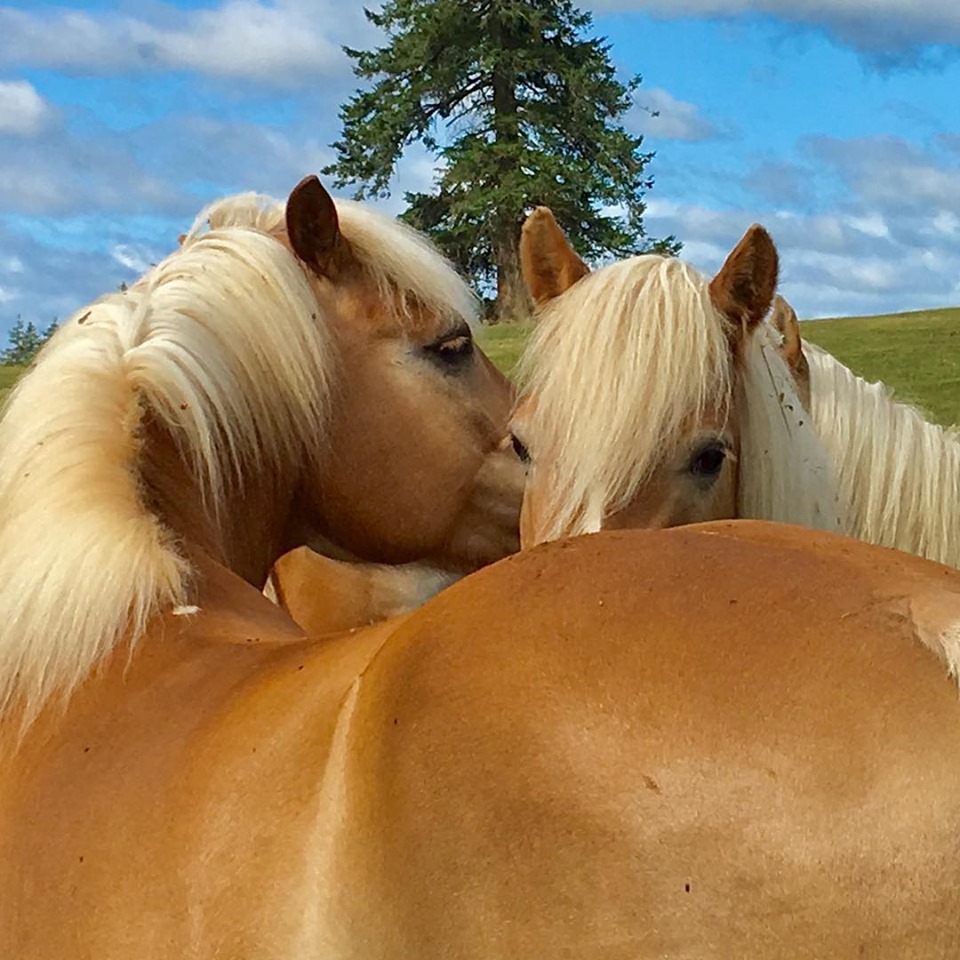
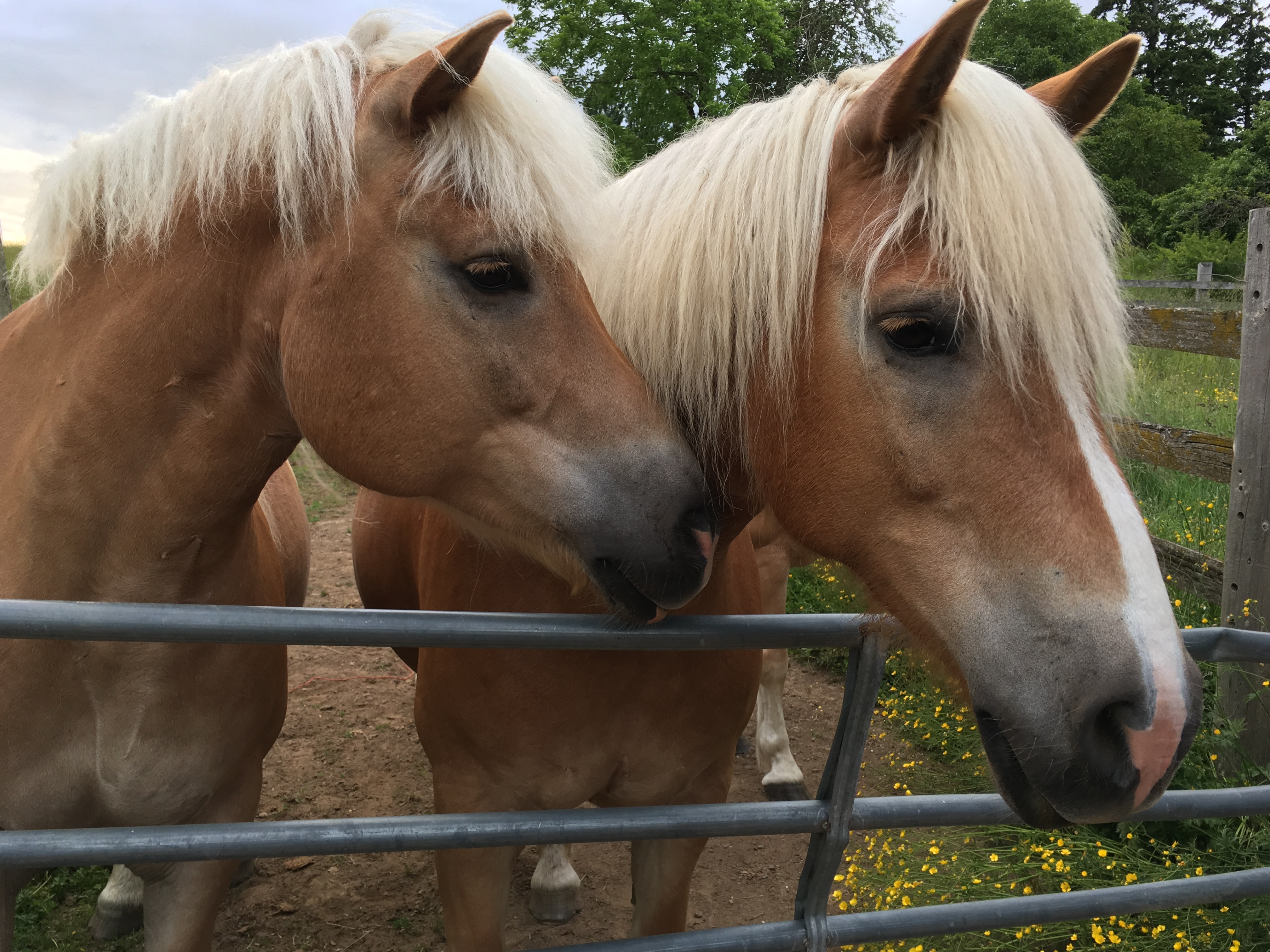
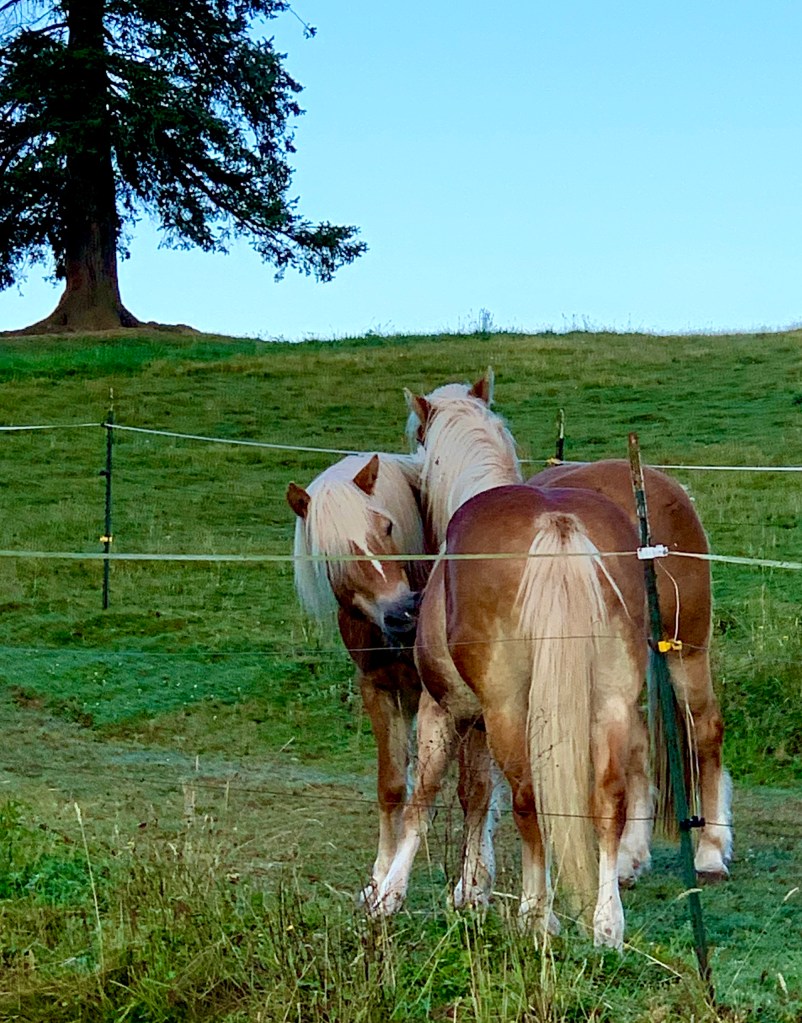
Is there anything as wonderful as a good friend?
Someone who doesn’t mind if you are getting long in the tooth and fluffy around the waist and getting white around the whiskers?
Someone who will listen to your most trivial troubles and nod and understand even if they really don’t?
Someone who will fix you up when you are hurt and celebrate when you are happy?
Someone who knows exactly where your itches are that need scratching, even if it means a mouthful of hair?
We all need at least one. We all need to be one for at least one other.
Isn’t it good to know? You’ve got a friend in me…
One-Time
Monthly
Yearly
Make a one-time or recurring donation to support daily Barnstorming posts
The object of a New Year is not that we should have a new year. It is that we should have a new soul and a new nose; new feet, a new backbone, new ears, and new eyes. Unless a man starts afresh about things, he will certainly do nothing effective. ~G.K.Chesterton “A Chesterton Calendar”
All days are sacred days to wake New gladness in the sunny air. Only a night from old to new; Only a sleep from night to morn. The new is but the old come true; Each sunrise sees a new year born. ~Helen Hunt Jackson from “New Year’s Morning”
On this New Year’s Day, I resolve to adopt better coping skills based on observing my horses’ adaptation to change.
As a horse keeper, I know how important a predictable routine is to my animals. They thrive on a schedule, with meal times at the same time every day and familiar people feeding and handling them. But it doesn’t always work out to keep things comfortably identical day to day.
Some days I have to feed early before the sun is up, so I’m flipping lights on in the barn when it is still night outside. The horses blink in their adjustment to the sudden light, leaping up from their shavings beds to shake off the sawdust remnants that cling to their coats. Some days I don’t get out to the barn quite when I’m expected, and I can hear them bouncing their empty water buckets and knocking the sides of their stalls with their hoofs, declaring their impatience at my tardiness.
On the days when the weather is terribly windy, wet and cold, the routine of going outside for the day is changed, and the horses must adapt to a day inside their stalls. After several days of establishing their indoor routine, the weather brightens and they are able to go back outside again. I vary their stalls so they become used to going in and out of any stall I ask them to use. I vary the walk to their outdoor enclosure as much as I’m able, to get them accustomed to a new path with unfamiliar sights, sounds and smells, and to trust me that I will get them safely to their destination even if it isn’t the way we took yesterday.
And I expect obedience even if things aren’t the same. Sometimes there is a subtle change in the scenery that I haven’t noticed but the horses always do. If something is a bit out of place from the previous day, or there is something new that wasn’t there before, the horse I’m leading often stops, gives a soft snort, and takes in the new configuration, trying to absorb it and accept it. Once settled, then the horse will move on, satisfied that all is well, even if everything is not the same.
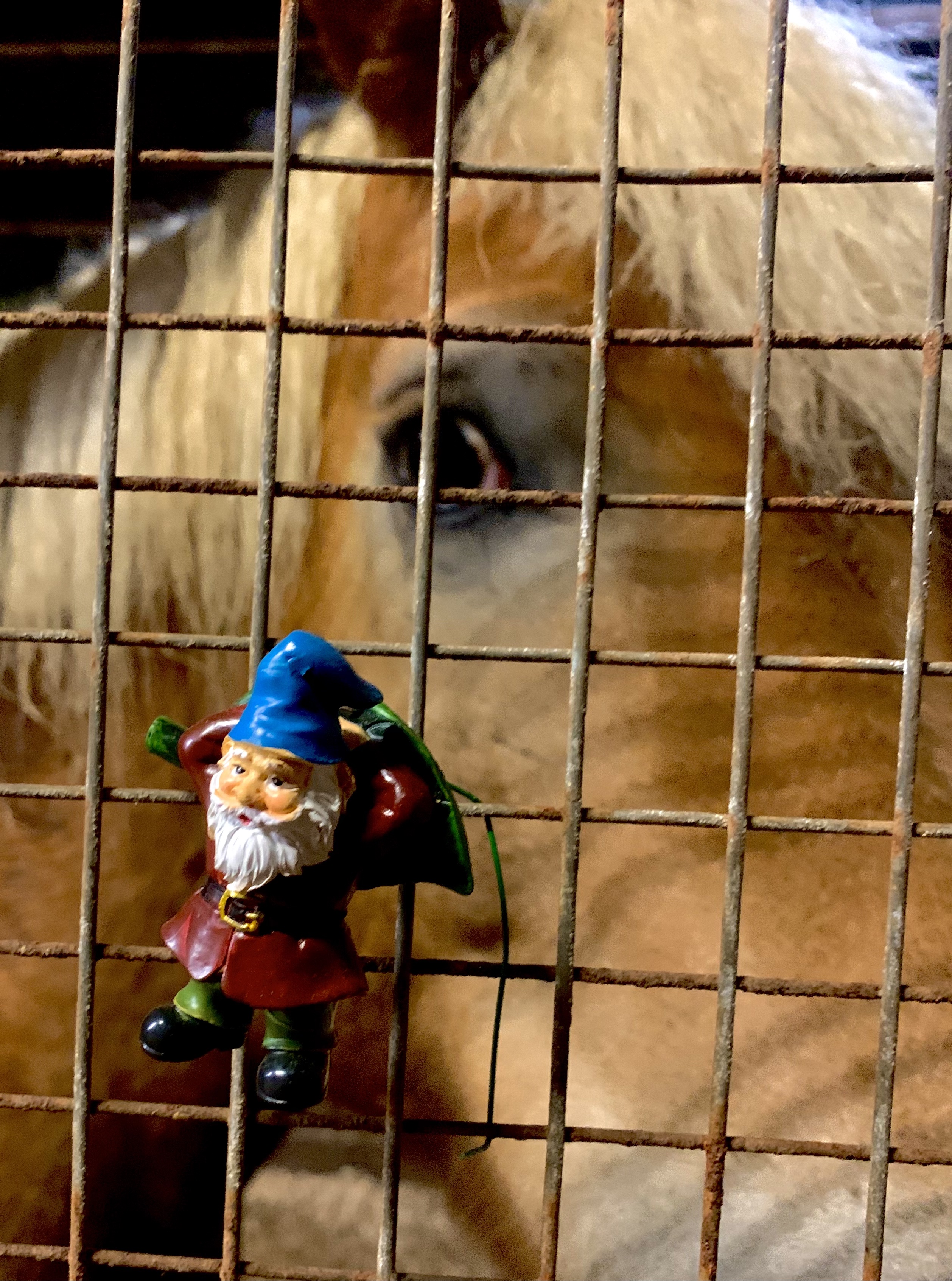
One day, I moved one of our garden gnomes to a new outpost in the yard. The horses were not amused. In their minds, he was not where he belonged and seeing him someplace unfamiliar undid them one by one. Once they accepted him in his new home, it was no longer a problem for them–until I moved him again just to keep them on their toes.
Today, I feel I’m too often like my horses in my reluctance to gracefully accept change. I prefer things familiar, safe and comfortable. Life rarely serves that up tidily, and in fact, most days are a jumble of coping with the unexpected. I’m not always sure the path I’m on is the straightest one, or the one with the fewest potholes, nor am I that confident that I’ve chosen the best path. I may stop, pull back, try to turn around, even snort a bit. Sometimes I may refuse to take another step.
But there is no turning back. Time leads irrevocably forward, with us in tow, and we must follow, however reluctant we may be. I’m grateful for the gentle flow of the hours and days into years, all too aware of the quickening pace as far more of my life has been lived out than lies ahead of me.
Perhaps what I’m needing most this new year is a slower walk – taking the time to look at all things with new eyes – breathing each breath appreciatively, to become keenly aware it was not my last.
One-Time
Monthly
Yearly
Make a one-time or recurring donation to support daily Barnstorming posts
Christmas Eve, and twelve of the clock. “Now they are all on their knees,” An elder said as we sat in a flock By the embers in hearthside ease. We pictured the meek mild creatures where They dwelt in their strawy pen, Nor did it occur to one of us there To doubt they were kneeling then.
So fair a fancy few would weave In these years! Yet, I feel, If someone said on Christmas Eve, “Come; see the oxen kneel, “In the lonely barton by yonder coomb Our childhood used to know,” I should go with him in the gloom, Hoping it might be so. ~Thomas Hardy “The Oxen”
Says a country legend told every year: Go to the barn on Christmas Eve and see what the creatures do as that long night tips over. Down on their knees they will go, the fire of an old memory whistling through their minds!
So I went. Wrapped to my eyes against the cold I creaked back the barn door and peered in. From town the church bells spilled their midnight music, and the beasts listened – yet they lay in their stalls like stone.
Oh the heretics! Not to remember Bethlehem, or the star as bright as a sun, or the child born on a bed of straw! To know only of the dissolving Now!
Still they drowsed on – citizens of the pure, the physical world, they loomed in the dark: powerful of body, peaceful of mind, innocent of history.
Brothers! I whispered. It is Christmas! And you are no heretics, but a miracle, immaculate still as when you thundered forth on the morning of creation! As for Bethlehem, that blazing star still sailed the dark, but only looked for me. Caught in its light, listening again to its story, I curled against some sleepy beast, who nuzzled my hair as though I were a child, and warmed me the best it could all night. ~Mary Oliver“Christmas Poem” from Goodness and Light
The winds were scornful, Passing by; And gathering Angels Wondered why
A burdened Mother Did not mind That only animals Were kind.
For who in all the world Could guess That God would search out Loneliness. ~Sr. M. Chrysostom, O.S.B. “The Stable”
Growing up on my childhood farm, remembering the magic of Christmas eve night, I bundled myself up to stay warm in our barn, to witness an unbelievable sight.
At midnight we knew the animals knelt down, speaking words we could all understand, to worship a Child born in Bethlehem town, in a barn, long ago in a far away land.
They were there that night, to see and to hear, the blessings that came from the sky. They patiently stood watch at the manger near, in a barn, while shepherds and kings stopped by.
My trips to the barn were always too late, our cows would be chewing, our chickens asleep, our horses breathing softly, cats climbing the gate, in our barn, there was never a neigh, moo or peep.
But I knew they had done it, I just missed it again! They were plainly so calm, well-fed and at peace in the sweet smelling straw, all snug in their pens, in a barn, a mystery, once more, took place.
Even now, I still bundle to go out Christmas eve, in the hope I’ll catch them just once more this time. Though I’m older and grayer, I still firmly believe in the barn, a Birth happened amid cobwebs and grime.
Our horses sigh low as they hear me come near, that tells me the time I hope for is now, they will drop to their knees without any fear in our barn, as worship, all living things bow.
I wonder anew at God’s immense trust for His creatures so sheltered that darkening night – the mystery of why of all places, His Son must begin life in a barn: a welcoming most holy and right. ~ “In the Barn” (written Christmas Eve 1999)
Latin text O magnum mysterium, et admirabile sacramentum, ut animalia viderent Dominum natum, iacentem in praesepio! Beata Virgo, cujus viscera meruerunt portare Dominum Iesum Christum. Alleluia!
English translation O great mystery, and wonderful sacrament, that animals should see the newborn Lord, lying in a manger! Blessed is the virgin whose womb was worthy to bear the Lord, Jesus Christ. Alleluia!
Jesus our brother, strong and good Was humbly born in a stable rude And the friendly beasts around him stood Jesus our brother, strong and good “I, ” said the donkey, shaggy and brown “I carried his mother up hill and down I carried his mother to Bethlehem town” “I, ” said the donkey, shaggy and brown “I, ” said the cow, all white and red “I gave him my manger for his bed I gave him my hay to pillow his head” “I, ” said the cow, all white and red “I, ” said the sheep with curly horn “I gave him my wool for his blanket warm He wore my coat on Christmas morn” “I, ” said the sheep with curly horn “I, ” said the dove from the rafters high “I cooed him to sleep so he would not cry We cooed him to sleep, my mate and I” “I, ” said the dove from rafters high Thus every beast by some good spell In the stable dark was glad to tell Of the gifts they gave Emmanuel Of the gifts they gave Emmanuel
Like waves of fire, they flared forward and to my eyes filled the whole world, empty till then. Perfect, ablaze, they were like ten gods with pure white hoofs, with manes like a dream of salt.
Their rumps were worlds and oranges.
Their color was honey, amber, fire.
There, in silence, at mid-day, in that dirty, disordered winter, those intense horses were the blood the rhythm, the inciting treasure of life.
I looked. I looked and was reborn: for there, unknowing, was the fountain, the dance of gold, heaven and the fire that lives in beauty.
I have forgotten that dark winter.
I will not forget the light of the horses. ~Pablo Neruda from “Horses”
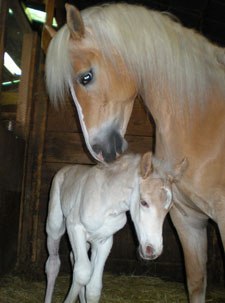
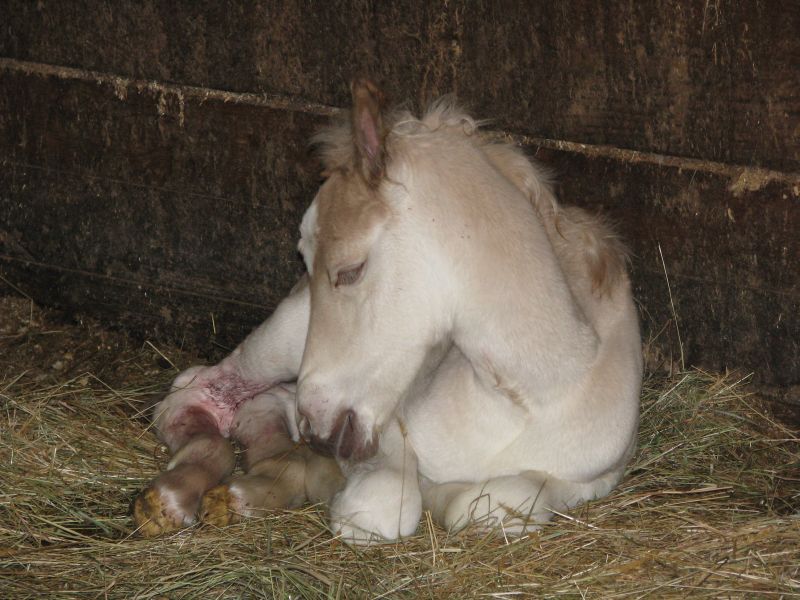
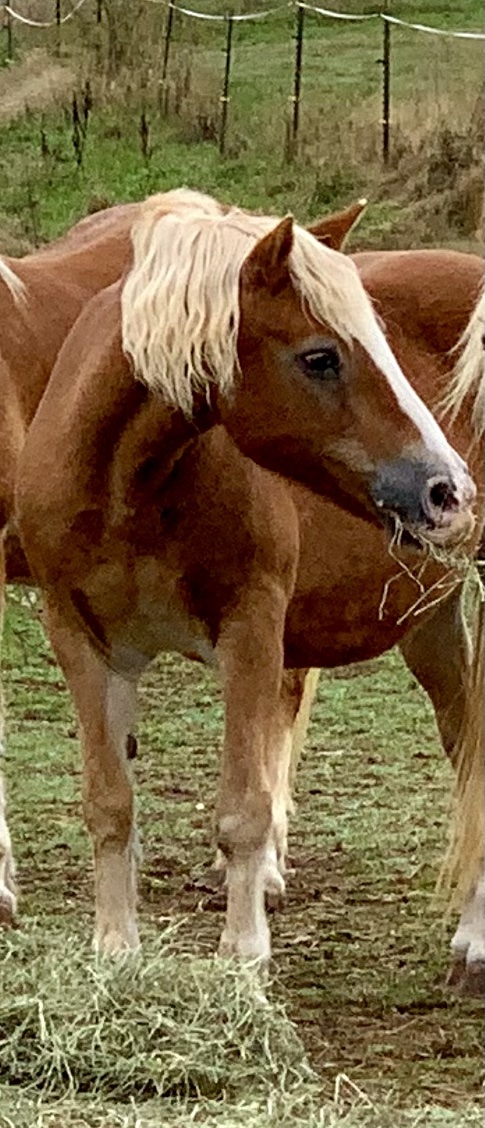
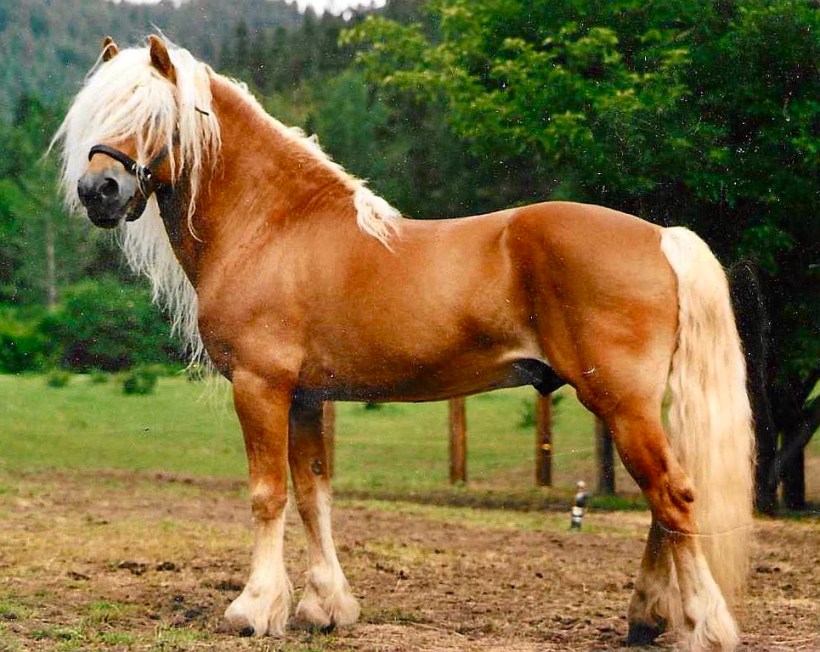
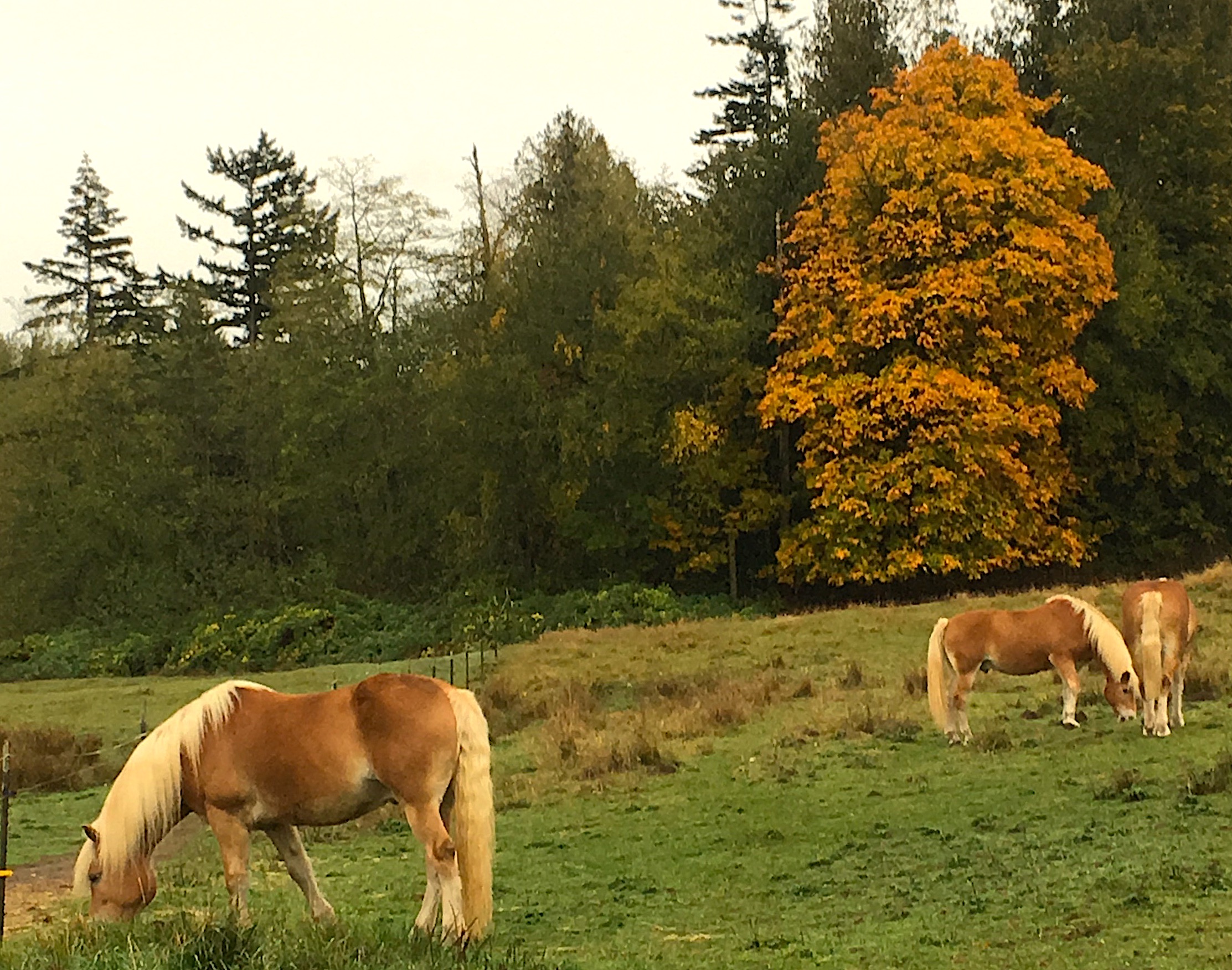
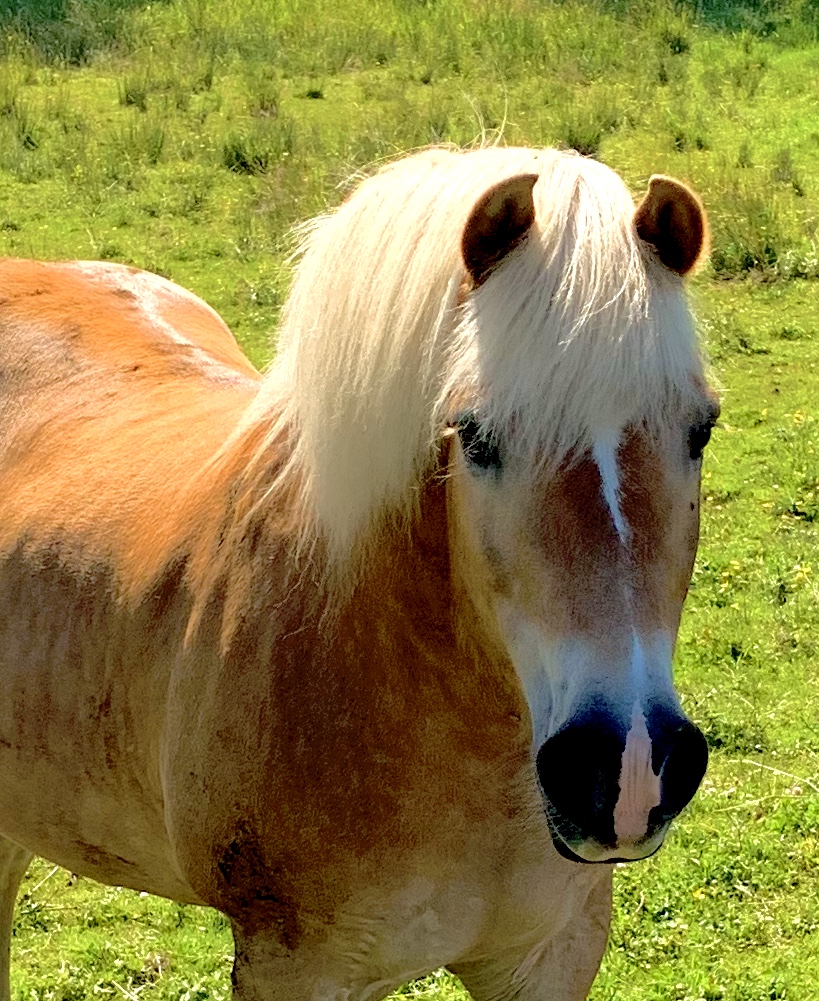
Haflingers have lived on our farm more than half my life. Like me, most of them are now retired, living a quiet life on pasture most of the year, and warm and dry in the barn during the winter months.
Trillium was one of our first foals born here, over thirty years ago. She had a pure Dutch pedigree with parents both imported from Holland. When she was five, Trillium became the McKee family’s first Haflinger, giving them three colts, and many trail rides over the years. She came back to our farm after fifteen years away, resuming her alpha mare role in our herd and worked part time as a schooling horse for beginning riders. She was a mainstay in our Haflinger display at our local fair, allowing hundreds of children to sit on her back for their first ever encounter with a horse.
She has been fully retired for a number of years as her joints became arthritic; she loved her time out on pasture, even during the last few months as she began losing weight and becoming more frail. The last cold spell was particularly hard on her so I had scheduled the inevitable appointment with the vet for her final goodbye for later this week.
Last night she ate all her hay and passed the usual amount of manure. Yet this morning, when I entered the barn to begin morning chores, I found her down, breathing her last breaths. Clearly something sudden had taken her down – perhaps a stroke or heart attack. Within ten minutes of my arrival, she was gone, just like that. She had decided to leave on her own terms, dying in the very same barn she was born in. How many horses ever have that privilege?
Trillium, like our other Haflingers, belonged on this farm even more than I do: she was born to graze on steep hillsides, to find the tenderest of clover leafs hiding among the bulrushes and thistles. She loved to laze about under the branches, swishing flies.
Most of all, Haflingers are the copper and gold so badly needed in the gray light of a northwest fall and winter. When my eyes and heart feel empty and in need of filling up, I go out into the fields to absorb the riches of their honey amber coats, their deep brown eyes, their stark white mane and tails. Trillium was always a rich and treasured part of the scenery.
Of course, I know the aging Haflingers won’t be here forever, nor will I. Like Trillium, we will someday be dust – no longer glinting of gold nor burning with the fire of life on this earth. But the memory of our light is forever as nothing can extinguish a beauty that is heaven-sent, whether it is horse or human.
You will be sorely missed, Trillium – may heaven’s clover always be sweet in your mouth.
Trillium enjoying breakfast just a few months ago
Mando (sire) – photo by Linda KindleTrillium as a foal with dam Tamara van de BijvankTrillium and Emily 29 years ago at the fairTrillium heading into the golden forest of heaven
One-Time
Monthly
Yearly
Make a one-time or recurring donation to support daily Barnstorming posts
The songs of small birds fade away into the bushes after sundown, the air dry, sweet with goldenrod. Beside the path, suddenly, bright asters flare in the dusk. The aged voices of a few crickets thread the silence. It is a quiet I love, though my life too often drives me through it deaf. Busy with costs and losses, I waste the time I have to be here—a time blessed beyond my deserts, as I know, if only I would keep aware. The leaves rest in the air, perfectly still. I would like them to rest in my mind as still, as simply spaced. As I approach, the sorrel filly looks up from her grazing, poised there, light on the slope as a young apple tree. A week ago I took her away to sell, and failed to get my price, and brought her home again. Now in the quiet I stand and look at her a long time, glad to have recovered what is lost in the exchange of something for money. ~Wendell Berry “The Sorrel Filly”
I am reminded at the end of a week of dark and wet and cold with chores not done yet, and horses waiting to be fed, of the value of decades of moments spent with long-lashed eyes, wind-swept manes, and velvet muzzles.
True, it appears to others to be time and money wasted. But for a farmer like me, sometimes deaf and blind to what is in front of me every day, not all valuables are preserved in a lock box.
Golden treasure can have four hooves, a tail, with a rumbling greeting asking if I’d somehow gotten lost since I’m a little later than usual and they were a bit concerned I’d forgotten them.
Only then I remember where my home is and how easy it is to wander from the path that somehow always leads me back here.
One-Time
Monthly
Yearly
Make a one-time or recurring donation to support daily Barnstorming posts
And then, that evening Late in the summer the strange horses came.
In the first moment we had never a thought That they were creatures to be owned and used.
Since then they have pulled our plows and borne our loads, But that free servitude still can pierce our hearts. Our life is changed; their coming our beginning. ~Edwin Muir from “The Horses”
There is nothing that truly compels a horse to wear a saddle, pull a heavy burden, chew a cold bit until it foams warm — no fear of whip or spur or harsh word. They, so much more powerful than we are, choose the work, to do what is needed, to serve freely, to be there because they were asked — whether asked nicely or not.
How much more we learn from the lather of their sweaty grace — how to choose the labor that changes lives, how to offer up love in gratitude for the reward of a scratch in just the right place and a nose buried in sweet clover.
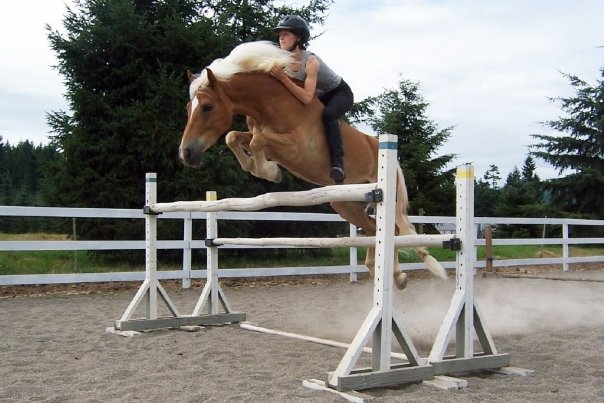
Chesna Klimek free-jumping her Haflinger gelding Pippin
One-Time
Monthly
Yearly
Make a one-time or recurring donation to support daily Barnstorming posts
Broad August burns in milky skies, The world is blanched with hazy heat; The vast green pasture, even, lies Too hot and bright for eyes and feet.
Amid the grassy levels rears The sycamore against the sun The dark boughs of a hundred years, The emerald foliage of one.
Lulled in a dream of shade and sheen, Within the clement twilight thrown By that great cloud of floating green, A horse is standing, still as stone.
He stirs nor head nor hoof, although The grass is fresh beneath the branch; His tail alone swings to and fro In graceful curves from haunch to haunch.
He stands quite lost, indifferent To rack or pasture, trace or rein; He feels the vaguely sweet content Of perfect sloth in limb and brain. ~William Canton “Standing Still”
I flunked sloth long ago. Perhaps I was born driven. My older sister, never a morning person, was thoroughly annoyed to share a bedroom with a toddler who awoke chirpy and cheerful, singing “Twinkle Twinkle” for all to hear and ready to conquer the day.
Since retiring, I admit I am becoming accustomed now to sloth-dom. I am still too cheerful in the early morning. It is a distinct character flaw.
Even so, I’m not immune to the attractions of a hot hazy day of doing absolutely nothing but standing still switching at flies. I envy our retired ponies in the pasture who spend the day grazing, moseying, and lazing because … I have worked hard to make that life possible for them.
I want to use my days well yet I know August was invented for lulling about. Maybe there is a reason to be here beyond just warning the flies away but I’m not working hard to find out what it might be. So perhaps I’ll get a passing grade in sloth after all.
One-Time
Monthly
Yearly
Make a one-time or recurring donation to support daily Barnstorming posts
Photo of Aaron Janicki haying with his Oberlander team in Skagit County courtesy of Tayler RaeBenjamin Janicki of Sedro Woolley raking hay with his team of Oberlanders
Travel as a backward step. You journey until you find a meadow where wildflowers grow with pre-factory-farming copiousness, a horse-drawn landscape where hay is saved in older ways, to revive the life you lived once, catch up with your past. ~Dennis O’Driscoll from Time Pieces (2002)
… The Amish have maintained what I like to think is a proper scale, largely by staying with the horse. The horse has restricted unlimited expansion. Not only does working with horses limit farm size, but horses are ideally suited to family life. With horses you unhitch at noon to water and feed the teams and then the family eats what we still call dinner. While the teams rest there is usually time for a short nap. And because God didn’t create the horse with headlights, we don’t work nights. Amish farmer David Kline in Great Possessions
photo by Tayler Rae
One evening I stopped by the field to watch the hay rake drawn toward me by two black, tall, ponderous horses who stepped like conquerors over the fallen oat stalks, light-shot dust at their heels, long shadows before them. At the ditch the driver turned back in a wide arc, the off-horse scrambling, the near-horse pivoting neatly. The big side-delivery rake came about with a shriek— its tines were crashing, the iron-bound tongue groaned aloud— then, Hup, Diamond! Hup, Duke! and they set off west, trace-deep in dust, going straight into the low sun.
The clangor grew faint, distance and light consumed them; a fiery chariot rolled away in a cloud of gold and faded slowly, brightness dying into brightness. The groaning iron, the prophesying wheels, the mighty horses with their necks like storms— all disappeared; nothing was left but a track of dust that climbed like smoke up the evening wind. ~Kate Barnes “The Hay Rake” from Where the Deer Are
My grandparents owned the land, worked the land, bound to the earth by seasons of planting and harvest.
They watched the sky, the habits of birds, hues of sunset, the moods of moon and clouds, the disposition of air. They inhaled the coming season, let it brighten their blood for the work ahead.
Soil sifted through their fingers imbedded beneath their nails and this is what they knew; this rhythm circling the years. They never left their land; each in their own time settled deeper. ~Lois Parker Edstrom “Almanac” from Night Beyond Black.
Nearing 68, I am old enough to have parents who both grew up on farms worked by horses, one raising wheat and lentils in the Palouse country of eastern Washington and the other logging in the woodlands of Fidalgo Island of western Washington. The horses were crucial to my grandfathers’ success in caring for and tilling the land, seeding and harvesting the crops and bringing supplies from town miles away. Theirs was a hardscrabble life in the early 20th century with few conveniences. Work was year round from dawn to dusk; caring for the animals came before any human comforts. Once night fell, work ceased and sleep was welcome respite for man and beast.
In the rural countryside where we live now, we’ve been fortunate enough to know people who still dabble in horse farming, whose draft teams are hitched to plows and mowers and manure spreaders as they head out to the fields to recapture the past. Watching a good team work with no diesel motor running means hearing bird calls from the field, the steady footfall of the horses, the harness chains jingling, the leather straps creaking, the machinery shushing quietly as gears turn and grass lays over in submission. No ear protection is needed. There is no clock needed to pace the day. There is a rhythm of nurture when animals instead of engines are part of the work day. The gauge for taking a break is the amount of foamy sweat on the horses and how fast they are breathing.It is time to stop and take a breather, it is time to start back up do a few more rows, it is time to water, it is time for a meal, it is time for a nap, it is time for a rest in a shady spot. This is gentle use of the land with four footed stewards who deposit right back to the soil the digested forage they have eaten only hours before.
Our modern agribusiness megafarm fossil-fuel-powered approach to food production has bypassed the small family farm which was so dependent on the muscle power of humans and animals. In our move away from horses worked by skilled teamsters, what has been gained in high production values has meant loss of self-sufficiency and dedicated stewardship of a particular plot of ground. Draft breeds, including the Haflinger horses we raise, now are bred for higher energy with lighter refined bone structure meant more for eye appeal and floating movement, rather than the sturdy conformation and unflappable low maintenance mindset needed for pulling work. Modern children are bred for different purpose as well, no longer raised to work together with other family members for a common purpose of daily survival. Their focus at school is waning as they have no morning farm chores when they get up, too little physical work to do before they arrive at their desks in the morning. Their physical energy, if directed at all, is directed to competitive sports, engaged in fantasy combat rather than winning a very real victory over hunger.
I am encouraged when young people still reach for horse collars and bridles, hitch up their horses and do the work as it used to be done. All is not lost if we can still make incremental daily progress, harnessed together as a team with our horses, tilling for truth and harvesting hope.
photo by Joel DeWaardphoto by Joel DeWaard
I like farming. I like the work. I like the livestock and the pastures and the woods. It’s not necessarily a good living, but it’s a good life. I now suspect that if we work with machines the world will seem to us to be a machine, but if we work with living creatures the world will appear to us as a living creature. That’s what I’ve spent my life doing, trying to create an authentic grounds for hope. ~Wendell Berry, horse farmer, essayist, poet, professor
One-Time
Monthly
Yearly
Make a one-time or recurring donation to support daily Barnstorming posts
O! for a horse with wings! ~William Shakespeare from Cymbeline
photo by Bette Vander Haakphoto by Bette Vander Haak
Be winged. Be the father of all flying horses. ~C.S. Lewis from The Magician’s Nephew
photo by Bette Vander Haak
photo by Bette Vander Haak
One reason why birds and horses are happy is because they are not trying to impress other birds and horses. ~Dale Carnegie
photo by Bette Vander Haakphoto by Bette Vander Haak
When I bestride him, I soar, I am a hawk: he trots the air; the earth sings when he touches it; ~William Shakespeare from Henry V
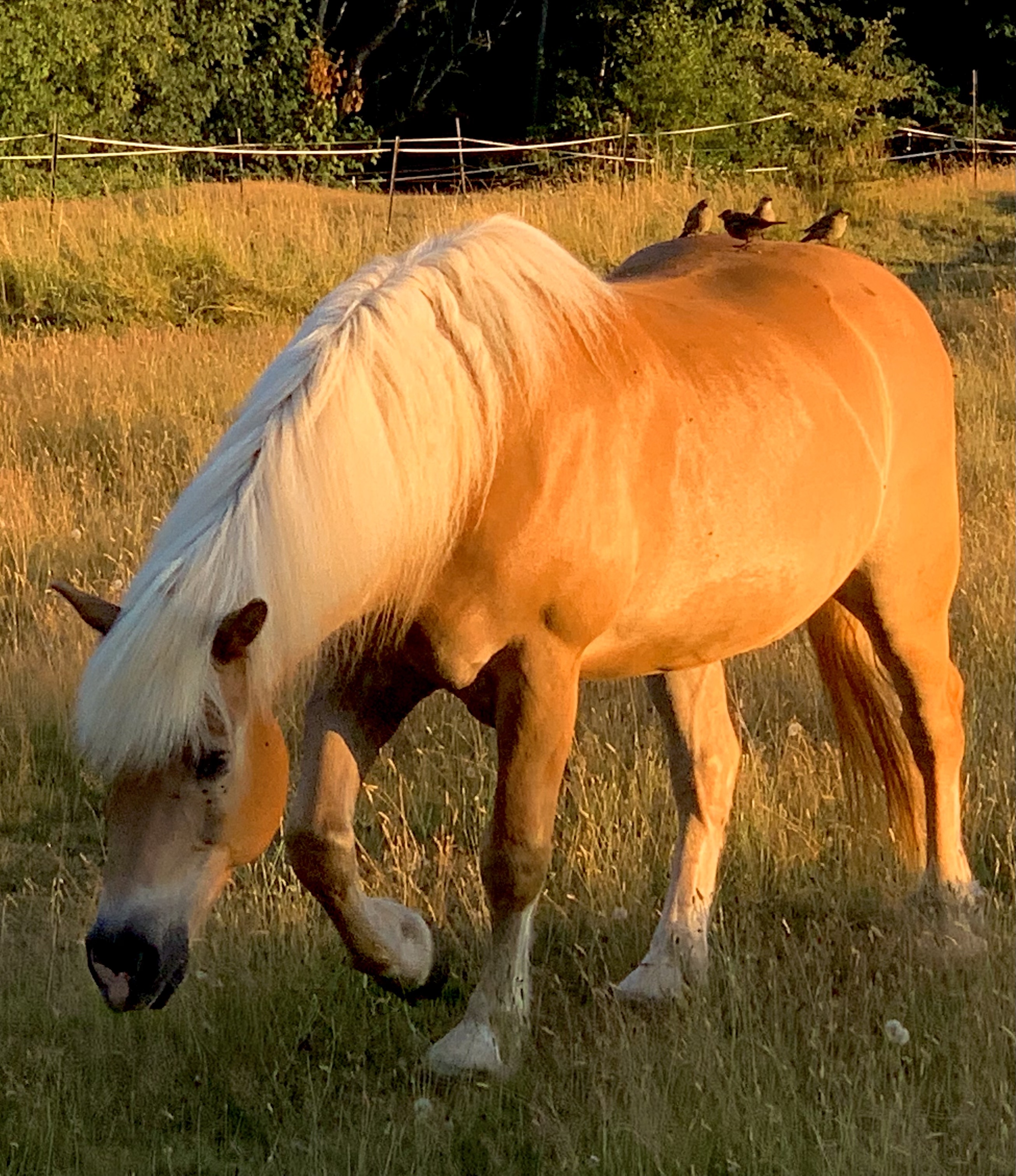
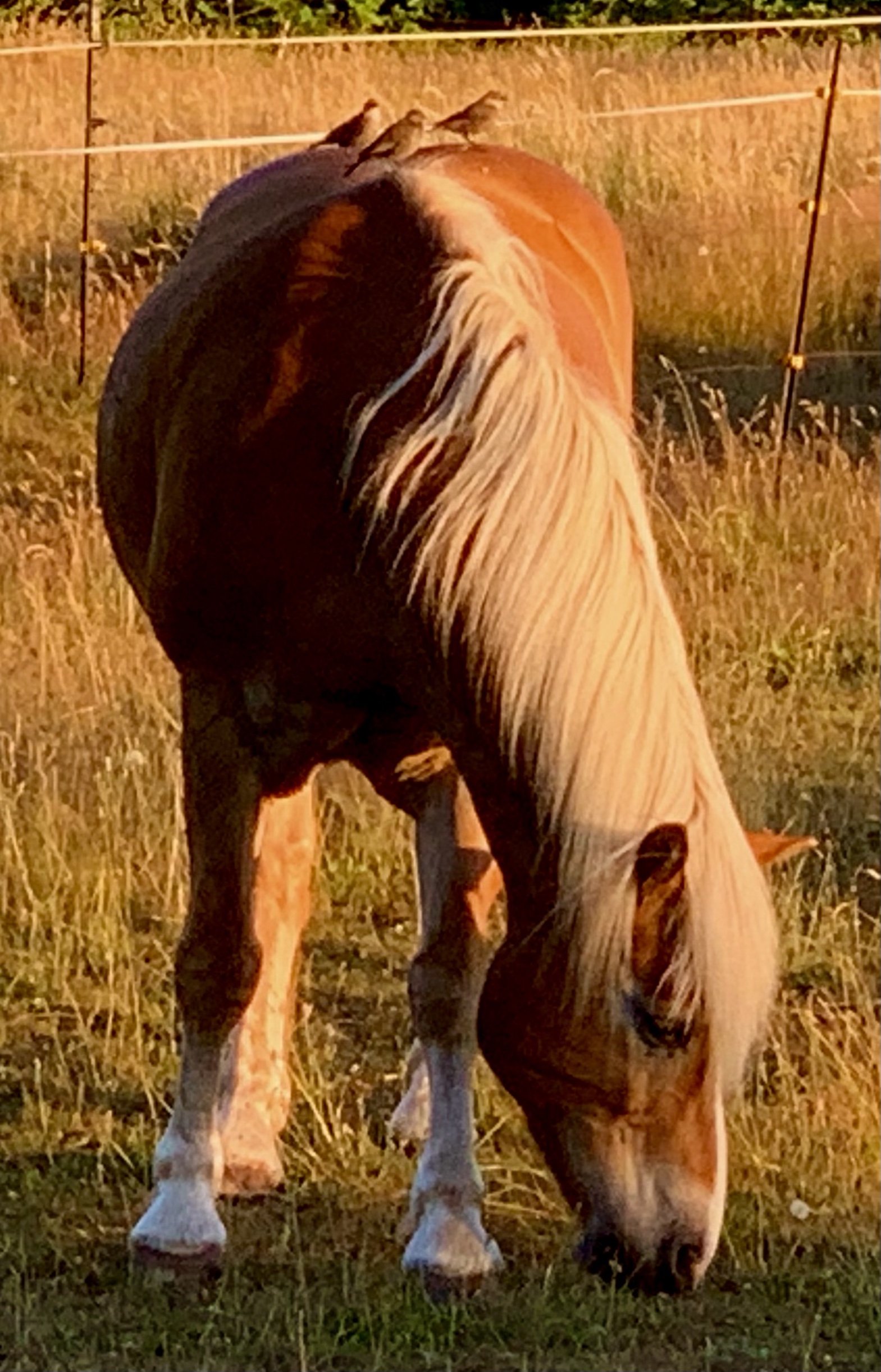
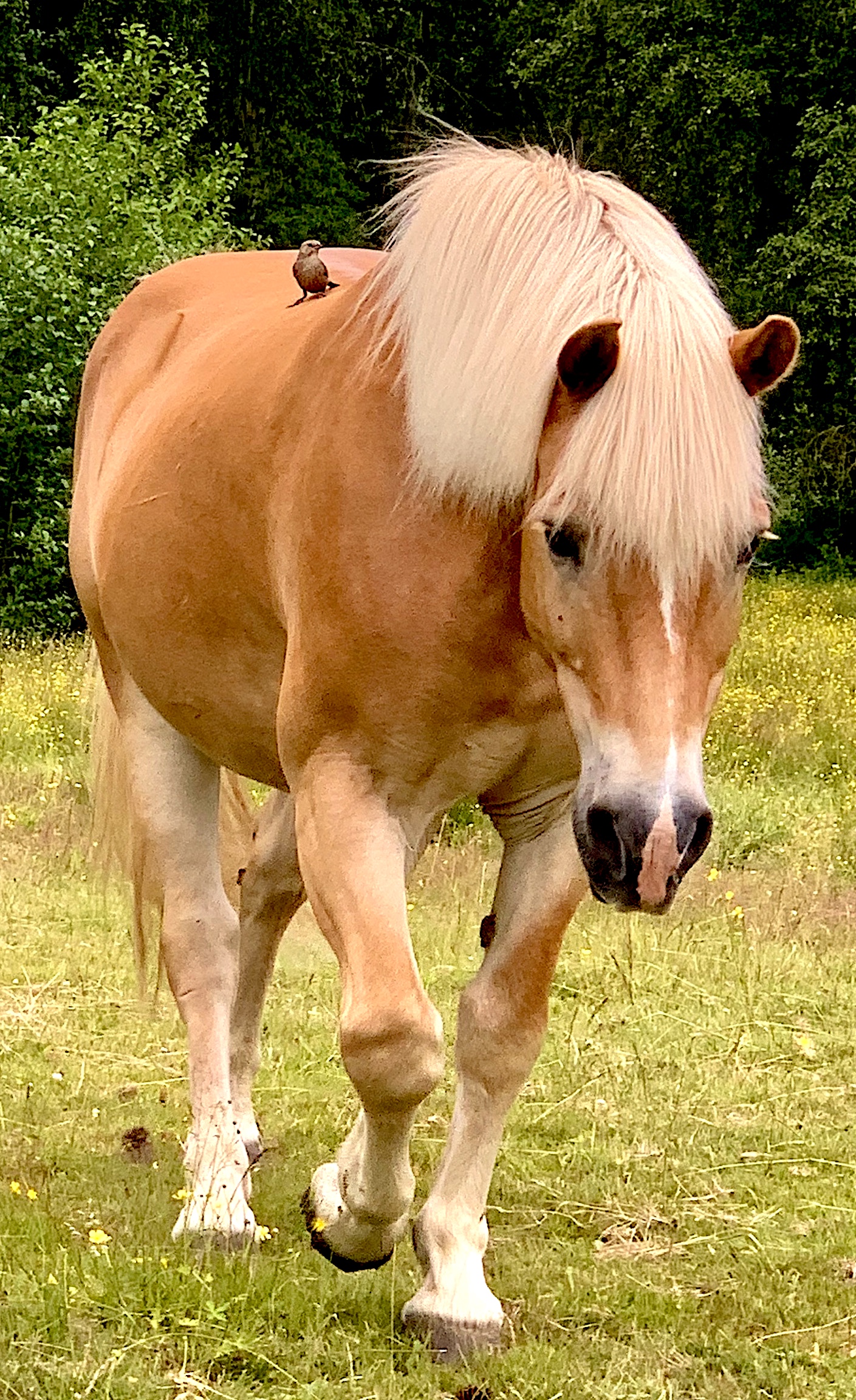
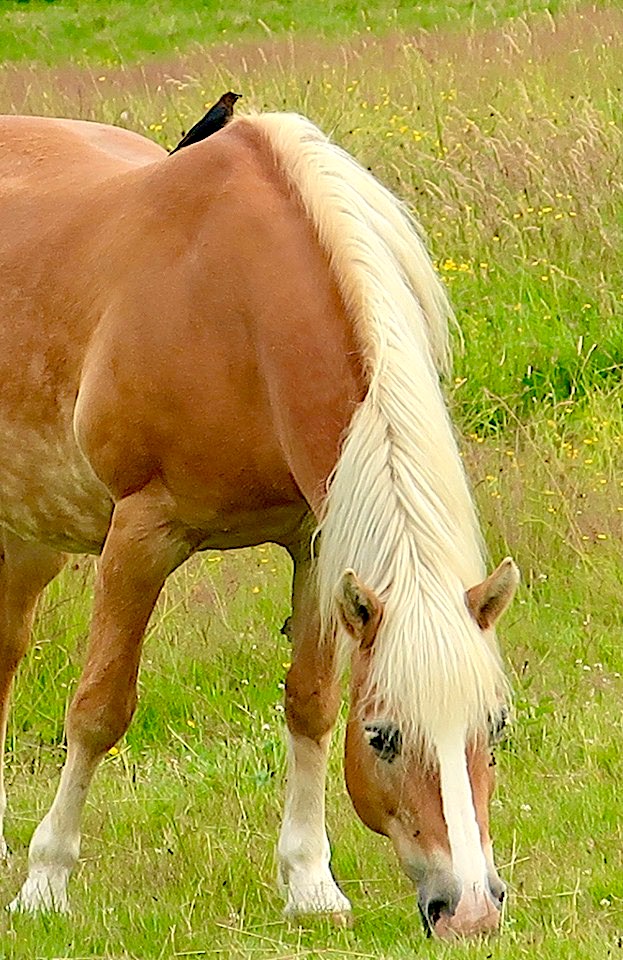
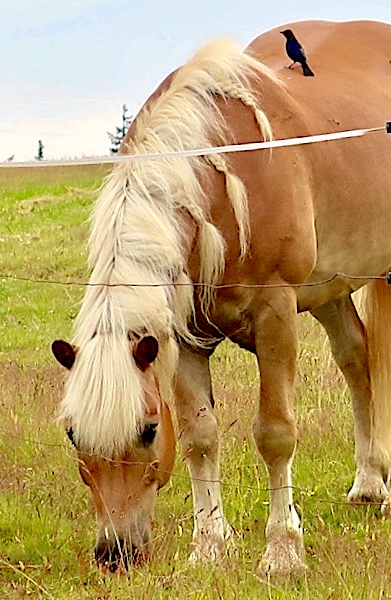
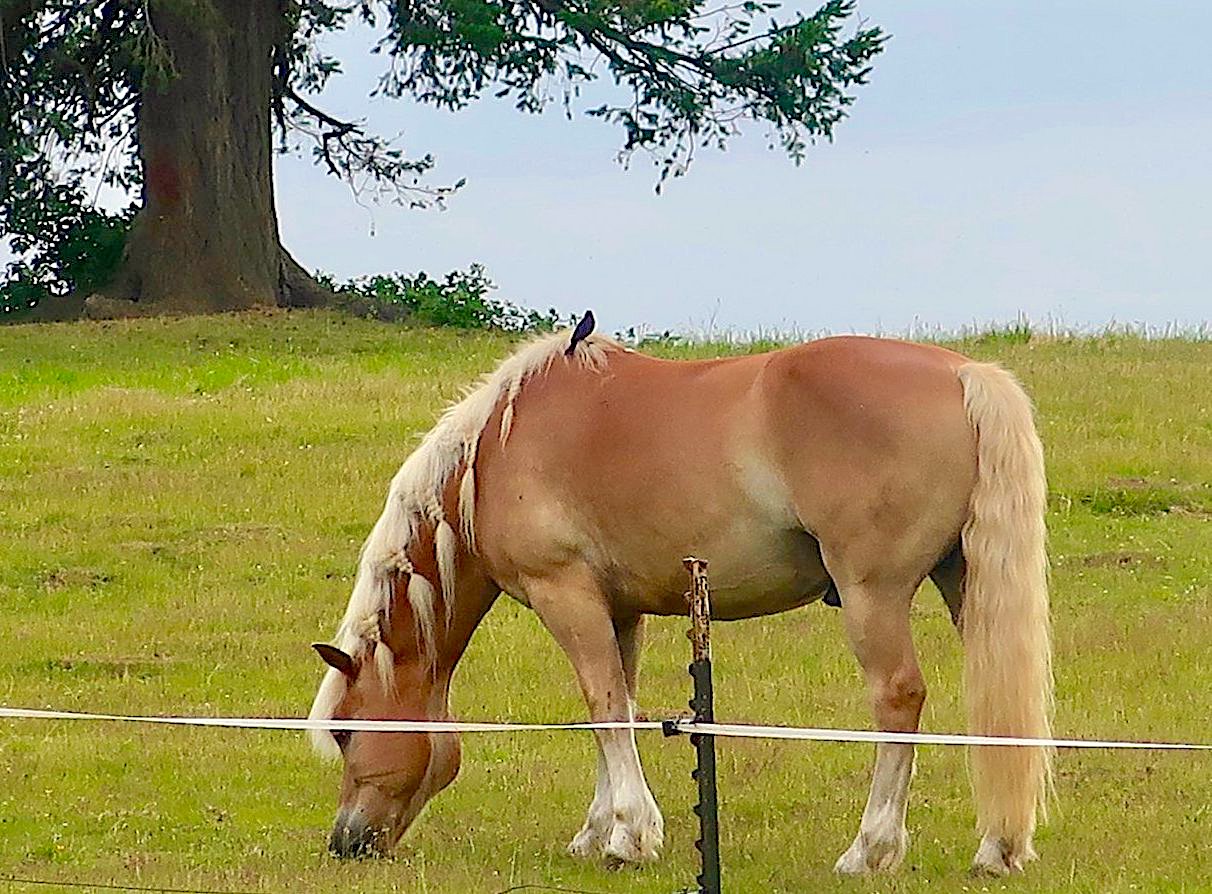
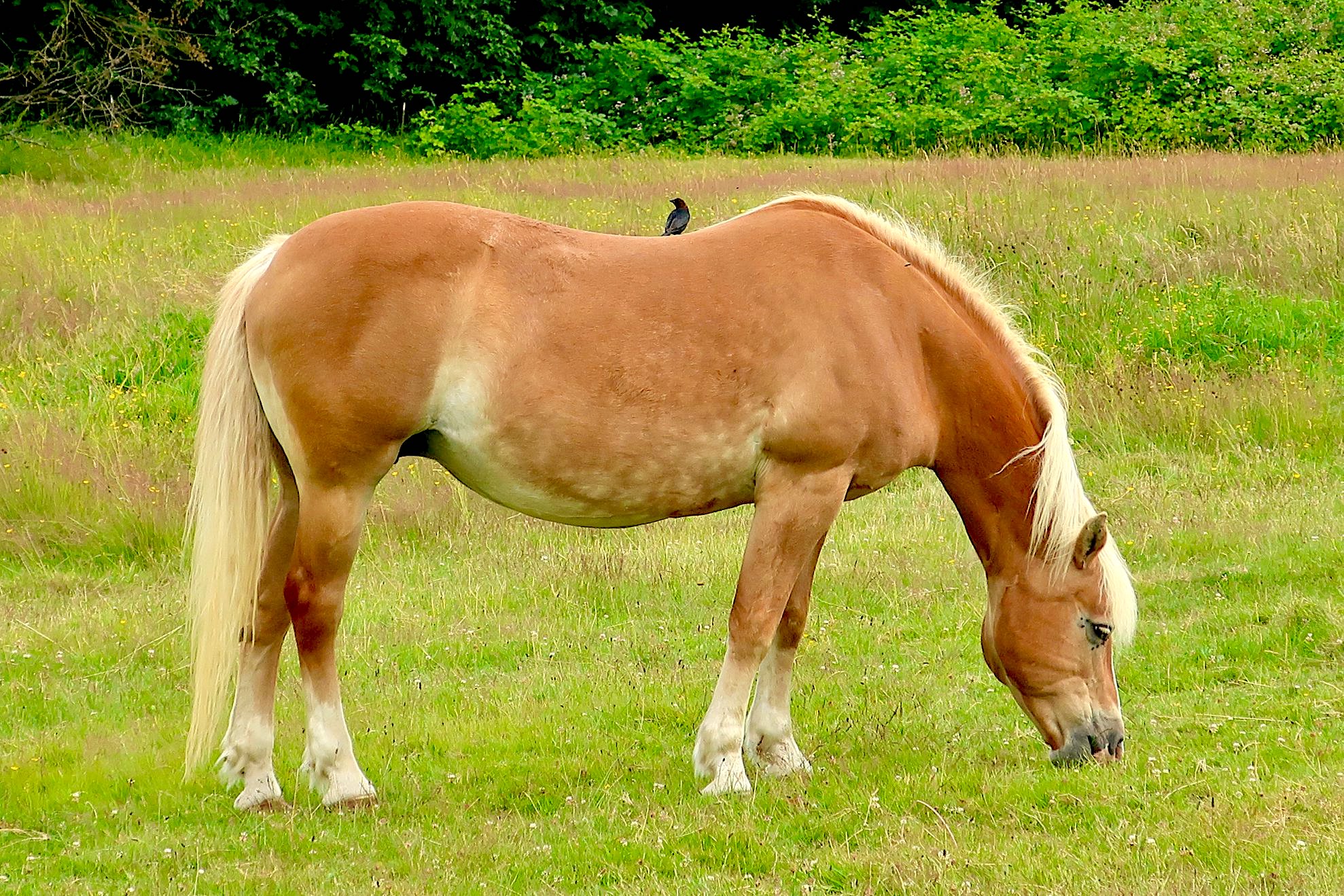
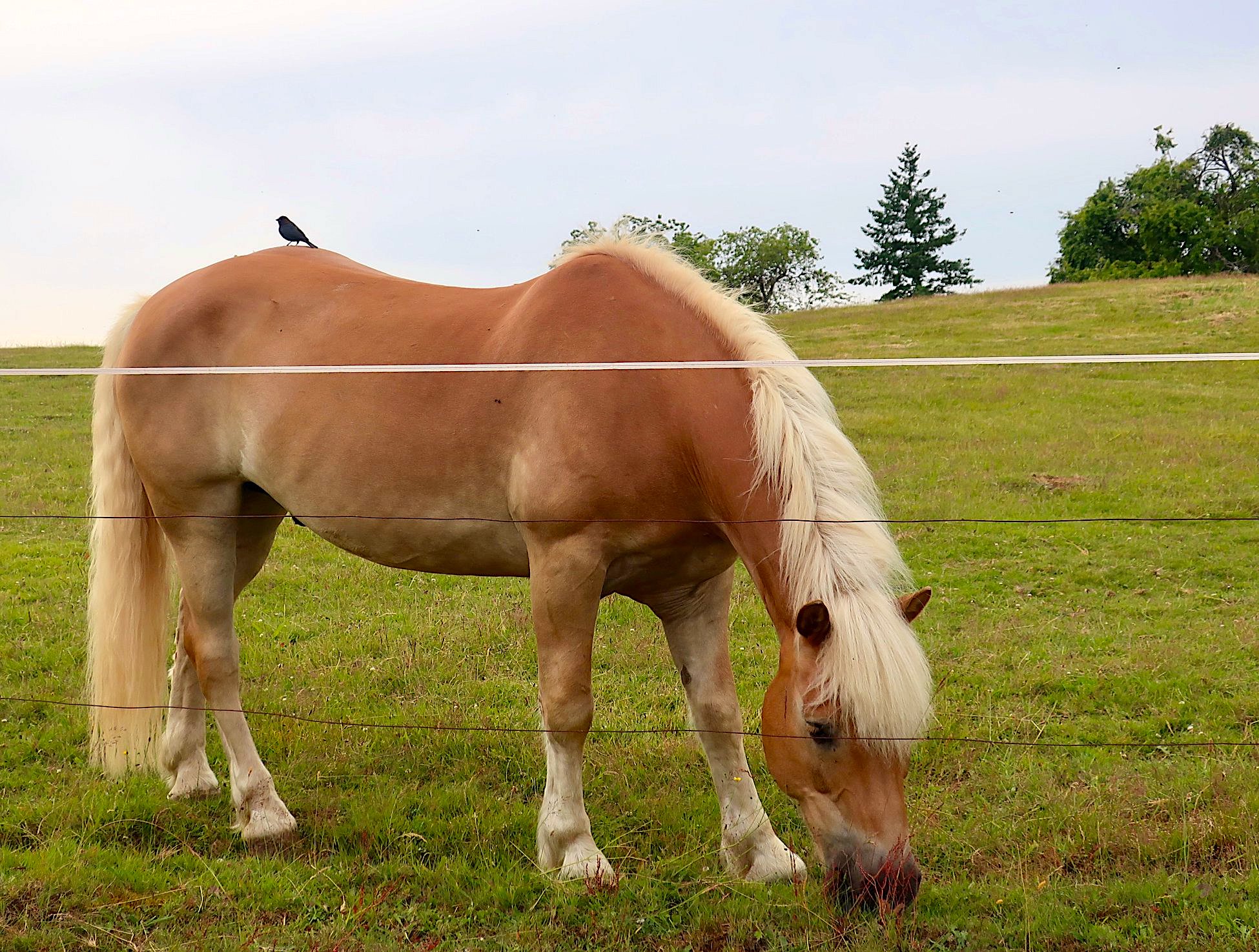
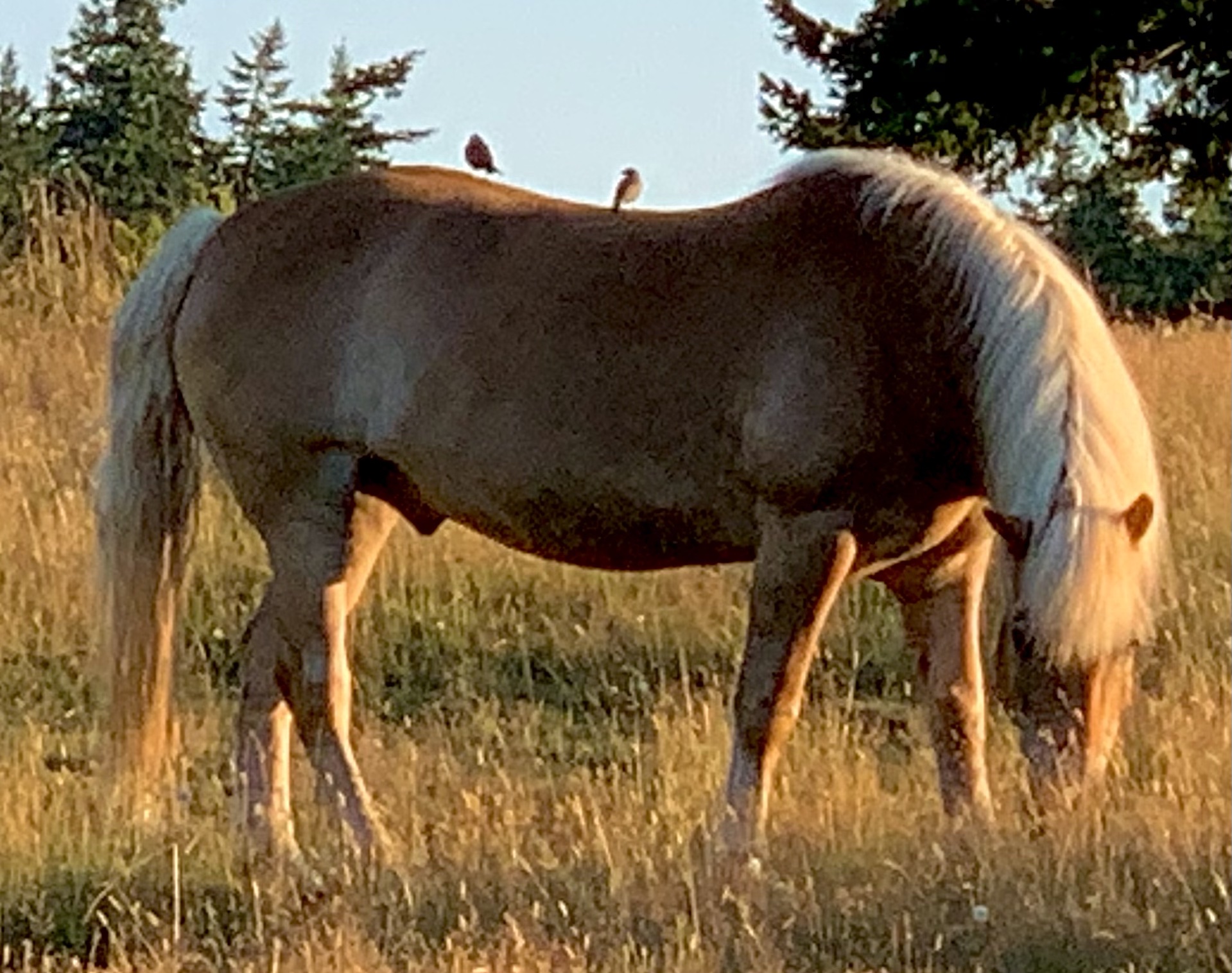
We all need someone along for the ride with us, blessing us with their company — a precious friend who has our back and scratches it wonderfully – helping to keep the biting flies away by gobbling them up.
It is symbiosis at its best: a relationship built on mutual trust and helpfulness. In exchange for relief from annoying insects that a tail can’t flick off, a Haflinger horse serves up bugs on a smorgasbord landing platform located safely above farm cats and marauding coyotes.
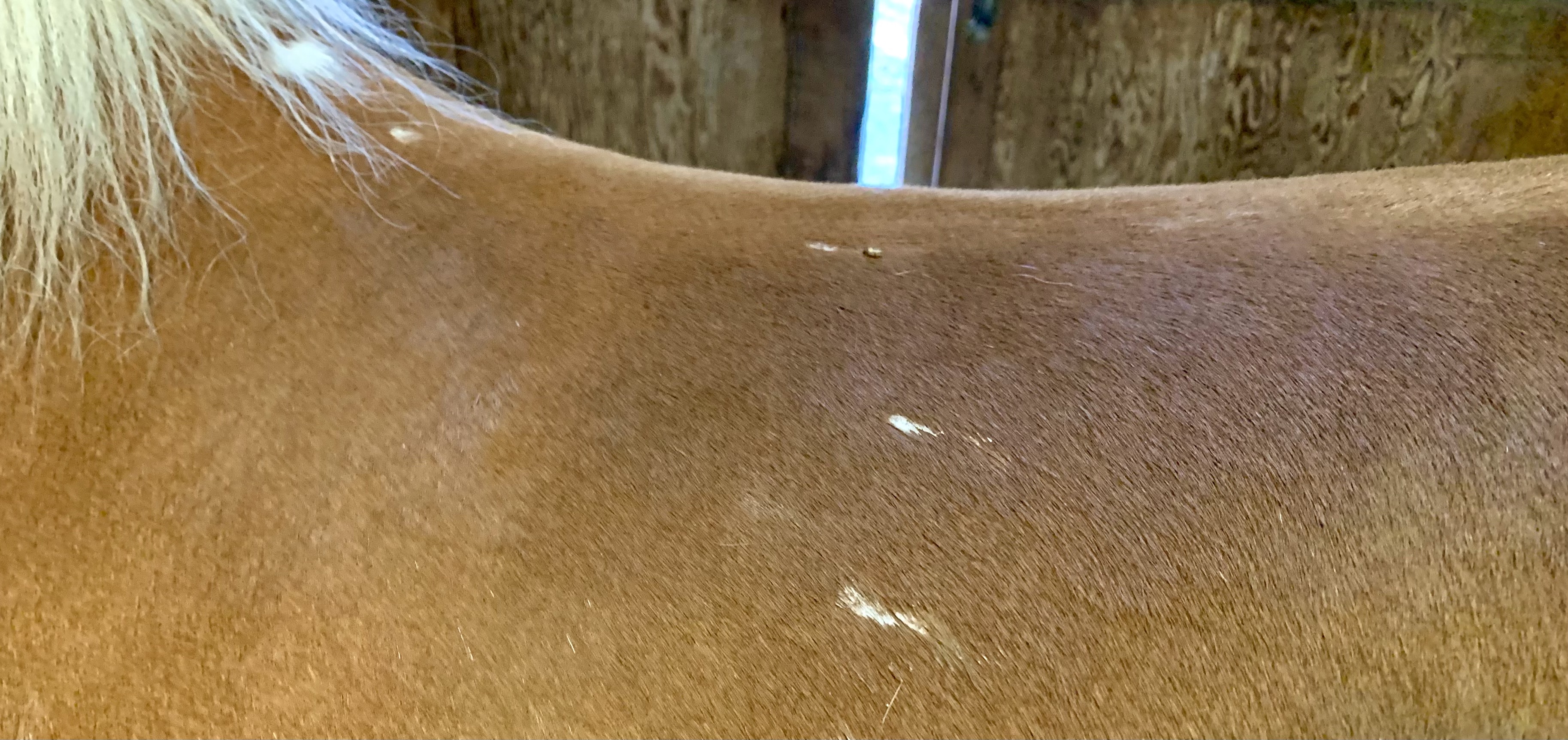
Thanks to their perpetual full meal deals, these cowbirds do leave generous “deposits” behind that need to be brushed off at the end of the day. Like any good friendship, cleaning up the little messes left behind is a small price to pay for the bliss of companionable comradeship.
We’re buds after all – best forever friends, trotting the air while the earth sings along.
And this is exactly what friends are for: one provides the feast while the other provides the wings, even when things get messy.
Be winged. Be fed. Together.
One-Time
Monthly
Yearly
Make a one-time or recurring donation to support daily Barnstorming posts



















 Barnstorming