A Difficult Game Indeed

The chief difficulty Alice found at first
was in managing her flamingo:
she succeeded in getting its body tucked away,
comfortably enough, under her arm,
with its legs hanging down, but generally,
just as she had got its neck nicely straightened out,
and was going to give the hedgehog
a blow with its head,
it would twist itself round and look up in her face,
with such a puzzled expression
that she could not help bursting out laughing:
and when she had got its head down,
and was going to begin again,
it was very provoking to find that
the hedgehog had unrolled itself,
and was in the act of crawling away….
Alice soon came to the conclusion
that it was a very difficult game indeed. 

~Lewis Carroll from Alice in Wonderland

Lewis Carroll Illustration
photo by Chris Duppenthaler

What a difficult game we find ourselves playing.

Does anyone understand the rules anymore?

Handed an uncooperative gangly mallet,
our aim is hopelessly thwarted.

The furry round target takes one look, sees no point, so wanders off, seeking a friendlier game to play somewhere else.

These are absurd times for humans and hedgehogs.

photo by Chris Duppenthaler

Weeds are Flowers Too…

Weeds are flowers too, once you get to know them…
~A.A.Milne from Winnie the Pooh (Eeyore)

What would the world be, once bereft
Of wet and wildness? Let them be left,
O let them be left, wildness and wet;
Long live the weeds and the wilderness yet.
~Gerard Manley Hopkins from “Inversnaid”

A weed is a plant whose virtues have not yet been discovered.
~Ralph Waldo Emerson from Fortune of the Republic   

I’ve always identified with weeds and wildflowers
more than cultivated blooms.
Even those which are thorny, bristly, spreading willy-nilly.

I too have undiscovered virtues –
I’m fluffy,
I thrive where I’m not necessarily wanted or needed,
I tend to be resilient through frost, drought or flood.  

The wild persistence of weeds inspires me
to just let most of them be, 
though stinging nettles, poison oak and ivy
need to keep to themselves.

Just as a wild beauty lies just beneath their weedy surface,
I try to keep flourishing in harsh surroundings,
a witness to a world bereft of softness.

O let them be left.
O let me be left.

Where His Happiness Has Been

Now a red, sleepy sun above the rim
Of twilight stares along the quiet weald,
And the kind, simple country shines revealed
In solitudes of peace, no longer dim.
The old horse lifts his face and thanks the light,
Then stretches down his head to crop the green.
All things that he has loved are in his sight;
The places where his happiness has been
Are in his eyes, his heart, and they are good.
~Siegfried Sassoon from “Break of Day”

My husband and I grow old along with our horses – we are now past 70, just as a couple of our horses in “horse” years.

None of us, horses or humans, need to climb in the harness or put on the saddle to pull or carry the heavy loads of our former work lives.

It is a good life – each day treasured for its ordinariness.

Our retired horses feel the morning sun on their withers and the green blades under their feet, they scan the pasture for the sweetest tender patch to munch in the fields they know and love so well. They nap more now than in their younger years, taking breaks to let their heads hang relaxed and nodding, their tails slowly swishing at flies.

This morning was not so ordinary.

Waldheer van de Wortel (Wally), imported from Holland as a foal 27 years ago to be our herd stallion, let me know he wasn’t feeling well. He repeatedly pawed at the ground and the pasture gates, biting at his flank, trying to lie down and then get back up, not eating – clearly experiencing colicky belly pain that was getting worse.

I wondered if Wally’s time had come to bid him farewell. I had made a promise to my geriatric horses that I would not allow them to live in pain just because I didn’t want to let them go.

The vet came quickly and we talked about Wally’s options. She remarked about how he didn’t look his age, was holding weight well, his coat so sleek and shiny, his long-lashed eyes still bright and curious. But she said an older horse could often have repeated bouts of colic before the end, even if they temporarily improve with medical treatment.

I decided it was the right time to let him go to Haflinger heaven on a sunny summer morning, nibbling a mouthful of clover I offered him.

He was laid to sleep where he had lived nearly three decades.

He leaves behind two sons who were his pasture buddies, a couple dozen offspring scattered around the country, and people who loved his ambassadorship for the Haflinger breed. In his younger days, he was an enthusiastic eventer in the northwest region, ridden by his trainer Jessica Heidemann. They both had an enthusiastic fan-following.

In his later years, Wally was patient and loving with our grandchildren and with us. He lived a good life in his place of happiness. I wanted him to die peacefully at home, without a worry.

It just doesn’t get much better than that.

Waldheer van de Wortel, 1998 foal in Holland
27 year old Wally
Art work made by a fan of Waldheer

The Dangerous Business of Going Out Your Door

Roads go ever ever on,
Over rock and under tree,
By caves where never sun has shone,
By streams that never find the sea;
Over snow by winter sown,
And through the merry flowers of June,
Over grass and over stone,
And under mountains in the moon.

Roads go ever ever on,
Under cloud and under star.
Yet feet that wandering have gone
Turn at last to home afar.
Eyes that fire and sword have seen,
And horror in the halls of stone
Look at last on meadows green,
And trees and hills they long have known.

The Road goes ever on and on
Down from the door where it began.
Now far ahead the Road has gone,
And I must follow, if I can,
Pursuing it with weary feet,
Until it joins some larger way,
Where many paths and errands meet.
And whither then? I cannot say.

The Road goes ever on and on
Out from the door where it began.
Now far ahead the Road has gone.
Let others follow, if they can!
Let them a journey new begin.
But I at last with weary feet
Will turn towards the lighted inn,
My evening-rest and sleep to meet.

Still ’round the corner there may wait
A new road or secret gate;
And though I oft have passed them by,
A day will come at last when I
Shall take the hidden paths that run
West of the Moon, East of the Sun.
~J.R.R. Tolkien “Bilbo’s Walking Song”

It’s a dangerous business, Frodo, going out of your door. You step into the Road, and if you don’t keep your feet, there is no knowing where you might be swept off too.
~J.R.R. Tolkien – Bilbo to Frodo in Fellowship of the Rings

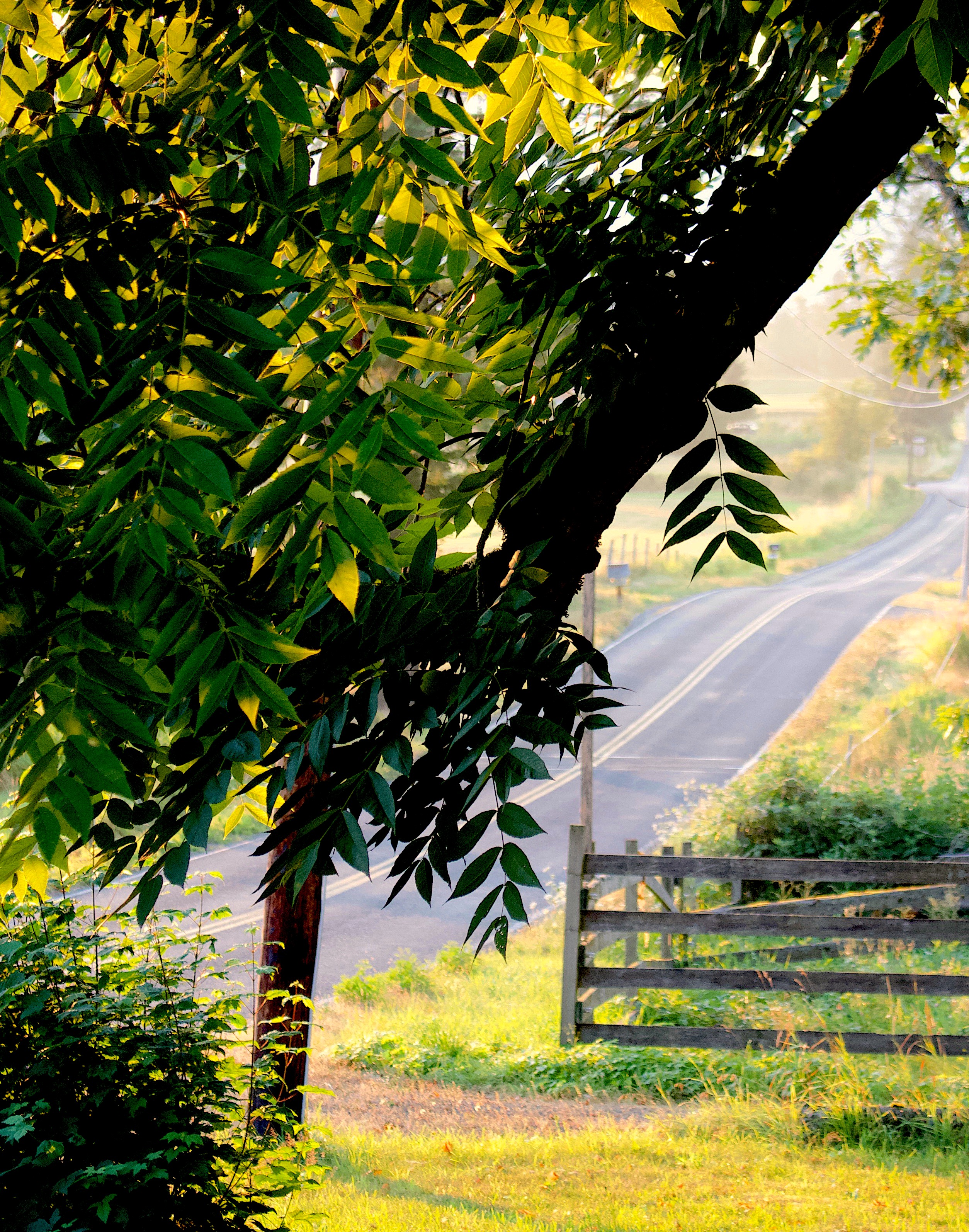
I love these country roads in June, at dawn or dusk,
the light and shadow playing over the path,
promising summer breezes and simple joys.

When we walk these roads,
we pass by deep ditches,
hop the potholes and avoid the bumps.

Still it’s a dangerous business,
walking out the front door into life,
not knowing just where we may be swept off to.

Passing by secret gates and overgrown paths,
I take the familiar route that leads me home,
following the Master Guide so I don’t lose my way.

I’m Comfortable in this Spot

There are no creatures you cannot love.
A frog calling at God
From the moon-filled ditch
As you stand on the country road in the June night.
The sound is enough to make the stars weep
With happiness.
In the morning the landscape green
Is lifted off the ground by the scent of grass.
The day is carried across its hours
Without any effort by the shining insects
That are living their secret lives.
The space between the prairie horizons
Makes us ache with its beauty.
Cottonwood leaves click in an ancient tongue
To the farthest cold dark in the universe.
The cottonwood also talks to you
Of breeze and speckled sunlight.
You are at home in these
great empty places
along with red-wing blackbirds and sloughs.
You are comfortable in this spot
so full of grace and being
that it sparkles like jewels
spilled on water.

~Tom Hennen “From a Country Overlooked”, from Darkness Sticks to Everything

There are some God’s creatures I struggle to love –
fleas, chiggers, mosquitoes, ticks, slugs, yellow jackets among them. Also poisonous snakes, spiders and scorpions come to mind.
And then there are pathogenic bacteria, parasites and viruses…

It is not their fault I struggle to find their value –
only God knows why He made them as He did.

What I have learned over 7 decades is to try to look for beauty wherever I am.

To listen to the breezes and the birds, to look for how the light plays with leaves and water and how it is all created to help us feel at home for the time we are here.

Yet, this is an imperfect world where beauty doesn’t provide shelter to those with their basic needs unfulfilled – where there is no comfort, no safety, no hope.

God, deliver us from being too comfortable when others suffer.
Help us feel Your love to pass on to those in need.
Help us to know how to make a difference for them.
We know that makes a difference to You.

AI image created for this post

Ridiculously Courageous

So I can’t save the world— 
can’t save even myself, 
can’t wrap my arms around 
every frightened child, can’t 
foster peace among nations, 
can’t bring love to all who 
feel unlovable. 

So I practice opening my heart 
right here in this room and being gentle 
with my insufficiency. I practice 
walking down the street heart first. 
And if it is insufficient to share love, 
I will practice loving anyway. 
I want to converse about truth, 
about trust. I want to invite compassion 
into every interaction. 
One willing heart can’t stop a war. 
One willing heart can’t feed all the hungry. 
And sometimes, daunted by a task too big, 
I ask myself, What’s the use of trying? 
But today, the invitation is clear: 
to be ridiculously courageous in love. 
To open the heart like a lilac in May, 
knowing freeze is possible 
and opening anyway. 
To take love seriously. 
To give love wildly. 
To race up to the world 
as if I were a puppy, 
adoring and unjaded, 
stumbling on my own exuberance. 
To feel the shock of indifference, 
of anger, of cruelty, of fear, 
and stay open. To love as if it matters, 
as if the world depends on it. 

~Rosemerry Wahtola Trommer “BecauseFrom The Unfolding

I can’t stop all the pain and suffering in the world or bring peace between angry nations.

But I can make a difference to those around me. It won’t stop a war or cure all diseases, but I can be ridiculously courageous in my compassion for others.

As we’ve been traveling for the past week, I’ve had many opportunities to treat others like I hope to be treated. I’ve tried to listen carefully, to express gratitude for the efforts others make. I try to smile more when I’m among strangers and meet their gaze, which takes the greatest courage of all for an introvert like me.

So I’ll take lessons from puppies I’ve known: to wag and wiggle and treat everyone as a best friend – with great joy and exuberance. It matters. Peace in the world depends on it.

photo by Brandon Dieleman
AI image created for this post

Whatever Remains of the Day

sundayevening

Every moment is a fresh beginning.
~T.S. Eliot

What is pertinent is the calmness of beauty, its sense of restraint. It is as though the land knows of its own beauty, its own greatness, and feels no need to shout it…

For a great many people, the evening is the most enjoyable part of the day. Perhaps, then, there is something to his advice that I should cease looking back so much, that I should adopt a more positive outlook and try to make the best of what remains of my day.

After all, what can we ever gain in forever looking back and blaming ourselves if our lives have not turned out quite as we might have wished?
~Kazuo Ishiguro from The Remains of the Day

I am ashamed to admit how much time I spend looking back, yearning for a day that has long since passed, tossing off these present precious hours as somehow not measuring up to what came before.

There have been nearly forty years of such days on this farm, one flowing gently after another, and most were exactly what I hoped for.

Even when I believe things will never change, they will, and I will.  What is left of the remains of the day may be the best yet.

I toss my heart ahead and set out after it.

storm518161
sunset41816

Trying Not to Cry

People have said, “Don’t cry” to other people for years and years, and all it has ever meant is, “I’m too uncomfortable when you show your feelings.  Don’t cry.”  I’d rather have them say, “Go ahead and cry.  I’m here to be with you.”

~Mister Fred Rogers

I cry easily, always have. Certain songs and hymns will trigger tears, and of course, any rituals surrounding baptisms, funerals, weddings, and graduations.

Tears don’t bother me, whether they are my own or someone else’s. My medical office and exam rooms were always well- stocked with boxes of tissues as a safe place to cry it out.

One of my routine mental health history questions was “what will bring tears to your eyes – dicing onions doesn’t count?”  

Some patients would look at me blankly, not sure they ever remember crying, and others will weep at the mere suggestion.

No matter what the reason for someone’s tears, it is a powerful outward expression of human feeling, like a laugh or a grimace of pain. I watch for those cues and sometimes feel their emotion as surely as if it were my own.

Even tears can bring peace – like a river.

I am with you.  And always intend to be.

Seeking a Close Encounter of Awful Quiet

A dark mist lay over the Black Hills, and the land was like iron.
At the top of ridge I caught sight of Devil’s Tower upthrust against the gray sky as if in the birth of time the core of the earth had broken through its crust and the motion of the world was begun.

There are things in nature
that engender an awful quiet in the heart of man;
Devil’s Tower is one of them.
~N.Scott Momaday in The Way to Rainy Mountain

We didn’t have a close encounter with Devil’s Tower on this particular trip yesterday through Wyoming. Over the years we have made many cross-country road trips like this one, passing by the turn-off to Devil’s Tower because there was urgency to get where we needed to go. Occasionally we would see it hazy in the far distance, so I could say I had “seen it” but I really had not seen it … according to my Stanford professor N. Scott Momaday.

Scott was from the Kiowa tribe. In his language, this rock formation is named Tso-i-e or “standing on a rock.” For him and his people, it is sacred ground. The Cheyenne, Crow, Lakota, Shoshone, and Arapahoe all revere this rock monolith, although most tribal members did not live near enough to see it themselves, but the legends traveled many miles through the generations through oral tradition.

I took Scott’s unforgettable class “Native American Mythology and Lore” in 1973, as a 19 year old sophomore. He had a commanding presence, a booming resonant voice for story telling, a predilection for the poetry of Emily Dickinson and a hankering since childhood to be a character in the stories of Billy the Kid. The first day of class, he introduced us to Tso-i-e first and foremost. He told us his grandmother’s story passed to her from her grandparents:

“Eight children were there at play, seven sisters and their brother. Suddenly the boy was struck dumb; he trembled and began to run upon his hands and feet. His fingers became claws, and his body was covered with fur. Directly there was a bear where the boy had been. The sisters were terrified.; they ran and the bear after them. They came to the stump of a great tree, and the tree spoke to them. It bade them climb upon it, and as they did so it began to rise into the air. The bear came to kill them, but they were just beyond its reach. It reared against the tree and scored the bark all around with its claws. The seven sisters were borne into the sky, and they became the stars of the Big Dipper.”

My family finally made time to see the Tower up close. For me, this “close encounter” was meant to connect the dots from my class and to understand more fully the spiritual background of the Plains people as our son, Ben, had lived and taught on the Pine Ridge Lakota Sioux Reservation in South Dakota for two years.

The Tower surely is awe-filled holy ground for us all – we are diminished in its presence. It disquiets the heart with its awful grandeur and sheer other-worldliness. In its own way, it is as resonant as Scott’s captivating stories about its origins, yet remains a reminder of the ever-changing impermanence of geologic formations.

We need more holy places in our lives even as they (and wechange with the sands and winds of time. We need to seek more “awful quiet” in our hearts, to continue to tell our sacred stories, generation to generation, never forgetting Who it is who set the world in motion.

AI image created for this post

Like Light and Cloud Shadows

…you mustn’t be frightened …
if a sadness rises in front of you,
larger than any you have ever seen;
if an anxiety, like light and cloud-shadows,
moves over your hands and over everything you do.
You must realize that something is happening to you,
that life has not forgotten you,
that it holds you in its hand and will not let you fall.
Why do you want to shut out of your life any uneasiness,
any misery, any depression, since after all
you don’t know what work these conditions are doing inside you?

~Rainer Maria Rilke from Letters to a Young Poet

…difficulties are magnified out of all proportion
simply by fear and anxiety.
From the moment we wake until we fall asleep
we must commend other people wholly and unreservedly to God and leave them in his hands,
and transform our anxiety for them into prayers on their behalf: 

With sorrow and with grief…
God will not be distracted.
~Dietrich Bonhoeffer in Letters from Prison

During my decades as a primary care physician for a university health center, my clinic days were often filled with young adults who were so consumed by anxiety they were immobilized in their ability to move forward through life’s inevitable obstacles and difficulties. They were so stuck in overwhelming feelings, they couldn’t sleep or eat or think clearly. They tended to self-medicate, self-injure and self-hate. Unable to nurture themselves or others, they withered like a flower without roots deep enough to reach the vast reservoir untapped beneath them.  In epidemic numbers, some decide to die, even before life really has fully begun for them.

My role was to help find healing solutions, whether it was counseling therapy, a break from school, or a medicine that may give some form of relief. 

My heart knows the ultimate answer is not as simple as choosing the right prescription – light and cloud shadows differ for each person – it can feel like the sun is blocked forever, all that is left is rain and snow and gray.

I too have known anxiety and how it can distort every thought.

We who are anxious can depend upon a Creator who is not distracted from His care for us even if we have turned away in our worry and sorrow, unable to look past our own eyelashes. 

Like a thirsty withering plant, we need to reach higher and deeper: asking for help and support, working through solutions with those helpers, acknowledging there exists a healing power greater than ourselves.

So we are called to pray for ourselves and for others. Self compassion and caring for others can disable anxiety and fear by transforming it to growth, gratitude and grace.  

No longer withering, we just might bloom.

AI image created for this post