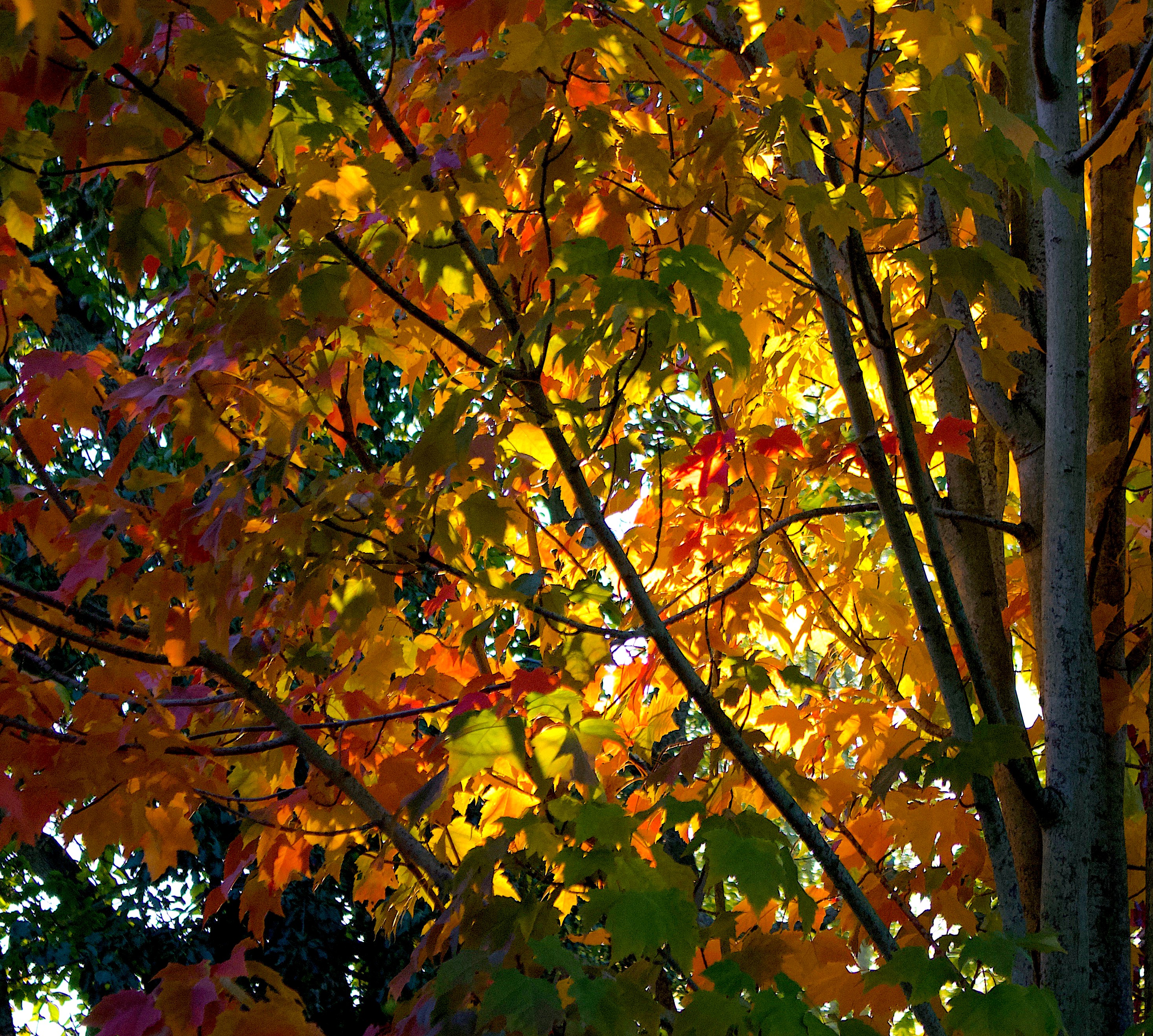
…the golden hour of the clock of the year. Everything that can run to fruit has already done so: round apples, oval plums, bottom-heavy pears, black walnuts and hickory nuts annealed in their shells, the woodchuck with his overcoat of fat. Flowers that were once bright as a box of crayons are now seed heads and thistle down. All the feathery grasses shine in the slanted light. It’s time to bring in the lawn chairs and wind chimes, time to draw the drapes against the wind, time to hunker down. Summer’s fruits are preserved in syrup, but nothing can stopper time. No way to seal it in wax or amber; it slides though our hands like a rope of silk. At night, the moon’s restless searchlight sweeps across the sky. ~Barbara Crooker “And Now it’s October” from Small Rain.
I do try to stopper time.
I try every day on this page, not to suspend time or render it frozen, but like flowers and fruit that wither, I want to preserve these moments – a few harvested words and pictures to sample some chilly day.
I offer it up to you now, a bit of fragrance, to sip of its sweetness as it glows, luminous in the bottle.
Let’s share. Leave it unstoppered. The passage of time is meant to be preserved this way.
The maple leaves abscond with summer’s green rain on such little stems connecting to spring’s essence, summer twigs’ foliage, the company of the living.
But now they shrug off their red-gold existence as if they’d never inhabited the verdure of the undead, drifting to a ground hardened by sudden frost. ~Donna Pucciani “One Minute”
I was standing lost, sunk, my hands in my pockets, gazing toward Tinker Mountain and feeling the earth reel down. All at once, I saw what looked like a Martian spaceship whirling towards me in the air. It flashed borrowed light like a propeller. Its forward motion greatly outran its fall. As I watched, transfixed, it rose, just before it would have touched a thistle, and hovered pirouetting in one spot, then twirled on and finally came to rest. I found it in the grass; it was a maple key…Hullo. I threw it into the wind and it flew off again, bristling with animate purpose, not like a thing dropped or windblown, pushed by the witless winds of convection currents hauling round the world’s rondure where they must, but like a creature muscled and vigorous, or a creature spread thin to that other wind, the wind of the spirit that bloweth where it listeth, lighting, and raising up, and easing down. O maple key, I thought, I must confess I thought, o welcome, cheers.
And the bell under my ribs rang a true note, a flourish of blended horns, clarion, sweet, and making a long dim sense I will try at length to explain. Flung is too harsh a word for the rush of the world. Blown is more like it, but blown by a generous, unending breath. That breath never ceases to kindle, exuberant, abandoned; frayed splinters spatter in every direction and burgeon into flame. And now when I sway to a fitful wind, alone and listing, I will think, maple key. When I see a photograph of earth from outer space, the planet so startlingly painterly and hung, I will think, maple key. When I shake your hand or meet your eyes, I will think two maple keys. If I am maple key falling, at least I can twirl. ~Annie Dillard from Pilgrim at Tinker Creek
If only there were living words as plentiful as the maple keys that twirl from each branch, words that release us from our dry roots, ready to unlock life’s secrets, unlatch and push ajar the doors to heavy hearts.
Who can ever be ready to go from vibrant and alive, colorful and mobile, to dropped and still?
The reality of another spent season is a slug to the gut. Time is passing. I’m wasting time. There is no stopping it without stopping me.
Let’s dwell in the company of the living until we fall away together.
Live well, fellow leaves and we’ll let go together: swaying to a fitful wind, giving a gentle shrug and drifting, easing into settling down when the time comes.
One-Time
Monthly
Yearly
Make a one-time or recurring donation to support daily Barnstorming posts
Under a sky the color of pea soup she is looking at her work growing away there actively, thickly like grapevines or pole beans as things grow in the real world, slowly enough. If you tend them properly, if you mulch, if you water, if you provide birds that eat insects a home and winter food, if the sun shines and you pick off caterpillars, if the praying mantis comes and the ladybugs and the bees, then the plants flourish, but at their own internal clock.
Connections are made slowly, sometimes they grow underground. You cannot tell always by looking what is happening. More than half the tree is spread out in the soil under your feet. Penetrate quietly as the earthworm that blows no trumpet. Fight persistently as the creeper that brings down the tree. Spread like the squash plant that overruns the garden. Gnaw in the dark and use the sun to make sugar.
Weave real connections, create real nodes, build real houses. Live a life you can endure: Make love that is loving. Keep tangling and interweaving and taking more in, a thicket and bramble wilderness to the outside but to us interconnected with rabbit runs and burrows and lairs.
Live as if you liked yourself, and it may happen: reach out, keep reaching out, keep bringing in. This is how we are going to live for a long time: not always, for every gardener knows that after the digging, after the planting, after the long season of tending and growth, the harvest comes. ~Marge Piercy “The Seven of Pentacles”
Our garden teaches us all kinds of life lessons, thanks to my husband’s hours of hard work preparing the soil, planting carefully and nurturing the emerging seedlings.
No garden tends itself – the growing plants reach out for connection to one another, for stability and companionship. The gardener nurtures, defends and harvests with an eye to preparing for the next growing season.
We who have been planted here need one another, interwoven and linked, both visibly and invisibly. I am woven around you and you around me; together we grow and thrive when tended, and as intended.
But more than anything else, we need our Gardener…
AI image created for this post
One-Time
Monthly
Yearly
Make a one-time or recurring donation to support daily Barnstorming posts
True gardeners cannot bear a glove Between the sure touch and the tender root, Must let their hands grow knotted as they move With a rough sensitivity about Under the earth, between the rock and shoot, Never to bruise or wound the hidden fruit. And so I watched my mother’s hands grow scarred, She who could heal the wounded plant or friend With the same vulnerable yet rigorous love; I minded once to see her beauty gnarled, But now her truth is given me to live, As I learn for myself we must be hard To move among the tender with an open hand, And to stay sensitive up to the end Pay with some toughness for a gentle world. ~May Sarton “An Observation”
I’m reminded every spring, as my husband’s hands prepare the soil in the garden for that season’s planting, how challenging is the job of the gardener. His hands must fight the chaos of weeds and rocks to prepare a gentle bed for each seed.
A seed is a plain, unadorned and ordinary thing, a little boring even, practically forgotten once it is placed in the ground. Yet the ordinariness is only the outer dress; the extraordinary is contained inside, and within days a tender shoot braves all to come to the surface, bowed and humble. It establishes a tenacious root that ensures survival, grabbing hold in even the most inhospitable ground.
So it is with Jesus whose ordinary origins belied his holiness and majesty. Both hardy root and tender shoot, he reaches up to the heavens while his feet tread the soil, both at once. His toughness paid for our chance at a more gentle world.
And thanks to Him, we are fed.
For he grew up before him like a young plant, and like a root out of dry ground; Isaiah 53:2a
AI image created for this post
One-Time
Monthly
Yearly
Make a one-time or recurring donation to support daily Barnstorming posts
I know a bleeding-heart plant that has thrived for sixty years if not more, and has never missed a spring without rising and spreading itself into a glossy bush, with many small red hearts dangling. Don’t you think that deserves a little thought? The woman who planted it has been gone for a long time, and everyone who saw it in that time has also died or moved away and so, like so many stories, this one can’t get finished properly. Most things that are important, have you noticed, lack a certain neatness. More delicious, anyway, is to remember my grandmother’s pleasure when the dissolve of winter was over and the green knobs appeared and began to rise, and to cre- ate their many hearts. One would say she was a simple woman, made happy by simple things. I think this was true. And more than once, in my long life, I have wished to be her. ~Mary Oliver “The Bleeding-Heart”from New and Selected Poems Volume Two
My Grandma Kittie grew flowers–lots of them. Her garden stretched along both sides of the sidewalk to her old two story farm house, in window boxes and beds around the perimeter, in little islands scattered about the yard anchored by a tree, or a piece of driftwood, a gold fish pond or a large rock. Wisteria hung like a thick curtain of purple braids from the roof of her chicken coop, and her greenhouse, far bigger than her home, smelled moist and mossy with hanging fuschia baskets. For her it was full time joy disguised as a job: she sold seedlings, and ready-to-display baskets, and fresh flower arrangements.
She often said she was sure heaven would be full of flowers needing tending, and she was just practicing for the day when she could make herself useful as a gardener for God.
Visiting Grandma meant spending summer evenings in her yard heavy with wafting flower perfume. She especially loved her bleeding hearts bushes that returned every spring, dripping their red blossoms over her unruly lawn.
Another of her favorite flowers was the evening primrose. It was one of a few night blooming plants meant to attract pollinating moths. Its tall stems were adorned by lance shaped leaves, with multiple buds and blooms per stem. Each evening, and it was possible to set one’s watch by its punctuality, only one green wrapped bud per stem would open, revealing a bright yellow blossom with four delicate veined petals, a rosette of stamens and a cross-shaped stigma in the center, rising far above the blossom. The yellow was so vivid and lively, it seemed almost like a drop of sun had been left on earth to light the night. By morning, the bloom would begin to wither and wilt under the real sunlight, somehow overcome with the brightness, and would blush a pinkish orange as it folded upon itself, ready to die and drop from the plant in only a day or two, leaving a bulging seed pod behind.
I would settle down on the damp lawn at twilight, usually right before dusk fell, to watch the choreography of opening of blossoms on stem after stem of evening primrose. Whatever the trigger was for the process of unfolding, there would be a sudden loosening of the protective green calyces, in an almost audible release. Then over the course of about a minute, the overlapping yellow petals would unfurl, slowly, gently, purposefully, revealing their pollen treasure trove inside. It was like watching time lapse cinematography, only this was an accelerated, real time flourish of beauty, happening right before my eyes. I always felt privileged to witness each unveiling as Grandma liked to remind me that few flowers ever allowed us to behold both their birth and death. The evening primrose was not at all shy about sharing itself and it would enhance the show with a sweet lingering fragrance.
Grandma knew how much I enjoyed the evening primrose display, so she saved seeds from the seed pods for me, and helped me plant them at our house during one of her spring time visits. I remember scattering the seeds with her in a specially chosen spot, in anticipation of the “drops of sun” that would grace our yard come summertime. However, Grandma was more tired than usual on this particular visit, taking naps and not as eager to go for walks or eat the special meals cooked in honor of her visit. Her usually resonant laughing brown eyes appeared dull, almost muddy.
The day she was to return to her home, she came into the kitchen at breakfast time, wearily setting down her packed bags. She gave me a hug and I looked at her. Something was dreadfully wrong. Grandma’s eyes were turning yellow.
Instead of returning home that day, she went to the hospital. Within a day, she had surgery and within two days, was told she had terminal pancreatic cancer. She did not last long, her skin becoming more jaundiced by the day, her eyes more icteric and far away. She soon left her earthly gardens to cultivate those in heaven.
I’ve kept bleeding hearts and evening primrose in my garden ever since. Grandma’s heart dangles from the bushes and she is released from each primrose bloom as it unfolds precipitously in the evening. She wafts across the yard in its perfume. Her spirit, a drop of sun coming to rest, luminous, for a brief stay upon the earth, only to fall before we’re ready to let it go. But as the wilted bloom lets go, its seeds have already begun to form.
I’m sure Grandma is still growing flowers. And my soil-covered hands look more like hers every day.
The grass withers and the flowers fall, because the breath of the Lord blows on them. Surely the people are grass. The grass withers and the flowers fall, but the word of our God endures forever. Isaiah 40: 7-8
This Lenten season I reflect on the words of the 19th century southern spiritual hymn “What Wondrous Love is This”
One-Time
Monthly
Yearly
Make a one-time or recurring donation to support daily Barnstorming posts
“All Christian thinking is resurrection thinking.” —Jay Parini Let this sorrow be a fallow field and grief the seeding rain. Then may I be hidden, a grain in night’s still mystery, until the day I’m risen, yield bound in sheaves of joy, and Negev is an ecstasy. ~Franchot Ballinger, “Let Me Be Like Those Who Dream” from Crossings
Ears of Wheat – Vincent Van GoghWheat Field with Sheaves -Vincent Van GoghSheaves of Wheat in a Field –Vincent Van Gogh
The love of God most High for our soul is so wonderful that it surpasses all knowledge. No created being can fully know the greatness, the sweetness, the tenderness, of the love that our Maker has for us. By his Grace and help therefore let us in spirit stand in awe and gaze, eternally marveling at the supreme, surpassing, single-minded, incalculable love that God, Who is all goodness, has for us. ~Juliana of Norwich “God’s Love for Us”
…you have been born again, not of perishable seed but of imperishable, through the living and abiding word of God; for
“All flesh is like grass and all its glory like the flower of grass. The grass withers, and the flower falls, but the word of the Lord remains forever.” 1Peter 1:23-25
The fields around our farm still show no signs of wakening. They are stubble and moss, mole hills and mud. It is unimaginable they might soon produce anything.
Then grief rains down on buried seed and the grain will rise.
All winter everything, everyone, has been so dead, so hidden, so hopeless; His touch calls us back to life. Nothing can be more hopeful than the barren made fruitful, the ugly made beautiful, the dead made alive.
Love is come again, digging deep into the fallow fields of our hearts.
This Lenten season I reflect on the words of the 19th century southern spiritual hymn “What Wondrous Love is This”
One-Time
Monthly
Yearly
Make a one-time or recurring donation to support Barnstorming daily posts
One minute I’m meandering down a country road on a magnificent fall day, lost in thought, radio playing, and the next minute I feel my wheels
on the loose gravel of the shoulder, there’s a deafening bang and I’m climbing out of what’s left of my car. The cop who came to investigate
was pretty sure I’d been speeding but settled for lecturing me about how lucky I was to walk away from such a crash, that I’d be dead if my car had hit the tree
just six inches further to the left. Anyone could see that what he said was true, but it also struck me as I stood there watching his car flash red and blue
that it was equally true the accident would not have happened at all if a raging storm some sixty years ago hadn’t blown an acorn six inches closer
to the road than where it would’ve landed on a day as sunny and calm as the one we were in. It was a point I thought deserved serious exploration—though perhaps
not just then, I decided, with a hundred birds singing their tiny hearts out overhead and the sky raining down yellow leaves, and definitely not with the cop. ~Jeff Coomer “Six Inches” from A Potentially Quite Remarkable Thursday.
For grace to be grace, it must give us things we didn’t know we needed and take us places where we didn’t know we didn’t want to go. ~Kathleen Norris from Cloister Walk
Grace and mercy salvaged me when I didn’t know I needed saving, handed me what I didn’t think I needed, so never asked for, and taken me where I never planned to be because I thought I was just fine where I was.
Grace is not about giving me what I want; not a reward for following the rules, for being “good” or staying out of trouble. It is rescue from a fate of meaninglessness – a gift of God’s heart buoying me in weakness when I deserve nothing whatsoever.
This grace is like an acorn falling to the exact spot where I needed a serious exploration of where I was heading, then decades later, finding a tree standing in my path, ready and waiting to stop my recklessness.
I am grateful, so very grateful, for what I did not know I needed to know.
And now I know…
One-Time
Monthly
Yearly
Make a one-time or recurring donation to support daily Barnstorming posts
White roses, tiny and old, flare among thorns by the barn door. For a hundred years under the June elm, under the gaze of seven generations, they lived briefly like this, in the month of roses, by the fields stout with corn, or with clover and timothy making thick hay, grown over, now, with milkweed, sumac, paintbrush. Old roses survive winter drifts, the melt in April, August parch, and men and women who sniffed roses in spring and called them pretty as we call them now, walking beside the barn on a day that perishes. ~Donald Hall “Old Roses” from The Selected Poems of Donald Hall.
The lily has a smooth stalk, Will never hurt your hand; But the rose upon her brier Is lady of the land.
There’s sweetness in an apple tree, And profit in the corn; But lady of all beauty Is a rose upon a thorn.
When with moss and honey She tips her bending brier, And half unfolds her glowing heart, She sets the world on fire. ~Christina Rossetti “The Rose”
We are continually overflowing toward those who preceded us, toward our origin, and toward those who seemingly come after us. It is our task to imprint this temporary, perishable earth into ourselves so deeply, so painfully and passionately, that its essence can rise again invisibly, inside us. ~Rainer Maria Rilke from The Selected Poetry of Rainer Maria Rilke
There is a rose bush that still blooms decades later on the farm where my grandparents raised their family, next to the walkway where the house once stood. Overwhelmed with weeds and blackberry vines, it still sets my heart on fire to witness its stubborn persistence, thriving through trauma, abandonment, loneliness and adversity. No one comes to water it in summer drought, and though frozen during ice-covering winters, it thrives again in spring with leaf and bud and blossom.
The vulnerable, perishable, and beloved seed will rise again, imperishable.
…let your adorning be the hidden person of the heart with the imperishable beauty of a gentle and quiet spirit, which in God’s sight is very precious. 1Peter 3:4
One-Time
Monthly
Yearly
Make a one-time or recurring donation to support daily Barnstorming posts
Oh let me fall as grain to the good earth And die away from all dry separation, Die to my sole self, and find new birth Within that very death, a dark fruition, Deep in this crowded underground, to learn The earthy otherness of every other, To know that nothing is achieved alone But only where these other fallen gather.
If I bear fruit and break through to bright air, Then fall upon me with your freeing flail To shuck this husk and leave me sheer and clear As heaven-handled Hopkins, that my fall May be more fruitful and my autumn still A golden evening where your barns are full. ~Malcolm Guite “Unless a Grain of Wheat Falls Into the Ground and Dies”
…new life starts in the dark. Whether it is a seed in the ground, a baby in the womb, or Jesus in the tomb, it starts in the dark. ~Barbara Brown Taylor from Learning to Walk in the Dark
The ground is slowly coming to life again; snowdrops, crocus, and daffodils are surfacing from months of dormancy, buds are swelling, the spring chorus frogs have come from the mud to sing again and birds now greet the lazy dawn.
The seed shakes off the darkness surrounding it as growth begins.
I too began a mere seed, plain and simple, lying dormant in the darkness of my mother’s body.
Just as the spring murmurs life to the seed in the ground, so the Word calls a human seed of life to stir and swell, becoming at once both an animate and intimate reflection of Himself.
I was awakened in the dark to sprout, bloom and fruit, to reach as far as my tethered roots allow, aiming beyond earthly bounds to touch the light.
Everything, everyone, so hidden; His touch calls us back to life. Love is come again to the fallow fields of our hearts.
This year’s Lenten theme: So we fix our eyes not on what is seen, but on what is unseen, since what is seen is temporary, but what is unseen is eternal. 2 Corinthians 4: 18
Underground is where life begins My heart will rejoice in the hiddenness Beyond the burial there’s a resurrection ~Kristene DiMarco
But when the fullness of time had come, God sent forth his Son, born of woman, born under the law,to redeem those who were under the law, so that we might receive adoption… Galatians 4: 4-5
“In the fullness of time” is one of my favorite expressions to remind myself that God’s timing is not linear so much as it is spherical – we find ourselves in the midst of His plans, surrounded by Him rather than journeying from point A to point B.
The sowing of the seed, its hidden growth underground, its taking root and sprouting, its dependency on the soil and water and sun to rise up, its development and maturation and fruition, its harvest and completion to feed and become seed yet again.
It is a circle, not a line.
I must rise boldly when He calls me forth from the darkness.
This year’s Lenten theme for Barnstorming is a daily selection from songs and hymns about Christ’s profound sacrifice on our behalf.
If we remain silent about Him, the stones themselves will shout out and start to sing (Luke 19:40).
In His name, may we sing…
In the quiet of the morning When no one knows and no one needs to know You speak to me, You give me strength There’s nothing like the secret place
Underground is where life begins My heart will rejoice in the hiddenness Beyond the burial there’s a resurrection Your will be done in me In the stillness all around You are working all the details out What’s in me will grow someday I trust Your timing and Your ways
Underground is where life begins My heart will rejoice in the hiddenness Beyond the burial there’s a resurrection
Your will be done in me Oh let my roots go deep I will rise, I will rise He holds the time that I will rise I will rise, I will rise He holds the time that I will rise I will rise, I will rise God through my life be lifted high I will rise, I will rise God through my life be lifted high Let Jesus rise, Jesus rise God through my life be glorified
One-Time
Monthly
Yearly
Make a one-time or recurring donation to support daily Barnstorming posts