Light wakes us – there’s the sun climbing the mountains’ rim, spilling across the valley, finding our faces. It is July, between the hay and harvest, a time at arm’s length from all other time…
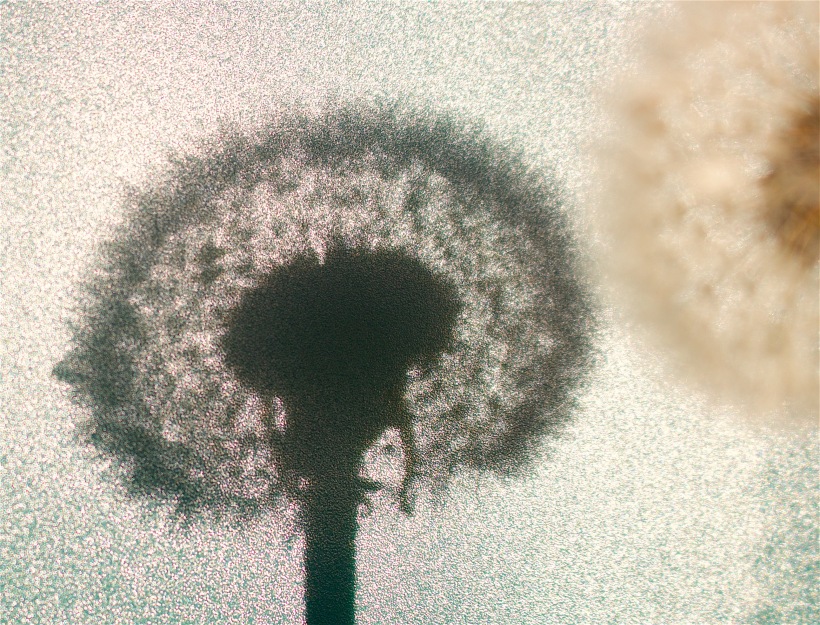
It is the time to set aside all vigil, good or ill, to loosen the fixed gaze of our attention as dandelions let seedlings to the wind. Wake with the light. Get up and go about the day and watch its surfaces that brighten with the sun. ~Kerry Hardie from “Sleep in Summer”
During intense election seasons like this one, I find myself seeking safety hiding under a rock where moderates tend to congregate. There is no political convention for us with rousing impassioned speeches, photo-op embraces for the cameras, or balloons falling on our heads.
Extremist views serve to keep us at arm’s length, to make the opposition appear more clearly the “other.” There is no discussion of compromise, negotiation or collaboration as that would be perceived as a sign of weakness. Instead it is “my way or the wrong way” rather than “our way.”
No way.
There is no choosing a “lesser of evils” this time.
When evil is too great, it is never a choice.
And so it goes. Each election cycle brings out the worst in our “leadership” as facts are distorted, the truth is stretched or completely abandoned, unseemly pandering abounds and curried favors are served for breakfast, lunch and dinner.
Enough already.
I’m ready to come out from under the rock,
loosen my attention from campaign and election news
and find the Light on my face.
Thank God there is still a Light to shine in the darkness.
John O’Donohue gave voice to the connection between beauty and those edges of life— thresholds was the word he loved—
where the fullness of reality becomes more stark and more clear.
If you go back to the etymology of the word “threshold,” it comes from “threshing,” which is to separate the grain from the husk. So the threshold, in a way, is a place where you move into more critical and challenging and worthy fullness.
There are huge thresholds in every life.
You know that, for instance, if you are in the middle of your life in a busy evening, fifty things to do and you get a phone call that somebody you love is suddenly dying, it takes ten seconds to communicate that information.
But when you put the phone down, you are already standing in a different world. Suddenly everything that seems so important before is all gone and now you are thinking of this.
So the given world that we think is there and the solid ground we are on is so tentative.
And a threshold is a line which separates two territories of spirit, and very often how we cross is the key thing.
These past few months of mass shootings, tragic deaths and never-ending conflict have forced us all to a threshold needing to be crossed. Yet we stand stubborn, immobilized, frozen and dying on the spot, peering out in fear but never peering inward for self-examination.
Instead of submitting to the crushing winnowing that must happen to blow away the chaff of our lives, to get down to the kernel of truth that sustains us, we cling to the old and familiar. It is we who have delivered ourselves a non-choice between two deeply flawed individuals for president. They represent what evils we tolerate as a people: celebrating entitlements, tolerating their legal, moral and financial shenanigans simply because they are rich and famous.
Unwilling to change attitude or perspective, reluctant to move forward into largely uncharted territory, mired in a tribalism only skin deep, we wonder why history repeats itself, why we are dying every day, by our own hand or by others’.
How to cross worthily? How to cross together, arm in arm, united in the need to move forward beyond this mess we have made for ourselves?
We need a good threshing, badly. We need to be worthy. We need to reach out our hands into the unknown that lies ahead, hoping and praying Someone is there to grab hold and lead us across to a better day.
We human beings do real harm.
History could make a stone weep.
~Marilynne Robinson–Gilead
Created with the freedom to choose our own way, we tend to opt for the path of least resistance with the highest pay back. Hey, after all, we’re human and that’s our excuse and we’re sticking to it.
No road less traveled for most of us–instead we blindly head down the superhighway of what’s best for number one, no matter what the means of transportation, what it costs to get there, how seedy the billboards or how many warning signs appear, or where the ultimate destination takes us.
History is full of the piled-high wrecking yards of demolition remnants from crashes along the way.
It’s enough to make a stone weep and so we weep aplenty.
Certainly God wept and probably still does as we are very dear to Him.
He knew what He was doing and thought it good at the time. Perhaps it still might be.
I am poured out like water, and all my bones are out of joint. My heart has turned to wax; it has melted within me. 15 My mouth is dried up like a potsherd, and my tongue sticks to the roof of my mouth; you lay me in the dust of death.
16 Dogs surround me, a pack of villains encircles me; they pierce my hands and my feet. 17 All my bones are on display; people stare and gloat over me. 18 They divide my clothes among them and cast lots for my garment.
19 But you, Lord, do not be far from me. You are my strength; come quickly to help me. ~Psalm 22: 14-19
See, my servant will act wisely; he will be raised and lifted up and highly exalted. 14 Just as there were many who were appalled at him— his appearance was so disfigured beyond that of any human being and his form marred beyond human likeness— 15 so he will sprinkle many nations, and kings will shut their mouths because of him. For what they were not told, they will see, and what they have not heard, they will understand. Isaiah 52: 13-15
When I was wounded whether by God, the devil, or myself —I don’t know yet which— it was seeing the sparrows again and clumps of clover, after three days, that told me I hadn’t died. When I was young, all it took were those sparrows, those lush little leaves, for me to sing praises, dedicate operas to the Lord. But a dog who’s been beaten is slow to go back to barking and making a fuss over his owner —an animal, not a person like me who can ask: Why do you beat me? Which is why, despite the sparrows and the clover, a subtle shadow still hovers over my spirit. May whoever hurt me, forgive me. ~Adelia Prado “Divine Wrath” translated from BrazilianPortuguese by Ellen Doré Watson
*******************************
Emmet Till’s mother speaking over the radio
She tells in a comforting voice what it was like to touch her dead boy’s face,
how she’d lingered and traced the broken jaw, the crushed eyes–
the face that badly beaten, disfigured— before confirming his identity.
And then she compares his face to the face of Jesus, dying on the cross.
This mother says no, she’d not recognize her Lord, for he was beaten far, far worse
than the son she loved with all her heart. For, she said, she could still discern her son’s curved earlobe,
but the face of Christ was beaten to death by the whole world. ~Richard Jones “The Face” fromBetween Midnight and Dawn
******************************
In a daring and beautiful creative reversal, God takes the worse we can do to Him
and turns it into the very best He can do for us.
~Malcolm Guite from The Word in the Wilderness
Strangely enough~
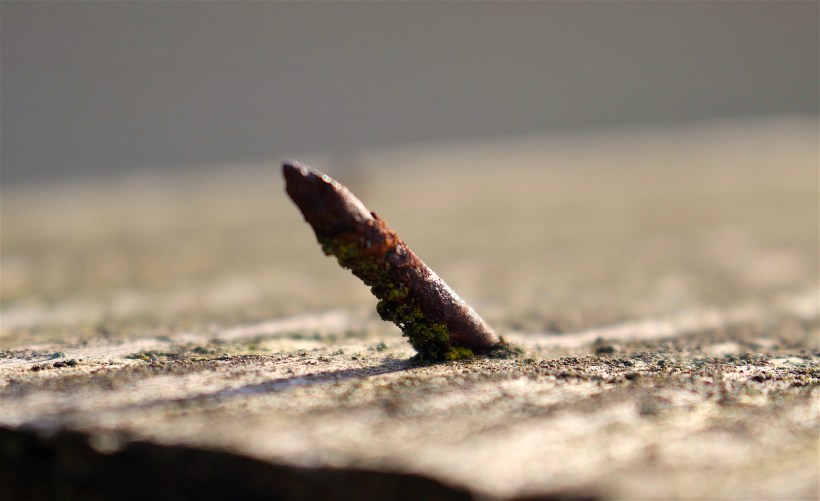
it is the nail,
not the hammer,
that brings us together~
becoming the glue,
the safety,
the permanence of
solid foundation,
and strong supports,
or protecting roof.
The hammer is only a tool
to pound in the nail
where it binds so tightly
it can’t blend or be forgotten,
where the hole it leaves behind
is a forever reminder
of what I, as hammer, have done
and how thoroughly
I am forgiven.
During this Lenten season, I will be drawing inspiration from the new devotional collection edited by Sarah Arthur —Between Midnight and Dawn
Big Foot, a great Chief of the Sioux often said,
“I will stand in peace till my last day comes.”
He did many good and brave deeds for the white man and the red man.
Many innocent women and children who knew no wrong died here.
~Inscription on the Wounded Knee Monument
“the nation’s hoop is broken and scattered.
There is no center any longer, and the sacred tree is dead.”
~Black Elk, (wounded trying to rescue his people after the Wounded Knee Massacre) from Black Elk Speaks
“Today is the anniversary of the massacre at Wounded Knee, which took place in South Dakota in 1890. Twenty-three years earlier, the local tribes had signed a treaty with the United States government that guaranteed them the rights to the land around the Black Hills, which was sacred land. The treaty said that not only could no one move there, but they couldn’t even travel through without the consent of the Indians.
But in the 1870s, gold was discovered in the Black Hills, and the treaty was broken. People from the Sioux tribe were forced onto a reservation, with a promise of more food and supplies, which never came. Then in 1889, a native prophet named Wovoka, from the Paiute tribe in Nevada, had a vision of a ceremony that would renew the earth, return the buffalo, and cause the white men to leave and return the land that belonged to the Indians. This ceremony was called the Ghost Dance. People traveled across the plains to hear Wovoka speak, including emissaries from the Sioux tribe, and they brought back his teachings. The Ghost Dance, performed in special brightly colored shirts, spread through the villages on the Sioux reservation, and it scared the white Indian agents. They considered the ceremony a battle cry, dangerous and antagonistic. So one of them wired Washington to say that he was afraid and wanted to arrest the leaders, and he was given permission to arrest Chief Sitting Bull, who was killed in the attempt. The next on the wanted list was Sitting Bull’s half-brother, Chief Big Foot. Some members of Sitting Bull’s tribe made their way to Big Foot, and when he found out what had happened, he decided to lead them along with the rest of his people to Pine Ridge Reservation for protection. But it was winter, 40 degrees below zero, and he contracted pneumonia on the way.
Big Foot was sick, he was flying a white flag, and he was a peaceful man. He was one of the leaders who had actually renounced the Ghost Dance. But the Army didn’t make distinctions. They intercepted Big Foot’s band and ordered them into the camp on the banks of the Wounded Knee Creek. Big Foot went peacefully.
The next morning federal soldiers began confiscating their weapons, and a scuffle broke out between a soldier and an Indian. The federal soldiers opened fire, killing almost 300 men, women, and children, including Big Foot. Even though it wasn’t really a battle, the massacre at Wounded Knee is considered the end of the Indian Wars, a blanket term to refer to the fighting between the Native Americans and the federal government, which had lasted 350 years.
One of the people wounded but not killed during the massacre was the famous medicine man Black Elk, author of Black Elk Speaks (1932). Speaking about Wounded Knee, he said: ‘I did not know then how much was ended. When I look back now from this high hill of my old age, I can still see the butchered women and children lying heaped and scattered all along the crooked gulch as plain as when I saw them with eyes still young. And I can see that something else died there in the bloody mud, and was buried in the blizzard. A people’s dream died there. It was a beautiful dream.'”
~Garrison Keillor from A Writers’ Almanac
Like most twentieth century American children, I grew up with a sanitized understanding of American and Native history. I had only a superficial knowledge of what happened at Wounded Knee, a low hill that rises above a creek bed on the South Dakota Pine Ridge Reservation, gleaned primarily from the 71 day symbolic standoff in 1973 between members of the Oglala Sioux and the American Indian Movement and the FBI, resulting in several shooting deaths.
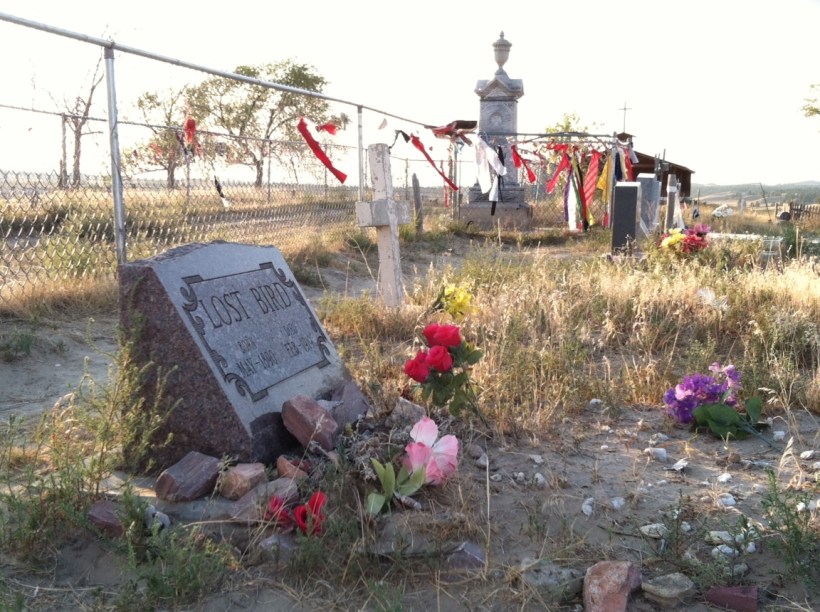
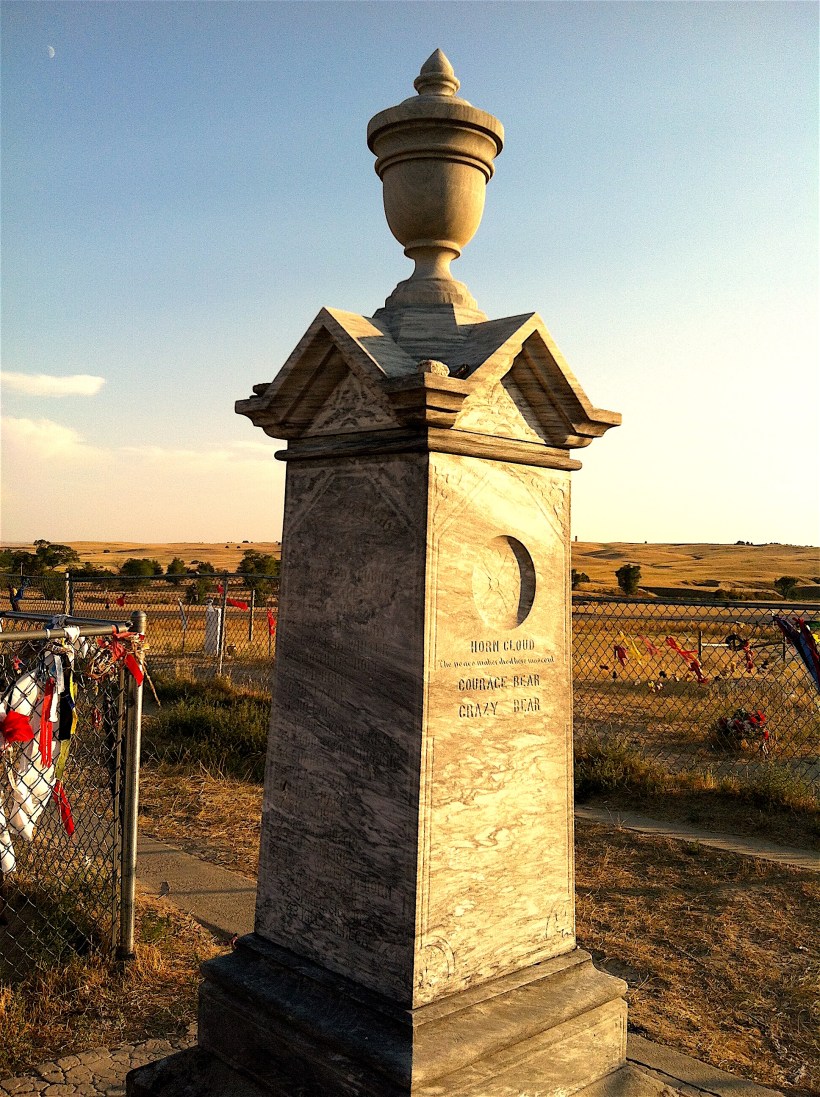
Three years ago, when our son was teaching math at Little Wound High School on the Pine Ridge Reservation, we visited the site of this last major battle between the white man and Native people, which broke the spirit of the tribes’ striving to maintain their nomadic life as free people. This brutal massacre of over 150 Lakota men, women and children by the Seventh Regiment of the U.S. Army Cavalry took place in December 1890.
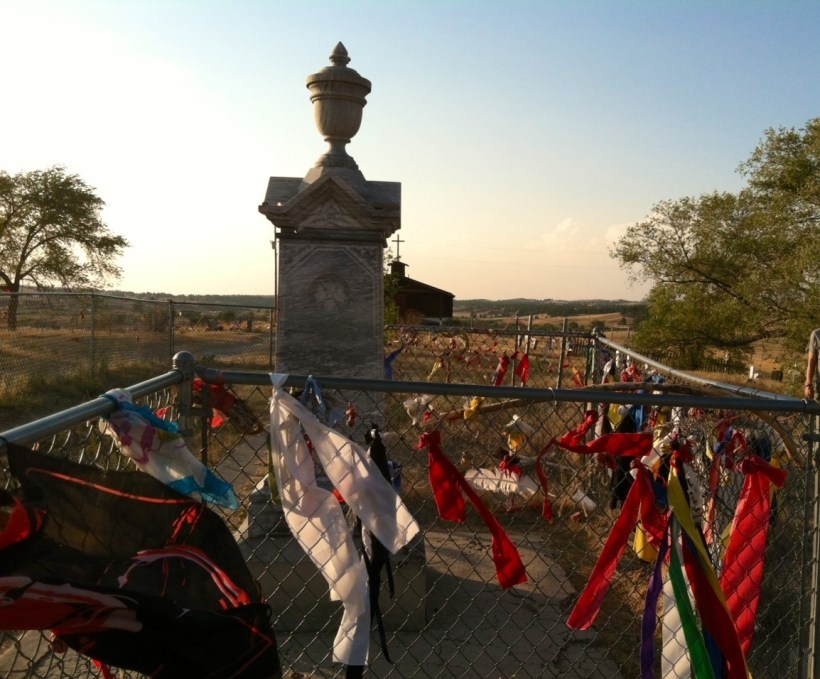
The dead lay where they fell for four days due to a severe blizzard. When the frozen corpses were finally gathered up by the Army, a deep mass grave was dug at the top of the hill, the bodies buried stacked one on top of another. The massive grave is now marked by a humble memorial monument surrounded by a chain link fence, adjacent to a small church, circled by more recent Lakota gravesites.
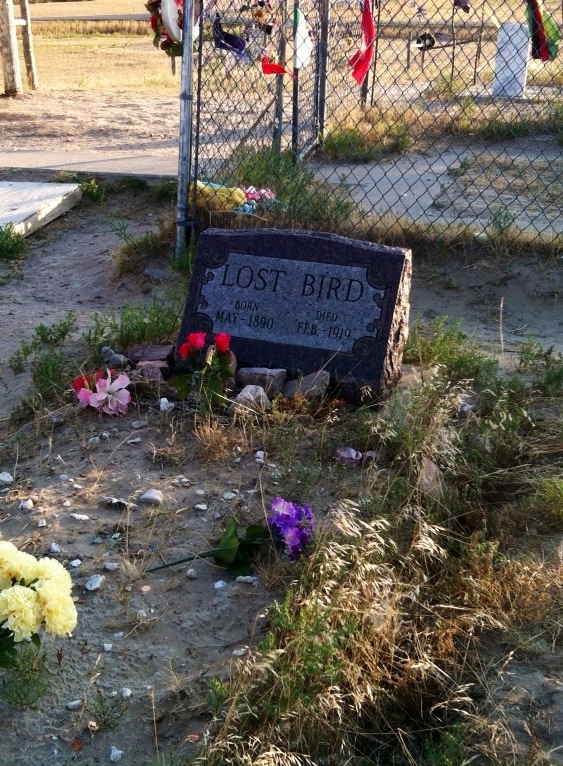
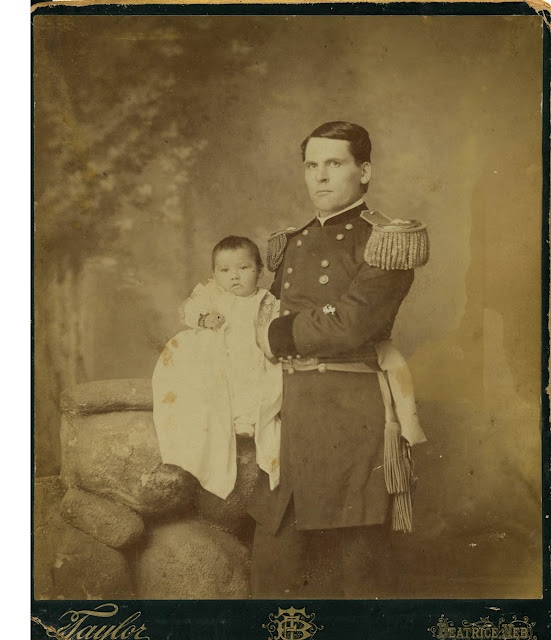
Four infants survived the four days of blizzard conditions wrapped in their dead mothers’ robes. One baby girl, only a few months old, was named “Lost Bird” after the massacre, bartered for and adopted by an Army Colonel as an interesting Indian “relic.” Rather than this adoption giving her a new chance, she died at age 29, having endured much illness, prejudice in white society, as well as estrangement from her native community and culture. Her story has been told in a book by Renee Sansom Flood, who helped to locate and move her remains back to Wounded Knee, where in death she is now back with her people.
There is unspeakable desolation and sadness on that lonely hill of graves. It is a regrettable part of our history that descendants of immigrants to American soil need to understand: by coming to the “New World” for opportunity, or refuge from oppression elsewhere, we made refugees of the people already here.
As Black Elk wrote, the dreams of a great people have been scattered and lack a center.
We must never allow hope to be buried at Wounded Knee nor must we ever forget what it means to no longer be safe in one’s own homeland.
A voice is heard in Ramah, mourning and great weeping, Rachel weeping for her children and refusing to be comforted, because they are no more. Matthew 2:18 and Jeremiah 31:15
Jesus wept. John 11:35
“My soul is overwhelmed with sorrow to the point of death. Stay here and keep watch with me.” 39 Going a little farther, he fell with his face to the ground and prayed, “My Father, if it is possible, may this cup be taken from me. Yet not as I will, but as you will.” Matthew 26: 38-39
God could, had He pleased, have been incarnate in a man of iron nerves, the Stoic sort who lets no sigh escape him. Of His great humility He chose to be incarnate in a man of delicate sensibilities who wept at the grave of Lazarus and sweated blood in Gethsemane. Otherwise we should have missed the great lesson that it is by his will alone that a man is good or bad, and that feelings are not, in themselves, of any importance. We should also have missed the all-important help of knowing that He has faced all that the weakest of us face, has shared not only the strength of our nature but every weakness of it except sin. If He had been incarnate in a man of immense natural courage, that would have been for many of us almost the same as His not being incarnate at all. ― C.S. Lewis, The Collected Letters of C.S. Lewis
…as you sit beneath your beautifully decorated tree, eat the rich food of celebration, and laugh with your loved ones, you must not let yourself forget the horror and violence at the beginning and end of the Christmas story. The story begins with the horrible slaughter of children and ends with the violent murder of the Son of God. The slaughter depicts how much the earth needs grace. The murder is the moment when that grace is given.
Look into that manger representing a new life and see the One who came to die. Hear the angels’ celebratory song and remember that sad death would be the only way that peace would be given. Look at your tree and remember another tree – one not decorated with shining ornaments, but stained with the blood of God.
As you celebrate, remember that the pathway to your celebration was the death of the One you celebrate, and be thankful. ~Paul Tripp
Written for too many innocents who have died this year at the hands of others…
There can be no consolation;
only mourning and great weeping,
sobbing that wrings dry
every human cell,
leaving dust behind,
dust, only dust
which is beginning
and end.
He came to us
for times such as this,
born of
the dust of woman and
the breath of Spirit,
God who bent down to
lie in barn dust,
walk on roads of dust,
die and be laid to rest as dust
in order to conquer
such evil as this
that could terrify masses
and massacre innocents.
He became dust to be
like us
He began a mere speck in a womb
like us,
so easily washed away
as unexpected, unneeded, unwanted.
Lord, You are long expected.
You are needed
You are wanted.
Your heart beat
like ours
breathing each breath
like ours
until a fearful fallen world
took Your
and our breath
away.
You shine through
the shadows of death
to guide our stumbling uncertain feet.
Your tender mercies flow freely
when there is no consolation
when there is no comfort.
You hear our cries
as You cry too.
You know our tears
as You weep too.
You know our mourning
as You mourned too.
You know our dying
as You died too.
God weeps
as tragedy happens.
Evil comes not from God
yet humankind embraces it.
Sin is a choice
we made from the beginning,
a choice we continue to make.
Only God can glue together
what evil has shattered.
He just asks us to hand Him
the pieces of our broken hearts.
We will know His peace
when He comes
to bring us home,
our tears will finally be dried,
our cells no longer
just dust,
never only dust
as we are glued together
by the breath of God
forevermore.
~EPG
the tender mercy of our God, by which the rising sun will come to us from heaven to shine on those living in darkness and in the shadow of death, to guide our feet into the path of peace. Luke 1: 78-79
Lully, lulla, thou little tiny child,
By by, lully, lullay.
1. O sisters too,
How may we do,
For to preserve this day?
This poor Youngling
For Whom we sing
By by, lully, lullay?
2. Herod the king,
In his raging,
Chargèd he hath this day
His men of might,
In his own sight,
All young children to slay.
3. That woe is me,
Poor Child for Thee!
And ever morn and may,
For thy parting
Neither say nor sing,
By, by, lully, lullay.
Lully, lullay, thou little tiny Child,
By by, lully, lullay.
Good people all, this Christmas time
Consider well and bear in mind
What our good God for us has done
In sending His beloved Son
With Mary holy we should pray
To God with love this Christmas day
In Bethlehem upon that morn’
There was a blessed Messiah born
Near Bethlehem did shepherds keep
Their flocks of lambs and feeding sheep
To whom God’s angels did appear
Which put the shepherds in great fear
“Arise and go”, the angels said
“To Bethlehem, be not afraid
For there you’ll find this happy morn’
A princely Babe, sweet Jesus born”
With thankful heart and joyful mind
The shepherds went that Babe to find
And as God’s angel had foretold
They did our Savior Christ behold
Within a manger He was laid
And by his side the Virgin maid
As long foretold upon that morn’
There was a blessed Messiah born
What wondrous love is this, O my soul, O my soul!
What wondrous love is this, O my soul!
What wondrous love is this
That caused the Lord of bliss
To bear the dreadful curse for my soul, for my soul,
To bear the dreadful curse for my soul!
When I was sinking down, sinking down, sinking down,
When I was sinking down, sinking down,
When I was sinking down
Beneath God’s righteous frown,
Christ laid aside His crown for my soul for my soul,
Christ laid aside His crown for my soul.
To God and to the Lamb I will sing, I will sing;
To God and to the Lamb I will sing;
To God and to the Lamb,
Who is the great I AM,
While millions join the theme, I will sing, I will sing,
While millions join the theme, I will sing.
And when from death I’m free, I’ll sing on, I’ll sing on;
And when from death I’m free, I’ll sing on.
And when from death I’m free
I’ll sing His love for me,
And through eternity I’ll sing on, I’ll sing on,
And through eternity I’ll sing on.
Since the children have flesh and blood, he too shared in their humanity … for this reason he had to be made like them, fully human in every way, in order that he might become a merciful and faithful high priest in service to God, and that he might make atonement for the sins of the people. Hebrews 2: 14, 17
And in the Incarnation the whole human race recovers the dignity of the image of God. Henceforth, any attack even on the least of men is an attack on Christ, who took the form of man, and in his own Person restored the image of God in all that bears a human form. Through fellowship and communion with the incarnate Lord, we recover our true humanity, and at the same time we are delivered from that individualism which is the consequence of sin, and retrieve our solidarity with the whole human race. By being partakers of Christ incarnate, we are partakers in the whole humanity which he bore. We now know that we have been taken up and borne in the humanity of Jesus, and therefore that new nature we now enjoy means that we too must bear the sins and sorrows of others. The incarnate Lord makes his followers the brothers of all mankind. ~Dietrich Bonhoeffer, The Cost of Discipleship
_________________
I’m reminded after every long day in my clinic, weighted down by the sorrows of the people I am asked to help — how much greater was the weight borne by God as mere baby delivered by woman to become humanity with us and for us.
His incarnate presence unites us all as brothers and sisters to each other, whether or not we speak the same language, whether or not our skin color is the same, whether or not we have great riches or dire need.
This is the truth of the God of love, that we should love one another, even after a week such as this — we are delivered by Him who was delivered.
EPG
All poor men and humble, All lame men who stumble, Come haste ye, nor feel ye afraid;
For Jesus, our treasure, With love past all measure, In lowly poor manger was laid.
Though wise men who found him Laid rich gifts around him, yet oxen they gave him their hay; And Jesus in beauty Accepted their duty, Contented in manger he lay. Then haste we to show him The praises we owe him; Our service he ne’er can despise; Whose love still is able To show us that stable Where softly in manger he lies.
Poverty Carol (Welsh)
This is the truth sent from above
The truth of God, the God of love
Therefore don’t turn me from your door
But hearken will both rich and poor
The first thing that I do relate
Is that God did man create
The next thing which to you I’ll tell
Woman was made with man to dwell
And after that, ’twas God’s own choice
To place them both in Paradise,
There to remain of evil free
Except they ate of such a tree.
But they did eat, which was a sin,
And so their ruin did begin,
Ruined themselves, both you and me,
And all of their posterity.
Thus we were heirs to endless woes
Till God and Lord did interpose
And so a promise soon did run
That He would redeem us by His Son
And at that season of the year
Our blessed redeemer did appear
He here did live and here did preach
And many thousands he did teach
Thus He in love to us behaved
To show us how we must be saved
And if you want to know the way
Be pleased to hear what He did say
~The Truth from Above — Traditional English Carol
It was gardener/author Alphonse Karr in the mid-19th century who wrote that even though most people grumble about roses having thorns, he was grateful that thorns have roses. After all, there was a time when thorns were not part of our world, when we knew nothing of suffering and death, but pursuing and desiring more than we were already generously given, we received a bit more than we bargained for.
We continue to reel under the thorns our choices produce — indeed every day there is more bloodletting.
So a rose was sent to adorn the thorns and even then we chose thorns to make Him bleed and still do to this day.
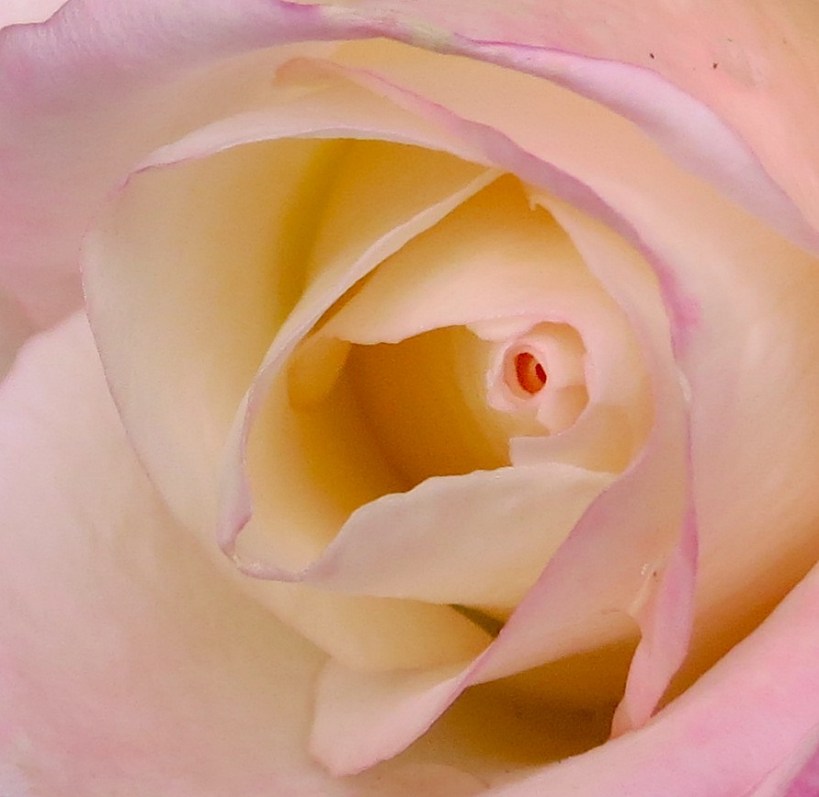
Yes, a fragrant rose blooms beautiful, bleeding amid the thorns, and will to the endless day.
Lo, how a Rose e’er blooming from tender stem hath sprung!
Of Jesse’s lineage coming, as men of old have sung.
It came, a floweret bright, amid the cold of winter,
When half spent was the night.
Isaiah ’twas foretold it, the Rose I have in mind;
With Mary we behold it, the virgin mother kind.
To show God’s love aright, she bore to men a Savior,
When half spent was the night.
The shepherds heard the story proclaimed by angels bright,
How Christ, the Lord of glory was born on earth this night.
To Bethlehem they sped and in the manger found Him,
As angel heralds said.
This Flower, whose fragrance tender with sweetness fills the air,
Dispels with glorious splendor the darkness everywhere;
True Man, yet very God, from sin and death He saves us,
And lightens every load.
O Savior, Child of Mary, who felt our human woe,
O Savior, King of glory, who dost our weakness know;
Bring us at length we pray, to the bright courts of Heaven,
And to the endless day!
1. Maria walks amid the thorn, Kyrie eleison. Maria walks amid the thorn, Which seven years no leaf has born. Jesus and Maria.
2. What ‘neath her heart doth Mary bear? Kyrie eleison. A little child doth Mary bear, Beneath her heart He nestles there. Jesus and Maria.
3. And as the two are passing near, Kyrie eleison, Lo! roses on the thorns appear, Lo! roses on the thorns appear. Jesus and Maria.
When Jesus Christ was yet a child He had a garden small and wild Where-in he cherished roses fair And wove them into garlands there
Now as the summertime drew nigh There came a troop of children by And seeing roses on the tree With shouts they plucked them merrily
“Do you bind roses in your hair?”
They cried in scorn to Jesus there The boy said humbly “Take I pray All but the naked thorns away”
Then of the thorns they made a crown And with rough fingers pressed it down Till on his forehead fair and young Red drops of blood like roses sprung
~Plechtcheev, melody by Tchaikovsky
We have waited in silence
on your loving-kindness,
O God.
~Psalm 48:8
The Lord is in his holy temple; let all the earth be silent before him. Habakkuk 2:20
Then hear now the silence He comes in the silence in silence he enters the womb of the bearer
in silence he goes to the realm of the shadows redeeming and shriving in silence he moves from the grave cloths, the dark tomb in silence he rises ascends to the glory leaving his promise leaving his comfort leaving his silence
So come now, Lord Jesus Come in your silence breaking our noising laughter of panic breaking this earth’s time breaking us breaking us quickly Lord Jesus make no long tarrying
When will you come and how will you come and will we be ready for silence your silence ~Madeleine L’Engle “Ready for Silence”
_________________________
In our weakness, we are so noisy.
We think strength
is in shouting and shooting.
Instead we broke you,
we break each other
and ourselves.
We have forgotten the power
of waiting in silence,
waiting for your silence,
so come now
clothed in our weakness,
to carry us home.
~EPG
A new Advent Hymn from Redeemer in New York City
O come, Desired of nations, Whom priest and prophet long foretold, Will break the captive fetters, Redeem the long-lost fold.
O come in peace and meekness, For lowly will your cradle be: Though clothed in human weakness, We shall your God-head see
O come, Divine Messiah, The world in silence waits the day When hope shall sing its triumph, And sadness flee away.
~In Silence, Advent hymn from Redeemer Presbyterian, New York
How silently, how silently The wondrous gift is given! So God imparts to human hearts The blessings of His heaven.
~from “O Little Town of Bethlehem”
By common confession, great is the mystery of godliness:
He who was revealed in the flesh,
Was vindicated in the Spirit,
Seen by angels,
Proclaimed among the nations,
Believed on in the world,
Taken up in glory. 1Timothy 3:16
Here are two mysteries for the price of one — the plurality of persons within the unity of God, and the union of Godhead and manhood in the person of Jesus. . . . Nothing in fiction is so fantastic as is this truth of the Incarnation. ~J. L. Packer from Knowing God
The Christ is not just a reflection of the Father God onto earth, no mere shadow projected from God’s image in heaven. No, our Savior is real flesh and blood, sinew and tissue, neurons and synapses, exactly as we are.
A fantastic truth and endless mystery to ponder: Jesus as mortal flesh gifts Himself to us so that we may know the Three in One; the powers of hell vanish as the shadows are cleared away.
~EPG
(it is worth waiting through the first minute of silence as the choir enters in darkness bearing candles, a lovely arrangement)
1 Let all mortal flesh keep silence, and with fear and trembling stand; ponder nothing earthly minded, for with blessing in his hand Christ our God to earth descendeth, our full homage to demand.
2 King of kings, yet born of Mary, as of old on earth he stood, Lord of lords, in human vesture, in the body and the blood, he will give to all the faithful his own self for heavenly food.
3 Rank on rank the host of heaven spreads its vanguard on the way, as the Light of light descendeth from the realms of endless day, that the powers of hell may vanish as the shadows clear away
4 At his feet the six-winged seraph, cherubim, with sleepless eye, veil their faces to the presence, as with ceaseless voice they cry, “Alleluia, alleluia, alleluia, Lord most high!” ~from the Liturgy of St. James, 4th century





















 Barnstorming