Our memories are, at best, so limited, so finite, that it is impossible for us to envisage an unlimited, infinite memory, the memory of God. It is something I want to believe in: that no atom of creation is ever forgotten by him; always is; cared for; developing; loved. ~Madeleine L’Engle from The Summer of the Great-Grandmother
…a friend told me a story about a little girl who wanted time alone with her infant brother. Her parents were suspicious of her motives. What if she did something to harm the baby? The big sister was so persistent that her mom and dad finally decided to allow her ten minutes alone with him in his room. After they closed the door, they listened quietly. They felt chills when they heard their daughter say, “Baby tell me what heaven is like. I’m starting to forget.” ~Sue Shanahan from “Fresh from Heaven”
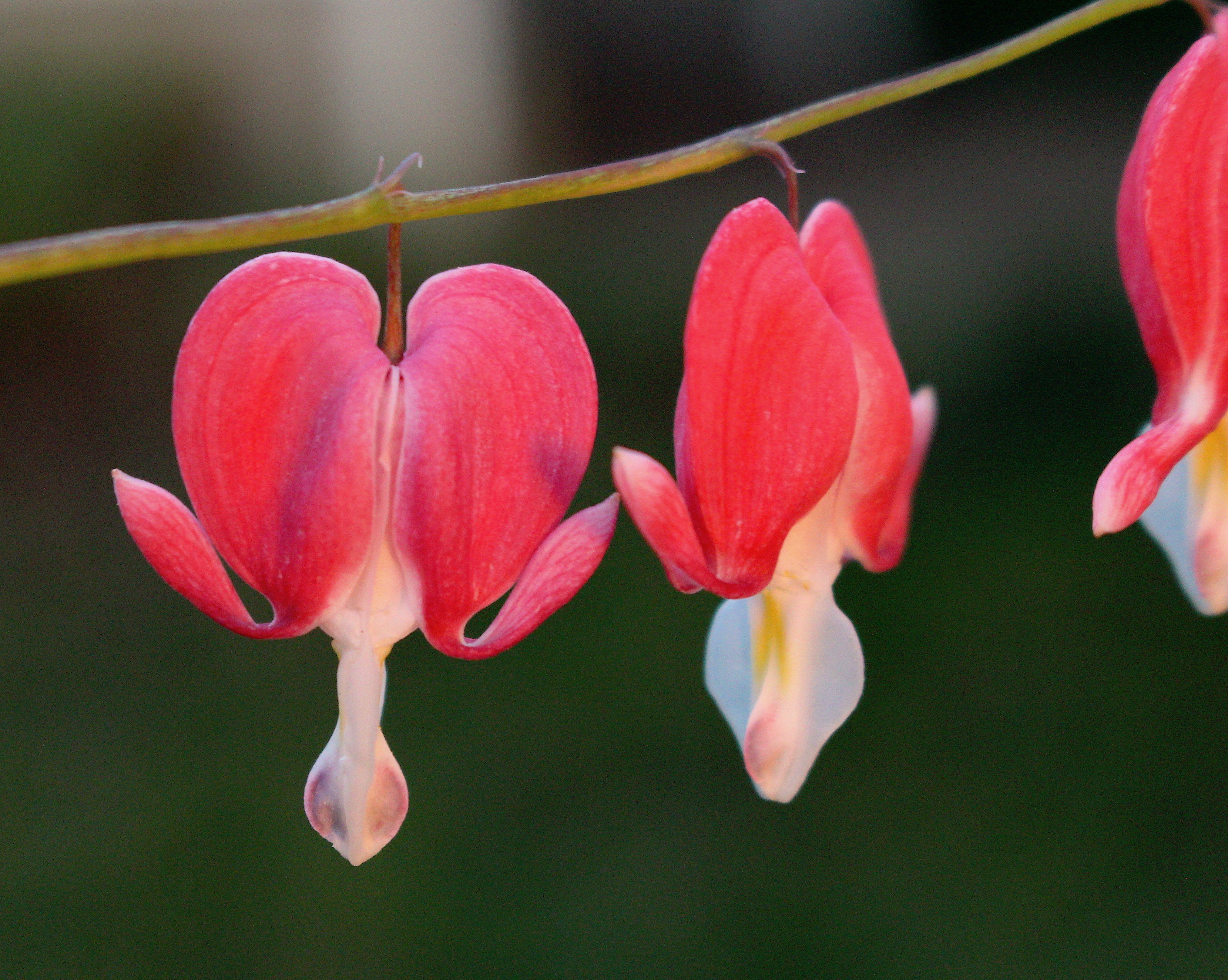
He of strength and hope, of infinite memory and everlasting love: He knows us down to our very atoms ~~ even we who are weak, broken, and undeserving. He causes us to burst into bloom in remembrance of having been in His presence.
Unless the eye catch fire, Then God will not be seen. Unless the ear catch fire Then God will not be heard. Unless the tongue catch fire Then God will not be named. Unless the heart catch fire, Then God will not be loved. Unless the mind catch fire, Then God will not be known. ~William Blake from “Pentecost”
I said to my soul, be still, and wait without hope For hope would be hope for the wrong thing; wait without love, For love would be love of the wrong thing; there is yet faith But the faith and the love and the hope are all in the waiting. Wait without thought, for you are not ready for thought: So the darkness shall be the light, and the stillness the dancing. Whisper of running streams, and winter lightning. The wild thyme unseen and the wild strawberry, The laughter in the garden, echoed ecstasy Not lost, but requiring, pointing to the agony Of death and birth.
Home is where one starts from. As we grow older the world becomes stranger, the pattern more complicated Of dead and living. Not the intense moment Isolated, with no before and after, But a lifetime burning in every moment
Love is most nearly itself When here and now cease to matter. ~T.S. Eliot from “East Coker”
Today, if we feel we are without hope, if faith feels frail, if love seems distant, we must wait, stilled, for the moment we are lit afire~ when the Living God is seen, heard, named, loved, known, forever burning in our hearts in this moment, for a lifetime and for eternity. Here and now ceases to matter.
She rarely made us do it—we’d clear the table instead— so my sister and I teased that some day we’d train our children right and not end up like her, after every meal stuck with red knuckles, a bleached rag to wipe and wring. The one chore she spared us: gummy plates in water greasy and swirling with sloughed peas, globs of egg and gravy. Or did she guard her place at the window? Not wanting to give up the gloss of the magnolia, the school traffic humming. Sunset, finches at the feeder. First sightings of the mail truck at the curb, just after noon, delivering a note, a card, the least bit of news. ~Susan Meyers “Mother, Washing Dishes”
My thoughts went round and round and it occurred to me that if I ever wrote a novel it would be of the ‘stream of consciousness’ type and deal with an hour in the life of a woman at the sink.
….I had to admit that nobody had compelled me to wash these dishes or to tidy this kitchen. It was the fussy spinster in me, the Martha who could not comfortably sit and make conversation when she knew that yesterday’s unwashed dishes were still in the sink. ~Barbara Pym from Excellent Women
Even the mundane task of washing dishes by hand is an example of the small tasks and personal activities that once filled people’s daily lives with a sense of achievement. ~B.F. Skinner, behavioral psychologist
I trace the faltering American family to the invention of the automatic dishwasher.
What ever has happened to the human dishwasher with two hands full of wash cloth and scrubber, alongside a dish dryer armed with a towel?
Where is the list on the refrigerator of whose turn is next, and the accountability if a family member somehow shirks their washing/drying responsibility and leaves the dishes to the next day?
No longer do family members have to cooperate to scrub clean glasses, dishes and utensils, put them in the dish rack, dry them one by one and place them in the cupboard where they belong. If the washer isn’t doing a proper job, the dryer immediately takes note and recycles the dirty dish right back to the sink. Instant accountability. I always preferred to be the dryer. If I washed, and my sister dried, we’d never get done. She would keep recycling the dishes back for another going-over. My messy nature exposed.
The family conversations started over a meal often continue over the clean-up process while concentrating on whether a smudge is permanent or not. I learned some important facts of life while washing and drying dishes that I might not have learned otherwise. Sensitive topics tend to be easier to discuss when elbow deep in soap suds. Spelling and vocabulary and math fact drills are more effective when the penalty for a missed word is a snap on the butt with a dish towel.
Modern society is missing the best opportunity for three times a day family-together time. Forget family “game” night, or parental “date” night, or even vacations. Dish washing and drying at the sink takes care of all those times when families need to be communicating and cooperating.
It is time to treat the automatic dishwasher as simply another storage cupboard and instead pull out the brillo pads, the white cotton dishtowels and the plastic dishrack.
Your days are short here; this is the last of your springs. And now in the serenity and quiet of this lovely place, touch the depths of truth, feel the hem of Heaven. You will go away with old, good friends. And don’t forget when you leave why you came. ~Adlai Stevenson, to the Class of ’54 Princeton University
I was eight years old in June 1963 when the Readers’ Digest arrived in the mail inside its little brown paper wrapper. As usual, I sat down in my favorite overstuffed chair with my skinny legs dangling over the side arm and started at the beginning, reading the jokes, the short articles and stories on harrowing adventures and rescues, pets that had been lost and found their way home, and then toward the back came to the book excerpt: “The Triumph of Janis Babson” by Lawrence Elliott.
Something about the little girl’s picture at the start of the story captured me right away–she had such friendly eyes with a sunny smile that partially hid buck teeth. This Canadian child, Janis Babson, was diagnosed with leukemia when she was only ten, and despite all efforts to stop the illness, she died in 1961. The story was written about her determination to donate her eyes after her death, and her courage facing death was astounding. Being nearly the same age, I was captivated and petrified at the story, amazed at Janis’ straight forward approach to her death, her family’s incredible support of her wishes, and especially her final moments, when (as I recall 54 years later) Janis looked as if she were beholding some splendor, her smile radiant.
”Is this Heaven?” she asked. She looked directly at her father and mother and called to them: “Mommy… Daddy !… come… quick !”
And then she was gone. I cried buckets of tears, reading and rereading that death scene. My mom finally had to take the magazine away from me and shooed me outside to go run off my grief. How could I run and play when Janis no longer could? It was a devastating realization that a child my age could get sick and die, and that God allowed it to happen.
Yet this story was more than just a tear-jerker for the readers. Janis’ final wish was granted –those eyes that had seen the angels were donated after her death so that they would help another person see. Janis had hoped never to be forgotten. Amazingly, she influenced thousands of people who read her story to consider and commit to organ donation, most of whom remember her vividly through that book excerpt in Readers’ Digest. I know I could not sleep the night after I read her story and determined to do something significant with my life, no matter how long or short it was. Her story influenced my eventual decision to become a physician. She made me think about death at a very young age as that little girl’s tragic story could have been mine and I was certain I could never have been so brave and so confident in my dying moments.
Janis persevered with a unique sense of purpose and mission for one so young. As a ten year old, she developed character that some people never develop in a much longer lifetime. Her faith and her deep respect for the gift she was capable of giving through her death brought hope and light to scores of people who still remember her to this day.
Out of the recesses of my memory, I recalled Janis’ story a few years ago when I learned of a local child who had been diagnosed with a serious cancer. I could not recall Janis’ name, but in googling “Readers’ Digest girl cancer story”, by the miracle of the internet I rediscovered her name, the name of the book and a discussion forum that included posts of people who were children in the sixties, like me, who had been incredibly touched by Janis when they read this same story as a child. Many were inspired to become health care providers like myself and some became professionals working with organ donation.
Janis and family, may you know the gift you gave so many people through your courage in the midst of suffering, and the resulting hope in the glory of the Lord. Your days were short here, but you touched the depth of truth and touched the hem of heaven. ~~the angels are coming indeed.
We who have been your old good friends, because of your story, have not forgotten how you left us and why you came in the first place.
For excerpts from “The Triumph of Janis Babson”, click here
If you want to identify me, ask me not where I live, or what I like to eat, or how I comb my hair, but ask me what I am living for, in detail, ask me what I think is keeping me from living fully for the thing I want to live for. ~ Thomas MertonfromMy Argument with the Gestapo
As a patient waiting to see my health care provider, I would adapt Merton’s template of personal revelation this way:
If you want to know who I am, ask me not about my insurance plan, or what is my current address, or whether I have a POLST on file, or whether I have signed the Notice of Privacy Practice, or whether I’ll accept a message on my phone — but ask me what I am most concerned about, in detail, ask me what I think is causing my symptoms and what I think is keeping me from eating healthy, exercising regularly, and choosing moderation in all things so that I can live fully for the thing I want to live for.
As a physician in the midst of a busy clinic day, I struggle to know who my patients are beyond their standard medical history and demographics. One of my goals in our primary care clinic, now sixteen years into electronic medical record (EMR) use, is to create a way for our patients to provide their personal history online to us via their password secured web portal. These are the questions our clinic staff may not have opportunity to ask or record during clinic visits. Having the patient personally document their social history and background for us to have in the chart –in essence, telling us their story in their own words–can be very helpful diagnostically and for individualizing the best treatment approach for each unique individual.
There needs to be an “About me” section in the EMR that would contain biographical and personal history information the patient could provide online via writing or video.
Tell us about yourself This is your own personal history in your own words to be added to your electronic medical record in the folder “About Me”. You can edit and add information at any time via this secure patient portal to update it.
We want to know your story. Only you can tell us what you think is most important for us as your health care providers to know about you. We may not always have the time to ask and document these detailed questions in a brief clinic visit, so we are asking for your help.
Why do we want to know your non-medical background as well as medical background?
We evaluate a patient’s symptoms of concern but we also are dedicated to helping our patients stay healthy life long. To assist us in this effort, it is very helpful to know as much about you as possible, in addition to your past medical history. It is crucial also to understand your family background and social history. We want to know more about your personal goals, and what you think may be preventing you right now from living fully for the things you consider most important to you.
This is your opportunity to tell us about yourself, with suggested questions below that you can consider answering. This information is treated as a confidential part of your medical record, just like all information contained in your record. You can add more at any time by returning to this site.
1) Tell us about your family—who raised you and grew up with you, and who currently lives with you– including your racial/ethnic/cultural heritage. If relevant, tell us whether you have biological beginnings outside of your family (e.g. adopted, egg donation, surrogate pregnancy, artificial insemination, in vitro fertilization) Provide information on any illnesses in your biologic family.
2) List the states or countries you have lived in, and what countries outside the U.S. you have lived in longer than a month. Have you served in the military or another government entity, like the Peace Corps?
3) Tell us about your educational and job background. This could include your schooling or training history, paid or volunteer work you’ve done. What are your hobbies, how do you spend your leisure time, what are your passions and future goals. Where do you see yourself in ten years?
4) Tell us about your sexual orientation and/or gender preference.
5) Tell us about your current emotional support system—who are you most likely to share with when things are going very well for you and especially when things are not going well.
6) Tell us about your spiritual background, whether you are part of a faith or religious community and if so, how it impacts your life.
7) Tell us what worries you most about your health.
8) What would you have done differently if you could change things in your life? What are you most thankful for in your life?
9) What else do you feel it is important for us to know about you?
Thank you for helping us get to know you better so we can provide medical care that best meets your unique needs.
As our clinic is moving to an updated EMR, I’m interested in hearing feedback from patients and health care providers. What additional questions would you want asked as part of personal history documentation in a medical record?
Electronic medical records allow us, as never before, the ability to share information securely between patients and their health care providers. Patients want to tell us their story and we want to know more about them.
It is time we asked them and truly listen to what they have to say.
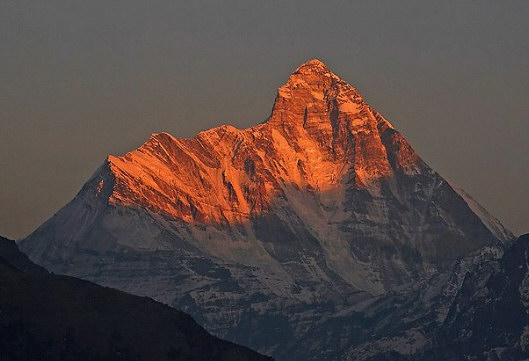
The news this week of the deaths of climbers on Nanda Devi peak in Nepal recalls the story of my high school classmate, Nanda Devi Unsoeld, whose body still rests on that mountain for which she was named.
The ripple effect from Nanda Devi’s arrival as a new junior in Olympia High School in 1970 reached me within minutes, as I felt the impact of her presence on campus immediately. One of my friends elbowed me, pointing out a new girl being escorted down the hall by the assistant principal. Students stared at the wake she left behind: Devi had wildly flowing wavy long blonde hair, a friendly smile and bold curious eyes greeting everyone she met.
From the neck up, she fit right in with the standard appearance at the time: as the younger sisters of the 60’s generation of free thinking flower children, we tried to emulate them in our dress and style, going braless and choosing bright colors and usually skirts that were too short and tight. There was the pretense we didn’t really care how we looked, but of course we did care very much, with hours spent daily preparing the “casual carefree” look that would perfectly express our freedom from fashion trends amid our feminist longings. Practicing careful nonconformity perfectly fit our peers’ expectations and aggravated our parents.
But Devi never looked like she cared what anyone else thought of her. The high school girls honestly weren’t sure what to make of her, speculating together whether she was “for real” and viewed her somewhat suspiciously, as if she was putting on an act.
The boys were mesmerized.
She preferred baggy torn khaki shorts or peasant skirts with uneven hems, loose fitting faded T shirts and ripped tennis shoes without shoelaces. Her legs were covered with long blonde hair, as were her armpits which she showed off while wearing tank tops. She pulled whole cucumbers from her backpack in class and ate them like cobs of corn, rind and all. She smelled like she had been camping without a shower for three days, but then riding her bike to school from her home 8 miles away in all kinds of weather accounted for that. One memorable day she arrived a bit late to school, pushing her bike through 6 inches of snow in soaking tennis shoes, wearing her usual broad smile of satisfaction.
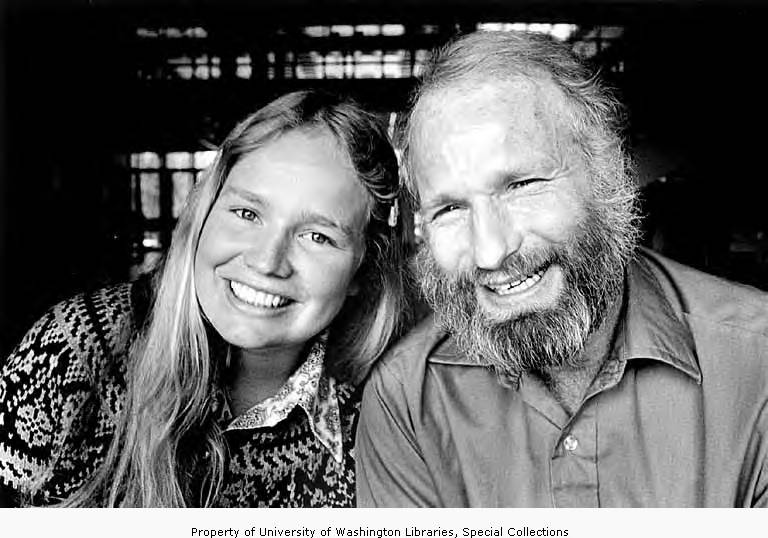
As a daughter of two Peace Corps workers who had just moved back to the U.S. after years of service in Nepal, Devi had lived very little of her life in the United States. Her father Willi Unsoeld, one of the first American climbers to reach the summit of Mt. Everest up the difficult west face, had recently accepted a professorship in comparative religion at a local college. He moved his wife and family back to the northwest to be near his beloved snowy peaks, suddenly immersing four children in an affluent culture that seemed foreign and wasteful.
Devi recycled before there was a word for it simply by never buying anything new and never throwing anything useful away, involved herself in social justice issues before anyone had coined the phrase, and was an activist behind the scenes more often than a leader, facilitating and encouraging others to speak out at anti-war rallies, organizing sit-ins for world hunger and volunteering in the local soup kitchen. She mentored adolescent peers to get beyond their self-consciousness and self-absorption to explore the world beyond the security of high school walls.
Regretfully, few of us followed her lead. We preferred the relative security and camaraderie of hanging out at the local drive-in to taking a shift at the local 24 hour crisis line. We showed up for our graduation ceremony in caps and gowns while the rumor was that Devi stood at the top of Mt. Rainier with her father that day.
I never saw Devi after high school but heard of her plans in 1976 to climb with an expedition to the summit of Nanda Devi, the peak in India for which she was named. She never returned, dying in her father’s arms as she suffered severe abdominal pain and irreversible high altitude sickness just below the summit. She lies forever buried in the ice on that faraway peak in India. Her father died in an avalanche only a few years later, as he led an expedition of college students on a climb on Mt. Rainier, only 60 miles from home.
Had Devi lived these last 40 years, I have no doubt she would have led our generation with her combination of charismatic boldness and excitement about each day’s new adventure. She lived without pretense, without hiding behind a mask of fad and fashion and conformity and without the desire for wealth or comfort.
I wish I had learned what she had to teach me when she sat beside me in class, encouraging me by her example to become someone more than the dictates of societal expectations. I secretly admired the freedom she embodied in not being concerned in the least about fitting in. Instead, I still mourn her loss all these years later, having to be content with the legacy she has now left behind on a snowy mountain peak that called her by name.
In science we have been reading only the notes to a poem: in Christianity we find the poem itself. ~C.S. Lewis from Miracles
Science – my life’s work – fails to love unconditionally, to grasp the hand of the dying, to give hope to the weak and afraid, to become sacrifice for sin, to offer everlasting forgiveness and grace.
Science is mere end-of-the-day footnote to the Word extending beyond the here and now; an unblinking fermata within Creation, leading into His ultimate symphonic Work.
Yet knowing how way leads on to way, I doubted if I should ever come back… I shall be telling this with a sigh Somewhere ages and ages hence… ~Robert Frost (1916) from “The Road Not Taken”
Two lonely cross-roads that themselves cross each other I have walked several times this winter without meeting or overtaking so much as a single person on foot or on runners. The practically unbroken condition of both for several days after a snow or a blow proves that neither is much travelled. Judge then how surprised I was the other evening as I came down one to see a man, who to my own unfamiliar eyes and in the dusk looked for all the world like myself, coming down the other, his approach to the point where our paths must intersect being so timed that unless one of us pulled up we must inevitably collide. I felt as if I was going to meet my own image in a slanting mirror. Or say I felt as we slowly converged on the same point with the same noiseless yet laborious stride as if we were two images about to float together with the uncrossing of someone’s eyes. I verily expected to take up or absorb this other self and feel the stronger by the addition for the three-mile journey home. But I didn’t go forward to the touch. I stood still in wonderment and let him pass by; and that, too, with the fatal omission of not trying to find out by a comparison of lives and immediate and remote interests what could have brought us by crossing paths to the same point in a wilderness at the same moment of nightfall. Some purpose I doubt not, if we could but have made out. I like a coincidence almost as well as an incongruity. ~Robert Frost (1911) from “Selected Letters”
Way leads on to way: I am far enough down the road that I don’t recall all the options I have faced over the years of my journey. I know there were times I ran into an impossible sticky thicket, so had to double back and try a different route. Maybe I have learned since to choose more carefully.
I don’t believe in coincidence and I don’t believe our choices are randomly made. I believe I am shepherded in the direction I am meant to go. The issue is whether I listen or whether I bolt the opposite way, come what may.
If grace is so wonderful, why do we have such difficulty recognizing and accepting it?
Maybe it’s because grace is not gentle or made-to-order.
It often comes disguised as loss, or failure, or unwelcome change. For grace to be grace, it must give us things we didn’t know we needed and take us places where we didn’t know we didn’t want to go. ~Kathleen Norris from Acedia and Me
I’ve been salvaged when I didn’t even know I needed saving. I’ve been given what I didn’t think I needed so never had asked. I’ve been taken places I never planned to be when I was sure things were fine right where I was.
Grace is not about giving me what I think I want; it is not a reward for good behavior.
It is giving me exactly what I need when I deserve nothing.
It is the thorny landing that catches me when I fall. It is the tiny drop that spares me in drought. It is scars formed as proof that healing happens to the deepest wounds. It is being scattered when I planned to remain whole.
I am grateful, so very grateful, for what I didn’t know. I am grateful, so very grateful, for grace disguised.
A poem begins as a lump in the throat, a sense of wrong, a homesickness, a lovesickness. ~Robert Frostin a letter to Louis Untermeyer
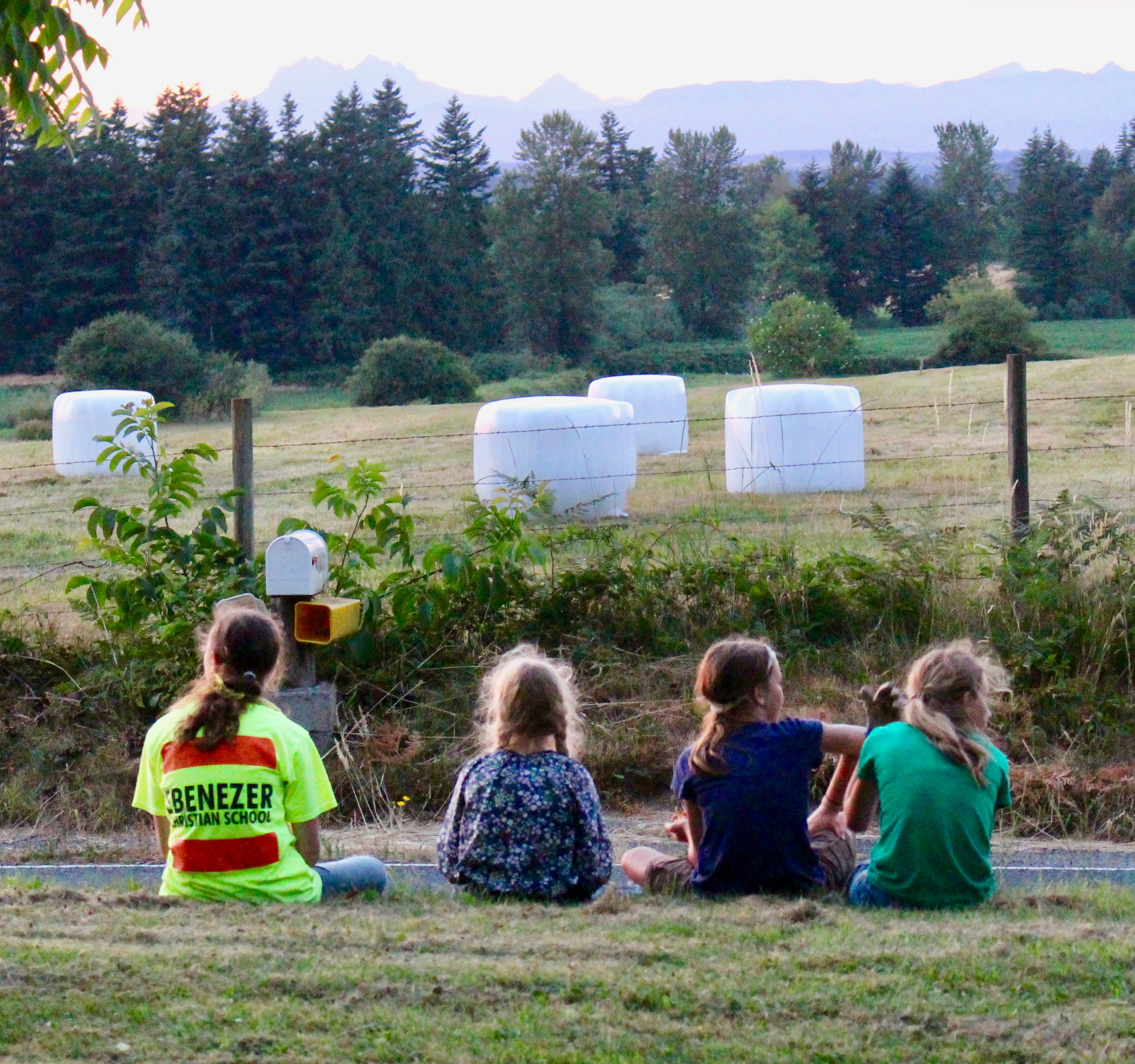
Spending time away from home has always been difficult for me. I was hopelessly homesick as a child whenever I stayed overnight with a friend or even with my grandma. Going to college two states away was a complete ordeal – it took me much longer than typical to let go of home and finally settle into a new life away from all that was familiar. I really did feel sick clinging too tightly to home base, unwilling to launch, barely able to wave good-bye.
Even now, as I travel away from the farm for a week for this or that, I sometimes get the lump-in-the-throat feeling that I remember keenly from my childhood years — knowing I am out of my element, stretching my comfort zone, not feeling at home away from home.
Will I ever grow out of this now that I’m in my mid-sixties or will it only get worse? Will I ever embrace a lovesickness for the rest of the world?
I keep trying – but the return trip is still the sweetest remedy for this sickness. There’s no place like home…









 Barnstorming