Preparing Through Parable: The Last Will Be First

118E20F9-E1F3-4252-87A7-84CE4E745736

For the kingdom of heaven is like a landowner who went out early in the morning to hire workers for his vineyard. 2 He agreed to pay them a denarius for the day and sent them into his vineyard.

3 “About nine in the morning he went out and saw others standing in the marketplace doing nothing. 4 He told them, ‘You also go and work in my vineyard, and I will pay you whatever is right.’ 5 So they went.

“He went out again about noon and about three in the afternoon and did the same thing. 6 About five in the afternoon he went out and found still others standing around. He asked them, ‘Why have you been standing here all day long doing nothing?’

7 “‘Because no one has hired us,’ they answered.

“He said to them, ‘You also go and work in my vineyard.’

8 “When evening came, the owner of the vineyard said to his foreman, ‘Call the workers and pay them their wages, beginning with the last ones hired and going on to the first.’

9 “The workers who were hired about five in the afternoon came and each received a denarius. 10 So when those came who were hired first, they expected to receive more. But each one of them also received a denarius. 11 When they received it, they began to grumble against the landowner. 12 ‘These who were hired last worked only one hour,’ they said, ‘and you have made them equal to us who have borne the burden of the work and the heat of the day.’

13 “But he answered one of them, ‘I am not being unfair to you, friend. Didn’t you agree to work for a denarius? 14 Take your pay and go. I want to give the one who was hired last the same as I gave you. 15 Don’t I have the right to do what I want with my own money? Or are you envious because I am generous?’

16 “So the last will be first, and the first will be last.”

Matthew 20:1-16

93413F7F-26CB-47D0-A4F6-9400B8AADD7A

One of the first complaints one hears from children is “it’s not fair!”  Once they are old enough to know which piece of pie is bigger, or which cookie has more chocolate chips, suddenly it is all about injustice and inequality.

As adults, we’re no better.  We’re always comparing ourselves to others, wondering if we have been shortchanged somehow.

Yet when it comes to the generosity of God, there is no inequality or injustice.  All’s fair when the last comes first and the first come last.  We’re on the same footing, loved tenderly and justly and righteously,  and no one could ask for more than that.

May my eyes see, my ears hear, my heart understand. He prepares me with parable.

E32C69B1-42B5-482C-B66E-23798A5D7024

Preparing Through Parable: A Great Chasm

morning315187


badlands20151


19 “There was a rich man who was dressed in purple and fine linen and lived in luxury every day. 20 At his gate was laid a beggar named Lazarus, covered with sores 21 and longing to eat what fell from the rich man’s table. Even the dogs came and licked his sores.

22 “The time came when the beggar died and the angels carried him to Abraham’s side. The rich man also died and was buried. 23 In Hades, where he was in torment, he looked up and saw Abraham far away, with Lazarus by his side. 24 So he called to him, ‘Father Abraham, have pity on me and send Lazarus to dip the tip of his finger in water and cool my tongue, because I am in agony in this fire.’

25 “But Abraham replied, ‘Son, remember that in your lifetime you received your good things, while Lazarus received bad things, but now he is comforted here and you are in agony. 26 And besides all this, between us and you a great chasm has been set in place, so that those who want to go from here to you cannot, nor can anyone cross over from there to us.’

27 “He answered, ‘Then I beg you, father, send Lazarus to my family, 28 for I have five brothers. Let him warn them, so that they will not also come to this place of torment.’

29 “Abraham replied, ‘They have Moses and the Prophets; let them listen to them.’

30 “‘No, father Abraham,’ he said, ‘but if someone from the dead goes to them, they will repent.’

31 “He said to him, ‘If they do not listen to Moses and the Prophets, they will not be convinced even if someone rises from the dead.’”

Luke 16: 19-31


artistpoint104177


The chasm is deep and wide between the riches of the world and the riches of heaven.  I know which is for eternity and which is not;  I know which side I hope to be.

May my eyes see, my ears hear, my heart understand.  He prepares me with parable.

 

sunrise313187


badlands2015

Preparing Through Parable: Commending the Prudent

morning315184


sunrise313189


“There was a rich man whose manager was accused of wasting his possessions. So he called him in and asked him, ‘What is this I hear about you? Give an account of your management, because you cannot be manager any longer.’

“The manager said to himself, ‘What shall I do now? My master is taking away my job. I’m not strong enough to dig, and I’m ashamed to beg— I know what I’ll do so that, when I lose my job here, people will welcome me into their houses.’

“So he called in each one of his master’s debtors. He asked the first, ‘How much do you owe my master?’

“‘Nine hundred gallons of olive oil,’ he replied.

“The manager told him, ‘Take your bill, sit down quickly, and make it four hundred and fifty.’

“Then he asked the second, ‘And how much do you owe?’

“‘A thousand bushels of wheat,’ he replied.

“He told him, ‘Take your bill and make it eight hundred.’

“The master commended the dishonest manager because he had acted shrewdly. For the people of this world are more shrewd in dealing with their own kind than are the people of the light.
Luke 16:1-8


sunrise313185


sunrise313184


I don’t easily understand how this parable is teaching better Christian living.  It describes a calculating and opportunistic manager who, being booted out the door when his dishonest practices are discovered, nevertheless manipulates his rich employer to ensure his future security.  Prudent?  apparently.  Shrewd? yes.  Unethical?  absolutely.

Yet the employer commends his former manager for his forward-thinking actions, as self-serving as they are.  And no, he doesn’t get his job back.  He is part of the world and its darkness.

But “people of the light” should be even more plan-full and prudent with the resources we are given so richly.  As we are illuminated by the Spirit, so shall we illuminate.

The Light is turned on.


May my eyes see, my ears hear, my heart understand.  He prepares me with parable.

sunset113187


IMG_2257

Preparing Through Parable: Back Safe and Sound


11 Jesus continued: “There was a man who had two sons. 12 The younger one said to his father, ‘Father, give me my share of the estate.’ So he divided his property between them.

13 “Not long after that, the younger son got together all he had, set off for a distant country and there squandered his wealth in wild living. 14 After he had spent everything, there was a severe famine in that whole country, and he began to be in need. 15 So he went and hired himself out to a citizen of that country, who sent him to his fields to feed pigs. 16 He longed to fill his stomach with the pods that the pigs were eating, but no one gave him anything.

17 “When he came to his senses, he said, ‘How many of my father’s hired servants have food to spare, and here I am starving to death! 18 I will set out and go back to my father and say to him: Father, I have sinned against heaven and against you.19 I am no longer worthy to be called your son; make me like one of your hired servants.’ 20 So he got up and went to his father.

“But while he was still a long way off, his father saw him and was filled with compassion for him; he ran to his son, threw his arms around him and kissed him.

21 “The son said to him, ‘Father, I have sinned against heaven and against you. I am no longer worthy to be called your son.’

22 “But the father said to his servants, ‘Quick! Bring the best robe and put it on him. Put a ring on his finger and sandals on his feet. 23 Bring the fattened calf and kill it. Let’s have a feast and celebrate. 24 For this son of mine was dead and is alive again; he was lost and is found.’ So they began to celebrate.

25 “Meanwhile, the older son was in the field. When he came near the house, he heard music and dancing. 26 So he called one of the servants and asked him what was going on. 27 ‘Your brother has come,’ he replied, ‘and your father has killed the fattened calf because he has him back safe and sound.’

28 “The older brother became angry and refused to go in. So his father went out and pleaded with him. 29 But he answered his father, ‘Look! All these years I’ve been slaving for you and never disobeyed your orders. Yet you never gave me even a young goat so I could celebrate with my friends. 30 But when this son of yours who has squandered your property with prostitutes comes home, you kill the fattened calf for him!’

31 “‘My son,’ the father said, ‘you are always with me, and everything I have is yours. 32 But we had to celebrate and be glad, because this brother of yours was dead and is alive again; he was lost and is found.’”
Luke 15:11-32


The story of the prodigal son(s) has such breadth and depth and heart and illumination  – it is impossible to read it again without peering into a glass darkly to find a new pinhole of truth.

We think it is about the wayward son who blows his inheritance on high and careless living, ends up jealous of the swine’s fodder, and comes back with remorse and repentance to be welcomed and embraced by his grieving father.

We think it is about the father full of forgiveness and longing for his lost child, who harbors not an ounce of bitterness, rejoicing at the restoration of his relationship with his son.

But for me it is about the older son, the more nuanced “prodigal” in the story, who becomes resentful and angry, unappreciative for the rich home and family legacy given him by his father.  As the “good” and dutiful son who towed the line, he feels entitled to whatever the father has but wastes the rich gift of generosity just as surely as his younger brother did, showing no compassion or relief when his brother returns home.  He is the one whose heart has truly wandered away and is lost, perhaps never to be found and restored again.

What is the true treasure of riches we inherit from our Father?   That pot of gold reflecting His Light is right where it has always been:  in the heart of the Father, in His grace and mercy and compassion for our brokenness, welcoming us back with open arms when we, wandering and lost, find our way back home.


May my eyes see, my ears hear, my heart understand.  He prepares me with parable.



Preparing Through Parable: The Lost is Found


“Or suppose a woman has ten silver coins and loses one. Doesn’t she light a lamp, sweep the house and search carefully until she finds it? And when she finds it, she calls her friends and neighbors together and says, ‘Rejoice with me; I have found my lost coin.’ 10 In the same way, I tell you, there is rejoicing in the presence of the angels of God over one sinner who repents.”
Luke 15: 8-10


We may be shattered, torn and oh-so-very lost. But the search is ongoing for us, high and low, in the dustiest and most hidden of places.

And once we are found…we become the greatest of treasures, transformed from plain to beautiful because we were missing and now are safely back home.


May my eyes see, my ears hear, my heart understand.  He prepares me with parable.

 

Preparing Through Parable: What Will It Cost?


28 “Suppose one of you wants to build a tower. Won’t you first sit down and estimate the cost to see if you have enough money to complete it? 29 For if you lay the foundation and are not able to finish it, everyone who sees it will ridicule you,30 saying, ‘This person began to build and wasn’t able to finish.’

31 “Or suppose a king is about to go to war against another king. Won’t he first sit down and consider whether he is able with ten thousand men to oppose the one coming against him with twenty thousand? 32 If he is not able, he will send a delegation while the other is still a long way off and will ask for terms of peace.

33 In the same way, those of you who do not give up everything you have cannot be my disciples.
Luke 14: 28-33


I am reminded I must grasp what material possessions I have loosely:  I must be prepared to let go when the time comes.

This is hard for someone like myself who plans things out carefully, works hard, yet despite all that effort, is left feeling unfinished and bereft.

Even in the most dire circumstances:  I let go of what is meaningless and grab hold and hang on tight to a Savior sent to rescue me from myself.


May my eyes see, my ears hear, my heart understand.  He prepares me with parable.

 

Preparing Through Parable: Go Out to the Country Lanes


16 Jesus replied: “A certain man was preparing a great banquet and invited many guests. 17 At the time of the banquet he sent his servant to tell those who had been invited, ‘Come, for everything is now ready.’

18 “But they all alike began to make excuses. The first said, ‘I have just bought a field, and I must go and see it. Please excuse me.’

19 “Another said, ‘I have just bought five yoke of oxen, and I’m on my way to try them out. Please excuse me.’

20 “Still another said, ‘I just got married, so I can’t come.’

21 “The servant came back and reported this to his master. Then the owner of the house became angry and ordered his servant, ‘Go out quickly into the streets and alleys of the town and bring in the poor, the crippled, the blind and the lame.’

22 “‘Sir,’ the servant said, ‘what you ordered has been done, but there is still room.’

23 “Then the master told his servant, ‘Go out to the roads and country lanes and compel them to come in, so that my house will be full. 24 I tell you, not one of those who were invited will get a taste of my banquet.’”
Luke 14: 16-24


We all have our excuses.   I have plenty to spare.

Too tired, too busy, too stressed, too committed, can’t be bothered.

I’m not paying attention to the generosity of the offer — all that is asked of me is to say “YES!” to the invitation.  I may not be asked again if I turn it down the first time, so no more excuses.

Then I too will search those city streets, alley ways,  roads and country lanes for there is still room.  There is still room for all without excuse.


May my eyes see, my ears hear, my heart understand.  He prepares me with parable.

Preparing Through Parable: Be Humbled


“When someone invites you to a wedding feast, do not take the place of honor, for a person more distinguished than you may have been invited. If so, the host who invited both of you will come and say to you, ‘Give this person your seat.’ Then, humiliated, you will have to take the least important place. 10 But when you are invited, take the lowest place, so that when your host comes, he will say to you, ‘Friend, move up to a better place.’ Then you will be honored in the presence of all the other guests. 11 For all those who exalt themselves will be humbled, and those who humble themselves will be exalted.”

“When you give a luncheon or dinner, do not invite your friends, your brothers or sisters, your relatives, or your rich neighbors; if you do, they may invite you back and so you will be repaid. 13 But when you give a banquet, invite the poor, the crippled, the lame, the blind, 14 and you will be blessed. Although they cannot repay you, you will be repaid at the resurrection of the righteous.”
Luke 14: 7-14


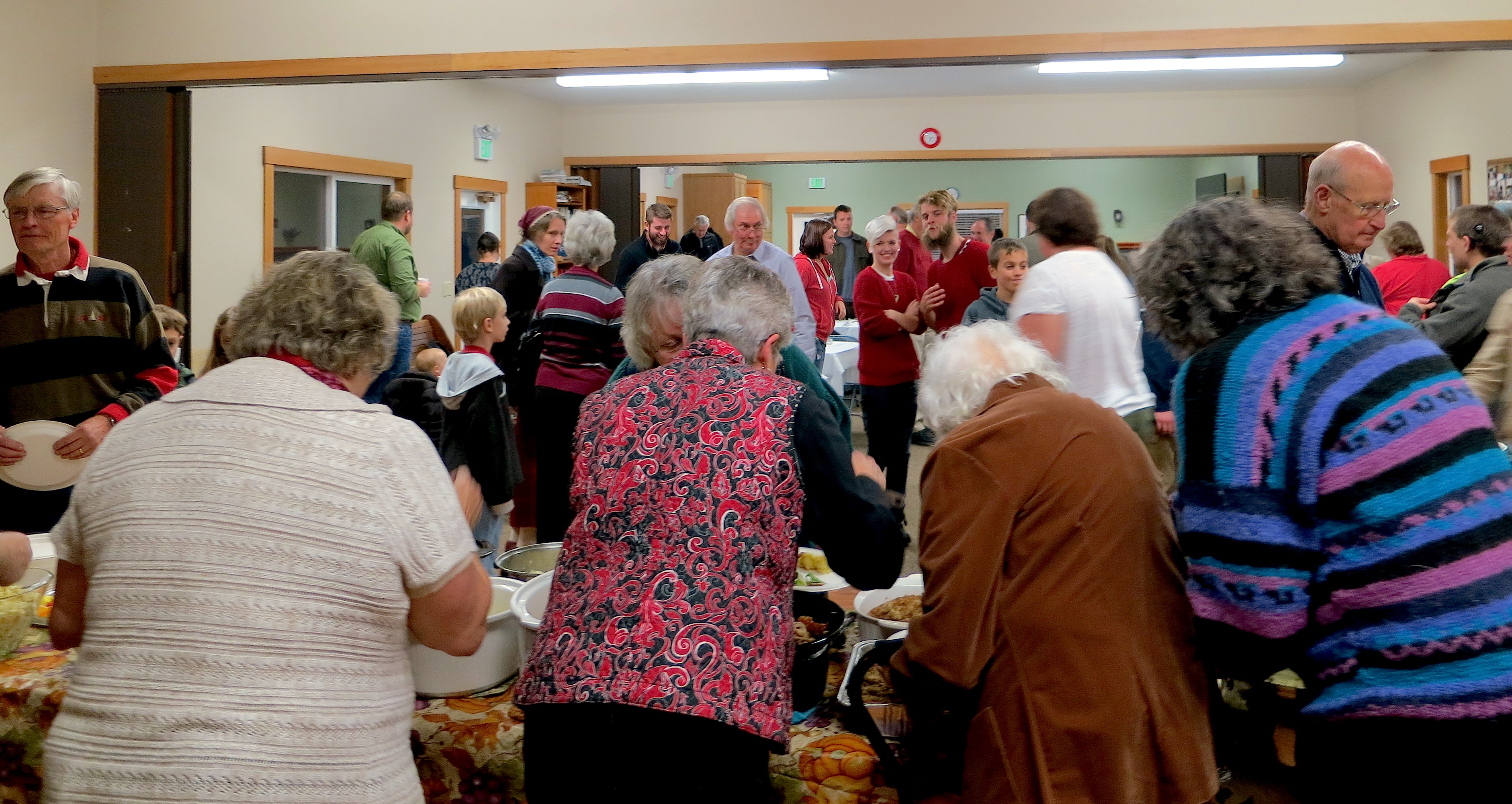
In the unspoken hierarchy of what makes a church function, I’m a kitchen lady and always will be.  I remember those very women from my childhood church of the fifties and sixties– their tight-knit ability to function as if one organism, swarming in aprons among tables set up in the fellowship hall and bustling around in the back by the stoves with steaming pots and pans and the occasionally dropped plate.

They kept the rest of us alive, those church ladies, by feeding us efficiently and plentifully and never ever sitting down.  I would occasionally see them eating standing up in the back of the hall, chatting amiably among themselves after the rest of us were served, but I knew they carefully wrapped up the leftovers during the clean up to deliver to shut-ins who couldn’t make it to the church supper.

I knew I was destined to become a kitchen lady, shy and introverted as I am, hiding myself behind huge plates of food and piles of dish cloths.  For me, it is a place of comfort and clean up filled with plenty of leftovers for anyone who needs them, and that just about perfectly describes the kingdom of God in my book and His Book.


May my eyes see, my ears hear, my heart understand.  He prepares me with parable.

Preparing Through Parable: Knock Like You Mean It


Then Jesus said to them, “Suppose you have a friend, and you go to him at midnight and say, ‘Friend, lend me three loaves of bread; a friend of mine on a journey has come to me, and I have no food to offer him.’
And suppose the one inside answers, ‘Don’t bother me. The door is already locked, and my children and I are in bed. I can’t get up and give you anything.’ I tell you, even though he will not get up and give you the bread because of friendship, yet because of your shameless audacity he will surely get up and give you as much as you need.
“So I say to you: Ask and it will be given to you; seek and you will find; knock and the door will be opened to you. 10 For everyone who asks receives; the one who seeks finds; and to the one who knocks, the door will be opened.”
Luke 11: 5-10


…we are faced with the shocking reality: 
Jesus stands at the door and knocks, in complete reality. 
He asks you for help in the form of a beggar, 
in the form of a ruined human being in torn clothing. 
He confronts you in every person that you meet. 
Christ walks on the earth as your neighbor as long as there are people. 
He walks on the earth as the one through whom 
God calls you, speaks to you and makes his demands. 
Christ stands at the door. 
Will you keep the door locked or open it to him?
~Dietrich Bonhoeffer from an Advent Sermon “The Coming of Jesus into our Midst”


Over ten years ago a young woman I’d been seeing for several weeks in my clinic for depression called unexpectedly on a Friday afternoon and canceled an upcoming appointment for the following Monday and did not reschedule. The receptionist sent me a message as is our policy for patients who “cancel and do not reschedule”. It gave me a bad feeling that she was turning her back on her treatment plan and I was uneasy about the upcoming weekend without knowing what was going on with her.

I could have just put on my coat and headed home at the end of that long Friday but decided to call my patient. She didn’t answer her phone. I mulled over my options, looked up her apartment address and drove there. As I approached her door, I could hear someone moving around in her apartment, but she didn’t respond to my knocks or my voice.

I decided to stay right there, talking to her through the door for about 15 minutes, letting her know I wasn’t leaving until she opened up the door. I finally told her she could decide to open the door or I would call 911 and ask the police to come to make sure she was okay. She then opened the door, tears streaming down her face. She had been drinking heavily, with liquor bottles strewn around on the floor. She admitted an intent to overdose on aspirin and vodka. The vodka was already consumed but the unopened aspirin bottle was in her hand. I was the last person she expected to see at her door.

I called the mental health unit at the local hospital and they had an open bed. I told my patient that we could save time and hassle by heading over right then and there, and avoid the emergency room mess, and the possibility of an involuntary detainment.

She agreed to come with me and be admitted voluntarily for stabilization. I went the following day to visit her and she greeted me with a hug and thanked me for not giving up on her when she had given up on herself. In sobriety, her eyes were brighter and she was more hopeful. She never expected anyone to care enough to come knocking on her door looking for her, and to stand firm when she was rejecting all approaches. She was astounded and grateful, and frankly, so was I.

Four years later, a small card arrived in my clinic mailbox on a most challenging work day, from an unfamiliar address two thousand miles away. The name looked vaguely familiar to me but when I opened and read the contents, this time it was my turn to let tears flow:

“Dear Doctor,

I am not sure if you will remember me considering you see a number of patients daily; however, I am a patient whose life you changed in the most positive way. I never truly THANKED YOU for listening to me and hearing my silent words of grief and hearing my cries for help. If it had not been for you, had you not knocked on my door, I would not be writing this letter to you today. I don’t know exactly what to say to the person who saved me from hurting myself fatally. You were a stranger in my life, but a dear friend in my time of need. THANK YOU, for everything that you did for me. You have a permanent place in my heart, you have given my spirit hope, you have reminded me that a life is worth living. Thank you, thank you, thank you! Sincerely, L_____”

I’m grateful so many years ago I had the sense to go knock on her door, the stubbornness to stay put until she responded, and most of all, I’m appreciative for her gracious note letting me know it made a difference. Later, on a most difficult day, she made a difference for me.

She kept knocking on my door and I opened it, awash in my own tears.


May my eyes see, my ears hear, my heart understand.  He prepares me with parable.

Preparing Through Parable: He Took Pity


“A man was going down from Jerusalem to Jericho, when he was attacked by robbers. They stripped him of his clothes, beat him and went away, leaving him half dead. 31 A priest happened to be going down the same road, and when he saw the man, he passed by on the other side. 32 So too, a Levite, when he came to the place and saw him, passed by on the other side.33 But a Samaritan, as he traveled, came where the man was; and when he saw him, he took pity on him. 34 He went to him and bandaged his wounds, pouring on oil and wine. Then he put the man on his own donkey, brought him to an inn and took care of him. 35 The next day he took out two denarii and gave them to the innkeeper. ‘Look after him,’ he said, ‘and when I return, I will reimburse you for any extra expense you may have.’

36 “Which of these three do you think was a neighbor to the man who fell into the hands of robbers?”

37 The expert in the law replied, “The one who had mercy on him.”

Jesus told him, “Go and do likewise.”
Luke 10: 30-37


No parable is as well known in secular circles as that of the good Samaritan – it has become law, under that very name, to protect those who would stop to help someone who is injured or needs assistance, without fear of legal reprisal.

That isn’t exactly why the Good Samaritan story was told: the purpose was not to promote legal protection for the helper, who needed no such protection.  It was to point out that the only one to bother to help was someone who was “other” – someone from Samaria of all places.  Someone of different ethnicity, from a different culture, having different beliefs, worshipping a God in a way considered “corrupted” – this was the person to show compassion, to give richly of himself:  his time, his money, his care, his mercy.  He was the neighbor and friend to the man lying beaten and robbed alongside the road, not the ones who might well have lived next door or who worked in the temple, or who looked like and believed as he did.

As Mr. Rogers once wrote:
“My mother would say to me, ‘Look for the helpers. You will always find people who are helping.’ To this day, especially in times of disaster, I remember my mother’s words, and I am always comforted by realizing that there are still so many helpers — so many caring people in this world.”

Sadly, in this day and age, we have far too many opportunities to recognize the helpers who will assist anyone, no matter who they are, the color of their skin or what they believe.

What a comfort that is!

May my eyes see, my ears hear, my heart understand.  He prepares me with parable.