Feeling Them Resting There

The sunlight now lay over the valley perfectly still.
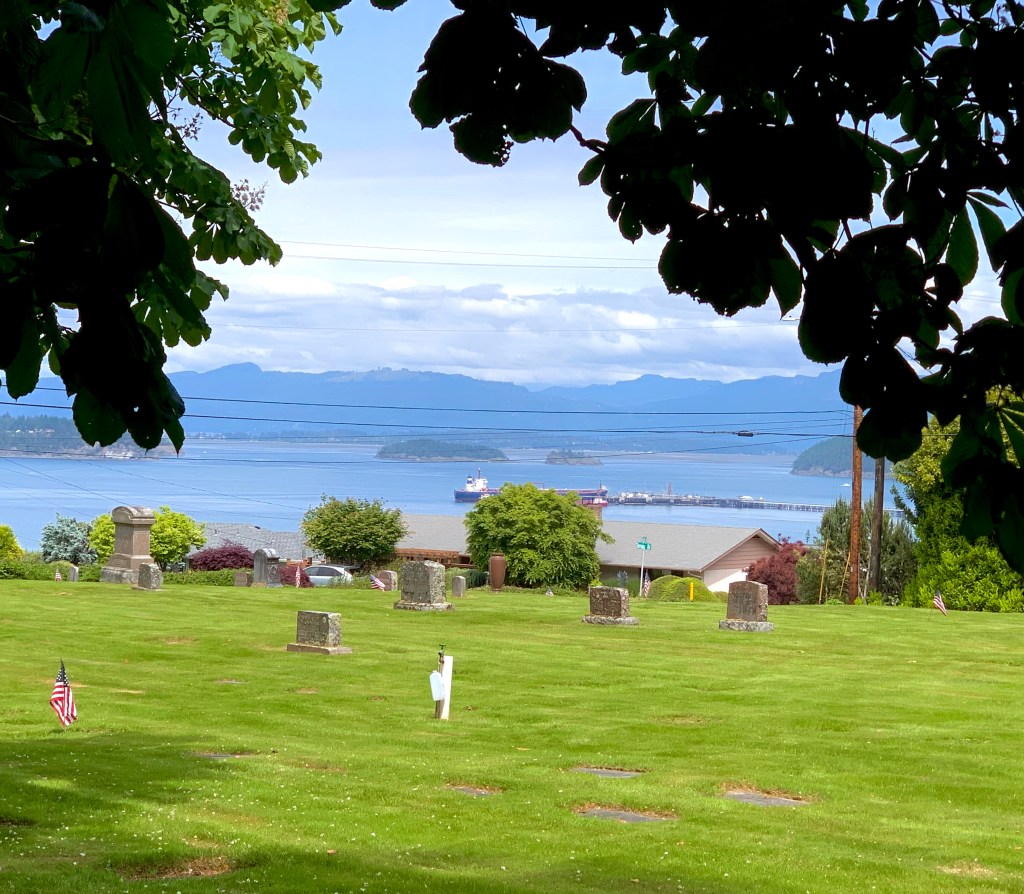
I went over to the graveyard beside the church
and found them under the old cedars…
I am finding it a little hard to say that I felt them resting there,

but I did…

I saw that, for me, this country would always be populated
with presences and absences,
presences of absences,
the living and the dead.
The world as it is

would always be a reminder
of the world that was,
and of the world that is to come.
~Wendell Berry in Jayber Crow
In great deeds, something abides. 
On great fields, something stays. 
Forms change and pass; bodies disappear; 
but spirits linger, 

to consecrate ground for the vision-place of souls. 

And reverent men and women from afar, 
and generations that know us not and that we know not of, 
heart-drawn to see where and by whom great things were suffered and done for them, shall come to this deathless field, 
to ponder and dream; and lo!

the shadow of a mighty presence shall wrap them in its bosom, 
and the power of the vision pass into their souls. 


This is the great reward of service. 
To live, far out and on, in the life of others;
this is the mystery of the Christ,

–to give life’s best for such high sake
that it shall be found again unto life eternal.

~Major-General Joshua Chamberlain, Gettysburg, Pennsylvania 1889
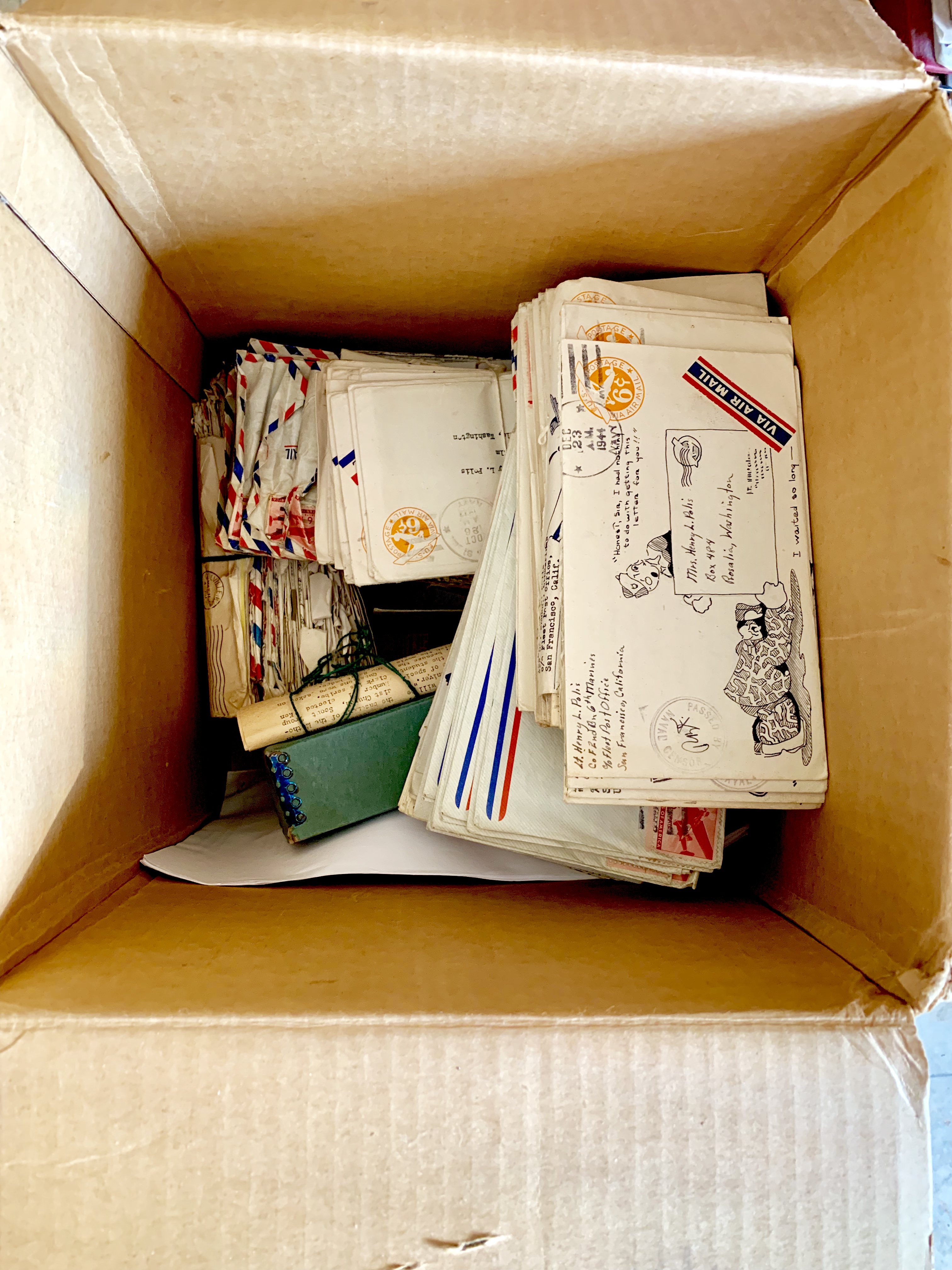
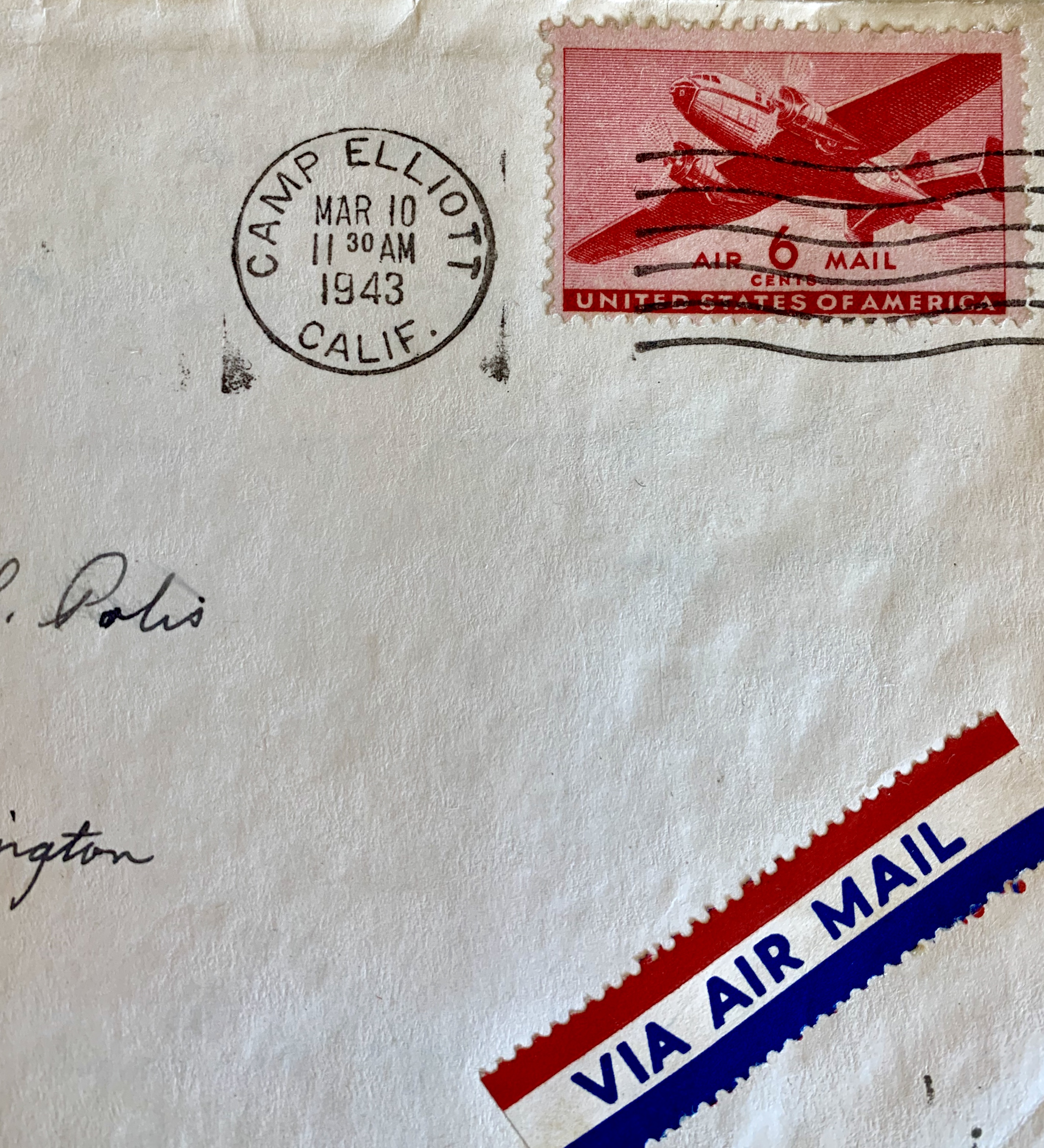
A box of over 700 letters, exchanged between my parents from late 1941 to mid-1945, sat unopened for six decades.

I started reading. I felt them resting in those inked words.

My parents barely knew each other before marrying quickly on Christmas Eve 1942 – the haste due to the uncertain future for a newly trained Second Lieutenant in the Marine Corps. They only had a few weeks together before she returned home to her rural teaching position and he readied himself to be shipped out for the island battles to come.

They had no idea they would not see each other for another 30+ months or even see each other again at all. They had no idea their marriage would fall apart 35 years later and they would reunite a decade after the divorce for five more years together before Dad died of cancer at age 73.

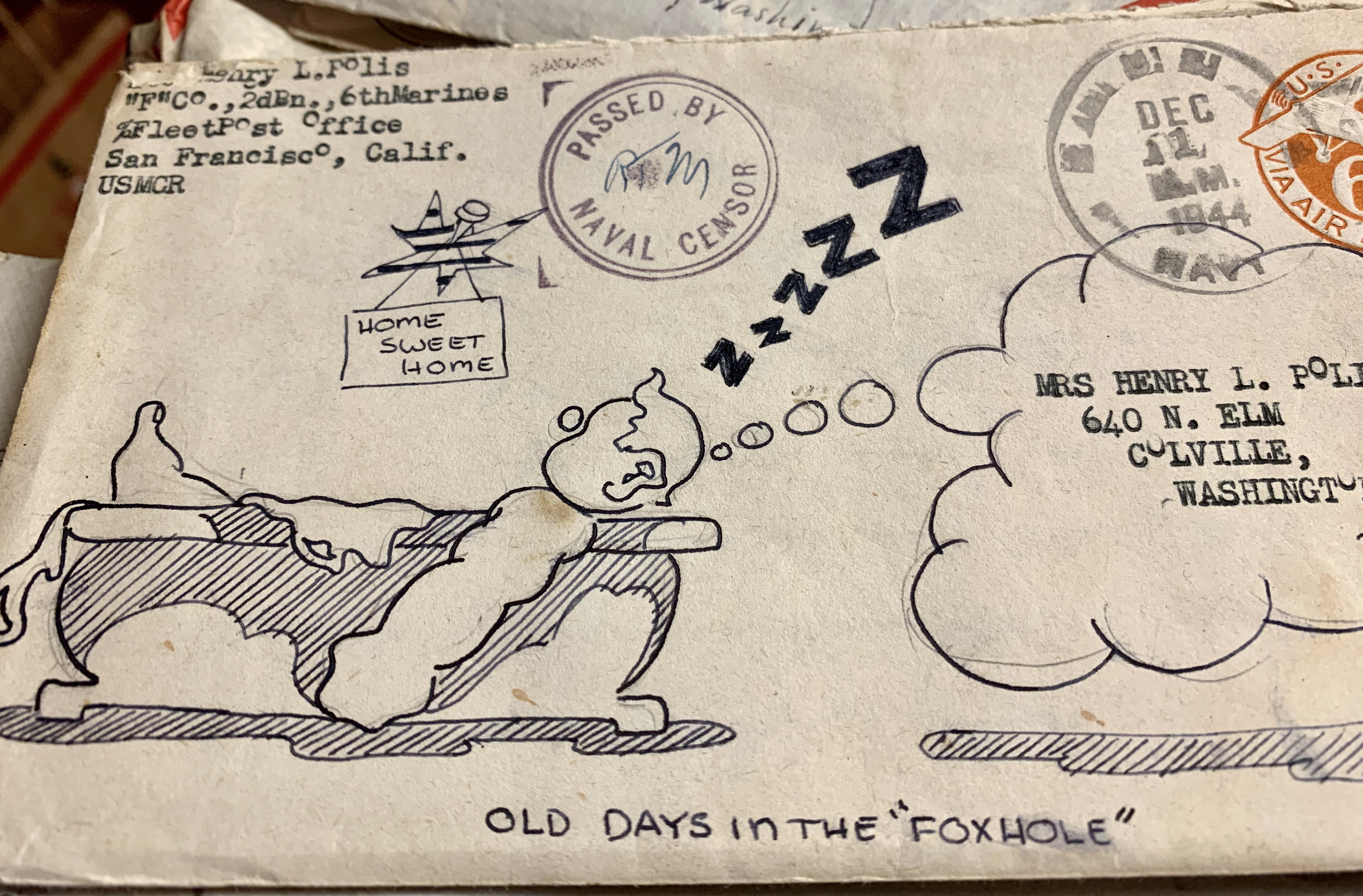
A presence of absence: the letters do contain the long-gone but still-familiar voices of my parents, but they are the words and worries of youngsters of 20 and 21, barely prepared for the horrors to come from war and interminable waiting. When he was fighting battles on Tarawa, Saipan, and Tinian, no letters or news would be received for a month or more, otherwise they tried to write each other daily, though with minimal news to share due to military censorship. They speak mostly of their desire for a normal life together rather than a routine centered on mailbox, pen and paper and waiting – lots and lots of waiting.

I’m not sure what I hoped to find in these letters. Perhaps I hoped for flowery romantic whisperings and the poetry of longing and loneliness. Instead I am reading plain spoken words from two people who somehow made it through those awful years to make my sister and brother and myself possible.

Our inheritance is contained in this musty box of words bereft of poetry. But decades later my heart is moved by these letters – I carefully refold them back into their envelopes and replace them gently back in order. A six cent airmail stamp – in fact hundreds and hundreds of them – was a worthwhile investment in the future, not only for themselves and their family to come, but for generations of U.S. citizens who tend to take their freedom for granted.

Thank you, Dad and Mom, for the early years together you gave up to make today possible for us and the generations to follow.

I hear the mountain birds
The sound of rivers singing
A song I’ve often heard
It flows through me now
So clear and so loud
I stand where I am
And forever I’m dreaming of home
I feel so alone, I’m dreaming of home

It’s carried in the air
The breeze of early morning
I see the land so fair
My heart opens wide
There’s sadness inside
I stand where I am
And forever I’m dreaming of home
I feel so alone, I’m dreaming of home

This is no foreign sky
I see no foreign light
But far away am I
From some peaceful land
I’m longing to stand
A hand in my hand
…forever I’m dreaming of home
I feel so alone, I’m dreaming of home
~Lori Barth and Philippe Rombi “I’m Dreaming of Home”

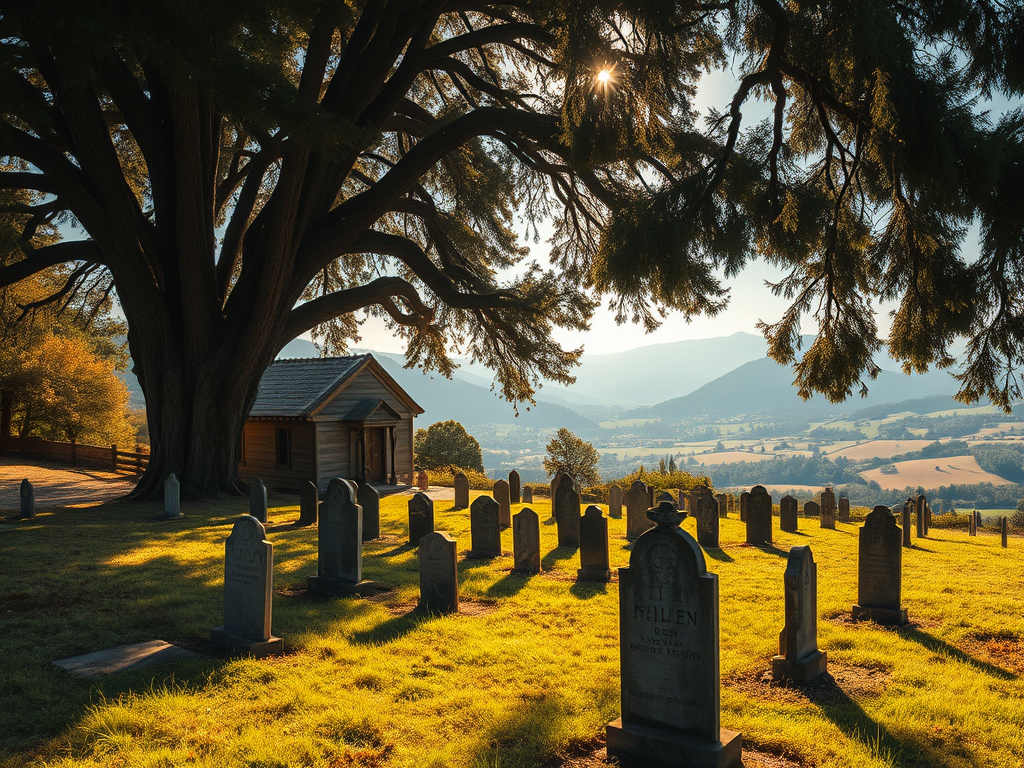
AI image created for this post
One-Time
Monthly
Yearly

Make a one-time or recurring donation to support daily Barnstorming posts

Make a monthly donation

Make a yearly donation

Choose an amount

$10.00
$25.00
$50.00
$5.00
$15.00
$100.00
$5.00
$15.00
$100.00

Or enter a custom amount

$

Your contribution is deeply appreciated.

Your contribution is appreciated.

Your contribution is appreciated.

DonateDonate monthlyDonate yearly
Waiting for the Letters

I love you forever
my father’s letter tells her
for forty-nine pages,
from the troopship crossing the Atlantic
before they’d ever heard of Anzio.

He misses her, the letter says,
counting out days of boredom, seasickness,
and changing weather,
poker games played for matches
when cash and cigarettes ran out,
a Red Cross package—soap,
cards, a mystery book he traded away
for The Rubaiyyat a bunkmate didn’t want.
He stood night watch and thought
of her. Don’t forget the payment
for insurance, he says.

My mother waits at home with me,
waits for the letter he writes day by day
moving farther across the ravenous ocean.
She will get it in three months and
her fingers will smooth the Army stationery
to suede.

He will come home, stand
beside her in the photograph, leaning
on crutches, holding
me against the rough wool
of his jacket. He will sit
alone and listen to Aïda

and they will pick up their
interrupted lives. Years later,
she will show her grandchildren
a yellow envelope with
forty-nine wilted pages telling her

of shimmering sequins on the water,
the moonlight catching sudden phosphorescence,
the churned wake that stretched a silver trail.
~Ellen Steinbaum, “Letter Home” from Container Gardening

The dead say little in their letters
they haven’t said before.
We find no secrets, and yet
how different every sentence sounds
heard across the years.

My father breaks my heart
simply by being so young and handsome.
He’s half my age, with jet-black hair.
Look at him in his navy uniform
grinning beside his dive-bomber.

It’s silly to get sentimental.
The dead have moved on. So should we.
But isn’t it equally simple-minded to miss
the special expertise of the departed
in clarifying our long-term plans?

They never let us forget that the line
between them and us is only temporary.
Get out there and dance! the letters shout
adding, Love always. Can’t wait to get home!
And soon we will be. See you there.
~Dana Gioia from “Finding a Box of Family Letters

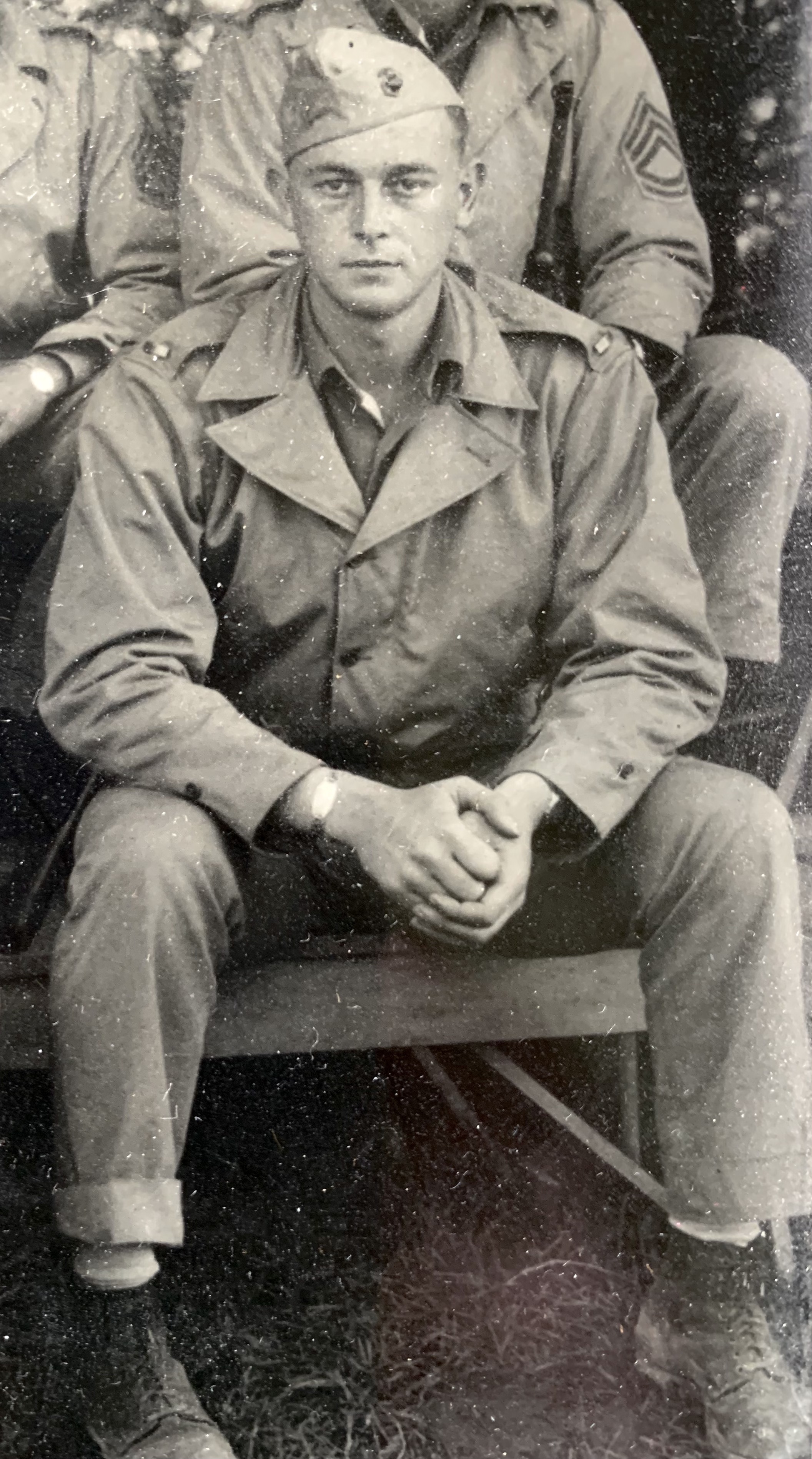
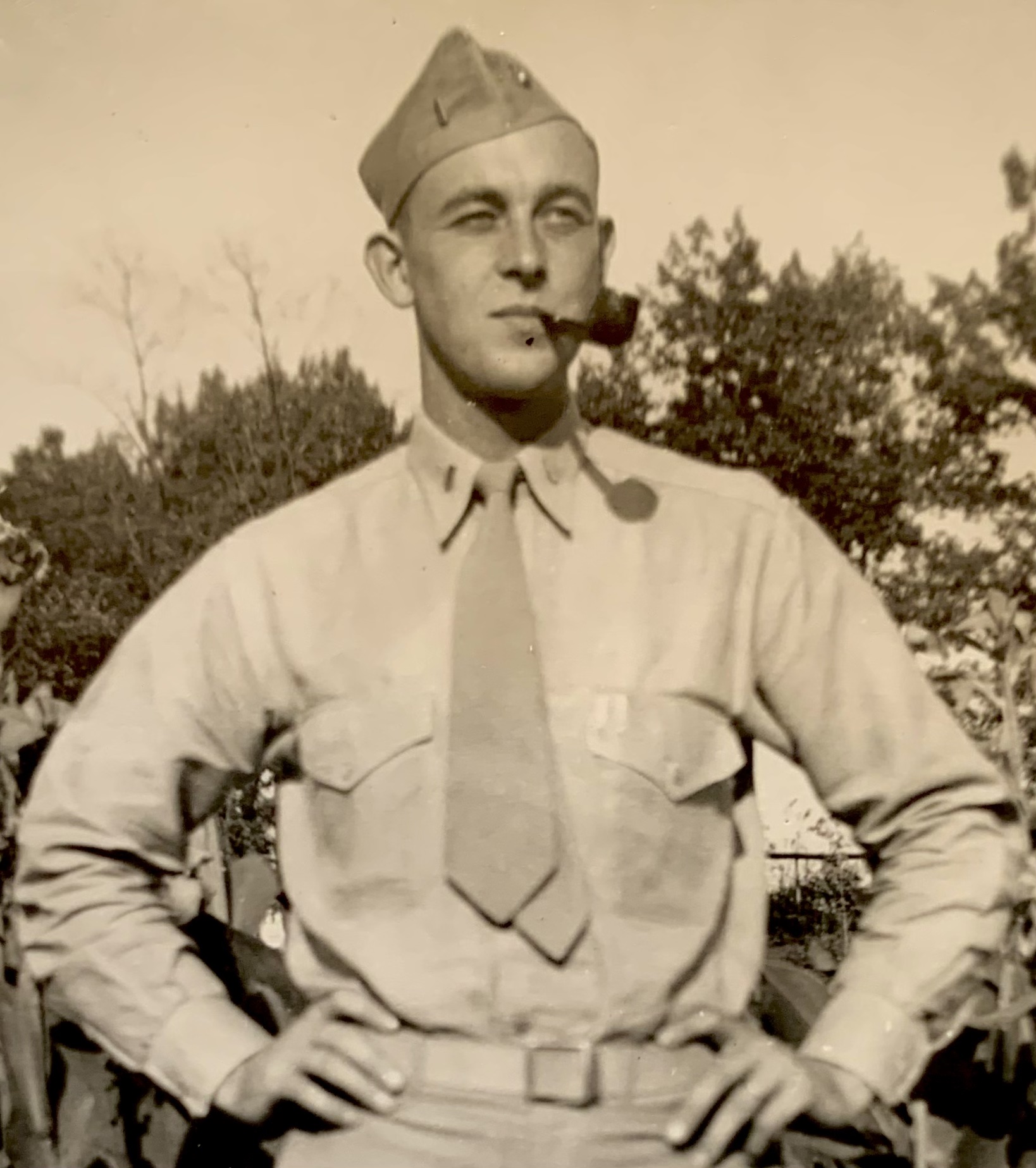
Marine Captain Henry Polis

Today is the 80th anniversary of the Battle of Tarawa, one of the bloodiest Marine Corps island victories in World War II. My 21 year old father was there, leading a company of over 100 men into battle on the “second wave.”

Below is a portion of a 1944 letter he sent home to my mother about approaching the island on November 21, 1943. When he was not in active battle, he wrote to her nearly daily. He returned home in late 1945, physically uninjured. He never spoke about his 36 months in combat, except in the most general terms.

I had never seen him with a gun in his hands, and wasn’t aware he even had kept a gun after leaving the Marines. One day, in the early 1970’s, one of our farm’s beef animals was injured so my father, for the first time in thirty years, pulled out a gun from its hiding place to put down the suffering animal. I never saw the gun again and believe my father disposed of it soon after – firing that gun after so many years was too much for him.

I have no idea what all my father witnessed and had to experience while under orders during those months in the South Pacific. I do know he would have done whatever his superiors asked him to do, just as the men under his command trusted him to lead them, even into their dying hour. These young men, some as teenagers at the time, guaranteed us the freedoms we blithely take for granted now.

His letter, which made it past the Marine censors:

“You mentioned a story of Navy landing craft taking the Marines into Tarawa.  It reminded me of something which impressed me a great deal and something I’m sure I’ll never forget. 

So you’ll understand what I mean I’ll try to start with an explanation.  In training – close order drill- etc.  there is a command that is given always when the men form in the morning – various times during the day– after firing– and always before a formation is dismissed.  The command is INSPECTION – ARMS.  On the command of EXECUTION- ARMS each man opens the bolt of his rifle.  It is supposed to be done in unison so you hear just one sound as the bolts are opened.  Usually it is pretty good and sounds O.K.

Just to show you how the morale of the men going to the <Tarawa> beach was – and how much it impressed me — we were on our way in – I was forward, watching the beach thru a little slit in the ramp – the men were crouched in the bottom of the boat, just waiting.  You see- we enter the landing boats with unloaded rifles and wait till it’s advisable before loading.  When we got about to the right distance in my estimation I turned around and said – LOAD and LOCK – I didn’t realize it, but every man had been crouching with his hand on the operating handle and when I said that — SLAM! — every bolt was open at once – I’ve never heard it done better – and those men meant business when they loaded those rifles. 

A man couldn’t be afraid with men like that behind him.
~ Marine Captain Henry Polis in a 1944 letter home about the Battle of Tarawa November 20-23, 1943

For photos of the battle:

National WWII Museum: The Battle of Tarawa

The History Channel: Battle of Tarawa

The Battle of Tarawa

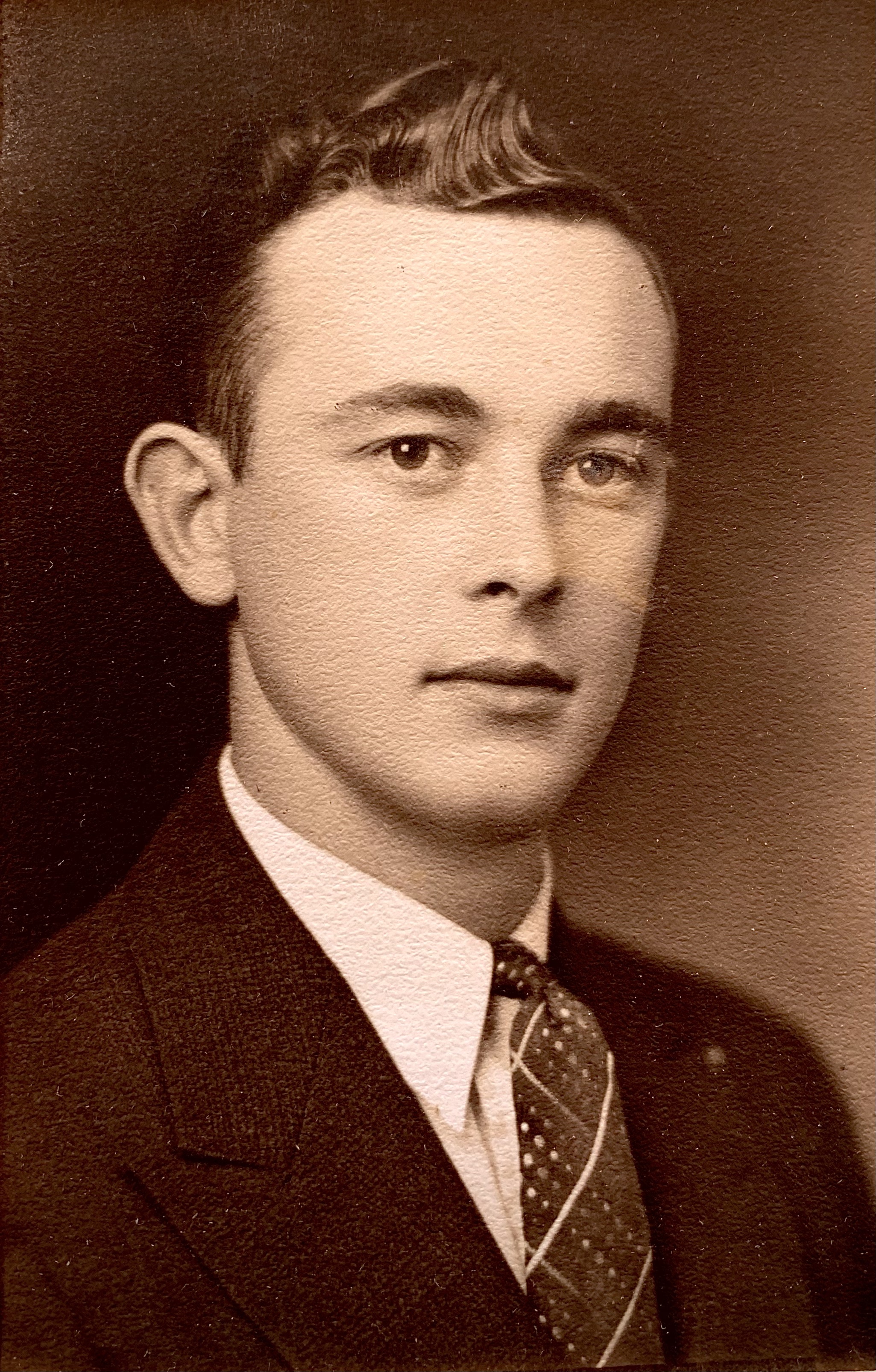
Henry Polis, Washington State College 1941 (age 20, before enlisting in the Marine Corps)
One-Time
Monthly
Yearly

Make a one-time or recurring donation to support daily ad-free Barnstorming posts

Make a monthly donation

Make a yearly donation

Choose an amount

$10.00
$25.00
$50.00
$5.00
$15.00
$100.00
$5.00
$15.00
$100.00

Or enter a custom amount

$

Your contribution is deeply appreciated.

Your contribution is appreciated.

Your contribution is appreciated.

DonateDonate monthlyDonate yearly
An Unthinkable Price

No, I will never know
what you saw or what you felt,
thrust into the maw of Eternity,

watching the mortars nightly
greedily making their rounds,
hearing the soft damp hiss

of men’s souls like helium escaping
their collapsing torn bodies,
or lying alone, feeling the great roar

of your own heart.
But I know:
there is a bitter knowledge

of death I have not achieved.
Thus in thankful ignorance,
and especially for my son

and for all who benefit so easily
at so unthinkable a price,
I thank you.

~Michael Burch “Privilege”


(for my father on Memorial Day)

It was only a part of what we knew about you-
serving three long years in the South Pacific,
spoken of obliquely
only if asked about,
but never really answered.

We knew you were a Marine battalion leader,
knew you spent too many nights without sleep,
unsure if you’d see the dawn
only to dread
what the next day would bring.

We knew you lost friends
and your innocence;
found unaccustomed strength
inside a mama’s boy
who once cried too easily and later almost never.

Somehow life had prepared you for this:
pulling your daddy out of bars when you were ten
watching him beat your mama
until finally getting big enough
to stand in the way.

Then Tarawa, Saipan, Tinian beaches
bitterly bloodsoaked
battles won,
to be restored and renewed
as vacation resorts.

We let you go without knowing
your full story–
even Mom didn’t ask.
You could not share the depth
of horror and fear you felt.

It was not shame that kept you silent;
simply no need to revisit
the pain of remembrance.
It was done, finished, you had done your duty.

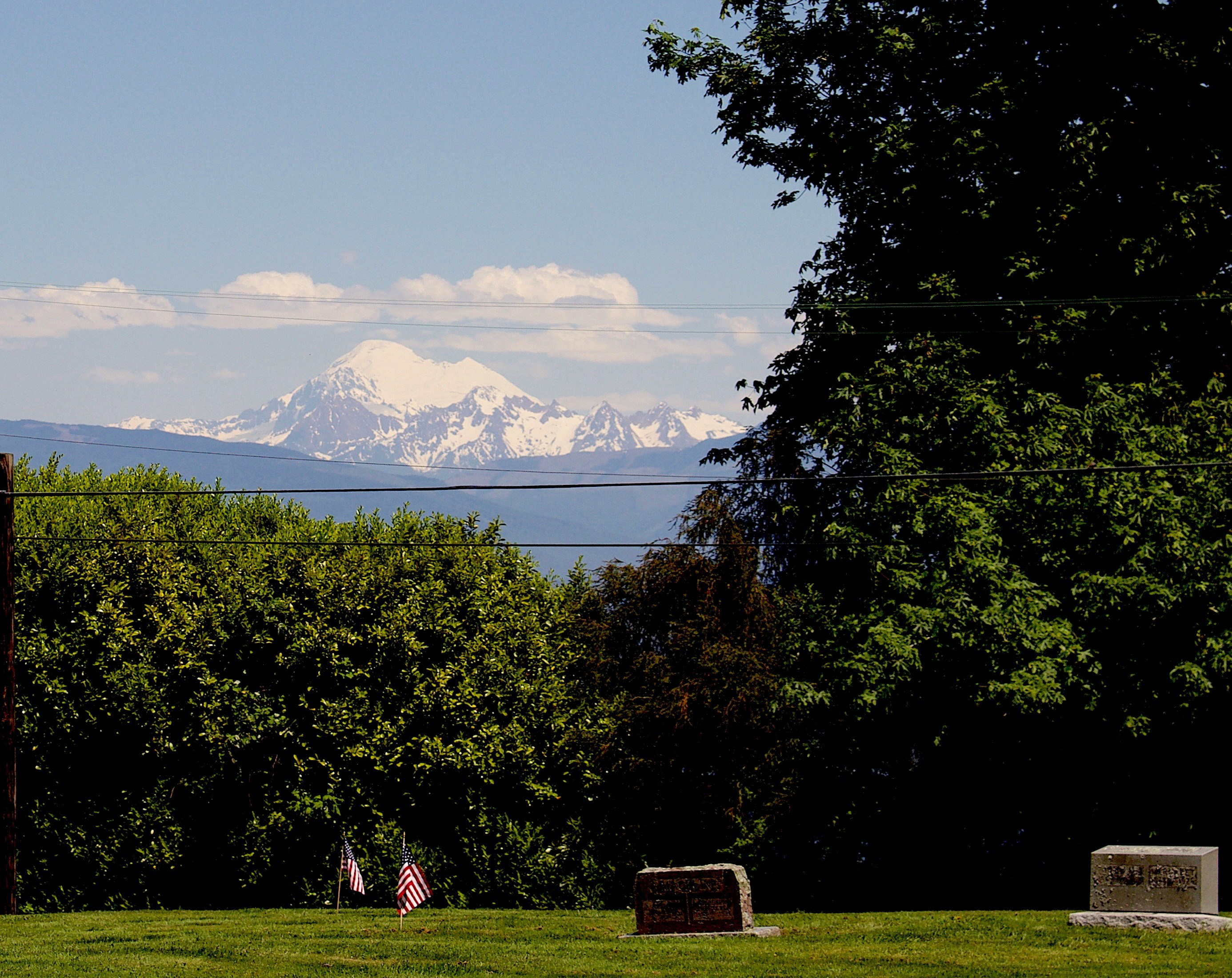
So as we again set flowers and flag
on your grave,
reunited with Mom after years apart,
I regret so many questions unasked
of a sacrifice beyond imagining,
you having paid an unthinkable price.

Sleep well, Dad,
with Mom now by your side.
I rejoice you finally wakened
to a renewed dawn.

One-Time
Monthly
Yearly

Make a one-time or recurring donation to support daily Barnstorming posts

Make a monthly donation

Make a yearly donation

Choose an amount

¤10.00
¤25.00
¤50.00
¤5.00
¤15.00
¤100.00
¤5.00
¤15.00
¤100.00

Or enter a custom amount

¤

Your contribution is deeply appreciated.

Your contribution is appreciated.

Your contribution is appreciated.

DonateDonate monthlyDonate yearly
Dismissed in Peace

wedding

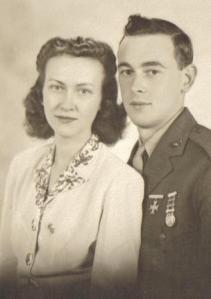
Seventy two years ago this week, my parents were married. Christmas Eve certainly wasn’t a typical wedding anniversary, but it did make it easy to remember during their years together. It was a date of necessity, only because a justice of the peace was available to marry a score of war-time couples in Quantico, Virginia, shortly before the newly trained Marine officers were shipped out to the South Pacific to fight in WWII.

Now that they are both gone, when I look at their young faces in their only wedding portrait, I see a hint of the impulsive decision that led to that wedding just a week before my father left for 30 months. They had known each other for over a year, had talked about a future together, but with my mother starting a teaching job, and the war potentially impacting all young men’s lives very directly, they had not set a date.

My father had to put his college education on hold to enlist, knowing that would give him some options he wouldn’t have if drafted, so they went their separate ways as he headed east to Virginia for his Marine officer training, and Mom started her high school teaching career as a speech and drama teacher in rural Colville in Eastern Washington. One day in early December, he called her and said, “If we’re going to get married, it’ll need to be before the end of the year. I’m shipping out the first week in January.” Mom went to her high school principal, asked for a two week leave of absence which was granted, told her astonished parents, bought a dress, and headed east on the train with a friend who had received a similar call from her boyfriend. This was a completely uncharacteristic thing for my overly cautious mother to do so it must have been love.

They were married in a brief civil ceremony with another couple as the witnesses. They stayed in Virginia only a couple days and took the train back to San Diego, and my father left. Just like that. Mom returned to her teaching position and the first three years of their married life was letter correspondence only, with gaps of up to a month during certain island battles when no mail could be delivered or posted.

As I sorted through my mother’s things following her death six years ago, their letters to each other, stacked neatly and tied together, reside now in a box in my bedroom. I have not yet opened them but will when I’m ready. What I will find there will be words written by two young people who could not have foretold the struggles that lay ahead for them during and after the war but who both depended on faith and trust to persevere despite the unknowns. The War itself seemed struggle enough for the millions of couples who endured the separation, the losses and grieving, as well as the eventual injuries–both physical and psychological.  It did not seem possible that beyond those realities, things could go sour after reuniting.

The hope and expectation of happiness and bliss must have been overwhelming, and real life doesn’t often deliver.  After raising three children, their 35 year marriage fell apart with traumatic finality.  When my father returned (again) over a decade later, asking for forgiveness, they remarried and had five more years together before my father died.

And so too there must have been expectations of happiness in the barn on that first Christmas Eve. It must have been frightening for the parents of this special Baby, knowing in their minds but not completely understanding in their hearts what responsibility lay in their arms. They had to find faith and trust, not just in God who had determined what their future held, but in each other, to support one another when things became very difficult. Those challenges mounted up quickly: there was to be no room for them, there was a baby to deliver without assistance from anyone, and the threat of Herod’s murder of innocents eventually drove them from their home country.

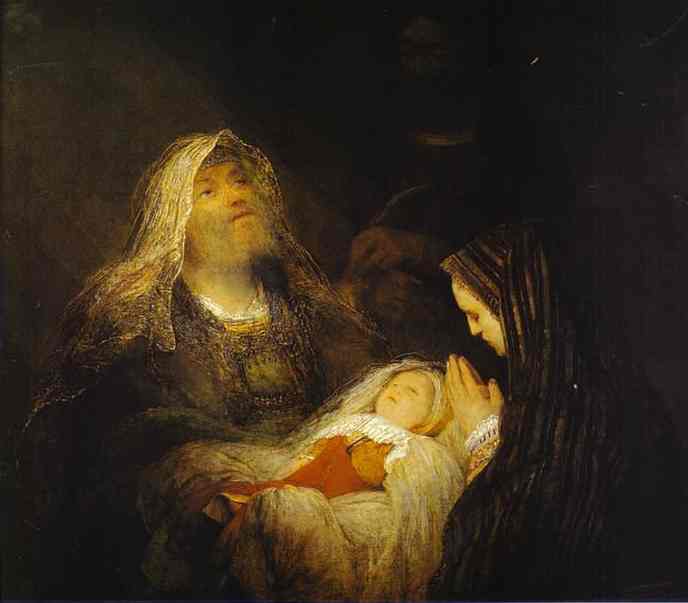
When Mary and Joseph go to the temple for the circumcision and consecration of their son the following week, they allow a “righteous and devout man”, Simeon,  to hold their baby as, moved by the Holy Spirit, he tells them the role this child is to play in the world.  He prays to the Lord, “As you have promised, you now dismiss your servant in peace.  For my eyes have seen your salvation, which you have prepared in the sight of all people, a light for revelation to the Gentiles and for glory to your people Israel.”

It must have been like looking into a crystal ball to hear Simeon speak, as we’re told “the child’s father and mother marveled at what was said about him.” But Simeon didn’t whitewash the reality to come. It would have been easy to do so– simply mention salvation, the light and the glory that will come to the people due to this little baby, but leave out the part about how His existence would cause division in Israel as well as the rejection, anguish and suffering that He would experience. Not only that, but the pain is not His alone but will be His parents’ to bear as well. I’m sure that statement must have ended the sense of “marvel” they were feeling, and replaced it instead with great sorrow and trepidation.

Christmas is a time of joy, a celebration of new beginnings and new life when God became man, humble, vulnerable and tender. But it also gives us a foretaste for the profound sacrifice made in giving up this earthly life, not always so gently. A baby in a manger is a lovely story to “treasure up” in our hearts but once He became a bleeding Redeemer on a cross, it pierces our living beating hearts, just as Simeon foretold.

My parents, such young idealistic adults 72 years ago, now servants dismissed from this life in peace. As I peer at their faces in their wedding photo, I know those same eyes, then unaware of what was to come,  now behold the light, the salvation and the glory~~the ultimate Christmas~~in His presence.

Song of Simeon by Aert De Gelder, a student of Rembrandt