What Wondrous Love: Straw as Sharp as Thorns

“My God, My God,” goes the Psalm 22, “hear me, why have you forsaken me?”  

This is the anguish all we of Godforsaken heart know well. But hear the revelation to which Christ directs us, further in the same psalm:

For He has not despised nor scorned the beggar’s supplication,
Nor has He turned away His face from me;
And when I cried out to Him, He heard me.

He hears us, and he knows, because he has suffered as one Godforsaken. Which means that you and I, even in our darkest hours, are not forsaken. Though we may hear nothing, feel nothing, believe nothing, we are not forsaken, and so we need not despair. And that is everything. That is Good Friday and it is hope, it is life in this darkened age, and it is the life of the world to come.
~Tony Woodlief from “We are Not Forsaken”

The whole of Christ’s life was a continual passion;
others die martyrs, but Christ was born a martyr.
He found a Golgotha, where he was crucified,
even in Bethlehem, where he was born;

for to his tenderness then the straws
were almost as sharp as the thorns after,
and the manger as uneasy at first as the cross at last.

His birth and his death were but one continual act,
and his Christmas Day and his Good Friday
are but the evening and the morning of one and the same day.

From the creche to the cross is an inseparable line. Christmas only points forward to Good Friday and Easter. It can have no meaning apart from that, where the Son of God displayed his glory by his death.
~John Donne in the opening words of his sermon on Christmas Day 1626

photo by Josh Scholten

How is faith to endure, O God, when you allow all this scraping and tearing on us? You have allowed rivers of blood to flow, mountains of suffering to pile up, sobs to become humanity’s song–all without lifting a finger that we could see. You have allowed bonds of love beyond number to be painfully snapped. If you have not abandoned us, explain yourself.

Instead of explaining our suffering God shares it.

We strain to hear. But instead of hearing an answer we catch sight of God himself scraped and torn. Through our tears we see the tears of God.
~Nicholas Wolterstorff  in Lament for a Son

In a daring and beautiful creative reversal, 
God takes the worse we can do to Him
and turns it into the very best He can do for us.
~Malcolm Guite from The Word in the Wilderness

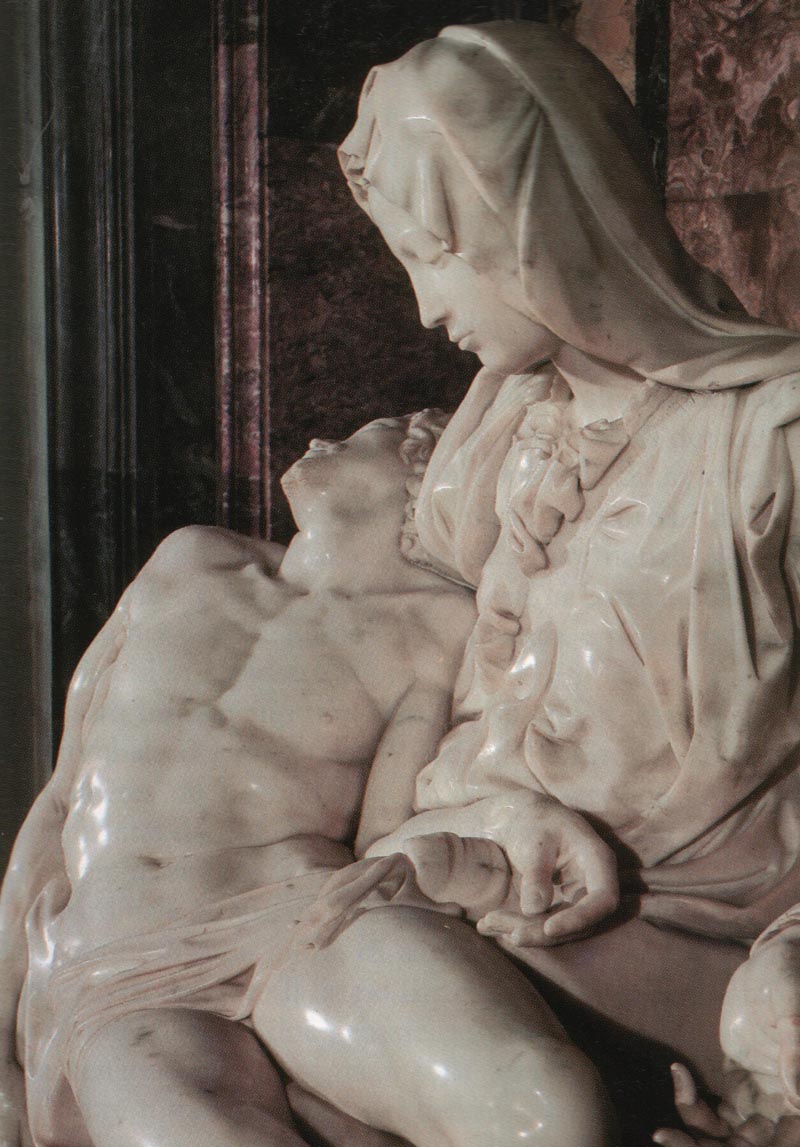
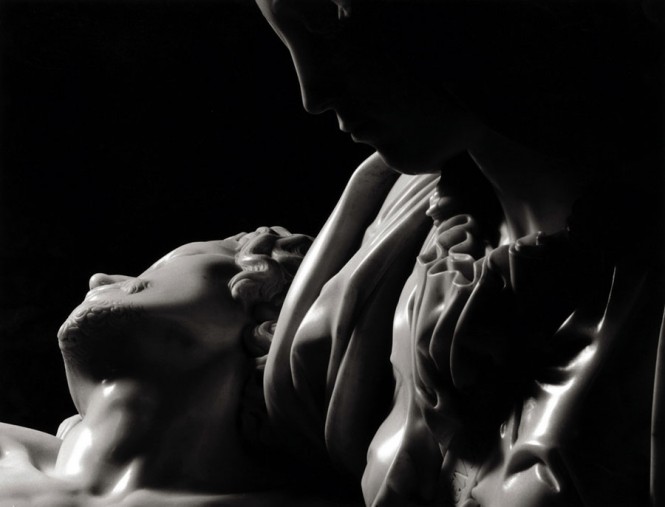
La Pietà of Michelangelo

Emmett Till’s mother
speaking over the radio

She tells in a comforting voice
what it was like to touch her dead boy’s face,

how she’d lingered and traced
the broken jaw, the crushed eyes —

the face that badly beaten, disfigured —
before confirming his identity.

And then she compares his face
to the face of Jesus, dying on the cross.

This mother says, no, she’d not recognize
her Lord, for he was beaten far, far worse

than the son she loved with all her heart.
For, she said, she could still discern her son’s curved earlobe,

but the face of Christ
was beaten to death by the whole world.
~Richard Jones “The Face” from Between Midnight and Dawn

May we remember today – Good Friday – of all days,
the worst that can happen became the best that can happen.

We tussle and haggle over the price of what this cost us, but realizing He paid all for us makes an impossible loss possible.

We are paid in full, no longer debtors. 

From now on, we recognize His face even when He is beaten unrecognizable: the worst became the best because He loves us over all else.

Detail from “Descent from the Cross” by Rogier van der Weyden

The Stones Themselves Will Start to Sing: The Sky Will Groan and Darken

A stable lamp is lighted
Whose glow shall wake the sky
The stars shall bend their voices
And every stone shall cry
And straw like gold will shine
A barn shall harbour heaven
A stall become a shrine

This child through David’s city
Will ride in triumph by
The palm shall strew its branches
And every stone shall cry
Though heavy, dull and dumb
And lie within the roadway
To pave the Kingdom come

Yet He shall be forsaken
And yielded up to die
The sky shall groan and darken
And every stone shall cry
For thorny hearts of men
God’s blood upon the spearhead
God’s love refused again

 
But now as at the ending
The low is lifted high
The stars will bend their voices
And every stone shall cry
In praises of the child
By whose descent among us
The worlds are reconciled
~Richard Wilbur
“A Christmas Hymn”

Castlerigg Stone Circle in Cumbria

Feeling heavy, dull and dumb,
I am convinced
I’m no better than a simple rock,
inconsequential and immobile,
trod upon and paved over,
forgettable and forgotten.

I could believe
there exists no pulse
in my stony heart,
incapable of love
if I turn away from God
who has come to walk beside me
on this humble ground .

Yet the especially the low are lifted high by His descent–
every stone, even the dumb and lifeless,
shall cry out in community with Him,
even the silent will find a voice to praise.

Even my own voice,
meager and anemic,
shall be heard.

I am no longer forgotten.
In fact, never have been forgotten.
So hard to reconcile:
as the stones have known Him all along,
then so should I.

So must I.

One-Time
Monthly
Yearly

Make a one-time or recurring donation to support daily Barnstorming posts

Make a monthly donation

Make a yearly donation

Choose an amount

¤5.00
¤10.00
¤20.00
¤5.00
¤15.00
¤100.00
¤5.00
¤15.00
¤100.00

Or enter a custom amount

¤

Your contribution is deeply appreciated.

Your contribution is appreciated.

Your contribution is appreciated.

DonateDonate monthlyDonate yearly

The Wobble in the Voice

I don’t know if you ever saw a doubt.
In fact, I doubt you did.
They’re shape shifting little shadows
and they’re more than often hid.


You could hear them on the whirling winds,
that whistled through the farm.
You could feel them in your stomach
or brush the goosebumps of your arm.


You’d hear them giggling in the corners,
in the darkness of the night.
They’re the wobble in the voice
that claims that things will be all right.


And the little doubts got larger,
until they no longer hid in holes.
They now lived out amongst them
and they slipped into their souls.


I know good times are coming back.
I know the sun will rise.
I know the hard earth soon will soften,
and plants will bloom before our eyes.

There will be colour in the meadows
and the river will unfreeze.
But if we’re to move beyond this moment
then these fiendish doubts must leave.

We need hopeful stories more than ever,
we should tell them till we’re blue.
We should tell them till we look outside
and see that they’ve come true.

And the doubts that wreak such havoc,
they were nowhere to be seen.
And the fear they’d brought forth with them
felt so much like a dream.

So remember, little sister,
take courage with you when you sleep.
For tomorrow we might all need it,
for the little doubts that creep.

~Tomos Roberts from “Doubts that Creep”

These days doubt is more epidemic than the COVID virus.

No one trusts anyone to tell the truth any longer and truth itself is up for grabs. Experts are suspect, while government agencies and their spokespersons surely must be part of a larger conspiracy.

It’s an “every man for himself” attitude with everyone doing what is right in their own eyes.

You can see where doubts leave us: we end up in a wintry forsaken place that looks, feels and frankly, is hopeless.

The most recent weeks have been difficult as most students start school at home again rather than in classrooms and no one is happy about it. Churches have been meeting online or outside and will need to make a difficult transition to limited indoor worship services that won’t feel familiar. Businesses continue to suffer the effects of people having less income to spend, and unwillingness to spend on anything but essentials.

A pandemic virus wreaks havoc with society but stories sowing doubts and mistrust are far more damaging. Rather than working together for solutions, we as a society have become more divided and divisive than ever.

When I speak with those whose well-being I care deeply about, yet who don’t trust my opinion or any medical opinion for that matter, my voice wobbles with concern. If I, as a caring friend and physician for forty years can’t be trusted, then whom will they trust?

A virus doesn’t give a rip what our politics are – it is an equal-opportunity opportunist seeking which cell to invade next. “Going viral” is yet another real life lesson in exponential multiplication, whether a packet of RNA or a social media meme or youtube link sowing mistrust and discord as it is shared millions of times and spreads with our help and consent.

We can’t allow creeping doubts to metastasize into a hopelessness cancer that is terminal.

We need hopeful stories, now more than ever. We need to take courage with us when we lay ourselves down to sleep, and dream the dreams of a better day on the horizon. We need truth that is not up for grabs to the highest bidder but is steadfast, transparent and … true.

Until then, we all should keep our masks on to stop the spread and protect others. It surely can’t hurt.

But By His Grace: Bearing Your Weight

The bridge of grace will bear your weight…
~Charles Spurgeon

Where God tears great gaps
we should not try to fill  them with human words.
They should remain open.
Our only comfort
is the God of the resurrection,

the Father of our Lord Jesus Christ,
who also was and is (our) God.

~Dietrich Bonhoeffer from “Circular Letters in the Church Struggle”

Great gaps are being torn in families, kept separate
in hospital ICUs and overflowing emergency rooms,
where patients struggle for breath and fight for life –
yet too sick, with too much risk
for loved ones to be near.

Christ too knew separation from His Father,
a chasm that appeared wholly unbridgeable-
forsaken, suffering for His brothers and sisters
by paying with His life
a ransom we could never satisfy:
we being so dead broke
and captive to our sin.

His grace is the only bridge able to bear our weight,
even now
even now
when our hearts break with uncertainty and fear.

We seek the comfort of
a grace strong enough
to fill our every hole
bridge our every gap
carry hope to our hopelessness
and restore us wholly to our Father
who was and is our God.

Lord, comfort us
by spanning our troubled waters,
bearing our weighty burdens,
to make sure we get safely to the Other Side
where Your arms await us.

This year’s Lenten theme for Barnstorming:

God sees us as we are,
loves us as we are,
and accepts us as we are.
But by His grace,
He does not leave us where we are.
~Tim Keller


He Loves Us As We Are: Even the Enemy

…{His is} the love for the enemy–
love for the one who does not love you
but mocks, threatens, and inflicts pain.
The tortured’s love for the torturer.
This is God’s love. It conquers the world.
~Frederich Buechner from The Magnificent Defeat

This is God with a man’s beating heart,
who bleeds from open wounds of a man’s skin,
while nailed to a tree,
considering His torturers below
and forgives them.

This is God with a man’s dry tongue
thirsting for relief
who ensures His love for us
will never run dry.

This is God with a man’s compassion
who grants grace to another who
confesses his guilt and shame.

This is God with a son’s love for His mother
who entrusts her future
to the care of His beloved friend.

This is God with a man’s debt to carry
who pays it all,
finished and done.

This is God with a man’s frailty and fear,
feeling forsaken,
conquering death and hatred
by dying for us.

This is God with a man’s last breath
giving His spirit into the hands of His father
and in so doing, ensures we live forever.

And now brothers,
I will ask you a terrible question,
and God knows I ask it also of myself.
Is the truth beyond all truths,
beyond the stars, just this:
that to live without him is the real death,
that to die with him the only life?
~Frederich Buechner from The Magnificent Defeat

This year’s Lenten theme on Barnstorming:

God sees us as we are,
loves us as we are,
and accepts us as we are.
But by His grace,
He does not leave us where we are.
~Tim Keller

Forsaking All Others

sunset115181


The forsaking of all others is a keeping of faith, not just with the chosen one, but with the ones forsaken…  One is married to marriage as well as to one’s spouse. But one is married also to something vital of one’s own that does not exist before the marriage: one’s given word. It now seems to me that the modern misunderstanding of marriage involves a gross misunderstanding and underestimation of the seriousness of giving one’s word, and of the dangers of breaking it once it is given. Adultery and divorce now must be looked upon as instances of that disease of word-breaking, which our age justifies as “realistic” or “practical” or “necessary,” but which is tattering the invariably single fabric of speech and trust.
~Wendell Berry from “The Body and the Earth” in The Art of the Commonplace: The Agrarian Essays


sunset114181


Covenant between two married people, between parent and child, between coworkers, between countries, between God and His people — is too often broken, irrevocably shattered when convenient and deemed necessary.

I see the sequelae of these broken vows, broken words, broken covenants every day in my work.   Divorcing parents destroy the integrity of a family built on trust and commitment.  Relationships wax and wane with the ebb and flow of one’s mood and need for something/someone new.

This disease of chronic deficiency of trustworthiness, this lack of keeping faith with one another, is a brittle bitter breaking of word and promise.  The only cure is clinging to the One who we forsake again and again, who keeps His promise fully and wholly as He renews His everlasting covenant with us until His last breath.  He deems us worthy.


Ye are Blood of my Blood, and Bone of my Bone,
I give ye my Body, that we Two might be One.
I give ye my Spirit, ’til our Life shall be Done
~Diana Gabaldon – a Scottish wedding vow from Outlander


sunrise115182


baker11518


Lenten Grace — The Tears of God

photo by Josh Scholten

From two authors who have lost children, reflecting on what today, Good Friday, means to them:

God is not only the God of the sufferers but the God who suffers. … It is said of God that no one can behold his face and live. I always thought this meant that no one could see his splendor and live. A friend said perhaps it meant that no one could see his sorrow and live. Or perhaps his sorrow is splendor. … Instead of explaining our suffering God shares it.

How is faith to endure, O God, when you allow all this scraping and tearing on us? You have allowed rivers of blood to flow, mountains of suffering to pile up, sobs to become humanity’s song–all without lifting a finger that we could see. You have allowed bonds of love beyond number to be painfully snapped. If you have not abandoned us, explain yourself.

We strain to hear. But instead of hearing an answer we catch sight of God himself scraped and torn. Through our tears we see the tears of God.
~Nicholas Wolterstorff  in Lament for a Son

287977_2179827607517_4154920_o

photo by Josh Scholten

“My God, My God,” goes the Psalm 22, “hear me, why have you forsaken me?”  This is the anguish all we of Godforsaken heart know well.But hear the revelation to which Christ directs us, further in the same psalm:

For He has not despised nor scorned the beggar’s supplication,
Nor has He turned away His face from me;
And when I cried out to Him, He heard me.

He hears us, and he knows, because he has suffered as one Godforsaken. Which means that you and I, even in our darkest hours, are not forsaken. Though we may hear nothing, feel nothing, believe nothing, we are not forsaken, and so we need not despair. And that is everything. That is Good Friday and it is hope, it is life in this darkened age, and it is the life of the world to come.
~Tony Woodlief from “We are Not Forsaken”
barbedbloom