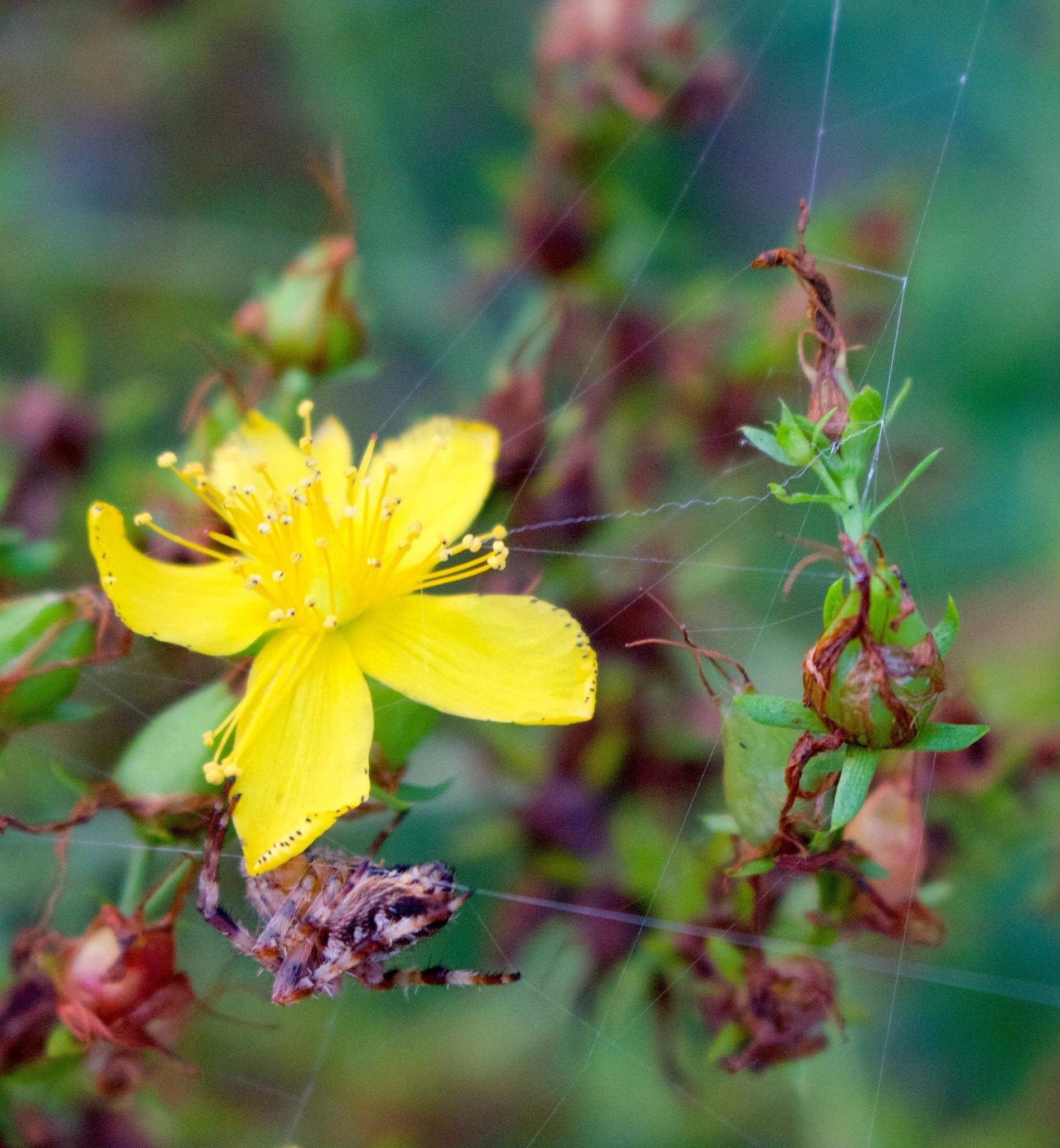
Silk-thin silver strings woven cleverly into a lair, An intricate entwining of divinest thread… Like strands of magic worked upon the air, The spider spins his enchanted web – His home so eerily, spiraling spreads.
His gossamer so rigid, yet lighter than mist, And like an eight-legged sorcerer – a wizard blest, His lace, like a spell, he conjures and knits; I witnessed such wild ingenuity wrought and finessed, Watching the spider weave a dream from his web. ~Jonathan Platt“A Spider’s Web”
I believed only air stretched between the dogwood
and the barberry: another thoughtless human assumption
sidetracking the best story this furrow spider knew to spin.
And, trying to get the sticky filament off my face, I must look,
to the neighbors, like someone being attacked by his own nervous
system, a man conducting an orchestra of bees. Or maybe it’s only the dance
of human history I’m reenacting: caught in his own careless wreckage,
Not everyone is taking a holiday today on Labor Day. Some are busier than ever, creating a masterpiece nightly, then waiting in hope for that labor to be rewarded.
I too spin elaborate dreams at night: some remembered, some bare fragments, some shattered, some potentially yield a meal.
We work because we are hungry. We work because someone we love is hungry and needs feeding.
Yet the best work is the work of weaving dreams ~out of thin air and gossamer strands~ where nothing existed before, not as a trap or lure or lair but as a work of beauty- a gift as welcome as a breath of fresh air.
Lyrics from E.B.White poem “Natural History” The spider, dropping down from twig Unfolds a plan of her devising A thin premeditated rig To use in rising
And all that journey down through space In cool descent and loyal hearted She spins a ladder to the place From where she started
Thus I, gone forth as spiders do In spider’s web a truth discerning Attach one silken thread to you For my returning
Lyrics
Take the silver thread of a spider’s web And spin, spin, spin Silver wings to fly and sing Upon the wind High above the trees, across the seas And through the sky To the rainbow’s bend, where stories never end And dreams never die
One-Time
Monthly
Yearly
Make a one-time or recurring donation to support daily Barnstorming posts
Would you believe I’ve been looking for rain, here, with few days remaining in this fleeting season of summer? Our days are numbered that we might share with the sun in a clear blue sky and the hours growing warmer, and I have kept an eye out for the clouds. Only I wish for the conditions and doubt that might send us all deep inside our dark homes to sleep and read and pray in preparation for the coming colder days. Would you believe that the sight of slate gray spanning horizon to zenith and down is one I am quite taken with? ~David K. Wheeler “The Cold Season” from Contingency Plans
My mother, who hates thunder storms, Holds up each summer day and shakes It out suspiciously, lest swarms Of grape-dark clouds are lurking there; But when the August weather breaks And rains begin, and brittle frost Sharpens the bird-abandoned air, Her worried summer look is lost,
And I her son, though summer-born And summer-loving, none the less Am easier when the leaves are gone Too often summer days appear Emblems of perfect happiness I can’t confront: I must await A time less bold, less rich, less clear: An autumn more appropriate. ~Philip Larkin “Mother, Summer, I”
Summer grass aches and whispers.
It wants something; it calls and sings; it pours out wishes to the overhead stars.
The rain hears; the rain answers; the rain is slow coming; the rain wets the face of the grass. ~Carl Sandberg “Summer Grass”
August rushes by like desert rainfall, A flood of frenzied upheaval, Expected, But still catching me unprepared. Like a match flame Bursting on the scene, Heat and haze of crimson sunsets. Like a dream Of moon and dark barely recalled, A moment, Shadows caught in a blink. Like a quick kiss; One wishes for more But it suddenly turns to leave, Dragging summer away. – Elizabeth Maua Taylor“August”
The endless clear skies of August now broken with exuberant clouds, rain falling in warm gusts, leaves landing on browned ground.
This summer ended up being simply too much – an excess of everything bright and beautiful, meant to make us joyful, yet bold and exhausting in its riches.
From endless hours of daylight, to high rising temperatures and wildfires, to palettes of smoke-filled landscapes to fruitfulness and abundant blooms.
While summer always fills a void after enduring cold spare dark days the rest of the year, I still depend on autumn returning.
I welcome darkening times back, knowing how much I miss those drear twilight months of longing for the overwhelming fullness of summer.
One-Time
Monthly
Yearly
Make a one-time or recurring donation to support daily Barnstorming posts
We have not yet encountered any god who is as merciful as a man who flicks a beetle over on its feet. ~Annie Dillard from The Force That Drives the Flower
What inference might one draw about the nature of God from a study of his works? An inordinate fondness for beetles. The Creator would appear as endowed with a passion for stars, on the one hand, and for beetles on the other. ~ J.B.S. Haldane, British biologist
Indeed, we stranded folk do encounter a God who saves us by flipping us back onto our feet as we lie helplessly waving our arms and legs in the air, so stuck and pitiful.
God knows all about the helplessness of suffering and hears our cry for mercy.
Once we are righted back to our feet, we walk forth forever changed – restored to the world, ready to help anyone we encounter who finds themselves stuck upside down in their misery.
When beetles fight these battles in a bottle with their paddles and the bottle’s on a poodle and the poodle’s eating noodles… …they call this a muddle puddle tweetle poodle beetle noodle bottle paddle battle. ~ Dr. Seuss from Fox in Socks
One-Time
Monthly
Yearly
Make a one-time or recurring donation to support daily Barnstorming posts
It’s the immemorial feelings I like the best: hunger, thirst, their satisfaction; work-weariness, earned rest; the falling again from loneliness to love; the green growth the mind takes from the pastures in March; the gayety in the stride of a good team of Belgian mares that seems to shudder from me through all my ancestry. ~Wendell Berry “Goods”
photo by Joel De Waardphoto by Joel De Waard
The plow has savaged this sweet field Misshapen clods of earth kicked up Rocks and twisted roots exposed to view Last year’s growth demolished by the blade.
I have plowed my life this way Turned over a whole history Looking for the roots of what went wrong Until my face is ravaged, furrowed, scarred.
Enough. The job is done. Whatever’s been uprooted, let it be Seedbed for the growing that’s to come. I plowed to unearth last year’s reasons—
The farmer plows to plant a greening season. ~Parker Palmer “Harrowing”
photo by Joel De Waardphoto by Joel De Waard
It’s not likely anyone would say I didn’t work hard enough.
After all, I come from a long line of human work-horses who knew it takes sweat and tears, and sometimes bleeding.
Even so, all those years I know I could have plowed more deeply than I did.
I could have thrown myself more fully into the pull on the tugs, shared the load more effectively, shouldered the yoke with greater enthusiasm, bent my neck down low with unbroken determination.
You could say somewhere I lost the gayety in my stride, and you would be right — toward the end, I was trudging through the furrow, bruised from turning up too many submerged rocks, bumping into immoveable tree stumps, tripping on hidden roots, stuck in the deep mud of long and lonely post-midnight hours.
You might even say the knowledge of a job well-done lay at a depth my plow could ever reach.
I had seen others die in the harness, never able to rest easy.
A few years ago I knew the time had come to shrug off the yoke, shake off the bridle and bit, shudder free of the harness.
On this side of the ground, I find myself wondering and wandering, the blinkers no longer impeding my vision, feeling the morning sun on my unyoked withers.
Yet when I see an untilled field, something in me even now still tries to hold on to the plow —
photo by Joel De Waardphoto by Joel De Waardphoto by Joel De Waard
One-Time
Monthly
Yearly
Make a one-time or recurring donation to support daily Barnstorming posts
Tonight at dusk we linger by the fence around the garden, watching the wound husks of moonflowers unclench themselves slowly, almost too slow for us to see their moving— you notice only when you look away and back, until the bloom decides, or seems to decide, the tease is over, and throws its petals backward like a sail in wind, a suddenness about this as though it screams, almost the way a newborn screams at pain and want and cold, and I still hear that cry in the shout across the garden to say another flower is about to break. I go to where my daughter stands, flowers strung along the vine like Christmas lights, one not yet lit. We praise the world by making others see what we see. So now she points and feels what must be pride when the bloom unlocks itself from itself. And then she turns to look at me. ~James Davis May “Moonflowers” from32 Poems Magazine
When once the sun sinks in the west, And dewdrops pearl the evening’s breast; Almost as pale as moonbeams are, Or its companionable star, The evening primrose opes anew Its delicate blossoms to the dew; And, hermit-like, shunning the light, Wastes its fair bloom upon the night, Who, blindfold to its fond caresses, Knows not the beauty it possesses; Thus it blooms on while night is by; When day looks out with open eye, Bashed at the gaze it cannot shun, It faints and withers and is gone. ~John Clare “Evening Primrose”
Ever since I was a kid, I have needed to share with others something special I’ve seen — a “hey, take a look at this!” moment so I can witness it again through their eyes.
Sharing can make it even sweeter.
Sometimes others see what I see; sometimes not. Sometimes others wonder what has gotten into me.
I was an odd farm kid, no question: a summer twilight’s entertainment might be watching evening primrose blossoms open at night.
Evening primrose and moonflower are night blooming plants meant to attract pollinating moths.
At dusk, (one could set one’s watch by the primrose’s punctuality) one green wrapped bud per stem would open, revealing a bright yellow blossom with four delicate veined petals, a rosette of stamens and a cross-shaped stigma in the center, rising far above the blossom. The yellow was so vivid and lively, it seemed almost like a drop of sun was left on earth to light the night. By morning, the bloom would begin to wither and wilt under the real sunlight, somehow overcome with the brightness, and would blush a pinkish orange as it folded upon itself, ready to die and drop from the plant in only a day or two, leaving a bulging seed pod behind.
As a kid, I would settle cross-legged on our damp lawn at twilight to watch the choreography of the opening of evening primrose blossoms. With diminishing light and cooler temperatures, there would be a sudden loosening of the protective green husk, an almost audible release. Then over the course of about a minute, the overlapping yellow petals would unfurl, slowly, gently and purposefully in an unlocking action that revealed their pollen treasure trove inside.
It was like watching time lapse cinematography, only this was an accelerated, real time flourish of sudden beauty, happening right before my eyes.
It was magic. I always felt privileged to witness each unveiling as so few flowers ever allow us to behold their unfolding.
On those lazy summer evenings, my younger brother wasn’t nearly as impressed when I tried to lure him into becoming flower-audience along with me. That’s okay; I was always underwhelmed by the significance of his favorite football team’s touchdowns that he insisted on sharing with me.
He was sure my priorities were screwy.
Possibly he was right. Even so, I wanted you all to know about something so special as a flower knowing exactly the best time to open to attract nocturnal pollinators, and manages it in under a minute, all because the waning light and cooler temperatures causes a sudden rush of cellular fluid into the bottom hinges of the petals, forcing them to pop open.
What a smart plant. What an even smarter God, worthy of praise.
One-Time
Monthly
Yearly
Make a one-time or recurring donation to support daily Barnstorming posts
It’s a dangerous business, Frodo, going out of your door. You step into the Road, and if you don’t keep your feet, there is no knowing where you might be swept off too. ~J.R.R. Tolkien – Bilbo to Frodo in Fellowship of the Rings
What if this road, that has held no surprises these many years, decided not to go home after all; what if it could turn left or right with no more ado than a kite-tail? What if its tarry skin were like a long, supple bolt of cloth, that is shaken and rolled out, and takes a new shape from the contours beneath? And if it chose to lay itself down in a new way, around a blind corner, across hills you must climb without knowing what’s on the other side, who would not hanker to be going, at all risks? Who wants to know a story’s end, or where a road will go? ~Sheenagh Pugh “What if This Road?”
I do not think that all who choose wrong roads perish; but their rescue consists in being put back on the right road. ~C.S. Lewis from The Great Divorce
We grow accustomed to the Dark — When Light is put away — As when the Neighbor holds the Lamp To witness her Good bye —
A Moment — We Uncertain step For newness of the night — Then — fit our Vision to the Dark — And meet the Road — erect —
And so of larger — Darknesses — Those Evenings of the Brain — When not a Moon disclose a sign — Or Star — come out — within —
The Bravest — grope a little — And sometimes hit a Tree Directly in the Forehead — But as they learn to see —
Either the Darkness alters — Or something in the sight Adjusts itself to Midnight — And Life steps almost straight. ~Emily Dickinson
So few grains of happiness measured against all the dark and still the scales balance.
The world asks of us only the strength we have and we give it. Then it asks more, and we give it. ~Jane Hirschfield from “The Weighing”
I admit I stumble if not careful, bearing some bruises and scrapes from hazards hidden in darkness.
My eyes slowly adjust to such bare illumination, when the Lamp is dim and the road unfamiliar.
I’m feeling my way through uncertainty in this time of life.
I suspect there are fellow darkness travelers who also have lost their way and their Light, giving away what they can and sometimes more than they have.
And so, blinded as we each are, we run forehead-first into the Tree which has always been there and always will be, the symbol of our salvation.
Because of who we are and Who loves us, we, now free and forgiven, safely follow a darkened road made nearly straight, all the way Home.
Lyrics: Tell me where is the road I can call my own, That I left, that I lost, so long ago. All these years I have wondered, oh when will I know, There’s a way, there’s a road that will lead me home.
After wind, After rain, when the dark is done, As I wake from a dream, in the gold of day, Through the air there’s a calling from far away, There’s a voice I can hear that will lead me home.
Rise up, follow me, come away is the call With (the) love in your heart as the only song There is no such beauty as where you belong Rise up, follow me, I will lead you home.
One-Time
Monthly
Yearly
Make a one-time or recurring donation to support daily Barnstorming posts
I closed my mother’s eyes when she died and again, my father’s
I made no fortune no headlines nothing went viral
I sang and danced for no one
I remembered I noticed I breathed
Just an ordinary life filled with extraordinary love.
How disappointing. ~Mary Poindexter McLaughlin “Alma Mater”
Parents can hold unreasonable expectations of success for their children; they tend to reflect their own deficiencies or failures. After all, we want our kids to make the world a better place than it was for us.
Yet no academic degree, no bank account, no notoriety or award can match living an ordinary life filled with extraordinary love.
And yes, I am disappointed in myself – not because of the unmet expectations of my parents – I checked off all the boxes they hoped I would achieve in my younger years, but I couldn’t match the extraordinary love they showed me.
The older me tended to withhold myself emotionally from them as they grew frailer, fearing their weaknesses would someday become my own.
I could have been more compassionate in their final years, rather than taking on the more professional role of the doctor-daughter – physically present but too distracted and stretched with competing responsibilities.
That is something I cannot undo now except to pray for forgiveness for how my own inner struggles made those years harder than they needed to be.
My husband and I birthed three tall kind people who we love and have sent into the world. I pray for them what I wish I had understood when I was sent into the world by my parents: living their ordinary life of extraordinary love is more important than anything else they set out to do.
I rejoice as I see them foster such love for their spouses and their children and their communities: remembering, noticing and breathing life into each new day.
Seeing that as the years go by, I keep planting my sunflowers, slowly letting go of my own disappointment in myself.
One-Time
Monthly
Yearly
Make a one-time or recurring donation to support daily Barnstorming posts
I went by the Druid stone That stands in the garden white and lone, And I stopped and looked at the shifting shadows That at some moments there are thrown From the tree hard by with a rhythmic swing, And they shaped in my imagining To the shade that a well-known head and shoulders Threw there when she was gardening.
I thought her behind my back, Yea, her I long had learned to lack, And I said: “I am sure you are standing behind me, Though how do you get into this old track?” And there was no sound but the fall of a leaf As a sad response; and to keep down grief I would not turn my head to discover That there was nothing in my belief.
Yet I wanted to look and see That nobody stood at the back of me; But I thought once more: “Nay, I’ll not unvision A shape which, somehow, there may be.” So I went on softly from the glade, And left her behind me throwing her shade, As she were indeed an apparition— My head unturned lest my dream should fade. ~Thomas Hardy “The Shadow on the Stone”
Scarce images of life, one here, one there, Lay vast and edgeways; like a dismal cirque Of Druid stones, upon a forlorn moor… ~John Keats from “Hyperion”
As living stones around a font today, Rejoice with those who roll the stone away. ~Malcolm Guite from “Baptism”
When Dan discovered this mighty boulder completely underground, near our family’s swing set, he decided it was to be unearthed to create our own standing stone garden close by.
Pulling out the stone took much digging and a strong tractor-pulled chain around its girth, but now here it sits, a Whatcom County sitting stone, where the crust of time is thin…
Big Rock Garden, Bellingham, WAThis dolmen is above the Irish Sea in Northern IrelandLegananny Dolmen, Northern Ireland
Just as a signpost warns of rockfalls near a cliff-edge, the standing stones were meant to mark a spot of danger. A spot where … what? Where the crust of time was thin? Where a gate of some sort stood ajar? ~Diana Gabaldon from Outlander
Castlerigg Stone Circle in Cumbria, UK
One-Time
Monthly
Yearly
Make a one-time or recurring donation to support daily Barnstorming posts
Today I’m sharing some poems I’ve collected recently about parenting, as I realize, looking back at my life, being a parent (and now a grandparent) has been my greatest joy.
In the early afternoon my mother was doing the dishes. I climbed onto the kitchen table, I suppose to play, and fell asleep there. I was drowsy and awake, though, as she lifted me up, carried me on her arms into the living room, and placed me on the davenport, but I pretended to be asleep the whole time, enjoying the luxury— I was too big for such a privilege and just old enough to form my only memory of her carrying me. She’s still moving me to a softer place. ~Leo Dangel “In Memoriam” from Saving Singletrees.
We stop at the dry cleaners and the grocery store and the gas station and the green market and Hurry up honey, I say, hurry, as she runs along two or three steps behind me her blue jacket unzipped and her socks rolled down.
Where do I want her to hurry to? To her grave? To mine? Where one day she might stand all grown? Today, when all the errands are finally done, I say to her, Honey I’m sorry I keep saying Hurry – you walk ahead of me. You be the mother.
And, Hurry up, she says, over her shoulder, looking back at me, laughing. Hurry up now darling, she says, hurry, hurry, taking the house keys from my hands. ~Marie Howe “Hurry”
It wouldn’t even matter if I could sleep as in was capable since soon as I tuck in my son calls from his bad dream and I’m upstairs wiping his brow and saying how it’s okay so I trudge back down and arrange the pillow just right and my breath steadies till my daughter coughs and needs water downstairs to get it creak back up and I tell her it’s okay and I flop downstairs again and find my bed after and in it the baby upset by all this walking and creaking and I hear her and I pat her on the back and make wave sounds with my mouth telling her she’s okay and I don’t know if I am really I’m tired but I also feel guilty like I’ve won something huge, opulent and undeserved. ~Mischa Willett “Price”
All day the stars watch from long ago my mother said I am going now when you are alone you will be all right whether or not you know you will know look at the old house in the dawn rain all the flowers are forms of water the sun reminds them through a white cloud touches the patchwork spread on the hill the washed colors of the afterlife that lived there long before you were born see how they wake without a question even though the whole world is burning ~ W.S. Merwin, “Rain Light” from The Shadow of Sirius
The best thing I did for my mother was to outlive her
for which I deserve no credit
though it makes me glad that she didn’t have to see me die
Like most people (I suppose) I feel I should have done more for her
Like what? I wasn’t such a bad son
I would have wanted to have loved her as much as she loved me but I couldn’t I had a life a son of my own
a wife and my youth that kept going on maybe too long
And now I love her more and more
so that perhaps when I die our love will be the same
When the doctor suggested surgery and a brace for all my youngest years, my parents scrambled to take me to massage therapy, deep tissue work, osteopathy, and soon my crooked spine unspooled a bit, I could breathe again, and move more in a body unclouded by pain. My mom would tell me to sing songs to her the whole forty-five minute drive to Middle Two Rock Road and forty- five minutes back from physical therapy. She’d say, even my voice sounded unfettered by my spine afterward. So I sang and sang, because I thought she liked it. I never asked her what she gave up to drive me, or how her day was before this chore. Today, at her age, I was driving myself home from yet another spine appointment, singing along to some maudlin but solid song on the radio, and I saw a mom take her raincoat off and give it to her young daughter when a storm took over the afternoon. My god, I thought, my whole life I’ve been under her raincoat thinking it was somehow a marvel that I never got wet. ~Ada Limón “The Raincoat”
In the spelling bee my daughter wore a good brown dress and kept her hands folded. There were twelve children speaking
into a microphone that was taller than they were. Each time it was her turn I could barely look. It wasn’t that I wanted
her to win but I hoped she would be happy with herself. The words were too hard for me; I would have missed chemical,
thermos, and dessert. Each time she spelled one correctly my heart became a bird. She once fluttered so restlessly beneath
my skin and, on the morning of her arrival, her little red hands held nothing. Her life since has been a surprise: she can
sew; she can draw; she can read. She hates raisins but loves science. All the parents must feel this, watching from the cheap
folding chairs. Somewhere inside them love took shape and now it stands at the microphone, spelling. ~Faith Shearin “Spelling Bee” from Moving the Piano.
Each carried a balloon from a special event for kids and their families.
It had been a morning of our family being together, just because. Being a grandparent needs no other reason other than “just because.”
Big sister was saying how she planned to take her balloon to school on Monday to show her friends. She was enjoying the balloon’s bobbing and weaving in the air … until suddenly it popped, causing her to jump and then she had nothing left but tatters in her hand.
Her face crumpled and the tears began to flow.
Little brother gripped his balloon more tightly, looking at his sister’s tears and worrying the same thing might happen to his balloon. His face contorted, ready to cry right along with her.
Then there was a moment of clarity and insight in his eyes.
He handed his balloon to her. He said, “here, you can have mine.” And though he was clearly sad at the thought of having no balloon himself, his eyes were shining with proud tears.
He had discovered what it meant to sacrifice, to comfort and care for someone he loved.
She was speechless. She held his balloon gently, struggling to know how to respond. If it was even possible, she loved him so much more in that moment.
So their parents said to her brother, “we think that gift deserves stopping for a hot chocolate on the way home.”
Big sister looked at her parents, looked again at her little brother, and handed the balloon back to him, saying “why don’t we share?”
Hot chocolate makes all things wonderful and cozy and better, when shared with children we would give up anything so they can flourish.
One-Time
Monthly
Yearly
Make a one-time and recurring donation to support daily Barnstorming posts
Lord of the pots and pans and things, since I’ve no time to be a saint by doing lovely things, or watching late with thee, or dreaming in the dawnlight, or storming heaven’s gates… make me a saint by getting meals and washing up the plates. Thou who didst love to give men food in room or by the sea, accept this service that I do— I do it unto thee. ~ Brother Lawrence from Practicing the Presence of God
Wash the plate not because it is dirty nor because you are told to wash it, but because you love the person who will use it next. ~St. Teresa of Calcutta
Even the mundane task of washing dishes by hand is an example of the small tasks and personal activities that once filled people’s daily lives with a sense of achievement. ~B.F. Skinner, behavioral psychologist
She rarely made us do it— we’d clear the table instead—so my sister and I teased that some day we’d train our children right and not end up like her, after every meal stuck with red knuckles, a bleached rag to wipe and wring.
The one chore she spared us: gummy plates in water greasy and swirling with sloughed peas, globs of egg and gravy. Or did she guard her place at the window? Not wanting to give up the gloss of the magnolia, the school traffic humming. Sunset, finches at the feeder. First sightings of the mail truck at the curb, just after noon, delivering a note, a card, the least bit of news. ~Susan Meyers “Mother, Washing Dishes”
My thoughts went round and round and it occurred to me that if I ever wrote a novel it would be of the ‘stream of consciousness’ type and deal with an hour in the life of a woman at the sink.
….I had to admit that nobody had compelled me to wash these dishes or to tidy this kitchen. It was the fussy spinster in me, the Martha who could not comfortably sit and make conversation when she knew that yesterday’s unwashed dishes were still in the sink. ~Barbara Pym from Excellent Women
I trace the struggling relationships and estrangements in the American family to the invention of the automatic dishwasher.
I have proof…
What happened to the necessary cooperation of a human dishwasher with two hands full of wash cloth and scrubber, having to get along with a dish dryer armed with a towel?
Where is the list on the refrigerator of whose turn is next, and the accountability if a family member somehow shirks their washing/drying responsibility and leaves the dishes to the next day?
No longer do family members have to cooperate in real time to scrub clean glasses, dishes and utensils, put them in the dish rack, dry them one by one and place them in the cupboard where they belong.
If the human dishwasher isn’t doing a proper job, the human dryer immediately takes note and recycles the dirty dish right back to the sink.
Instant accountability.
I always preferred to be the dryer. If I washed, and my sister dried, we’d never get done. She would keep recycling the dishes back for another going-over.
And so my messy nature was exposed.
Family conversations started over a meal often continue over the clean-up process while concentrating on whether a smudge is permanent or not. I learned some important facts of life while washing and drying dishes that I might not have learned otherwise. Sensitive topics tend to be easier to discuss when elbow deep in soap suds. Spelling and vocabulary and math fact drills are more effective when the penalty for a missed word or equation is a snap on the butt with a dish towel.
Our church hosts weekly Sunday evening potluck meals for 50-60 people after our evening worship service; we are committed to using real dishes, glasses and utensils rather than add to landfills with throwaways. There is no automatic dishwasher in our fellowship hall other than whoever stands up and heads to the sink first. There is no assigned duty list. Sometimes it takes a teetering stack of dishes to motivate the initiation of the wash/dry process. Sometimes there is an eager-beaver volunteer ready to wash as soon as the dirty dishes start to appear. Once the washing starts, there is always someone ready to dry, another someone ready to put things away and another someone to wipe down the tables, all having the best of conversations in the process.
It is cooperation in action, yet another example of how we all “pitch in” for the benefit and love of others.
So modern society is missing this best opportunity for daily family-together cooperation time. Forget family “game” night, or parental “date” night, or even vacations. Dish washing and drying at the sink takes care of all those times when families need to be communicating, all while coordinating efforts to clean, sort and organize.
It is time to treat the automatic dishwasher as simply another storage cupboard; instead pull out the brillo pads, the white cotton dishtowels and the plastic drainage dish rack.
Let’s start tonight.
And I think it is your turn first…
Holy as a day is spent Holy is the dish and drain The soap and sink, and the cup and plate And the warm wool socks, and the cold white tile Shower heads and good dry towels And frying eggs sound like psalms With bits of salt measured in my palm It’s all a part of a sacrament As holy as a day is spent Holy is the familiar room And quiet moments in the afternoon And folding sheets like folding hands To pray as only laundry can I’m letting go of all my fear Like autumn leaves made of earth and air For the summer came and the summer went As holy as a day is spent Holy is the place I stand To give whatever small good I can And the empty page, and the open book Redemption everywhere I look Unknowingly we slow our pace In the shade of unexpected grace And with grateful smiles and sad lament As holy as a day is spent And morning light sings ‘providence’ As holy as a day is spent ~Carrie Newcomer “Holy as a Day Is Spent “
One-Time
Monthly
Yearly
Make a one-time or recurring donation to support daily Barnstorming posts