what’s left of last year’s hydrangea blooms in the midst of new spring growth
We try to live gracefully
and at peace with our imagined deaths but in truth we go forward
stumbling, afraid of the dark,
of the cold, and of the great overwhelming
loneliness of being last. ~Maxine Kumin from “Death, Etc.”
she passed away at age 88 in February 2014
Let us go in; the fog is rising… ~Emily Dickinson, her last words
I have watched the dying
in their last hours:
often they see what I cannot,
listen to what is beyond my hearing,
stretch their arms overhead
as fingers touch what is beyond my reach.
I watch and wonder what it will be like
to reverse the steps that brought me here
from the fog of amnion.
The mist of living lifts
as we enter a place
unsurpassed in brilliance and clarity;
the mystery of what lies beyond solved
simply by going in.
Nobody in the hospital Could tell the age Of the old woman who Was called Susanna
Because she had no visitors I would stop by to see her But she was always sleeping
One day I was beside her When she woke up Opening small dark eyes Of a surprising clearness
She looked at me and said You want to know the truth? I answered Yes
She said it’s something that My mother told me
There’s not a single inch Of our whole body That the Lord does not love
She then went back to sleep. ~Anne Porter from “Susanna”
We tend to forget who made us,
including the funny looking feet,
the crooked teeth, the wrinkles, the scars, the split ends —
We see only imperfection
when our Creator sees dust made manifest
in His image.
He loves us even when we do not love ourselves,
hiding our nakedess.
He loves us even when we cover up with gloss
of polish, perms, plucking and plastic surgery,
hiding beneath our cosmetic masks.
He loves every inch
because we are His opus, a masterpiece.
He knew what He was doing.
Write as if you were dying. At the same time, assume you write for an audience consisting solely of terminal patients. That is, after all, the case. ~Annie Dillard from “Write Till You Drop”
I began to write after September 11, 2001 because that day it became obvious to me I was dying, albeit more slowly than the thousands who vanished in fire and ash, their voices obliterated with their bodies. So, nearly each day since, while I still have voice and a new dawn to greet, I speak through my fingers to others dying around me.
We are, after all, terminal patients, some of us more prepared than others to move on, as if our readiness had anything to do with the timing.
Each day I get a little closer, but I write in order to feel a little more ready. Each day I want to detach just a little bit, leaving a trace of my voice behind. Eventually, through unmerited grace, so much of me will be left on the page there won’t be anything or anyone left to do the typing.
There is no time or word to waste.
At its best, the sensation of writing is that of any unmerited grace. It is handed to you, but only if you look for it. You search, you break your fists, your back, your brain, and then – and only then -it is handed to you. From the corner of your eye you see motion. Something is moving through the air and headed your way. It is a parcel bound in ribbons and bows; it has two white wings. It flies directly at you; you can read your name on it. If it were a baseball, you would hit it out of the park. It is that one pitch in a thousand you see in slow motion; its wings beat slowly as a hawk’s.
One line of a poem, the poet said – only one line, but thank God for that one line – drops from the ceiling. Thornton Wilder cited this unnamed writer of sonnets: one line of a sonnet falls from the ceiling, and you tap in the others around it with a jeweler’s hammer. Nobody whispers it in your ear. It is like something you memorized once and forgot. Now it comes back and rips away your breath. You find and finger a phrase at a time; you lay it down as if with tongs, restraining your strength, and wait suspended and fierce until the next one finds you: yes, this; and yes, praise be, then this.
~Annie Dillard from “Write Till You Drop”
The cradle rocks above an abyss, and common sense tells us that our existence is but a brief crack of light between two eternities of darkness. Although the two are identical twins, man, as a rule, views the prenatal abyss with more calm than the one he is heading for. ~Vladimir Nabokov from Speak Memory
I think Nabokov had it wrong. This is the abyss.
That's why babies howl at birth,
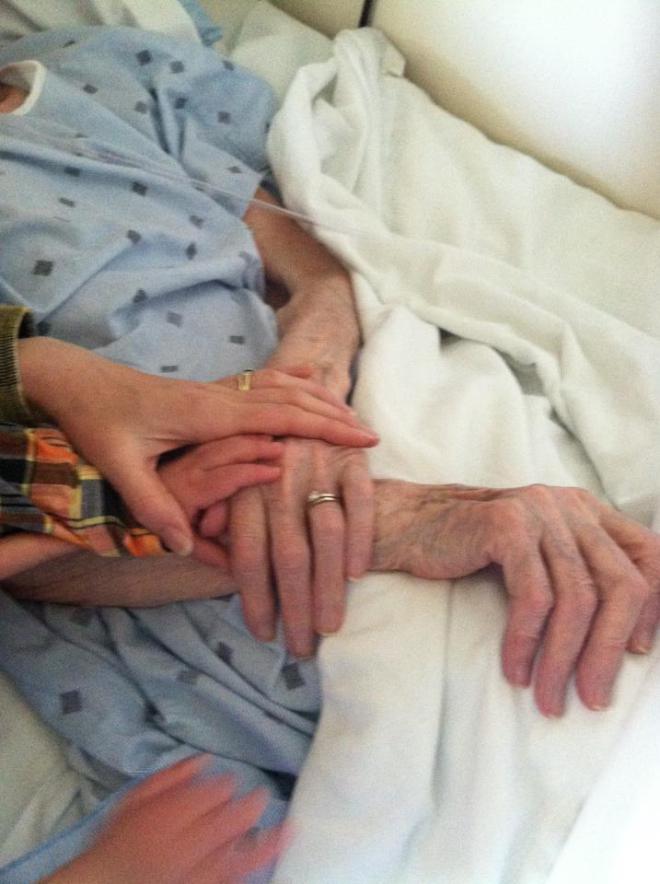
and why the dying so often reach
for something only they can apprehend.At the end they don't want their hands
to be under the covers, and if you should put
your hand on theirs in a tentative gesture
of solidarity, they'll pull the hand free;
and you must honor that desire,
and let them pull it free.~Jane Kenyon from "Reading Aloud to My Father"
We too often mistake this world, this existence, as the only light there is, a mere beam of illumination in the surrounding night of eternity, the only relief from overwhelming darkness. If we stand looking up from the bottom, we might erroneously assume we are the source of the light, we are all there is.
Yet looking at this world from a different perspective, gazing down into the abyss from above, it is clear the light does not come from below –it is from beyond us.
The newborn and the dying know this. They signal their transition into and out of this world with their hands. An infant holds tightly to whatever their fist finds, grasping and clinging so as not be lost to this darkness they have entered. The dying instead loosen their grip on this world, reaching up and picking the air on their climb back to heaven.
We hold babies tightly so they won’t lose their way in the dark. We loosen our grip on the dying to honor their reach out to the light that leads to something greater.
In the intervening years, we struggle in our blindness to climb out of the abyss to a vista of great beauty and grace. Only then we can see, with great calm and serenity, where we are headed.
Nothing was helping. Everything had been tried for a week of the most intensive critical care possible. A twenty year old man, completely healthy only two weeks previously, was holding on to life by a mere thread and nothing and no one could stop his dying.
His battle against MRSA pneumonia precipitated by a brief influenza-like illness had been lost. Despite aggressive hemodynamic, antibiotic and ventilator management, he was becoming more hypoxic, his lungs collapsing and his renal function deteriorating. He had remained unresponsive during the ordeal due to intentional sedation for his time in the ICU.
The intensivist looked weary and defeated. The nurses were staring at their laps, unable to look up, their eyes tearing. The hospital chaplain reached out to hold this young man’s mother’s hands.
After almost a week of heroic effort and treatment, there was now clarity about the next step.
Two hours later, a group of family and friends gathered in the waiting room outside the ICU doors. Most were the age of their friend; they assisted each other in tying on the gowns over their clothing, helped distribute gloves and masks. Together, holding each other up, they waited for the signal to come in after the ventilator had been removed and he was barely breathing without assistance. They entered his room and gathered around his bed.
He was ravaged by this sudden illness, his strong young body beaten and giving up. His breathing was now ragged and irregular, the sedation preventing response but not necessarily preventing awareness. He was surrounded by silence as each individual who had known and loved him struggled with the knowledge that this was the final goodbye.
His father approached the head of the bed and put his hands on his boy’s forehead and cheek. He held his son’s face tenderly, bowing in silent prayer and then murmuring words of comfort. It was okay to let go. It was okay to leave us now. We will see you again. We’ll meet again. We’ll know where you can be found.
His mother stood alongside, rubbing her son’s arms, gazing into his face as he slowly slowly slipped away. His father began humming, indistinguishable notes initially, just low sounds coming from a deep well of anguish and loss.
As the son’s breaths spaced farther apart, his dad’s hummed song became recognizable as the hymn of praise by John Newton, Amazing Grace. The words started to form around the notes. At first his dad was singing alone, giving this gift to his son as he passed, and then his mom joined in as well. His sisters wept and sang. His friends didn’t know all the words but tried to sing through their tears. The chaplain helped when we stumbled, not knowing if we were getting it right, not ever having done anything like this before.
Amazing Grace, how sweet the sound, That saved a wretch like me. I once was lost but now am found, Was blind, but now I see.
Through many dangers, toils and snares I have already come; ‘Tis Grace that brought me safe thus far and Grace will lead me home.
Yea, when this flesh and heart shall fail, And mortal life shall cease, I shall possess within the veil, A life of joy and peace.
When we’ve been here ten thousand years Bright shining as the sun. We’ve no less days to sing God’s praise Than when we’ve first begun.
And then he left us, his flesh and heart having failed, to enter into a new life of joy and peace.
His mom hugged each sobbing person there–the young friends, the nurses, the doctors humbled by a powerful pathogen. She thanked each one for being present for his death, for their vigil kept through the week in the hospital.
This young man, stricken by a common virus followed by a devastating bacterial pneumonia, was now lost to this mortal life, having profoundly touched so many people in his dying. His parents’ grief in their loss, so gracious and giving to the young people who had never confronted death before, remains, even now a few years later, unforgettable.
This was their promise to their son as they let him go, as he was lost to them: that he would be found, that he was deeply loved.
This was their sacred gift to us who witnessed this love in the letting go: such Grace will lead us all home.
God empties himself into the earth like a cloud. God takes the substance, contours of a man, and keeps them, dying, rising, walking, and still walking wherever there is motion. Annie Dillard from “Feast Days”
We soon will enter the season of Advent, an opportunity to reflect on a God who “takes the substance, contours of a man”, as He “empties himself into the earth like a cloud.” Like drought-stricken parched ground, we prepare to respond to the drenching of the Spirit, ready to spring up with growth anew.
He walked among us before His dying, and rising up, He walked among us again, appearing where least expected, sharing a meal, burning our hearts within us, inviting us to touch and know Him.
His invitation remains open-ended.
I think of that every time the clouds open and empty. He freely falls to earth, soaking us completely, through and through.























 Barnstorming