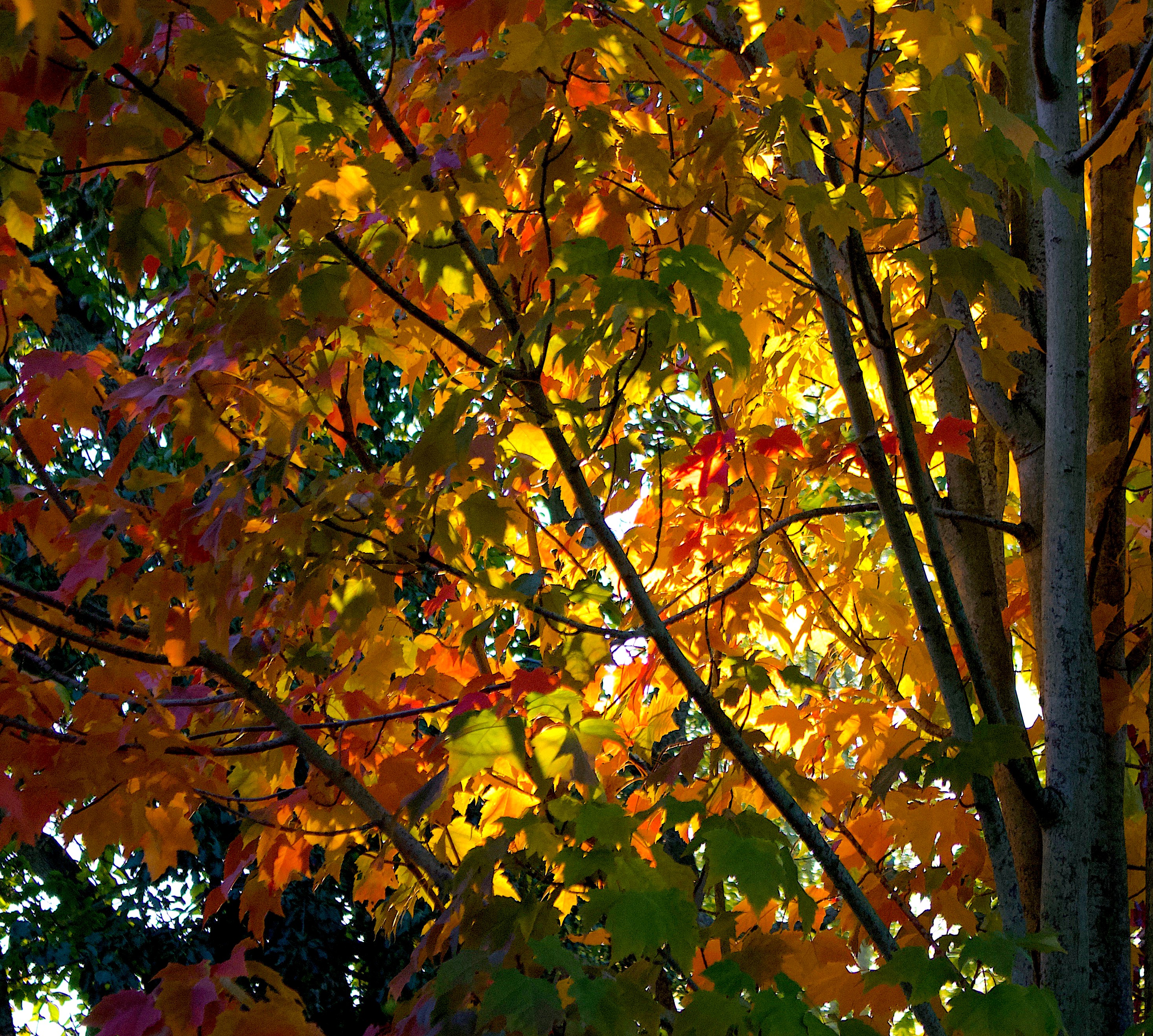
When I visited as a boy, too young for chores, a pair of maples flared before the farmhouse. My grandfather made me a swing, dangling rope from stout branches. I hurtled between them high as I could, pumping out half the day while my mind daydreamed the joy of no school, no camp, no blocks of other children fighting childhood’s wars. With the old people I listened to radio news of Japanese in Nanking, Madrid on fire, Hitler’s brownshirts heiling. The hurricane of 1938 ripped down the older maple.
When I was twelve and could work the fields, my grandfather and I, with Riley the horse, took four days to clear the acres of hay from the fields on both sides of the house. With a scythe I trimmed the uncut grass around boulders and trees, by stone walls, and raked every blade to one of Riley’s piles. My grandfather pitched hay onto the wagon where I climbed to load it, fitting it tight. We left the fields behind as neat as lawns. When I moved back to the house at forty, a neighbor’s machine took alfalfa down in an afternoon. Next morning, engines with huge claws grappled round green bales onto trucks, leaving loose hay scattered and grass standing at the field’s margin.
A solitary maple still rises. Seventy years after my grandfather hung the swing, maple branches snap from the old tree. I tear out dead limbs for next year’s sake, fearing the wind and ice storms of winter, fearing broken trees, cities, and hipbones. ~Donald Hall “Maples” from The Back Chamber.
Photo of Aaron Janicki haying with his Oberlander team in Skagit County courtesy of Tayler RaeBenjamin Janicki of Sedro Woolley raking hay with his team of Oberlanders
I sit with braided fingers and closed eyes in a span of late sunlight. The spokes are closing.
It is fall: warm milk of light, though from an aging breast. I do not mean to pray. The posture for thanks or supplication is the same as for weariness or relief. But I am glad for the luck of light. Surely it is godly, that it makes all things begin, and appear, and become actual to each other.
Light that’s sucked into the eye, warming the brain with wires of color. Light that hatched life out of the cold egg of earth. ~May Swenson from “October”
portrait of Dan’s mom, Emma Gibson, praying, by granddaughter Sara Larsen
I know all too well that by this time in October, the light is changing, the colors have faded, and the chill sets in. I grasp for memories of Octobers past and bundle up the scenes I can preserve now, like harvesting hay to be tied up in bales and stored safely until the middle of winter.
Then, at the right time, when I’m most hungry for color and light, when I’m most worried about what lies in store for us in the future, I loosen the strings on the memories and let the images tumble out, feeding me like mother’s milk.
And grateful, I fill up rather than break into pieces…
One-Time
Monthly
Yearly
Make a one-time or recurring donation to support daily Barnstorming posts
Had I not been awake I would have missed it, A wind that rose and whirled until the roof Pattered with quick leaves off the sycamore
And got me up, the whole of me a-patter, Alive and ticking like an electric fence: Had I not been awake I would have missed it
It came and went too unexpectedly And almost it seemed dangerously, Hurtling like an animal at the house,
A courier blast that there and then Lapsed ordinary. But not ever Afterwards. And not now. ~Seamus Heaney “Had I Not Been Awake”
October is the month of the sudden warm wind-blow, usually arriving from the south, intent on scattering leaves and slamming doors on its way past to head north to Canada. Our wind chimes outside clang a cacophony rather than the usual gentle harmonic tones. The window shades become percussion instruments over our still-open windows. Anything not fastened down goes airborne.
The air blows in a rush from somewhere else, bringing new smells and sensations, surging with an electric energy even as it tries to pull power lines down to render us powerless.
Nothing feels ordinary in a windstorm; there is no easy sleep.
And just as suddenly, the autumn storm passes and is gone. The trees have been stripped, embarrassed at their sudden nakedness. Branches litter the yard and driveway like so many toothpicks. My illusion of comfort and control has been undone by such a show of force and power.
I face my own frailty in the wake of life’s storms. Had I not been awake, I might have missed that altogether.
One-Time
Monthly
Yearly
Make a one-time or recurring donation to support daily Barnstorming posts
photo of Vancouver Island west coast by Nate Gibson
All night long do you know it? Do you care? Up and down the ocean beaches they are marching; All the lanesome peril of the winter nights they dare, Where the surf shoots, seething, landward in the bitter, biting air; And the fitful lights and shadows of the lanterns that they bear Make more wild the gloomy sky above them arching
Where the coast is bleak and cold; Where the rocks are high and bold, While the wind and snow and sleet are beating; Where the breakers rush and roar, There they watch for ships ashore, The cry for help with instant succor meeting.
All night long where the surges flood the dunes, Stern watch and ward they keep, strong eyes sweeping The offing, while the breakers are roaring savage runes, While the stormy winds are howling or wailing dismal tunes, While the rocks and sands are becoming broad lagoons, The life-saving watch these braves are keeping.
All night long while the timid landsmen sleep, Dreaming, snug and warm, on their downy pillows, The coast-guard, the surf-men down by the deep, Steadfastly, bravely, their watch heroic keep, Or into the sea—icy cold—they boldly leap, To rescue fellow-men from the billows.
Talk not of heroes whose trade it is to kill! Life savers! these are the god-like heroes still, Risking their lives for every life they save From the plunging wreck, or snatch from swirling wave.
O when your beds are warm, In nights of winter storm, When you are safe from wind and sea— Think of the surf-men brave: Their life watch by the wave, And cheer them by your grateful sympathy. ~Hannah Augusta Moore “The Life Savers”
Minnie Paterson and dog Yarrow (archive photo from Alberni Valley Museum)
Minnie Paterson rocked slowly in her rocking chair, nursing her infant son. She sat near the south window of the lighthouse living quarters, and studied the rain streaming down in rivulets. Wind gusts rattled the window. A lighthouse keeper’s home was constantly buffeted by wind bearing salty spray, nearly rendering the windows opaque with salt residue. This early December storm had picked up urgency throughout the night. Now with first light, Minnie looked out at driving rain blowing sideways, barely able to make out the rugged rocks below. The Pacific Ocean was anything but; the mist hung gray, melding horizon into sea, with flashes of white foam in crashing waves against the rocky cliffs of Cape Beale.
Whenever storms came, it seemed the Paterson family lived at the edge of civilization. Yet these storms were the reason she and Tom and their five children lived on the rugged west coast of Vancouver Island, in isolation at the southern edge of Barkley Sound. Tom’s job was to keep the foghorn blaring and the light glowing above the treacherous rocks, to guide sea vessels away from certain peril. The storms sometimes were too powerful even with the lighthouse as a beacon of warning. Nearly a year earlier, in January 1906, the ship Valencia had wrecked off the coast and only a few survivors had managed to make their way to shore, staggering up the rocky trail to the lighthouse where Minnie warmed them by the stove and fed them until rescuers could come.
Eleven months later, her husband came in the door in a rush from the upper room where he tended the light. Another ship, battered by the waves, its sails in tatters, was in distress just off the coast, threatening to run aground on the rocks and break apart.
Minnie went to the window again but could see nothing in the dark mist. Surely this could not be another Valencia disaster! Tom went to the telegraph in the corner of the room and tapped out the urgent message to the fishing village of Bamfield, five miles away inside Barkley Sound. He sat impatiently waiting for a reply, drumming his fingers on the desk. After ten minutes, he sent the message again with no response.
Clearly the telegraph lines were torn down in the storm. Fallen trees frequently pulled them down, leaving no option to summon rescuers. This ship would be doomed, just like the Valencia. There was no way the crew could come ashore in lifeboats without perishing on the rocks.
Seeing the helplessness Tom felt, Minnie knew immediately what she must do. He could not leave his post—it was a condition of his job. She would have to run the six miles for help, through the forest. She kissed Tom and five children goodbye, donned a cap and sweater, and as her swollen feet from recent pregnancy did not fit in her boots, she put on her husband’s slippers. She ran down the long stairway down the hill, taking their dog Yarrow as a precaution to help warn her of bears on the trails.
Minnie first had to cross through a tideland inlet with water waist deep. She quickly stripped from the waist down, held her skirt and slippers over her head and crossed through the icy water, her dog swimming alongside. Shivering on the other side, she quickly dressed, and started down the narrow winding forest trail, scrambling over large fallen trees blocking the way. She waded through deep mud, and crossed rocky beaches where wild waves drenched her. At times the tide was so high she crawled on her hands and knees through underbrush so as not to be swept away by the storm.
After four hours, she reached a home along the trail and with a friend, launched a rowboat to go on to Bamfield. The two women notified the anchored ship Quadra, which set out immediately for Cape Beale to rescue the stranded sailors. Within an hour, the Quadra had reached the Coloma which was taking on water fast, and drifting close to the rocks on shore.
Minnie walked the long way back home that night, clothing tattered, muscles cramping, exhausted and chilled. Her breasts overflowing, she gratefully fed her baby, unaware for days whether her efforts rescued the crew of the Coloma. When the locals learned of her heroism, they notified media sources in Vancouver, Victoria and Seattle. Minnie was hailed as a life saver, given gifts and honors, including the following citation from Seattle’s Union of Sailors of the Pacific: “…RESOLVED that we, the seamen of America, fully recognize her sterling worth as the highest type of womanhood, deeply appreciating her unselfish sacrifices in behalf of those ‘who go down to the sea in ships’ and assure her and hers of our undying gratitude.”
Tragically, her health compromised by her extreme exertion that night, she died five years later in 1911 of tuberculosis, forever a life saving heroine to remember.
original Cape Beale Lighthouse (archive from Alberni Valley Museum photo collection)Early 20th century photo of Cape Beale lighthouse and residence buildings (archive of Alberni Valley Museum)
This is a story Dan and I were told by locals during our stay in Bamfield on our honeymoon over forty years ago. On a bright September day, we walked the trail to visit the Cape Beale lighthouse, a most challenging and beautiful part of the world. The trail was so difficult, I was sure I was not fit enough to make it to the lighthouse and back, so how Minnie managed in a December storm, much of it in the dark with only a lantern for light, is beyond imagining. Her bravery captured me and I honor her sacrifice with this rendering of her remarkable storyof personal sacrifice.
modern Cape Beale lighthouse
You are not hidden There’s never been a moment You were forgotten You are not hopeless Though you have been broken Your innocence stolen I hear you whisper underneath your breath I hear your SOS, your SOS I will send out an army To find you in the middle of darkest night It’s true I will rescue you There is no distance That cannot be covered Over and over You’re not defenseless I’ll be your shelter I’ll be your armor I hear you whisper underneath your breath I will never stop marching To reach you in the middle of the hardest fight It’s true I will rescue you I hear the whisper underneath your breath I hear you whisper you have nothing left ~Lauren Daigle
One-Time
Monthly
Yearly
Make a one-time or recurring donation to support daily Barnstorming posts
There is weather on the day you are born and weather on the day you die. There is the year of drought, and the year of floods, when everything rises and swells, the year when winter will not stop falling, and the year when summer lightning burns the prairie, makes it disappear. There are the weathervanes, dizzy on top of farmhouses, hurricanes curled like cats on a map of sky: there are cows under the trees outlined in flies. There is the weather that blows a stranger into town and the weather that changes suddenly: an argument, a sickness, a baby born too soon. Crops fail and a field becomes a study in hunger; storm clouds billow over the sea; tornadoes appear like the drunk trunks of elephants. People talking about weather are people who don’t know what to say and yet the weather is what happens to all of us: the blizzard that makes our neighborhoods strange, the flood that carries away our plans. We are getting ready for the weather, or cleaning up after the weather, or enduring the weather. We are drenched in rain or sweat: we are looking for an umbrella, a second mitten; we are gathering wood to build a fire. ~Faith Shearin “Weather” from Orpheus, Turning.
On the planet the winds are blowing: the polar easterlies, the westerlies, the northeast and southeast trades… Lick a finger, feel the now. ~Annie Dillard from Pilgrim at Tinker Creek
I’m still discovering, right up to this moment, that it is only by living completely in this world that one learns to have faith. I mean living unreservedly in life’s duties, problems, successes and failures, experiences and perplexities. In so doing, we throw ourselves completely into the arms of God. ~Dietrich Bonhoeffer from The Cost of Discipleship
Never before in the history of humanity have we had the ability to pull the weather forecast out of our pocket and know not only what to anticipate in the next 24 hours, but what is happening right now. Prior to phone apps, we scanned the skies, checked the barometer, monitored the thermometer, and put a licked finger up to test the wind direction. As obsolete as those measures seem now, I confess they still make sense to me.
It’s surreal if my phone says it is raining at “my location” and I can’t find a single cloud.
I want to know what is happening around me from my own observation, trust my own eyes, feel my own physical response to the heat, the cold, the dry, the wet. I want to know we’re all in this together, right now.
I want to live completely in this world, living now, finger held to the wind. Then, having the information I need, I throw myself completely into the arms of God.
One-Time
Monthly
Yearly
Support daily Barnstorming posts by making a one-time or recurring donation
The wind blows wherever it pleases. You hear its sound, but you cannot tell where it comes from or where it is going. So it is with everyone born of the Spirit. John 3: 8
Question: What causes the wind? Why do I feel some way in wind?
Answer: Trees fan the wind as they sway. Bushes help. Your heart fills up. ~Annie Dillard from “Some Questions and Answers About Natural History from Tickets for a Prayer Wheel
Let the wind die down. Let the shed go black inside. Let evening come.
Let it come, as it will, and don’t be afraid. God does not leave us comfortless, so let evening come. ~Jane Kenyon from “Let Evening Come”
We’re in the middle of an arctic outflow northeaster that is predicted to blow for several more days and bring snow. What felt like hints of spring have literally gone back underground – the peeper frogs’ song at night is gone, the shoots of snowdrops are frozen in place, delicate buds are in shock, daffodils that recently emerged are now held in suspense.
This is no gentle breeze nor is it a life threatening hurricane. Instead, it is a consistent bone-chilling reminder how vulnerable we are to forces far more powerful than our frail and temporary earthly bodies.
We are not in control, never have been. It helps to remember that.
So we sit tight indoors as much as possible, bundling up when we need to go out for farm chores, yet knowing eventually this bruising air will eventually go still. We ourselves are changed and humbled, with hearts full of the knowledge that God is within those unseen forces. Though we may be afraid of the buffeting sting of a strong chill wind, we pray for the inevitable calm and comfort to come.
And I have no doubt – God Himself will bring it.
This year’s Barnstorming Lenten theme is taken from 2 Corinthians 4: 18: So we fix our eyes not on what is seen, but on what is unseen, since what is seen is temporary, but what is unseen is eternal.
May the wind always be in her hair May the sky always be wide with hope above her And may all the hills be an exhilaration the trials but a trail, all the stones but stairs to God. May she be bread and feed many with her life and her laughter May she be thread and mend brokenness and knit hearts… ~Ann Voskamp from “A Prayer for a Daughter”
Nate and Ben and brand new baby LeaDaddy and Lea
Mommy and Lea
“I have noticed,” she said slowly, “that time does not really exist for mothers, with regard to their children. It does not matter greatly how old the child is – in the blink of an eye, the mother can see the child again as she was when she was born, when she learned to walk, as she was at any age — at any time, even when the child is fully grown….” ~Diana Gabaldon from Voyager
Just checking to see if she is real…
Your rolling and stretching had grown quieter that stormy winter night thirty years ago, but still no labor came as it should. Already a week overdue post-Christmas, you clung to amnion and womb, not yet ready. Then as the wind blew more wicked and snow flew sideways, landing in piling drifts, the roads became more impassable, nearly impossible to traverse.
So your dad and I tried, concerned about your stillness and my advanced age, worried about being stranded on the farm far from town. When a neighbor came to stay with your brothers overnight, we headed down the road and our car got stuck in a snowpile in the deep darkness, our tires spinning, whining against the snow. Another neighbor’s earth mover dug us out to freedom.
You floated silent and still, knowing your time was not yet.
Creeping slowly through the dark night blizzard, we arrived to the warm glow of the hospital, your heartbeat checked out steady, all seemed fine.
I slept not at all.
The morning’s sun glistened off sculptured snow as your heart ominously slowed. You and I were jostled, turned, oxygenated, but nothing changed. You beat even more slowly, threatening to let go your tenuous grip on life.
The nurses’ eyes told me we had trouble. The doctor, grim faced, announced delivery must happen quickly, taking you now, hoping we were not too late. I was rolled, numbed, stunned, clasping your father’s hand, closing my eyes, not wanting to see the bustle around me, trying not to hear the shouted orders, the tension in the voices, the quiet at the moment of opening when it was unknown what would be found.
And then you cried. A hearty healthy husky cry, a welcomed song of life uninterrupted. Perturbed and disturbed from the warmth of womb, to the cold shock of a bright lit operating room, your first vocal solo brought applause from the surrounding audience who admired your purplish pink skin, your shock of damp red hair, your blue eyes squeezed tight, then blinking open, wondering and wondrous, emerging and saved from a storm within and without.
You were brought wrapped for me to see and touch before you were whisked away to be checked over thoroughly, your father trailing behind the parade to the nursery. I closed my eyes, swirling in a brain blizzard of what-ifs.
If no snow storm had come, you would have fallen asleep forever within my womb, no longer nurtured by my aging and failing placenta, cut off from what you needed to stay alive. There would have been only our soft weeping, knowing what could have been if we had only known, if God had provided a sign to go for help.
So you were saved by a providential storm and dug out from a drift: I celebrate when I hear your voice singing- your students love you as their teacher and mentor, you are a thread born to knit and mend hearts, all because of a night of blowing snow.
My annual retelling of the most remarkable day of my life thirty years ago today when our daughter Eleanor (“Lea”) Sarah Gibson was born, hale and hearty because the good Lord sent a wind and snow storm to blow us into the hospital in time to save her. She is now married to her true love Brian–another gift sent from the Lord; we know you will be awesome parents when your turn comes!
There’s nothing romantic about the Christmas story. If anything, it offers a slice of a brutal world in which a child is born on the street, so to speak, with next to nothing in the way of rights and security, and not even a home.
He whose birthday we celebrate at Christmas said, even as a grown man, “I have nothing. I am nowhere at home. Even at night, I have no place to rest or lay my head”.…But now this man from Nazareth comes to us and invites us to mirror God’s image, and shows us how. He says: you too can become light, as God is light. Because what is all around you is not hell, but rather a world waiting to be filled with hope and faith. ~Jörg Zink, from Türen zum Fest.
The Christmas Feast is already a fading memory, And already the mind begins to be vaguely aware Of an unpleasant whiff of apprehension at the thought Of Lent and Good Friday which cannot, after all, now Be very far off. But, for the time being, here we all are… ~W.H.Auden from “For the Time Being: A Christmas Oratorio”
As we drove down the freeway through Seattle yesterday for a Christmas gathering of far-flung family members, I couldn’t help but flinch seeing the stark reality of ramshackle shelters and tents perched in the most precarious places along the roadside. This has been a week of freezing rain and ice, wind and snow for most of our country; here are people trying to survive in the lowliest of places through the worst of conditions. Surely, if this is not hell on earth, it is close to it. A merry Christmas indeed.
Suffering is never far off from where we are, whether we are confronted with homelessness, or it finds its way into our own lives, unbidden and overwhelming. In few weeks we begin the observance of Lent to remember the sacrifice and suffering of the Man born as a homeless baby into loving arms, having come from Loving Arms to rescue the lost.
So recently filled with Christmas feasting and cheer, I’m reminded of the struggle to find home, warmth, love and nurture in a world that can be so cruel, dark and cold.
The Babe has come to quake the gates of hell – here we all are, feeling the ground shaking…
This little Babe so few days old
is come to rifle Satan's fold;
all hell doth at his presence quake
though he himself for cold do shake;
for in this weak unarmèd wise
the gates of hell he will surprise.

With tears he fights and wins the field,
his naked breast stands for a shield;
his battering shot are babish cries,
his arrows looks of weeping eyes,
his martial ensigns Cold and Need
and feeble Flesh his warrior's steed.

His camp is pitchèd in a stall,
his bulwark but a broken wall;
the crib his trench, haystacks his stakes;
of shepherds he his muster makes;
and thus, as sure his foe to wound,
the angels' trump alarum sound.

My soul, with Christ join thou in fight,
stick to the tents that he hath pight.
Within his crib is surest ward,
this little Babe will be thy guard.
If thou wilt foil thy foes with joy,
then flit not from this heavenly Boy.
One-Time
Monthly
Yearly
Make a one-time or recurring donation to support daily Barnstorming posts
Some candle clear burns somewhere I come by. I muse at how its being puts blissful back With yellowy moisture mild night’s blear-all black, Or to-fro tender trambeams truckle at the eye. By that window what task what fingers ply, I plod wondering, a-wanting, just for lack Of answer the eagerer a-wanting Jessy or Jack There God to aggrándise, God to glorify.—
Come you indoors, come home; your fading fire Mend first and vital candle in close heart’s vault: You there are master, do your own desire; What hinders? Are you beam-blind, yet to a fault In a neighbour deft-handed? Are you that liar And, cast by conscience out, spendsavour salt? ~Gerard Manley Hopkins “The Candle Indoors”
Sometimes a lantern moves along the night, That interests our eyes. And who goes there? I think; where from and bound, I wonder, where, With, all down darkness wide, his wading light?
Men go by me whom either beauty bright In mould or mind or what not else makes rare: They rain against our much-thick and marsh air Rich beams, till death or distance buys them quite.
Death or distance soon consumes them: wind What most I may eye after, be in at the end I cannot, and out of sight is out of mind.
Christ minds: Christ’s interest, what to avow or amend There, éyes them, heart wánts, care haúnts, foot fóllows kínd, Their ránsom, théir rescue, ánd first, fást, last friénd. ~Gerard Manley Hopkins “The Lantern Out of Doors“
Now burn, new born to the world, Doubled-naturèd name, The heaven-flung, heart-fleshed, maiden-furled Miracle-in-Mary-of-flame, Mid-numbered he in three of the thunder-throne!
Not a dooms-day dazzle in his coming nor dark as he came; Kind, but royally reclaiming his own; A released shower, let flash to the shire, not a lightning of fíre hard-hurled.
Let him easter in us, be a dayspring to the dimness of us, be a crimson-cresseted east… ~Gerard Manley Hopkins from “The Wreck of the Deutschland”
In three days, we have gone from a sub-zero wind chill ice storm from the north to a balmy 60 degree storm from the south, both winds taking out our power and plunging us into a deeper darker night.
Rather than resort to generator power immediately, I break the darkness with candle light. It is only a brief respite as candles burn down, batteries die, and we’re back in darkness again until the power lines are patched and the transformers restored.
Sometimes the Advent and Christmas season can feel like that: a recharge for my faith that has gone dark and cold, a fire lit under me to banish creeping doubt and discouragement. I need more than Advent rituals and Christmas traditions to keep the darkness in its place beyond today.
God doesn’t need beeswax or batteries to keep His Light on. He just needs us: our trust, our love, our desire for understanding, our need for Him.
We are the candles that shine forth in the world to light the way for those around us who are floundering in the dark.
And that, Charlie Brown, is what Christmas is all about…
One-Time
Monthly
Yearly
Make a one-time or recurring donation to support daily Barnstorming posts
When the day of Pentecost came, they were all together in one place. Suddenly a sound like the blowing of a violent wind came from heaven and filled the whole house where they were sitting. They saw what seemed to be tongues of fire that separated and came to rest on each of them. All of them were filled with the Holy Spirit and began to speak in other tongues as the Spirit enabled them. Acts 2: 1-4
Today we feel the wind beneath our wings Today the hidden fountain flows and plays Today the church draws breath at last and sings As every flame becomes a Tongue of praise. This is the feast of fire, air, and water Poured out and breathed and kindled into earth. The earth herself awakens to her maker And is translated out of death to birth. The right words come today in their right order And every word spells freedom and release Today the gospel crosses every border All tongues are loosened by the Prince of Peace Today the lost are found in His translation. Whose mother tongue is Love in every nation. ~Malcolm Guite “Pentecost” from Sounding the Seasons
Love flows from God into man, Like a bird Who rivers the air Without moving her wings. Thus we move in His world, One in body and soul, Though outwardly separate in form. As the Source strikes the note, Humanity sings– The Holy Spirit is our harpist, And all strings Which are touched in Love Must sound. ~Mechtild of Magdeburg 1207-1297 “Effortlessly” trans. Jane Hirshfield
Home is where one starts from. As we grow older the world becomes stranger, the pattern more complicated Of dead and living. Not the intense moment Isolated, with no before and after, But a lifetime burning in every moment
Love is most nearly itself When here and now cease to matter. ~T.S. Eliot from “East Coker”
When we feel we are without hope, when faith feels frail, when love seems distant, if we feel abandoned… we wait, stilled, for the moment we are lit afire~
when the Living God is seen, heard, named, loved, known, forever burning in our hearts in this moment and for a lifetime.
As we are consumed, carried as His breath and words into multicolor clouds to the ends of the earth, here and now ceases to matter.
One-Time
Monthly
Yearly
Make a one-time or recurring donation to support daily Barnstorming posts
a gentle breeze was lightly tussling shells and stones meant to strike on each other to sibilate, hiss, and whisper your own freshly loosed thoughts back into your soul. like voices afar off the jangling of each woven shroud brought sundry pitch and textured sounds awakening new areas of my mind. deep breaths of open musing rose and fell with the wind as it returned to tantalize the ornamental chimes that had waited so long in silence. Lifted on the breeze freed to manifest each ubiquitous interval and send forth vibrations into nature’s lonely sentiment. I close my eyes and feel the sounds made so effortlessly that tranquilize my worries and open my heart to hear the rapture of the universe. –so fortunate to be sitting here. ~Suzanne Eaton “windchimes”
She goes out to hang the windchime in her nightie and her work boots. It’s six-thirty in the morning and she’s standing on the plastic ice chest tiptoe to reach the crossbeam of the porch, windchime in her left hand, hammer in her right, the nail gripped tight between her teeth but nothing happens next because she’s trying to figure out how to switch #1 with #3.
She must have been standing in the kitchen, coffee in her hand, asleep, when she heard it—the wind blowing through the sound the windchime wasn’t making because it wasn’t there... ~Tony Hoagland from “Windchime”
Once upon a time, nearly 5 decades ago, I attended a university with a bell carillon in a tower that frequently played wonderful concerts. I missed spontaneous music floating on the air after I graduated. Living rural, we are nowhere near a bell tower, nor can we hear our church bells ringing in our Chapel belfry a few miles away.
So when the merest breeze is able to make music, I find it a hopeful reminder the earth itself has its own breath and rhythm and holds its own concerts if given the tools.
We have four windchimes of varying size and tuning hanging from our front porch and back yard, each with its own song and personality. Depending on where we are in the house, we hear different harmony and pitch. The largest sounds like church bells, deep and resonant, another is a pentatonix of harmony, one plays the notes of “Amazing Grace” and the last is just random tintinnabulation.
In certain seasons, our area can get strong northeast or southerly winds that blow over 50 mph. In that case, we take the windchimes down temporarily – the battering clatter and clanging becomes more unsettling than the storm itself. Once the winds die down again, it is too quiet – the silence reminds me to replace the chimes on their hooks.
As I wake in the night to hear their gentle melodies through our open window, my worries are soothed and my heart lifts and floats along with the breeze.
The earth continues to breath and so, for now, will I.
One-Time
Monthly
Yearly
Make a one-time or recurring donation to support daily Barnstorming posts