Reflecting Back…

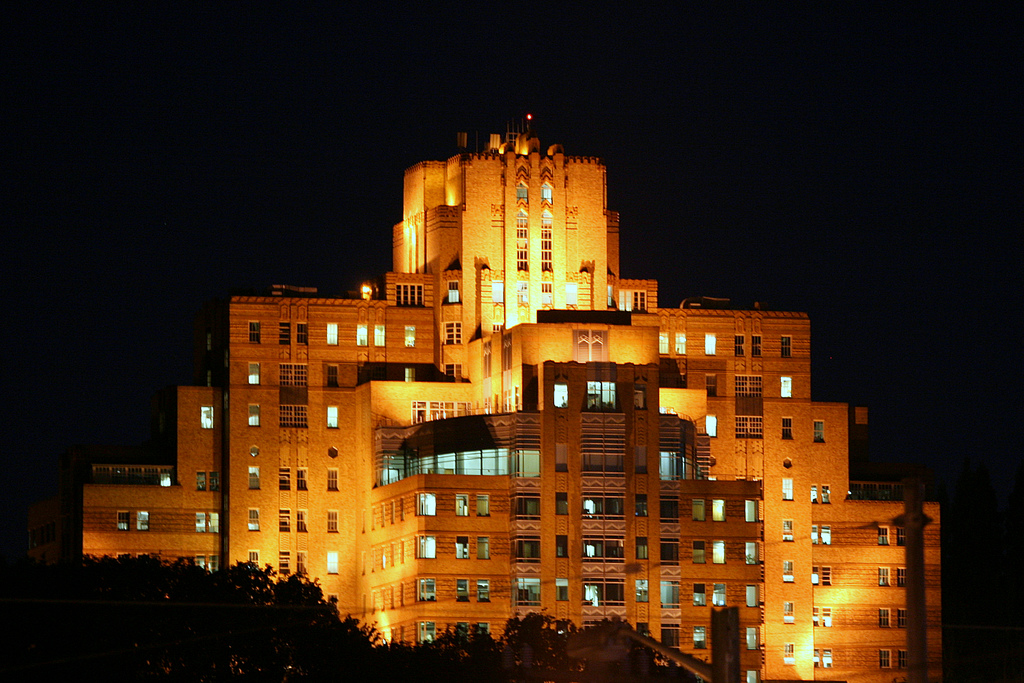
The Pacific Medical Center (2012) Photo by Joe Mabel
http://www.pactower.org

Some years ago, while sitting with my husband and young family high in the upper reaches of Seattle’s (then) Safeco Field watching the Mariners lose to the Cleveland (then) Indians, my attention diverted from the baseball game to the expansive view of the surrounding city.

In particular, I couldn’t help but place myself back inside the old Art Deco building that sits up on Beacon Hill (now known as the Pac Tower.) I had spent a hundreds of hours of my life in that building in the late 1970s; it was easy imagine my younger self in those hallways and rooms.

The 90 year old building had a number of different purposes since originally being constructed to provide hospital care for the region’s Merchant seamen. By 1999, it had become the home of a five year old business that had outgrown Jeff Bezos’ garage — Amazon.com. 

I trained inside the walls of that Public Health Hospital, back in the days when it was the hospital in the region for not only Merchant Marines, but many of the indigenous people of the Pacific northwest and Alaska, in addition to local folks who needed affordable (as in free) health care. I had opportunity to work several clinical rotations in this building as a University of Washington medical student, and to think of it being Amazon’s first (but not last) major headquarters for Amazon made my brain do twists. 

I remembered so much life and death happening inside those walls over the years. 

I first walked into this building as a very green 24 year old med student beginning a surgical rotation in fall 1976, knowing only which end of the stethoscope to put in my ears and which end rests on the patient. On the first day I was shown how to put on a surgical gown, masks and sterile gloves without contaminating myself and the people around me. I never have forgotten that sequence of moves, even though my opportunity to go into an operating room (other than as a patient) became rare after my training days. My chief surgical resident was an exceptionally talented young man who worked himself and everyone working with him around the clock caring for his patients. This brilliant surgeon could only operate on patients while listening and singing to the music of Elvis Presley. I can’t hear any Elvis Presley songs to this day without smelling the odors of surgery–cauterized blood vessels and pus. 

He was soon to become a leading trauma surgeon in a city known for its fine surgeons. The pressure was too much for him. He experienced a personal crisis for which he sought treatment. When he returned to medicine, he abandoned his incredible surgical skills to train as a psychiatrist and still remains an authority on helping impaired physicians, assisting other care providers to acknowledge and deal with addiction and mental health burnout before they harm a patient. 

Those endless clinical rotation days and nights meant witnessing the misery of the most vulnerable of humanity in desperate need of healing, and sometimes we succeeded, but often we did not.  I still have a recurring dream of running up and down the staircases of the Public Health Hospital, bringing pint after pint of blood to the OR from the lab as our team operated on an Alaskan indigenous patient bleeding from dilated esophageal varices, developed as a result of a damaged liver from chronic alcohol dependency. We did not save her, nor have I saved her even once in my dreams over the decades, though I keep trying to run faster. My response to her death was to spend 20 years of my clinical career working with patients in an alcohol and drug treatment program, hoping to prevent her fate in others.

Nor did we save a classmate of mine, on a rotation on a different service, the daughter of a beloved radiologist in this very hospital, who for reasons unknown, had a cardiac arrest while napping briefly during her 32 hour shift.  Another medical student sleeping in the same room heard her odd breathing, found her unresponsive and all medical interventions were employed, to no avail. Even when all the right people, and the right equipment, and the right medicine is seconds away, death can still come, even to healthy people in their 20s.  This was a shock to us all, and an extraordinarily humbling lesson to the pompous and overconfident among us. We might die, in our sleep, whenever it is our time. Years later, I still remember that in my evening prayers.

There was also the young surgical resident who was hospitalized there with jaundice and subsequently died of Hepatitis B, contracted from a blood exposure during his training. No vaccination was available in those days, but was in development. And it was in this and other hospitals in the city, we began to see unusual cases of gay men with severe wasting, rare skin cancers and difficult to treat pneumonias. Initially called GRID (gay-related immune deficiency), it was renamed AIDS as it began appearing in the general population as well, and for too long was a death sentence for anyone infected.

One on-call night in particular is memorable. It was Christmas Eve, and a heavy snowstorm had brought the city to a standstill.  We had very little to do that night in the hospital as the elective surgeries were all postponed until after the holiday and no ambulance could easily make it up the steep drive to the ER, so they were being diverted to other hospitals. As a result, our patient load was light. I was in my tiny sleeping room, on the 14th floor of the tower, facing out north to the city of Seattle, able to enjoy the view of the city, everything blanketed under snow, so peaceful and very quiet.  The freeway, ordinarily so busy day and night, was practically abandoned, and the lights of the city were brighter from the snowfall. It was an enchanting vision of a city forced to slow itself and be still, so anticipatory on a sacred and holy night.

I remember thinking about how young and inexperienced I was, and how very little I knew. My chief resident thought I’d make a good surgeon – I was a diligent worker and technically very good with my hands. My heart told me that I’d be better as a generalist/family doctor. The city held many attractions and excitement, but I longed to return to a farm and a someday family. It was a wistful bittersweet night and I slept very little, perched on that little bed overlooking the sleeping snowy city. I wondered where life might take me, as I reflected on who I was becoming and where I was meant to be.

Forty five years later, I still am reminded every day at how little I know,  but I do realize this:
for however long we’re on this earth, each day we have a distinct purpose and reason for being.

That day, my purpose was to be snowbound on that Christmas day at the old Public Health Hospital, unable to go home from my shift because my car was stuck in the parking lot. Instead, I covered for others who couldn’t make it in to work, singing Christmas carols for all the patients who had to stay put in their hospital beds.

Soon, my purpose was to meet the man I was to marry, eventually living with three beloved children on a little farm 100 miles to the north while practicing medicine in a variety of primary care roles for over forty years. 

And perhaps, my purpose now in retirement is to share a few stories while reflecting on a life still in progress.

Only the Lord knows why He places us where He does.

view from the “sleeping room” at the top of the tower
One-Time
Monthly
Yearly

Make a one-time or recurring donation to support daily Barnstorming posts

Make a monthly donation

Make a yearly donation

Choose an amount

$10.00
$25.00
$50.00
$5.00
$15.00
$100.00
$5.00
$15.00
$100.00

Or enter a custom amount

$

Your contribution is deeply appreciated.

Your contribution is appreciated.

Your contribution is appreciated.

DonateDonate monthlyDonate yearly


When Mortal Life Shall Cease

(Fourteen years ago this week, a healthy young college student came to our university health clinic ill with seasonal influenza complicated by pneumonia. His family gave permission for his story to be told. I share this again to honor the patients, young and old, who have fallen victim to the even more devastating COVID-19 pandemic over the past two years, as well as their families who have not had the same privilege of being at their bedside as they die. And honoring the health care workers who have witnessed so many preventable deaths over and over and will never truly recover from that experience.)

Nothing was helping.  Everything had been tried for a week of the most intensive critical care possible.  A twenty year old man – completely healthy only two weeks previously – was dying and nothing could stop it.

The battle against a sudden MRSA (Methicillin Resistant Staph Aureus) pneumonia precipitated by a routine seasonal influenza infection had been lost. Despite aggressive hemodynamic, antibiotic, antiviral and ventilator management, he was becoming more hypoxic and his renal function was deteriorating.  He was no longer responsive to stimuli.

The intensivist looked weary and defeated. The nurses were staring at their laps, unable to look up, their eyes tearing. The hospital chaplain reached out to hold this young man’s mother’s shaking hands.

After a week of heroic effort and treatment, there was now clarity about the next step.

Two hours later, a group gathered in the waiting room outside the ICU doors. The average age was about 21; they assisted each other in tying on the gowns over their clothing, distributed gloves and masks. Together, holding each other up, they waited for the signal to gather in his room after the ventilator had been removed and he was breathing without assistance. They entered and gathered around his bed.

He was ravaged by this sudden illness, his strong body beaten and giving up. His breathing was now ragged and irregular, sedation preventing response but not necessarily preventing awareness. He was surrounded by silence as each individual who had known and loved him struggled with the knowledge that this was the final goodbye.

His father approached the head of the bed and put his hands on his boy’s forehead and cheek.  He held this young man’s face tenderly, bowing in silent prayer and then murmuring words of comfort:

It is okay to let go. It is okay to leave us now.
We will see you again. We’ll meet again.
We’ll know where you will be.

His mother stood alongside, rubbing her son’s arms, gazing into his face as he slowly slowly slipped away. His father began humming, indistinguishable notes initially, just low sounds coming from a deep well of anguish and loss.

As the son’s breaths spaced farther apart, his dad’s hummed song became recognizable as the hymn of praise by John Newton, Amazing Grace.  The words started to form around the notes. At first his dad was singing alone, giving this gift to his son as he passed, and then his mom joined in as well. His sisters wept. His friends didn’t know all the words but tried to sing through their tears. The chaplain helped when we stumbled, not knowing if we were getting it right, not ever having done anything like this before.

Amazing Grace, how sweet the sound,
That saved a wretch like me.
I once was lost but now am found,
Was blind, but now I see.

Through many dangers, toils and snares
I have already come;
‘Tis Grace that brought me safe thus far
and Grace will lead me home.

Yea, when this flesh and heart shall fail,
And mortal life shall cease,
I shall possess within the veil,
A life of joy and peace.

When we’ve been here ten thousand years
Bright shining as the sun.
We’ve no less days to sing God’s praise
Than when we’ve first begun.

And he left us.

His mom hugged each sobbing person there–the young friends, the nurses, the doctors humbled by powerful pathogens. She thanked each one for being present for his death, for their vigil kept through the week in the hospital as his flesh and heart had failed.

This young man, now lost to this mortal life, had profoundly touched people in a way he could not have ever predicted or expected. His parents’ grief, so gracious and giving to the young people who had never confronted death before, remains unforgettable.

This was their sacred gift to their son so Grace could lead him home.

To Break Your Heart

Here is a story
to break your heart.
Are you willing?
This winter
the loons came to our harbor
and died, one by one,
of nothing we could see.
A friend told me
of one on the shore
that lifted its head and opened
the elegant beak and cried out
in the long, sweet savoring of its life
which, if you have heard it,
you know is a sacred thing.,
and for which, if you have not heard it,
you had better hurry to where
they still sing.
And, believe me, tell no one
just where that is.
The next morning
this loon, speckled
and iridescent and with a plan
to fly home
to some hidden lake,
was dead on the shore.
I tell you this
to break your heart,
by which I mean only
that it break open and never close again
to the rest of the world.
~Mary Oliver “Lead” from New and Selected Poems

Why shouldn’t we go through heartbreaks?

…if through a broken heart
God can bring His purposes to pass in the world,
then thank Him for breaking your heart.
~Oswald Chambers from “Ye are not your own” from My Utmost for the Highest

These last two years have seen an epidemic of heart-break.

Due to hospital visitor restrictions, thousands of loved ones have died of COVID without family by their side, deprived of the solace of hearing familiar voices and being touched by familiar hands. A weary and over-worked health care team can only do so much in their efforts to comfort and console when so many patients are losing their battle with the virus at the same time. Although nurses and doctors have always been witnesses to the cries of the dying and the weeping of the grief-stricken, that is usually together at the bedside.

An iPad screen isn’t the same for those saying good-bye forever.

For all the advances of our modern society – through technology and communication and the development of medical miracles – people still die and others still grieve and weep over their loss. We’re not used to dying happening with such frequency to those who have no business dying in the first place. We assume death rates exceeding birth rates happens only in third world countries beset with drought or plague.

Not any more.

So my heart is tender – for those lost, for those left behind, for those trying their best to save lives when they are weary and ill themselves, for the irony of hundreds of thousands of unnecessary deaths when the preventive measures available to us all are so clear-cut.

If anything, a breaking heart is an open invitation for the solace of a God who himself had no business dying in the first place, but did. He cried out in a long, sweet savoring of his life and ours, saving us in the process.

One-Time
Monthly
Yearly

Make a one-time or recurring donation to Barnstorming

Make a monthly donation

Make a yearly donation

Choose an amount

¤5.00
¤10.00
¤20.00
¤5.00
¤15.00
¤100.00
¤5.00
¤15.00
¤100.00

Or enter a custom amount

¤

Your contribution is deeply appreciated.

Your contribution is appreciated.

Your contribution is appreciated.

DonateDonate monthlyDonate yearly

When the Light Left

sundown

From my six week psychiatric inpatient rotation at a Veteran’s Hospital—February/March 1979

Sixty eight year old male catatonic with depression

He lies still, so very still under the sheet, eyes closed; the only clue that he is living is the slight rise and fall of his chest.  His face is skull like with bony prominences framing his sunken eyes, his facial bones standing out like shelves above the hollows of his cheeks, his hands lie skeletal next to an emaciated body.  He looks as if he is dying of cancer but without the smell of decay.  He rouses a little when touched, not at all when spoken to.  His eyes open only when it is demanded of him, and he focuses with difficulty.  His tongue is thick and dry, his whispered words mostly indecipherable, heard best by bending down low to the bed, holding an ear almost to his cracked lips.

He has stopped feeding himself, not caring about hunger pangs, not salivating at enticing aromas or enjoying the taste of beloved coffee.  His meals are fed through a beige rubber tube running through a hole in his abdominal wall emptying into his stomach, dripping a yeasty smelling concoction of thick white fluid full of calories.   He ‘eats’ without tasting and without caring.  His sedating antidepressant pills are crushed, pushed through the tube, oozing into him, deepening his sleep, but are designed to eventually wake him from his deep debilitating melancholy.

After two weeks of treatment and nutrition, his cheeks start to fill in, and his eyes are closed less often.  He watches people as they move around the room and he responds a little faster to questions and starts to look us in the eye.   He asks for coffee, then pudding and eventually he asks for steak.  By the third week he is sitting up in a chair, reading the paper.

After a month, he walks out of the hospital, 15 pounds heavier than when he was wheeled in.  His lips, no longer dried and cracking, have begun to smile again.

****************************************************************************************************************************

Thirty two year old male rescued by the Coast Guard at 3 AM in the middle of the bay

As he shouts, his eyes dart, his voice breaks, his head tosses back and forth, his back arches and then collapses as he lies tethered to the gurney with leather restraints.  He writhes constantly, his arm and leg muscles flexing against the wrist and ankle bracelets.

“The angels are waiting!!  They’re calling me to come!! Can’t you hear them?  What’s wrong with you?   I’m Jesus Christ, King of Kings!!  Lord of Lords!!  If you don’t let me return to them, I can’t stop the destruction!”

He finally falls asleep by mid-morning after being given enough antipsychotic medication to kill a horse.  He sleeps uninterrupted for nine hours.  Then suddenly his eyes fly open, and he looks startled.

He glares at me.  “Where am I? How did I get here?”

“You are hospitalized in the VA psych ward after being picked up by the Coast Guard after swimming out into the bay in the middle of the night. You said you were trying to reach the angels.”

He turns his head away, his fists relaxing in the restraints, and begins to weep uncontrollably, the tears streaming down his face.

“Forgive them, Father, for they know not what they do.”

*********************************************************************************************************************************

Twenty two year old male with auditory and visual hallucinations

He seems serene, much more comfortable in his own skin when compared to the others on the ward. Walking up and down the long hallways alone, he is always in deep conversation. He takes turns talking, but more often is listening, nodding,  almost conspiratorial.

During a one-on-one session, he looks at me briefly, but his attention continues to be diverted, first watching an invisible something or someone enter the room, move from the door to the middle of the room, until finally, his eyes lock on an empty chair to my left.  I ask him what he sees next to me.

“Jesus wants you to know He loves you.”

It takes all my will power not to turn and look at the empty chair.

**************************************************************************************************************************************

Fifty four year old male with chronic paranoid schizophrenia

He has been disabled with psychiatric illness for thirty years, having his first psychotic break while serving in World War II.   His only time living outside of institutions has been spent sharing a home with his mother who is now in her eighties.  This hospitalization was precipitated by his increasing delusion that his mother is the devil and the voices in his head commanded that he kill her.  He had become increasingly agitated and angry, had threatened her with a knife, so she called the police, pleading with them not to arrest him, but to bring him to the hospital for medication adjustment.

His eyes have taken on the glassy staring look of the overmedicated psychotic, and he sits in the day room much of the day sleeping in a chair, drool dripping off his lower lip.  When awake he answers questions calmly and appropriately with no indication of the delusions or agitation that led to his hospitalization.  His mother visits him almost daily, bringing him his favorite foods from home which he gratefully accepts and eats with enthusiasm.   By the second week, he is able to take short passes to go home with her, spending a lunch time together and then returning to the ward for dinner and overnight.   By the third week, he is ready for discharge, his mother gratefully thanking the doctors for the improvement she sees in her son.  I watch them walk down the long hallway together to be let through the locked doors to freedom.

Two days later, a headline in the local paper:

“Veteran Beheads Elderly Mother”

*************************************************************************************************************************************

Forty five year old male — bipolar disorder with psychotic features

He has been on the ward for almost a year, his unique high pitched laughter heard easily from behind closed doors,  his eyes intense in his effort to conceal his struggles.  Trying to follow his line of thinking is challenging, as he talks quickly, with frequent brilliant off topic tangents, and at times he lapses into a “word salad” of almost nonsensical sentences.  Every day as I meet with him I become more confused about what is going on with him, and am unclear what is expected of me in my interactions with him.  He senses my discomfort and tries to ease my concern.

“Listen, this is not your problem to fix but I’m bipolar and regularly hear command voices and have intrusive thoughts.  My medication keeps me under good control.  But just tell me if you think I’m not making sense because I don’t always recognize it in myself.”

During my rotation, his tenuous tether to sanity is close to breaking.  He starts to listen more intently to the voices in his head, becoming frightened and anxious, often mumbling and murmuring under his breath as he goes about his day.

On this particular morning, all the patients are more anxious than usual, pacing and wringing their hands as the light outdoors slowly fades, with noon being transformed to an oddly shadowy dusk.  The street lights turn on automatically and cars are driving with headlights shining.  We stand at the windows in the hospital, watching the city become dark as night in the middle of the day.   The unstable patients are sure the world is ending and extra doses of medication are dispensed as needed while the light slowly returns to the streets outside.  Within an hour the sunlight is back, and all the patients are napping soundly.

The psychiatrist, now floridly psychotic, locks himself in his office and doesn’t respond to knocks on the door or calls on his desk phone.

Stressed by the recent homicide by one of his discharged patients, and identifying too closely with his patients due to his own mental illness,  he is overwhelmed by the eclipse.   The nurses call the hospital administrator who comes to the ward with two security guards.  They unlock the door and lead the psychiatrist off the ward.  We watch him leave, knowing he won’t be back.

It is as if the light left and only shadow remains.

total eclipse