Our Ordinary Unmysterious Lives

Definite beliefs are what make the radical mystery
those moments when we suddenly know there is a God
about whom we “know” absolutely nothing –
accessible to us and our ordinary, unmysterious lives.

And more crucially:

definite beliefs enable us to withstand the storms of suffering

that come into every life, and that tend to destroy
any spiritual disposition that does not have deep roots.

~Christian Wiman from My Bright Abyss

photo of Wiser Lake Chapel sanctuary by Barb Hoelle

Does anyone have the foggiest idea
of what sort of power we so blithely invoke?
Or, as I suspect, does no one believe a word of it?
The churches are children playing on the floor with their chemistry sets,
mixing up a batch of TNT to kill a Sunday morning.
It is madness to wear ladies’ straw hats and velvet hats to church;
we should all be wearing crash helmets.
Ushers should issue life preservers and signal flares;
they should lash us to our pews.

~Annie Dillard from Teaching a Stone to Talk

Unexpected God,
your advent alarms us.
Wake us from drowsy worship,
from the sleep that neglects love,
and the sedative of misdirected frenzy.
Awaken us now to your coming,
and bend our angers into your peace.
Amen.
~Revised Common Lectionary First Sunday of Advent

We are only a few weeks away from the beginning of Advent, a time when I am very guilty of blithely invoking the gentle story of Christmas Eve’s silent night, the sleeping infant away in a manger, the devoted parents hovering, the humble shepherds peering in the stable door.

The reality, I’m confident, was far different.

There was nothing gentle about a teenage mother giving birth in a stable, laying her baby in a feed trough–I’m sure there were times when Mary could have used a life preserver.
There was nothing gentle about the heavenly host appearing to the shepherds, shouting and singing the glories and leaving them “sore afraid.” The shepherds needed crash helmets.
There was nothing gentle about Herod’s response to the news that a Messiah had been born–he swept overboard a legion of male children whose parents undoubtedly begged for mercy, clinging to their children about to be murdered.
There was nothing gentle about a family’s flight to Egypt to flee that fate for their only Son.
There was nothing gentle about the life Jesus eventually led during his ministry:  itinerant and homeless, tempted and fasting in the wilderness for forty days,  owning nothing, rejected by his own people, betrayed by his disciples,  sentenced to death by acclamation before Pilate, tortured and hung on a cross until he took his last breath.

Yet he understood the power that originally brought him to earth and would return him to heaven, and back again someday. 
No signal flares needed there.

When I hear skeptics scoff at Christianity as a “crutch for the weak”, they underestimate the courage it takes to walk into church each week as a desperate person who will never ever save oneself.   We cling to the life preserver found in the Word, lashed to our seats and hanging on.  It is only because of grace that we survive the tempests of temptation, guilt and self-doubt to let go of our own anger in order to confront the reality of the radical mystery of God.

It is not for the faint of heart, this finding a “definite belief” within our ordinary unmysterious lives and giving it deep roots to thrive. It is reasonable and necessary to be “sore afraid” and “bend our anger” into His peace.

And not forget our crash helmets.

walking to church in Tokyo


This Momentous Giving

To be amazed by love is not to be blinded but
to let the flare of wonder fill you
like air filling a sail.


Isn’t this the voice of God at work?

Even his silence breathes life into you, a golden sigh as fresh
as Eden. To love someone is not to lose anything,
but to gain it in giving it all away.
~Luci Shaw from “Amazed by Love” in Water Lines

Lovers must not live for themselves alone. 
They must finally turn their gaze at one another
back toward the community. 
If they had only themselves to consider,
lovers would not need to marry,
but they must think of others and of other things. 
They say their vows to the community as much as to one another,
and the community gathers around them
to hear and to wish them well, on their behalf and on its own. 


It gathers around them because it understands how necessary,
how joyful, and how fearful this joining is. 
These lovers, pledging themselves to one another “until death,”
are giving themselves away… 
Lovers, then, “die” into their union with one another
as a soul “dies” into its union with God. 


And so, here, at the very heart of community life,
we find … this momentous giving. 
If the community cannot protect this giving,
it can protect nothing—and our time is proving that this is so.
~Wendell Berry from Sex, Economy, Freedom & Community

Before God and this gathering, I vow from my heart and spirit that I will be your wife/husband for as long as we both shall live.

I will love you with faithfulness, knowing its importance in sustaining us through good times and bad.

I will love you with respect, serving your greatest good and supporting your continued growth.

I will love you with compassion, knowing the strength and power of forgiveness.

I will love you with hope, remembering our shared belief in the grace of God and His guidance of our marriage.

“And at home, by the fire, whenever you look up, there I shall be–and whenever I look up, there will be you.”

(our wedding vows for our September 19, 1981 wedding at First Seattle Christian Reformed Church — the last line adapted from Thomas Hardy’s  “Far From the Madding Crowd”)

Our Chance to Choose

We may ignore, but we can nowhere evade, the presence of God.
The world is crowded with Him.
He walks everywhere incognito.
And the incognito is not always easy to penetrate.
The real labor is to remember to attend.

In fact to come awake.
Still more to remain awake.
~C.S. Lewis from “Letters to Malcolm: Chiefly on Prayer”

God is going to invade, all right:
but what is the good of saying you are on his side then,
when you see the whole natural universe
melting away like a dream and something else –
something it never entered your head to conceive –
comes crashing in;
something so beautiful to some of us and so terrible to others
that none of us will have any choice left?

For this time it will be God without disguise;
something so overwhelming that it will strike
either irresistible love
or irresistible horror
into every creature.
It will be too late then to choose your side.

There is no use saying you choose to lie down
when it has become impossible to stand up.
That will not be the time for choosing:
it will be the time when we discover
which side we really have chosen,
whether we realized it before or not.
Now, today, this moment, is our chance to choose the right side.
~C.S. Lewis from
Mere Christianity

The older I get, the more I recognize the need to be alert and awake to the presence of God in the crowded world around me. It doesn’t come naturally. We humans have an attention deficit, choosing to focus inwardly on self and ignoring the rest. If it isn’t for me, or like me, or about me, it somehow is not worthy of my consideration.

We wear blinders, asleep, unaware we must choose an incognito God;
we think His invisible immensity must be obvious, like a lightning flash.

And so – He has come and walked among us in plain sight.
No longer incognito.
The time to choose has come.

photo of lightning over Anacortes, Washington from Komonews.com

Finding My Way Home

Bees do have a smell, you know,
and if they don’t they should,
for their feet are dusted with spices
from a million flowers.”
~Ray Bradbury, Dandelion Wine


I studied bees, who were able
to convey messages through dancing
and could find their ways
home to their hives
even if someone put up a blockade of sheets
and boards and wire.
Bees had radar in their wings and brains
that humans could barely understand.
I wrote a paper proclaiming
their brilliance and superiority
and revised it at a small café
featuring wooden hive-shaped honey-dippers
in silver honeypots
at every table.
~Naomi Shihab Nye from “Bees Were Better”

Suddenly a bee, big as a blackberry,
bumbles against my window, knocking
for attention. Rolling in azalea cups all morning,
she weaves in slow motion then hovers
like a helicopter, humming
to herself. The key, C major.
No black notes, no sharps, no flats.
Only naturals—the fan of her own wings,
the bliss of her own buzz.

She doesn’t practice.
She doesn’t have to. She knows.
To make honey, you follow the dance.
~Alice Friman  from “The Key”

I wish I had a homing device in my body that would bring me home no matter where I wander. I simply turn my face to the sun and my wings take me back there, even if I wasn’t paying attention to the dance of others and I’m off kilter or too stubborn to admit home is where I need to be.

After a summer of watching thousands of bees making a “bee-line” to home at night as if they are on a superhighway to their very own hive and honey cell, I need to be just as determined, just as committed, just as confident that I’m heading to where I belong.

The rest are waiting for me and have left the light on.


Sabbath Morning

The Old Church leans nearby a well worn road 
upon a hill that has no grass or tree 
The winds from off the prairie now unload 
the dust they bring around it fitfully 
The path that leads up to the open door 
is worn and grayed by many toiling feet 
of us who listen to the Bible lore 
and once again the old time hymns repeat.
And every Sabbath Morning we are still 
returning to the altar standing there; 
a hush, a prayer, a pause, and voices 
fill the Master’s House with a triumphant air.
The old church leans awry and looks quite odd,
But it is beautiful to us, and God.

~Stephen Paulus “The Old Church”

…when I experienced the warm, unpretentious reception of those who have nothing to boast about, and experienced a loving embrace from people who didn’t ask any questions, I began to discover that a true spiritual homecoming means a return to the poor in spirit to whom the kingdom of heaven belongs.
~Henri Nouwen from The Return of the Prodigal Son

Our family had driven past the boxy building countless times hurrying on our way to other places, barely giving it a second glance. It had a classic design, but showed its age with peeling paint,  a few missing shingles, an old fashioned square flat roofed belfry, and arched windows. The hand lettered sign spelling out “Wiser Lake Chapel” by the road constituted a humble invitation of sorts, simply by listing the times of the services.

On a blustery December Sunday evening in 1990, we had no place else to be for a change.  Instead of driving past, we stopped, welcomed by the yellow glow pouring from the windows and an almost full parking lot. Our young family climbed the steps to the big double doors, and inside were immediately greeted by a large balding man with a huge grin and encompassing handshake. He pointed us to one of the few open spots still available in the old wooden pews.

The sanctuary was a warm and open space with a high lofted ceiling, dark wood trim accents matching the ancient pews, and a plain wooden cross above the pulpit in front. There was a pungent smell from fir bough garlands strung along high wainscoting, and a circle of candles standing lit on a small altar table. Apple pie was baking in the kitchen oven, blending with the aroma of good coffee and hot cocoa.

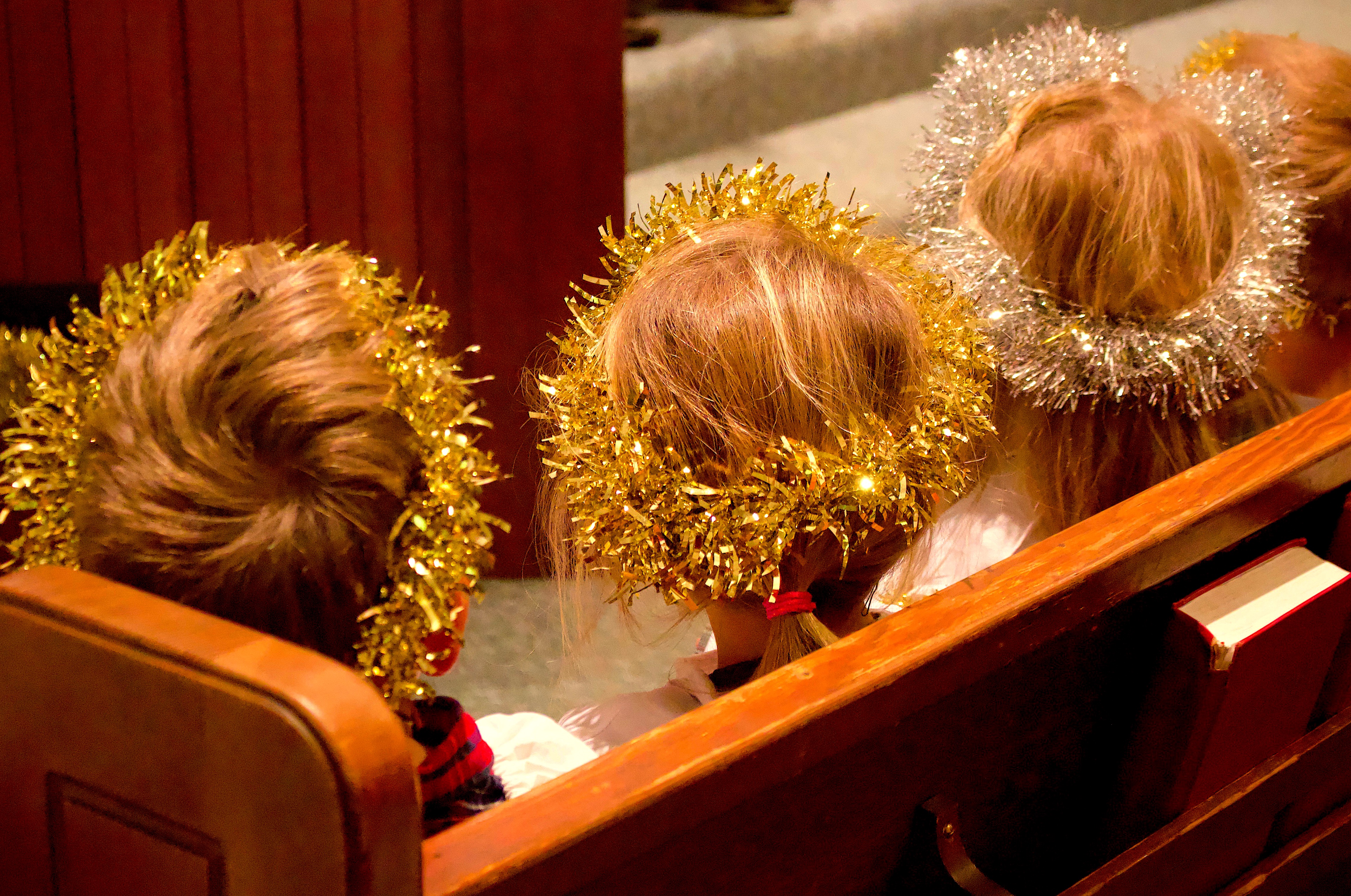
The service was a Sunday School Christmas program, with thirty some children of all ages and skin colors standing up front in bathrobes and white sheet angel gowns, wearing gold foil halos, tinfoil crowns and dish towels wrapped with string around their heads. They were prompted by their teachers through carols and readings of the Christmas story. The final song was Silent Night, sung by candle light, with each child and member of the congregation holding a lit candle. There was a moment of excitement when one girl’s long hair briefly caught fire, but after that was quickly extinguished, the evening ended in darkness, with the soft glow of candlelight illuminating faces of the young and old, some in tears streaming over their smiles.

It felt like home. We had found our church.

We’ve never left and every Sabbath day finds us back there.

Over the past 103 years, this old building has seen a few thousand people come and go, has had peeling paint and missing shingles, a basement that flooded when the rain comes down hard, toilets that didn’t always flush, and though it smells heavenly on potluck days, there are times when it can be just a bit out of sorts and musty. It really isn’t anything to boast about.

It is humble and unpretentious yet envelops its people in its loving and imperfect embrace, with warmth, character and a uniqueness that is unforgettable.

It really is not so different from the folks who have gathered there over the years.

We know we belong,
such as we are,
just as we are,
blessed by God with a place to join together.

Here and Now

Unless the eye catch fire,
Then God will not be seen.
Unless the ear catch fire
Then God will not be heard.
Unless the tongue catch fire
Then God will not be named.
Unless the heart catch fire,
Then God will not be loved.
Unless the mind catch fire,
Then God will not be known.
~William Blake from “Pentecost”

I said to my soul, be still, and wait without hope
For hope would be hope for the wrong thing; wait without love,
For love would be love of the wrong thing; there is yet faith
But the faith and the love and the hope are all in the waiting.
Wait without thought, for you are not ready for thought:
So the darkness shall be the light, and the stillness the dancing.
Whisper of running streams, and winter lightning.
The wild thyme unseen and the wild strawberry,
The laughter in the garden, echoed ecstasy
Not lost, but requiring, pointing to the agony
Of death and birth.

Home is where one starts from. As we grow older
the world becomes stranger, the pattern more complicated
Of dead and living. Not the intense moment
Isolated, with no before and after,
But a lifetime burning in every moment

Love is most nearly itself
When here and now cease to matter.
~T.S. Eliot from “East Coker”

Today, if we feel we are without hope,
if faith feels frail,
if love seems distant,
we must wait, stilled,
for the moment we are lit afire~
when the Living God is
seen, heard, named, loved, known,
forever burning in our hearts
in this moment, for a lifetime
and for eternity.
Here and now ceases to matter.

A Bright Sadness: Take Your Shoes Off

Earth’s crammed with heaven,
And every common bush afire with God:
But only he who sees takes off his shoes.
~Elizabeth Barrett Browning

Over the next eight days, the body of Christian believers will be traversing once again the holy ground of Jesus’ passion, death and resurrection.

Indeed, our children, happy to be barefoot most of the time, are more apt than the grown ups to follow the instruction of the Lord when He told Moses:

Remove your sandals from your feet, for the place on which you are standing is holy ground.

There have long been cultures where shoes are to be removed before touching the surface of the floor inside a residence or temple in an intentional act of leaving the dirt of the world at the door to preserve the sanctity and cleanliness of the inner life.

Yet we as Christians wear shoes into church every Sunday, having walked in muck and mire of one sort or another all week. We try our best to clean up for Sunday, but we track in the detritus of our lives when we come to sit in the pews. Rather than leave it at the door, it comes right in with us, not exactly hidden and sometimes downright stinky. That is when we are in obvious need for a good washing, shoes, feet, soul and all, and that is exactly why we  need to worship together as a church family in need of cleansing, whether indoors or outdoors.

Jesus Himself demonstrated our need for a wash-up on the last night of His life, soaking the dusty feet of His disciples.

And then there is what God said. He asked that holy ground be respected by the removal of our sandals. We must remove any barrier that prevents us from entering fully into His presence, whether it be our attitude, our stubbornness, our unbelief, or our constant centering on self rather than other.

No separation, even a thin layer of leather, is desirable when encountering God.

We trample roughshod over holy ground all the time, blind to where our feet land and the impact they leave behind. Perhaps by shedding the covering of our eyes, our minds, and our feet, we would see earth crammed with heaven and God on fire everywhere, in every common bush and in every common heart.

So we may see.
So we may listen.
So we may feast together.
So we may weep at what we have done, yet stand forgiven.
So we may celebrate as our Risen Lord startles us by calling our name.
So we remove our sandals so our bare feet may touch His holy ground.

A Bright Sadness: Let Him Easter in Us

Let Him easter in us,
be a dayspring to the dimness of us,
be a crimson-cresseted east.
~Gerard Manley Hopkin

There is a fragrance in the air, 
a certain passage of a song, 
an old photograph falling out from the pages of a book, 
the sound of somebody’s voice in the hall 
that makes your heart leap and fills your eyes with tears. 
Who can say when or how it will be 
that something easters up out of the dimness 
to remind us of a time before we were born and after we will die?
God himself does not give answers. He gives himself.
~Frederick Buechner from Telling the Truth: The Gospel as Tragedy, Comedy and Fairy Tale

Traditionally, Lent does not include the five Sundays before Easter as every Sabbath is a celebration of Christ’s resurrection. We should let Him Easter in us every week!

So this is my first of six Easter reflections on Barnstorming during the next few weeks. We wait for the glorious day when we can meet as Christ’s body on April 21, first on our farm’s hill at dawn, and then later inside our church’s sanctuary to feel the full impact of “He is Risen!”

It is a slow coming of spring this year, seeming in no hurry whatsoever.  Snow remains in residual drifts around the farm from the storms of a month ago, the foothills are still white and the greening of the fields has yet to begin. The flowering plum and cherry trees remain dormant in the continued chill. 

Like Narnia, winter still has its terrible grip on us.

We wait, frozen in a darkened world, for a sun that shines and actually warms us from our dormancy.

This is exactly what eastering is.  It is awakening out of a restless sleep, opening a door to let in fresh air, and the stone that locked us in the dark rolled back.

Overnight all will be changed, changed utterly.

He is not only risen.  He is given indeed.


The Paradox of Already But Not Yet

chardfreeze


chardfreeze2


If ever you find yourself in the midst of paradox,
you can be sure you stand on the edge of truth.

~Diana Gabaldon from An Echo in the Bone


freezechard


Tomorrow we begin the season of Advent: the greatest time of year for great mystery and paradox.

One who never left us, came to us, did not leave us hopeless,  yet will come again.
Already, but not yet.

This is the ultimate paradox of our times:
Our Creator God pierces through the veil of humankind to become us, His Image Man;
He comes to live among us to live in us and for us and through us,
to die for us and rise to life again so that we may not die but live.

He has come, He never left, yet He will come again.

When we feel ourselves in the midst of paradox, we find we are on the verge of Truth.
Perhaps enough paradox for one day — standing on the edge of Truth feels a tad overwhelming.

More to come…


decemberleaf2


When They Were Young

moonandsisters


conwaychurch1


empty-church1


On the green hill with the river beyond it
long ago and my father there
and my grandmother standing in her faded clothes
wrinkled high-laced black shoes in the spring grass
among the few gravestones inside their low fence
by the small white wooden church
the clear panes of its windows
letting the scene through from the windows
on the other side of the empty room
and a view of the trees over there
my grandmother hardly turned her head
staring like a cloud at the empty air
not looking at the green glass gravestone
with the name on it of the man to whom
she had been married and who had been
my father’s father she went on saying nothing
her eyes wandering above the trees
that hid the river from where we were
a place where she had stood with him one time
when they were young and the bell kept ringing
~W.S. Merwin “Windnoon” from The Moon Before Morning


peekaboocloud


perfectday


Visiting the graves of those who lived and loved for decades,
now mere dust lying side by side,
their spirits risen and flown~
we realize we were young once and now
feel the weight of change and passage of the years
despite our effort to grab and hold them still.

The bells of time keep ringing in our memories.


marshmallowmay3


evening5718


stock-footage-church-bells-ringing-on-a-summer-day