
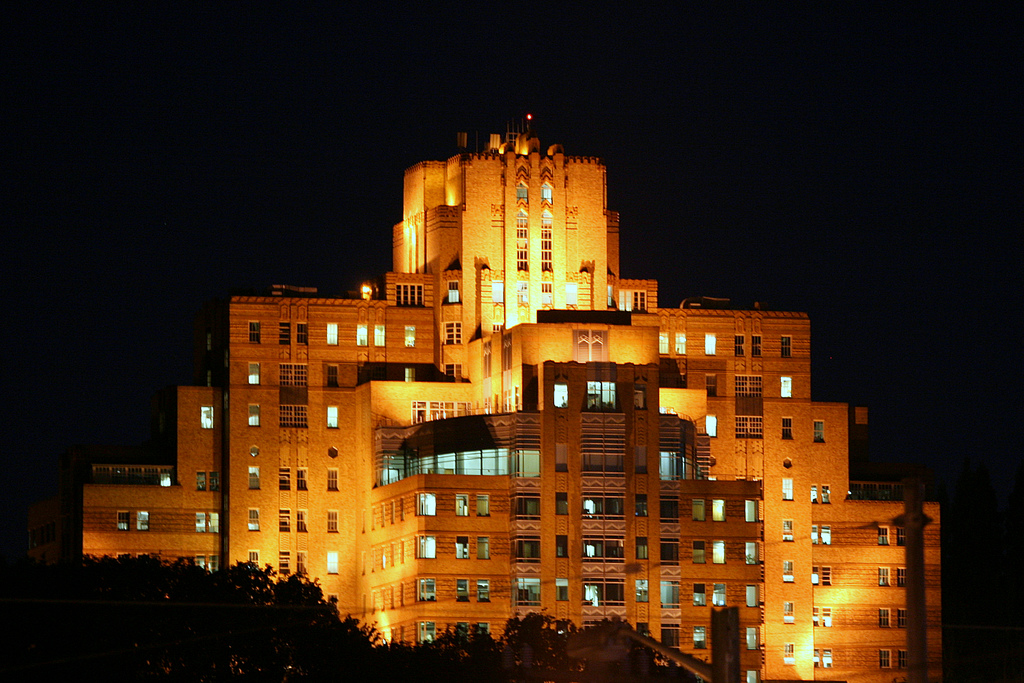
Some years ago, while sitting with my husband and young family high in the upper reaches of Seattle’s (then) Safeco Field watching the Mariners lose to the Cleveland (then) Indians, my attention diverted from the baseball game to the expansive view of the surrounding city.
In particular, I couldn’t help but place myself back inside the old Art Deco building that sits up on Beacon Hill (now known as the Pac Tower.) I had spent a hundreds of hours of my life in that building in the late 1970s; it was easy imagine my younger self in those hallways and rooms.
The 90 year old building had a number of different purposes since originally being constructed to provide hospital care for the region’s Merchant seamen. By 1999, it had become the home of a five year old business that had outgrown Jeff Bezos’ garage — Amazon.com.
I trained inside the walls of that Public Health Hospital, back in the days when it was the hospital in the region for not only Merchant Marines, but many of the indigenous people of the Pacific northwest and Alaska, in addition to local folks who needed affordable (as in free) health care. I had opportunity to work several clinical rotations in this building as a University of Washington medical student, and to think of it being Amazon’s first (but not last) major headquarters for Amazon made my brain do twists.
I remembered so much life and death happening inside those walls over the years.
I first walked into this building as a very green 24 year old med student beginning a surgical rotation in fall 1976, knowing only which end of the stethoscope to put in my ears and which end rests on the patient. On the first day I was shown how to put on a surgical gown, masks and sterile gloves without contaminating myself and the people around me. I never have forgotten that sequence of moves, even though my opportunity to go into an operating room (other than as a patient) became rare after my training days. My chief surgical resident was an exceptionally talented young man who worked himself and everyone working with him around the clock caring for his patients. This brilliant surgeon could only operate on patients while listening and singing to the music of Elvis Presley. I can’t hear any Elvis Presley songs to this day without smelling the odors of surgery–cauterized blood vessels and pus.
He was soon to become a leading trauma surgeon in a city known for its fine surgeons. The pressure was too much for him. He experienced a personal crisis for which he sought treatment. When he returned to medicine, he abandoned his incredible surgical skills to train as a psychiatrist and still remains an authority on helping impaired physicians, assisting other care providers to acknowledge and deal with addiction and mental health burnout before they harm a patient.
Those endless clinical rotation days and nights meant witnessing the misery of the most vulnerable of humanity in desperate need of healing, and sometimes we succeeded, but often we did not. I still have a recurring dream of running up and down the staircases of the Public Health Hospital, bringing pint after pint of blood to the OR from the lab as our team operated on an Alaskan indigenous patient bleeding from dilated esophageal varices, developed as a result of a damaged liver from chronic alcohol dependency. We did not save her, nor have I saved her even once in my dreams over the decades, though I keep trying to run faster. My response to her death was to spend 20 years of my clinical career working with patients in an alcohol and drug treatment program, hoping to prevent her fate in others.
Nor did we save a classmate of mine, on a rotation on a different service, the daughter of a beloved radiologist in this very hospital, who for reasons unknown, had a cardiac arrest while napping briefly during her 32 hour shift. Another medical student sleeping in the same room heard her odd breathing, found her unresponsive and all medical interventions were employed, to no avail. Even when all the right people, and the right equipment, and the right medicine is seconds away, death can still come, even to healthy people in their 20s. This was a shock to us all, and an extraordinarily humbling lesson to the pompous and overconfident among us. We might die, in our sleep, whenever it is our time. Years later, I still remember that in my evening prayers.
There was also the young surgical resident who was hospitalized there with jaundice and subsequently died of Hepatitis B, contracted from a blood exposure during his training. No vaccination was available in those days, but was in development. And it was in this and other hospitals in the city, we began to see unusual cases of gay men with severe wasting, rare skin cancers and difficult to treat pneumonias. Initially called GRID (gay-related immune deficiency), it was renamed AIDS as it began appearing in the general population as well, and for too long was a death sentence for anyone infected.
One on-call night in particular is memorable. It was Christmas Eve, and a heavy snowstorm had brought the city to a standstill. We had very little to do that night in the hospital as the elective surgeries were all postponed until after the holiday and no ambulance could easily make it up the steep drive to the ER, so they were being diverted to other hospitals. As a result, our patient load was light. I was in my tiny sleeping room, on the 14th floor of the tower, facing out north to the city of Seattle, able to enjoy the view of the city, everything blanketed under snow, so peaceful and very quiet. The freeway, ordinarily so busy day and night, was practically abandoned, and the lights of the city were brighter from the snowfall. It was an enchanting vision of a city forced to slow itself and be still, so anticipatory on a sacred and holy night.
I remember thinking about how young and inexperienced I was, and how very little I knew. My chief resident thought I’d make a good surgeon – I was a diligent worker and technically very good with my hands. My heart told me that I’d be better as a generalist/family doctor. The city held many attractions and excitement, but I longed to return to a farm and a someday family. It was a wistful bittersweet night and I slept very little, perched on that little bed overlooking the sleeping snowy city. I wondered where life might take me, as I reflected on who I was becoming and where I was meant to be.
Forty five years later, I still am reminded every day at how little I know, but I do realize this:
for however long we’re on this earth, each day we have a distinct purpose and reason for being.
That day, my purpose was to be snowbound on that Christmas day at the old Public Health Hospital, unable to go home from my shift because my car was stuck in the parking lot. Instead, I covered for others who couldn’t make it in to work, singing Christmas carols for all the patients who had to stay put in their hospital beds.
Soon, my purpose was to meet the man I was to marry, eventually living with three beloved children on a little farm 100 miles to the north while practicing medicine in a variety of primary care roles for over forty years.
And perhaps, my purpose now in retirement is to share a few stories while reflecting on a life still in progress.
Only the Lord knows why He places us where He does.
Make a one-time or recurring donation to support daily Barnstorming posts
Make a monthly donation
Make a yearly donation
Choose an amount
Or enter a custom amount
Your contribution is deeply appreciated.
Your contribution is appreciated.
Your contribution is appreciated.
DonateDonate monthlyDonate yearly

















 Barnstorming