Learning the Hard Way

photo by Nate Gibson

“There are three kinds of men. The ones that learn by reading. The few who learn by observation.  The rest of them have to pee on the electric fence for themselves.”
— Will Rogers
photo by Nate Gibson

Learning is a universal human experience from the moment we take our first breath.  It is never finished until the last breath is given up.  With a lifetime of learning, eventually we should get it right.

But we don’t.  We tend to learn the hard way when it comes to our health.

As physicians we “see one, do one, teach one.”   That kind of approach doesn’t always go so well for the patient.   As patients, we like to eat, drink, and live how we wish,  which also doesn’t go so well for the patient.  You’d think we’d know better, but as fallible human beings, we sometimes impulsively make decisions about our health without using our heads (is it evidence-based?) or even listening to our hearts (is this what I really must have right at this moment?).

The cows and horses on our farm need to touch an electric fence only once when reaching for greener grass on the other side.  That moment provides a sufficient learning curve for them to make an important decision.  They won’t try testing it again no matter how alluring the world appears on the other side.   Human beings should learn as quickly as animals but don’t always.  I know all too well what a shock feels like and I want to avoid repeating that experience.  Even so, in unguarded careless moments of feeling invulnerable (it can’t happen to me!), and yearning to have what I don’t necessarily need,   I may find myself touching a hot fence even though I know better.   I suspect I’m not alone in my surprise when I’m jolted back to reality.

Many great minds have worked out various theories of effective learning, but, great mind or not,  Will Rogers confirms a common sense suspicion: a painful or scary experience can be a powerful teacher and,  as health care providers, we need to know when to use the momentum of this kind of bolt out of the blue.  As clinicians, we call it “a teachable moment.”  It could be a DUI, an abused spouse finally walking out, an unexpected unwanted positive pregnancy test,  or a diagnosis of a sexually transmitted infection in a “monogamous” relationship.  Such moments make up any primary care physician’s clinic day, creating many opportunities for us to teach while the patient is open to absorb what we say.

Patient health education is about how decisions made today affect health and well being now and into the future.  Physicians know how futile many of our prevention education efforts are.  We hand out reams of health ed pamphlets, show endless loops of video messages in our waiting rooms, have attractive web sites and interactivity on social media, send out innumerable invitations to on-site wellness classes.  Yet until that patient is hit over the head and impacted directly– the elevated lab value, the abnormality on an imaging study, the rising blood pressure, the BMI topping 30, a family member facing a life threatening illness– that patient’s “head”  knowledge may not translate to actual motivation to change and do things differently.

Tobacco use is an example of how little impact well documented and unquestioned scientific facts have on behavioral change.   The change is more likely to happen when the patient finds it too uncomfortable to continue to do what they are doing–cigarettes get priced out of reach, no smoking is allowed at work or public places, becoming socially isolated because of being avoided by others due to ashtray breath and smelling like a chimney (i.e. “Grandma stinks so I don’t want her to kiss me any more”).  That’s when the motivation to change potentially overcomes the rewards of continuing the behavior.

Health care providers and the systems they work within need to find ways to create incentives to make it “easy” to choose healthier behaviors–increasing insurance premium rebates for maintaining healthy weight or non-smoking status, encouraging free preventive screening that significantly impacts quality and length of life, emphasizing positive change with a flood of encouraging words.

When there is discomfort inflicted by unhealthy lifestyle choices, that misery should not be glossed over by the physician– not avoided, dismissed or forgotten.  It needs emphasis that is gently emphatic yet compassionate– using words that say “I know you can do better and now you know too.  How can I help you turn this around?”

Sometimes both physicians and patients learn the hard way.  We need to come along aside one another to help absorb the shock.
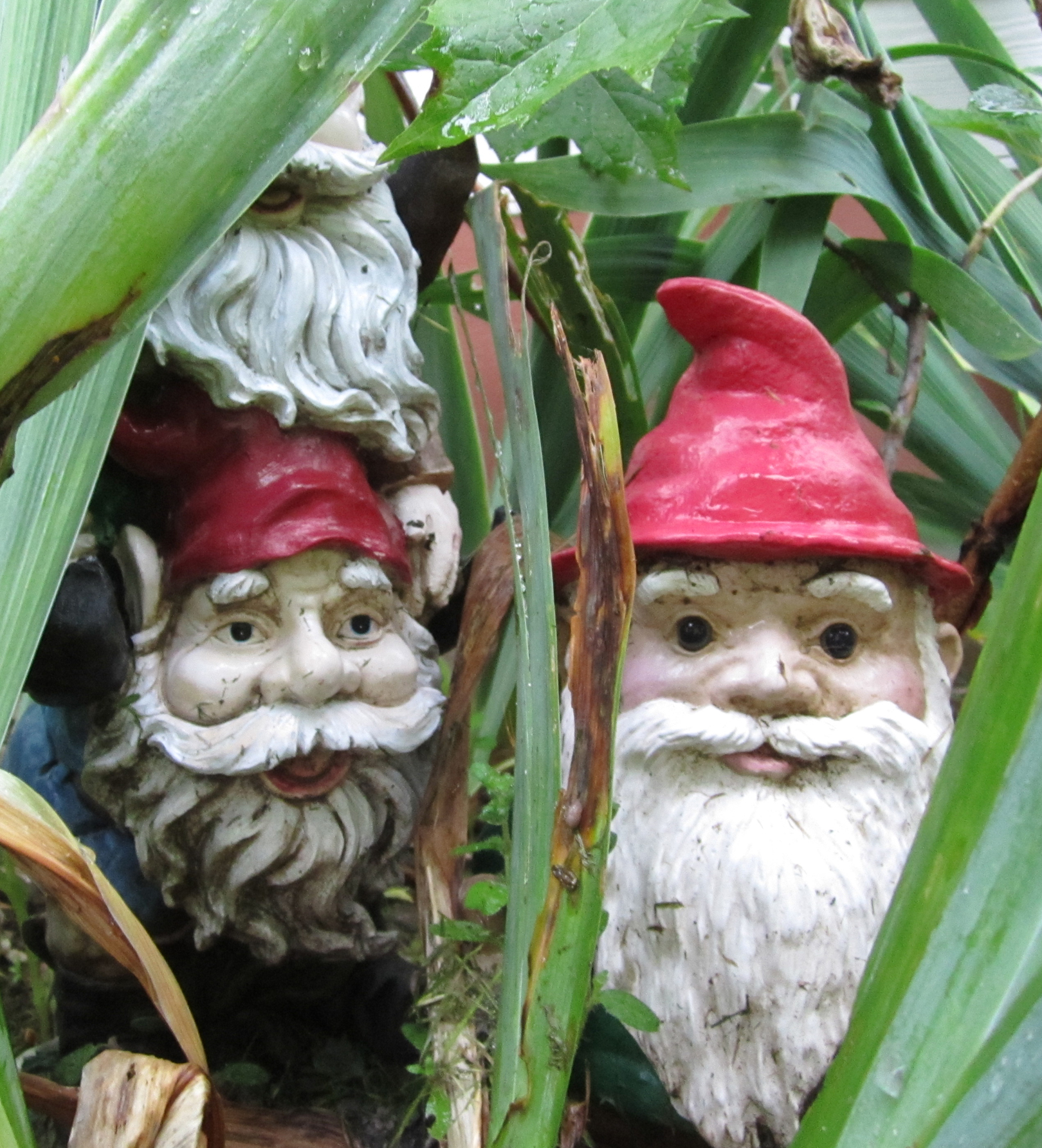
Gernumbli gardensi Infestation

She lingered in that charming little garden to say hello to the gnomes, such a glorious infestation!  How few wizards realize just how much we can learn from the wise little gnomes-or, to give them their correct names, the Gernumbli gardensi.
‘Ours do know a lot of excellent swear words,’ said Ron…
J.K. Rowling in Harry Potter and the Deathly Hallows

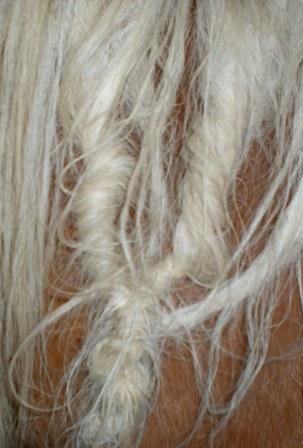
It is hard to say exactly when the first one moved in.  This farm was distinctly gnome-less when we bought it, largely due to twenty-seven hungry barn cats residing here at the time,  in various stages of pregnancy, growth, development and aging.  It took awhile for the feline numbers to whittle down to an equilibrium that matched the rodent population.  In the mean time,  our horse numbers increased from three to seven to over fifteen with a resultant exponential increase in barn chores.   One spring over a decade ago,  I was surprised to walk in the barn one morning to find numerous complex knots tied in the Haflingers’ manes.  Puzzling as I took precious time to undo them, literally adding hours to my chores, I knew I needed to find the cause or culprit.

It took some research to determine the probable origin of these tight tangles.  Based on everything I read, they appeared to be the work of Gernumbli faenilesi, a usually transient species of gnome preferring to live in barns and haylofts in close proximity to heavy maned ponies.  In this case, as the tangles persisted for months, they clearly had moved in, lock, stock and barrel.   The complicated knots were their signature pride and joy, their artistic way of showing their devotion to a happy farm.

All well and good,  but the extra work was killing my fingers and thinning my horses’ hair.  I plotted ways to get them to cease and desist.

I set live traps of cheese and peanut butter cracker sandwiches, hoping to lure them into cages for a “catch and release”. Hoping to drive them away, I played polka music on the radio in the barn at night.  Hoping to be preemptive, I braided the manes up to be less tempting but even those got twisted and jumbled.  Just as I was becoming ever more desperate and about to round up more feral cats, the tangling stopped.

It appeared the gnomes had moved on to a more hospitable habitat.   I had succeeded in my gnome eradication plan.  Or so I thought.

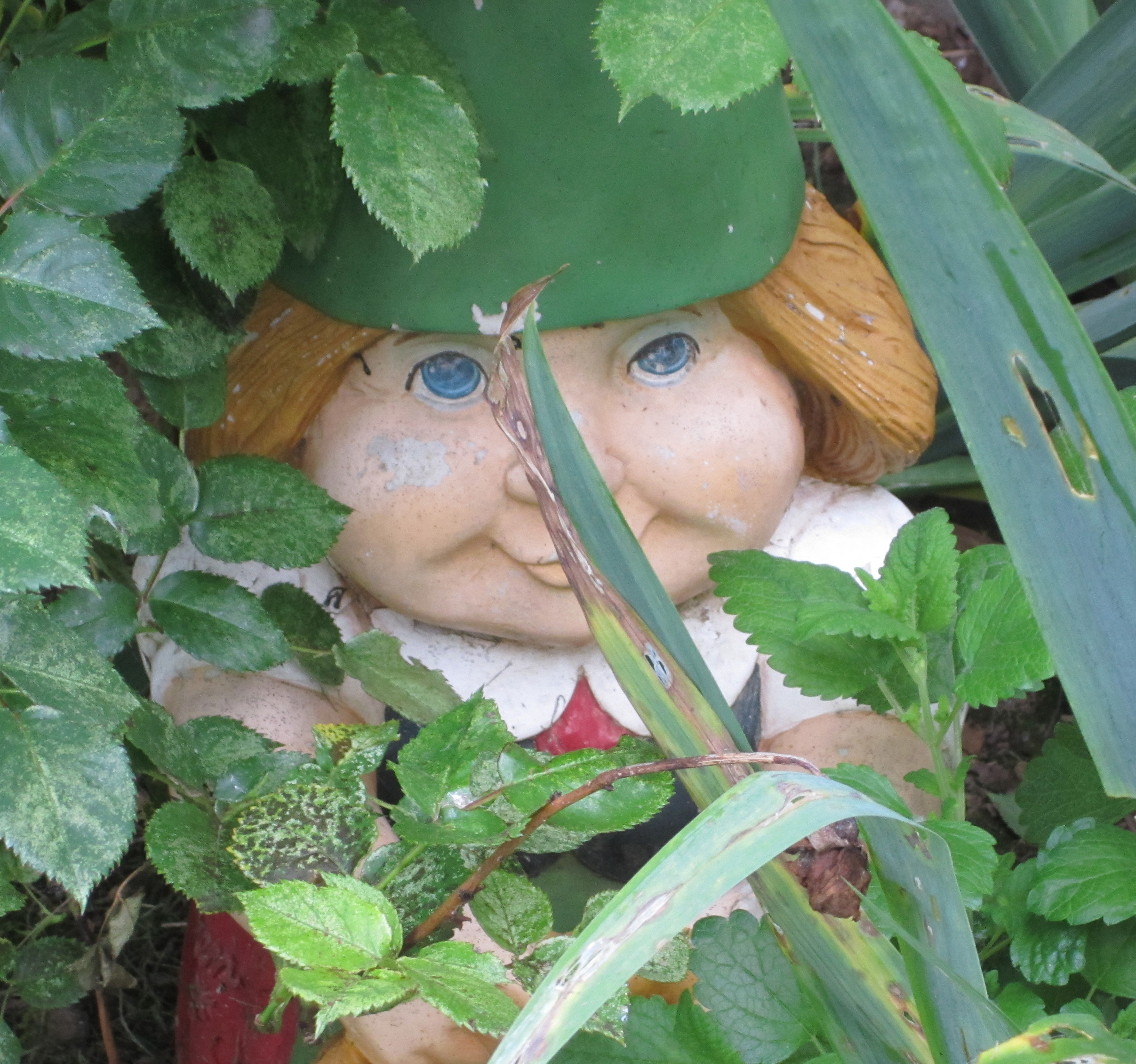
Not long after, I had the distinct feeling of being watched as I walked past some rose bushes in the yard.  I stopped to take a look, expecting to spy the shining eyes of one of the pesky raccoons that frequents our yard to steal from the cats’ food dish.  Instead, beneath the thorny foliage, I saw two round blue eyes peering at me serenely.   This little gal was not at all intimidated by me, and made no move to escape.   She was an ideal example of Gernumbli gardensi, a garden gnome known for their ability to keep varmints and vermin away from plants and flowers.  They also happen to actively feud with Gernumbli Faenilesi so that explained the sudden disappearance of my little knot-tying pests in the barn.

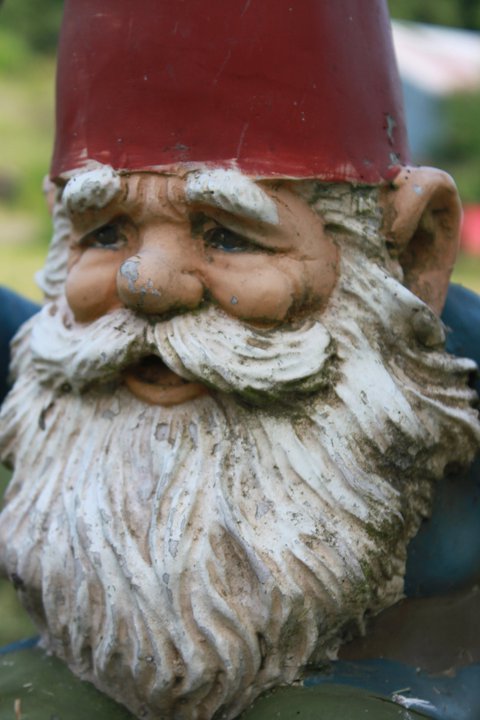
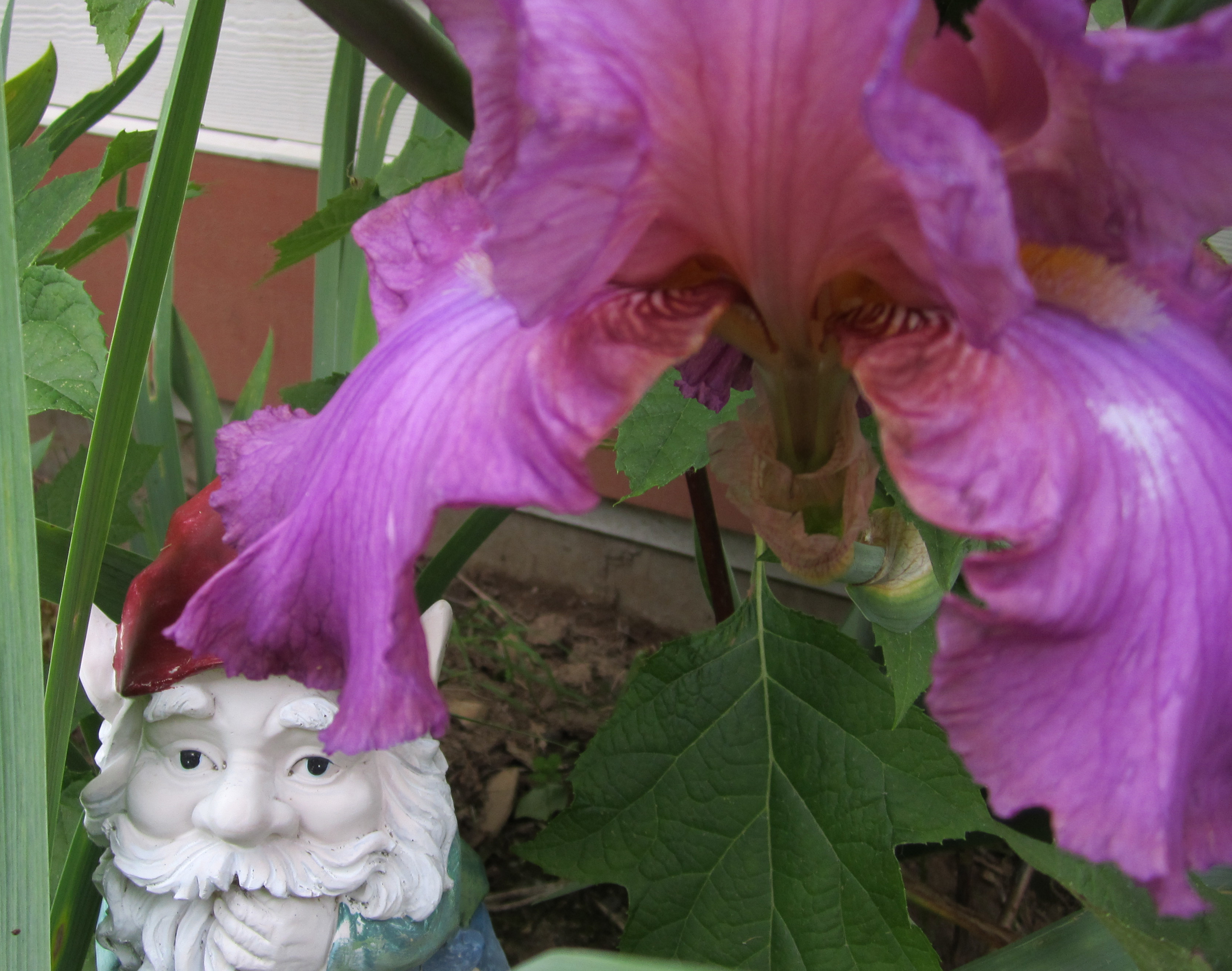
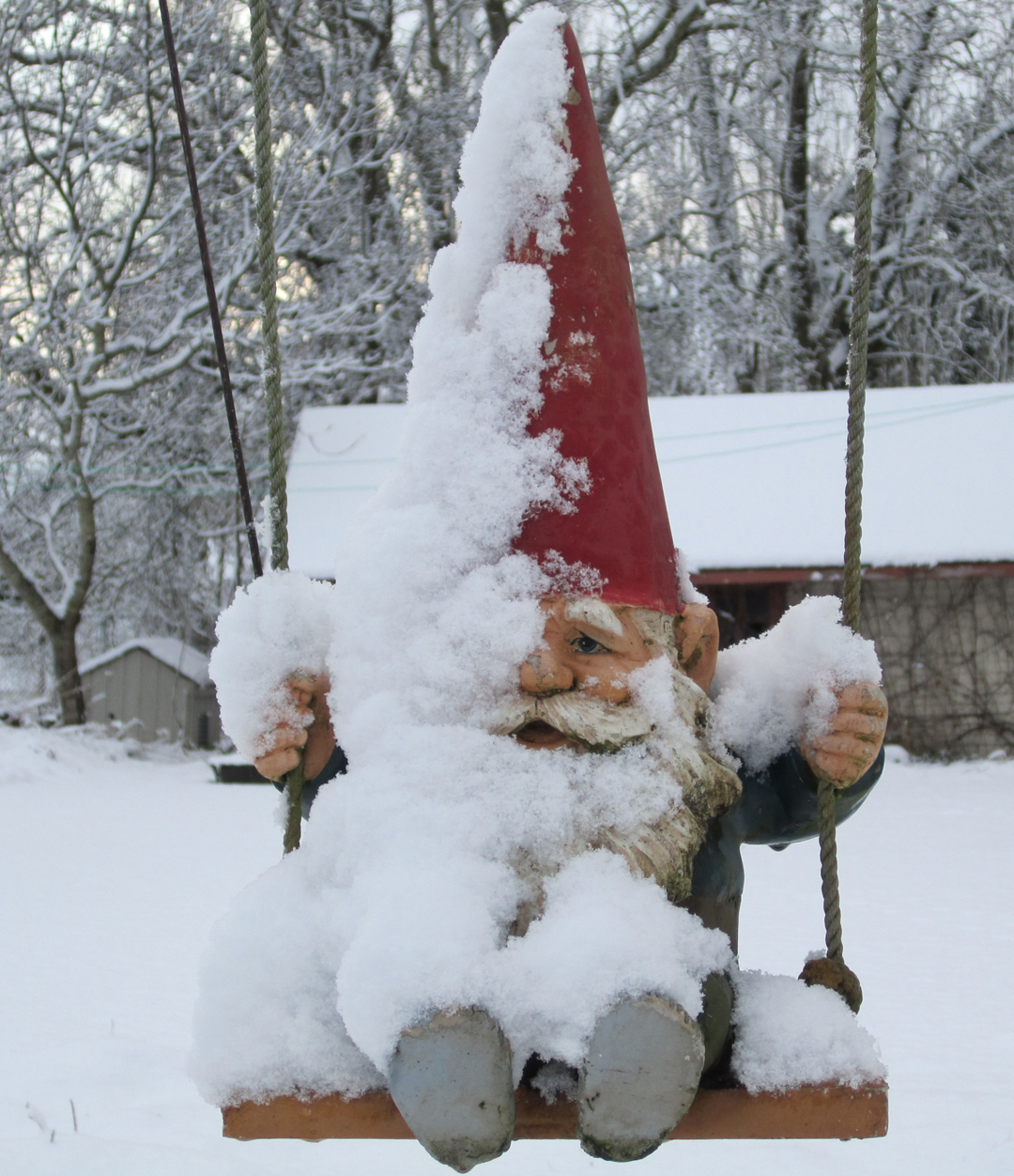
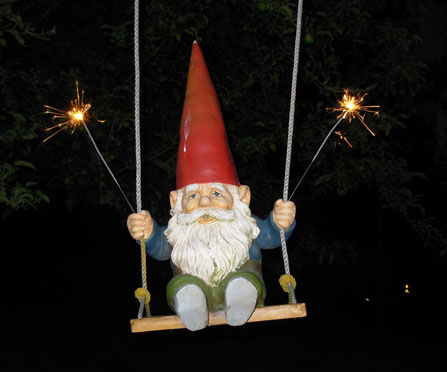
It wasn’t long before more Gardensi moved in, a gnomey infestation.  They tended to arrive in pairs and bunches, liked to play music, smoked pipes, played on a teeter totter, worked with garden tools, took naps on sun-warmed rocks and one even preferred a swing.  They are a bit of a rowdy bunch but I enjoy their happy presence and jovial demeanor.   I haven’t yet heard any bad language as we have a “keep it clean” policy about bad words around here.  They seem quite hardy, stoically withstand extremes in weather, and only seem fearful when hornets build a nest right in their lap.

As long as they continue to coexist peaceably with us and each other, keep the varmints and their knot tying cousins away,  and avoid bad habits and swear words, I’m quite happy they are here.   Actually, I’ve given them the run of the place.  I’ve been told to be cautious as there are now news reports of an even more invasive species of gnome,  Gernumbli kitschsi, that could move in and take over if I’m not careful.

I shudder to think.  One has to consider the neighborhood.

I wrote this for Father’s Day two years ago in honor of my father, Henry “Hank” Polis, and it is every bit as true now as it was then. I also wrote about another “project” of his here: https://briarcroft.wordpress.com/2009/02/08/branching-out/ and about his service as a WWII Marine here : https://briarcroft.wordpress.com/2009/11/14/coming-full-circle/ He’s been gone nearly 17 years and when I look at his 47 years young face in these pictures, I am in awe at what he accomplished through sheer muscle, will, stubbornness and determination. I’m a lot like him, if you subtract the sheer muscle. Emily

Barnstorming

In acknowledgment of Father’s Day, I pulled out a particular photo album that chronicles my father’s 1968 backyard project.   This was no ordinary project, but like every other project he took on, it was accomplished during the daylight hours after he got home from his desk job and then consumed most of his weekend waking hours.  He had been dreaming it up for a number of years, and then one day, grabbed a shovel and simply got started and didn’t quit until it was finished.

He was determined to build a full size swimming pool, by himself, with his own two hands.  He did use our little Farmall Cub tractor to blade away the first layer of topsoil, but the rest of the digging was by the shovel-full.   He wanted a kidney shaped pool rather than a rectangular one, so he soaked the wooden forms in water to form the…

View original post 341 more words

Raising the Lodged

After death, willing or not, the body serves,
entering the earth. And so what was heaviest
and most mute is at last raised up into song.
Wendell Berry

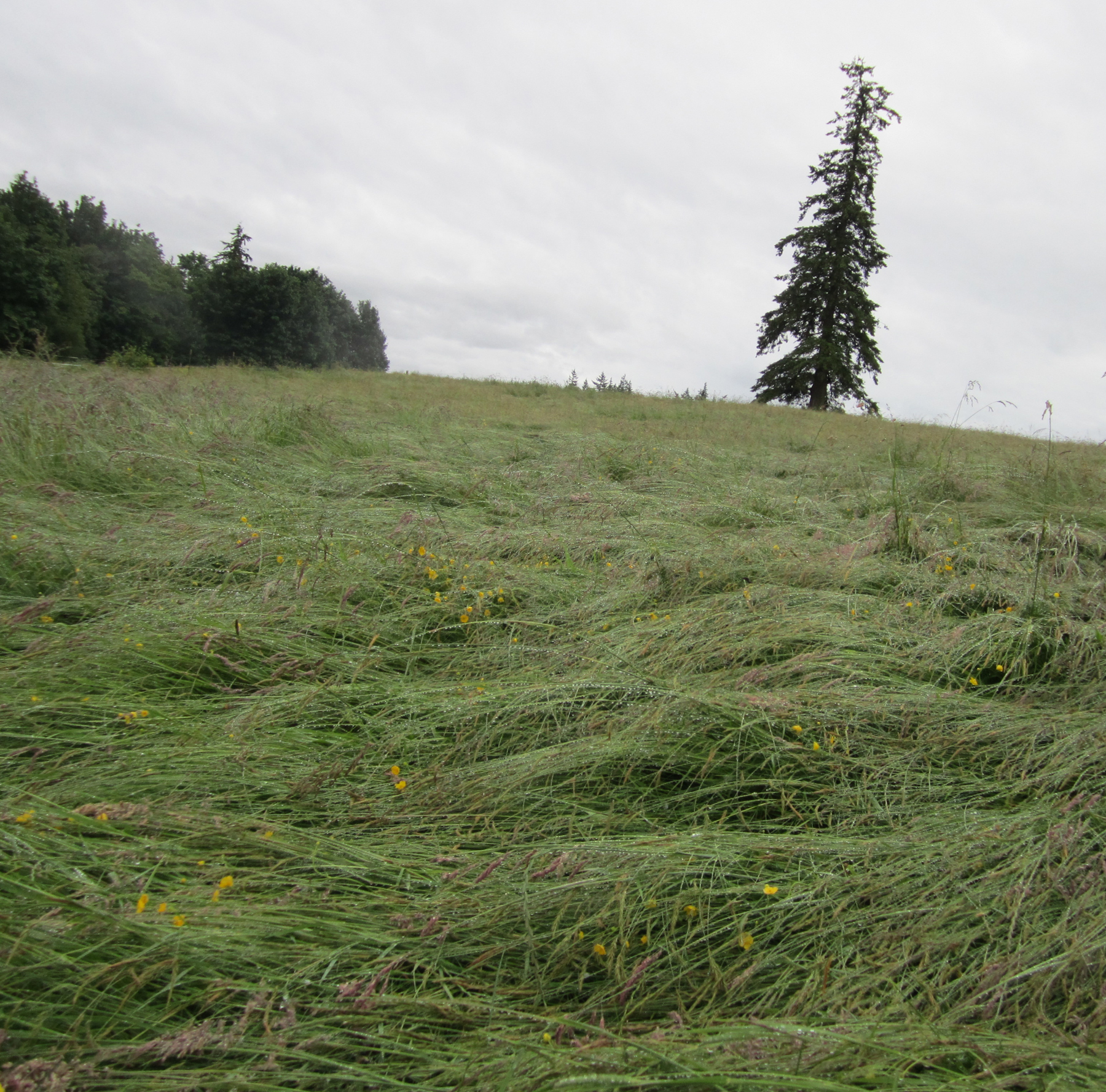
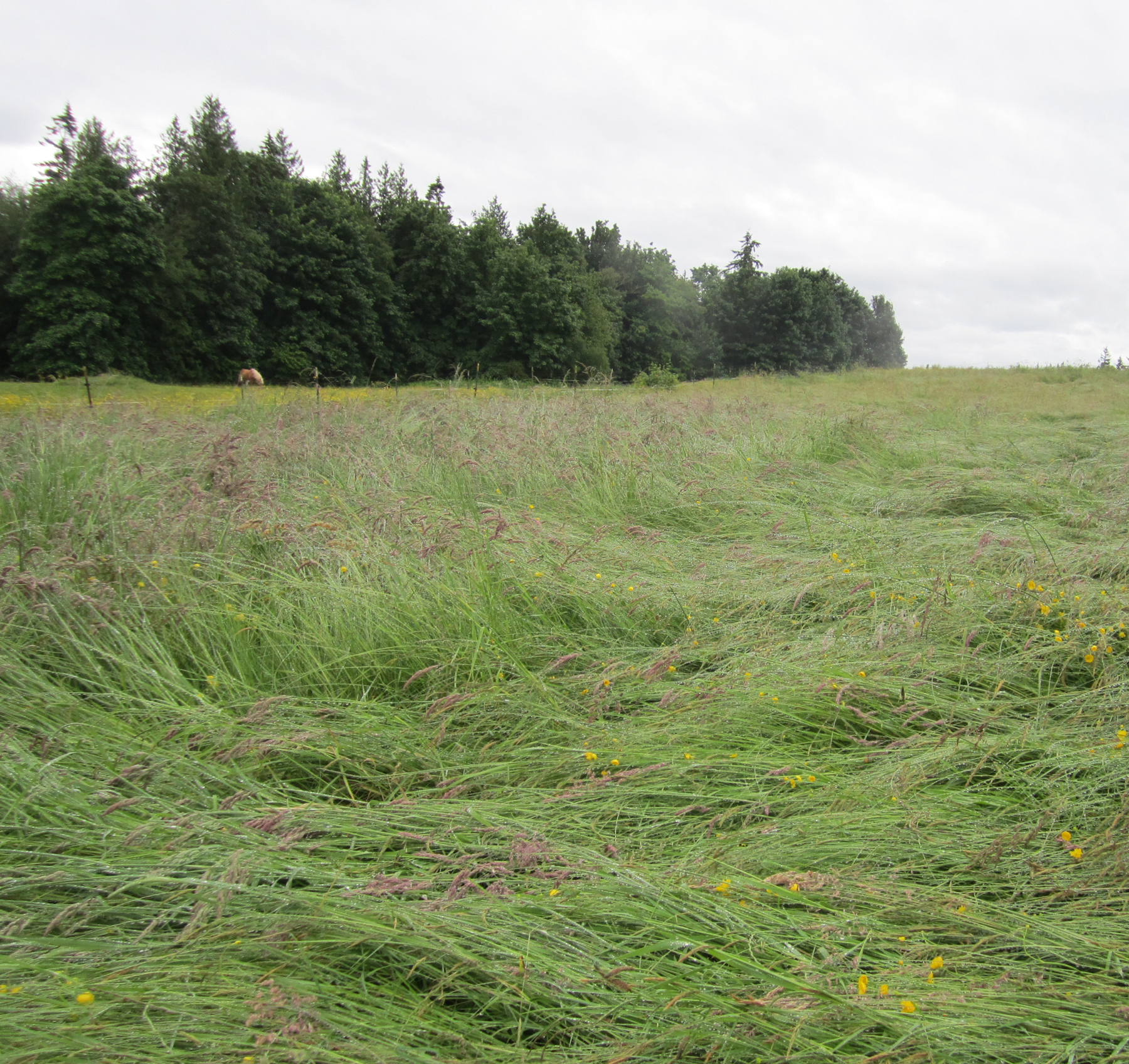
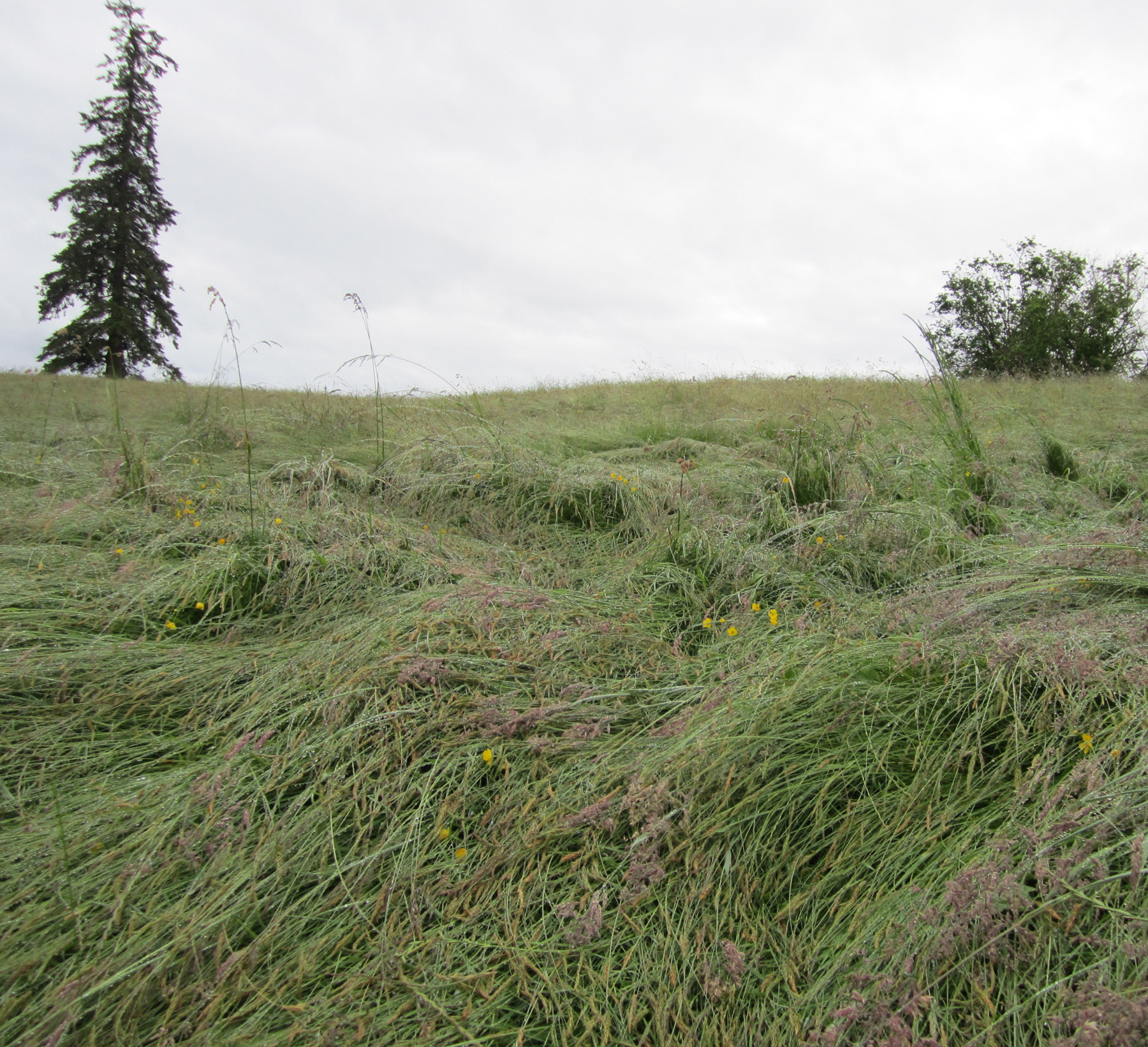
When abundant grasses in our hay field were hit hard with heavy rainfall today, they collapsed under the weight of the moisture.  Thousands of 3-4 foot tall tender stems are now lodged and flattened in undulating waves of green, bent over as if to embrace the earth from which they arose.  If the rain continues as predicted this week, the grass may not recover, unable to dry out enough to stand upright again.  It is ironic to lose a crop from too much of a good thing– heavy growth does demand,  but often cannot withstand, a quenching rain.  The grass simply keels over in community, broken and crumpled, unsuitable for cutting or baling into hay, and will melt back into the soil again.

However–if there are dry spells amid the showers over the next few days, with a breeze to lift the soaked heads and squeeze out the wet sponge created by layered forage–the lodged crop may survive and rise back up. It may be raised and lifted again, pushing up to meet the sun, the stems strengthening and straightening.

What once was heavy laden will lighten;
what was silent could once again move and sing with the wind.

A Gardener for God

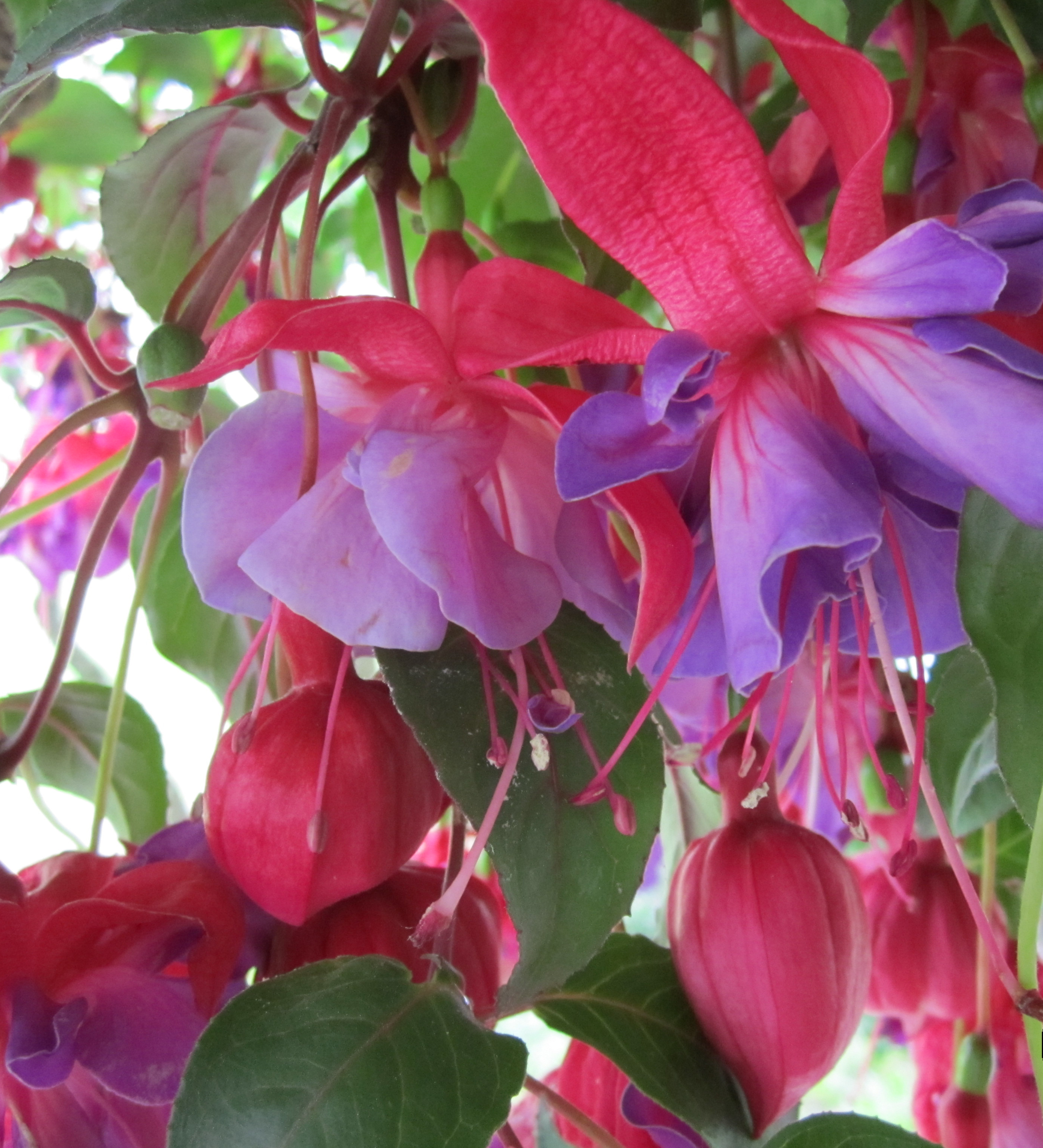
Grandma grew flowers–lots of them.  Her garden stretched along both sides of the sidewalk to her old two story farm house, in window boxes and beds around the perimeter, in little islands scattered about the yard anchored by a tree, or a piece of driftwood, a gold fish pond or a large rock.  Wisteria hung like a thick curtain of purple braids from the roof of her chicken coop, and her greenhouse, far bigger than her home, smelled moist and mossy with hanging fuschia baskets.  For her it was full time joy disguised as a job: she sold seedlings, and ready-to-display baskets, and fresh flower arrangements.  She often said she was sure heaven would be full of flowers needing tending, and she was just practicing for the day when she could make herself useful as a gardener for God.

Visiting Grandma was often an overnight stay, and summer evenings in her yard were heavy with wafting flower perfume.  She would also allow entry into her “fuschia house” to walk among hundreds of delicate dangling multi-colored blossoms.  There was overwhelming temptation to audibly pop the bulbous unopened blossoms but she had a “no touch, just look” policy, reminding her grandchildren that each plant knew the precise instant when a flower should open, and it should not happen a moment sooner or nature’s rhythm would be disturbed.

One of her favorite rhythmic flowers –indeed it was so hardy and vigorous it really could be considered a weed–was the evening primrose.  It was one of a few night blooming plants meant to attract pollinating moths.   Its tall stems were adorned by lance shaped leaves, with multiple buds and blooms per stem.  Each evening, and it was possible to set one’s watch by its punctual cycles, only one green wrapped bud per stem would open, revealing a bright yellow blossom with four delicate veined petals, a rosette of stamens and a cross-shaped stigma in the center, rising far above the blossom.  The yellow was so vivid and lively, it seemed almost like a drop of sun had been left on earth to light the night.  By morning, the bloom would begin to wither and wilt under the real sunlight, somehow overcome with the brightness, and would blush a pinkish orange as it folded upon itself, ready to die and drop from the plant in only a day or two, leaving a bulging seed pod behind.

I would settle down on the damp lawn at twilight, usually right before dusk fell, to watch the choreography of opening of blossoms on stem after stem of evening primrose.  Whatever the trigger was for the process of unfolding, there would be a sudden loosening of the protective green calyces, in an almost audible pop.  Then over the course of about a minute, the overlapping yellow petals would unfurl, slowly, gently, purposefully, revealing their pollen treasure trove inside.   It was like watching time lapse cinematography, only this was an accelerated, real time flourish of beauty, happening right before my eyes.  I always felt privileged to witness each unveiling as Grandma liked to remind me that few flowers actually allowed us to behold their birthing process.  The evening primrose was not at all shy about sharing itself and it would enhance the show with a sweet lingering fragrance.

Grandma knew how much I enjoyed the evening primrose display, so she saved seeds from the seed pods for me, and helped me plant them at our house during one of her spring time visits.   I remember scattering the seeds with her in a specially chosen spot, in anticipation of the “drops of sun” that would grace our yard come summertime.  However, Grandma was more tired than usual on this particular visit, taking naps and not as eager to go for walks or eat the special meals cooked in honor of her visit.  Her usually resonant laughing brown eyes appeared dull, almost muddy.

The day she was to return home she came into the kitchen at breakfast time, wearily setting down her packed bags.  She gave me a hug and I looked at her, suddenly understanding what I had feared to believe.  Something was dreadfully wrong.  Grandma’s eyes were turning yellow.

Instead of returning home that day, she went to the hospital.  Within a day, she had surgery and within two days, was told she had terminal pancreatic cancer.  She did not last long, her skin becoming more jaundiced by the day, her eyes more icteric and far away.  She soon left her earthly gardens to cultivate those in heaven.

I’ve kept hanging fuschia baskets on my porch and evening primrose has been in my garden ever since.  Grandma is inside each bloom as it opens on its own schedule, according to its own rhythm,  unfolding precipitously in the evening.  She wafts across the yard in its perfume.  Her spirit is a drop of sun coming to rest,  luminous,  for a brief stay upon the earth, only to die before we’re ready to let it go.  But as the wilted bloom lets go,  the seeds have already begun to form.

Surely Grandma is still growing flowers, lots of them.  They blossom under her loving care, each bud opening on schedule,  not a moment sooner than it should.

photo by Troy Mullens from blog ICU Nature

Evening Primrose by John Clare

When once the sun sinks in the west,
And dewdrops pearl the evening’s breast;
Almost as pale as moonbeams are,
Or its companionable star,
The evening primrose opes anew
Its delicate blossoms to the dew;
And, hermit-like, shunning the light,
Wastes its fair bloom upon the night,
Who, blindfold to its fond caresses,
Knows not the beauty it possesses;
Thus it blooms on while night is by;
When day looks out with open eye,
Bashed at the gaze it cannot shun,
It faints and withers and is gone.

A Splintered Wreck

photo by Josh Scholten

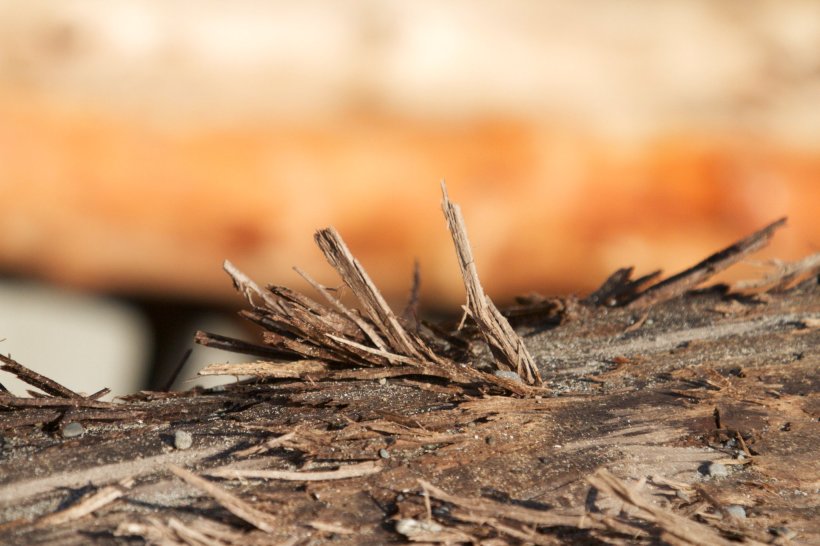
“The new is always present with the old, however hidden.  I am a frayed and nibbled survivor in a fallen world, and I am getting along. I am aging and eaten and have done my share of eating too. I am not washed and beautiful, in control of a shining world in which everything fits, but instead am wandering awed about on a splintered wreck I’ve come to care for, whose gnawed trees breath delicate air, whose bloodied and scarred creatures are my dearest companions, and whose beauty beats and shines not in its imperfections, but overwhelmingly in spite of them…”
Annie Dillard

Once every few years one of our horses gets hurt and had I made different decisions, I know I could have prevented it from happening.  I feel deeply responsible for the pain experienced by a creature I love and have cared for over two decades; I am a splintered wreck, unable to sleep, sick with guilt.

When the bird chorus began as the clock flipped to 4 AM this morning, my eyes had been open for hours, listening for sounds of distress from the barn. I knew I needed to check on her as soon as daylight dawned.  I walked to the barn in my bathrobe and rubber boots to make sure she had made it okay through the night.  As I approached, I heard her greeting me with her usual morning nicker, welcoming me back into her home, showing me grace despite her misery,  her eyes shining bright and expectant despite her cuts and bruises.

The barn contains a world of forgiving despite horses never ever forgetting.  She still loves me in spite of my imperfections.  I wander awed into her stall, touch her tender body and weep.

So, because of this, because of love that surpasses understanding, I am getting along, washed through my tears moistening her dried blood.

Hidden Heartbeats

…speaking of stones, what about
The little ones you can
Hold in your hands, their heartbeats
So secret, so hidden it may take years

Before, finally, you hear them?
Mary Oliver

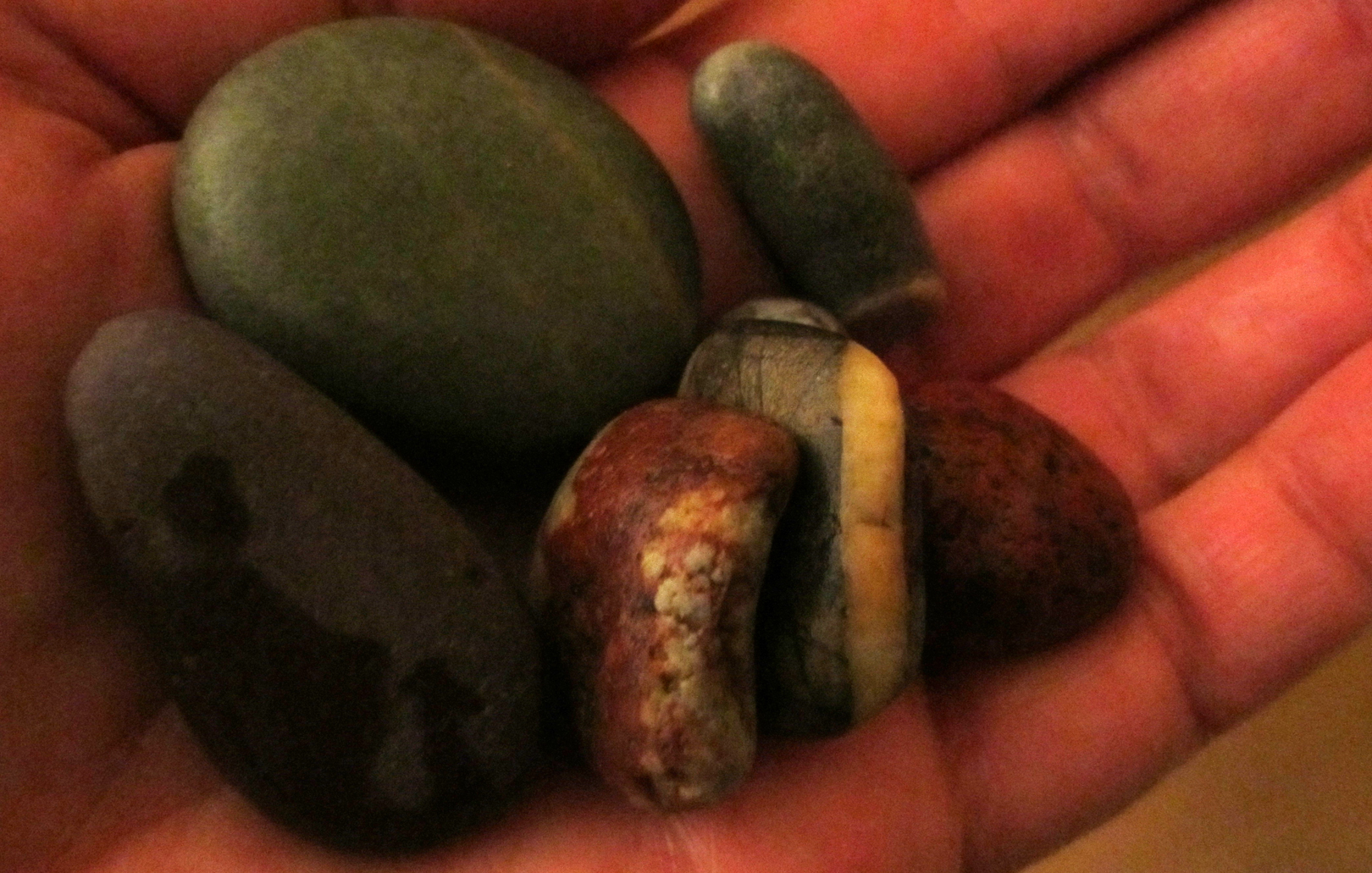
In the laundry room, I often find pebbles in my pockets.  I’d like to think they just jumped in on their own, eager to journey with me, but that isn’t the case.  Instead, they were hijacked.  I tend to watch the ground as I walk, partly out of concern that I don’t misstep but also because I’m a bit of a hunter-gatherer.   As stones on the ground are unlikely to be missed by anyone, there are always a few that make their way home with me.  This isn’t exactly stealing;  it feels more like I am offering them a foster home for a little while, just a blip on the timeline of their long lives.

Beaches are my greatest gathering challenge as there are so many imperfect stones waiting for a pocket ride into my life.  They need to be a little odd to catch my eye in the midst of millions.  They need to be easily palmed and hugged by my hand and they need to have an interesting feel to my fingertips.  I’ve discovered they have a hidden, secret heartbeat that I can feel right up my fingers into my own heart.

These are not pet rocks, worry stones or precious metal to me, only plain ordinary mundane pebbles with the pulse of the ages.  I’m reminded how old they are in comparison with relatively young me.  Each is a solid unique individual, hanging out with me for the time being but eventually will make their way back to a garden display, an outside gravel path, a seashore or pond edge.

In the meantime, they have stories to tell and I’m listening.  So secret, so hidden, so ancient and now I can hear.

A Bit Messy

“Do not be so open-minded that your brains fall out.”
G.K. Chesterton

Few things are as condemning in this day and age than being accused of being close-minded.  In religion and politics, the most zealous are the least likely to see another point of view, much less tolerate it.  There is no chance of growth or redemption when there is not openness and willingness to change and admit one is wrong.

But I’ve known those who are so open-minded, there is nothing left inside but “whatever.”   It doesn’t matter, anything goes, if it works for you, who am I to judge, it’s a free country.  No boundaries, no barriers, all windows and free to come and go breezes, no foundational beliefs, hopelessly robbed blind.  It is a terribly empty void to behold.

Instead I strive to remain unlocked and ready to answer the knock on the door of my convictions and opinions to see who or what may be there, to be receptive to the possibility of something other.

But in reality I’d rather be open-hearted over open-minded.  It is far riskier, this bleeding of the heart,  when touched, bruised or pierced.   Perhaps even a bit messy.

Intentional, not accidental.  Grace once spilled from an open beating heart and still does.

Always has.  Always will.

“I tell you this
to break your heart,
by which I mean only
that it break open and never close again
to the rest of the world.”
— Mary Oliver

An Appreciative Audience

“We are here to abet creation and to witness it, to notice each thing so each thing gets noticed. Together we notice not only each mountain shadow and each stone on the beach but we notice each other’s beautiful face and complex nature so that creation need not play to an empty house.”
Annie Dillard

Creation is in desperate need of an appreciative audience.  Beyond polite applause and positive reviews, it deserves a devoted following with reverential bowed heads and bended knees, not missing even one tiny detail of its expanse and grandeur.

Yet, instead of adopting an attitude of submission and gratitude for the small part we play, our modern culture claims every one of us has a hidden leader inside needing to be spawned and molded by strength-based leadership training initiatives. The ultimate fulfillment of our destiny is to learn to take charge, be empowered, overcome weaknesses, assert needs, demand to be seen and heard and followed.

No.

Our destiny is noticing, hearing, appreciating, witnessing, sacrificing, obeying.

Our fulfillment is in worshipful followership.

Otherwise, we will forget
we came from dust
and to dust we must return.

Inexhaustible Grace

photo by Josh Scholten

“It has always been a happy thought to me that the creek runs on all night, new every minute, whether I wish it or know it or care, as a closed book on a shelf continues to whisper to itself its own inexhaustible tale. So many things have been shown so to me on these banks, so much light has illumined me by reflection here where the water comes down, that I can hardly believe that this grace never flags, that the pouring from ever-renewable sources is endless, impartial, and free.”
Annie Dillard in Pilgrim at Tinker Creek

This grace never flags, never exhausts itself, flows free and endlessly.
And that is so– yet free comes at great cost.  Freedom can never be free.
Snow and ice melt, clouds deplete, emptying out their weight,
transfigured into something other.
There is sacrifice upstream and from the heavens.
It could and has run red, it is so costly.
Quenching our every thirst,  we no longer lie panting and parched.
Revived, renewed, transformed, grateful,
Forever changed.
Amazed and amazing, we are purchased and paid in full.

photo by Josh Scholten