Time for Breakfast

trilliumheart


Jesus said to them, “Come and have breakfast.” None of the disciples dared ask him, “Who are you?” They knew it was the Lord.
John 21:12

It is so easy to let go of Easter — slide back into the Monday routine, continue to survive each day as we did before.
God knows this about us.  So He feeds us, a tangible and meaningful act of nourishing us in our most basic human needs though we’ve done nothing to deserve the gift.

Sharing a meal and breaking bread in Emmaus to open the eyes and hearts of the blinded.
Cooking up fish on a beach at dawn and inviting us to join Him.

When He offers me a meal,  I want to accept it with open eyes of gratitude, knowing the gift He hands me is nothing less than Himself.


…be comforted in the fact that the ache in your heart and the confusion in your soul means that you are still alive, still human, and still open to the beauty of the world, even though you have done nothing to deserve it.
Paul Harding in Tinkers

Lenten Grace — Barnstormed

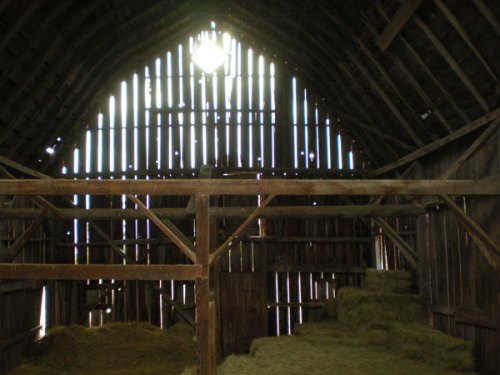
(Emily’s note: I’ve been asked how my blog came to be named “Barnstorming” — most assume it is a doctor-farmer’s twist on “brainstorming” which didn’t occur to me until someone mentioned it to me.  Instead, the name has nothing to do with brains, baseball teams, politics or daredevil piloting of small airplanes.  It has everything to do with a storm taking place in our barn at the beginning of Holy Week a few years ago.  This is a repost.)

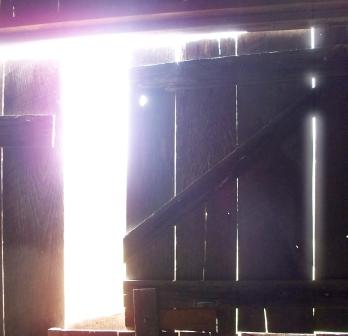
An unexpected southerly wind hit suddenly late Sunday night, gusting up to 40 miles an hour and slamming the house with drenching rain as we prepared to go to bed. Chores in the barn had been done hours before, but as we had not been expecting a storm, the north/south center aisle doors were still open, and I could hear banging and rattling as they were buffeted in the wind. I quickly dressed to go latch the doors for the night, but the tempest had done its damage. Hay, empty buckets, horse blankets, tack and cat food had blown all over, while the Haflingers stood wide-eyed and fretful in their stalls. A storm was blowing inside the barn as well as outside it.

It took some time to tidy up the mess after the doors were secured but all was soon made right. The wind continued to bash at the doors, but it no longer could touch anything inside them. The horses relaxed and got back to their evening meal though the noise coming from outside was deafening. I headed back up to the house and slept fitfully listening to the wind blow all night, wondering if the metal barn roof might pull off in a gust, exposing everything within.

Yet in the new daylight this Monday morning, all is calm. The barn is still there, the roof still on, the horses are where they belong and all seems to be as it was before the barnstorming wind. Or so it might appear.

This wind heralds another storm coming this week that hits with such force that I’m knocked off my feet, swept away, and left bruised and breathless. No latches, locks, or barricades are strong enough to protect me from what will come over the next few days.

Yesterday he rode in on a donkey softly, humbly, and wept at what he knew.

Today, he overturns the tables in his fury.

Tomorrow he echoes the destruction that is to happen.

Wednesday, he teaches the people to prepare them, then rests in anticipation.

On Thursday, he kneels, pours water over dusty feet, presides over a simple meal, and then, abandoned,  sweats blood in agonized prayer.

By Friday, all culminates in the perfect storm, transforming everything in its path, leaving nothing untouched.

The silence on Saturday is deafening.

Next Sunday, the Son rises and returns, all is calm, all is well, all set to right.  He calls my name, my heart burns within me at his words and I can never be the same again.

Barnstormed to the depths of my soul. Doors flung open wide, the roof pulled off, everything blown away and now replaced, renewed and reconciled.

May it be done as he has said, again and yet again.

Lenten Grace — It is All Those Things

photo by Josh Scholten

Imagine him, speaking,
and don’t worry about what is reality,
or what is plain, or what is mysterious.
If you were there, it was all those things.
If you can imagine it, it is all those things.
Mary Oliver, from “Logos”

Many reject him because they weren’t there,
how can they know
what was real without seeing and hearing him
with their own eyes and ears.

We read his words
and think about
how his voice sounded
in a crowd
of 5000 people hungry
and how his eyes teared
as he was betrayed
and rejected
and nailed

We weren’t in the garden
that day when he was mistaken
for the gardener
nor were we on the road to Emmaus
walking beside a stranger whose words
made our hearts burn within us
but we can imagine hearing our name spoken
and knowing it is him
or watching him break the bread
and recognizing his body.

We weren’t there
but we didn’t have to be.

If we can imagine it
it is plain and real
a mystery of the heart

all those things
all those things
and so much more

Lenten Grace — Everyday Moments

photo by Josh Scholten

The sacred moments, the moments of miracle, are often the everyday moments, the moments which, if we do not look with more than our eyes or listen with more than our ears reveal only…a gardener, a stranger coming down the road behind us, a meal like any other meal. But if we look with our hearts, if we listen with all our being and imagination.. what we may see is Jesus himself.
~Frederick Buechner

We can be blinded by the everyday-ness of it.  A simple loaf of bread is only that.  A gardener crouches in a row of weeds, trying to restore order in chaos.  A wanderer along the road engages in conversation.

Every day contains millions of everyday moments that are lost and forgotten, seemingly meaningless.

We would see Jesus if we only opened our eyes and listened with our ears.   At the table, on the road, in the garden.

There is nothing everyday about the miracle of Him abiding with us.

photo by Josh Scholten

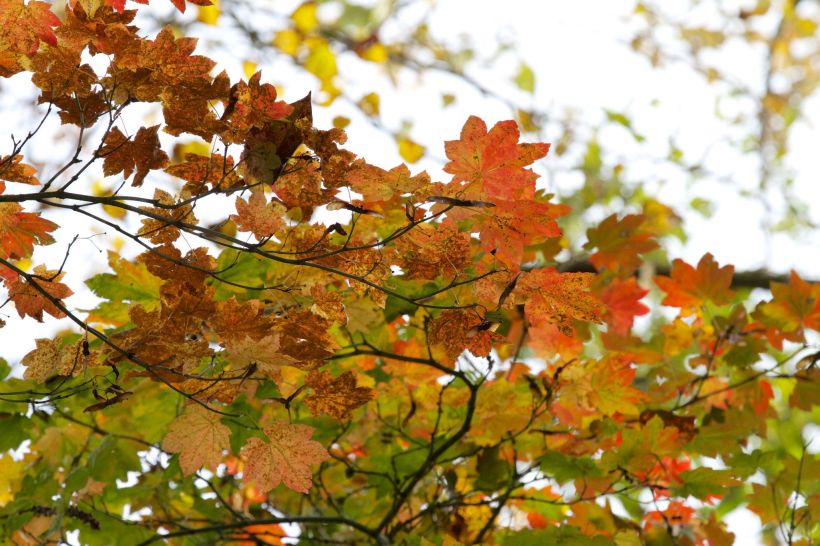
A Heaven of Impermanence

photo by Josh Scholten

My friend, you have led me farther than I have ever been.
To a garden in autumn. To a heaven of impermanence
where the final falling off is slow, a slow and radiant happening.
The light is gold. And while we’re here, I think it must
    be heaven.
~Elizabeth Spires from “In Heaven it is Always Autumn”

I wander the autumn garden mystified at the passing of the weeks since seed was first sown, weeds pulled, peapods picked.  It could not possibly be done so soon–this patch of productivity and beauty, now wilted and brown, vines crushed to the ground, no longer fruitful.

The root cellar is filling up, the freezer packed.  The work of putting away is almost done.

So why do I go back to the now barren soil I so carefully worked, numb in the knowledge I will pick no more this season, feel the burst of a cherry tomato exploding in my mouth or the green freshness of a bean straight off the vine?

Because for a few fertile weeks, only a few weeks, the garden was a bit of heaven on earth, impermanent but a real taste nonetheless.   We may have mistaken Him for the gardener when He appeared to us radiant, suddenly unfamiliar, but He offered the care of the garden, to bring in the sheaves, to share the forever mercies in the form of daily bread grown right here and now.

When He says my name, then I will know Him.  He will lead me farther than I have ever been.

photo by Josh Scholten

…in heaven it is always autumn, his mercies are ever in their maturity.  God comes to thee, not as in the dawning of the day, not as in the bud of the spring, but as the sun at noon,  to illustrate all shadows, as the sheaves in harvest…
~John Donne in Christmas Day Sermon 1624

Barbarous in Beauty

Summer ends now; now, barbarous in beauty, the stooks rise
Around; up above, what wind-walks! what lovely behaviour
Of silk-sack clouds! has wilder, willful-wavier
Meal-drift moulded ever and melted across skies?

 I walk, I lift up, I lift up heart, eyes,
Down all that glory in the heavens to glean our Saviour;
And, eyes, heart, what looks, what lips yet gave you a
Rapturous love’s greeting of realer, of rounder replies?

And the azurous hung hills are his world wielding shoulder
Majestic as a stallion stalwart, very-violet-sweet! –
These things, these things were here and but the beholder
Wanting; which two when they once meet,
The heart rears wings bold and bolder
And hurls for him, O half hurls earth for him off under his feet.
~Gerard Manley Hopkins “Hurrahing in Harvest”

Reading Hopkins invokes God’s intentional accessibility “stallion stalwart, very-violet-sweet” in our daily lives, if we simply open our eyes to see and ears to hear.  The details Hopkins captures in marvelous word pictures, painting with sound and syllable, pull us in.  The “heart rears wings” as we are lifted up to see the Lord manifest in Creation.  We can’t help but be harvested to live obediently as we “glean our Savior” through raised heart and eyes to the glory in the heavens.

As Kathleen Mulhern in her blog “Dry Bones” says in her analysis of “a Christ sighting”:
“There is no point in seeing without responding; there is no way to respond without seeing. Christian life and practice require both faith (the sight of the heart) and works (the lurch of the heart toward him in obedience).”

The gleaning of our Savior is particularly manifest in the sacrament of communion, the earthly meal Jesus invites us to partake of His harvest.  In the bread and wine,  “a barbarous beauty” representing his body and blood,  He lifts us up to taste the glories of heaven.

Our heart “hurls for him, O half hurls earth for him” in response.

What else,  at summer’s end,  can we do?

We walk in faith, raised up, glorious.

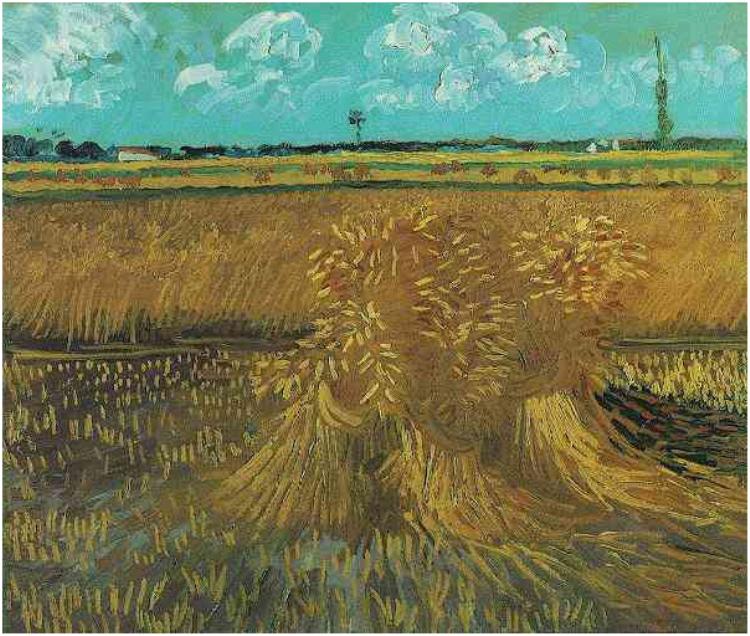
Sheaves of Wheat in a Field –Vincent Van Gogh

Ploughing Deep

Field with Plowing Farmer by Vincent Van Gogh
O wet red swathe of earth laid bare,
O truth, O strength, O gleaming share,
O patient eyes that watch the goal,
O ploughman of the sinner’s soul.
O Jesus, drive the coulter deep
To plough my living man from sleep…
Lo, all my heart’s field red and torn,
And Thou wilt bring the young green corn,
And when the field is fresh and fair
Thy blessed feet shall glitter there,
And we will walk the weeded field,
And tell the golden harvest’s yield,
The corn that makes the holy bread
By which the soul of man is fed,
The holy bread, the food unpriced,
Thy everlasting mercy, Christ.
~John Masefield from The Everlasting Mercy


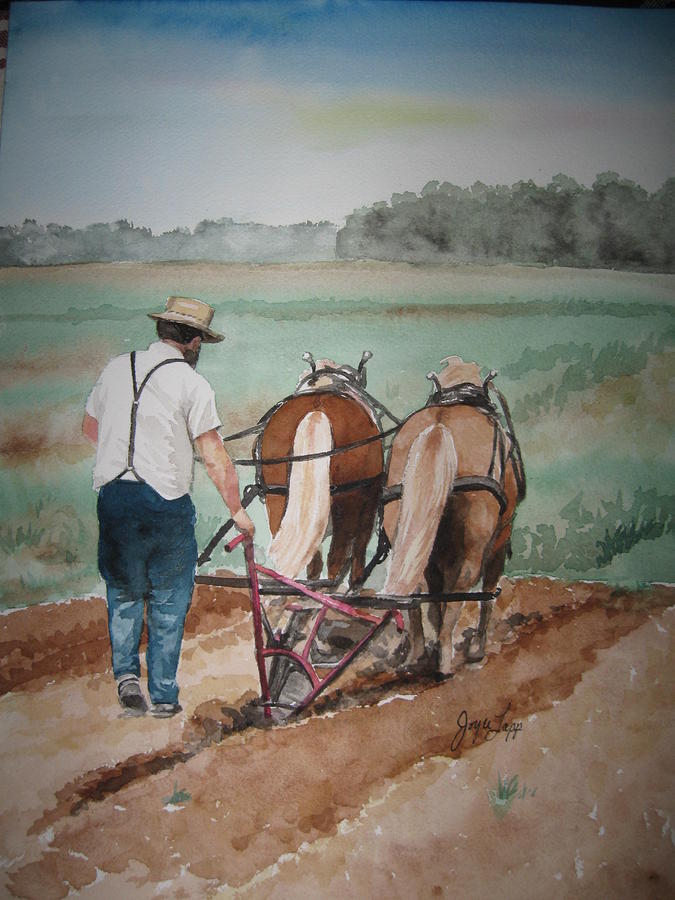
My heart land is plowed,
yielding to the plowshare digging deep with the pull of the harness,
the steady teamster centering the coulter.  
The furrow should be straight and narrow. 
I am tread upon yet still bloom; 
I am turned upside down yet still produce bread.
The plowing under brings freshness to the surface,
a new face upturned to the cleansing dew,
knots of worms now making fertile simple dust. 
Plow deep my heart, dear Lord. 
May it grow what is needed
to feed your hungry children.
Painting “Plowing the Field” by Joyce Lapp
photo by Josh Scholten

Stretched Thin

“I feel thin, sort of stretched, like butter scraped over too much bread.”
J.R.R. Tolkien

It is not supposed to happen while taking vacation days from work.  I’m supposed to be well-rested, eager to return to work and ready for the next challenge.  Instead, some viral crud has collided with my immune system and won;  I’ve spent the last 24 hours with chills, fever, muscle aches and no appetite.   I was thinking my strange dreams and overwhelming laziness over the previous two days was just the real “me” coming out while on vacation, but now I know it was the real virus instead.

I try to go at 100 miles per hour in my professional and personal life to get everything done, rarely taking breaks as I feel I’ll never regain the momentum needed.  I’m finding that approach to life can’t be sustained, either because my body can’t do it any longer, or more likely, my brain doesn’t easily stretch that thin any longer.    I’m realizing there may a steady pace that is sustainable and I need to find it.  Right now that pace is from bed to bathroom to computer and back to bed.  I hope to aim for a little more adventure tomorrow.

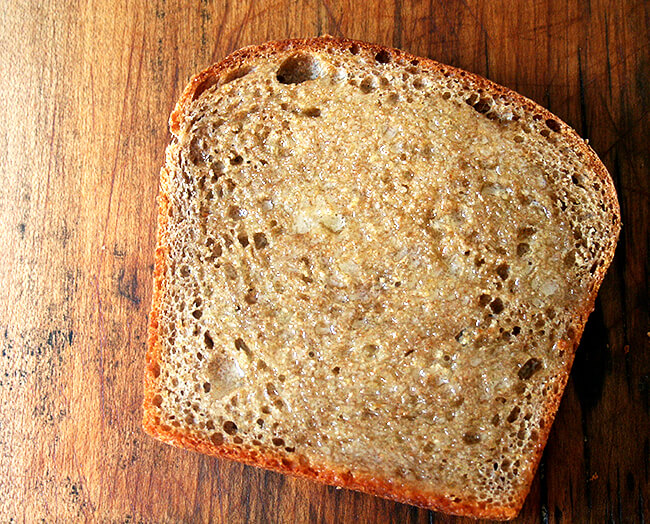
When I am stretched too thin–when tears flow easy–it is time to slow down and taste the bread and not worry about buttering it.

It is time for the body to be restored by the Body.