Plenty Messy and Mushy

Politics is applesauce.
~Will Rogers
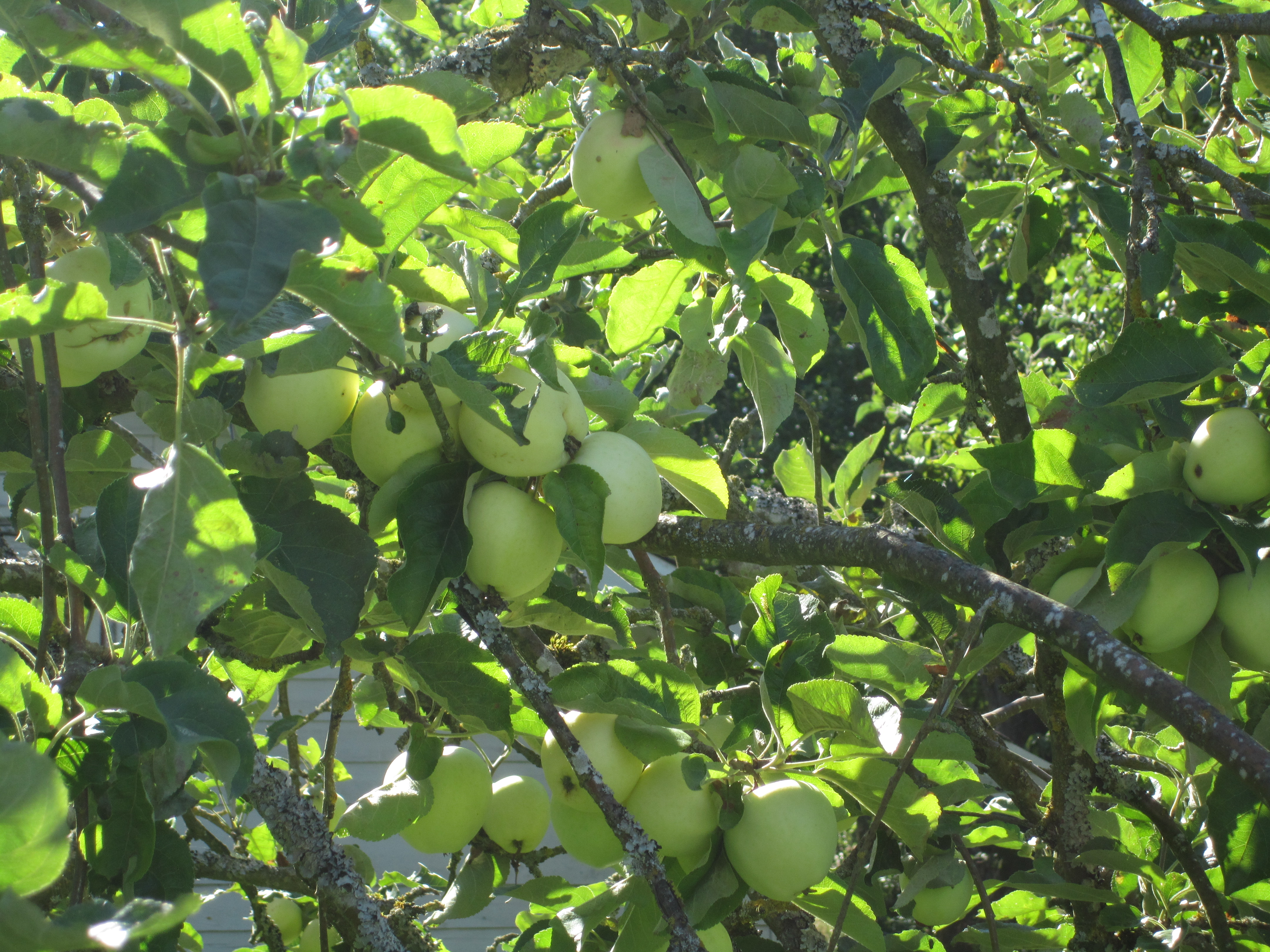
Our transparent apple trees are heavily burdened with fruit this time of year, to the point of breaking branches crashing to the ground with the weight. There have been few windfalls.

There is a short span for this variety between fruit too green and sour becoming too mealy and mushy.  With the hot weather, the thin-skinned apples will start to crack and turn to mush right on the tree without even letting go first.  So the window for applesauce is now, this week, ready or not.

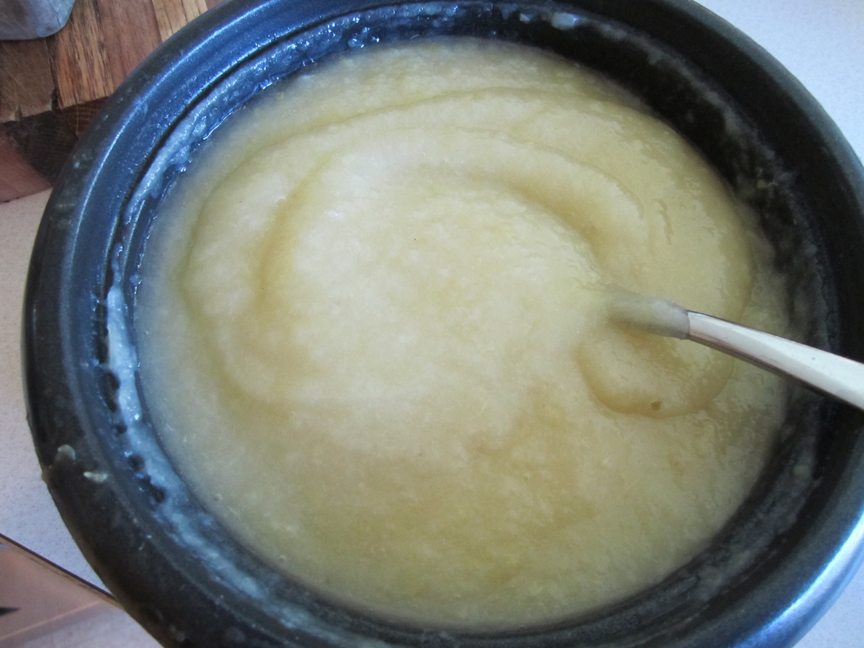
Applesauce-making is one of my more satisfying domestic activities.  Peeling and coring apples can be tedious, there are always a few bad spots to cut out, and though rare with the organic transparents, there is the occasional wiggling worm to dispose of before cooking.  They make a tart sauce, need no sugar;  but with all the careful preparation before the cooking, the result is smooth to the tongue and a lovely creamy light color, with all blemishes removed, extra unwanted wormy protein deposited in the compost bucket along with mountains of peel, cores and seeds.

Would that I could similarly pare out, peel off, dispose in the compost all the political flyers flooding our mailbox, the automated telephone voter polls coming into our “unlisted” number, the radio, TV and internet ads that burden us all until we crack and break under the weight.  Actually most of the election fruit is already rotting on the tree, turning us to mush in the process.  I’m weary just thinking about the millions of dollars spent in advertising candidates that could be used for far greater good and benefit for the citizenry.

The process of selecting a president and members of Congress, a governor and voting on controversial initiatives can be so vile and mean-spirited that the whole kettle of sauce is spoiled.   I could cook it all day long and there still will be worms waving in the air, rotten cores festering, scabby peels floating on top, the bottom scalding with the heat of the cook stove.  How does a reasonable person decide what is best for the country when nothing is transparent at all in what politicians say versus what they do?

And how palatable will the political flavors be when all is said and done?   I guess we’ll need to wait until November to know how the messy mush of elections will taste.

Thankfully I will have stored up plenty of the real stuff in the freezer so we can drown our misery in the creaminess of summer apples prepared and cooked to perfection: no blemishes, no scabs, no rot, and no worms waving back.

What a world.

A Hairy Toes Blessing

“May the hair on your toes never fall out!”
J.R.R. Tolkien in The Hobbit (Thorin Oakenshield addressing Bilbo Baggins)

It’s a safe bet my toes and your toes have never been subjected to a blessing.   But I like the idea of being blest starting from the bottom up,  encompassing my most humble and homely parts first.

The world would be a better place if we rediscovered the art of bestowing blessings–those specific prayers of favor and protection that reinforce community and connection to each other and to something larger than ourselves.   They have become passé in a modern society where God’s relationship with and blessing of His people is not much more than an after-thought.   Benedictions can extend beyond the end of worship services to all tender partings;  wedding receptions can go beyond roasting and toasting to encompass sincere prayers for a future life together.

But let’s start at the very beginning: let’s bless our hairy toes.  That is a very good place to start…

“I can, with one eye squinted, take it all as a blessing.”
Flannery O’Connor

May you always have…
Walls for the winds
A roof for the rain
Tea beside the fire
Laughter to cheer you
Those you love near you
And all your heart might desire

May those who love us, love us;
and those who don’t love us, may God turn their hearts;
and if He doesn’t turn their hearts, may he turn their ankles
so we’ll know them by their limping.
Traditional Irish Blessings

Prayer for a Little Child
by Winifred M. Letts

God keep my jewel this day from danger;
From tinker and pooka and black-hearted stranger.
From harm of the water, from hurt of the fire.
From the horns of the cows going home to the byre.
From the sight of the fairies that maybe might change her.
From teasing the ass when he’s tied to the manger.
From stones that would bruise her, from thorns of the briar.
From evil red berries that wake her desire.
From hunting the gander and vexing the goat.
From the depths o’ sea water by Danny’s old boat.
From cut and from tumble, from sickness and weeping;
May God have my jewel this day in his keeping.

Without Headlights

Photo by Tayler Rae of Aaron Janicki haying this week with his Belgian team in Skagit County

... The Amish have maintained what I like to think is a proper scale, largely by staying with the horse. The horse has restricted unlimited expansion. Not only does working with horses limit farm size, but horses are ideally suited to family life. With horses you unhitch at noon to water and feed the teams and then the family eats what we still call dinner. While the teams rest there is usually time for a short nap. And because God didn’t create the horse with headlights, we don’t work nights.
Amish farmer David Kline in Great Possessions

Nearing 58, I am old enough to have parents who grew up on farms worked by horses, one raising wheat and lentils in the Palouse country of eastern Washington and the other logging in the woodlands of Fidalgo Island of western Washington.  The horses were crucial to my grandfathers’ success in caring for and tilling the land, seeding and harvesting the crops and bringing supplies from town miles away.  Theirs was a hardscrabble life in the early 20th century with few conveniences.  Work was year round from dawn to dusk; caring for the animals came before any human comforts.  Once night fell, work ceased and sleep was welcome respite for man and beast.

You can’t have the family farm without the family.–G.K. Chesterton

In the rural countryside where we live now, we’ve been fortunate enough to know people who still dabble in horse farming, whose draft teams are hitched to plows and mowers and manure spreaders as they head out to the fields to recapture the past.  Watching a good team work with no diesel motor running means hearing bird calls from the field, the steady footfall of the horses, the harness chains jingling, the leather straps creaking, the machinery shushing quietly as gears turn and grass lays over in submission.  No ear protection is needed.  There is no clock needed to pace the day.   There is a rhythm of nurture when animals instead of engines are part of the work day.   The gauge for taking a break is the amount of foamy sweat on the horses and how fast they are breathing. It is time to stop and take a breather, it is time to start back up do a few more rows, it is time to water, it is time for a meal, it is time for a nap, it is time for a rest in a shady spot.  This is gentle use of the land with four footed stewards who deposit right back to the soil the digested forage they have eaten only hours before.

When we stop working with our hands, we cease to understand how the world really works. — Clive Thompson

Our modern agribusiness megafarm fossil-fuel-powered approach to food production has bypassed the small family farm which was so dependent on the muscle power of humans and animals.    In our move away from horses worked by skilled teamsters,  what has been gained in high production values has meant loss of self-sufficiency and dedicated stewardship of a particular plot of ground.  Draft breeds, including the Haflinger horses we raise, now are bred for higher energy with lighter refined bone structure meant more for eye appeal and floating movement,  rather than the sturdy conformation and unflappable low maintenance mindset needed for pulling work.   Modern children are bred for different purpose as well, no longer raised to work together with other family members for a common purpose of daily survival.   Their focus at school is waning as they have no morning farm chores when they get up, too little physical work to do before they arrive at their desks in the morning.   Their physical energy, if directed at all,  is directed to competitive sports, engaged in fantasy combat rather than winning a very real victory over hunger.

I am encouraged when young people still reach for horse collars and bridles, hitch up their horses and do the work as it used to be done.   All is not lost if we can still make incremental daily progress,  harnessed together as a team with our horses, tilling for truth and harvesting hope.


I like farming. I like the work. I like the livestock and the pastures and the woods.  It’s not necessarily a good living, but it’s a good life.  I now suspect that if we work with machines the world will seem to us to be a machine, but if we work with living creatures the world will appear to us as a living creature.  That’s what I’ve spent my life doing, trying to create an authentic grounds for hope. –Wendell Berry, horse farmer, essayist, poet, professor

photo by Tayler Rae

Rosy Sunsets

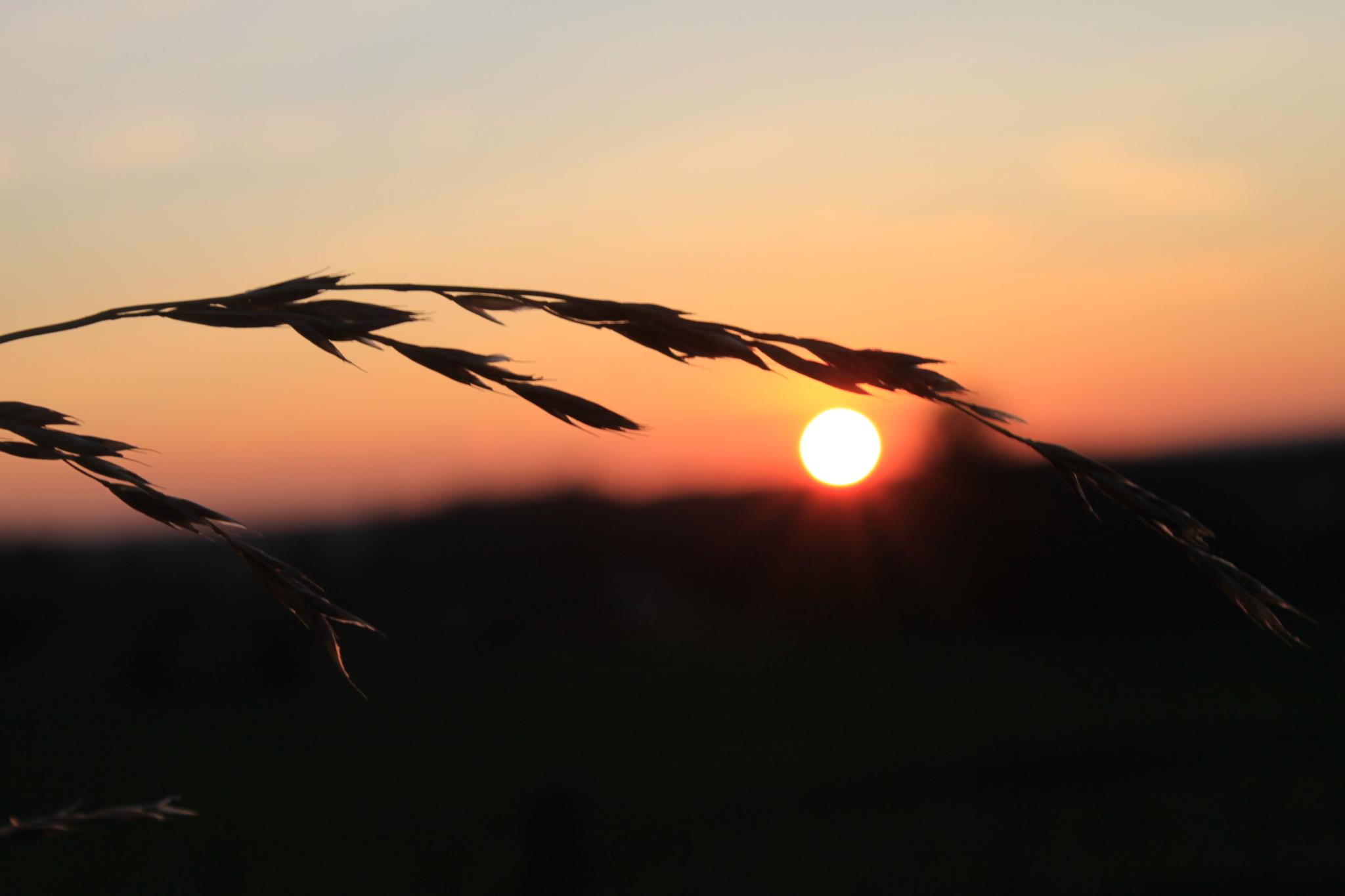
photo by Nate Gibson

If I can put one touch of rosy sunset into the life of any man or woman, I shall feel that I have worked with God.
G.K. Chesterton

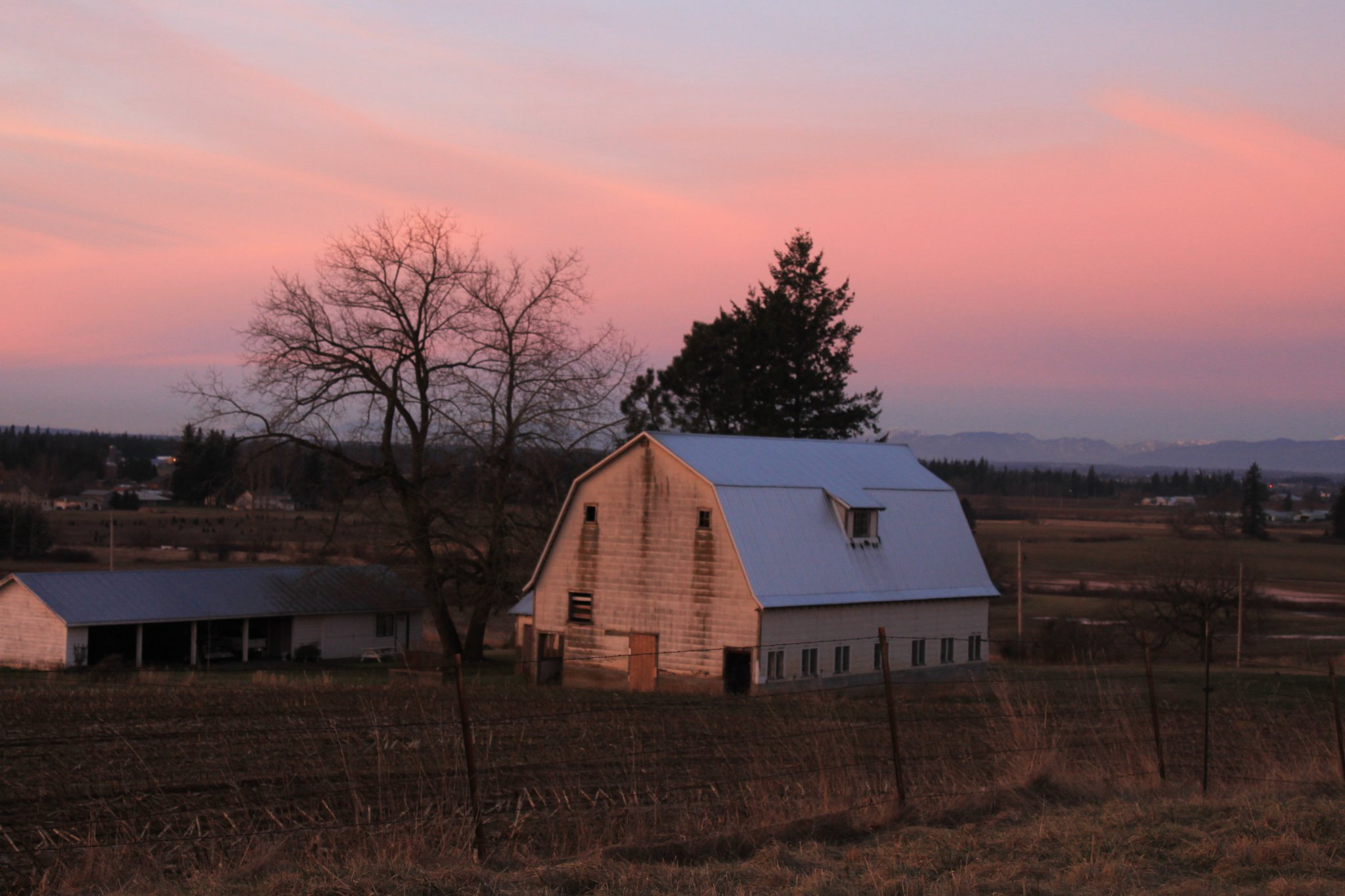
Most evenings there is no sunset fanfare, no departing glowing orb on the horizon, no color spreading upward into the clouds.  The typical evening canvas is just grey and ordinary at dusk, transitioning to twilight, giving into nightfall. Grey-darkergrey-black.

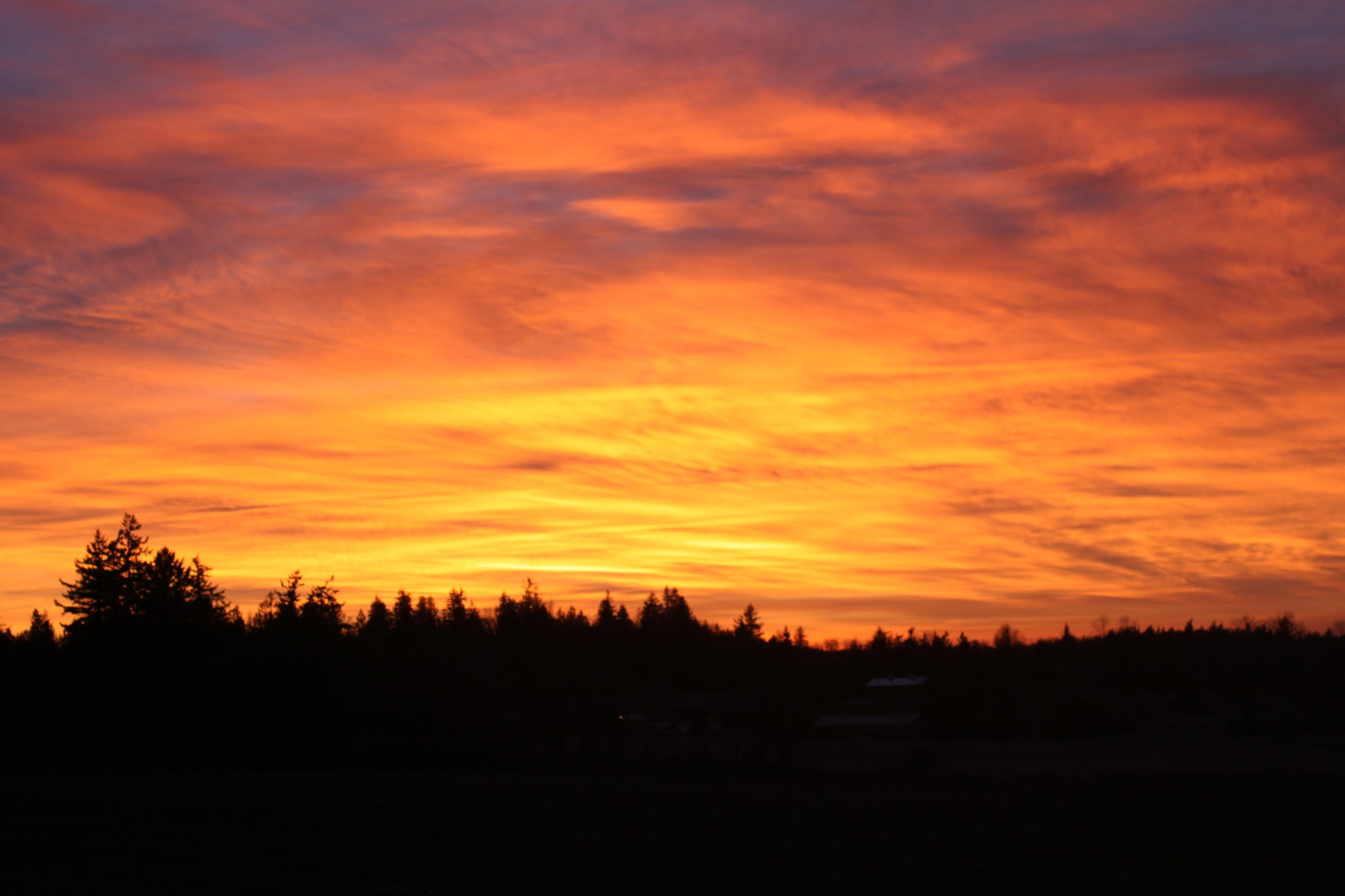
Yet there are times not at all ordinary.  On those evenings, the Master reaches deep for his palette and starts mixing.  As He begins His work,  grey gradually gives way to amber and orange, shifting to red and purple and yellow.   A daub here, a speckle there, then full out splash and streak.  We are invited to pick up a brush and apprentice for Him, learning the sweep of the hand, the grace of the wrist stroke, the fine work of the brush tip outlining the black of darkening shadows.

There can be no wrong color combination; anything goes.  It is a riveting gift of extraordinary artwork: it is meant to be shared, to be taught, to be cherished even if only for a few brief minutes.

When the sky glows with unfolding rose petals, all will see it; this work won’t be hidden away in a gallery or museum.

All too soon it moves on, the canvas plain and dark once again.  And we’re left holding the brush, eager and ready to try again when the timing is right.

photo by Nate Gibson

Lenten Reflection–No Fear

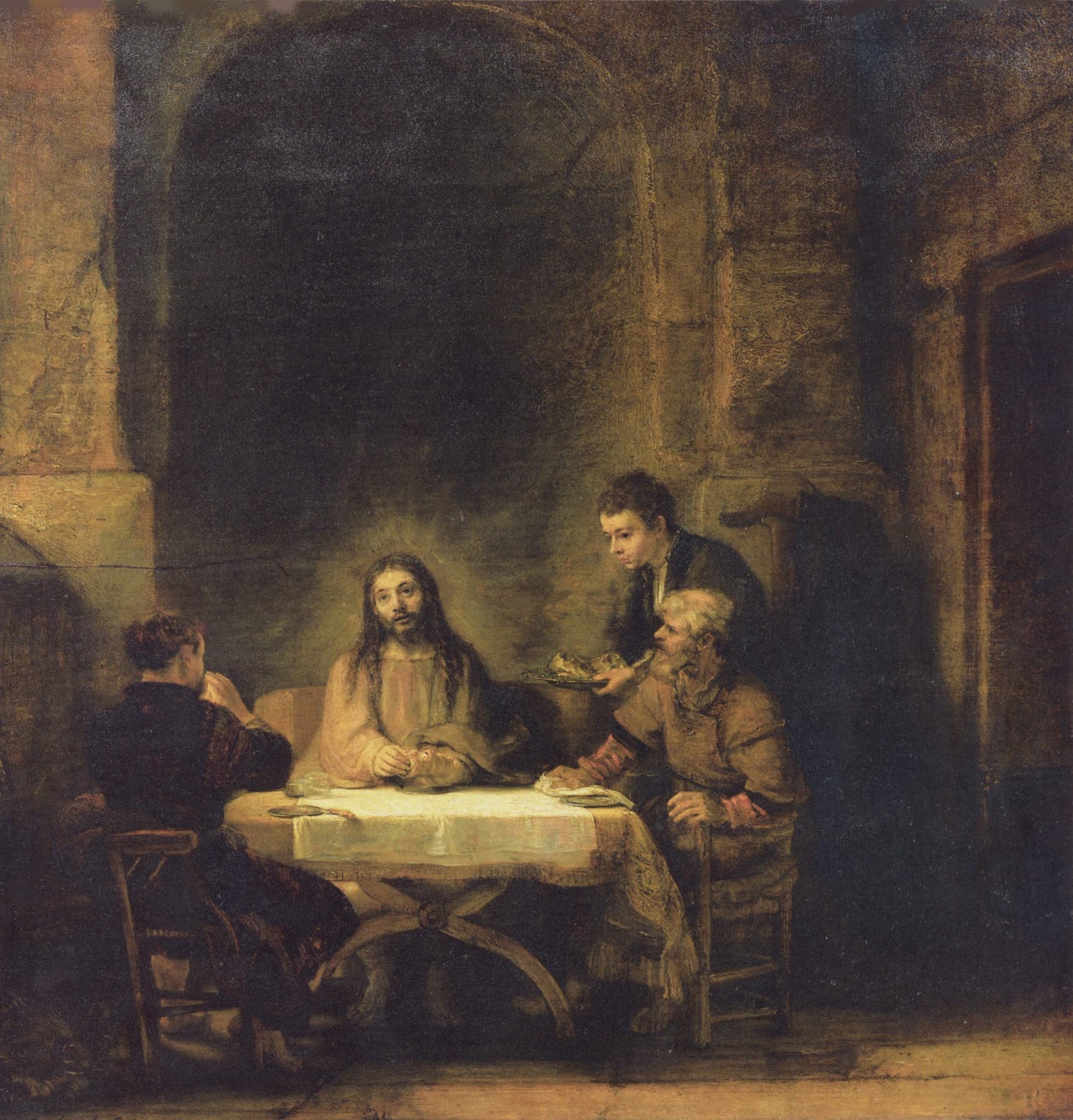
Rembrandt's Christ at Emmaus

There is no fear in love, but perfect love casts out fear
1 John 4:18

The community of faith and community of life in the first love was marked by the risen Christ–the Christ who had said, “I am with you always.” Everything depends on seeing the mystery of the risen Christ as unconditional love. In Christ, God’s love is put into practice.
Eberhard Arnold

Of course there was plenty to fear. There had been a brutal arrest in a garden, facilitated by one of His own. The rest ran or actively denied involvement. There was a hasty hearing, and a trial of sorts, and then beatings and condemnation by acclamation. There was the impossible task of lugging a heavy cross up hill, then being attached by nails, hung, dehydrated, denigrated, left to die.

Plenty, plenty to fear. Those who loved Him were terrified.

When they returned after the Sabbath to care for His body, still concerned for their own safety, they heard again very familiar words: “Do not be afraid.” He was conceived and born under those words, and after His death, those were among the first words they heard the risen Christ say, and He repeated them as often as they needed to hear them, which was often.

Do not be afraid.

Perfect love casts out fear. As we are so flawed, so incapable of perfect-anything, we fear, and fear desperately. But because He is capable of perfect unconditional love, He demonstrates that love tangibly and palpably: breaking bread, breaking Himself, pouring wine, pouring out Himself. He creates an everlasting community of love by promising to be with us always. So we put it into practice with each other, and especially with those who are strangers and enemies.

Why fear any longer? He is walking alongside us illuminating our minds and filling our hearts, He is at the table feeding us, He is holding us as we pass into His arms.

Perfect
mysterious
unending
unprecedented
unconditional
love has no fear
forever.

Lenten Reflection–The Flooded Path

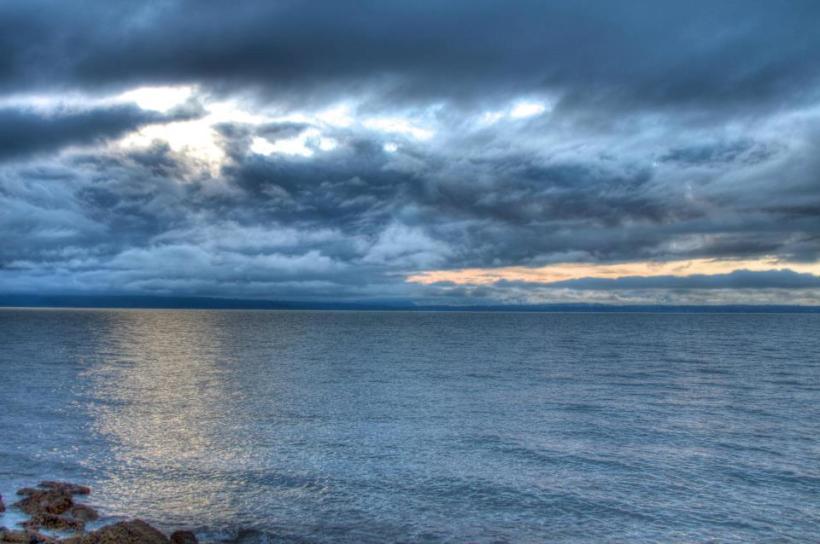
photo by Josh Scholten

God of our life,
there are days when the burdens we carry
chafe our shoulders and weigh us down;
when the road seems dreary and endless,
the skies grey and threatening;
when our lives have no music in them,
and our hearts are lonely,
and our souls have lost their courage.

Flood the path with light,
run our eyes to where the skies are full of promise;
tune our hearts to brave music;
give us the sense of comradeship with heroes and saints of every age;
and so quicken our spirits
that we may be able to encourage the souls of all
who journey with us on the road of life,
to Your honour and glory.
Augustine

Those final few days may have been like this:
the sky oppressive with storm clouds,
the shouldered burden too painful,
the soul weighed down, discouraged, disheartened.
Each step brought Him closer
to a desperate loneliness borne of betrayal and rejection.

But the end of that dark walk was just the beginning
of a journey into new covenant.

Instead of rain, those clouds bore light, flooding the pathway so we can come together to lift the load.
Instead of loneliness, there arises community.
Instead of stillness, there is declaration of glory.
Instead of discouragement, He embodies hope for all hearts.
The promise fulfilled, spills over our path.
We are drenched.

photo by Josh Scholten

Shedding Some Light

I’m a bit confused here.

While more states, including my own, grant the legal right to marry to same sex couples, more and more heterosexual couples are rejecting official marriage that includes a signed “piece of paper”, preferring to bear their children out of wedlock. What one minority segment of U.S. society has fought hard for over several decades, now granted through society’s expanding acceptance and tolerance of diverse lifestyles, the heterosexual majority increasingly deems marriage worthless and to be avoided.

Can someone shed some light on what is going on here?

I’m all for celebrating legal sanctioning of personal commitment. I have seen what happens when there is no commitment to commitment. Without steadfast loyalty, dependability, predictability, and honoring of promises made, relationships flounder and fizzle, descending into selfish silos of an “every person for themselves” approach to life. I watched it happen late in my parents’ marriage as their focus became less on the inherent value of the union of two people who made vows before God to stay together through thick and thin, and more on what’s best for the individual when needs go unmet. Any divorce is heartbreaking and painful, but the implosion of a 35 year marriage is truly tragic and unnecessary. Ironically, their original commitment reignited ten years later as they married again for the last few years of my father’s life.

There are now too many scarred and scared young people unwilling to take the step of marriage, having grown up inside the back and forth visitation homes of divorce or in a home offering no significant modeling of long term emotional commitment. Even monogamous devotion to a new sexual partner is seen as unnecessarily restrictive, while an unplanned new life conceived within that relationship becomes too easily postponed until it is “convenient” for the unprepared parents. We have forgotten what promises mean, what stability represents to a relationship and children, how trusting obedience to the longevity of the union should trump short term individual desires.

My clinic day increasingly is filled with the detritus of failed and failing relationships. Too many of my young adult patients who describe symptoms of depression and anxiety struggle with whether they want to continue to live at all, sometimes expressing their misery in escalating self harming behaviors or anesthetizing with alcohol or recreational drugs. They describe the chaos of parents living sequentially with multiple partners, of no certain “home” outside their school dorm or apartment, unsolvable complications with half- and step- sibling relationships, and all too frequently financial uncertainty. Many grew up supervised by TV and computer games rather than being held accountable to (mostly absent) parental expectations. They are more comfortable with on-line communication than risk being truthful about who they really are with flesh and blood people they see every day. They fear failure as they have seldom been allowed to make mistakes and subsequently experience forgiveness and grace from those who love them. They are emotional orphans.

In short, they know little about how love manifests through self-sacrifice and faithfulness.

Keeping commitment becomes the light that illuminates our lives, as reliable as the fact the sun rises every morning.

At least on that we can depend.

A Destiny of Many Colors Tied Together

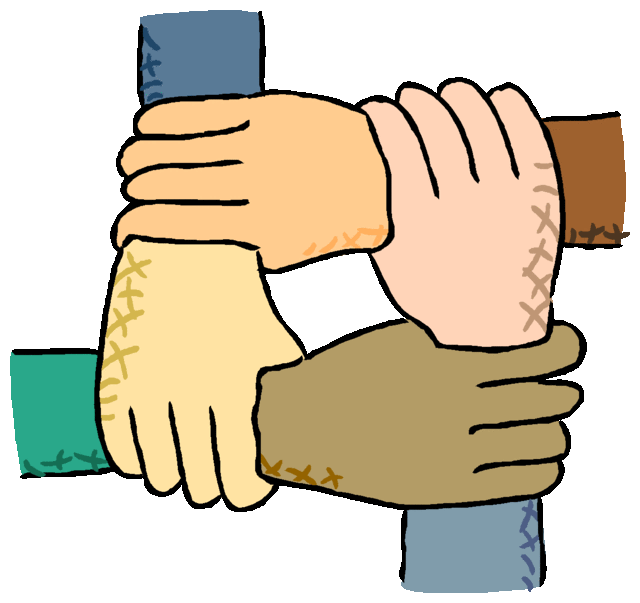
Let me say finally, that in the midst of the hollering and in the midst of the discourtesy tonight, we got to come to see that however much we dislike it, the destinies of white and black America are tied together. Now the races don’t understand this apparently. But our destinies are tied together. And somehow, we must all learn to live together as brothers in this country or we’re all going to perish together as fools. …Whether we like it or not culturally and otherwise, every white person is a little bit negro and every negro is a little bit white. Our language, our music, our material prosperity and even our food are an amalgam of black and white, so there can be no separate black path to power and fulfillment that does not intersect white routes and there can ultimately be no separate white path to power and fulfillment short of social disaster without recognizing the necessity of sharing that power with black aspirations for freedom and human dignity.
Martin Luther King,Jr.– in one of his last speeches, given at Grosse Point, Michigan high school (near Detroit) to a mostly white and often heckling audience, March 14, 1968

I grew up in Olympia, Washington, a fair-sized state capitol of 20,000+ people in the 1960′s that had only one black family.

One.

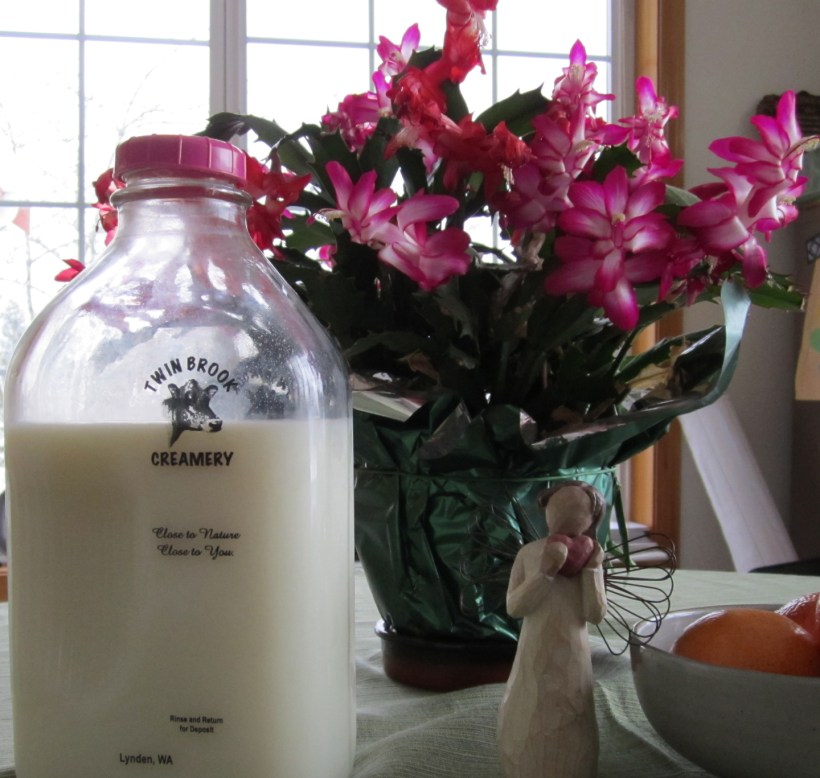
There were a few Japanese and Korean families, a few Hispanics, but other than the Native American folks from the nearby Nisqually Reservation, our community seemed comprised of homogenized milk. Pretty much plain white.

In 1970, the Caucasian Olympia High School graduation student speaker caused a controversy resulting in numerous parents walking out of the ceremony when in her speech she called our town a “white racist ghetto”. It was the first time I’d heard someone other than Martin Luther King, Jr. actually crack a previously unspoken barrier using only words. What she said caused much anger, but the ensuing debate in the newspaper Letters to the Editor, around lunch counters at the five and dime, and in the churches and real estate offices made a difference. Olympia slowly, in recognition at being called out for racism, began to open its social and political doors to people who weren’t white.

Heading to college in California helped broaden my point of view, to be sure, but in the 70′s there were few diversity admissions initiatives, so it was still a vastly Caucasian campus. When I went to study wild chimpanzees in Africa in 1975, I had the enlightening experience of being one of two whites traveling among hundreds of very dark skinned Tanzanians on trains and boats in the interior of the country. I became the one gawked at, viewed as an oddity, pointed at by small children who were frightened by my appearance, and so constantly felt out of place. I did not belong. Yet I was treated graciously, with hospitality, although always a curiosity.

Returning to the Northwest meant blending in with homogenized white milk again. Although there was some minimal diversity in my medical school class (even women constituted less than 25% of my class of 1980), it wasn’t until I was in family practice residency at Seattle’s Group Health Cooperative that I began to experience the world in technicolor. I joined a group of doctors in training that included a black activist from the east coast, a Kiowa Indian, several Jews, someone of Spanish descent, a son of Mexican immigrants, a daughter of Chinese immigrants, a Japanese American, and a Yupik Eskimo. Not only was I challenged to articulate how I perceived our inner city patients’ cultural and family context, but I witnessed how much more effectively my colleagues and teachers worked with patients who looked or grew up like them. It was such a foundational experience that I was drawn to a medical practice in a Group Health Rainier Valley neighborhood clinic. There I saw patients who lived in the projects that lined Martin Luther King Way, struggling with poverty and social fragmentation, clustered together in diverse little knots of extended family within a few square miles. There were many ethnic groups: African Americans, Vietnamese, Cambodian and Laotian refugees, Askenazi Jews, Middle East Muslims, Russian immigrants and some Catholic Italian families who spoke broken English. I delivered babies who would grow up learning languages and traditions from every corner of the globe. It was a wide world of color that walked into my exam rooms, enriching my life in ways I had never imagined. I found that white milk, nurturing as it was, didn’t hold a candle to some of the flavors I was discovering.

When I married, and later became pregnant myself, we made the decision to move north near my husband’s home community of Lynden, a town of Dutch dairy farming immigrants. We planned to own our own farm to raise our children in a rural setting just as both of us had been raised. There was significant adjustment necessary once again even though it was a primarily Caucasian community. I am not Dutch even though I am as white and tall as the Frieslanders (some of my ancestry is from Schleswig-Holstein in Germany, right across the Holland border).

I didn’t have the same cultural background to fit in easily in my new home. The color of my skin no longer was noticeable, but the difference in rituals, the language quirks and traditions stood out. In other words, the milk looked just as white, (maybe skim versus whole or 2%), but varied significantly in taste (were the cows just let out on grass??)

Even with those apparent differences, our rural community has transformed over the last twenty six years since we moved here. We have two growing Native American sovereign nations near by, the Nooksack and Lummi tribes, along with increasing numbers of migrant Hispanic families who work the seasonal berry and orchard harvest, many of whom have settled in year round. My supervisors where I work are African American. Our close proximity to the lower mainland of British Columbia has brought Taiwanese, Japanese and Hong Kong immigrants to our area, and East Indians are immigrating to our county in large extended families, attracted by affordable farmland. I was shopping yesterday at a new rural corner grocery only a few miles from our farm, built and managed by Sikhs who have stocked the shelves with the most amazing array of Indian spices and Mexican chili sauce, with Dutch peppermints and licorice thrown in for good measure.

Our children have grown up rural but, as adults, are now part of communities far more varied. Nate teaches multiracial high school students in Tokyo, Japan (and as of 2014, is married to Tomomi), Ben is a Teach for America high school math teacher on the Pine Ridge Lakota Sioux Reservation in South Dakota, and Lea is deep in Spanish Education courses at college, hoping to continue her summer work in a local Migrant Workers’ Head Start program. They, as I have been, are privileged to work in a kaleidoscope of humanity and our family has become multiracial.

Homogenized can mean something other than just plain white. It can mean blending so there is no longer separation.

Martin Luther King’s term “amalgam” is apt. His well articulated hope and dream is happening within my life time.
Hope is Stirring at the Edges

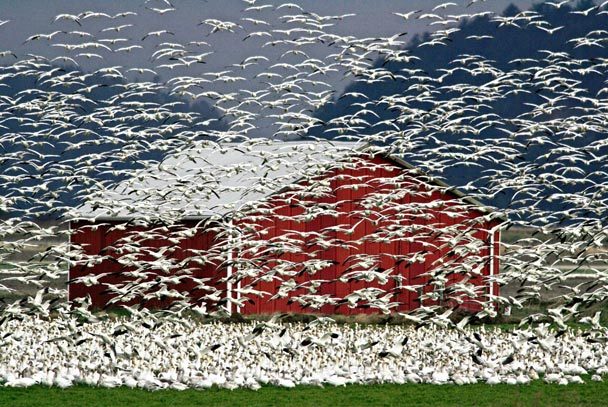
Skagit Flats Snow Geese

“Spring seems far off, impossible, but it is coming. Already there is dusk instead of darkness at five in the afternoon; already hope is stirring at the edges of the day.”
Kathleen Norris in Dakota: A Spiritual Biography

For the last several days, whenever I am outside in the barnyard wheelbarrowing loads of manure, or carrying buckets of water, I’ll hear the approaching honking crescendo of snow geese coming from the north. I stop whatever I am doing to watch the sky. The geese fly in precise V formation as they head from northeast of here, the Frasier River Valley in British Columbia, southwest to the Skagit Valley flats some forty miles away where thousands of them will glean leftovers from harvested farm fields for the next few weeks. They are in constant vocal and visual contact with one another as they fly over, perhaps pointing out a point of interest here, or sharing a juicy bit of gossip there. Maybe they simply navigate by following the sound of the goose whose tail is right in front of their own honking feathery face. It is like an a capella male chorus of a dozen voices warming up using only one note–E flat.

There is such expectancy in each noisy group that passes over, each oblivious to me enviously watching them from below. They have clear mission and purpose without needing a vision statement or strategic planning retreats. They know where they have been, where they are headed and that there will be full bellies by nightfall. They work as a team to get there with minimal energy expenditure and high efficiency. They never appear ambivalent or confused. I even suspect they like each other quite a lot.

I wish I had such clarity. I stumble about wondering which direction I need to turn next, what task has highest priority, who needs to go with me or who I should follow behind, how I can be more fruitful rather than futile.

I need the hope of the snow geese. Winter won’t last forever.

Psalm 147:16-18
16 He spreads the snow like wool
and scatters the frost like ashes.
17 He hurls down his hail like pebbles.
Who can withstand his icy blast?
18 He sends his word and melts them;
at the breath of his mouth, the waters flow.

Seattle Times photo by Mark Harrison

The Rhythm of Remembrance

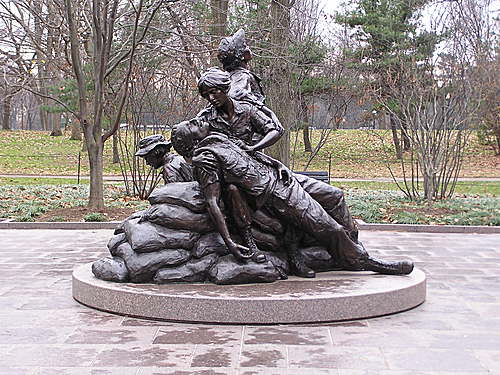
Vietnam Women Veteran's Memorial

“For in self-giving, if anywhere, we touch a rhythm not only of all creation but of all being.”
C.S. Lewis

I’m unsure why the United States does not call November 11 Remembrance Day as the rest of the Commonwealth nations did after WWI. This is a day that demands much more than the more passive name Veterans’ Day represents.

This day calls all citizens who appreciate their freedoms to stop what they are doing and disrupt the routine rhythm of their lives. We are to remember in humble thankfulness the generations of military veterans who sacrificed time, resources, sometimes health and well being, and too often their lives in answering the call to defend their countries.

Remembrance means never forgetting what it costs to defend freedom. It means acknowledging the millions who have given of themselves and continue to do so on our behalf. It means never ceasing to care. It means a commitment to provide resources needed for the military to remain strong. It means unending prayers for safe return home to family. It means we hold these men and women close in our hearts, always teaching the next generation about the sacrifices they made.

Most of all, it means being willing to become the sacrifice if called.