Lenten Meditation: Watch With Me

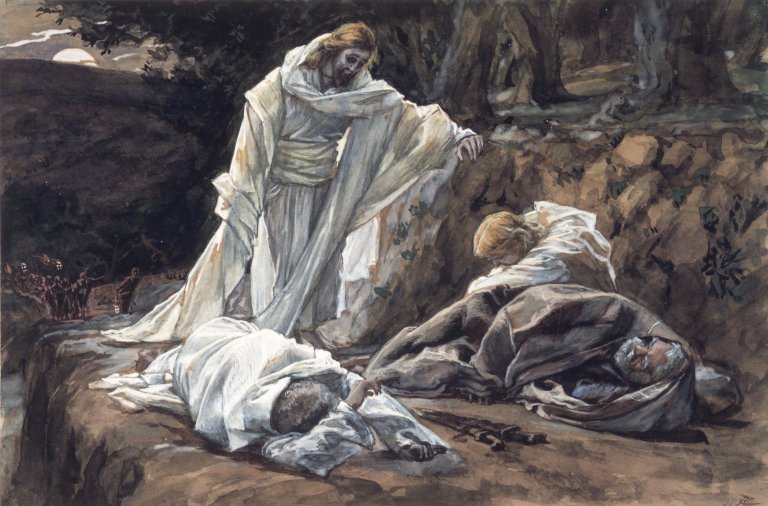
You could not watch one hour with me--James Tissot

Matthew 26:40

Then he returned to his disciples and found them sleeping. “Could you men not keep watch with me for one hour?” he asked Peter.

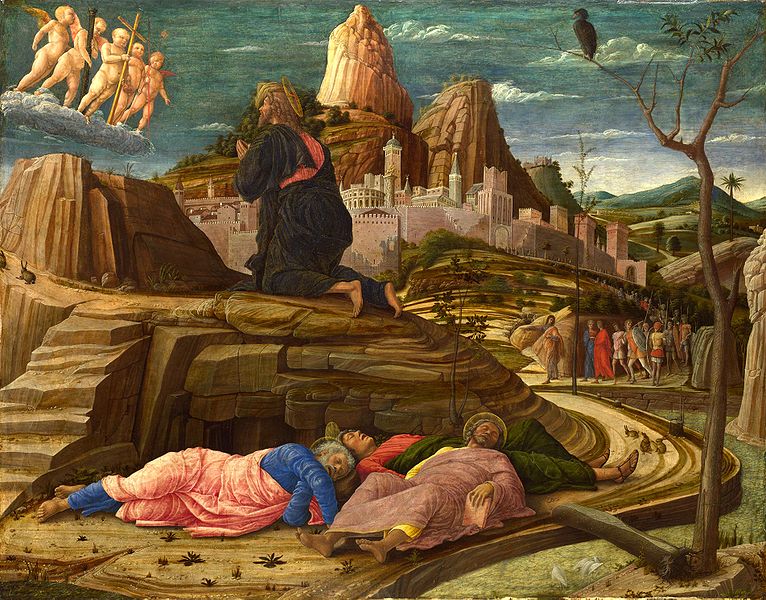
Every time I read of this scene in Gethsemane, I am convicted yet again of my own drowsing faith and how inadequate it is when the pressure is on.  “Gethsemane” means “oil press”  so it becomes an appropriate setting among the olive trees for the pressure to be turned up high, on the disciples, as well as Jesus.

The disciples are expected, indeed commanded, to keep watch by the Master, to be filled with prayer, to avoid the temptation thrown at them at every turn.  But they fail pressure testing and fall apart.  And so too, we are lulled by the complacency of our modern times, by an over-indulged satiety for material comforts that do not truly fill hunger or quench thirst,   by an expectation that being called a disciple of Jesus is enough.

It is not enough.

We sleep through His anguish.  We dream, oblivious, while He sweats blood.  We deny we know Him when the pressure is turned up,  yet incredibly He loves us anyway.

So, like the disciples who walked alongside Him, we must pray: to remain watchful, to be faithful under stress, to be forgiven for falling asleep when He needs us most.

Andrea Mantegna: Agony in the Garden, circa 1460

Sun Settling

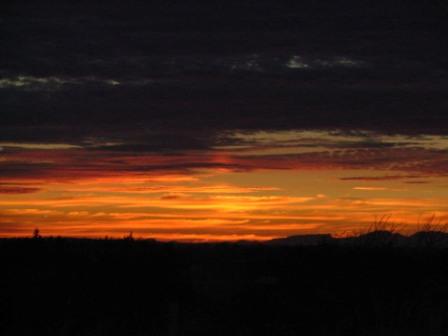
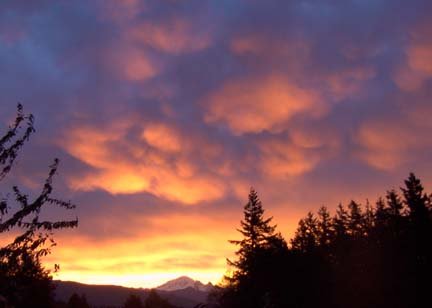
It is soon time to bid farewell to autumn and accept the arrival of the winter solstice signaling the long slow climb back to daylight. A recent December sunset was a startling send-off for fall, coloring Mt. Baker pink in the Cascade range and surrounding an almost full moon with purple in the eastern sky. Our farm, for a deceptive few minutes, appeared rosy and warm in crisp subfreezing weather. Then all became gray again, and within an hour we were shrouded in thick fog which iced the asphalt as darkness fell and it became a challenge to avoid the deep ditches along our county roads, with the white fog line being the critical marker preventing potential disaster.

The everpresent evening fog this time of year cloaks and smothers in the darkness, not unlike the respiratory viruses that have hit so many households. People are feverish, coughing and snuffling, unable to see past the ends of their own swollen noses, as if the fog descended upon each in an impenetrable gray cloud. It is an unwelcome reminder of our vulnerability to microscopic organisms that defeat us and lay us low in a matter of hours, just as a sudden fog can misguide us to the ditch. We are forced to stay put, at a time when there are dozens of responsibilities vying for attention in preparation for the holidays. Little gets accomplished other than the slow wait for healing and clarity–at some point the viral fog will dissipate and we can try climbing back into life and navigating without the fog lines as guides.

So the day’s transition to night is bittersweet: bright flames of color, yet heralding our uneasy future sleep. The sun “settles” upon the earth and so must we.

Be at ease, put down the heavy burden and rest. We can celebrate, with chorus and gifts, the arrival of brilliant light in our lives. Instead of darkness overcoming us, our lives have become illuminated in glory and grace.

The Son has settled among us.

In Defiance of Winter

3461126069_650bcd5980_b

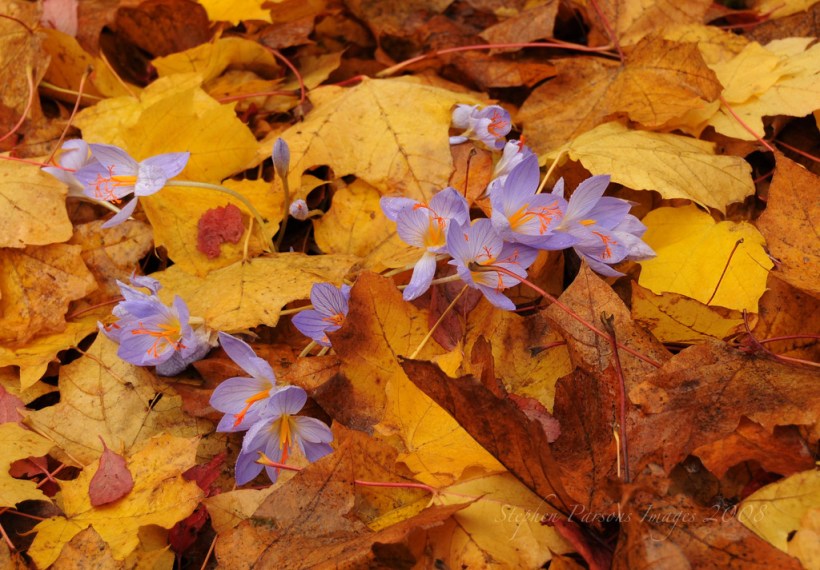
Whether mid-winter or early autumn
the crocus are unexpected,
surprising even to the observant.

Hidden potential beneath the surface,
an incubation readily triggered
by advancing or retreating light from above.

Waiting with temerity,
to be called forth from earthly grime
and granted reprieve from indefinite interment.

A luminous gift of hope and beauty
borne from a humble bulb;
plain and only dirt adorned.

Summoned, the deep lavender harbinger rises
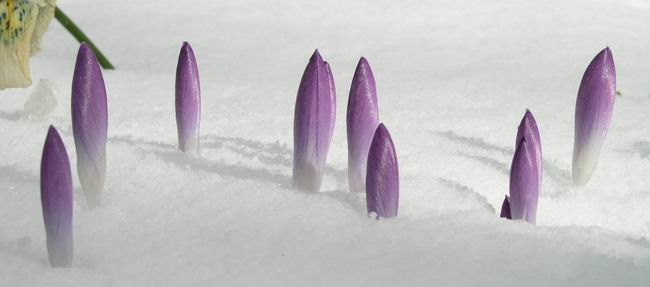
from sleeping frosted ground in February
or spent topsoil, exhausted in October.

These bold blossoms do not pause
for snow and ice nor hesitate to pierce through
a musty carpet of fallen leaves.

They break free to surge skyward
cloaked in tightly bound brilliance,
spaced strategically to be deployed against the darkness.

Slowly unfurling, the violet petals peel to reveal golden crowns,
royally renouncing the chill of winter’s beginning and end,
staying brazenly alive when little else is.

In the end,  they painfully wilt, deeply bruised and purple
under the Sun’s reflection made manifest;
returning defeated, inglorious, fallen, to dust.

They will rise yet again.


(written on a theme of “Purple”)

Crocus in snow

Where’s the Party?

gnomeparty

Fireworks on our farm's hill taken by Nate Gibson

I  remember childhood summers as 3 months of full-out celebration– long lazy days stretching into nights that didn’t seem to really darken until 11 PM and bright birdsong mornings starting out at 4:30 AM.  Not only were there the brief family vacations at the beach or to visit cousins, but there was the Fourth of July, Daily Vacation Bible School, the county fair, family reunions, and of course and most importantly, my July birthday.  Yes, there were mundane chores to be done, a garden to tend, a barn to clean, berries to pick,  a lawn to mow and all that stuff, but my memories of summer are mostly about fluff and frolic.

So where are the summer parties now?  Who is out there celebrating without me?  Nothing seems to be spontaneous as it was when I was a child. Instead there is still the routine of going to work most days in the summer.

I’m finding myself in the midst of my 55th summer and I have to create celebrations if they are going to happen in my life.  Without that perspective, the bird song at 4:30 AM can feel more irritant than blessing and the long days often mean I fall asleep nodding over a book at 9 PM.  I want to treasure every, every minute of this precious time yet they flow through my fingers like so much water, faster and faster.

I realize there will be few “family” summers left as I watch my children grow into adults and spread their wings.  They may be on to their next adventure in future summers.  So each family ritual and experience together takes on special meaning and needs to be appreciated and remembered.

So….for this summer my family has crammed as much in as we can in celebration of the season:

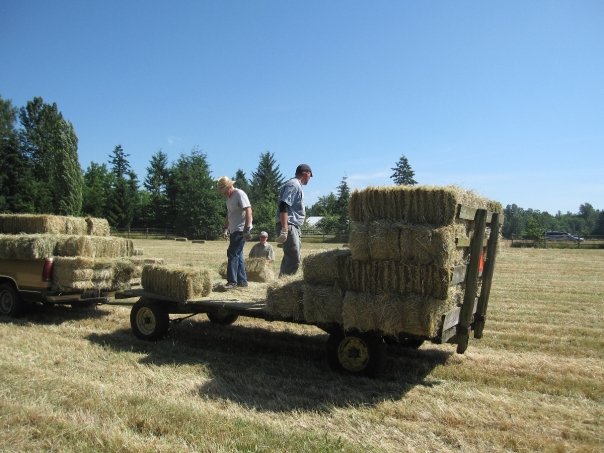
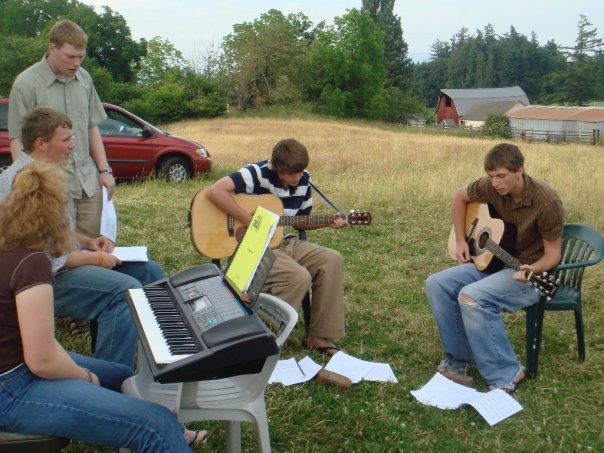
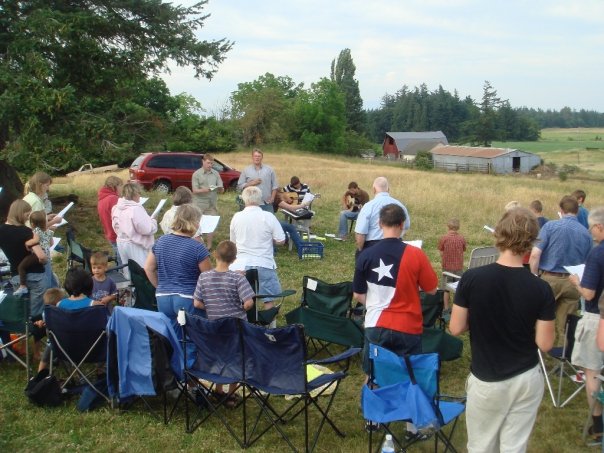
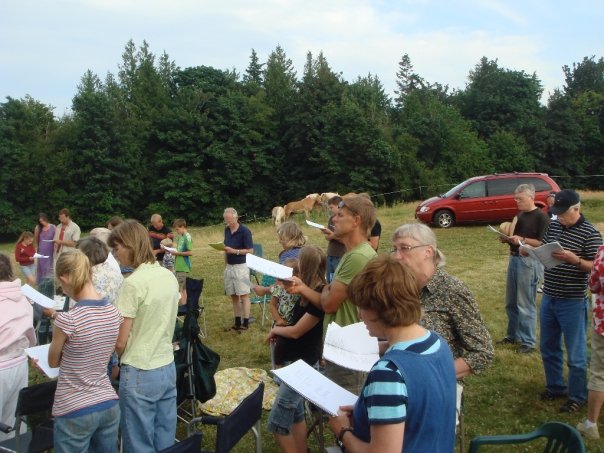
We just spent some time in the hayfields bringing in the bales with friends–our little crew of seven–sweating and itchy and exhausted, but the sight and smell of several hundred hay bales, grown on our own land, harvested without being rained on and piled in the barn is sweet indeed.   Weekly we are out on the softball field in church league,  yelling encouragement and high-fiving each other, hooting at the good hits and the bad, the great catches and the near misses, and getting dirty and sprained, and as happy to lose as to win.  We had a wonderful July 4 barbeque with good friends culminating in the fireworks show on our farm’s hill overlooking miles of valley around us, appreciating everyone else’s backyard displays as well as our own.  We are now able to sing hymns in church in four part harmony, and last night our children helped lead the singing last night in an evening “campfire church” for over fifty fellow worshipers on our hill.  In a couple weeks, we’ll take to the beach for three days of playing in the sand, roasting hot dogs. reading good books, and playing board games.  We’ll try to make the trek down to Seattle by train to spend the day watching the Mariners play (and likely lose). One change this year is we won’t be returning back to the Lynden fair with our horses–due to “off the farm” work and school schedules, we couldn’t muster the necessary round-the-clock crew after seventeen years of being there to display our little part of small town agricultural pursuits.

Yet the real party happens right here every day in small ways without any special planning.  It doesn’t require money or special food or traveling beyond our own soil.  It is the smiles and good laughs we share together, and the hugs for kids taller than I am. It’s adult conversations with the new adults in our family–no longer adolescents.  It’s finding delight in fresh cherries from our own trees, currants and berries from our own bushes, greens from the garden, flowers for the table from the yard.  It is the Haflingers in the field that come right up to us to enjoy rubs and scratches and follow us like puppies. It is babysitting for toddlers who remind us of the old days of having small children, and who give us a glimpse of future grandparenthood.  It is good friends coming from far away to ride our horses and learn farm skills. It is an early morning walk in the woods or a late evening stroll over the hills. It is daily contact with aging parents who no longer hear well or feel well but nevertheless share of themselves in the ways they are able.  It is the awesome power of an evening sunset filled with hope and the calming promise of a new day somewhere else in this world of ours.

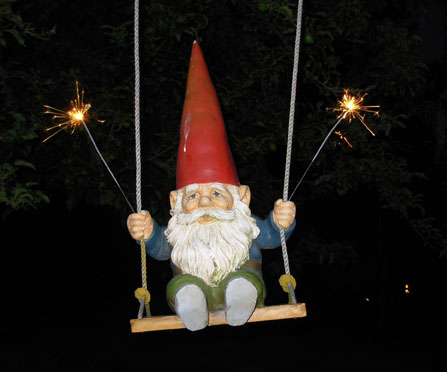
Some days may not look or feel like there’s a party happening, but that is only because I haven’t searched hard enough.  The party is here, sparklers and all, even if only in my own mind.

6651_512624400914_148300158_30510731_6701452_n

5260_1191428224258_1184942921_564392_5453600_n

5260_1191428264259_1184942921_564393_5982503_n

Campfire church photos by Bette VanderHaak

sunsett

Hung Out to Dry

clothesline

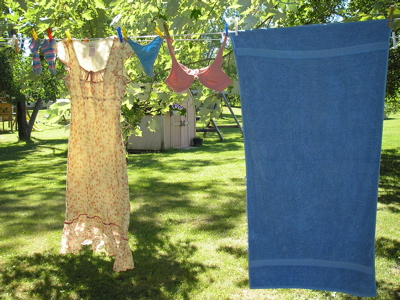
Ninety degrees Fahrenheit
(free solar energy),
5-10 mph breeze blowing from the south
(free wind generation),
mother and teenage daughter
(mostly free muscle power with occasional grumbling attached).

A basket of wet clothes,
a bag of recycled wooden clothes pins,
two lines of white plastic cord stretched 20 feet between posts
and a little bit of time.

Hanging clothes outdoors
doesn’t slow global warming;
it is a selfish act.
Who can resist a night’s sleep
with the smell of line-dried sheets
and dry off with bath towels line-snapped rough?

Underwear stiff
dish rags sun-bleached
bras dangling like empty shells
socks mismatched in a row.

A household of truths and dares
hangs for all to bear witness
without need for xray vision;
no hidden agendas,
no wondering “briefs or jocks”
no wondering about sizes or shapes or undercover secrets.

Return in the late afternoon as a rain shower threatens
to undo the dry cycle, piling loads of freshness in our arms,
clasping eight, ten, twelve clothespins in one hand
in a clean sweep to see who can hold the most.

If only my personal laundry basket
overflowing with sweaty muddy moldy yucky stuff
could be so simply transformed in an afternoon
of sweet breezes, purifying light and open scrutiny.

Then I could sleep so much better tonight knowing
The Lord washes and dries, folds and softens
what I wish to keep hidden~ my dirty laundry.

I rest in His basket of renewal,
His clean sweep of freshness gathering me up
before the storm.

Cast Your Cares

asset_upload_file707_2983-1In late May, on our farm,  there is only a brief period of utter silence during the dark of the night.  Up until about 2 AM, the spring peepers are croaking and chorusing vigorously in our ponds and wetlands, and around 4 AM the diverse bird song begins in the many tall trees surrounding the house and barnyard.
In between those bookend symphonies is stillness–usually.

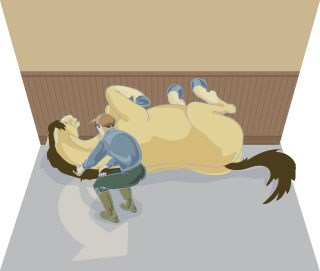
I woke too early this morning aware of something being unstill.  It was an intermittent banging, coming from the barn.  I lay in bed, trying to discern the middle of the night noise that could be a sign of a major problem, like a horse stuck up against a stall wall or “cast” in horseman’s parlance,  or simply one of my water-bucket-banging youngsters who enjoys nocturnal percussion.

This was not sounding like a bucket drum set.  It was emphatic hooves frantically banging against metal walls.

Throwing on sweats and boots, I head out the back door into the mere light of pre-dawn, dewy, with the birds just starting to rouse from sleep, the floral perfume of lingering apple blossoms heavy in the air.  Entering the barn, I throw on the lights and start to count the noses I can see in the stalls as I walk down the aisle~all present and accounted for until I get to the very end of the row.  No nose.   Down in the corner is our eleven year old mare on her side, too close to the wall, her feet askew up against the boards and metal siding.  She nickered low to me, and my entering the stall sent her into a renewed effort to right herself, but all she could do was scrabble against the wall, digging an even bigger hole beneath her body.

This has happened infrequently over our 25 years of owning horses, usually when a horse is rolling to scratch their back and rolls too close to the wall, and becomes lodged there.  Haflingers, who have a fairly round conformation, are a bit prone to being cast.  Our older barn,  with dirt floors, is particularly likely to having this happen, as depressions in the floor where horses have been digging end up becoming deeper and trap a hapless horse that was nonchalantly rolling.  The horse literally is trapped like a turtle on its back.

Righting a 1000 lb. horse that is frantically flailing and struggling is not a particularly easy or safe task.  Thankfully Haflingers tend to be pretty sensible in this situation and will calm when spoken to and reassured.  I looped a rope around each lower leg, and with my tall strong son’s help, we were able to pull her back over and then jump out of the way quickly.  She got up, shook herself off and immediately asked for breakfast–a good sign this was not a horse in distress or colicking with abdominal pain.

So my day started early.

I hope when I find myself trapped in a hole of my own making, when I’ve been careless about watching where I’m heading and find myself helpless and hopeless with no where to turn, someone will hear my struggles and come rescue me.  I promise not to kick out or bite,  but to wait patiently, in gratitude, for such gracious liberation.   My cares will be cast upon my rescuer.

And then please, feed me breakfast.

Hay Bale Pews

n148300158_30161194_6704

Where His people gather, He is.

On the road to Emmaus, men walked alongside Jesus without recognizing him, their hearts “burning within” them as He spoke, yet did not know Him until he broke bread and fed them. Worship and wonder does still take place in unlikely places alongside country roads.

Our farm is along such a road amidst rolling hills of evergreens and fields, next to a crossroads where 100 years ago sat the village of Forest Grove. This small settlement boasted a one room school house, a general store, a saw mill and a small Methodist church. Families would travel by horse and buggy to attend Sunday morning services, and during good weather, would picnic together on our farm’s nearby hill top to enjoy the expansive view. And every Easter, the small congregation would gather on the hill for a service at sunrise.

When the sawmill closed 80 years ago, the village shut its doors as well. The buildings were dismantled; the beams and timbers were transformed into our large hay barn and the humble little church became our farm’s chicken coop, long and narrow with smooth fragrant cedar lined walls and rough fir floors. Hens lay their eggs to the echoes of sacred hymns still resonating in those walls and floor.

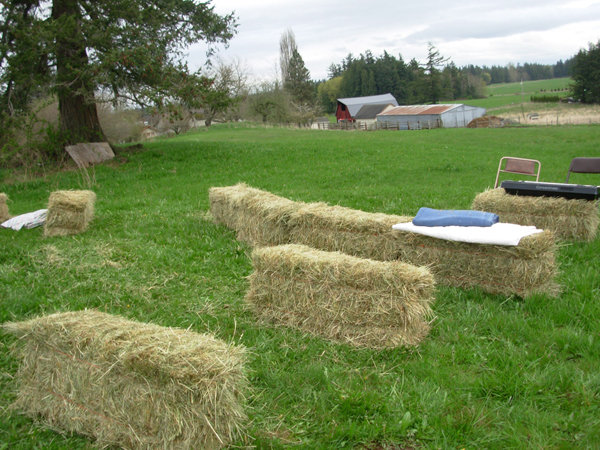
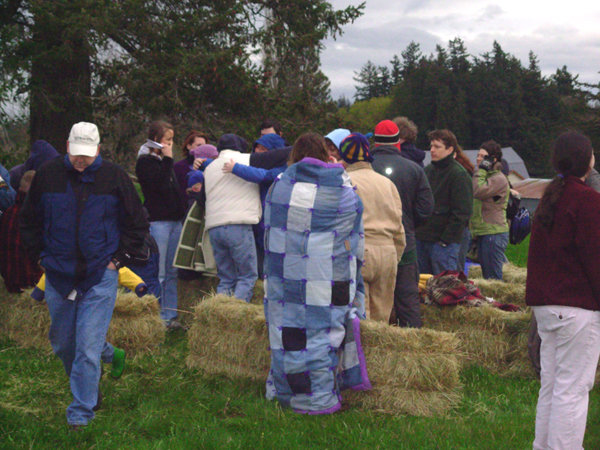
Formal worship moved to nearby towns, yet the Easter Sunrise Service tradition remains alive on our farm. Cherished by local families and neighborhood folk, some of whom have attended since they were children, this service is never canceled for any reason–not rain, not northeasters, not even the occasional Easter snow shower. If it is too stormy to be outside on the hill, the service takes place in the big red hay barn. In either setting, a tiered row of rough stickery hay bales, theater style, creates a semicircle of seats ready and waiting for the intrepid faithful who come annually to celebrate Christ’s resurrection, huddled together for warmth under blankets.

Each year a different Resurrection theme is explored through Bible readings and hymn singing. One year, it was noted how God has walked with His people since the beginning of time. First, in the Garden, He is “walking… in the cool of the day”  looking for Adam and Eve, but after the Resurrection, Jesus walked with the men to Emmaus. Because of Jesus, we go from hiding from God as He walks in the garden, ashamed of the forbidden meal we have eaten, to Emmaus where we walk alongside Him, invited to join Him as He shares with us the Bread of Life.

We are called to worship Him: from knowing dread to being fed.

Hay bale pews don’t create the most comfortable seating for worship. They poke us where we are most tender. Yet it is good to be reminded from where true comfort arises. Even when in shame we hide from Him, even when we do not recognize Him as He walks alongside us, our hearts burn for Him.

And He feeds us wherever we gather.

Amen!

n148300158_30161398_79231n148300158_30161401_51663


Not Playing Possum

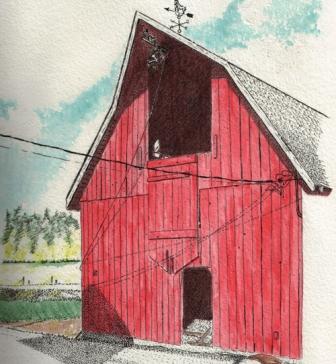
Painting of our old barn by our friend Dick Laninga

We are preparing for the Sunday Easter Sunrise service our farm has hosted for most of the last 30 years.  Ordinarily, this gathering of neighborhood families takes place on our hilltop open field overlooking the Canadian mountains to the north, the valley reaching out to Puget Sound to the west and to Mt. Baker and the Twin Sisters peaks to the east.  However, every few years, the weather is foul enough to drive us into the hay barn to worship, so we need to always plan for that contingency and have the barn ready if we wake up to rain Sunday morning.

There still is considerable summer hay stored in our large red barn, so it takes some organizing of the bales to create a seating arrangement for 70+ people.  Once we started moving bales around this week, it became quite apparent that we had a visitor who had decided to make the barn home and ended up not leaving.  Something had definitely died in there. The smell hung thick and pervasive, clinging to us and refusing to be ignored.

We eventually found the source: a dead opossum.  Not just pretending either–no ‘playing possum’.  Truly, utterly, completely, and sincerely dead. Tucking himself between hay bales, he must have gone to sleep and forgotten to wake up.   Having lost his hiding place and his life, we needed badly to find him a final resting place so the air could clear between now and Easter, in case our worship is in the barn.  Somehow the stench of death is just not fitting in the celebration of life on Easter morning.

Yet overcoming death is what it is all about.

Mr. Opossum is now resting in the ground and our noses are no longer assaulted by his untimely death.  Instead we now must prepare for an all-out spiritual assault on our souls this week.  Being reminded of rotting flesh is rather helpful right before Easter.  Death is an overwhelming reality to each of us; how can we begin to imagine its defeat?  Death cannot be faked like some startled opossum temporarily gone floppy.

Where is death’s victory, where is its sting/stink?  No longer in our barn and no longer for us !

We are renewed instead of being unceremoniously disposed of–not buried in the deep pit we deserve.

We are saved, preserved and graciously restored.


On the Trail of Trillium

trillium2

Spring is already in full swing here on the farm.  Grass grows so fast that mowing once a week is not sufficient,  dandelions are dotting the fields in a yellow carpet, the flowering plums and cherries are peaking, the daffodils are in full bloom and the tulips are coming up fast.  The goldfish in our pond have decided to surface from underneath all the winter debris and have grown to a shocking 8 or 9 inches over the winter and now are busy feasting on mosquito larvae as the insects have awakened as well.   At times I feel so overwhelmed by the accelerated pace of growth and activity that I sheepishly long for the dark quiet gray days of winter, if just for the respite of a nap.

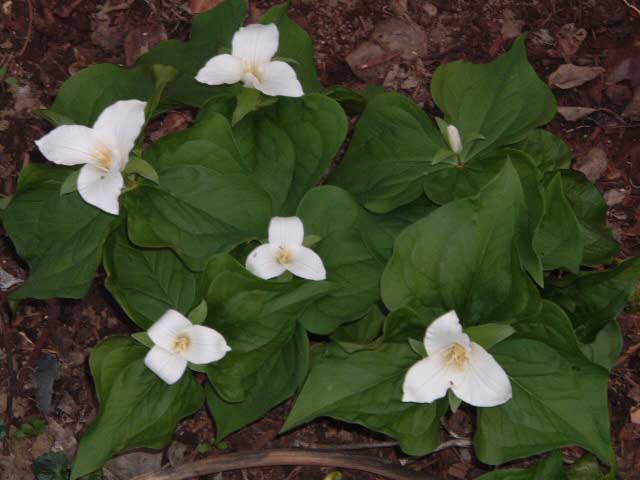
Instead of a nap, I go hunting for trillium.  They are the traditional harbinger of spring and without them, it all seems like just so much pretending.  These are somber plants that will only grow in certain conditions of woods and shade, with leafy mulched soil.  Once established, they reliably spring up from their bulbs every spring with their rich green trio of leaves on each stem that are at once soft and slightly shimmery, and at the top the purest of three white petals, one per leaf cluster.  The blossoms last a week or two, then turn purplish and fade away, followed weeks later by the fading of the foliage, not to spring  again from the soil until the following year.  Picking a trillium blossom necessitates picking the leaf foliage beneath it, and that in turn destroys the bulb’s ability to nourish and regenerate, and the plant never forms again.  I think I have known this from my earliest childhood days as I was a compulsive wildflower gatherer as a little kid, having devastated more than my share of trillium bulbs until I learned the awful truth of the damage I had done.  I have since treated them as sacrosanct and untouchable and have taught that respect in my children.

There are still a few trillium blossoms to be found on our farm, steadfast survivors, yet completely vulnerable to someone’s impulse to bring the beauty indoors for a few days in a vase.  What a tenuous grip on life when people are desiring to pluck them, with their resulting oblivion. How unknowingly destructive we are in our blind selfish pursuit of beauty for our own pleasure and purposes.  These pure triad blossoms and leaves, representing all that is preciously drawn from the earth and enriched and nourished by sunlight, can be obliterated, never to return, never to bloom, never to rise again from the dust.

How much more precious is that which rises again to bloom and flourish forever despite our senseless destructiveness?  And He is here, among us, waiting for us, forgiving us for what we have done.

Trillium have been legendary symbols representing the Holy Trinity of Father, Son and Spirit and I’m reminded of that analogy as our family and larger church family walk through this Holy Week leading to Easter.  We prepare ourselves and our farm for this week’s events–our church’s Thursday evening Bread and Soup supper with communion tonight, then followed by the Tenebrae service Good Friday evening to meditate on the last words of Jesus from the Cross, followed Saturday night by an overnight Easter vigil service around a bonfire on our farm while we “watch and wait”.

Early Sunday morning our neighborhood community meets on our hilltop to celebrate the resurrection of Christ.  We are touched and stricken anew, year after year.

I look at the trillium longingly, wanting to touch them, wanting to own them and hold them, and knowing I never will.  They are meant to stay where they are, as I hope to remain, rooted and thriving for years, yet fragile in the everlasting soil of life.

Alleluia!

Outdoor Easter Sunrise Service on our farm

Easter Sunrise Service at BriarCroft
(formerly Walnut Hill Farm)

sunrise view from our hill

Sunday, April 12, 2009, 7:00 AM Easter Sunrise Service on the hill above our farm

When we purchased Walnut Hill Farm from the Morton Lawrence family in 1990, part of the tradition of this farm was a hilltop non-denominational Easter sunrise service held here for the previous 10+ years.  We have continued that tradition, with an open invitation to families from our surrounding rural neighborhood and communities, as well as our church family from Wiser Lake Chapel, to start Easter morning on our hill with a worship service of celebration of the resurrection of Jesus Christ.

At our annual Easter Sunrise Service in Whatcom County, we develop a different Easter theme each year through use of scripture readings and songs, led by Dan Gibson. We sit on hay bales on the hill for the worship service, followed by breakfast of cinnamon rolls, hot chocolate and coffee in our barn.  As many of the people who attend come from some distance from all over the county, we try to conclude by 8 AM so they may have time to get to morning church services.

We invite all to come to our farm to participate in this traditional service of celebration.  Please dress warmly with sturdy shoes as you will be walking through wet grass to reach the hilltop.  Bring heavy blankets or sleeping bags to wrap up in if it is a chilly morning.  In case of rain, we meet in the big red hay barn on the farm, so we never cancel this service.

If you would like more information and directions, please email us at briarcroft@clearwire.net.

Dan and Emily Gibson– Nate, Ben and Lea