
The Word became flesh.
Ultimate Mystery born with a skull you could crush one-handed.
Incarnation.
It is not tame.
It is not beautiful.
It is uninhabitable terror.
It is unthinkable darkness riven with unbearable light.
Agonized laboring led to it,
vast upheavals of intergalactic space,
time split apart,
a wrenching and tearing of the very sinews of reality itself.
You can only cover your eyes and shudder before it, before this:
“God of God, Light of Light, very God of very God… who for us and for our salvation,” as the Nicene Creed puts it, “came down from heaven.”
Came down.
Only then do we dare uncover our eyes and see what we can see.
It is the Resurrection and the Life she holds in her arms.
It is the bitterness of death he takes at her breast.
~Frederick Buechner from Whistling in the Dark


Down he came from up,
and in from out,
and here from there.
A long leap,
an incandescent fall
from magnificent
to naked, frail, small,
through space,
between stars,
into our chill night air,
shrunk, in infant grace,
to our damp, cramped
earthy place
among all
the shivering sheep.
And now, after all,
there he lies,
fast asleep.
~Luci Shaw “Descent” from Accompanied By Angels

[The Incarnation is like] a wave of the sea which,
rushing up on the flat beach,
runs out, even thinner and more transparent,
and does not return to its source but sinks into the sand and disappears.
~Hans Urs von Balthasar from Origen: Spirit and Fire

Perhaps it is the mystery of the thing that brings us back,
again and again, to read the story of
how God came down and disappeared into us.
How can this be?
God appearing on earth first to animals,
then the most humble of humans.
How can He be?
Through the will of the Father and the breath of the Spirit,
the Son was, and is and yet to be.
O great mystery beyond all understanding.



O magnum mysterium,
et admirabile sacramentum,
ut animalia viderent Dominum natum,
jacentem in praesepio!
Beata Virgo,
cujus viscera meruerunt portare Dominum Christum.
Alleluia!
O great mystery and wondrous sacrament,
that animals should see the new-born Lord lying in their Manger!
Blessed is the Virgin
whose womb was worthy to bear the Lord Jesus Christ.
Alleluia!
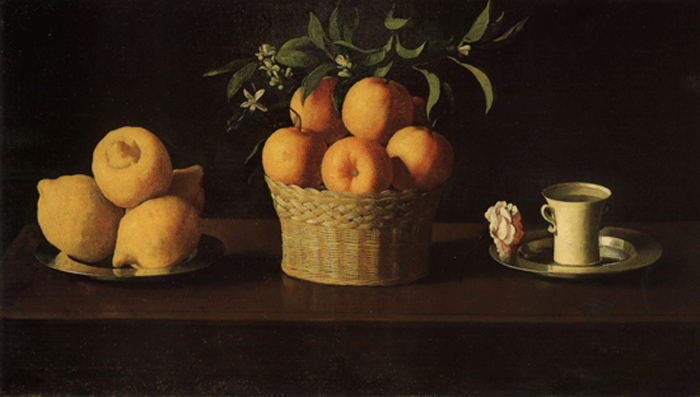
The composer Morten Lauridsen, is a Washington state native who was born only a few miles from where my mother grew up in the wheat fields of the Palouse, and now lives in retirement in the San Juan Islands. He wrote about his inspiration, wanting to compose something that honored the words as much as the Still Life painted by Zurbaran (above) honored the Virgin Mary.
In Lauridsen’s own words:
“Zurbarán (1598-1664) is the painter of “Still Life with Lemons, Oranges and a Rose.” The objects in this work are symbolic offerings to the Virgin Mary. Her love, purity and chastity are signified by the rose and the cup of water. The lemons are an Easter fruit that, along with the oranges with blossoms, indicate renewed life. The table is a symbolic altar. The objects on it are set off in sharp contrast to the dark, blurred backdrop and radiate with clarity and luminosity against the shadows.
In composing music to these inspirational words about Christ’s birth and the veneration of the Virgin Mary, I sought to impart, as Zurbarán did before me, a transforming spiritual experience within what I call “a quiet song of profound inner joy.” I wanted this piece to resonate immediately and deeply into the core of the listener, to illumine through sound.
The most challenging part of this piece for me was the second line of text having to do with the Virgin Mary. She above all was chosen to bear the Christ child and then she endured the horror and sorrow of his death on the cross. How can her significance and suffering be portrayed musically?
After exploring several paths, I decided to depict this by a single note. On the word “Virgo,” the altos sing a dissonant appoggiatura G-sharp. It’s the only tone in the entire work that is foreign to the main key of D. That note stands out against a consonant backdrop as if a sonic light has suddenly been focused upon it, edifying its meaning. It is the most important note in the piece.
A scholarly essay about Lauridsen’s composition is here.
Another version by a different composer:
Make a one-time or recurring donation to support daily Barnstorming posts
Make a monthly donation
Make a yearly donation
Choose an amount
Or enter a custom amount
Your contribution is deeply appreciated.
Your contribution is appreciated.
Your contribution is appreciated.
DonateDonate monthlyDonate yearly Barnstorming