Advent Meditation–Bright and Morning Star

There are a few moments between the blackness of a long dark night–something we have plenty of this time of year–and the renewal of the sunrise splash of color that spreads across the sky like spilled paint jars of pink and orange.   Illuminated in those few moments is a transitional dawn-light or daybreak rather than the evening transition of twilight, and that is when the morning “stars” of Mercury and Venus become most visible.  They don’t “twinkle” or appear effervescent like the night stars.  They are solid radiant globes heralding the Sun to come.

The “star” that guides and leads, that points to home, that illuminates the birth of God come to earth as man, that presages the New Day to come.  We are witnesses if we arise early enough, peering through the clouds of everyday troubles, and prepare, ready for the dawning to come.


Revelation 22:16

Witness to Sunrise

rise1rise3rise6rise7

Written in late October 2003 after significant regional flooding

The two constant days of rain (over 3 inches total) stopped during the night and the winds calmed. It was balmy warm and I opened windows during the night because the house felt so stuffy (in mid-October yet!) Though our northern county has been declared in a state of emergency because of extreme flooding of the Nooksack River around the communities of Everson and Lynden, we are high and dry on our hill top farm that overlooks the valley that is waterlogged and trying to recover. Many of our dairy farmer friends are living on farmyards that are now islands, with impassable roads around them, and struggling to get from house to barn to cows in their hip waders.

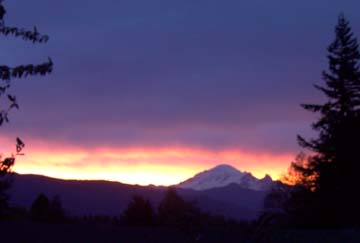
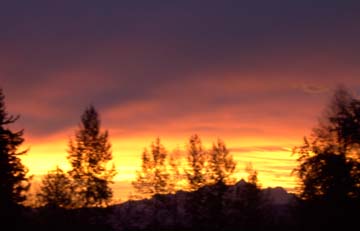
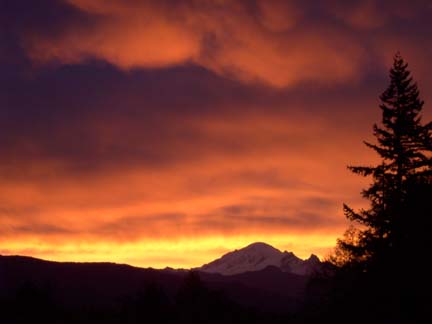
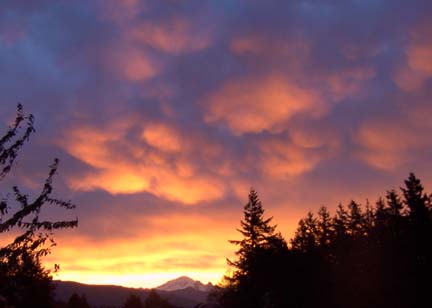
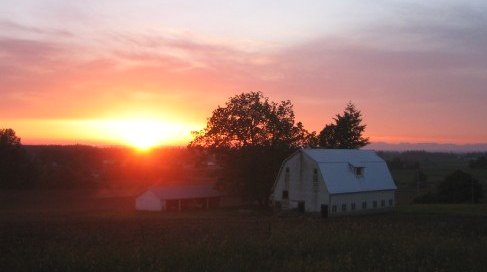
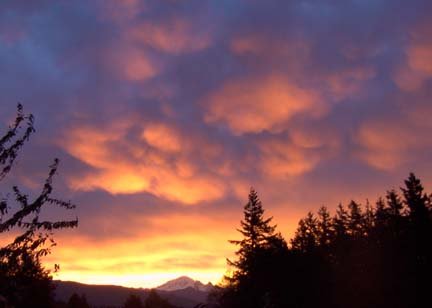
The first hints of orange sunrise this morning began shortly before 7 AM, and rapidly stretched across the eastern horizon north and south, with the colors deepening and spreading across the cloud cover. Mt. Baker and the Twin Sisters started as dark silhouettes against this palette of rich color, then began to show their crags, glaciers and new snow cover as the sun illuminated the clouds above them. The entire farm was cast in an orange glow for a few brief seconds as the color crept higher and higher up the cloud banks overhead. Then it ended as quickly as it began, lasting at most 6 minutes, giving me barely enough time to run to the top of our hill for the best view and to take these photos. Amazingly, all at once, everything returned to gray and ordinary, with no hint of the spectacular show that had just taken place. It could be dismissed so easily but must not be forgotten in our return to the routine of every breath, every step of our daily lives.

I then went back down to the barn to set the Haflingers free from their two days of barn confinement due to the extreme weather conditions we’ve had. They gratefully leaped and danced across the fields, sending up sprays of water as they splashed through new puddles and “instant ponds” created by the storm. Freedom! Fresh air! Fields of green! Joyous and oblivious to what had happened moments before. Living creatures that know only what their needs are for this moment, not concerned for what comes next or what has just been. Uncomplicated and untroubled. Not much like their human stewards at all.

This rare sunrise is encouragement after the events of the previous two days. It can only happen when the clouds become canvas backdrop on which the color is able to be painted–clouds that created havoc, floods, power outages, and injuries only hours before. Then this. Startling, wondrous magnificence beyond imagination. Grace that brings us to our knees, especially when we are mired in our gray troubled ordinariness and plainness.

Drink deeply of this. Hold it, savor it and know that to witness any sunrise is to see the face of God.

The Farm Dream

n148300158_30188070_8736

5145_512481287714_148300158_30504624_8229602_n

This time of year our farm is brilliant, verdant and delicious to behold.  The cherry orchard blossoms yield to fruit and the pastures are knee high with grass.  By mid-June, the daylight starts creeping over the eastern foothills at 4 AM and the last glimpse of sun disappears at nearly 10 PM.   So many hours of light to work with!  I yearn for a dark rainy day to hide inside with a book.  Instead the lawnmower and weed whacker call my name, and the fish pond needs cleaning and the garden must be weeded.  It’s not that things don’t happen on the farm during months like this.  It’s just that nothing we do is enough.  Blackberry brambles have taken over everything, grass grows faster than we can keep it mowed down, the manure piles spread on the fields in May are growing exponentially again.  The fences always need fixing.  The stall doors are sticking and not closing properly.  Foals have gotten large and strong without having the good halter lessons they needed when they were much smaller and easier to control.   The supply of bedding shavings is non-existent due to the depressed lumber industry, so our shavings shed is bare and old hay is now serving as bedding in the stalls. The weather has become iffy in the last week so no string of days has been available for hay cutting– we are low on the priority list of the local dairy man who cuts and bales our hay,  so we may not have anything but junk hay in the barn this winter in a year when hay will cost a premium.  No one is buying horses in this economy, not even really well bred horses, so we are no longer breeding our stallion and mares, and for the first time in 18 years, have made the painful decision not to be part of our regional fair.

Suddenly our farm dream seems not nearly so compelling.

We have spent many years dreaming about the farm as we hoped it would be.  We imagined the pastures managed perfectly with fencing that was both functional and beautiful.  Our barns and buildings would be tidy and leak-proof, and the stalls secure and safe.  We’d have a really nice pick up truck with low miles on it, not a 25 year old hand me down truck with almost 200,000 miles. We would have trees pruned expertly and we’d have flower beds blooming as well as a vegetable garden yielding 9 months of the year.  Our hay would never be rained on. We would have dogs that wouldn’t run off and cats that would take care of all the rodents.  We wouldn’t have any moles, thistles, dandelions or buttercup.  The pheasant, deer, coyotes, raccoons, and wild rabbits would only stroll through the yard for our amusement and not disturb anything.  We’d have livestock with the best bloodlines we could afford and a steady demand from customers to purchase their offspring at reasonable prices so that not a dime of our off-farm income would be necessary to pay farm expenses.   Our animals (and we) would never get sick or injured.

And our house would always stay clean.

Dream on.  Farms are often back-breaking, morale-eroding, expensive sinkholes.   I know ours is.  Yet here we be and here we stay.

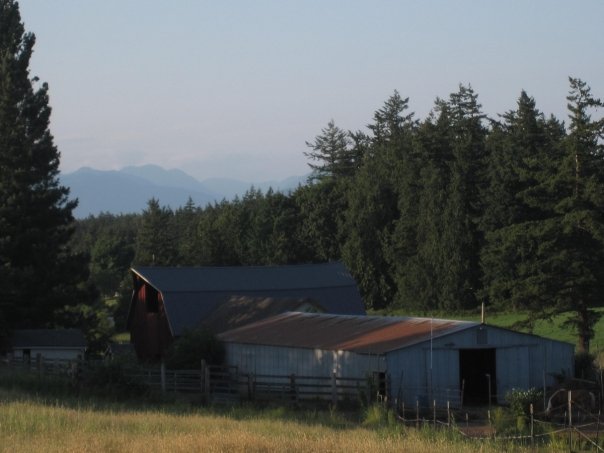
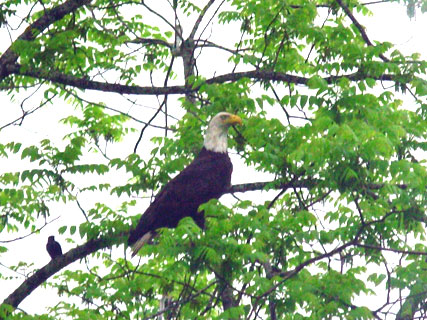
It’s home.  We’ve raised three wonderful children here.  We’ve bred and grown good horses and great garden and orchard crops and tons of hay from our own fields.  We breathe clean air and daily hear dozens of different bird songs and look out at some of the best scenery this side of heaven.  Eagles land in the trees in our front yard. It’s all enough for us even if we are not enough for the farm.  I know there will come a time when the farm will need to be a fond memory and not a daily reality.  Until then we will keep pursuing our dream as we and the farm grow older.   Dreams age and mature and I know now what I dreamed of when I was younger was not the important stuff.

We have been blessed with one another, with the sunrises and the sunsets and everything in between.  This is the stuff of which the best dreams are made.

1eagle

Hay Bale Pews

n148300158_30161194_6704

Where His people gather, He is.

On the road to Emmaus, men walked alongside Jesus without recognizing him, their hearts “burning within” them as He spoke, yet did not know Him until he broke bread and fed them. Worship and wonder does still take place in unlikely places alongside country roads.

Our farm is along such a road amidst rolling hills of evergreens and fields, next to a crossroads where 100 years ago sat the village of Forest Grove. This small settlement boasted a one room school house, a general store, a saw mill and a small Methodist church. Families would travel by horse and buggy to attend Sunday morning services, and during good weather, would picnic together on our farm’s nearby hill top to enjoy the expansive view. And every Easter, the small congregation would gather on the hill for a service at sunrise.

When the sawmill closed 80 years ago, the village shut its doors as well. The buildings were dismantled; the beams and timbers were transformed into our large hay barn and the humble little church became our farm’s chicken coop, long and narrow with smooth fragrant cedar lined walls and rough fir floors. Hens lay their eggs to the echoes of sacred hymns still resonating in those walls and floor.

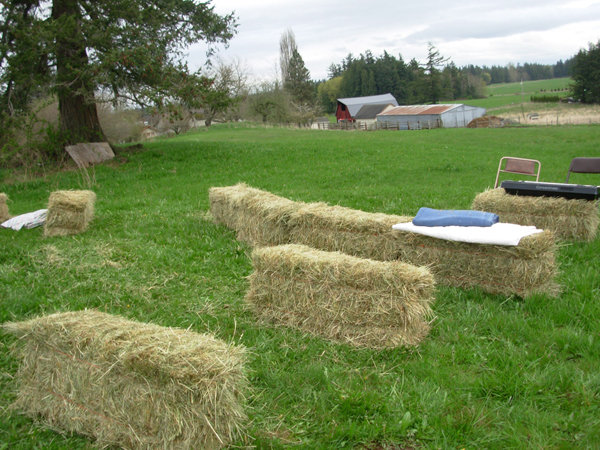
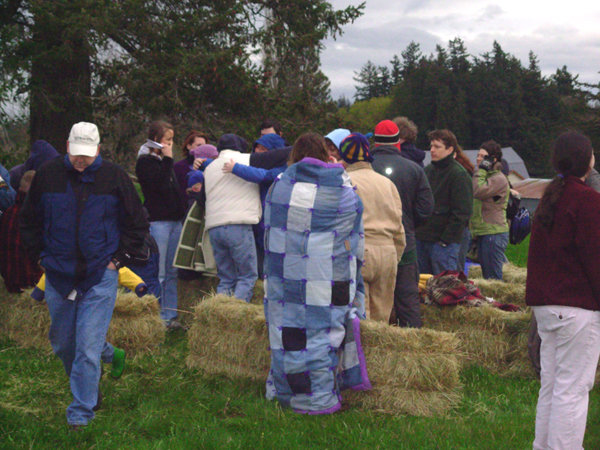
Formal worship moved to nearby towns, yet the Easter Sunrise Service tradition remains alive on our farm. Cherished by local families and neighborhood folk, some of whom have attended since they were children, this service is never canceled for any reason–not rain, not northeasters, not even the occasional Easter snow shower. If it is too stormy to be outside on the hill, the service takes place in the big red hay barn. In either setting, a tiered row of rough stickery hay bales, theater style, creates a semicircle of seats ready and waiting for the intrepid faithful who come annually to celebrate Christ’s resurrection, huddled together for warmth under blankets.

Each year a different Resurrection theme is explored through Bible readings and hymn singing. One year, it was noted how God has walked with His people since the beginning of time. First, in the Garden, He is “walking… in the cool of the day”  looking for Adam and Eve, but after the Resurrection, Jesus walked with the men to Emmaus. Because of Jesus, we go from hiding from God as He walks in the garden, ashamed of the forbidden meal we have eaten, to Emmaus where we walk alongside Him, invited to join Him as He shares with us the Bread of Life.

We are called to worship Him: from knowing dread to being fed.

Hay bale pews don’t create the most comfortable seating for worship. They poke us where we are most tender. Yet it is good to be reminded from where true comfort arises. Even when in shame we hide from Him, even when we do not recognize Him as He walks alongside us, our hearts burn for Him.

And He feeds us wherever we gather.

Amen!

n148300158_30161398_79231n148300158_30161401_51663


Outdoor Easter Sunrise Service on our farm

Easter Sunrise Service at BriarCroft
(formerly Walnut Hill Farm)

sunrise view from our hill

Sunday, April 12, 2009, 7:00 AM Easter Sunrise Service on the hill above our farm

When we purchased Walnut Hill Farm from the Morton Lawrence family in 1990, part of the tradition of this farm was a hilltop non-denominational Easter sunrise service held here for the previous 10+ years.  We have continued that tradition, with an open invitation to families from our surrounding rural neighborhood and communities, as well as our church family from Wiser Lake Chapel, to start Easter morning on our hill with a worship service of celebration of the resurrection of Jesus Christ.

At our annual Easter Sunrise Service in Whatcom County, we develop a different Easter theme each year through use of scripture readings and songs, led by Dan Gibson. We sit on hay bales on the hill for the worship service, followed by breakfast of cinnamon rolls, hot chocolate and coffee in our barn.  As many of the people who attend come from some distance from all over the county, we try to conclude by 8 AM so they may have time to get to morning church services.

We invite all to come to our farm to participate in this traditional service of celebration.  Please dress warmly with sturdy shoes as you will be walking through wet grass to reach the hilltop.  Bring heavy blankets or sleeping bags to wrap up in if it is a chilly morning.  In case of rain, we meet in the big red hay barn on the farm, so we never cancel this service.

If you would like more information and directions, please email us at briarcroft@clearwire.net.

Dan and Emily Gibson– Nate, Ben and Lea

‘Tis the Season to be Grumbly

baker_sunset

Originally written in December 2003–in the last week, with all the avalanche news and tragic deaths, I remembered this story in particular and thought I’d share it.

We are in our darkest of dark days today in our corner of the world–about 16 hours of darkness underwhelming our senses, restricting, confining and defining us in our little circles of artificial light that we depend on so mightily. Yesterday, we had a sudden power outage at home around 5 PM, and our bright, noisy, Christmas-tree-lit carol-playing house was suddenly plunged into pitch blackness and silence. Each family member groped around blindly, looking for elusive candles and flashlights in the dark, each running our toes and knees into things, and then found that each of us had to share a little circle of light to navigate. Dinner, which was almost ready in the oven, was eaten gratefully by candlelight, and became a sacrament of sorts as we huddled around our advent candles, now burning out of necessity, not just in a ceremony of anticipation.

The light this morning is just now finally coming up in the southeastern sky, blending the gray of the ubiquitous clouds with the mist over the fields and barns here on the farm and over the mountain peaks and waters of the bay in the distance. Even the Haflingers are gray in this light. It all melts together with the deep green of the forests and fields–a blended water-saturated pallet struck by rays of piercing rosy light here and there, creating alpenglow on the distant mountain snow, and sporadic pools of brightness in our barnyard.

It is so tempting to be consumed and lost in these dark days, stumbling from one obligation to the next, one foot in front of the other, bumping and bruising ourselves and each other in our blindness. Lines are long at the stores, impatience runs high, people coughing and shivering with the spreading flu virus, others stricken by loneliness and desperation. So much grumbling in the dark.

I had a conversation with a remarkable young college student recovering at the hospital this week reminding me about the self-absorbance of grumbling. A week ago she was snowshoeing with two companions in the bright sun above the clouds at the foot of nearby Mt. Baker. A sudden avalanche buried all three–she remembers the roar and then the deathly quiet of being covered up, and the deep darkness that surrounded her. She was buried hunched over, with the weight of the snow above her too much to break through. She had a pocket of air beneath her and in this crouching kneeling position, she could only pray–not move, not shout, not anything else. Only God was with her in that small dark place. She believes that 45 minutes later, rescuers dug her out to safety from beneath that three feet of snow. In actuality, it was 24 hours later but she had been wrapped in the cocoon of her prayers, and miraculously, kept safe and warm enough to survive. Her hands and legs, blackish purple when she was pulled out of the snow, turned pink with the rewarming process at the hospital, and a day later, when I visited her, she glowed with a light that came only from within–it kept her alive.

One of her friends died in that avalanche, never having a chance of survival because of how she was trapped and covered with the suffocating snow. The other friend struggled for the full 24 hours to free himself, bravely fighting the dark and the cold to reach the light, courageously finding help to try to rescue his friends.

At times we must fight with the dark–wrestle it and rale against it, being bruised and beaten up in the process, but so necessary to save ourselves and others from being consumed. At other times we must kneel in the darkness and wait– praying, hoping, knowing the light is to come, one way or the other. Grateful, grace-filled, not grumbling.

May the Light find you this week in your moments of darkness.

Ordinary to Extraordinary and Back Again

Nate Gibson's photo of our woods

Today was typical of most dark December winter mornings. I am an early riser but procrastinate indoors, reading and responding to emails, fixing coffee, eating my breakfast, and making the walk to the mailbox in pitch dark to get the newspaper. I don’t like doing barn chores in the dark if I can avoid it, so I try to postpone until there is at least a little light peeking over the foothills to the east. I keep one eye out the kitchen window as I sit reading at the table, watching for Mount Baker to slowly appear in silhouette as dawn approaches, knowing that is my signal to get dressed and go out to feed the farm critters.

I wasn’t prepared for what this morning brought. Given the number of things I needed to attend to today post-Christmas, I was more than a little preoccupied. As I sat with my nose buried in the newspaper, and my mouth full of oatmeal, outside the hills began to glow orange along their snowy crest, as if a flame had been lit and was spreading from the shadows. It caught me unaware, appearing in the periphery of my vision. I had to shake myself from my preoccupation to stop what I was doing and gaze awestruck at the spectacle. I quickly realized I was missing the opportunity to capture this brilliance on my camera to save and share. The orange paintbrush strokes were reaching higher in the sky, bathing the glaciers of Mount Baker and stretching down to the Twin Sisters peaks to the south. It was startling transformation of the ordinary to the extraordinary.

By the time I’d grabbed my camera, exchanged slippers for muck boots and then raced outside in my bathrobe to capture it, it was gone. In under 2 minutes the sky had faded to gray, the mountains and countryside snowy white again and all became ordinary. It was as if it had never happened and I would never have any proof that it did.

Yet I write about it because for a few moments glory shone right in my own back yard and it shone on me. But I have no “proof.”

We don’t have photos of what the shepherds saw that night when the angel of the Lord came to them and glory shone all around them. We don’t know what the heavenly host looked or sounded like but we know their timeless words of “peace on earth, good will toward men”. We know that the angels then left the shepherds to stand awestruck in their fields, and all became ordinary again. Yet the shepherds themselves had been transformed. They had experienced glory, compelled to tell others what they had seen and heard though they were neither gregarious nor articulate nor even valued members of society.

The shepherds were most unlikely witnesses of that first Christmas eve and we remain unlikely witnesses each subsequent day. The glory shines all around us but we tend to remain preoccupied, too busy to notice and therefore unable to appreciate what has been given to us.

Nothing can be ordinary again as we have been transformed. For unto us a child is born and a Son is given.