Dismissed in Peace

wedding

Seventy two years ago this week, my parents were married. Christmas Eve certainly wasn’t a typical wedding anniversary, but it did make it easy to remember during their years together. It was a date of necessity, only because a justice of the peace was available to marry a score of war-time couples in Quantico, Virginia, shortly before the newly trained Marine officers were shipped out to the South Pacific to fight in WWII.

Now that they are both gone, when I look at their young faces in their only wedding portrait, I see a hint of the impulsive decision that led to that wedding just a week before my father left for 30 months. They had known each other for over a year, had talked about a future together, but with my mother starting a teaching job, and the war potentially impacting all young men’s lives very directly, they had not set a date.

My father had to put his college education on hold to enlist, knowing that would give him some options he wouldn’t have if drafted, so they went their separate ways as he headed east to Virginia for his Marine officer training, and Mom started her high school teaching career as a speech and drama teacher in rural Colville in Eastern Washington. One day in early December, he called her and said, “If we’re going to get married, it’ll need to be before the end of the year. I’m shipping out the first week in January.” Mom went to her high school principal, asked for a two week leave of absence which was granted, told her astonished parents, bought a dress, and headed east on the train with a friend who had received a similar call from her boyfriend. This was a completely uncharacteristic thing for my overly cautious mother to do so it must have been love.

They were married in a brief civil ceremony with another couple as the witnesses. They stayed in Virginia only a couple days and took the train back to San Diego, and my father left. Just like that. Mom returned to her teaching position and the first three years of their married life was letter correspondence only, with gaps of up to a month during certain island battles when no mail could be delivered or posted.

As I sorted through my mother’s things following her death six years ago, their letters to each other, stacked neatly and tied together, reside now in a box in my bedroom. I have not yet opened them but will when I’m ready. What I will find there will be words written by two young people who could not have foretold the struggles that lay ahead for them during and after the war but who both depended on faith and trust to persevere despite the unknowns. The War itself seemed struggle enough for the millions of couples who endured the separation, the losses and grieving, as well as the eventual injuries–both physical and psychological.  It did not seem possible that beyond those realities, things could go sour after reuniting.

The hope and expectation of happiness and bliss must have been overwhelming, and real life doesn’t often deliver.  After raising three children, their 35 year marriage fell apart with traumatic finality.  When my father returned (again) over a decade later, asking for forgiveness, they remarried and had five more years together before my father died.

And so too there must have been expectations of happiness in the barn on that first Christmas Eve. It must have been frightening for the parents of this special Baby, knowing in their minds but not completely understanding in their hearts what responsibility lay in their arms. They had to find faith and trust, not just in God who had determined what their future held, but in each other, to support one another when things became very difficult. Those challenges mounted up quickly: there was to be no room for them, there was a baby to deliver without assistance from anyone, and the threat of Herod’s murder of innocents eventually drove them from their home country.

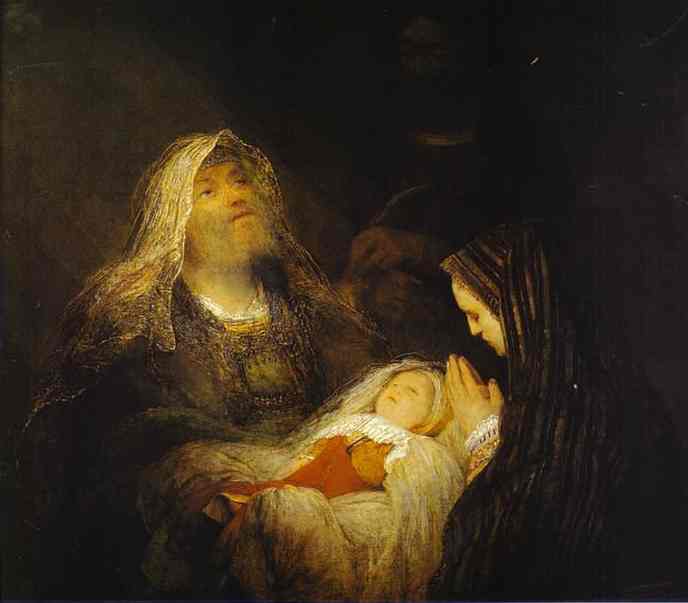
When Mary and Joseph go to the temple for the circumcision and consecration of their son the following week, they allow a “righteous and devout man”, Simeon,  to hold their baby as, moved by the Holy Spirit, he tells them the role this child is to play in the world.  He prays to the Lord, “As you have promised, you now dismiss your servant in peace.  For my eyes have seen your salvation, which you have prepared in the sight of all people, a light for revelation to the Gentiles and for glory to your people Israel.”

It must have been like looking into a crystal ball to hear Simeon speak, as we’re told “the child’s father and mother marveled at what was said about him.” But Simeon didn’t whitewash the reality to come. It would have been easy to do so– simply mention salvation, the light and the glory that will come to the people due to this little baby, but leave out the part about how His existence would cause division in Israel as well as the rejection, anguish and suffering that He would experience. Not only that, but the pain is not His alone but will be His parents’ to bear as well. I’m sure that statement must have ended the sense of “marvel” they were feeling, and replaced it instead with great sorrow and trepidation.

Christmas is a time of joy, a celebration of new beginnings and new life when God became man, humble, vulnerable and tender. But it also gives us a foretaste for the profound sacrifice made in giving up this earthly life, not always so gently. A baby in a manger is a lovely story to “treasure up” in our hearts but once He became a bleeding Redeemer on a cross, it pierces our living beating hearts, just as Simeon foretold.

My parents, such young idealistic adults 72 years ago, now servants dismissed from this life in peace. As I peer at their faces in their wedding photo, I know those same eyes, then unaware of what was to come,  now behold the light, the salvation and the glory~~the ultimate Christmas~~in His presence.

Song of Simeon by Aert De Gelder, a student of Rembrandt

A Little Tepid Pool

photo by Josh Scholten
I know what my heart is like
      Since your love died:
It is like a hollow ledge
Holding a little pool
      Left there by the tide,
      A little tepid pool,
Drying inward from the edge.
~Edna St. Vincent Millay “Ebb”
My mother was my age when my father left her for a younger woman.  For weeks my mother withered, crying until there were no more tears left, drying inward from her edges.
It took ten years, but he came back like an overdue high tide.   She was sure her love had died but the tepid pool refilled, the water cool to the touch, yet overflowing.

Shedding Some Light

I’m a bit confused here.

While more states, including my own, grant the legal right to marry to same sex couples, more and more heterosexual couples are rejecting official marriage that includes a signed “piece of paper”, preferring to bear their children out of wedlock. What one minority segment of U.S. society has fought hard for over several decades, now granted through society’s expanding acceptance and tolerance of diverse lifestyles, the heterosexual majority increasingly deems marriage worthless and to be avoided.

Can someone shed some light on what is going on here?

I’m all for celebrating legal sanctioning of personal commitment. I have seen what happens when there is no commitment to commitment. Without steadfast loyalty, dependability, predictability, and honoring of promises made, relationships flounder and fizzle, descending into selfish silos of an “every person for themselves” approach to life. I watched it happen late in my parents’ marriage as their focus became less on the inherent value of the union of two people who made vows before God to stay together through thick and thin, and more on what’s best for the individual when needs go unmet. Any divorce is heartbreaking and painful, but the implosion of a 35 year marriage is truly tragic and unnecessary. Ironically, their original commitment reignited ten years later as they married again for the last few years of my father’s life.

There are now too many scarred and scared young people unwilling to take the step of marriage, having grown up inside the back and forth visitation homes of divorce or in a home offering no significant modeling of long term emotional commitment. Even monogamous devotion to a new sexual partner is seen as unnecessarily restrictive, while an unplanned new life conceived within that relationship becomes too easily postponed until it is “convenient” for the unprepared parents. We have forgotten what promises mean, what stability represents to a relationship and children, how trusting obedience to the longevity of the union should trump short term individual desires.

My clinic day increasingly is filled with the detritus of failed and failing relationships. Too many of my young adult patients who describe symptoms of depression and anxiety struggle with whether they want to continue to live at all, sometimes expressing their misery in escalating self harming behaviors or anesthetizing with alcohol or recreational drugs. They describe the chaos of parents living sequentially with multiple partners, of no certain “home” outside their school dorm or apartment, unsolvable complications with half- and step- sibling relationships, and all too frequently financial uncertainty. Many grew up supervised by TV and computer games rather than being held accountable to (mostly absent) parental expectations. They are more comfortable with on-line communication than risk being truthful about who they really are with flesh and blood people they see every day. They fear failure as they have seldom been allowed to make mistakes and subsequently experience forgiveness and grace from those who love them. They are emotional orphans.

In short, they know little about how love manifests through self-sacrifice and faithfulness.

Keeping commitment becomes the light that illuminates our lives, as reliable as the fact the sun rises every morning.

At least on that we can depend.

A Shared Nest

It’s spring. My dove just hatched her single egg yesterday after two weeks of faithful brooding.   I was puzzled when I approached the dove house as she was in the outside enclosure sunning herself for the first time in those two weeks.  Inside, on the nest, her mate was dutifully taking his turn sitting atop the hatchling, making sure the little naked baby didn’t get cold in the brisk morning temperature.  He was giving her a break from her 24/7 job yet he himself had been her constant companion during those two weeks, sitting on a perch where he could watch her and protect her and the egg if the need arose.    Who was going to give him a break from his vigilance?

They are monogamous and committed partners, these two.  It does my heart good to see such instinctive drive to cooperate together to raise the next generation.  There are a few species who prove over and over again how beneficial it is when two parents work together to raise the young.  I’m not always sure humans are one of those species.  Monogamy is taking a heavy beating in today’s society.

More children are born out of wedlock now than to married parents.  More children grow up in single parent homes than in homes with two parents.  More children are left alone to their own care, or to the care of the internet or television than at any time in history.  They are raising themselves~~disastrously.  There is no one sitting on the nest.

In the mean time the adults are struggling to sort out just what they want for themselves.  While one segment of society is fighting hard for the legal right to get married (and of course divorced),  a majority of heterosexuals are increasingly rejecting legal marriage in favor of a  “roommates with benefits” arrangement.  No harm, no foul.  Those who do spend an average of $20,000 for a wedding ceremony and reception can anticipate a 45% divorce rate within fifteen years.  Not a great return on investment.  I wouldn’t gamble that kind of money.

A New York Times article this week reported on the increasing divorce rates in rural communities as traditional womens’ roles in the home have been turned on their head by economics, politics, education and changes in moral and spiritual values.  Women are opting out rather than staying put in a relationship that doesn’t meet their expectations.  Some are taking their children with them, others choose to leave them behind.  The article is disturbing enough to read, but even more so the hostile and vitriolic comments about marriage and monogamy that follow the article.  My comment in defense of the covenant implied in marriage vows, which takes precedence over the desires of the individual, was a distinct minority view.  Most people want their “pursuit of happiness” to include escaping the bonds of marriage if that is what it takes.  I once attended a wedding where the couple’s vows were “as long as we both shall will.”  Oh really?  And how long might that be?

So just what did they expect?  The princess wedding dress and crisp tuxedo suit with a half dozen attendants along with the anticipation of “happily ever after” is not enough to carry a couple through many sleepless nights, baby poop and toddler vomit, pounds gained and jobs lost.  It can be an interminable tough slog.  It’s not long before it isn’t fun and fantasy anymore, the passion is past, and it is hard work to stay together.  Some people move on, still looking for happily ever after, wherever they may find it: in material possessions, in status and income, in another partner’s bed, in a bottle, or in the haze of smoked substances.

I’m blessed to be bound nearly thirty years in marriage to someone who I celebrate every day, even in the times when it is work to share our nest.  When I look at my dove’s devoted partner, I see that same protective look that I see in my husband’s eyes in his commitment to stay by my side no matter what, helping to raise our youngsters until they fly from our nest to their own adventures and someday families.  And I am committed to stay with him,  just as we said in our vows to each other (from Thomas Hardy): “And at home by the fire, whenever you look up there I shall be— and whenever I look up, there will be you.”

When our nest is empty, now only in a matter of a few months, we will still have one another to keep us warm.

Happily together ever after, as long as we both shall live.

Straddling Two Rooms

In 1959, when I was five years old, our family moved from an older 3 story farm house in a rural community east of Stanwood, Washington, to a rambler style home on seven acres just outside the city limits of Olympia, Washington.  It was a big adjustment to move to a much smaller house without a basement or upper story, no garage, and no large haybarn nor chicken coop.  It meant most things we owned didn’t make the move with us.

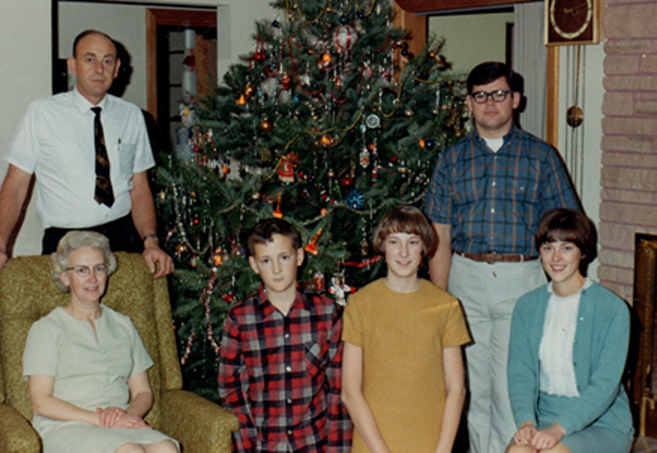
The rambler had side by side mirror image rooms as the primary central living space sitting between the kitchen on one side and the hallway to the bedrooms on the other.  The living room could only be entered through the front door and the family room was accessed through the back door with a shared sandstone hearth in the center, containing a fireplace in each room.  The only opening between the rooms had a folding door which was shut most of the year.  In December, the door was opened to accomodate the Christmas tree, so it was partially in the living room and depending on its generous width, spilling over into the family room.  That way it was visible from both rooms, and didn’t take up too much floor space.

The living room, because it contained the only carpeting in the house, and our “best” furniture,  was sacrosanct.  In order to keep our two matching sectional knobby gray fabric sofas,  a green upholstered chair and gold crushed velvet covered love seat in pristine condition, the room was to be avoided unless we had company or for some very specific reason, like practicing the piano that sat in one corner.    The carpet was never to develop a traffic pattern, there would be no food, beverage, or pet ever allowed in that room, and the front door was not to be used unless a visitor arrived.  The hearth never saw a fire lit on that side, only on the family room side because of the potential of messy ashes or smoke smell. This was not a room where our family talked loudly, laughed much or roughhoused on the floor.  This was not a room for arguments or games and certainly not for toys. For most of the year, the “living” room was strictly off-limits, not lived in at all. The chiming clock next to the hearth, wound with weighted cones on the end of chains, called out the hours without an audience.

One week before Christmas, a tree was chosen to fit in the space where it could overflow into the family room.  I enjoyed decorating the “family room” side of the tree, using all my favorite ornaments that were less likely to break if they fell on the linoleum floor on that side of the door.

It was as if the Christmas tree itself became divided, with a “formal” side in the living room and a “real life” face on the other side where “living” was actually taking place.  It straddled more than just the two rooms.  Every year that tree’s branches tried to reach out to shelter a family that was slowly, although imperceptibly,  falling apart, like fir needles dropping to the floor.