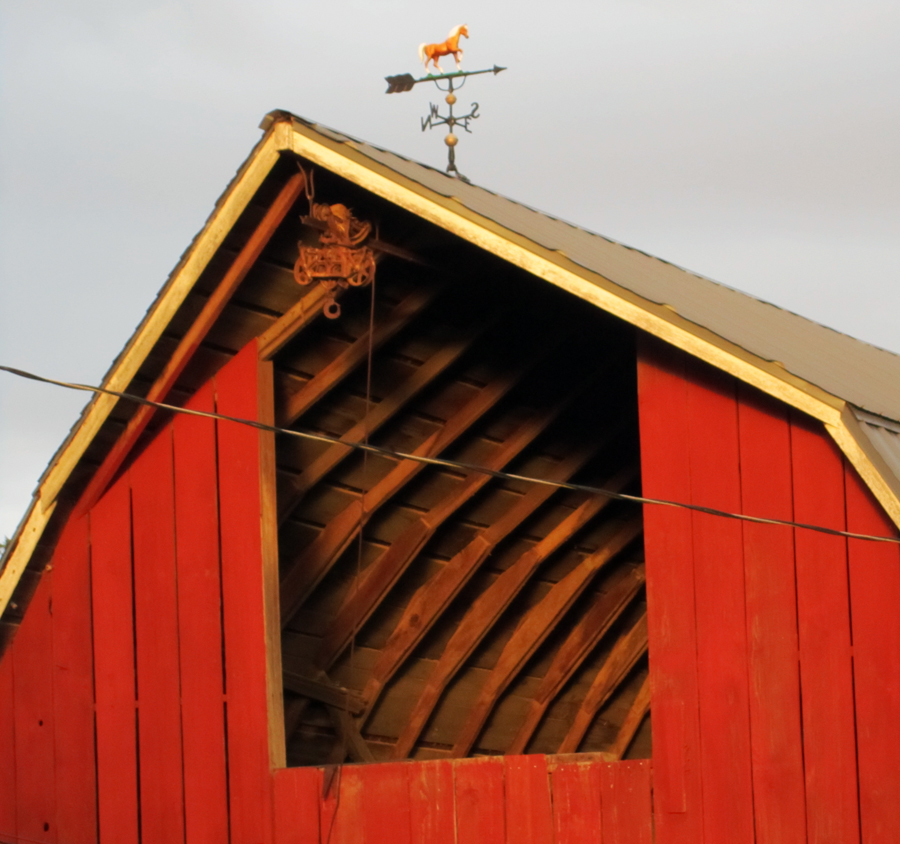
Barn Blaze

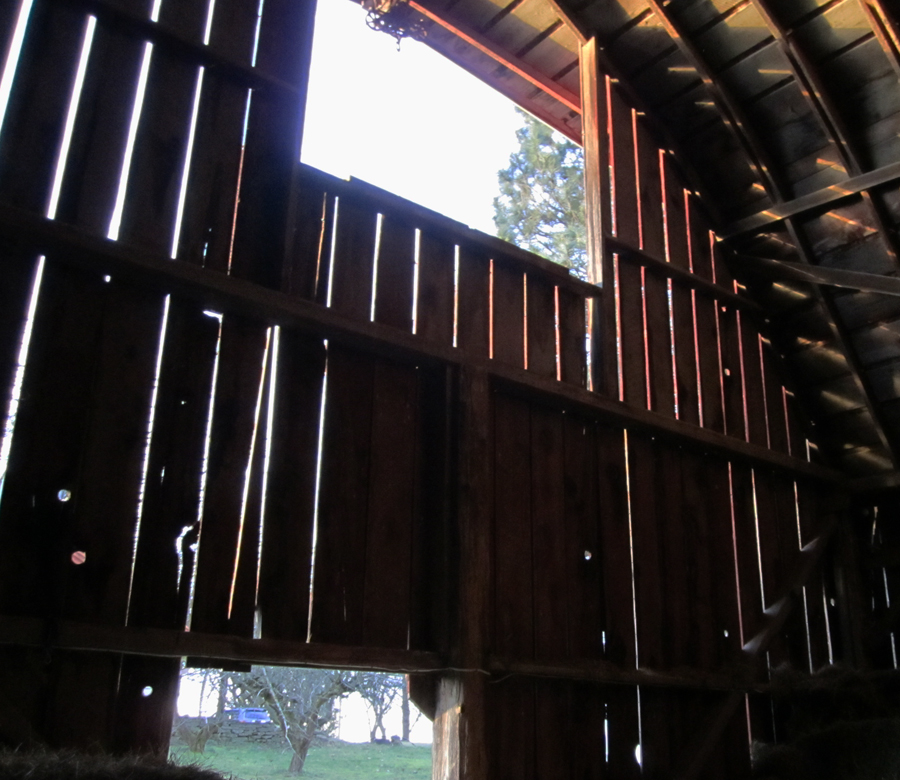
Let the light of late afternoon
shine through chinks in the barn, moving
up the bales as the sun moves down.

Let it come, as it will, and don’t
be afraid. God does not leave us
comfortless, so let evening come.

from “Let Evening Come” by Jane Kenyon
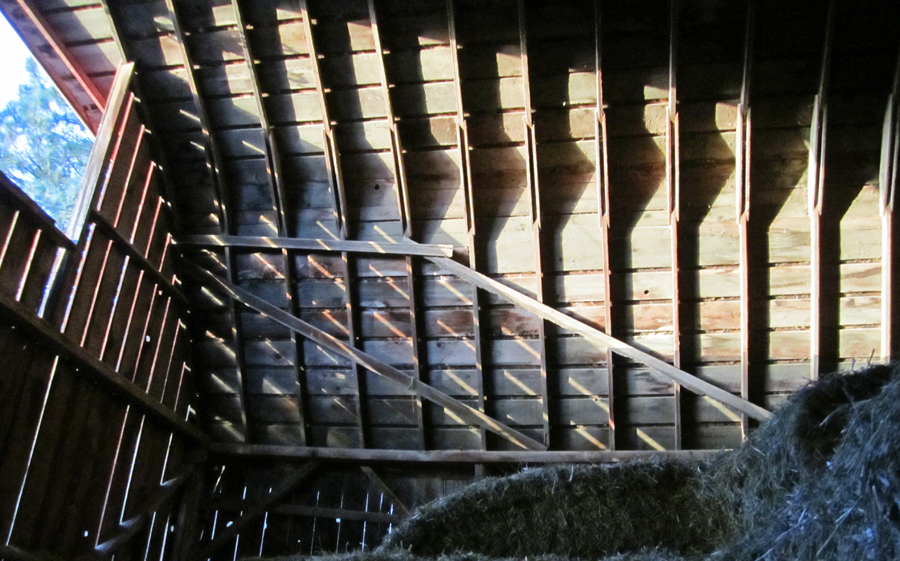
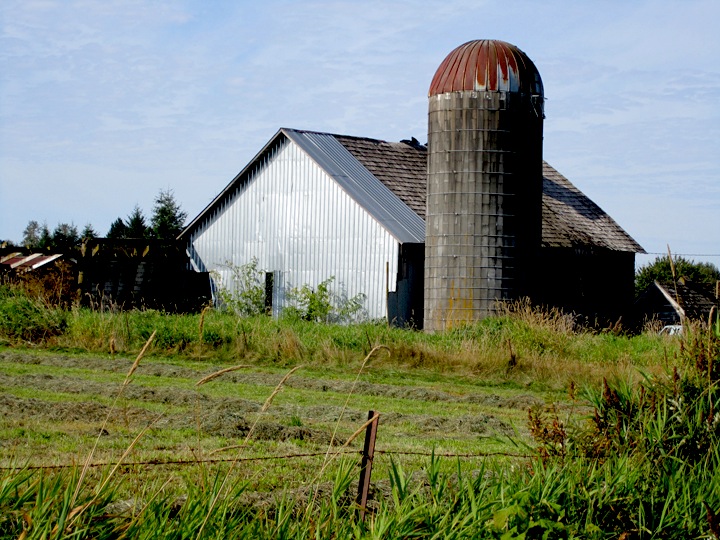
During our northwest winters, there is so little sunlight on gray cloudy days that I routinely turn on the two light bulbs in the big hay barn any time I need to go in to fetch hay bales for the horses. This is to help me avoid falling into the holes that inevitably develop in the hay stack between bales. The murky lighting tends to hide the dark shadows of the leg-swallowing pits among the bales, something that is particularly hazardous when carrying a 60 pound hay bale.

When I went to feed the horses at sunset tonight, I looked up at the lights blazing in the hay barn and went to the light switch to shut them off, but the switch was already off. Puzzled, I realized that lighting up the barn was a precise angle of the setting sun, not light bulbs at all. The last of the day’s sun rays were streaming through the barn slat openings, richocheting off the roof timbers onto the bales, casting an almost fiery glow onto the hay. The barn was ignited and ablaze without fire and smoke which are the last things one would even want in a hay barn. I could scramble among the bales without worry to get my chores accomplished.

It seems even in my life outside the barn I’ve been falling into more than my share of dark holes lately. Even when I know where they lie and how deep they are, some days I will manage to step right in anyway. Each time it knocks the breath out of me, makes me cry out, makes me want to quit trying to lift the heavy loads. It leaves me fearful to even venture out.

Then, amazingly, a light comes from the most unexpected of places, blazing a trail to help me see where to step, what to avoid, how to navigate the hazards to avoid collapsing on my face. I’m redirected, inspired anew, granted grace, gratefully calmed and comforted amid my fears. Even though the light fades, and the darkness descends again, it is only until tomorrow. Then it will reignite again.

The light returns and so will I.
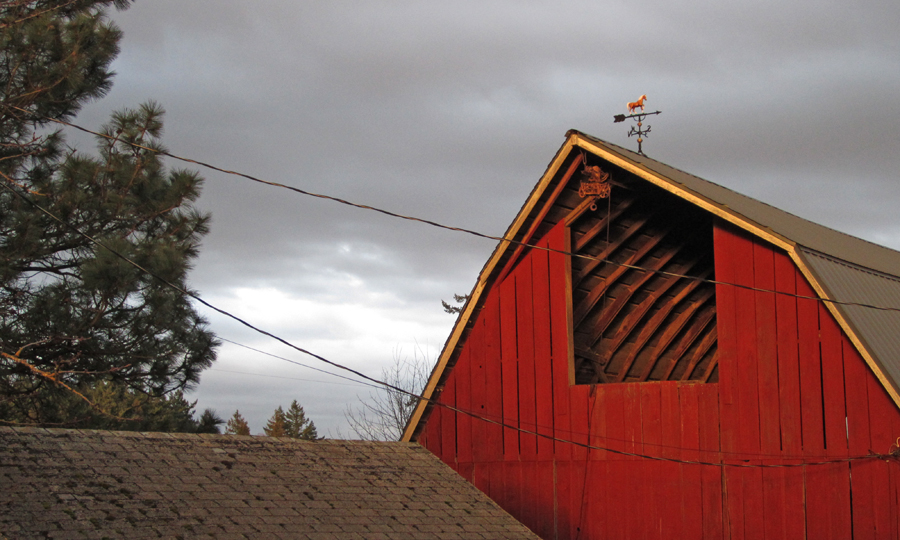
An Advent Tapestry–Lies in Manger Pressed as Hay

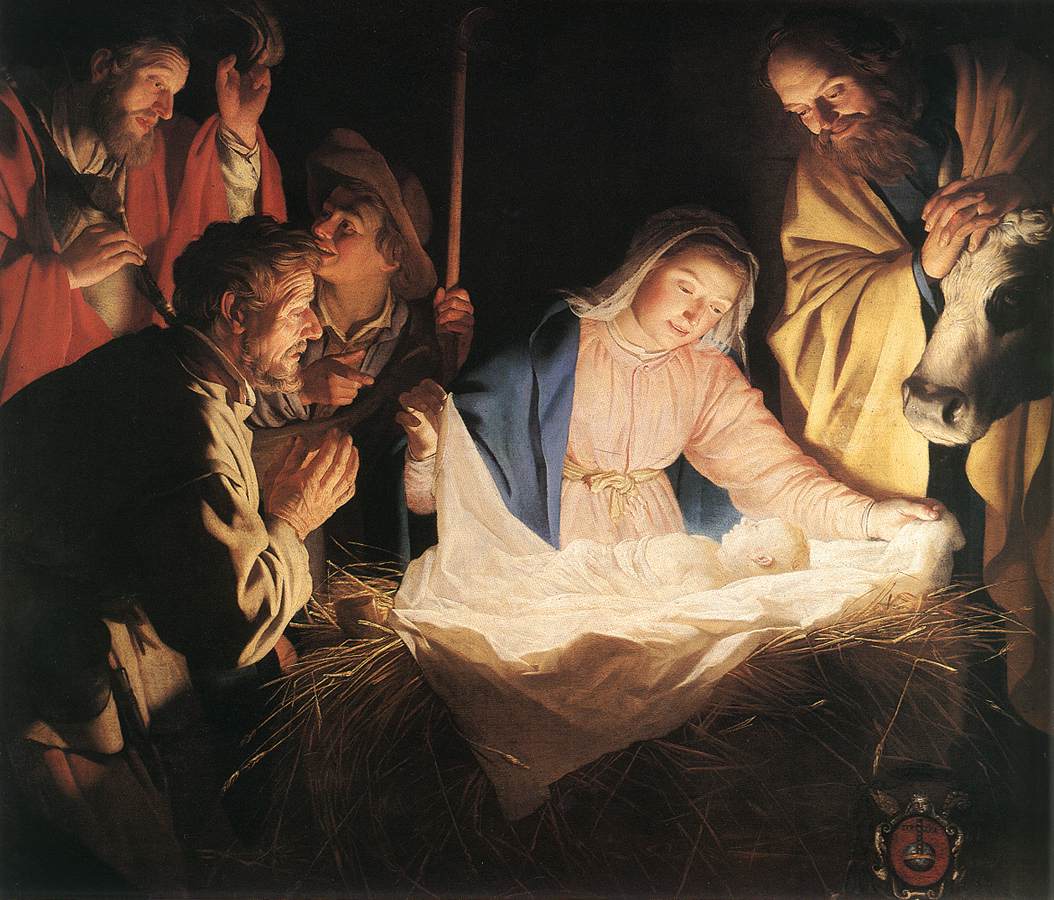
Adoration of the Shepherds by Gerard van Honthorst
Man altered by sin from man to beast;
Beast’s food is hay, hay is all mortal flesh.
Now God is flesh and lies in manger pressed
As hay, the brutish sinner to refresh.
O happy field wherein this fodder grew,
Whose taste doth us from beasts to men renew.
from The Nativity of the Christ  by Robert Southwell, Jesuit poet (1561-1595)
I spent considerable time up in our hay loft today, pulling bales down off the stack, throwing them down to pile up for feed for the horses over the next several days.  This poem by a priest from the 16th century kept resonating in my mind as I remembered the green fields that yielded this hay, gathered by our family and friends on a hot summer’s evening, and placed in the barn so I could do just what I did today.
I have written about hay before, but appreciate Southwell’s concept of God now flesh,  as the hay which forms His bed, refreshes and renews the sinner to righteousness:
Hay crew
Remembered on
Frosty mornings before dawn
When bales are broken for feed
And fragrant summer spills forth.

In the dead of winter
During the darkest blowing icy nights
The bales open like a picture book
Illustrating how life once was,
and will be again~

Rainy spring nights hay
Becomes soft bedding
For new foals’ sleep 

To guarantee sunshine
In the barn
On the darkest of days:
Communion.


Walking Through Stubble

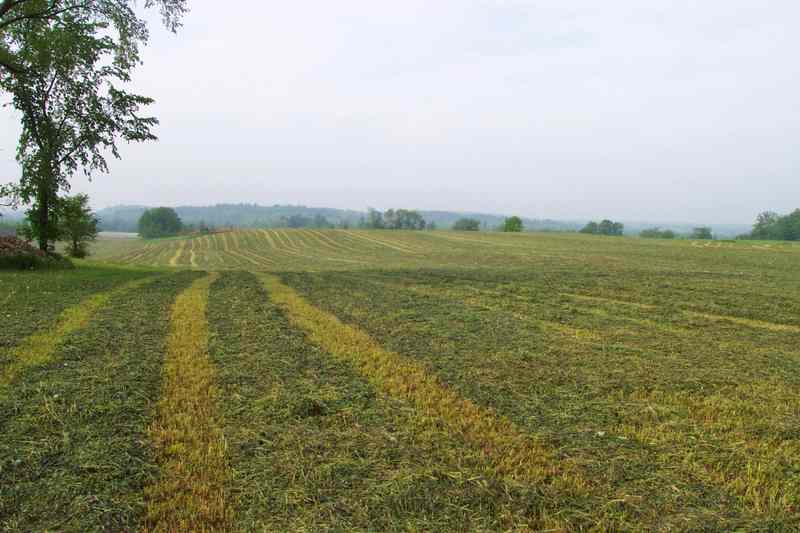
A pass of the blade leaves behind
rough stems, a blunt cut field of
paths through naked slopes and
bristly contoured hollows.

Once swept and stored, the hay stays
baled for a future day, its deep roots yielding
newly tender growth,  tempted forth
by warmth and summer rain.

A full grassy beard sprouts
lush again, to obscure the landscape
rise and fall, conceal each molehill,
pothole, ditch and burrow.

I trace the burgeoning stubble with gentle touch,
fingertips graze the rise of cheek, the swell of upper lip
and indent of dimpled chin with healed scar, the stalwart jaw,
the terrain oh so familiar it welcomes me back home.

September Hay Field

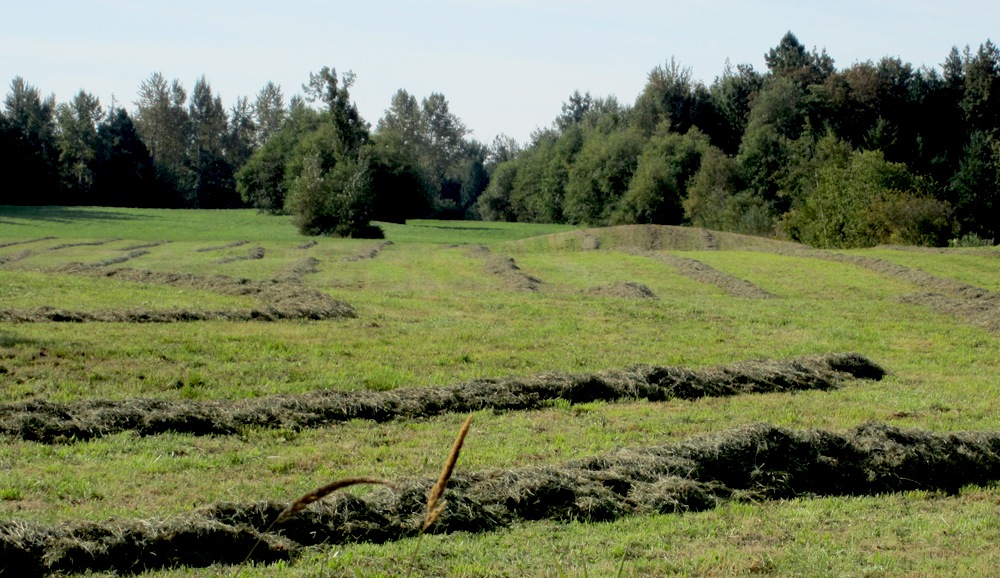
By now the fields have survived
A first, and even second cutting
Mowed and tedded
Raked and baled, scalped clean then
Rained upon in spurts and spells.

The grass blades rise again, reluctant-
Certain of the cuts to come;
No longer brazen, reaching to the sky
With the blinding bright enthusiasm of May and June endless days,
But shorter, gentle growth of late summer golden sunsets.

The third cutting sparse and short as thinning hair
Tender baby soft forage, light in the hands and on the wagon
Precious cargo carried back to the barn;
Fragrant treasure for vesper manger meals
A special Thanksgiving and Christmas Eve gift.

Once again the fields are bare, aching for cover
Which comes as leaves rain and swirl in release,
Winds buffet, offering respite of deepening winter
Snowdrifts, blanketing in silent relief and rest
Until patiently stirred by melting soaking warmth

To rouse again, reaching toward the light.

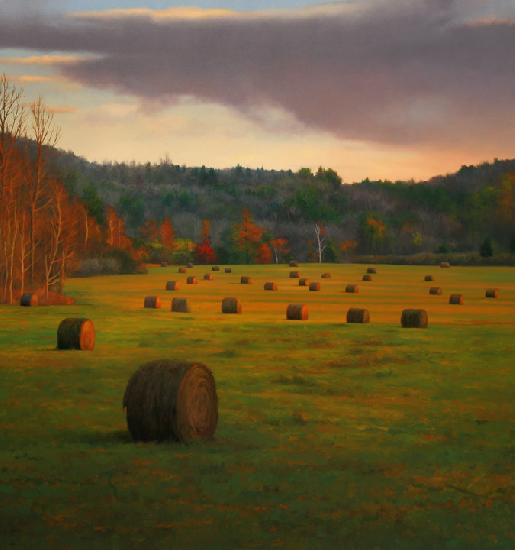
Hayfield--oil painting by Scott Prior www.scottpriorart.com
Hayfield–oil painting by Scott Prior http://www.scottpriorart.com

Loosening the Ties

Man Scything Hay by Todd Reifers

The small farm outside the village of East Stanwood, Washington on which I spent my first four years had three milking guernsey cows and a large crippled paint horse. In addition to ten acres of woodlot, we had about 6 acres of pasture, some of which was used to grow our winter hay supply.

My father was a small town high school agriculture teacher, supervising FFA kids and working far more hours than he was paid for.  He was determined to help make ends meet for his growing family by being as self-sufficient as possible on our few acres. Our own milk was pasteurized on our wood stove, we raised our own  beef, pork and chicken/eggs, and grew and stored as much forage as possible.  We had a large hay barn, but could not afford much more than the old tractor that my father kept patched together with gum and baling wire.  We certainly didn’t have baling equipment so our hay had to be put up loose, usually cut by a sickle bar attached to the tractor.

For reasons known only to him, my father often preferred to cut our hay with his hand held scythe.  Perhaps it was out of necessity, or more likely he enjoyed the rhythm of the physical work.  I can still see and hear him slashing through the grass, laying it neatly in a pile as he moved through the field.  In fact, I was so interested in watching him that I came up behind him one sunny day, wanting to follow his path in my own dreamy three year old way, and he reached back with the scythe handle to cut his next big swath, not aware I was behind him and the handle bumped right into my face, slicing my eyebrow open and laying me down neatly right along aside the nice pile of grass. I must have wailed hard and bled profusely as I remember him scooping me up, his face a mask of worry, and rushed me into the house, and then downtown to the kindly old lady doctor who butterflied my face back together.  I still can find that spot in my eyebrow when I look closely–a testament to the dangers of being too curious and too quiet.

The work of putting up loose hay is significantly different than baled hay.  It is much slower and deliberate, not nearly the frenetic activity of today’s hay crew.  When the hay is ready to be brought in,  it must be scooped by the pitchfork load onto the hay wagon, piled high as possible without much toppling off, and then slowly brought to the hay barn where the large hay fork would be let down on its pulley, opened and closed over the pile, hauled back up inside the hay mow to be released into a big pile.  There it would be in a fragrant mound waiting to be forked down into the mangers every morning and night as the cows were milked.  It never gets packed tight, it remains loose and fluffy and often not as musty as the baled hay can be.  However, there is more loss in the harvesting process, it blows in the slightest breeze and has a life of its own while bales sit where you put them and stay there until retrieved. Predictable, efficient, easy to store and move but without give or flexibility.

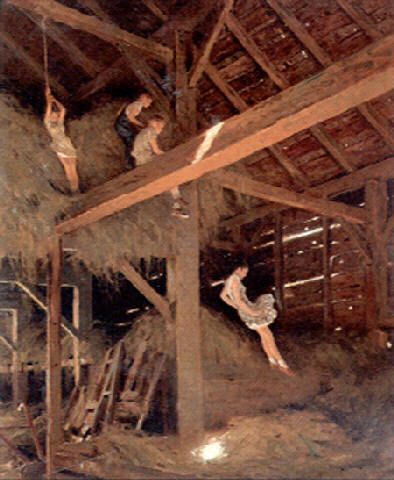
Jumping into loose hay is a feeling of being enveloped and cushioned.  The occasional broken bale I find in the loft softens in my hands as I scoop it up–what a delight.  One of the joys of doing chores is breaking the twine on the bales and freeing the hay into flakes as the portions are distributed to each stall.  Would I find carrying pitchforks of loose hay as gratifying?  Perhaps, but harder work indeed and much more lost along the way.

Is each day lived in tightly bound bales or as free-spirit loose hay?  I experience both, stretching against the cords that bind me at times, but needing the ties that keep me from blowing away at the slightest puff of wind.  Life stacks us up, builds us and grows us, but too soon pulls us apart and we are dust again.  We must thrive with our covenant “ties” –the twines that keep together our faith, our relationships, our children.  But we can overdo, sometimes binding too tightly, and not unlike our children who must eventually be free, we must loosen our ties, let them breathe and avoid the “mustiness” that can develop over time if they never are opened up.

It is time to celebrate the hay stack and know that we belong, bound or loose, to the dust from which we arose.

children-playing-in-hay-loft

Stacking the Hay

6651_512624400914_148300158_30510731_6701452_n6651_512624395924_148300158_30510730_6814861_n

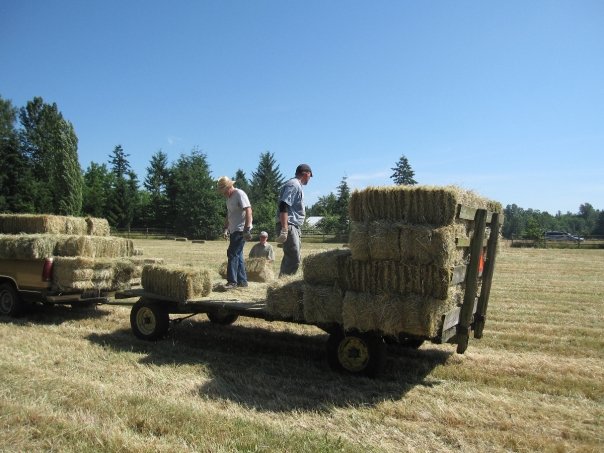
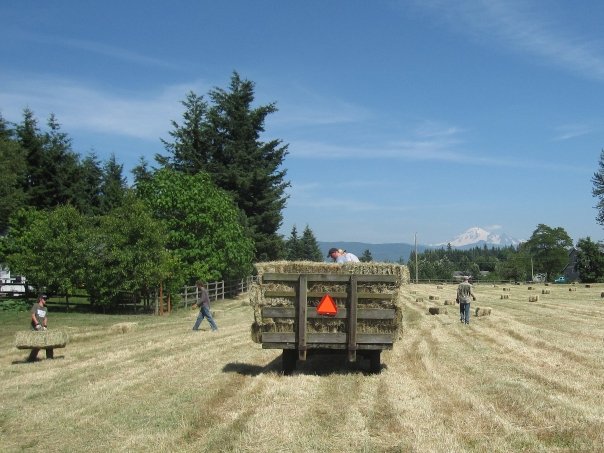
Every hay crew is the same
Though the names change;
Young men flexing their muscles,
A seasoned farmer defying his age
Tossing four bales high,
Determined girls bucking up on the wagon,
Young children rolling bales closer,
Add a school teacher, pastor,
Professor, lawyer and doctor
Getting sweaty and dusty
United in being farmers
If only for an evening.

Stacking
Basket weave
Interlocking
Cut side up
Steadying the load
Riding over hills
Through valleys
In slow motion
Eagles over head
Searching the bare fields
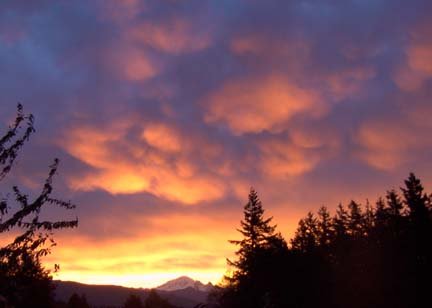
Evening alpen glow
Of snowbound
Eastern peaks

Friends and neighbors
Walking the dotted pastures,
Piling on the wagons,
Driving the truck,
Riding the top of hay stack
In the evening breeze,
Filling empty barn space to the rafters,
Making gallons of lemonade in the kitchen.
A hearty meal consumed
In celebration
Of summer baled, stored, preserved
For another year.

Hay crew
Remembered on
Frosty autumn mornings before dawn
When bales are broken for feed
And fragrant summer spills forth.
In the dead of winter

Hay Bale Pews

n148300158_30161194_6704

Where His people gather, He is.

On the road to Emmaus, men walked alongside Jesus without recognizing him, their hearts “burning within” them as He spoke, yet did not know Him until he broke bread and fed them. Worship and wonder does still take place in unlikely places alongside country roads.

Our farm is along such a road amidst rolling hills of evergreens and fields, next to a crossroads where 100 years ago sat the village of Forest Grove. This small settlement boasted a one room school house, a general store, a saw mill and a small Methodist church. Families would travel by horse and buggy to attend Sunday morning services, and during good weather, would picnic together on our farm’s nearby hill top to enjoy the expansive view. And every Easter, the small congregation would gather on the hill for a service at sunrise.

When the sawmill closed 80 years ago, the village shut its doors as well. The buildings were dismantled; the beams and timbers were transformed into our large hay barn and the humble little church became our farm’s chicken coop, long and narrow with smooth fragrant cedar lined walls and rough fir floors. Hens lay their eggs to the echoes of sacred hymns still resonating in those walls and floor.

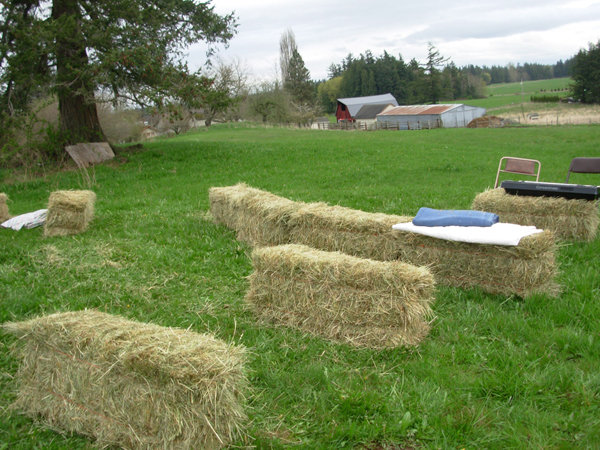
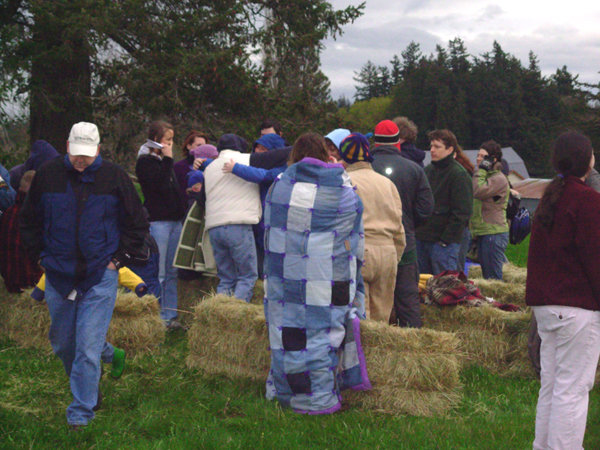
Formal worship moved to nearby towns, yet the Easter Sunrise Service tradition remains alive on our farm. Cherished by local families and neighborhood folk, some of whom have attended since they were children, this service is never canceled for any reason–not rain, not northeasters, not even the occasional Easter snow shower. If it is too stormy to be outside on the hill, the service takes place in the big red hay barn. In either setting, a tiered row of rough stickery hay bales, theater style, creates a semicircle of seats ready and waiting for the intrepid faithful who come annually to celebrate Christ’s resurrection, huddled together for warmth under blankets.

Each year a different Resurrection theme is explored through Bible readings and hymn singing. One year, it was noted how God has walked with His people since the beginning of time. First, in the Garden, He is “walking… in the cool of the day”  looking for Adam and Eve, but after the Resurrection, Jesus walked with the men to Emmaus. Because of Jesus, we go from hiding from God as He walks in the garden, ashamed of the forbidden meal we have eaten, to Emmaus where we walk alongside Him, invited to join Him as He shares with us the Bread of Life.

We are called to worship Him: from knowing dread to being fed.

Hay bale pews don’t create the most comfortable seating for worship. They poke us where we are most tender. Yet it is good to be reminded from where true comfort arises. Even when in shame we hide from Him, even when we do not recognize Him as He walks alongside us, our hearts burn for Him.

And He feeds us wherever we gather.

Amen!

n148300158_30161398_79231n148300158_30161401_51663