Another Manure Tale

I spend about an hour a day shoveling manure out of eight horse stalls.  Wheeled to a mountainous pile in our barnyard,  it happily composts year round, becoming rich fertilizer in a matter of months through a crucible-like heating process of organic chemistry, bacteria and earthworms.  Nothing mankind has achieved quite matches the drama of useless and basically disgusting stuff transforming into the essential elements needed for productive growth and survival.  I’m in awe, every day, at being part of this process.  The horses, major contributors that they are, act underwhelmed by my enthusiasm.  I guess some miracles are relative, depending on one’s perspective, but if the horses understood that the grass they contentedly eat in the pasture, or the hay they munch on during the winter months, was grown thanks to their carefully recycled manure, they might be more impressed.

Their nonchalance about the daily mucking routine is understandable.  If they are outside, they probably don’t notice their beds are clean when they return to the stalls at night.  If they are inside during the heavy rain days, they feel duty-bound to be in my face as I move about their stall, toting my pitchfork and pushing a wheelbarrow.  I’m a source of constant amusement as they nose my jacket pockets for treats that I never carry, as they beg for scratches on their unreachable itchy spots, and as they attempt to overturn an almost full load, just to see balls of manure roll to all corners of the stall like breaking a rack of billiard balls in a game of pool.  Good thing I’m a patient person.

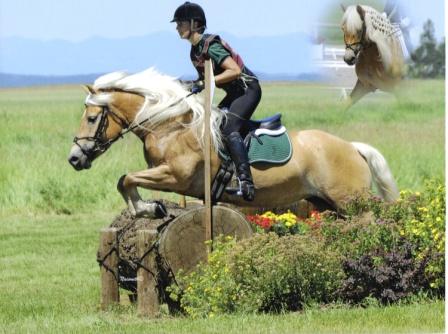
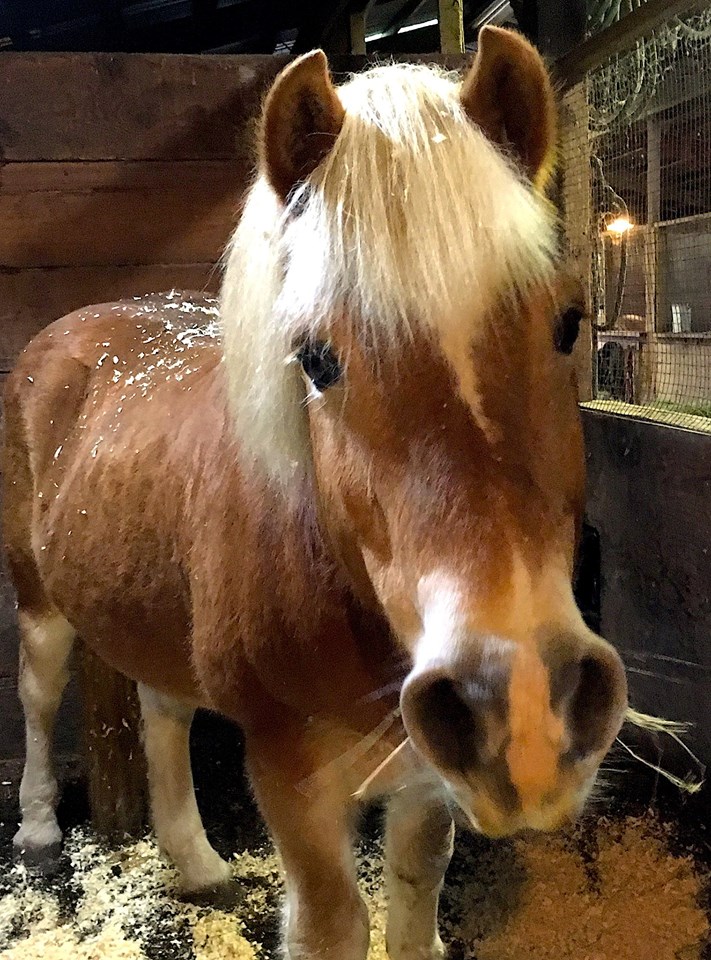
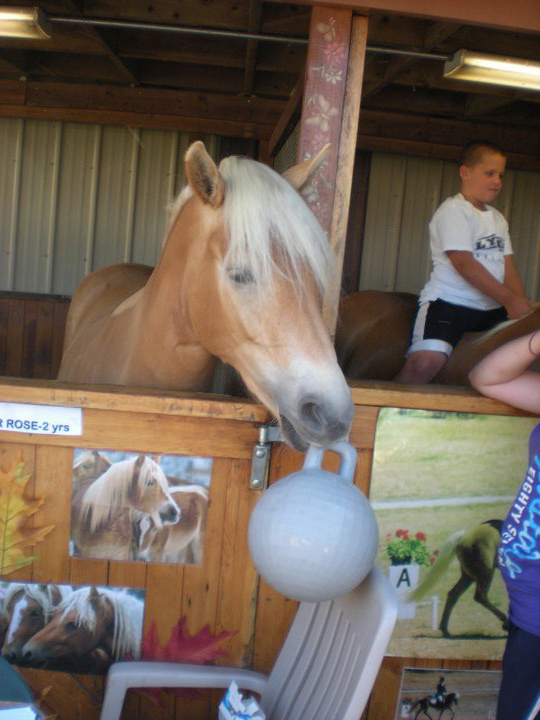
So my stallion discovered a way to make my life easier rather than complicating it.  He hauled a rubber tub into his stall from his paddock, by tossing it into the air with his teeth and throwing it, and it finally settled against one wall.  Then he began to consistently pile his manure, with precise aim, right in the tub.  I didn’t ask him to do this.  It had never occurred to me.  I hadn’t even thought it was possible for a horse to house train himself.  But there it is, proof that some horses prefer neat and tidy rather than the whirlwind eggbeater approach to manure distribution.  After a day of his manure pile plopping, it is actually too heavy for me to pick up and dump into the wheelbarrow all in one tub load, but it takes 1/4 of the time to clean his stall than the others, and he spares all this bedding.  What a guy.

Now, once I teach him to put the seat back down when he’s done, he’s welcome to move into the house…

Putting Things Back Together

Twice in ten years,  two young Haflinger geldings on our farm have suffered injuries so severe that if a skilled veterinarian had not been available, neither would have survived.  In both cases, the injury was severing of the lower lip and we really have no idea how the injury occurred.

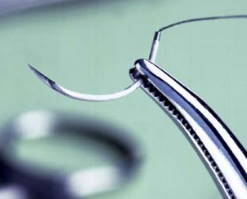
The first time was a yearling who was out in the field with his buddies, and when we went to fetch him in that evening, half of his lower lip was dangling completely loose, full of bloody grass and dirt.   I couldn’t imagine it could be successfully repaired, and feared he was doomed.  I called our horse vet,  who came out to the farm, silently surveyed the damage, moving the loose piece this way and that to gauge how it could come together.  He looked at me then and said  “this would be something I’d ordinarily do in the operating room at the clinic”.   But given the time of night, the willingness of the patient and the owner,  we set up surgery right in the barn aisle under bright lights, with calm music playing on the radio, and that lip was pieced together again.  It took many stitches and several weeks but it healed. It always had a little droop to it but this young horse survived thanks to the skilled needle and suture of a forgiving vet willing to work in less than ideal circumstances.

Lightening is not supposed to hit the same place twice, but it did this week.  The rainy weather kept the Haflingers in their stalls.  Out of boredom our two year old gelding had killed several water buckets by twisting them off their hooks, throwing them around and then playing them like bongos with this feet.

We walked in to find his stall was a bloody mess, from the walls, to the shavings, to his legs.  His lower lip was a mangle of pieces of loose flesh on one side, extending up to the corner of his mouth.  We  searched that stall high and low for signs of anything sharp that may have caused such a horrific injury, but there was nothing.  There was only an innocent appearing water bucket, still 1/3 full, hanging as usual on a blunt metal J hook that swivels on an O ring.  And an incriminating huge swath of blood extending on the wall down from that hook.  I suspect he was twisting the full bucket on its hook, trying to dislodge it in order to play with it and caught his lip between the bucket handle and the O ring, and the tightness of the pinch caused him to panic, pull back and his lower lip shredded as he did.  The bucket had its revenge at last.

There was no other explanation to be found.  I called our vet, again at night, and on the phone reminded him of the great feat of plastic surgery he had performed years ago in our barn.  He didn’t sound really nostalgic about the memory, as he suspected what was coming next.   He arrived with a full surgical suite packed in his truck and got to work setting up the lights, equipment, sterile fields and suture.  The greatest challenge was keeping the barn cats from hopping up on the table with sterile surgical instruments.

Our Haflinger patient was very cooperative once again, hanging his head low under sedation.  The vet sat on a vitamin bucket, cleaning the wound thoroughly so all the pieces could be sorted out and put back in place like a jigsaw puzzle.  He was able to pull together the deeper tissue with dissolvable sutures, and then started approximating the external lip edges.   By the time he was done, the shreds looked very much like a mouth again.

Two days later, my gelding is eating and drinking normally, just a bit puffy and droopy on one side of this mouth, but he is just fine thanks to a superb vet willing to work in a barn late on a cold and rainy night instead of a surgical suite with assistants and a more appropriate  environment (no barn cats strolling around underfoot).

Even in less than perfectly controlled circumstances, miracles can occur.  I am filled with unbounded gratitude.

*************************

Over the last four days, Haiti has seen many miracles take place in the rubble thanks to people who are willing to do what they can to help even in the most dire circumstances.    There are times when the only way to preserve life and put things back together is to do what we can when we can, even if it is messy and imperfect.

Bless those individuals who are making the on-site effort to help the Haitians, even if that help feels inadequate at the time, and surely insufficient.  The willingness to try to restore what once was–it is what will make all the difference in the midst of suffering and sorrow.

Dreams Do Still Come True…

One of my golden ponies with 12 year old Elizabeth Dickson at the fair

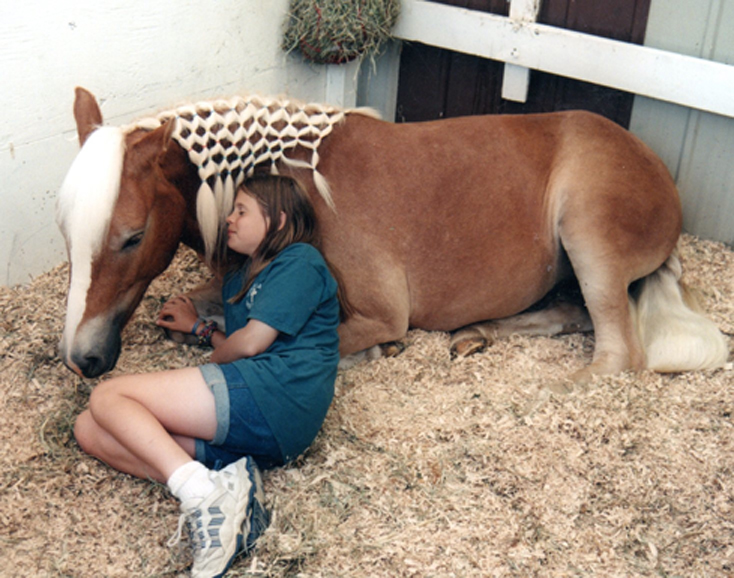
This is a date that stands out on my calendar every year. Whenever November 27 comes around, I think back to a very skinny freckled eleven year old girl who wanted nothing more than to have her own horse. Every inch of my bedroom wall had posters of horses, all my shelves were filled with horse books and horse figurines and my bed piled with stuffed horses. Everything but the real thing out on the small acreage we lived on. We had a small shed, not a real barn, and no fences, and though I was earning money as best I could picking berries and babysitting, I was a long way away from the $150 it would take to buy a trained horse back in 1965. I dreamed horsey dreams, mostly about golden horses with long white manes, hoping for that day when it would become real for me.

When the  local radio station KGY’s Saturday morning horse news program announced their “Win a Horse” contest, I knew I had to try. The prize was a weanling colt, part Appaloosa, part Thoroughbred, and the contest was only open to youth ages 9 to 16 years old. All I had to do was write a 250 word or less essay on “Why I Should Have a Horse”. I worked and worked on my essay, crafting the right words and putting all my heart into it, hoping the judges would see me as a worthy potential owner. My family took me to visit the colt, a fuzzy engaging little bay fellow who was getting plenty of attention from all the children coming to visit him, and that visit made me even more determined. I mailed in my essay and waited.

On November 27, 1965, I got up early to listen to the program that was always featured on the radio at 8 AM on Saturday mornings. They said they had over 300 essays to choose from, and it was very difficult for them to decide who the colt should go to. I knew then I didn’t have a chance. They had several consolation prizes for 2nd through 4th place, so they read those essays, all written by teenagers and my heart was sinking by the minute. Then they said they were going to read the winning essay. The first sentence sounded very familiar to me, but it wasn’t until several sentences later that I realized they were reading my essay, not someone else’s. I leaped and shouted and woke up my whole family, including my dad, sick in bed with the flu, who opened one eye, looked at me, and said, “I guess I better get a fence up today, right?”

That little bay colt came home to live with me the next day. Over the next few months he and I learned together, as I checked out horse training books from the library, and tried every different technique in addition to joining 4H. By the time he was two, I was sitting on him, and by age three, I had earned enough to buy a saddle and was riding him on my own. Though he was not a golden-colored horse, he was my horse and I loved every inch of him.

When I went off to college, I found him a new home with someone who was able to care for him and he continued a happy life as I spent the next 13 years of my life living in the city. The horse dreams still swept me up as I spent hours in book stores poring over horse books and learning about various breeds. I knew I’d had my one special “gift” by winning my first horse, so the next horse I would have to earn on my own. I worked long hours, many nights and many holidays, earning what I could to eventually move from the city and own some land for a future horse and a future family.

Along the way, I found a farm boy also “stuck” in the city and together we worked on building our dream (his was NOT horses but he was gracious enough to honor my dream!). We bought our farm a full two years before we actually could afford to leave our city jobs behind to move there. In the meantime, I had opened a book in one of my many city bookstore visits, and there were my golden dream horses, running wild through green mountain meadows, their white manes and tails streaming out behind them. I bought that book in a heart beat, and began my search for the magical Haflinger. Within a month of our moving to the farm, on November 27, 1985, our first Haflinger joined us.

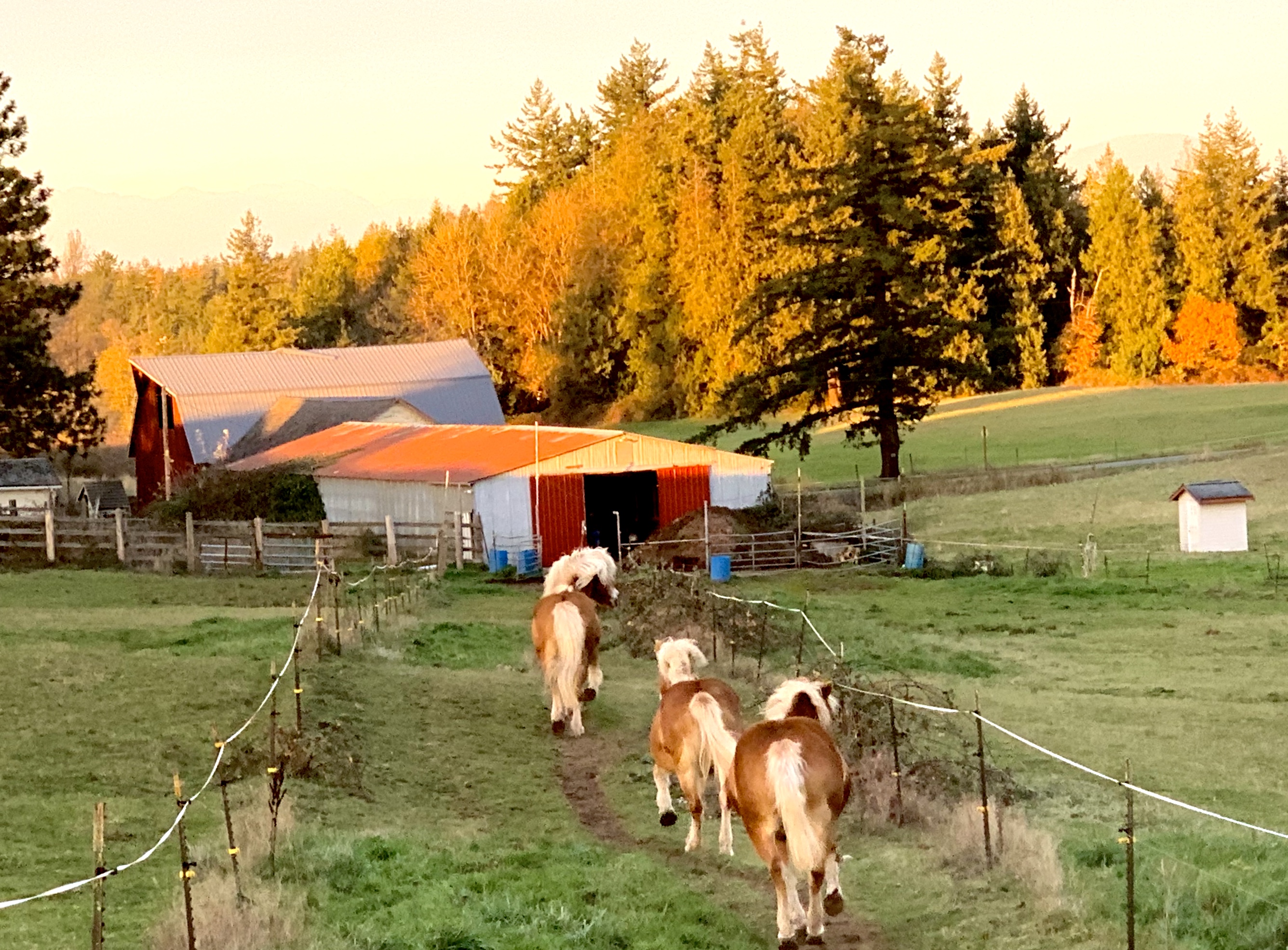
Twenty years separated my first horse from my second horse, but November 27 represents the date I was able to realize my dreams. As I was cleaning the barn this morning, after moving seven golden Haflingers out to their day time paddocks, I marveled at the privilege it is to work to raise these beautiful horses. They own me, heart and soul. I will do whatever I must to help this dream come true for others who have known that someday, there must be a golden horse in their future.

Rubber Bucket Belly Bumpers

nuancemontage1

Haflingers do have a variety of creative techniques for attracting attention to themselves when someone walks in the barn, especially around feeding time. Over the years, we’ve had the gamut: the noisy neigher, the mane tosser, the foot stomper, the stall door striker, the play with your lips in the water and splash everything, and most irritating of all, the teeth raked across the woven wire front of the stall. Some Haflingers wait patiently for their turn for attention, without fussing or furor, sometimes nickering a low “huhuhuhuhuh” of greeting. That is truly blissful in comparison.

Most creative of all, however, was our mare, Nuance, who did not live up to her name in any way. She was the least “nuanced” Haflinger we’ve owned. Her chosen method of bringing attention to herself was to bump her belly up against her rubber water buckets that hang in the stall, making them bounce wildly about, spraying water everywhere, drenching her, and her stall in the process. She loved it. It was sport for her to see if she could tip the buckets to the point of emptying them and then knock them off their hooks so she could boot them around the stall, destroying a few in the process. Nothing made this mare happier. When she had occasion to share a big stall space with one of her half-siblings, she found that the bucket bouncing technique was very effective at keeping her brothers away, as they had no desire to be drenched and they didn’t find noisy bucket bumping very attractive. So her hay pile was hers alone–very clever thinking.

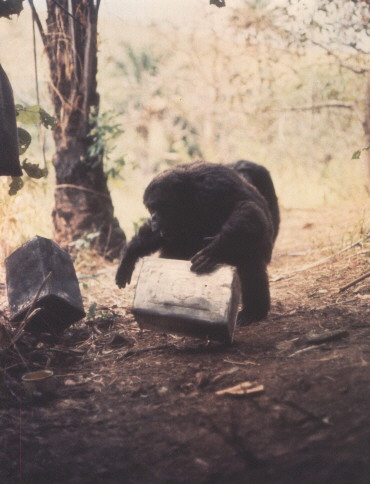
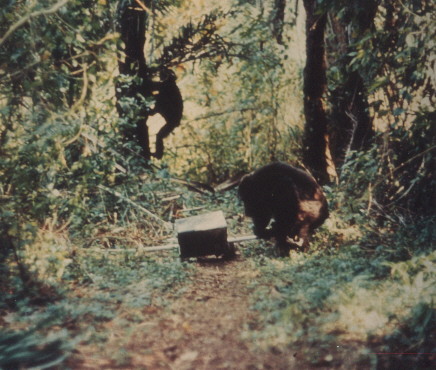
This is not unlike a wild chimpanzee that I knew at Gombe in Tanzania, named “Mike” by Jane Goodall, who found an ingenious way of rising to alpha male status by incorporating empty oil drums in his “displays” of aggression, pounding on them and rolling them down hills to take advantage of their noise and completely intimidating effect on the other male chimpanzees. Mike was on the small side, and a bit old to be alpha male, but assumed the position in spite of his limitations through use of his oil drum displays. So Nuance, my noise and water splashing mare,  became alpha over her peers.

We humans have our various ways of attracting attention too. Some of us talk too much, even if we have nothing much to say, some of us strut our physical beauty and toss our hair, while some of us are pushy to the point of obnoxiousness. And some of us are real bluffers, making a whole lot more noise and fuss than is warranted, but enjoying the chaos that ensues. Meanwhile we may leave a wake of destruction behind us–not unlike my mare with her soaked stall, and mangled buckets–all done to make sure someone notices.

I’ve learned I need to quit stomping and quit knocking the door in my impatience, quit hollering when a quiet greeting is far more welcome. And I need to quit soaking everyone else with my water–after all, it yields me nothing more than empty buckets, and eventually I get very thirsty and wish I hadn’t been so foolish. As my horses are trainable to have better manners, so am I.

And I really am trying.

mikeialpha

Haflinger and Fugue in D Minor

wallychew

The skies have opened up and dumped buckets of rain in the northwest today. It was dark and black this morning with a cloud cover that allowed no sunrise, and the southeast winds started picking up early, gusting up to 50 miles an hour in some places in our county. So when I went out to the barn this morning, I informed my seven resident Haflingers that they were stuck indoors for the day, and none of them objected as long as they had a pile of hay to munch, a comfy clean bed of shavings and fresh water. Contentment reigneth as I closed up the doors and headed to work.

By the time I made it home from work tonight, got dinner started in the house and headed down to the barn through sheets of blowing horizontal rain, I was assaulted by seven excited voices that greeted my opening the barn door. The deep bass from our stallion Waldheer, the tenor from Wheaton, the alto of Noblesse, Belinda, and Weissach, and the high soprano nicker of our yearling BriarRose. But nothing compares with the shrill piccolo squeal that comes from Marlee–heard above all and frankly, ear piercing! I realized as I walked in the barn that their chorus was only the melody line for the constant din of rain drumming on the metal roof and the banging of the sliding doors as the wind buffeted them. It was truly a concert out there, and I’m sure the Haflingers had heard plenty of noise from the storm all day and enough was enough. They wanted some relief, like, ah, food, like– you know–right now, to take their minds off of it.

I moved quickly to fetch grain and vitamins to them in record time, throwing hay flakes in their stalls and freshening up their water. They settled into the rhythmic chewing that I always find as comforting as a lullaby as I cleaned and prepared their beds.

Five more days of rain and wind are predicted. This could be a long confinement for the Haflingers if the weather stays this soppy and nasty the whole time. They may even compose a complete symphony before it is over. Rehearsals scheduled at 6:30 AM and 6:30 PM with performances daily at stall cleaning time, attended by one grateful lady farmer.

I’ll be asking for an encore.

ponybarn2

Listening to What the Ears Have to Say

tonyears


I have an appreciation for social cues, both human and animal–those often nonverbal signals that are communicated through subtle means–in people, perhaps it is a raised eyebrow, a rapid blink, a tensing of the lips, a fidgeting foot.  In horses, it can be harder to read but their nonverbal language is there for all to see.  The herdmates and the human handler, with careful observation and interpretation, should not be surprised about “what is going to happen next.”  It is not a mystery.

I don’t consider Haflingers particularly subtle in their communication with each other or with humans. They can tend to have a “bull in a china shop” approach to life; this is not a breed that evolved particularly plagued with the existence of many predators in the Austrian Alps, so the need to blend into the background was minimal. So Haflingers tend to be “out there”: unafraid, bold, meeting one’s gaze, sometimes challenging.

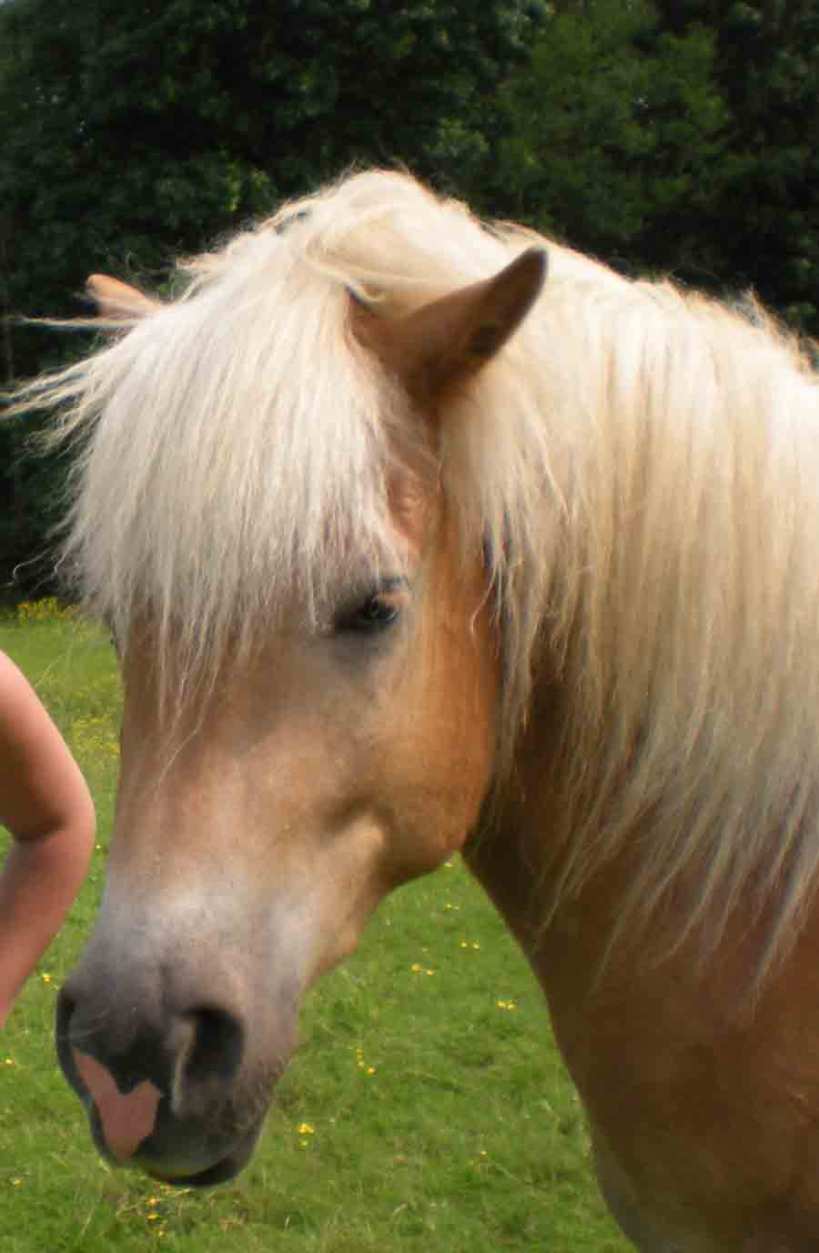
I’ve found over the years that the best way to interpret a Haflinger’s emotions is by watching their ears, and to a lesser extent, their lips and tails. They usually have “poker face” eyes, deceptive at times in their depth, calmness and serenity. I tend to get lost in the beauty of their eyes and not pay attention to what the rest of the horse is saying. Watching them interact with each other, almost everything is said with their ears. A horse with a friendly approach has ears
forward, receptive, eager. If the horse being approached is welcoming, the ears are relaxed, sometimes as forward. Two good friends grooming or grazing together have swiveling, loose ears, often pointing toward each other, almost like a unique conversation between the four ears themselves. So when a Haflinger is happy to approach, or be approached by humans, the ears always say so.

Ears that are swiveling back, tensing and tight, or pinning are another story altogether. It is the clear signal of “get outta my way!”, or “you are not sharing this pile of hay with me” or “you may think you are a cute colt, but if you climb on me one more time…” Those ears can signal impatience “you are not getting my grain fast enough”, or “I’ve been standing here tied for too long!” A simple change in ear position can cause a group of horses to part like the Red Sea.

I have a mare who was orphaned at 3 days of age, and spent her early weeks with intensive handling by people, and then allowed to socialize with a patient older gelding until she was old enough to be among other weanlings. When she came to our farm at 6 months of age, she had not learned all the usual equine social cues of a mare herd, and though very astute at reading human gestures and behavior, took awhile to learn appropriate responses. When turned out with the herd, she was completely clueless–she’d approach the dominant alpha mare incorrectly, without proper submission, get herself bitten and kicked and was the bottom of the social heap for years, a lonesome little filly with few friends and very few social skills.

She had never learned submission with people either, and had to have many remedial lessons on her training path. Once she was a mature working mare, her relationship with people markedly improved as there was structure to her work and predictability for her, and after having her own foals, she picked up cues and signals that helped her keep her foal safe, though she has always been one of our most relaxed “do whatever you need to do” mothers when we handle her foals as she simply never learned that she needed to be concerned.

Over the years, as the herd has changed, this mare has become the alpha mare, largely by default and seniority, so I don’t believe she really trusts her position as “real”. She can tend to bully, and react too quickly out of her own insecurity about her inherited position. She is very skilled with her ears but she is also a master at the tail “whip” and the tensed upper lip–no teeth, just a slight wrinkling of the lip. The herd scatters when they see her face change.

The irony of it all is that now that she’s “on top” of the herd hierarchy, she is more lonely than when she was at the bottom. She is a whole lot less happy as she has few grooming partners any more. I really feel for her as she has created this for herself, but she would rather have power than friends right now. It is the sad choice she’s made.

I certainly see people like this at times in the world. Some are not at all attuned to social cues, blundering their way into situations without understanding the consequences and “blurting without thinking”. It takes lots of kicks and bites for them to learn how to read other people and behave appropriately. Sometimes they turn to bullying because it is communication that everyone understands and responds to, primarily by “getting out of their way”. Perhaps they are very lonely, insecure, and need friends but their need for power overcomes their need for support. I see it every day in the people I know.  I see it in me.

So I will continue “watching the ears”–both Haflinger and human. And continue to refine my own way of communicating so that I’m not a mystery to those around me, and hoping no one scatters when they see me coming…

Putting On a New Coat

photo of Noblesse by Krisula Steiger

This story, written in 2003, is now published in the Oct/Nov 2009 issue of Country Magazine. Photos by Lynden Christian student Krisula Steiger.

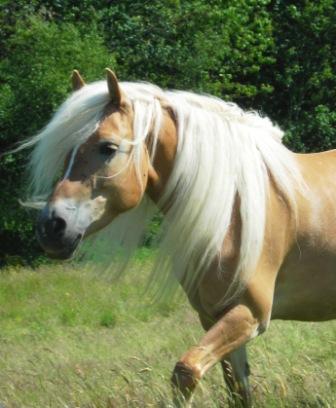
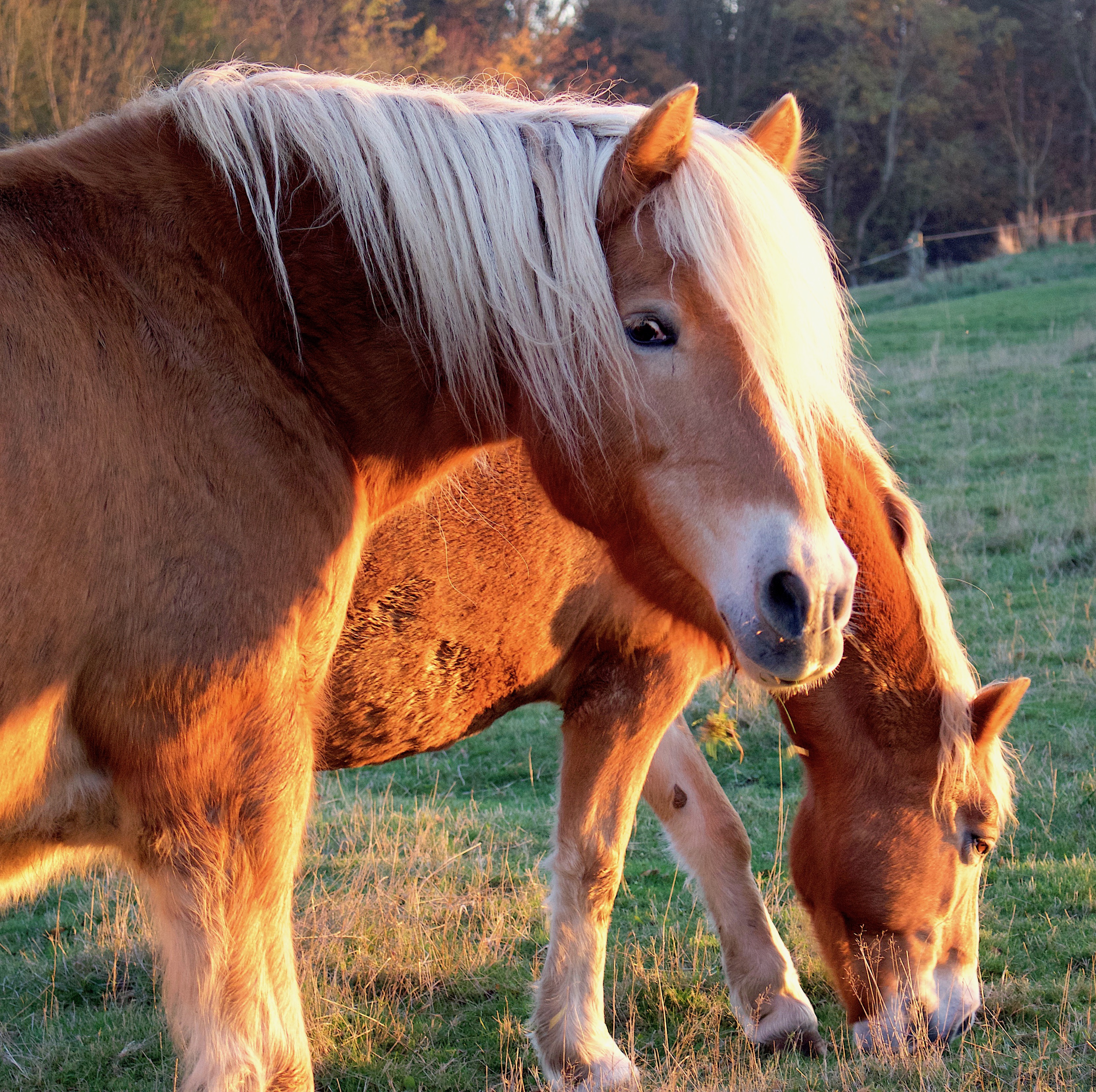
Generally late September is when we start to see our Haflinger horses growing in their longer coat for winter. Their color starts to deepen with the new hair as the sun bleached summer coat loosens and flies with the late summer breezes. The nights here, when the skies are cloudless, can get perilously close to freezing this time of year, though our first frost is generally not until well into October. The Haflingers, outside during the day, and inside their snug stalls at night, don’t worry too much about needing their extra hair quite yet, especially when the day time temperatures are still comfortably in the 70s. So they are not in a hurry to be furrier. Neither am I. But I enjoy watching this daily change in their coats, as if they were ripening at harvest time. Their copper colors are so rich against the green fields and trees, especially at sunset when the orange hue of their coat is enhanced by the sunlit color palette of fall leaves undergoing their own transformation in their dying.

In another six months, it will be a reverse process once again. This heavy hair will have served its purpose, dulled by the harsh weather it has been exposed to, and coming out in clumps and tufts, revealing that iridescent short hair summer coat that shines and shimmers metallic in comparison, although several shades lighter, sometimes with nuances of dapples peeking through. Metamorphosis from fur ball to copper penny.

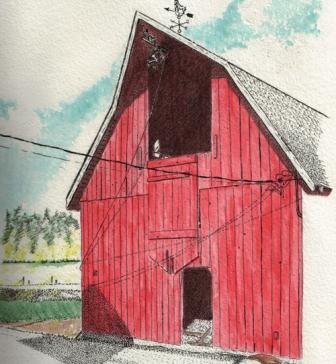
It occurs to me our old barn buildings on our farm have also undergone a similar transformation, having received a new coat of paint this summer. As a dairy farm for its previous owners starting in the early 1900s until a few years before we purchased it in the late 80s, it has accumulated more than its share of sheds and buildings constructed over the years to serve one purpose or another: the big hay barn with mighty old growth beams and timbers in its framework (still hay storage), the attached milking parlor (converted by us to individual box stalls for our weanlings and yearlings) and milk house where the bulk tank once stood, the older separate milk house where the milk used to be stored in cans waiting for pick up by the milk truck (now garden shed and harness storage), the old smoke house for smoking meats (was our chicken coop, but now the dogs claim it), the old bunk house and root cellar (more storage), the old large chicken coop (now parking for our carts and carriage), and the garage (a Methodist church in its former life and moved 1/4 mile up the road to our farm some 70 years ago when the little community of Forest Grove that had formed around a saw mill, store, school and church disbanded after 30 years of prosperity when there were no more trees to cut down in the area). When we bought this farm, these buildings had not seen a coat of paint in many many years. They were weathering badly–we set to work right away in an effort to save them if we could, and got them repainted–“barn red” for the barn and cream white for the other buildings with red trim around the windows and roof lines.

That was over 10 years ago now and we’ve been trying to hold off on another round of painting but it was clear this summer that it needed to happen. Now that they have their fresh paint coats, these old buildings appear to have new life again, though it is only on the surface. We know there are roofs that need patching, wiring that needs to be redone, plumbing that needs repair, foundations that need shoring up, windows that are drafty and need replacing, doors that don’t shut properly anymore–the list goes on. That superficial coat of paint does not solve all those problems–it will help prolong the life of the buildings, to be sure, but in many ways, all we’ve done is cosmetic surgery. What we really need is a full time carpenter –which neither of us is and at this point can’t afford.

In my middle age, there are times when I wish fervently for that “new coat” for myself–i.e. fewer gray hairs, fewer pounds, fewer wrinkles and one less chin, less achy stronger muscles. I buy a new fall jacket and realize that all my deficiencies are simply covered for the time being. I may be warmer but I’m not one bit younger. That jacket will, I hope, protect me from the brisk northeast winds and the incessant drizzle of the region, but it will not stop the inevitable underneath. It will not change who I am and what I will become.

True change can only come from within, from deep inside our very foundations, requiring a transforming influence that comes from outside. For the Haflingers, it is the diminishing light and lower temperatures. For the buildings, it is the hammer and nail, and the capable hands that wield them. For me, it is knowing there is salvage for people too, not just for old barns and sheds. Our foundations are hoisted up and reinforced, and we’re cleaned, patched and saved despite who we have become. And unlike new paint, or a winter coat, it lasts forever.

Watercolor of our hay barn by Dick Laninga

Fair Weather Farewell

n1207615738_30186331_7994

n1207615738_30186348_4966

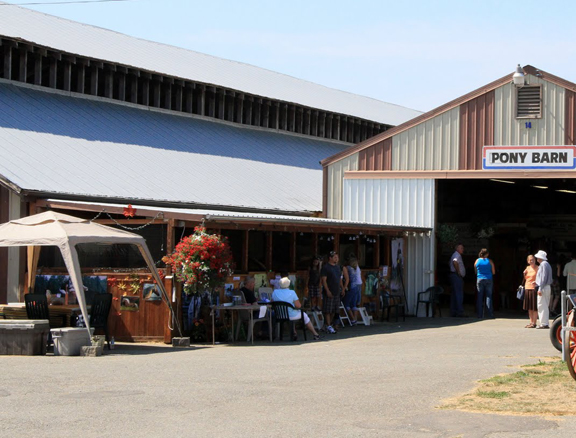
For the first time since 1992, we are not preparing this weekend to spend the week displaying our Haflinger horses at the Northwest Washington Fair in Lynden.  BriarCroft has been a consistent presence at this fair for almost two decades, promoting the Haflinger breed in a well  decorated display, providing 24 hour a day coverage for the horses for the 6 days of the fair. We begged the Fair Board for 5 years to allow us to display at the fair, and they finally said “okay, here’s the space, build it yourself” and we did! We were not there for classes, competition, or ribbons. We were there because people enjoyed our Haflingers and we enjoyed the people.

But this year, it was not to be.  Our faithful trick riders Kelsy and Chesna who performed daring feats on their Haflingers in front of the grandstand crowds are busy with their horse training in Tenino, our adult sons have headed off to work in Tokyo, Japan, and college in Chicago, leaving us short of the crew needed to man the display for the week as Dan and I have to work our day jobs.  It was a painful decision to make, but it was simply not going to be possible to do it this year.  I will miss spending time with our dedicated young helpers–my daughter Lea, and the Vander Haak family–Emily, Christopher and David.  Over the years we’ve had many young helpers spend the week with us, now many of them grown with children of their own.

Every year since 1992, we evaluated whether we had the energy and resources to do it  again–for the initial 6 years when Dan and I were the sole farm doing  the display, it meant a week of vacation from work, and very very long days, juggling our small children as well as several horses. Then, with the help of 3R Farms and Teaglach Farm as well as older children, we were able to rotate shifts, still work at our “real” jobs part days, share duties and expenses together. The older kids watched the younger kids, the inbetween kids did most of the horse stall cleaning duty, and the adults sit and shoot the breeze.

Did this sell horses for us? Not really. But it sure did create good will for the fair visitors who depended on us every year to be there with horses that they and their children could actually pet (and sit on ) without fear, who enjoyed our braiding demonstrations, and our various Haflinger trivia contests with prizes.

Most of all, why we continued to do this so long, was that we provided what  dreams are made of. I’m not sure how many times a day there would be a bright eyed child who approached our stalls, climbed up on the step stools and reached up to pet a Haflinger nose or neck and looked deep into those big brown Haflinger eyes, and lost their heart forever to the breed. They will not forget that moment when a horse they had never met before loved them back. Haflingers are magic with children and we saw that over and over again.

Our first year, in 1992, a mom and her 6 year old son came up to our stalls, as do some  10,000 people a day, and spent a long time petting the horses and talking to them, and enjoying them. They walked off, with the little boy looking over his shoulder at the Haflingers until they turned a corner and went out of sight. An hour later they were back and spent more time with the Haflingers. I offered the little boy a chance to sit on a Haflinger, and he agreed readily, and sat and sat and sat, playing with the mane and petting the shoulder and neck and was simply in heaven, quietly dreaming his own dreams on the back of a horse. His mom told me that they lived in a suburb near Seattle, but always spent this particular week in August at a local beach cabin, and the fair was one of their favorite activities each year. Her son Gary had never had an opportunity to sit on a horse before.

Next year, they were back, and Gary was a little taller, but still a quiet boy, and he kept dragging his mom back to the Haflingers, and she’d sit and visit as he’d sit on the Haflingers. He watched as we watered the horses, or fed them hay, or cleaned their stalls, and pretty soon he was asking if he could do the scooping, or dump the buckets or brush the horses. So he became, out of his own initiative, a helper.

By the time he was 8, he was spending several hours at a time with us at the stalls, taking his turn at the chores, and his mom, trusting that he was in good hands, and that he certainly wasn’t going to wander away from the Haflingers, would check back with him now and then to see if he wanted to go on rides, or see a performance, and his response was always “no, I can do that anytime, but I don’t get to see Haflingers very often!” He would talk a little about his hope someday to have a farm where he could raise Haflingers, and one year even said that his folks were looking at property to buy with acreage, but apparently a job for his dad didn’t materialize, so he remained a city kid in reality, even if he was a future farm kid in his heart.

He was one of our regular kid helpers every year until he was 12 when he started turning out for junior high football, and the football summer camp coincided with our fair week, so we’d only see him briefly on Saturdays as he got into his teens. He’d stop by to say hi, pet the horses, catch up on the Haflinger news, and because he only had a few hours to spend at the fair, he’d head off to other things. I really missed him and his happy smile around the stalls.

When he was 15, I missed seeing him because I was working when he stopped by. When he stopped by at age 16, he strolled up to me and I found I was looking up at this young man who I had to study to recognize. I’m a tall woman of 5’10”–he was at least 4 inches taller than me! He told me he wanted to come by because some of his best summer memories were of spending time with the Haflingers at the fair and he wanted me to know that. He thanked me for welcoming him and allowing him to “hang out” with the Haflingers. He told me his hope and dream someday was to live somewhere where he could raise Haflingers, and he was working hard in school so he could make that happen. He was a  4.0 student and the first string quarterback on his high school football team. I was as proud as if he was my own son.

This young man received a full scholarship to play football at a major university, and over four years waited his turn to be the starting quarterback.  Once he had his chance, after only a few games, he was tackled hard, sustaining a neck fracture which thankfully resulted in no permanent damage, but his college football career was suddenly over.

I hope someday to see Gary again–it would be great to see this tall accomplished young man who so recently was a shy quiet little city boy of 6, draped across the broad back of a Haflinger, and lost in his dreams of a “someday” Haflinger of his own. This is why we’ve done what we have at the fair all these years. It was for people like Gary who made a connection with a horse and never ever forget it. I’d like to think that a little bit of who Gary is and what he is becoming is because he had a dream of a horse farm that he held onto all these years.

Perhaps we’ll be back again at the Lynden Fair in the future if we can organize enough helpers.  We do hope the fair-goers miss the friendly golden horses with the big brown eyes that help make dreams come true.

Wholly Weaned

oldnest

The usual peace and quiet on our farm has been anything but the last few days. The time has come to wean foals from their mothers and they are all protesting loudly about the separation, day and night. This is always a difficult time every year, rattling my senses more than usual because I am in the process of being weaned as well. Their cries echo deeply in my unsettled heart. As the mares stand at the field gate calling to their babies stowed safely in the barn, I know they want them back for their own comfort–mostly to relieve swollen painful udders. They also need to know their babies are safe and content. This feeling I know all too well.

We’ve recently delivered our second child back to college, even farther from home than our first child chose to go. It was a difficult leave taking in many ways, primarily because I wasn’t as prepared as I hoped to be. I still want that comfortable feeling of knowing my children were tucked safely under my wings. It just doesn’t seem possible they don’t fit there as easily as they used to. My children certainly understand that better than I as they are the ones feeling crowded and anxious to leave, ready to embark on independent adult lives.

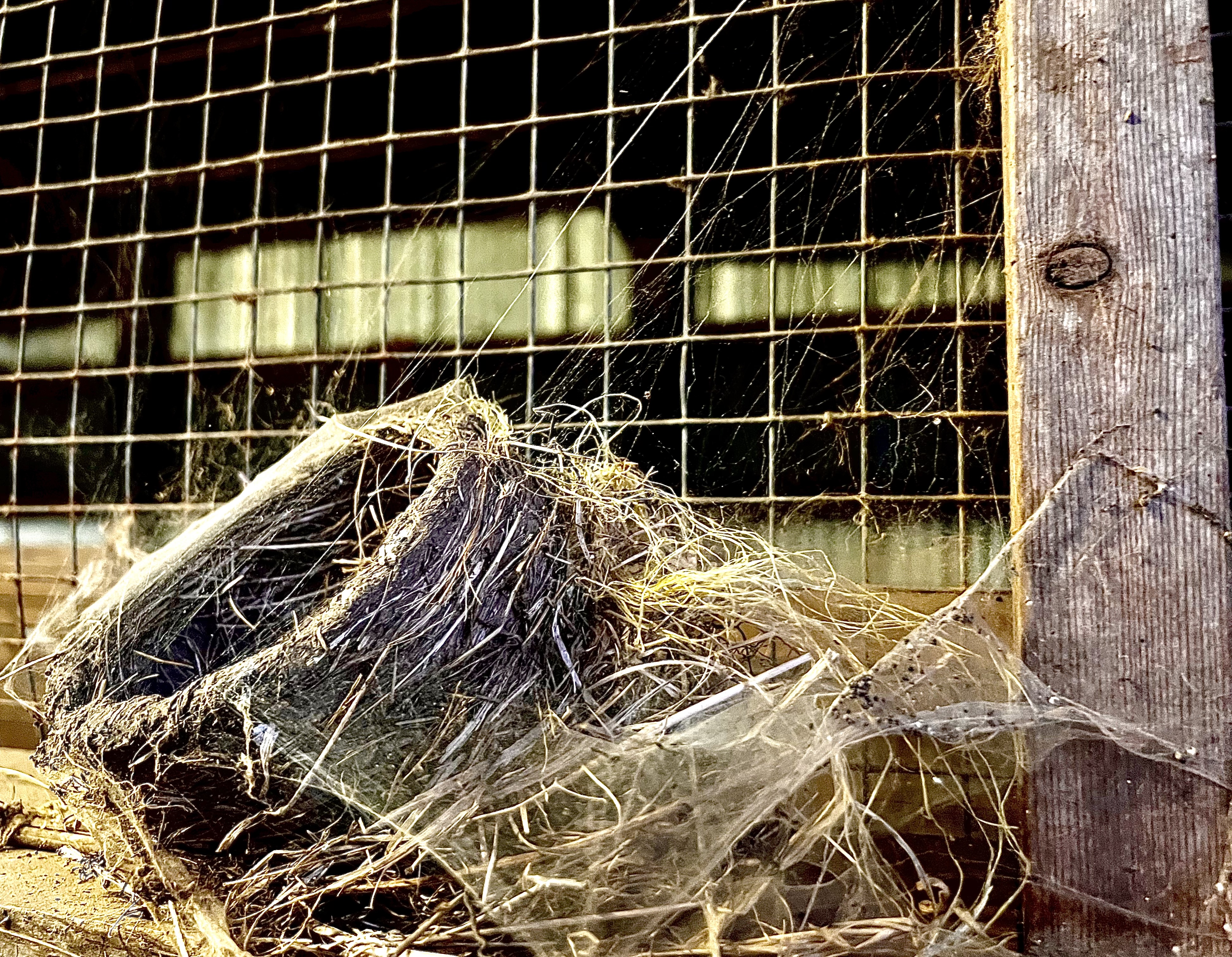
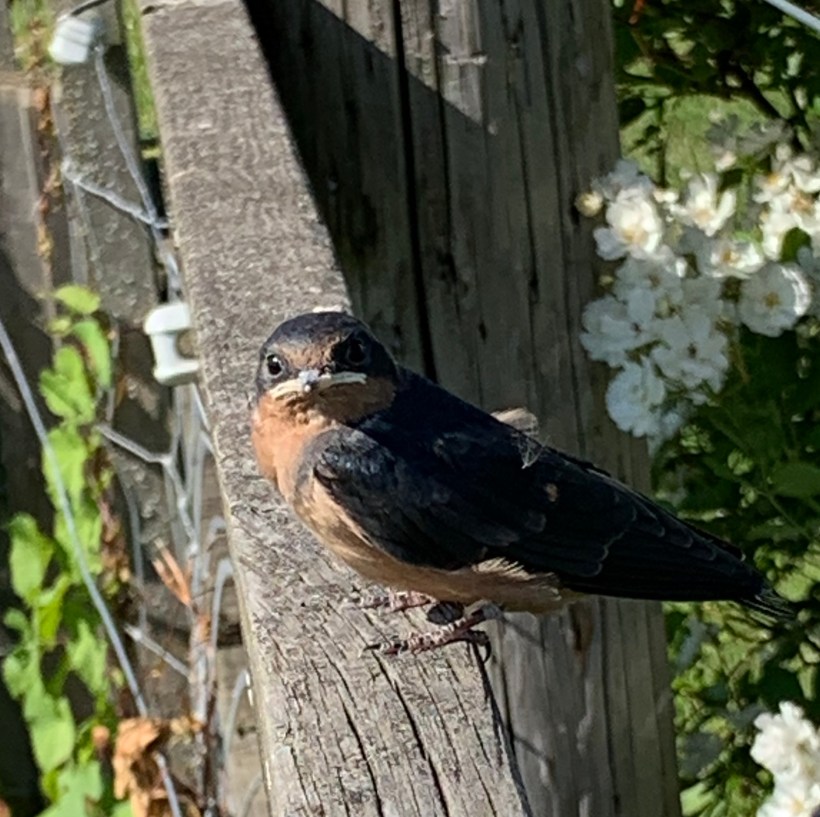
An unexpected preparation took place recently when we took several of our Haflingers to a regional fair for a week’s stay. We moved into covered outdoor stalls that stand empty 51 weeks of the year, but for this one week, the stalls are decorated and built up with fluffy shavings, and the horses shined to a gloss. The night before the fair was to open, I was sweeping the area in front and discovered a barn swallow’s nest had been built in the rafters right above where the public would be standing to pet our horses. The pile of bird droppings had heaped high on the cement and the nest was full of chirping fledglings all prepared to produce more where that had come from. It was an inconvenient and potentially messy spot for a nest’s front porch so I carefully lifted it and its chirpy contents from the front rafter and placed it on a back rafter above one horse’s stall. It was a minor move of about 10 feet, but that proved to be a major obstacle for two dedicated swallow parents who had five noisy hungry mouths to feed. I hoped I had not completely disrupted this little family’s world.

It took about an hour for the swallow parents to decide they couldn’t bear to listen to their displaced babes’ cheeping any more, so they swooped into the stall with insects to feed five gaping mouths, putting aside their indignation at the semi-eviction and the objectionable human and horse smell all over their home. They felt compelled to care for those offspring, no matter what the dangers may be.

It became quite the show stopper during the week as people leaned over the stall gates to pet our horses and a swallow would swoop right past their ear on its way to the nest. We watched those five babies grow fluffier over the course of the week, and several times had to rescue one or another from a horrible fate under a horses’ hoof as the birds bumped and jostled each other out of the crowded nest. By the end of the week, they were not yet flying but they were able to sit independently next to the nest on the rafter beam and a few days later when I went back to check on them, they were already gone, the nest feather-lined and poop filled, looking a bit forlorn and terribly empty, no longer a comfortable fit for a family that had outgrown it.

A barn swallow is more resilient than I am about letting their offspring go. Even my mares are slowly settling into the knowledge their youngsters are now on their own and perfectly capable of taking care of themselves in the big world. I am not nearly so settled with my children’s transition to adulthood. Yet I know it must come. It’s not just about the inevitable resolution of the uncomfortably swollen udder, but in time to feel the calm and quiet fullness in the heart of the wholly weaned.

photo by Harry Rodenberger
video by Harry Rodenberger

Listening to the Vetch

vetch

Hot humid summer days are barely tolerable for a temperate climate sissy pants like me.  I am melting even as I get up in the morning, and right now our house is two degrees warmer (93 degrees) than the out of doors.  So distractions from the heat are more than welcome.

For me today it started as I drove the ten miles of country roads to get to work in town, running a bit late to an important meeting.  I was listening to the news on the car radio when I puzzled over why the radio station would be playing cat meows over the news.  I turned off the radio, and realized the meows didn’t go away.

As soon as I was able, I pulled into a parking lot and surveyed my van from back to front, looking under seats, opened the back, scratched my head.  Then the meowing started again—under the hood.  I struggled with the latch, lifted up the hood and a distressed bundle of kitten fur hurtled out at me, clinging all four little greasy paws to my shirt.  Unscathed except for greasy feet, this little two month old kitten had survived a 50 mile per hour ride for 20 minutes, including several turns and stops.  He immediately crawled up to my shoulder, settled in by my ear, and began to purr.  I contemplated showing up at a meeting with a kitten and grease marks all over me, vs. heading back home with my newly portable neck warmer.  I opted to call in with the excuse “my cat hitchhiked to work with me this morning and is thumbing for a ride back home” and headed back down the road to take him back to the barn where he belongs, now with the new name “Harley” because he clearly desires the open road.

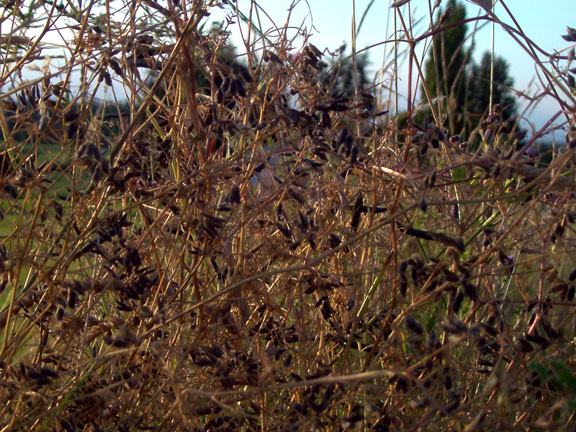
At that point, my meeting in town was already completed without me so I went out to check fence line as the hot wire seemed to be shorting out somewhere in the pasture as the mares had decided that the wire interfered with their hearts’ desire and had broken through, so it clearly was not hot enough to discourage them.  It has been a very hot few days with persistent drying breezes this afternoon so as I approached the fence line, I heard numerous snaps and pops that I interpreted as hot wire shorting out in the dry grass and weeds, creating a fire hazard and certainly potentially dangerous with the winds whipping up.  I walked closer and was really puzzled to hear snaps all up and down the fence, but could not see sparks.  I approached more closely and heard a little “snap” and a tiny seed pod burst open in front of my eyes, dropping its contents very effectively.  It was the dried common vetch seed pods that were snapping and popping, not hot wire shorting out.  They were literally exploding all up and down the fenceline in a reproductive symphony of seed release.  I put the broken wire back to together, plugged it in and all was well, at least until the next Haflinger decides the adjacent pasture looks better.

Returning to the barn,  I saw our stallion pawing furiously at his round black rubber water tub in his paddock, splashing water everywhere and creating quite a spectacle.  I went up to him to refill the tub with the hose and he continued to paw and splash in the tub and actually went down on his knees in the tub and then tried to lower one shoulder into it and his neck and face.  By this time he had created quite a mud puddle of the thick dust around the tub and his splashing and thrashing was causing mud to fly everywhere, including all over me, my hair, covering his mane and tail and belly and legs.  I took the hose and sprayed the cold water over him and he leaned closer to me, begging me to spray him everywhere, turning around so I could do his other side, facing me so I could spray his face.  I drenched him completely, and he was one happy horsie and I was laughing my head off at what he had done to me.  Both drenched, muddy, dirty, but happy and much much cooler.  What a sight we were.  This is the Haflinger that hesitates sometimes at water hazards on the cross country courses because he wants to splash and play in it.

This was a hot day on the farm indeed but with plenty else to occupy my mind.  It is never dull here.

Remember to bang on your car hood before you get in, keep the hotwire hot, and share a mud bath with your Haflinger. But especially, listen to the vetch and don’t let it fool you that catastrophe is about to happen.  The vetch is simply exploding in noisy reproductive ecstasy.  It doesn’t get much better than that.