Putting Things Back Together

Twice in ten years,  two young Haflinger geldings on our farm have suffered injuries so severe that if a skilled veterinarian had not been available, neither would have survived.  In both cases, the injury was severing of the lower lip and we really have no idea how the injury occurred.

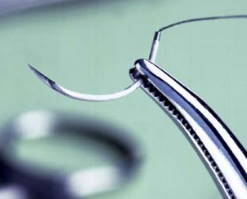
The first time was a yearling who was out in the field with his buddies, and when we went to fetch him in that evening, half of his lower lip was dangling completely loose, full of bloody grass and dirt.   I couldn’t imagine it could be successfully repaired, and feared he was doomed.  I called our horse vet,  who came out to the farm, silently surveyed the damage, moving the loose piece this way and that to gauge how it could come together.  He looked at me then and said  “this would be something I’d ordinarily do in the operating room at the clinic”.   But given the time of night, the willingness of the patient and the owner,  we set up surgery right in the barn aisle under bright lights, with calm music playing on the radio, and that lip was pieced together again.  It took many stitches and several weeks but it healed. It always had a little droop to it but this young horse survived thanks to the skilled needle and suture of a forgiving vet willing to work in less than ideal circumstances.

Lightening is not supposed to hit the same place twice, but it did this week.  The rainy weather kept the Haflingers in their stalls.  Out of boredom our two year old gelding had killed several water buckets by twisting them off their hooks, throwing them around and then playing them like bongos with this feet.

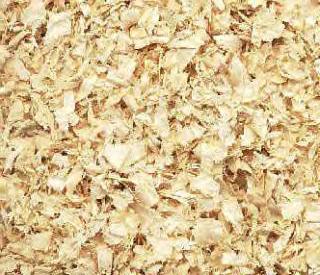
We walked in to find his stall was a bloody mess, from the walls, to the shavings, to his legs.  His lower lip was a mangle of pieces of loose flesh on one side, extending up to the corner of his mouth.  We  searched that stall high and low for signs of anything sharp that may have caused such a horrific injury, but there was nothing.  There was only an innocent appearing water bucket, still 1/3 full, hanging as usual on a blunt metal J hook that swivels on an O ring.  And an incriminating huge swath of blood extending on the wall down from that hook.  I suspect he was twisting the full bucket on its hook, trying to dislodge it in order to play with it and caught his lip between the bucket handle and the O ring, and the tightness of the pinch caused him to panic, pull back and his lower lip shredded as he did.  The bucket had its revenge at last.

There was no other explanation to be found.  I called our vet, again at night, and on the phone reminded him of the great feat of plastic surgery he had performed years ago in our barn.  He didn’t sound really nostalgic about the memory, as he suspected what was coming next.   He arrived with a full surgical suite packed in his truck and got to work setting up the lights, equipment, sterile fields and suture.  The greatest challenge was keeping the barn cats from hopping up on the table with sterile surgical instruments.

Our Haflinger patient was very cooperative once again, hanging his head low under sedation.  The vet sat on a vitamin bucket, cleaning the wound thoroughly so all the pieces could be sorted out and put back in place like a jigsaw puzzle.  He was able to pull together the deeper tissue with dissolvable sutures, and then started approximating the external lip edges.   By the time he was done, the shreds looked very much like a mouth again.

Two days later, my gelding is eating and drinking normally, just a bit puffy and droopy on one side of this mouth, but he is just fine thanks to a superb vet willing to work in a barn late on a cold and rainy night instead of a surgical suite with assistants and a more appropriate  environment (no barn cats strolling around underfoot).

Even in less than perfectly controlled circumstances, miracles can occur.  I am filled with unbounded gratitude.

*************************

Over the last four days, Haiti has seen many miracles take place in the rubble thanks to people who are willing to do what they can to help even in the most dire circumstances.    There are times when the only way to preserve life and put things back together is to do what we can when we can, even if it is messy and imperfect.

Bless those individuals who are making the on-site effort to help the Haitians, even if that help feels inadequate at the time, and surely insufficient.  The willingness to try to restore what once was–it is what will make all the difference in the midst of suffering and sorrow.
Breaking Through the Ice

http://www.photo.accuweather.com

Freezing rain needs to happen every two or three years just to remind Pacific Northwesterners that regular rain isn’t such a bad thing.  We webfoot Washingtonians tend to grouse about our continuously gray cloud-covered bleak dreary drizzly wet mildew-ridden existence. But that’s not us actually grumbling.  That’s just us choosing not to exhibit overwhelming joy.  They don’t call Bellingham, the town ten miles from our farm,  the “city of subdued excitement” for no good reason.

So when the temperatures drop in our moderate climate and things start to ice up, or the snowflakes start to fall, we celebrate the diversion from rain.  Our children are out building snowmen when there is a mere 1/2 inch of snow on the ground, leaving lawns bare and green with one large snowman in the middle.  Schools start to cancel at 2 inches.  We natives are pitifully terrible snowy road drivers compared to the highly experienced (and at times overconfident) midwestern and northeastern transplants in our midst.

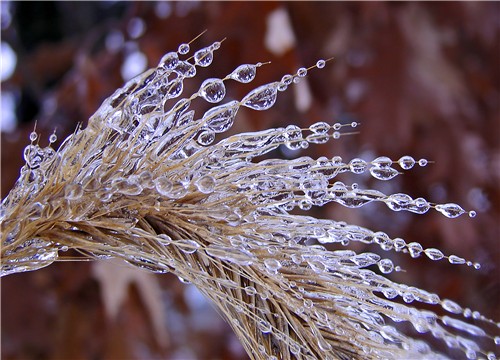
But then this little meteorologic phenomenon known as freezing rain and the resultant silver thaw happens.  It warms up enough that it really isn’t snowing but it also really isn’t raining because the temperatures are still subfreezing at ground level, so it spills ice drops from the sky–noisy little splatters that land and stay beaded up on any surface.  Branches become botanical popsicles, sidewalks become bumpy rinks, roads become sheer black ice, windows encase with textured glass twice as thick as usual.

So in the midst of this frozen concoction coming from the sky, I put off farm chores tonight as long as possible, knowing it would take major navigation aids to simply make my way out the back steps, across the sidewalk and down the hill, then up the slick cement slope to open the big sliding barn doors.  Chains on my muck boots help, to a degree.  The barn doors thankfully hadn’t iced together as they have in the past when the northeast wind blows freezing rain into the tiny gap between them, so by breaking foot holds into the ice on the cement, I was able to roll back the doors just enough to sneak through before shutting them quickly behind me, blocking the arctic wind blast.  Then I turned around to face the barn aisle and drink in the warmth of seven stalls of hungry Haflinger horsie bodies, noisily greeting me by chastising me for my tardiness in feeding them dinner.

Wintertime chores are always more time-consuming but ice time chores are even more so.  Water buckets need to be filled individually because the hoses are frozen solid.  Hay bales stored in the hay barn must be hauled up the slick slope to the horse barn.  Frozen manure piles need to be hacked to pieces with a shovel rather than a pitchfork.   Who needs a bench press and fancy weight lifting equipment when you can lift five gallon buckets, sixty pound bales and twenty pounds of poop per shovel full?  Why invest in an elliptical exerciser to get the aerobic work out in?  This farm life is saving me money… I think.

Once inside each stall, I take a moment to run my ungloved hand over a fluffy golden winter coat, to untangle a mane knot or two, and to breathe in sweet Haflinger hay breath from a velvety nose.   It is the reason I slide downhill and I land on my face pushing loads of hay uphill to feed these beloved animals, no matter how hazardous the footing or miserable the weather.  It is why their stalls get picked up more often than our bedrooms, their stomachs are filled before ours, and I pay for hoof trims for the herd rather than manicures and pedicures for the people residing in the house.

The temperatures will rise tomorrow, the overwhelming ice covering will start to thaw and our farm will be happily back to drippy and overcast.  No matter what the weather,  the barn will always be a refuge of comfort, even when the work is hard and the effort is a challenge for this middle aged farmer.

It’s enough to melt even the most grumbly heart and the thickest coating of ice.

Waiting in the Dark

We have fairly short hours of daylight here in the Pacific Northwest this time of year–only about 8 hours from sunrise to sunset and that little bit is compromised even more with the heavy cloud cover and the perpetual rain.

This morning it wasn’t raining for a change, so I moved the Haflingers out of the barn to their daytime paddocks, in the anticipation of a drier day and maybe a ray of sun now and again.

No such luck. The rains started within an hour of putting the horses outside, but we were headed off to a workday that would keep us away all day and the horses had no choice but to stand with their tails facing the driving rain, and their heads hunkered down. I felt badly that I’d left them “out to soak” so to speak, rather than “out to dry”. Wrong decision.

When it is still light out, the horses seem relatively content to stay out, even after their hay ration is eaten and there is nothing but raindrops to look at. But once the sun is down and it is dark, they are anxious to return to the light of the barn. They whinny expectantly whenever they hear the back door of the house open, or a car drive into the driveway. They are waiting in the dark, feeling more urgent with every passing hour. “It is time! Come now! Don’t delay! I’m ready for you to take me home!”

It was pitch black out tonight as I went to fetch them. We are in the process of rewiring our old barns, so our usual lighting of the path from paddocks to barn is absent, and the barn itself has only a couple lights working right now. I forgot to tuck a flashlight in my barncoat pocket so I was feeling blindly my way to the barn and then out to the paddocks to walk my wet, miserable, impatient horses back to the barn, one by one. They have been waiting, waiting. Knowing what is to come: a path back to the light, back to a dry bed of shavings, back to a filling meal. Content and comforted. Eager and excited to leave the dark behind.

I am waiting too, sometimes lost and miserable, often blinded in the dark. Waiting with anticipation, knowing, hoping for what is about to come. Watching for the door to open, the light to turn on, for someone who loves me and cares for me to walk right through the darkness to find me, and staying beside me, fetch me home.

Only then comes the comfort of knowing that once I’ve been brought into the light, darkness can not surround me again.

Haflinger and Fugue in D Minor

wallychew

The skies have opened up and dumped buckets of rain in the northwest today. It was dark and black this morning with a cloud cover that allowed no sunrise, and the southeast winds started picking up early, gusting up to 50 miles an hour in some places in our county. So when I went out to the barn this morning, I informed my seven resident Haflingers that they were stuck indoors for the day, and none of them objected as long as they had a pile of hay to munch, a comfy clean bed of shavings and fresh water. Contentment reigneth as I closed up the doors and headed to work.

By the time I made it home from work tonight, got dinner started in the house and headed down to the barn through sheets of blowing horizontal rain, I was assaulted by seven excited voices that greeted my opening the barn door. The deep bass from our stallion Waldheer, the tenor from Wheaton, the alto of Noblesse, Belinda, and Weissach, and the high soprano nicker of our yearling BriarRose. But nothing compares with the shrill piccolo squeal that comes from Marlee–heard above all and frankly, ear piercing! I realized as I walked in the barn that their chorus was only the melody line for the constant din of rain drumming on the metal roof and the banging of the sliding doors as the wind buffeted them. It was truly a concert out there, and I’m sure the Haflingers had heard plenty of noise from the storm all day and enough was enough. They wanted some relief, like, ah, food, like– you know–right now, to take their minds off of it.

I moved quickly to fetch grain and vitamins to them in record time, throwing hay flakes in their stalls and freshening up their water. They settled into the rhythmic chewing that I always find as comforting as a lullaby as I cleaned and prepared their beds.

Five more days of rain and wind are predicted. This could be a long confinement for the Haflingers if the weather stays this soppy and nasty the whole time. They may even compose a complete symphony before it is over. Rehearsals scheduled at 6:30 AM and 6:30 PM with performances daily at stall cleaning time, attended by one grateful lady farmer.

I’ll be asking for an encore.

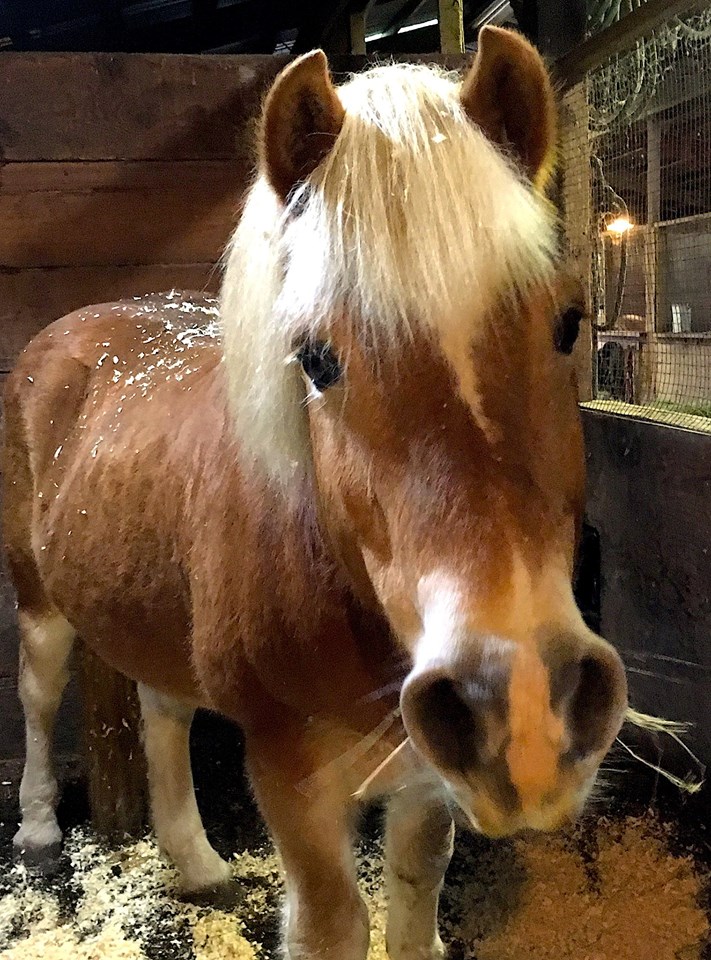
ponybarn2

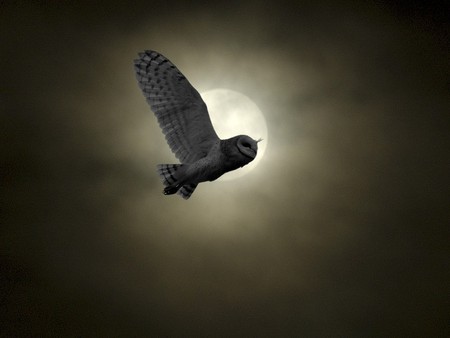
Under the Owl Moon

157370-bigthumbnail

Shadows
stretch long
under full moonlight
paths streaked
in semigloss
glow

Barnyard
lies silent
evening calm spreads
loft to stall
in advancing
twilight

Silhouette
branches move
against crisp sky
as wings
swish softly
searching

Clicking
cadenced duet
calling the question:
nocturnal overture
Who? again
Who?

Answers
from treetops
barn roof rafters
echoing soliloquy
of the lost
Found

Putting On a New Coat

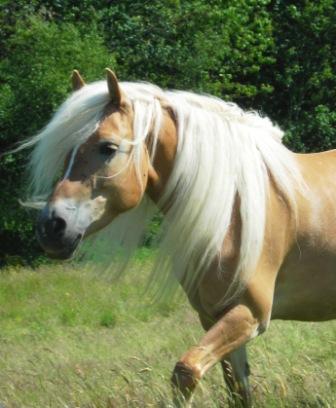
photo of Noblesse by Krisula Steiger

This story, written in 2003, is now published in the Oct/Nov 2009 issue of Country Magazine. Photos by Lynden Christian student Krisula Steiger.

Generally late September is when we start to see our Haflinger horses growing in their longer coat for winter. Their color starts to deepen with the new hair as the sun bleached summer coat loosens and flies with the late summer breezes. The nights here, when the skies are cloudless, can get perilously close to freezing this time of year, though our first frost is generally not until well into October. The Haflingers, outside during the day, and inside their snug stalls at night, don’t worry too much about needing their extra hair quite yet, especially when the day time temperatures are still comfortably in the 70s. So they are not in a hurry to be furrier. Neither am I. But I enjoy watching this daily change in their coats, as if they were ripening at harvest time. Their copper colors are so rich against the green fields and trees, especially at sunset when the orange hue of their coat is enhanced by the sunlit color palette of fall leaves undergoing their own transformation in their dying.

In another six months, it will be a reverse process once again. This heavy hair will have served its purpose, dulled by the harsh weather it has been exposed to, and coming out in clumps and tufts, revealing that iridescent short hair summer coat that shines and shimmers metallic in comparison, although several shades lighter, sometimes with nuances of dapples peeking through. Metamorphosis from fur ball to copper penny.

It occurs to me our old barn buildings on our farm have also undergone a similar transformation, having received a new coat of paint this summer. As a dairy farm for its previous owners starting in the early 1900s until a few years before we purchased it in the late 80s, it has accumulated more than its share of sheds and buildings constructed over the years to serve one purpose or another: the big hay barn with mighty old growth beams and timbers in its framework (still hay storage), the attached milking parlor (converted by us to individual box stalls for our weanlings and yearlings) and milk house where the bulk tank once stood, the older separate milk house where the milk used to be stored in cans waiting for pick up by the milk truck (now garden shed and harness storage), the old smoke house for smoking meats (was our chicken coop, but now the dogs claim it), the old bunk house and root cellar (more storage), the old large chicken coop (now parking for our carts and carriage), and the garage (a Methodist church in its former life and moved 1/4 mile up the road to our farm some 70 years ago when the little community of Forest Grove that had formed around a saw mill, store, school and church disbanded after 30 years of prosperity when there were no more trees to cut down in the area). When we bought this farm, these buildings had not seen a coat of paint in many many years. They were weathering badly–we set to work right away in an effort to save them if we could, and got them repainted–“barn red” for the barn and cream white for the other buildings with red trim around the windows and roof lines.

That was over 10 years ago now and we’ve been trying to hold off on another round of painting but it was clear this summer that it needed to happen. Now that they have their fresh paint coats, these old buildings appear to have new life again, though it is only on the surface. We know there are roofs that need patching, wiring that needs to be redone, plumbing that needs repair, foundations that need shoring up, windows that are drafty and need replacing, doors that don’t shut properly anymore–the list goes on. That superficial coat of paint does not solve all those problems–it will help prolong the life of the buildings, to be sure, but in many ways, all we’ve done is cosmetic surgery. What we really need is a full time carpenter –which neither of us is and at this point can’t afford.

In my middle age, there are times when I wish fervently for that “new coat” for myself–i.e. fewer gray hairs, fewer pounds, fewer wrinkles and one less chin, less achy stronger muscles. I buy a new fall jacket and realize that all my deficiencies are simply covered for the time being. I may be warmer but I’m not one bit younger. That jacket will, I hope, protect me from the brisk northeast winds and the incessant drizzle of the region, but it will not stop the inevitable underneath. It will not change who I am and what I will become.

True change can only come from within, from deep inside our very foundations, requiring a transforming influence that comes from outside. For the Haflingers, it is the diminishing light and lower temperatures. For the buildings, it is the hammer and nail, and the capable hands that wield them. For me, it is knowing there is salvage for people too, not just for old barns and sheds. Our foundations are hoisted up and reinforced, and we’re cleaned, patched and saved despite who we have become. And unlike new paint, or a winter coat, it lasts forever.

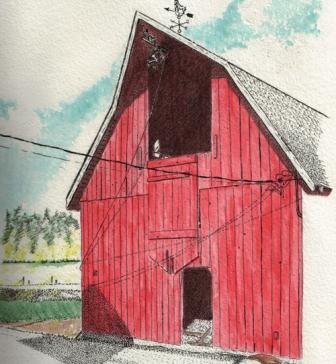
Watercolor of our hay barn by Dick Laninga

Being Tucked In

eveningbarnwritten September 11, 2001

There are moments of epiphany in horse and family raising, and tonight brought one of those moments. The world suddenly feels so incredibly uncertain, yet simple moments of grace-filled routine offer themselves up unexpectedly, and I know the Lord is beside us no matter what has happened.

Tonight it was tucking the horses into bed, almost as precious to me as tucking our children into bed. In fact, my family knows I cannot sit down to dinner until the job is done out in the barn–so human dinner waits until horsie dinner is served and their beds prepared.

My work schedule is usually such that I must take the horses out to their paddocks from their cozy box stalls while the sky is still dark, and then bring them back in later in the day after the sun goes down. We have quite a long driveway from barn to the paddocks which are strategically placed by the road so the horses are exposed to all manner of road noise, vehicles, logging, milk and hay trucks, school buses, and never blink when these zip past their noses. They must learn from weanling stage on to walk politely and respectfully alongside me as I make that trek from the barn in the morning and back to the barn in the evening.

Bringing the horses in tonight was a particular joy because I was a little earlier than usual and not needing to rush: the sun was setting quite golden orange, the world had a glow, the poplar and maple leaves have carpeted the driveway and each horse walked with me without challenge,  no rushing, pushing, or pulling–just walking alongside me like the partner they have been taught to be.

I enjoy putting each into their own box stall bed at night, with fresh fluffed shavings, a pile of sweet smelling hay and fresh water. I can feel them breathe this big sigh of relief that they have their own space for the night–no jostling for position or feed, no hierarchy for 12 hours, and then it is back out the next morning to the herd, with all the conflict that can come from coping with other individuals in your same space.  My horses love their stalls, because that is their safe sanctuary, that is where they get special scratching and hugs, and visits from a little red haired girl who loves them and sings them songs.

Then comes my joy of returning to the house, feeding my human family and tucking precious children into bed, even though two are now taller than me. The world feels momentarily predictable and comforting in spite of devastation and tragedy.   Hugging a favorite pillow and wrapping up in a familiar soft blanket, there is warmth and safety in being tucked in.

I’ll continue to search for those moments of epiphany whenever I’m frightened, hurting and unable to cope.  I need a quiet routine to help remind me how precious it is to be here, looking for a sanctuary to regroup and renew.

I don’t need to look far…

Loosening the Ties

Man Scything Hay by Todd Reifers

The small farm outside the village of East Stanwood, Washington on which I spent my first four years had three milking guernsey cows and a large crippled paint horse. In addition to ten acres of woodlot, we had about 6 acres of pasture, some of which was used to grow our winter hay supply.

My father was a small town high school agriculture teacher, supervising FFA kids and working far more hours than he was paid for.  He was determined to help make ends meet for his growing family by being as self-sufficient as possible on our few acres. Our own milk was pasteurized on our wood stove, we raised our own  beef, pork and chicken/eggs, and grew and stored as much forage as possible.  We had a large hay barn, but could not afford much more than the old tractor that my father kept patched together with gum and baling wire.  We certainly didn’t have baling equipment so our hay had to be put up loose, usually cut by a sickle bar attached to the tractor.

For reasons known only to him, my father often preferred to cut our hay with his hand held scythe.  Perhaps it was out of necessity, or more likely he enjoyed the rhythm of the physical work.  I can still see and hear him slashing through the grass, laying it neatly in a pile as he moved through the field.  In fact, I was so interested in watching him that I came up behind him one sunny day, wanting to follow his path in my own dreamy three year old way, and he reached back with the scythe handle to cut his next big swath, not aware I was behind him and the handle bumped right into my face, slicing my eyebrow open and laying me down neatly right along aside the nice pile of grass. I must have wailed hard and bled profusely as I remember him scooping me up, his face a mask of worry, and rushed me into the house, and then downtown to the kindly old lady doctor who butterflied my face back together.  I still can find that spot in my eyebrow when I look closely–a testament to the dangers of being too curious and too quiet.

The work of putting up loose hay is significantly different than baled hay.  It is much slower and deliberate, not nearly the frenetic activity of today’s hay crew.  When the hay is ready to be brought in,  it must be scooped by the pitchfork load onto the hay wagon, piled high as possible without much toppling off, and then slowly brought to the hay barn where the large hay fork would be let down on its pulley, opened and closed over the pile, hauled back up inside the hay mow to be released into a big pile.  There it would be in a fragrant mound waiting to be forked down into the mangers every morning and night as the cows were milked.  It never gets packed tight, it remains loose and fluffy and often not as musty as the baled hay can be.  However, there is more loss in the harvesting process, it blows in the slightest breeze and has a life of its own while bales sit where you put them and stay there until retrieved. Predictable, efficient, easy to store and move but without give or flexibility.

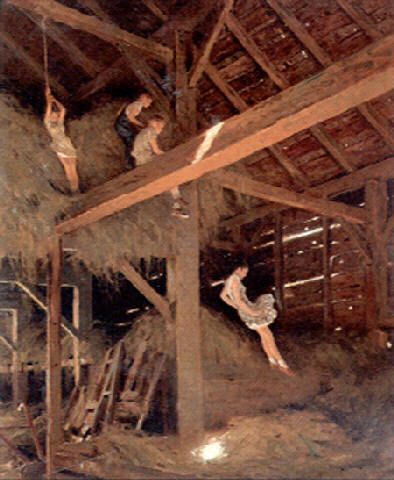
Jumping into loose hay is a feeling of being enveloped and cushioned.  The occasional broken bale I find in the loft softens in my hands as I scoop it up–what a delight.  One of the joys of doing chores is breaking the twine on the bales and freeing the hay into flakes as the portions are distributed to each stall.  Would I find carrying pitchforks of loose hay as gratifying?  Perhaps, but harder work indeed and much more lost along the way.

Is each day lived in tightly bound bales or as free-spirit loose hay?  I experience both, stretching against the cords that bind me at times, but needing the ties that keep me from blowing away at the slightest puff of wind.  Life stacks us up, builds us and grows us, but too soon pulls us apart and we are dust again.  We must thrive with our covenant “ties” –the twines that keep together our faith, our relationships, our children.  But we can overdo, sometimes binding too tightly, and not unlike our children who must eventually be free, we must loosen our ties, let them breathe and avoid the “mustiness” that can develop over time if they never are opened up.

It is time to celebrate the hay stack and know that we belong, bound or loose, to the dust from which we arose.

children-playing-in-hay-loft

Stacking the Hay

6651_512624400914_148300158_30510731_6701452_n6651_512624395924_148300158_30510730_6814861_n

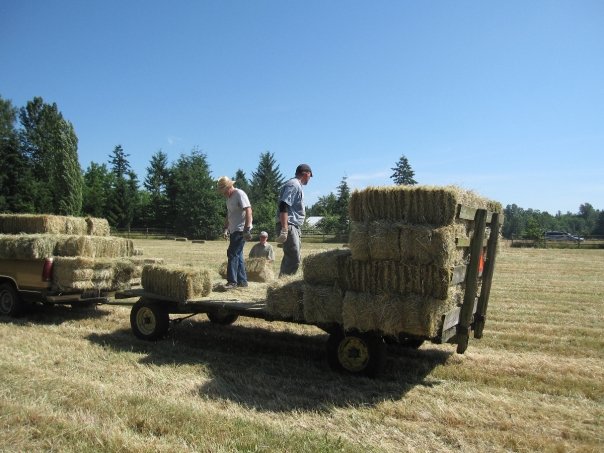
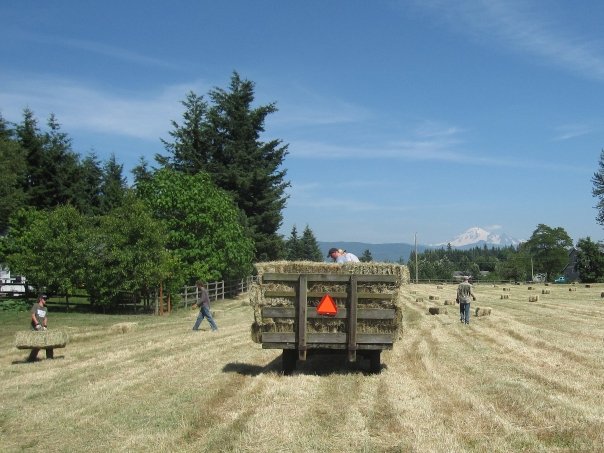
Every hay crew is the same
Though the names change;
Young men flexing their muscles,
A seasoned farmer defying his age
Tossing four bales high,
Determined girls bucking up on the wagon,
Young children rolling bales closer,
Add a school teacher, pastor,
Professor, lawyer and doctor
Getting sweaty and dusty
United in being farmers
If only for an evening.

Stacking
Basket weave
Interlocking
Cut side up
Steadying the load
Riding over hills
Through valleys
In slow motion
Eagles over head
Searching the bare fields
Evening alpen glow
Of snowbound
Eastern peaks

Friends and neighbors
Walking the dotted pastures,
Piling on the wagons,
Driving the truck,
Riding the top of hay stack
In the evening breeze,
Filling empty barn space to the rafters,
Making gallons of lemonade in the kitchen.
A hearty meal consumed
In celebration
Of summer baled, stored, preserved
For another year.

Hay crew
Remembered on
Frosty autumn mornings before dawn
When bales are broken for feed
And fragrant summer spills forth.
In the dead of winter

Bed Spreading

shavingspile

When I glanced out the  window and saw the large shavings truck pull up to our barn to dump its load in the shavings shed, you’d have thought it was the Second Coming.  I could almost hear the trumpet sound and the heavens sing.  It was that welcome and long anticipated.

We’re in the middle of a wood shavings shortage in the northwest and have been for over a year.  Even pellet stoves are going wanting. Here we are in the land of the evergreens, of thousands of acres of woodlands, and in the old days, a saw mill on every corner.  Many factors have threatened the lumber industry in our part of the country: less expensive lumber coming down from Canada, the spotted owl and the Endangered Species Act, and most recently, a new housing slump because of the economic down turn.  The mills shut down for extended times so the shavings stockpiles have evaporated quickly.  In addition, the mills have decided that their own shavings can convert to pretty decent fuel for steam powered machinery, so they are keeping it and burning it themselves, when previously, it went to whoever would haul it away–free.

No more.

I always try to plan ahead for when I’ll need my next truckload of shavings for bedding the horse stalls.  A two week lead time used to work pretty well, and by the time I’m scooping my last wheelbarrow load to haul to the barn, the truck will drive in ready to dump the next mountain for me, usually lasting about 2-3 months, depending on the time of year and how many horses we have.

I called in early December, knowing I’d need more shavings soon, but hadn’t run out yet.  The local friendly shavings guy said he was out of the business.  It’s not looking good, I was told.  Orders were backing up and the stockpiles were gone.  They were totally dependent on the mills starting back up after Christmas and I was totally dependent on them.

Meantime I was starting to be very careful in my stall cleaning strategy.  No more wasteful scooping of shavings and poop–I needed to filter out the good shavings as best I could.  It easily doubled the cleaning time, this “panning for poop” approach.  But I stretched the shavings I had another week or so.

Then I had to go buy baled shavings at the feed store to tide me over.  This is an outrageously expensive way to go–easily 6x the cost of bulk shavings hauled in by truck.   Pretty soon, even the baled shavings were sold out and none anticipated any time soon.  Then we resorted to straw bedding–a truly desperate measure.  Cleaning straw beds in horse stalls is one of the most difficult jobs as the horse manure just sinks to the bottom of the straw bed and has to be searched out like so many brown Easter eggs.    Straw makes Haflingers happy though–it is like a constant brunch underfoot.

So I was near despair and so were all my local horsey friends.  Then my ship came in from British Columbia today.  Yes, it is costing 150% more than it did when I last had a truckload hauled in a year ago.  But it is sweet fluffy shavings and it made my day.

When I came home tonight, it was pure joy to put on my muck boots and head to the barn.  I started in on the cleaning process and realized that two months of scrimping had left these dirt floor stalls in a sad and mired state.  They are not damp, but they are in dire need of a deep clean that I cannot even begin to do–it will take weeks to dig out all the old stuff so the new bed can be spread.  All I could really do was put on a coating of fresh clean shavings tonight on top of the layers, knowing full well they will be mixed up thoroughly and spoiled by the morning.  However, over time, I will manage to get back to the clean beds I once had.

We can tend to accumulate a lot of muck in our lives, never really doing a deep clean when it is needed.  We get pretty used to sleeping in it, eating in it and not even noticing it after awhile.  But the day when fresh new clean stuff arrives in our lives, how do we react?  Just put it on top of the muck and hope no one will notice what is still underneath?  Abandon the old stalls and build new ones, ready for a fresh start?  Or dig down and really get rid of the old dirt, working as long as it takes to remove it?  What an amazing thing to have a chance to clean it all up!

All I know is that I celebrate that there is still renewal that can come into my life when I least expect it or deserve it.  I can start again and hope for the best.   There is nothing like a sweet fresh bed to rest in.