Lenten Reflection–Better to be Broken

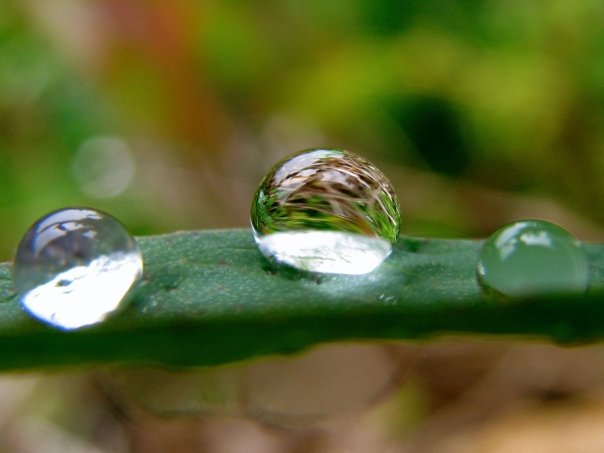
photo by Josh Scholten

God uses broken things.
It takes broken soil to produce a crop,
broken clouds to give rain,
broken grain to give bread,
broken bread to give strength.
It is the broken alabaster box
that gives forth perfume.
It is Peter,
weeping bitterly,
who returns to
greater power than ever.
Vance Havner

We yearn for perfection,
for flawless and faultless,
unblemished,
aiming for symmetry,
straight and smooth.

Life serves up something
far different
and our eye searches
to find the cracks,
scratches and damage,
whether it is in
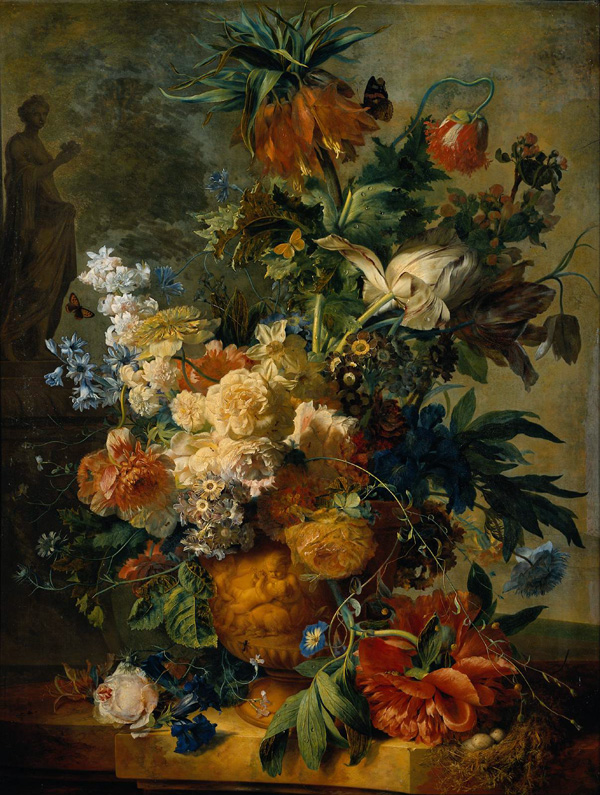
a master’s still life portrait
replete with crawling flying insects
and broken blossoms,
or in the not so still life
of our next door neighbor.

In the beginning we were created
unblemished,
image bearers of perfection.
No longer.
We bear witness to brokenness
with shattered lives,
fragile minds and weakening bodies.
It is our leaks and warts
that stand out now.

To restore
the lost relationship with Him,
God provides the glue
needed to heal the broken.

He broke Himself
to mend us,
binding us to Him
forever.

Still Life With Flowers--Jan Huysum
photo by Josh Scholten

Lenten Reflection–Morning Marching Orders

photo by Josh Scholten

All my life I have risen regularly at four o’clock and have gone into the woods and talked to God. There He gives me my orders for the day.
George Washington Carver

To rise early is to know the quiet solitude before dawn and look out with anticipation upon the expanse of an unwritten day. The ordained details are unknown to me and that is just as well. If I knew I might dive back under the covers, trying in vain to hide.

So when I do get up early and talk to God, mostly I listen. I am asked to trust and leave the details up to Him.

Then I try to obey, as best I can muster. Too often I mess up: I head off in the wrong direction, turn left instead of right, trip over my own feet, fall flat on my face.

So I’m pulled up out of the dirt yet again, dusted off, and sent on, the way clearly demarcated, the pathway straight.

Even I can’t miss it and can’t mess it up. Thank God.

photo by Josh Scholten

Lenten Reflection–Substitutions Allowed

photo by Josh Scholten

For the essence of sin is
man substituting himself for God,
while the essence of salvation is
God substituting Himself for man.

Man asserts himself against God and puts himself
where only God deserves to be;
God sacrifices Himself for man and puts Himself
where only man deserves to be.

Man claims prerogatives that belong to God alone;
God accepts penalties that belong to man alone.

John Stott, The Cross of Christ

Our struggle with God, from our first breath, is wanting to forget we are made from dust, molded from mud, and will return to the ground, no matter what. Between the womb and the tomb is the choice of acting as though we own the earth and somehow it owes us everything because we exist, or whether we tread lightly, knowing each breath, each morsel, each day is an undeserved gift granted by Him taking our place. When we acknowledge that His heart on earth bled so that ours will continue to beat, so that we may laugh, cry, love and worship–only then we are right with God, instead of insisting we be God.

His heart for ours. A substitution made perfect.

Lenten Reflection–He is Enough

photo by Josh Scholten

Let nothing disturb you, nothing frighten you, all things are passing. God never changes. Patience obtains all things. Whoever has God lacks nothing. God is enough.
The Prayer of St. Teresa of Avila (1515-1582)

There are sleepless nights when the burdens of our waking hours weigh heavily on our brows. Almost anything feels more overwhelming at night, as we struggle to see clarity in the dark through our tears. Even in broad daylight, the puzzle pieces of our lives may well be scattered, making no logical pattern or sense. We can feel as random as pebbles on a beach.

In those helpless moments, we must remember that even in our emptiest moments, if we have God, we lack nothing. This too shall pass. God does not change, even as we brace against the waves of life which shift and turn us over and over, smoothing our edges, leaving us upended.

Patience, patience.

He is enough for now, for tonight, for today, for tomorrow.

And forever.

Lenten Reflection–The Best Work Of All

photo by Josh Scholten

If I can put one touch of rosy sunset into the life of any man or woman, I shall feel that I have worked with God.
G.K. Chesterton

This short video about a young man with Down’s Syndrome who changes a work place illustrates such a simple point: anyone can make a memorable difference in the lives of others by bringing a touch of beauty and meaning into their otherwise routine work. I found it inspiring as it was shared by one of my co-workers and now each of us is searching for our own special way to touch others with that daily “rosy sunset.”

The point is the unexpected gift, whether it is a palette of color in the sky at the end of the day, a thoughtful gesture that pays forward inspiring others to do the same, or the sacrifice that pays for all debts forever. It is doing the work of God in other’s lives–the best work of all.

thanks to our near neighbors Bellewood Acres for this beautiful sunset photo from 3/6/12

Lenten Reflection–The Gradual Descent

photo by Josh Scholten

It does not matter how small the sins are provided that their cumulative effect is to edge one away from the Light and out into the Nothing. Murder is no better than cards if cards can do the trick. Indeed, the safest road to Hell is the gradual one — the gentle slope, soft underfoot, without sudden turnings, without milestones, without signposts.
C.S.Lewis in “The Screwtape Letters”

I recall a Twilight Zone episode long ago written by Earl Hamner, Jr. (who later went on to write “The Waltons”) about a back woods hunter and his coon dog who drowned pursuing a raccoon one fateful evening. The next day they found themselves lying alongside the pond, and set down a trail looking for the way back home. The trail took them to an entrance gate where the friendly gatekeeper welcomed the old hunter in but refused to allow the dog (who would have smelled the brimstone far beyond the gate). The hunter refused to enter without his dog so they continued down a long long path that seemed far less traveled.

Eventually they were found by a messenger who was looking for them, and who led them on up the road to paradise–coon hunting and square dances every night. They were told, “You see, a man, well, he’ll walk right into Hell with both eyes open. But even the Devil can’t fool a dog!”

As a child, I remember thinking how quickly I would have been lured in the wrong gate, choosing the easy way rather than seeking the longer way of the harder path that would lead to heaven.

Each step, every day, takes me closer. The path itself may not be an easy one, but it was never meant to be. I hope it won’t take a dog to help me know which way to go.

Lenten Reflection–Pathway of Flowers and Thorns


We are to follow in His steps; and can we wish, if it were possible, to walk in a path strewed with flowers when His was strewed with thorns?
John Newton

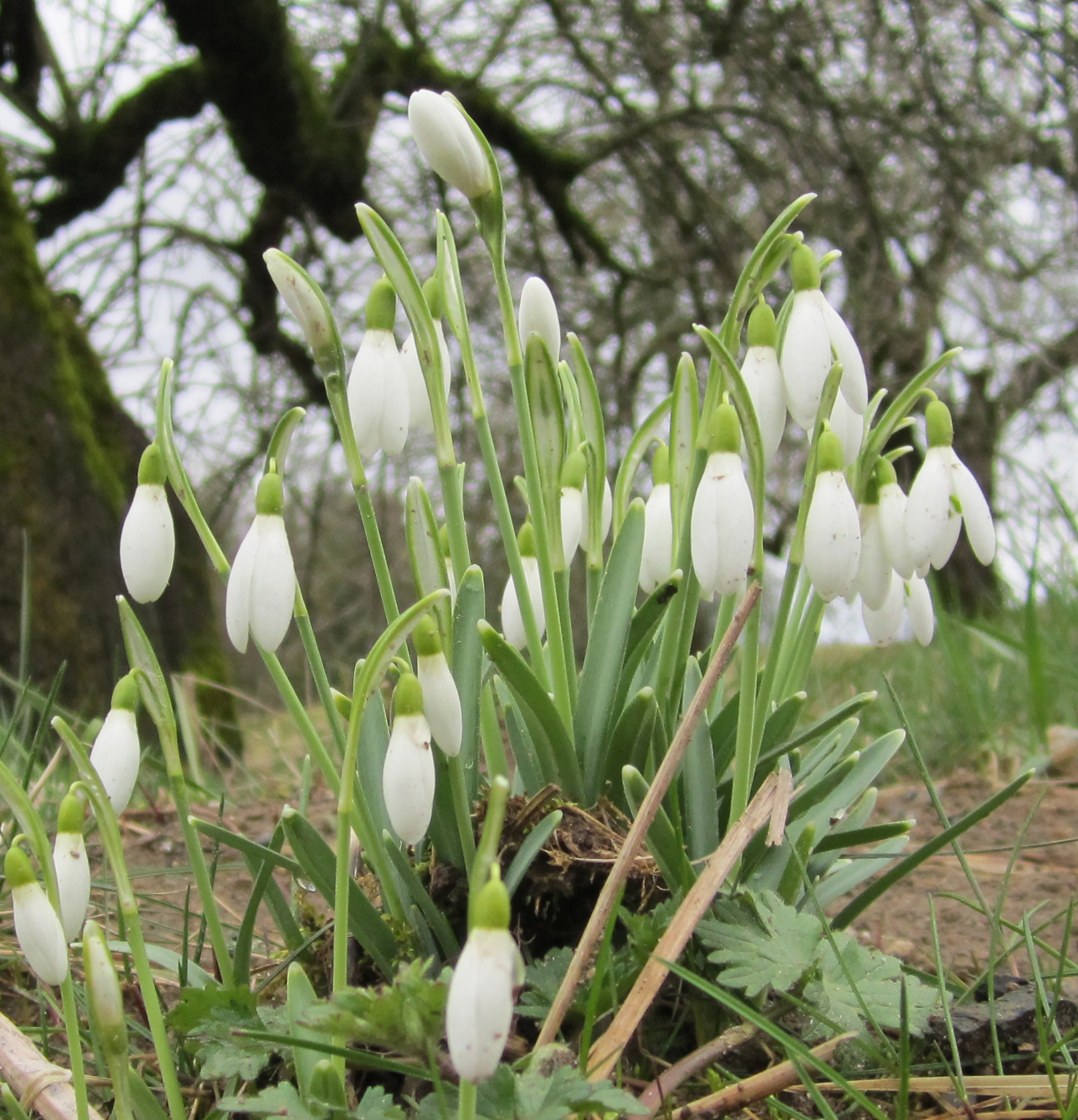
A little over two months ago, two days before Christmas, our family made the necessary decision to have one of our two older dogs, just diagnosed with inoperable cancer, euthanized at home. The vet came on a blustery Friday evening after his clinic appointments were done; my husband and son had worked in the cold wind preparing the grave on a little hill overlooking the barnyard. This peaceful but unmarked spot has become a pet cemetery over the years, now with three dogs and at least that many cats lying under the apple trees.

It was difficult for our family that night to think of our dog’s still warm body tucked into that cold ground. That bare patch of dirt has stared at me as I’ve passed by over the last few weeks and our other dog has paused there once or twice, as if knowing where his old friend lies, and where someday he will be. Then over the last few days, though we are still in the midst of wintry weather, with passing storms of hale, frozen rain and snow showers, I was astonished to see that plot of bare ground transforming.

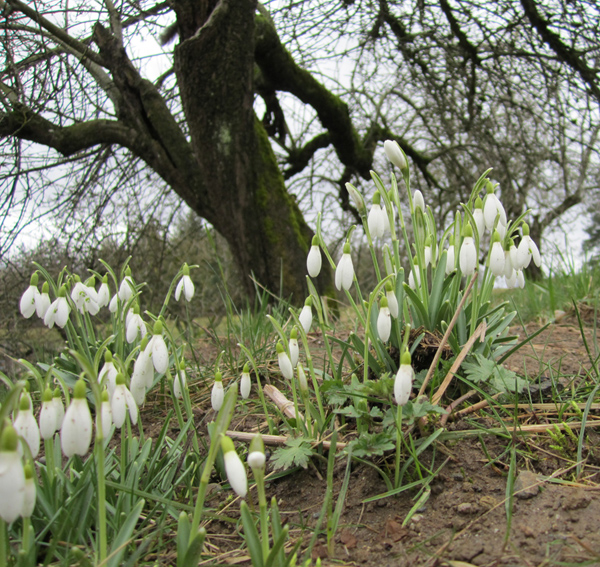
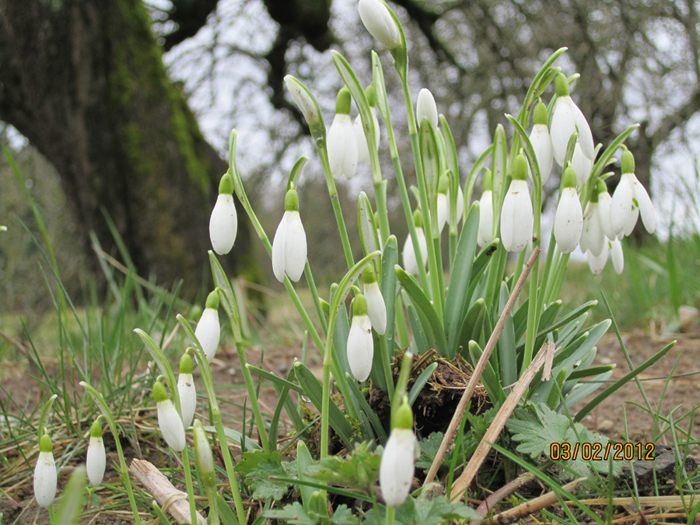
Snowdrop flowers had appeared from nowhere. They had not been there before and I have no idea where they would have come from. Possibly disturbing the ground brought previously hidden bulbs closer to the surface. No matter how they found their way there, they are a breath of relief and promise after a dark winter. They are bright and clean and pure in the midst of otherwise unadorned mud, embraced overhead by stark bare orchard branches, their little white bells stirred by winter breezes.

They are brave and insistent that life goes on, in reality thriving over the top of death.

So we are encouraged to follow in His steps, one slow difficult step at a time. The going is painful much of the time, strewn as life can be with thorns and tears. Yet, because He walked there first, going ahead of us, His footprints through the thorns are filling with flowers, cushioning our path with unsurpassed love and beauty.

Lenten Reflection–The Waiting Look

photo by Josh Scholten

The Lord turned and looked straight at Peter. Then Peter remembered…and he went outside and wept bitterly.
Luke 22:61-62

“Peter never thought of turning (in the thick of his sin), but the Lord turned (first). And when Peter would rather have looked anywhere else than at the Lord, the Lord looked at Peter. Only when we come to our Father in response to his waiting look can we be freed and forgiven.” Henry Drummond

Peter’s bitter tears flowed–from predicted personal failure, recognizing his guilt, being caught in the act of doing what he said he would never do, knowing he had turned away and denied his best friend, mentor, and Lord.

What nonverbal message did the Lord send when he turned first with that “waiting look” after Peter had turned away? I doubt it was anger as Peter’s denial was just as predicted so not at all unexpected. I doubt it was condemnatory–Peter feels the heaviness of his guilt without any assistance at all.

I suspect it was just as Drummond suggests: it was a look of sad longing and waiting, a look reflecting rejection and hurt, a look of resignation and acknowledgement of the hard and painful work lying ahead, a look wondering how long it will take the children of God to accept grace and to open the gift of forgiveness they were freely given.

We need to know, even when we turn away, denying and rejecting our relationship with him, he turns to us first with a look of compassion and understanding so we will remember and respond.

photo by Josh Scholten

Lenten Reflection–Thirsty

photo by Josh Scholten

Later, knowing that everything had now been finished, and so that Scripture would be fulfilled, Jesus said, “I am thirsty.”
John 19:28

God thirsts to be thirsted after.
Augustine

I may be mistaken, but I think this is the only statement Jesus makes in the Gospel that reflects his bodily need. During his years of ministry, he doesn’t complain about a headache or backache, or sore feet, or a bad cold or feeling hungry. In one story, the writer John says Jesus is tired after a journey to Samaria where he sits down to rest at noon and asks a Samaritan woman for a drink of water from the well. As they talk, she asks for “living water” from him–her thirst, despite having easy access to a well, exceeds his.

So it is from the cross. He has extreme thirst, no question. He is offered vinegar on a sponge–hardly an answer to thirst–what we offer to him in his need is not worthy of spit. We stand beneath the cross with our own unquenchable thirst–unsatisfied by money or gadgets or status or power or pleasure or gallons of drink– that is slaked only as this man offers himself to us.

He tells us of his thirst so we remember our own deep need, unmet and unsatisfied until “it is finished.”

Only then we drink freely and deeply.

Lenten Reflection–In the End, It’s All One

photo by Josh Scholten


Even in laughter the heart may ache, and rejoicing may end in grief.
Proverbs 14:13

Blessed are you who weep now, for you will laugh.
Luke 6:21

Laugh till you weep. Weep till there’s nothing left but to laugh at your weeping. In the end it’s all one.
Frederick Buechner

I work in a place where there are kleenex tissue boxes everywhere you turn. On any given day hundreds of tissues cover sneezes and coughs and blow over 120 runny noses. That is reason enough, but they are essential for those tender and vulnerable moments when eyes start to well up and overflow, and the tears start to stream. There is nothing more helpless than crying and having it leak and puddle all around you with nothing to catch the stream. Handing someone a tissue is one of my most nurturing acts. My standard line is a variation of Buechner’s quote: “sometimes our feelings are so overwhelmed we aren’t sure whether to laugh or cry, so we end up doing both–just let it flow.” It almost always gets a smile and chuckle even from the biggest toughest guy who is sobbing his heart out over a lost love or his parents’ divorce, or the confirmed cry baby who has been designated the “town crier” by her roommates because she can’t not cry at every little thing.

I know something about this personally as I’m an easy crier as well, though these days it is primarily my family who is aware of it. In fact, it has become a contest to see how early on Christmas Day will Mom start to cry. Certain movies will always trigger my tears. Even certain commercials–remember those old Kodak commercials with the song “Turn Around”? And especially the whistled version of Greensleeves for the old “Lassie” show. Gets me every time.

Our joy and sorrow become so intertwined in our hearts and minds that we actually dwell inside both at once. That is the essence of Lent–the Bright Sadness of our long journey through His pain and suffering to find that His death–our death–has been transformed to eternal life.

Laugh through the tears and cry through the giggles. In the end, it’s all one.