
Managing the Flamingo

flamingo

photo by Chris Duppenthaler
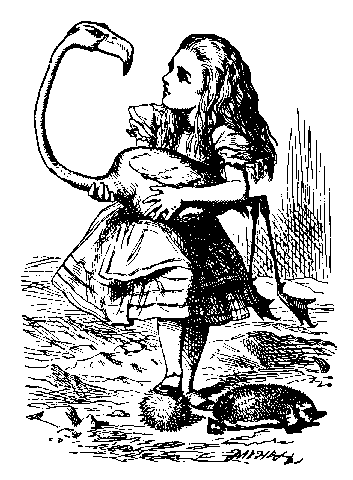
Lewis Carroll Illustration

The chief difficulty Alice found at first was in managing her flamingo: she succeeded in getting its body tucked away, comfortably enough, under her arm, with its legs hanging down, but generally, just as she had got its neck nicely straightened out, and was going to give the hedgehog a blow with its head, it would twist itself round and look up in her face, with such a puzzled expression that she could not help bursting out laughing: and when she had got its head down, and was going to begin again, it was very provoking to find that the hedgehog had unrolled itself, and was in the act of crawling away…. Alice soon came to the conclusion that it was a very difficult game indeed. ~Lewis Carroll from Alice in Wonderland

Navigating the U.S. health care system these days reminds me of Alice’s dreamscape game of Wonderland croquet.  A physician is given a flamingo mallet and a hedgehog ball and ordered — by the Queen at the risk of having one’s head lopped off — to go play, but the mallet won’t cooperate and the ball keeps unrolling itself and crawling away.  Just like any day in a medical clinic, a doctor’s time is spent trying to manage their flamingo and the patient gets tired of waiting,  so gets up and leaves.  At least Alice gets a good giggle out of it, but the reality in health care causes more tears than laughter.   We are playing a very difficult game of changing rules and equipment.

The flamingo in the doctor’s hands could represent the increasingly time-consuming requirement now to search over 68,000 ICD-10 diagnosis codes rather than the previous 14,000 ICD-9 codes.  Or the requirement to search for a 10 digit NDC number for any prescription medicine sent electronically to a pharmacy.  Or the “meaningful use” criteria that regulate mandatory data collection and reportage on patients to the Federal Government in order to receive full payment for Medicare or Medicaid billings.  Or the newly updated HIPAA and HITECH electronic security requirements to ensure privacy.  Or the obligations to the new Accountable Care Organization that your employer has joined.  Or the Maintenance of Certification hoops to jump through in order to continue to practice medicine.   The exasperated and uncooperative “managed” flamingo keeps curling itself around and looking at us with a puzzled expression:  just what is it you were supposed to be trained to do?    is there actually a patient to pay attention to in all this morass of mandates?

And the poor hapless hedgehog patient is just rolled up in a ball waiting for the blow that never comes, for something, anything that might look like health care is about to happen.  Instead there are unread Notices of Patient Privacy to sign, as well as releases to share medical information to sign, agreements to pay today’s co-pay and tomorrow’s deductible and whatever is left unpaid by Affordable Care Act insurance, passwords to choose for patient portals, insurance portals, lab portals and healthcare.gov.  It might be easier and less painful to just crawl away and hide from that bumbling physician who can’t seem to get her act together.

I wish I were laughing, but I’m not.  As both physician and patient, it’s getting harder and harder to play the game that is no game at all.  The threat of losing credentialing in an insurance plan, or getting poor ratings on anonymous online physician grading sites, or being inexplicably dropped from a provider list, or too unproductive to remain in an employer medical group, or losing/forgoing board certification is like a professional beheading.  We keep trying to juggle the flamingo motivated by those threats, all the while ineptly managing the managed care system, and hoping the patient won’t walk away out of sheer frustration.

It’s hard to remember why I’m in the game at all. I think, at least I hope,  I wanted to take care of people, heal their illnesses and help them cope with life if they can’t be healed.  I wanted to provide compassionate care.

It is enough to make a doctor cry.  At least we can meet our patients at the Kleenex box and compare notes, and maybe, just maybe, we’ll find enough common ground to even share a laugh or two.


 

flamingo2

photo by Chris Duppenthaler

The Helpless Prayer

Faye Jubilee with her sister Merry

I pray because I can’t help myself.
I pray because I’m helpless.
I pray because the need flows out of me all the time — waking and sleeping.
It doesn’t change God — it changes me.

~C.S. Lewis

Almost four weeks ago I wrote about our little neighbor, two year old Faye Jubilee, sickened by E.Coli 0157 infection/toxin to the point of becoming critically ill with Hemolytic Uremic Syndrome (plummeting cell counts and renal failure).  My post is found here:

https://briarcroft.wordpress.com/2015/05/01/may-god-have-my-jewel-in-his-keeping/

At the worst point of her illness, when the doctors were sounding very worried on her behalf, Faye’s mother Danyale wrote to our Wiser Lake Chapel Pastor Bert Hitchcock with a plea for prayers from the church in the midst of her helplessness:

Here is how he responded:

“I understand that Faye  (and everyone dealing with her) is fighting for her life. And that’s the way I am praying: that God in his merciful power, would deliver her, even if her condition looks hopeless.

If you were able to be in church this morning, you might hear my sense of urgency, for I have chosen this benediction, with which to close the service — and I give it to you right now, from the mouth of our Lord:
Jesus said: “Do not be afraid, Danyale!
I am the First and the Last.
I am the Living One.
I died, but look – I am alive forever and ever!
And I hold the keys of death and the grave.

Neither you nor I know how this will turn out — the possibilities are terrifying. But we do know who holds the keys of life and health and death; He is the Life-giver, who heals all our diseases — nothing can rip our lives (or little Faye’s life) out of His hands. And, when He does allow these bodies to give out, He promises to give us glorious new life, safe forever in His presence. These are not pious platitudes; these are the rock-hard promises of the one who loves us more than life, and who is absolutely in control of what is happening today.

Safe in the arms of Jesus,
Safe on His gentle breast;
There by His love o’ershaded,
Sweetly my soul shall rest.

I’m praying for you all; and the Chapel Family will be praying this morning, as we gather in the Lord’s presence.

Love you, and yours, Danyale,

Pastor Bert Hitchcock


And now Faye is home, with normal kidney function and improving cell counts,  having also survived a bout with pneumonia.
Thanks to you all for your prayers lifted around the world on her behalf.   Here is a summary from her mother:


Dear Friends and readers of Barnstorming,

Some of you we know, but so many of you we do not. Whichever the case, Emily tells me you have prayed for our little girl, Faye, throughout her sickness and into her recovery. What can parents say when people–many of whom we may never be privileged to meet in this life–have come alongside us to beseech the Lord for our daughter’s life and pray for her healing? Thank you. Thank you!

Faye is doing so well; stronger every day, more and more herself! It is wonderful to see.

This week we head back down to Seattle Children’s for a check up–we’ll get to say hello to the good folks who saw her through her sickness. A special stop will be made on the dialysis unit to see Nurse Kathy, a favorite of Faye’s. We anticipate a good report!

Thanks again for your love and support, far and wide. Truly astounding.
Danyale and Jesse Tamminga, for Faye, too


Faye at church this past Sunday, looking very much like herself again


Our prayers of helplessness to God continue for the healing and strengthening of Towa Aoyagi, the fourteen year old son of Pastor Seima and Naoko in Tokyo, Japan, who remains paralyzed following a neck injury four weeks ago today.   He is currently in rehab in Tokyo, trying to stabilize enough to come to the United States for state-of-the-art spinal cord injury treatment to learn how to live and thrive in his changed body.

May God have our jewels this day in His keeping.

A Light From Within

window2People are like stained-glass windows.  They sparkle and shine when the sun is out, but when the darkness sets in, their true beauty is revealed only if there is a light from within.
~ Elisabeth Kübler-Ross

In my work I tend to meet people in their dark times.   It is rare for a patient to come to clinic because all is well.  They come because they are struggling to keep going, are running out of fuel, too blown about by the storms of life.

It is my responsibility to search out the light hidden dim within, to assist my patient to fight back the darkness from their inner resources and offer what little I have to stoke and feed the light from the outside.

I offer a sanctuary from the storm; in return I am bathed in their glow.


My Own Usefulness

hand

Like a doctor, I learned to create
from another’s suffering my own usefulness, and once
you know how to do this, you can never refuse.
To every house you enter, you must offer
healing: a chocolate cake you baked yourself,
the blessing of your voice, your chaste touch.
~Julie Kasdorf from “What I Learned From My Mother”
When my clinical responsibilities top out at 14 hours a day and there is still more to do,  when I’m weary and grumbling about work load, I need reminding that my usefulness is completely dependent on others’ suffering.
No illness, no misery, no suffering and I’m out of a job.
If only. What bliss that would be.
If I’d known it could help you, I’d have baked a cake…

Definitely chocolate.

Patients Telling Their Own Stories

“Window” photo by Nate Gibson

If you want to identify me,
ask me not where I live,
or what I like to eat,
or how I comb my hair,
but ask me what I am living for,
in detail,
ask me what I think is keeping me
from living fully
for the thing I want to live for.
~ Thomas Merton

As a patient waiting to see my health care provider,  I would adapt Merton’s template of personal revelation:

If you want to know who I am,
ask me not about my insurance plan,
or what is my current address,
or whether I have a POLST on file,
but ask me what I am most concerned about,
in detail,
ask me what I think is causing my symptoms
and what I think is keeping me
from eating healthy, exercising regularly, choosing moderation in all things
so that I can live fully
for the thing I want to live for.

As a physician in the midst of a busy clinic day, I struggle to know who my patients are beyond their standard medical history and demographics.  One of my goals in our primary care clinic, now almost a decade into electronic medical record keeping,  is to create a way for interested patients to provide their personal history online to us via our password secured web portal.   These are the questions our clinic staff may not have opportunity to ask or record during clinic visits.  Having the patient personally document their social history and background for us to have in the chart –in essence, telling us their story in their own words–can be very helpful diagnostically and for individualizing the best treatment approach for each unique individual.

We are creating an “About Me” folder in the electronic medical record that would contain information the patient would provide online via their secure patient portal.   It will be introduced once the patient signs onto their patient portal for the first time and views their online chart:

Tell us about yourself
This is your own personal history in your own words to be added to your electronic medical record in the folder “About Me”. You can edit and add information at any time via this secure patient portal to update it.

We want to know your story.  Only you can tell us what you think is most important for us as your health care providers to know about you.  We may not always have the time to ask and document these detailed questions in a brief clinic visit, so we are asking for your help.  

Why do we want to know your non-medical background as well as medical background?

We evaluate a patient’s symptoms of concern but we also are dedicated to helping our patients stay healthy life long.  To assist us in this effort, it is very helpful to know as much about you as possible, in addition to your past medical history.   It is crucial also to understand your family background and social history.  We want to know more about your personal goals, and what you think may be preventing you right now from living fully for the things you consider most important to you. 

This is your opportunity to tell us about yourself, with suggested questions below that you can consider answering.  This information is treated as a confidential part of your medical record, just like all information contained in your record.  You can add more at any time by returning to this site.

1)      Tell us about your family—who raised you and grew up with you, and who currently lives with you– including racial/ethnic/cultural heritage. If relevant,  tell us whether you have biological beginnings outside of your family (e.g. adopted, egg donation, surrogate pregnancy, artificial insemination, in vitro fertilization)    Provide information on any illnesses in your biologic family.

2)     List the states or countries you have lived in, and what countries outside the U.S. you have lived in longer than a month.  Have you served in the military or another government organization, like the Peace Corps?

3)      Tell us about your educational and job background. This could include your schooling or training history,  paid or volunteer work you’ve done.  What are your hobbies, how do you spend your leisure time, what are your passions and future goals.  Where do you see yourself in ten years?

4)      Tell us about your sexual orientation and/or gender preference.

5)      Tell us about your current emotional support system—who are you most likely to share with when things are going very well for you and especially when things are not going well.

6)      Tell us about your spiritual background,  whether you are part of a faith or religious community and if so, how it impacts your life.

7)       Tell us what worries you most about your health.

8)      What would you have done differently if you could change things in your life?  What are you most thankful for in your life?

9)      What else do you feel it is important for us to know about you?

Thank you for helping us get to know you better so we can provide medical care that best meets your unique needs.

As this effort is a work in progress, I’m interested in hearing feedback from patients and health care providers.  What additional questions would you want asked as part of personal history documentation in a medical record?

Electronic medical records allow us, as never before, the ability to share information securely between patients and their health care providers.
Patients want to tell us their story.  It is time we asked them.