Finding Her Way Home

schweisgut5

scweisgut4

Papa had been sick for a week. His cough shook our little house, perched as it was in a clearing a hundred yards from a rocky shelf high in the Tyrolian Alps.

Mama was so worried, her face hollow with lack of sleep. She sponged his face with cool water melted from the snow outside.

“Pieter, we must have medicine for your Papa, “ she murmured as she rubbed his legs with liniment to warm them.

“Mama, I can go to the village to the apothecary and bring back what you need.” I said confidently. “They’ll know what will help him.”

“It is such a hard trip this time of year, Pieter. You are only fourteen and there are storms…”

“I know, Mama, I’ll have Dalia to lead me. She will know the way.”

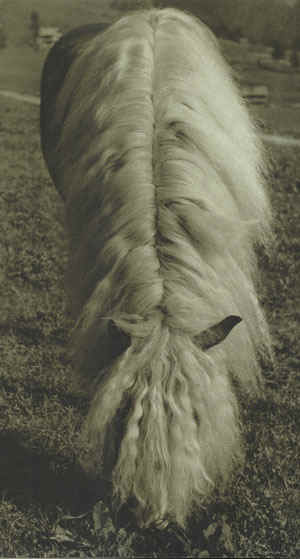
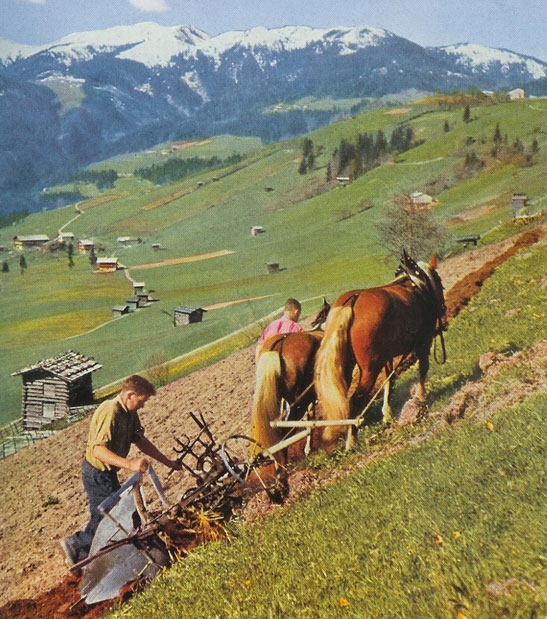
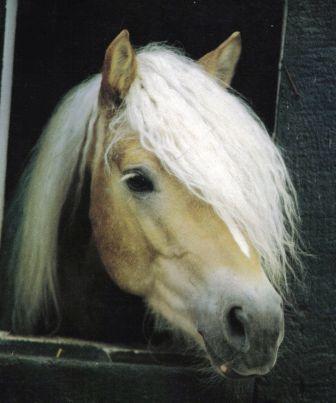
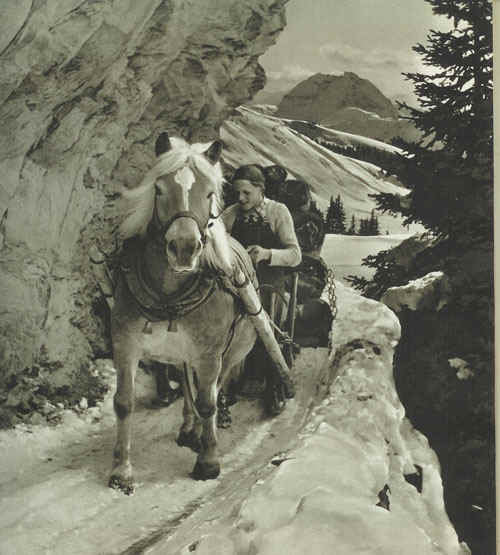
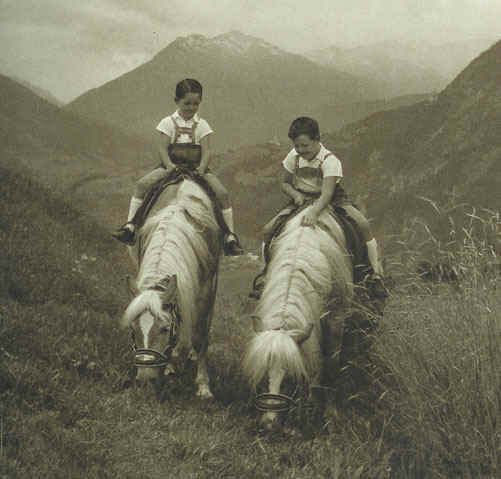
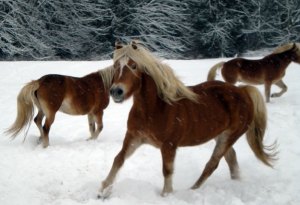
Dalia is our Haflinger mare. She is a sturdy mountain pony, bred in the Alps for just this kind of task– able to pull loads with harness for us, plow the rocky ground, pack with heavy weight on her back, provide warm milk when our cow is dry. Her golden coat glistens in the summer sun, and her heavy wavy white mane and tail are protection against the wintry winds. She is my Papa’s work partner, carrying his wood carvings to the village to sell, and bringing our supplies back on her back. Dalia takes me for rides across the mountain meadows of edelweiss in the spring, and skijoring in the autumn snows.

I harnessed her to the sled and Mama packed a lunch of cheese and bread for me, with a jug of milk. The November day was cloudy, but no new snow had fallen for several days, so we found the trail easily down the mountain path. Dalia picked her way carefully along the ledge, her surefooted amble brisk. I whistled to her and her copper ears flicked back and forth as she listened to my tune.

We reached the village in an hour where our package was quickly assembled and tied onto the sled, and I picked up supplies at the market.

It was time to head back, shortly after noon. I gazed up at the Alpen peaks high above the village, knowing our trip home would take at least twice as long with the steep climb up the trail.

Dalia was eager. She knew the trail home meant returning to her little stall in the snug barn next to the house, and to her 6 month old filly. Dalia leaned into the collar of the harness, pulling the sled up the trail as I sat, reins in hand, not needing to tell her where to go.

The clouds grew heavier and more threatening as we climbed. I urged little Dalia onward, hoping to get home before the snow started. It wasn’t long before the flakes started to fall, first heavy and lazy, and soon blowing wildly around our heads.

“Dalia, walk on!” She tugged harder, willing to try to go faster up the trail.

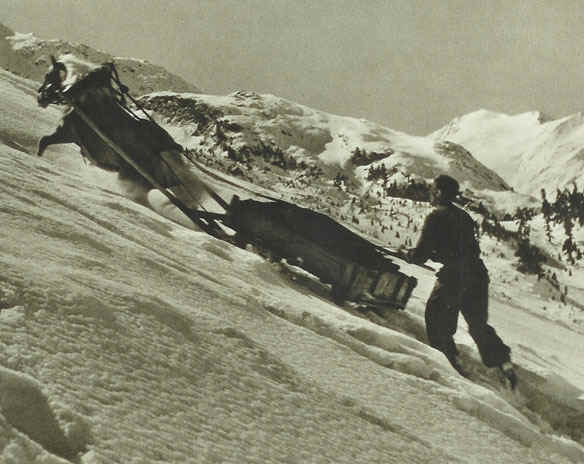
It soon was white everywhere around us and the snow was deepening by the minute, forcing Dalia to wade through up to her knees. I got off the sled and walked beside her. There was no longer a visible trail, and I began to worry we would lose our way in the blinding snow. I had to trust my brave little Haflinger.

She was soon up to her chest in the snow, pushing her way through, lunging at times to cross drifts. I hung onto her side, clinging to the harness leather, praying she would have the strength to go on despite the bite of the wind.

It seemed as if we were making no progress at all. The sun had gone down, the cold so bitter I could no longer feel my hands or feet. Dalia suddenly stopped, her sides heaving hard. She had brought us to the door of our little house, the oil lamp burning bright through the window.

Mama rushed to the door. “Pieter! You made it back! Praise God!”

“Yes, Mama. I’m back. Praise God and praise our Dalia. She found her way home as I would have been lost in the snow.”

I gave Mama the medicine for Papa, and I took Dalia to the barn for warm bran mash and hay from the summer meadows where she and I would someday ride again. And before long Papa will plow, and carve, and harvest again, thanks to our special Haflinger.
photos from Otto Schweisgut’s books “Haflinger Horses”  published in the 1950s and 1960s.
schweisgut1

scweisgut3

schweisgut2

Caritas

written originally in early March 2007

aktuell

We are all waiting for winter to be finished with us.  Instead it is snowing and blowing, ruining our dreams of spring and reminding us once again we have no control over the elements.  Cars were upside down in the ditches yesterday morning following a night of snow and freezing rain, and trying to accelerate up hill after a red stop light turned green was an exercise in futility.  I could have made it to work faster by hiking.

Not only the blustery out of doors has us in a strangle hold.  There are the winter viruses controlling everything inside our skin.  Workload at my clinic has doubled during influenza season, so I’m relegated to seeing patients in 10 minute slots to try to see everyone who is triaged.  There is little opportunity to provide much more than very basic assessment and advice and a moment of eye contact, a hand on the shoulder and reassurance that “this too will pass”.   After all, there is not much else a physician can do for the influenza patients who drag themselves out of bed finally on the third day of their illness, wondering what hit them like a truck.  We can only commiserate and advocate for signing up for next season’s flu vaccine 9 months from now.  Am I really doing much of value?  Some days I’m not so sure.  Yet I return each day to my work because I am needed by others, whether I make a difference that day or not.  It is what I am called to do– this caritas of the spirit.

When work load off the farm is this heavy, there is little that happens at home except basic daily maintenance.  The kitchen floor gets mopped less frequently, the laundry pile grows higher and the vacuum stays idle, but the barn chores continue unchanged.  It is my cherished routine to head to the barn in the dark of a winter’s morning and turn on the lights, and 7 pairs of Haflinger eyes blink and 7 Haflinger voices rumble greetings.  I am truly anticipated and appreciated and I have a clear task that I do that will make a difference.  Last summer’s hay bales are broken open and the fragrance of the clover and timothy fields is as grand as my morning cup of coffee.  I cradle the hay flakes to each expectant horse and they nod and bow in gratitude when I open their door.  Their buckets are filled with fresh clean water and they drink gratefully and deeply.  I share with each horse a moment of eye contact, a scratch on the wither and the reassurance that I will return at the end of the day to repeat our ritual and prepare their beds for the night.  And then I am gone, leaving the radio to play “oldies” to them while the weather rages outside.  I am needed and it is what I am called to do–this horse keeping.

Remarkably, the crocuses are up through the snow, the snowdrops are flourishing and the orchard trees are beginning to swell their buds.  Bird song is plentiful in the frozen mornings, with far more variety than a month ago.  There will be a spring coming soon, despite how things feel to me now.   This exhaustion will be replaced by renewal and the fresh air will be filled soon with the sweetness of cherry and apple blossoms.  The fields will grow lush and soft  and the sun will be warm on my horses’ withers once again.  And I will celebrate the defeat of winter once again.

Barnstorm

haybarn3

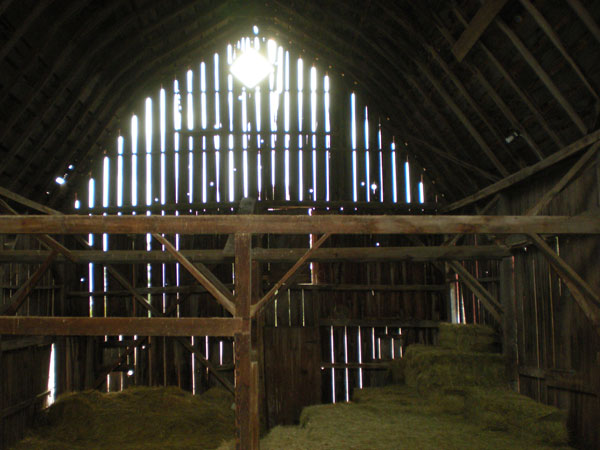
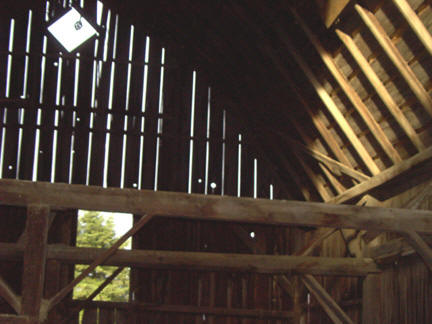
Most of my life, a barn has stood a few dozen yards from my back door. As a small child, I learned to ride a tricycle on the wooden planks of the chicken coop, sat on the bony back of a Guernsey cow while my father milked by hand, found new litters of kittens in cobweb-filled hideaways, and leaped with abandon into stacks of loose hay in a massive loft.

As a young girl, I preferred to clean stalls rather than my bedroom. The acoustics in the barn were first rate for singing loud and the horses and cows never covered their ears, although the dog would usually howl. A hay loft was the perfect spot for hiding a writing journal and reading books. It was a place for quiet contemplation and sometimes fervent prayer when I was worried: a sanctuary for turbulent adolescence.

Through college and medical training, I managed to live over twelve years in the city without access to a barn or the critters that lived inside. I searched for plenty of surrogate retreats: the library stacks, empty chapels within the hospitals I worked, even a remote mountainous wildlife refuge in central Africa.

It is hard to ignore one’s genetic destiny to struggle as a steward of the land through the challenges of economics and weather. My blood runs with DNA of wheat and lentil growers, loggers, cattle ranchers, dairy farmers, work horse teamsters, and flower and vegetable gardeners. A farm eventually called me to come back home and so I heeded, bringing along a husband (from a dairy farming background himself), and eventually there followed three children.

It hasn’t always been pastoral and sublime on the farm. It’s a lot like life itself.

Recently, a sudden southerly wind hit our farm one winter night, powerfully gusting up to 60 miles an hour and slamming the house with drenching rain as we prepared to go to bed. Chores in the barn had been finished hours before, but as we had not been expecting a storm, the north/south center aisle doors were still open, banging and rattling as they were buffeted in the wind. I quickly dressed to go latch the doors for the night, but the tempest had already done its damage. Hay, empty buckets, horse blankets, tack and cat food had flown down the aisle, while the horses stood wide-eyed and fretful in their stalls. A storm was blowing inside the barn as well as outside. This was not the safe haven a barn was meant to be. It took all my strength to roll the doors shut, latch them tight, take a deep breath and then survey the damage.

It took some time to clean up the mess. The wind continued to bash at the doors, but it no longer could touch anything inside. The horses relaxed and got back to their evening meal though the noise coming from outside was deafening. I headed back to the house and slept fitfully listening to the wind blow all night, wondering if the barn roof might pull off in a gust, exposing everything within.

Yet in daylight the following morning, all was calm. The barn was still there, the roof still on, the horses where they belong and all inside was even tidier than before the barnstorm. Or so it appeared.

Like my sturdily built barn, I’m buffeted by the sudden gales of mid-life. My doors have been flung open wide, my roof pulled off, at times everything blown away, leaving me reeling. More and more often, I need restoration, renewal and reconciliation. And so I set to work to fix up my life with all the skill I can muster: setting things right where they’ve been upended, painting a fresh coat where chipped and dulled, shoring up rotted foundations. If only I can get it done well enough, with sufficient perseverance, I surely will recover from the latest blow.

But my hard work and determination is not enough. It is never enough. I am never finished.

The only true sanctuary isn’t found in a weather-beaten barn of rough-hewn old growth timbers vulnerable to the winds of life.

The barnstorming happens within me, in the depths of my soul, comforted only by the encompassing and salvaging arms of God. There I am held, transformed and restored, grateful beyond measure.

barn31

Rearranging the Pile

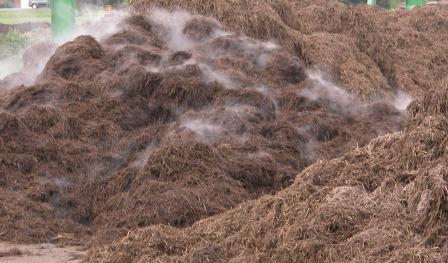
manureThe sun has actually shown itself for two days, after weeks of rain, then wind, then snow, then sleet, then rain, then flooding, then fog.  The light above finally reappeared and it shone brightly, cheerfully, unblinkingly…. on my manure pile.
During all the bad weather, the chief barn cleaner (that would be me) really didn’t enjoy wheelbarrowing all the manure out to the pile, through the elements, whether it was an arctic blast wind, or a foot of snow, or ice covering the pathway, or huge deep puddles.  I went for a “dump and run” technique which meant I didn’t pile things up in a careful methodical way.  Instead I left piles randomly everywhere.  This is not the way to build a manure pile.  Nothing really heats up and decomposes when it is not piled together.  Instead it just sits there, taking up space and not doing what manure does best–become useful fertilizer for the spring pastures.

So I had no excuses yesterday.  It had to be done.   I had to pitch and move the manure pile into a semblance of orderly compost, flattening it out into a sloping ramp for ease of future dumping.  Yes, it took time and muscle and patience–all things I did not exercise much of in the last few weeks of excuse-laden poor weather.  Today, when I went out to the barnyard to survey my good work,  I only had to lift one shovelful to see the steam rise happily from beneath.  This is now happy manure, if there is such a thing.

My life is too often a dump and run affair too.  I don’t measure out my minutes carefully enough to take care of things in the orderly way they should be managed.  Anyone who has been to my house knows this about me.  I know what are in those piles of books, papers, clothing, etc.   It just doesn’t look like I do when I start searching for something…

I know what is in the piles of stuff I’d sooner forget about, kind of like the manure pile in the barnyard.  There are parts of me that I’d like to dump and run away from: things I say or do or think that I’m certainly not proud of, that I regret the moment it happens. I leave it in a little pile, all by itself, not wanting to ever return to it and do what really needs doing.  Instead it needs to be ceremonially heated up and decomposed so it never happens again, or with all the other stuff I do every day, it needs to someday become fertilizer for a better life lived down the line.

Maybe my children will learn from watching me manage my personal manure piles,  and benefit from my mistakes, rather than being busy creating their own.

The Light is shining on the manure piles of my life.    It is unblinking, stark and at times blinding.   It is time for me to quit the “dump and run” and to face the heat, knowing it will inevitably create something better out of me.  I will become the fertilizer someday.

Tied in Knots

n707166118_2259849_2297

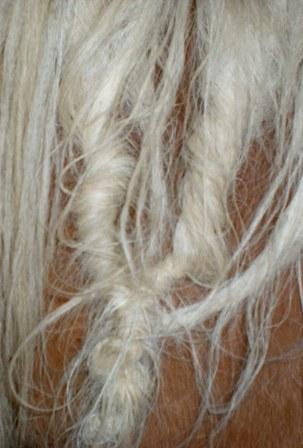
One of my favorite things about my Haflinger horses is their long lovely manes–the whiter, and wavier, the better. I enjoy everything about that long hair — except sometimes the maintenance involved. It usually doesn’t take a lot of fuss, but this time of year, when the air is moist and there is frequent rainfall, I find that those long manes come in from the fields all a-tangle and frequently in elaborate tight knots. Not just uncombed dreadlocks, but tight, cinched up and truly snarled knots.

I have two theories about how these knots and tangles happen: Most likely, I suspect the Haflingers tend to toss their heads and shake their necks more in the rain, to shower off the raindrops that are dripping down their faces. There is something about this repetitive movement that causes the long mane strands to knot and then flop and fold back into themselves with each neck shake, so that there are sometimes three, four or five successive knots tied in a collection of strands. A second theory involves one very agile Haflinger mouth, tying knots in her unsuspecting pasture mates’ manes. I haven’t witnessed this personally, but this theory is suggested by the fact that I have several horses who always come in with knotted manes and one who never does. The “knotter” and the “knottees?” Perhaps….

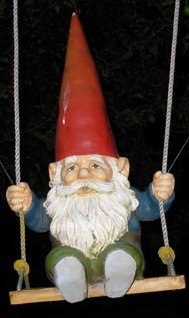
My Scandinavian friends tell me there is a little gnome named Tomten in a gray coat and red cap who lives in the barn and ties knots in pony manes as a way to show how much he is caring for the farm. I haven’t seen him at work, as my little Tomten gnome swings on a swing in our back yard and I have yet to see him do anything except smile and make me happy when I look at him. But I like the thought that he may be responsible for these tangles.

So these wet evenings, I find myself working down the barn aisle, releasing all these knots that have formed during the day. This can be a bit time consuming and not a little aggravating, but necessary if I hope to keep these three and four foot manes intact and growing. So far I’ve not had to take scissors to any, but that is only because in matters of Haflinger mane, I’m extremely motivated and patient. Long white flowing wavy manes are part of the “fairy tale” that Haflingers embody. They are sadly being lost in some of the modern bloodlines, as the trend is toward a lighter weight hair that is more easily hunter braided and thinned, more like a warmblood type sporthorse’s minimal mane. True, all the long Haflinger mane can get tangled in the reins or the lines and represent a hazard, and though there is always the question of just how much a Haflinger can actually see through all that forelock, nevertheless, I want the hair to stay, and it kills me to even cut a bridle path.

What is the good of all that hair besides aesthetics? It surely is an outer protective layer in the harsh weather conditions to which Haflingers had to adapt long ago, and it is amazingly effective at keeping the head and neck warm and dry. The double manes are incredible umbrellas, allowing the rain to drip down that top oily layer of hair and drop to the ground, never touching the fur and skin underneath. But what a sauna it creates in the heat of summer!

There are times I wish I wore such a “veil” myself–able to hide my face when I need to, and impervious to the harshness sometimes flung my way– the “slings and arrows” of every day life. But when things heat up, it can be quite a liability with the heaviness and uncompromising barrier it creates.This is a difficult trade off for the potential comfort of privacy and protection risking smothering, knotting and tangling. Like the Haflingers, I can only hope that when I’m all tied up in knots, someone will care enough to untangle me gently, smooth me out, and braid me up so I feel relief in the midst of the heat, respecting me enough to not destroy something that helps define me.

So I keep caring for those manes, knowing their loveliness has its downside, and recognizing they are part of what makes my horses “Haflingers”, the fairy tale horses that dance in my dreams, which are part of what makes me who I am.

n707166118_2259850_9280

Cured of a Fatal Disease

viewphp1

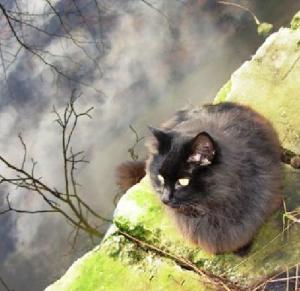
Considering myself a Dr. Doolittle of sorts, always talking to the animals, I reached out to pet a stray cat sitting quietly outside our barn one evening a month ago while doing barn chores.  This is a grayish fluffy cat I see around the barns every few months or so–he doesn’t put in frequent appearances and reminds me of a kitten we raised on this farm a few years back, though his markings are a bit different,  so I know it is not our cat.

We have 6 cats to pet here who claim “us” as their home and family, so there is no lack of fur balls to love.  There are probably that many more who hang out,  now and then,  considering our farm fair game and looking for an occasional free meal.  This cat just seemed to need a reassuring pat at that moment or maybe I needed the reassurance.  Wrong.

I found myself with a cat attached to my wrist by teeth and claws.  It took a bit of an effort to shake him off and he escaped into the night. I then surveyed the damage he inflicted and immediately went to wash my wounds.  They were deep punctures near my wrist joint–not good.  Lucky for me I was up to date on my tetanus booster.

By the next day the wounds were getting inflamed and quite sore.  I know all too well the propensity of cat bites to get badly infected with Pasteurella Multocida, a “bad actor” bacteria that can penetrate deep tissues and bone if not treated with aggressive antibiotics.  After getting 6 opinions from my colleagues at clinic, all of whom stood solemnly shaking their heads at my 12 hour delay in getting medical attention,  I surrendered and called my doctor’s office.  I pleaded for a “no visit” prescription as I was up to my eyeballs in my own patients, and he obliged me.  I picked up the antibiotic prescription during a break, sat in the car ready to swallow the first one and then decided to wait a little longer before starting them, knowing they wallop the gut bacteria and cause pretty nasty side effects.  I wanted to see if my own immune system might just be sufficient.

So the bacterial infection risk was significant and real but I was prepared to deal with it.  For some reason I didn’t really think about the risk of rabies until the middle of the night when all dark and depressing thoughts seem to come real to me.

I don’t know this cat.  I doubt he has an owner and it is highly unlikely he is rabies vaccinated.  My own cats aren’t rabies vaccinated (and neither am I) though if I was a conscientious owner, they would be.  Yes, we have bats in our barns and woods and no, there has not been a rabid bat reported in our area in some time.

But what if this cat were potentially infected with the rabies virus but not yet showing symptoms?  Now my mind started to work overtime as any good neurotic will do.  Last summer a rabid kitten in North Carolina potentially exposed 10 people when it was passed around a softball tournament, no one aware it was ill until it died and was tested.  Lots of people had to have rabies shots as a result.

This cat who had bitten me was long gone–there was no finding him in the vast woods and farmland surrounding us.  He couldn’t be kept in observation for 10 days and watched for symptoms, nor could he be sacrificed to examine his neural tissue for signs of the virus.

I called the health department to ask what their recommendation was in a case like this.  Do they recommend rabies immune globulin injection which should have been done as soon as possible after the bite?   I talked with a nurse who read from a prepared script for neurotic people like me.  Feral cats in our area have not been reported to have rabies nor have skunks or raccoons.  Only local bats have been reported to have rabies but not recently.  This cat would have had to have been bitten by a rabid bat to be rabid.  This was considered a “provoked” attack as I had reached out to pet the cat.  This was not a cat acting unusually other than having wrapped itself around my arm.  No, the Health Dept would not recommend rabies immune globulin in this situation but I was free to contact my own doctor to have it done at my own expense if I wished to have the series of 5 vaccination shots over the next month at a cost of about $3000.   Yes, there would be a degree of uncertainty about this and I’d have to live with that uncertainty but she reassured me this was considered a very low risk incident.

I knew this was exactly what I would be told and I would have counseled any patient with the same words.  Somehow it is always more personal when the risk of being wrong has such dire consequences.  I could see the headlines “Local Doctor Dies From Rabid Cat Bite”.

This is not how I want to be remembered.

Rabies is one of the worst possible ways to die.  The cases I’ve read about are among the most frightening I’ve ever seen in the medical literature. Not only is it painful and horrific but it puts family and care providers at risk as well.  It also has an unpredictable incubation period of a up to a month or two, even being reported as long as a year after an exposure.  What a long time to wait in uncertainty.  It also has a prodrome of several days of very nonspecific symptoms of headache, fever and general malaise, like any other viral infection before the encephalitis and other bad stuff hits.  I was going to think about it any time I had a little headache or chill.  This was assuredly going to be a real test of my dubious ability to stifle my tendency for 4-dimensional worries.

I decided to live with the low risk uncertainty and forego the vaccination series.  It was a pragmatic decision based on the odds.  My wounds slowly healed without needing antibiotics.  For ten days I watched for my attacker cat whenever I went to the barn, but he didn’t put in an appearance.  I put out extra food and hoped to lure him in.  It would have been just be so nice to see his healthy face and not have to think about this gray cloud hanging over me for the next few months, as I wondered about every stray symptom.  No gray kitty to be seen.

Almost a month has gone by now and he finally showed up last night.  I could have grabbed him and hugged him but I know better now. No more Dr. Doolittle.

He is perfectly fine and now so am I, cured of a terminal case of worry and hypochondria which is not nearly as deadly as rabies but can be debilitating and life shortening none the less.

You’d think I’d eventually learn…

Ark Building

viewphp

I’ve got a bad case of the drearies. Rain has fallen heavily for just four days, with balmy temperatures up to 50 degrees, right after three weeks of freezing temperatures, ice and multiple feet of snow. As a result we have a state of emergency in our county with flooding in places that have not been flooded in decades, if ever. There are many people unable to leave their homes due to roads that have become rivers and some have had to sadly abandon their flooded homes. The drive time to work has been tripled because the detours are zigzagging all over the county.

Even those of us who are natives become overwhelmed by rain and moisture that clings to everything and everyone, blocking daylight so thoroughly that we leave for work in the dark and return in the dark despite lengthening days. The continuing rain is not predicted to end anytime soon, so I wonder about hitting the proverbial 40 days of rain. Indeed, it’s time to build an ark. Otherwise we may be left treading water as it rises around us.

Along with the local rivers and streams overflowing their banks, there is a new lake in our lower field. We have this little problem with our barn, located strategically at the bottom of a hillside. Four of our twelve stalls have standing water, so the Haflingers are bunking in the remainder, happy to be out of the wet, but insulted at prolonged confinement as there is no place to go outside without mud and mire. Regular flakes of hay bribe them into complacency. Things can’t be too bad when the best part of the day involves eating…

Ah, but it takes it’s toll on our psyches. Wet cold dankness without reprieve can be hard on man and beast. We are all waiting, waiting, wishing for something different, wanting relief. The Haflingers wait for their freedom from confinement and desire the sun on their backs once again, but settle for the memory of the sun and pastures as it is tossed in the form of flakes of dried field grass under their noses. I imagine they breathe deeply into that hay and reminisce about those warm lazy days in the pasture with every mouthful.

What do I wait for? I am discontent, antsy and eager for a respite from this. No one tosses a flake of hay to me to keep me from complaining, though it just might work if it was served with hot chocolate with whipped cream topping.

Actually, the waiting, the anticipation is for something beyond the temporary satisfaction of hunger or thirst. It is a far deeper need, and a greater want and desire. Our longing for light in our deepest darkest times can urge us forward, to prepare us for what comes next.

And it can come from the most unlikely source. It can come from a barn, bedded in hay, tucked in a manger. That baby whose birth we celebrated two weeks ago is the ark that keeps us afloat in the flood.

In our dreariest of moments, we must wait and prepare. The sun will return, surround us, dry us out and warm us, and we will be ready. In the mean time, I’ll crawl into the manger and tuck myself in and breathe deeply of the hay, pondering the promise of summer.

So I don’t plan to build an ark after all. I’m buoyed,  held up and here to stay: soppy, saturated, and drenched with the showering of life.

crossingthedelaware1

Treading on Thin Ice

runsinsnowOur colder than customary winter in the Pacific Northwest has defied global warming trends worldwide.  We still have piles of snow drifts lying unmelted from our pre-Christmas storm, and day time temperatures only rose above freezing over the last 24 hours.  What that means is that we have superficial thawing during the day with rain showers, and then under a cover of fog and frost during the night, all is iced up again in the morning, making roads especially deceptive and treacherous.
Our barnyard is no different.  The slabs around our barn have the same coating of black ice in the morning as the roads do.  In particular, the slab behind our hillside horse barn is the source from run off of rain and ground water from the fields sloping above it, streaming to the fields that lie below.  The slab can be a veritable river most rainy winter days, and it has been flowing actively over the last several warmer days.  However, it froze hard during the night, and became a sheet of very slippery ice by this morning.

This is a challenge for the Haflingers as they are allowed out for some fresh air in the fields while we clean their stalls.  All year they are accustomed to going from barn aisle to open gate without considering the footing over the slab, focused only on the green grass beyond rather than the journey required to get there, but mornings like this are a whole other story.

I know better than to try to lead a horse across the ice like this as my ability to stay upright is seriously compromised if I’m pushed off balance.  So the horses must navigate this 10 yards untethered to me and with only my verbal cautions as a guide.  I certainly fear a horse falling on the ice and being injured, especially my mares who are in late pregnancy.  Some of them listen and learn better than others.

Our 25 year old gelding is always cautious and careful.  He’s seen enough unpredictable situations over the years and knows to check things out before committing himself, so takes it easy over the slab and has no difficulty.  Our yearling colt is also wary as he does not always know what to expect from the world yet, so he stops, sniffs the ice, tentatively puts a foot out as a test run and minces his way across, skittering as his smaller hooves give him little traction but he remains on his feet.

Our two pregnant mares, normally impatient about getting to any source of food, are heavy bellied and move awkwardly in the best of circumstances these days, so they are not eager to take chances either.  They seem to know they are more vulnerable and move deliberately and ponderously, safely carrying themselves and their unborn foals over the hazardous footing with an air of great responsibility and I breathe much easier when they reach the field.

Not so cautious is our younger mare.  She is unencumbered by pregnancy, full of pent up energy from lack of steady work in winter, and fueled by hormones.  Nothing seems to really penetrate her brain aside from her own desires and urges–all that matters is what she wants right now!–so she rushes too fast once beyond the barn, does a little skating across the slab and woomph! lands butt first as her feet go out from under her.  Getting up isn’t easy when you have newly trimmed smooth hooves, so she gathers up what is left of her dignity and balance, and gets upright again, stands still for a moment assessing how to proceed and then with great care, full of  grace she lacked a few moments before, walks the rest of the distance to the gate.  A painful lesson in impulsivity and selfish desire.

I’m certainly at a more cautious time of my life myself.  I’ve been through more impulsive, selfish and impatient stages in my younger years and remember all too well disregarding the admonitions and cautions from wiser people than myself.  I had to land hard a few times to “get it”.  I still lapse now and then and find myself treading too fast on “thin ice” but it seems less often as I grow older and perhaps a bit wiser myself.  I find that I’m trying now to guide not just my horses across the ice, but certainly my children and my patients as they navigate the hazards in their lives.  A fall now and then is inevitable and through grace we are picked back up.  That teaches far more effectively than my words of caution ever can.

Nevertheless here is the advice I have, given my own slips and slides on the thin ice of life:

Proceed forward with courage and boldness, anticipating each step as new and unfamiliar.  Remember you carry more than just yourself–you carry your past, your future and indeed that present moment itself–as precious as the moment just past and the moment yet to come.  And when you may think you have “arrived”, you’ll find yet another journey, perhaps just as filled with the unknown,  is about to begin.  Tread lightly within that knowledge, rejoicing in the journey itself and the destination will take care of you when you finally find yourself safe on the other side.

snowplay2

Do Not Be Afraid

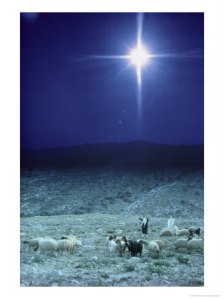
131218shepherds-watch-their-flocks-under-the-light-from-a-distant-star-near-bethlehem-israel-posters1

We’ve had a very blustery week of chilly snowy weather, with strong winds from the north, blowing branches off trees and anything not tied down. Our horses were out in their winter paddocks yesterday, as usual, and due to the fullness of the day’s activities, we didn’t get out to do chores until after dark to bring them in one by one.

The wind definitely changes everything once it is dark out, for us and for the horses. The familiar walk along the dark path from the paddocks to the barn, past several buildings, suddenly becomes spooky and more epic adventure than evening stroll. The wind whistles between the buildings, so everything sounds different than usual, and the blowing branches and goodness knows what else can appear threatening and menacing.

The horses’ eyes are big and bright with white as we walk in, and they jig and trot, glancing this way and that, clearly unnerved by the familiar becoming unfamiliar. They are uneasy and frightened, breathing hard and fast, and the younger ones are frankly terrified when a branch blows across their path, coming out of nowhere in the dark, and disappearing just as quickly. I talk to the horses as we walk, reassuring them, telling them there is no reason to be afraid, that there is nothing out here that will eat them or chase them, and they cock their ears back and forth, listening to me, then back to listening for that unknown “thing” out there that just might be ready to get them. If they had their ‘druthers, they’d be racing for the safety of the barn at full tilt, but that is not acceptable behavior, so they cope with being asked to stay close and walk alongside me.

Once in the barn, with muzzles into the feeders and eating their evening meal, their eyes soften again, and they relax, settling, knowing that they are safe and cared for and protected. A roll in the fresh shavings, a good shake and a huge snort of relief, and all is well. I can be easily unnerved too by the familiar suddenly becoming unfamiliar. I like to think I cope well with the unexpected, but it isn’t always the case, so I often need plenty of reassurance, and a steady voice beside me so I don’t get catastrophic in my fear.

Sometimes, as a president so wisely implied years ago, our own fear becomes the thing we fear the most. And it need not be.This type of fear in the face of the unexpected happened years and years ago, to people who were society’s cast-offs, relegated to tending flocks as they had no other skill of value. They were the forgotten and the least of men. Yet what they saw and heard that Christmas night put them first, allowed them access that no one else had. Within the familiarity of their fields and flocks came this most unexpected and frightening experience, terrifying in its sheer “other worldliness”, and blinding in its grandeur. They must have been flattened with fear and terror.

And so the reassurance came: “Be not afraid”.

In the same way we whisper to our frightened horses and hold them close to us, so these shepherds were picked up, dusted off and sent on their way to the safety and familiar security of a barn, to see with their own eyes what they could not imagine. A baby born in so primitive a place, yet celebrated from the heavens. The least becomes first, and the first becomes the least.

Sometimes, in these dark times, our terror is for good reason, and we need to know where to seek our reassurance. It is there for us and always has been, walking beside us, speaking to us from a manger bed, feeding us when we are hungry and tending to us when we need it.

Merry Christmas and do not be afraid.

At the Feeding Trough

If I recall correctly, the first catalog with holiday theme items arrived in our mailbox in late July. The “BEST CHRISTMAS ISSUE EVER!” magazines hit the racks in September. Then, with the chill in the air in October and Halloween past, the stores put out the Santa decorations and red and white candy, instead of the orange and black candy of the previous 6 weeks. I have been inundated with commercial “Christmas” for months now and finally, it is about to arrive, after considerable fanfare and folderol. I don’t know about you, but I’m exhausted, beat to a “best ever holiday” pulp.

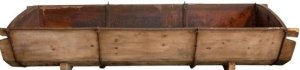
All of this has little to do with the original gift given that first Christmas night, lying small and helpless in a barn feed trough. I know a fair amount about feed troughs, having daily encounters with them in our barn, and there is no fanfare there and no grandiosity. Just basic sustenance– every day needs fulfilled in the most simple and plain way. Our wooden troughs are so old, they have been filled with fodder thousands of times over the decades. The wood has been worn smooth and shiny from years of being sanded by cows’ rough tongues, and over the last two decades, our horses’ smoother tongues, as they lick up every last morsel, extracting every bit of flavor and nourishment from what has been offered there. No matter how tired, how hungry, there is comfort offered at those troughs. The horses know it, anticipate it, depend on it, thrive because of it.

The shepherds in the hills that night were starving too. They had so little, yet became the first invited to the feast at the trough. They must have been overwhelmed, having never known such plenty before. Overcome with the immensity of what was laid before them, they certainly could not contain themselves, and told everyone they could about what they had seen.

His mother listened to the excitement of the visiting shepherds and that she “treasured up all these things and pondered them in her heart”. Whenever I’m getting caught up in the frenetic overblown commercialism of modern Christmas, I go out to the barn and look at our rough hewn feed troughs and think about what courage it took to entrust an infant to such a bed. She knew in her heart, indeed she had been told, that her son was to feed the hungry souls of human kind and He became fodder Himself.

Now I am at the trough, starving, sometimes stamping in impatience, often anxious and weary, at times hopeless and helpless. He was placed there for good reason: a treasure to be shared plain and simple, nurture without end for all.

Who needs Christmas cookies, pumpkin pies and the candy canes to fill the empty spot deep inside?

Just kneel at the manger.n707166118_2339813_1983