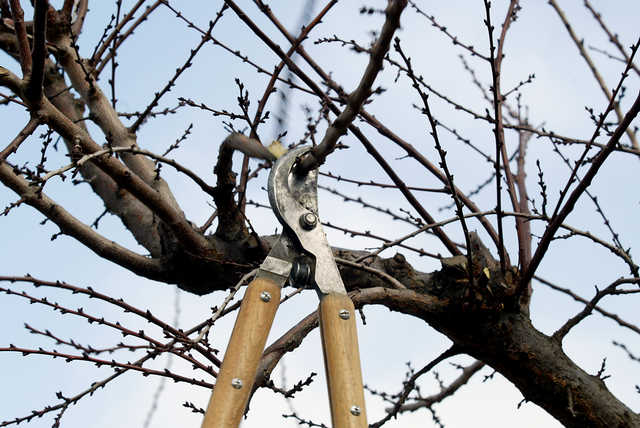
Spring is rapidly advancing at a furious pace and on my way to the barn, I’ve glanced furtively at our many orchard trees, knowing that I’ll soon lose my best window of opportunity to get our annual pruning done. It’s “now or never” time–actually not never, but pruning done after new growth already started is potentially damaging and wasteful to the energy the tree is expending this time of year in its rush to push out green from those dead looking branches.
Pruning is one of those tasks that is immensely satisfying–after it’s done–way after. Several years after in some cases. In the case of our fruit trees, which all have an average age of 80 years or more, it is a matter of prune or lose them forever, as they had a long respite from pruning in the 80s before we bought this farm and were growing wild and chaotic. We set to work early on in our tenure on this farm, trying to gently retrain these huge mature apple, cherry and pear trees, but our consistency was lacking and the trees remained on the wild side, defying us, and in two cases, toppling over in windstorms due to their weakened frame. Once we hired additional help, hoping to get ahead of the new growth, but our helper had the “chain saw” approach to pruning and literally scalped several trees into dormancy before we saw what was happening and stopped the savaging.
Instead, the process of retraining a wild tree is slow, meticulous, thoughtful, and expectant. You must study the tree, the setting, know the fruit it is supposed to bear, and begin making decisions before you make cuts. The dead stuff goes first–that’s easy. It’s not useful, it’s taking up space, it’s outta here. It’s the removal of viable branches that takes courage. Like thinning healthy vegetable plants in a garden, I can almost hear the plant utter a little scream as I choose it to be the next one to go. Gardening is not for the faint of heart. So ideally, I choose to trim about a third of the superfluous branches when I prune, rather than taking them all at once, and in three years, I’ll have the tree I hoped for, bearing fruit that is larger, healthier and hardier. Then we’re in maintenance mode. That takes patience, vision, dedication, and love. That’s the ideal world.
The reality is I skip years of pruning work, sometimes several years in a row. Or I make a really dumb error and prune in a way that is counter productive, and it takes several years for the tree to recover. Or, in the case of the scalping, those trees took years to ever bear fruit again–standing embarrassed and naked among their peers. Then there is the clean up process after pruning–if it was just lopping off stuff, I’d be out there doing it right now, but the process of picking up all those discarded branches off the ground, carrying them to a brush pile and burning them takes much more time and effort. That’s where kids
come in very handy.
I see the training work we do with our young horses as a similar process –we are shaping them for their eventual fruitfulness as productive working stock. Even the most wild and untamed of youngsters eventually respond to the gentle process of “pruning” away the unwanted behavior and encouraging the growth of the best behavior. Nipping is not fruitful–it is never encouraged; it is actively discouraged. Kicking belongs on the brush pile. Horse training is not for the faint of heart. Leading quietly and standing tied without a fuss are rewarded with the treat of scratches and rubs. The final product takes years of effort before it bears fruit, but our work is essential otherwise the grown horse may be completely unusable, and discarded like a tree that topples due to its weakness.
Our three children are not just a work in progress, but are about to bear fruit. They’ve been tolerating our shaping, trimming and pruning for years now, and are standing tall and strong and ready to meet the world, to give it all they’ve got, thanks to a sturdy foundation. In our hopes and dreams for them, there are times we probably pruned a bit in haste, or sometimes neglected to prune enough, but even so, they’ve apparently grown up with few “scars” to show for our mistakes. Child rearing is not for the faint of heart. Now we turn over the maintenance to the Master Gardener, to keep our children rooted, fed, watered, thriving and fruitful. This is the ultimate act of faith and love. It is no longer our job to do, but we turn it over to Another, just as my parents did decades ago for me.
I’m still pruned, regularly, often painfully. Sometimes I see the pruning hook coming, knowing the dead branches that I’ve needlessly hung onto must go, and sometimes it comes as a complete surprise, cutting me at my most vulnerable spots. Some years I bear better fruit than other years. Some years, it seems, hardly any at all. Being pruned when you are mature, set in your ways, and a bit opinionated is not for the faint of heart. Yet, I’m still rooted, still fed when hungry and watered when thirsty, and still, amazingly enough, loved. I’ll continue to hang on to the root that chose to feed me and hold me fast in the windstorms of life. Even when my trunk is leaning, my branches broken, my fruit withered, I will know that love sustains, no matter what.
 Barnstorming
Ah, Emily; my delay in commenting was purely due to time limitations. Like walking out to the two pear trees in our front yard with pruning saws and shears, “tackling” this requires contemplation, which requires time.
You have chosen the ultimate life lesson metaphor for me, Dear Lady; I’ve never owned a horse or a cat, I don’t have children, and I’ve never experienced many of your adventures. But my father LOVED fruit trees, flowering shrubs, and vegetables. Except for the few weeks after our house fire, I’ve never been without a guitar or without pruning “clippers,” Dad called the little hand-held ones; “loppers” was his term for the larger ones that require two hands.
Growing up, I toted branches for Dad while he was on a ladder, volunteerly pruning fruit trees for neighbors. He would stand on the ground and walk around the tree, studying the relationship of all the limbs to each other and the way each limb may or may not permit sunlight to strike other limbs. “Every piece of fruit on the tree needs to get at least a little bit of direct sunlight every day,” he would explain to me in his demonstration lectures, “and the direction of next year’s growth is determined by the leaf bud that you cut right behind, leaving it the end of the limb. So you find a bud pointing toward where you want that limb to go, and cut just to the outside of it.
Like you say, Emily, it gets scary thinking about all the “fruit” you’re dropping to the ground, BUT the comfort lies in knowing that healthy trees WILL grow and controlled growth permits each piece of fruit to get the necessary light. Both my pear trees have missed more pruning seasons than they should have, but any lopping off I can do is good because new growth needs the opportunity to reach outside the tree for that blessed light.
I remember the first winter after Dad died. I still had a couple of peach trees in addition to one pear and two apple trees at the time. So much stuff had been going on that the pear tree had missed a good basic pruning for two years, so there was one sizeable limb that needed removing literally from the trunk. Getting to it took some planning and thinking, eventually requiring to do a partial cut from one direction, then finish the cut from another side of the limb. A lot of work. Slow, meticulous work. I finally finished, pulled the separated limb out of the way, and stood back to look. The FIRST thought in my mind was, “Wow, wait till Dad gets over here to see THIS!!” BAM! It immediately hit me, he ain’t coming over here to look. And NOBODY else would have the frame of reference to appreciate the task like Dad. And then it came to me that getting a pat on the back does not quantify the value of an achievement. I know it’s well done. The fact that it is stands on its own. I never mentioned that pruning feat to anybody. Till right now!!
LikeLike