Being Tucked In

eveningbarnwritten September 11, 2001

There are moments of epiphany in horse and family raising, and tonight brought one of those moments. The world suddenly feels so incredibly uncertain, yet simple moments of grace-filled routine offer themselves up unexpectedly, and I know the Lord is beside us no matter what has happened.

Tonight it was tucking the horses into bed, almost as precious to me as tucking our children into bed. In fact, my family knows I cannot sit down to dinner until the job is done out in the barn–so human dinner waits until horsie dinner is served and their beds prepared.

My work schedule is usually such that I must take the horses out to their paddocks from their cozy box stalls while the sky is still dark, and then bring them back in later in the day after the sun goes down. We have quite a long driveway from barn to the paddocks which are strategically placed by the road so the horses are exposed to all manner of road noise, vehicles, logging, milk and hay trucks, school buses, and never blink when these zip past their noses. They must learn from weanling stage on to walk politely and respectfully alongside me as I make that trek from the barn in the morning and back to the barn in the evening.

Bringing the horses in tonight was a particular joy because I was a little earlier than usual and not needing to rush: the sun was setting quite golden orange, the world had a glow, the poplar and maple leaves have carpeted the driveway and each horse walked with me without challenge,  no rushing, pushing, or pulling–just walking alongside me like the partner they have been taught to be.

I enjoy putting each into their own box stall bed at night, with fresh fluffed shavings, a pile of sweet smelling hay and fresh water. I can feel them breathe this big sigh of relief that they have their own space for the night–no jostling for position or feed, no hierarchy for 12 hours, and then it is back out the next morning to the herd, with all the conflict that can come from coping with other individuals in your same space.  My horses love their stalls, because that is their safe sanctuary, that is where they get special scratching and hugs, and visits from a little red haired girl who loves them and sings them songs.

Then comes my joy of returning to the house, feeding my human family and tucking precious children into bed, even though two are now taller than me. The world feels momentarily predictable and comforting in spite of devastation and tragedy.   Hugging a favorite pillow and wrapping up in a familiar soft blanket, there is warmth and safety in being tucked in.

I’ll continue to search for those moments of epiphany whenever I’m frightened, hurting and unable to cope.  I need a quiet routine to help remind me how precious it is to be here, looking for a sanctuary to regroup and renew.

I don’t need to look far…
Green Bean Casserole

green+beans

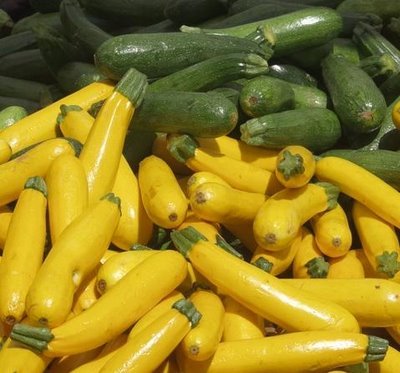
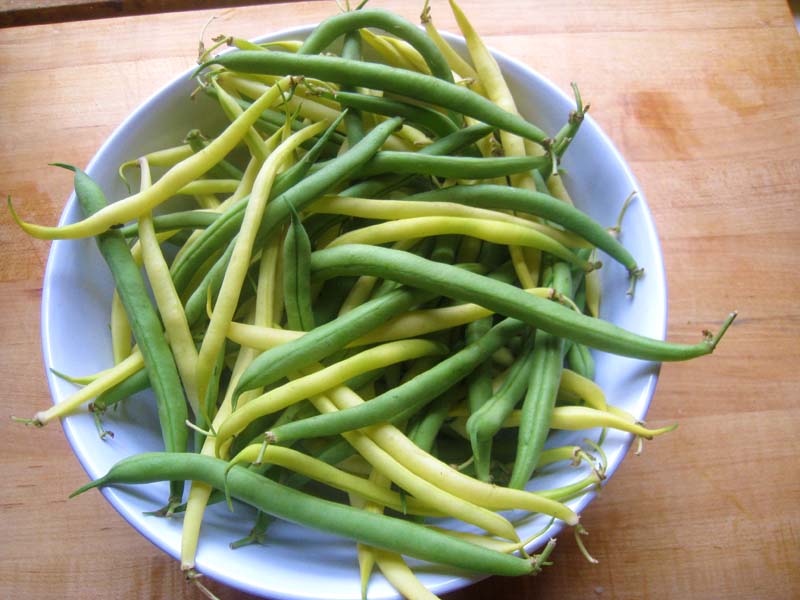
Our garden was sowed late this spring so the harvest has been late as well.  We are overwhelmed with tomatoes, carrots, corn and zucchini and are giving away as much as we are keeping. We have just finished picking all the bush beans–several 10 gallon buckets full–and spent several evenings sitting and snapping them, preparing them for blanching and freezing, with visions of green bean casserole during the winter months dancing in our heads.

Bean snapping is one of those uniquely front porch American Gothic kind of activities.  Old black and white Saturday matinee movies would somehow work in a bean snapping scene with an old maid aunt sitting on her ranch house porch.  She’d be rocking back and forth in her rocking chair, her apron wrinkled and well-worn, her graying hair in a bun at the nape of her neck and wearily pushing back tendrils of hair from her face. As the sole guardian, she’d be counseling some lonely orphaned niece or nephew about life’s rough roads and why their dog or pony had just died and then pausing for a moment holding a bean in her hand, she’d talk about how to cope when things are tough. She was the rock for this child’s life.  Then she’d rather gruffly shove a bowl of unsnapped beans in the child’s lap, and tell them to get back to work–life goes on–start snapping. Then she’d look at that precious child out of the corner of her eye, betraying the love and compassion that dwells in her heart but was not in her nature to speak of.  If only that grieving child understood they sat upon a rock of strength and hope.

So life goes on after tragedy.  Even on a day eight years ago when life as we knew it ended in fire and smoke for thousands of innocents.  A day that started like any other but ended up changing us all beyond recognition.  We are hated and we will wear the scars forever.  It bears talking about possible responses to hatred with one’s children over bean snapping.  It is too easy to learn to hate because we are hated. Finding forgiveness is much harder work.

Just as I sat with my mother snapping beans some 40+ years ago and talked about some difficult things that were unique to the 60’s,  I sat snapping beans this week together with my family, talking about  hopes and disappointments and fears and listened to our children grumble that I was making them do something so utterly trivial when from their perspective, there are far more important things to be doing. My response is a loving and gruff “keep snapping”.  Of course we really don’t have to snap the beans, as they could be frozen whole, but they pack tighter snapped, and it is simply tradition to do so.  We enjoy that crisp satisfying crack of a perfectly bisected bean broken by hand–no need for knife to cut off the top and tail.    We prepare for a coming winter by putting away the vegetables we have sowed and weeded and watered and cared for, because life will go on and eating the harvest of our own soil and toil is sweet.  We must do this. Indeed it is all we can do when the world is tumbling down around us.

Indeed, I want to be more rubbery like a bean that doesn’t snap automatically under pressure, more resilient.

There is an old Shaker Hymn that I learned long ago and sing to myself when I need to be reminded where I must end up when I’m at the breaking point.

I will bow and be simple,
I will bow and be free,
I will bow and be humble,
Yea, bow like the willow tree.

I will bow, this is the token,
I will wear the easy yoke,
I will bow and will be broken,
Yea, I'll fall upon the rock.

As people of resilient faith we seek to wear the yoke we’ve been given to pull, bow in humility under its burden and know the freedom that comes with service to others.  Even in the midst of the most horrific brokenness, we fall upon the rock that bears us up with love and compassion that we are often not even aware of.  It is there under us and we’ve done nothing whatsoever to earn it.

Time for us to get back to work and start snapping–life does go on.

Don’t Wanna Hold Your Hand

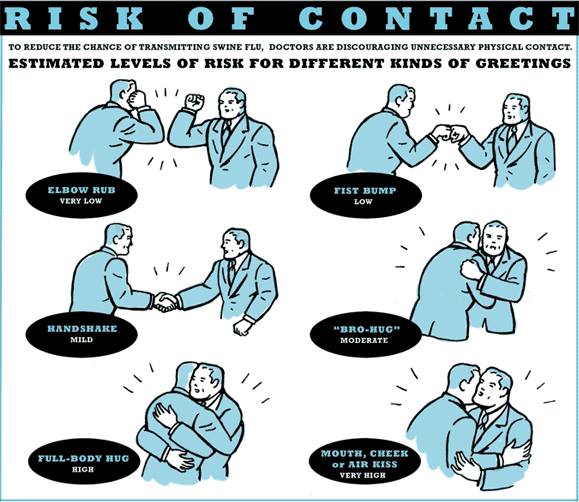
NYT_ILLO_RISK_590
Ross MacDonald illustration for the New York Times

Suffice to say, I’m not germ phobic.  If I were, I wouldn’t live on a farm handling manure everyday, and I wouldn’t work as a health care provider in the “culture media” otherwise referred to as a university student health center.  I’ve learned to live in harmony with all the pathogens I come in contact with, and, for the most part, we leave each other alone.

Yet there comes a time (and this is it!) when a little paranoia about viruses is warranted.  This current early influenza season has the potential to be a real humdinger because the virus people are passing between them is unfamiliar to the majority of the younger (under age 50) population, so their immune systems are not readily primed for the antibody fight.  So there may be good reason for social rituals to adapt to protect the unprotected.

There is reasonable evidence that H1N1 influenza really takes hold in environments where people are doing a great deal of “meet and greet” activities, such as sorority and fraternity “rush” week at universities.  That means that hand shakes and hugs, or the seemingly benign cheek kiss, confer more than good will.  They become the vectors of a viral gift, ready to transfer to our mucus membranes with an innocent rub of an itchy eye, or licking of our lips after touching the outside of our mouths, or running the back of our hand across our noses.

In other words, we inadvertently share and receive more than we intend with a simple greeting ritual.  This becomes important during a time when potentially fatal viruses are circulating widely, especially as a certain percentage of the population will tend to be “carriers” without having obvious symptoms,  effectively becoming unwitting transmitters.

So this fall, the time has come to stop greeting with hand shakes, particularly in “high volume” situations like political rallies, wedding and funeral receptions, church lobbies and school orientation activities.  The options to replace the hand shake are plenty, but ideally should minimize physical contact.   I prefer a simple nod, leaning forward, hands behind my back, and actually using my vocal cords to do the work:  “good to see you”  or some other gracious few words.

I’m not being unfriendly, nor am I rebuffing your friendly extended hand.  I just don’t want to share what I may have just been exposed to a few minutes earlier without having had a chance to adequately wash my hands, as I would if I were working in the barn or the clinic.  Just like the classic classroom exercise illustrating how many sexual partners you exponentially end up with when you consider all the partners of the partner’s partners, etc. —when you shake my hand, you are shaking the hand of everyone I’ve touched since the last time I washed my hands.  In certain social situations, that can be an overwhelming number of contacts.  So let’s just take handshaking out of the equation and make it a little tougher for this virus to find its way from me to you.

So it’s good to see you looking so well. And I really want you to stay that way.

Savoring the Sweetness

Apples11(published a year ago in Country Magazine)
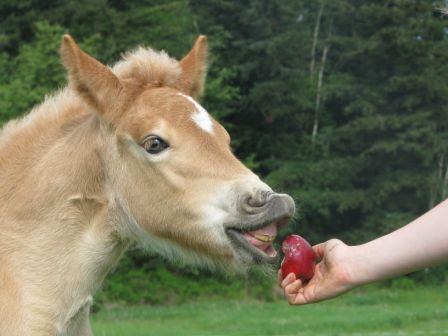
I’ve been picking up windfall apples to haul down to the barn for a special treat each night for the Haflingers. These are apples that we humans wouldn’t take a second glance at in all our satiety and fussiness, but the Haflingers certainly don’t mind a bruise, or a worm hole or slug trails over apple skin.

I’ve found over the years that our horses must be taught to eat apples–if they have no experience with them, they will bypass them lying in the field and not give them a second look. There simply is not enough odor to make them interesting or appealing–until they are cut in slices that is. Then they become irresistible and no apple is left alone from that point forward.

When I offer a whole apple to a young Haflinger who has never tasted one before, they will sniff it, perhaps roll it on my hand a bit with their lips, but I’ve yet to have one simply bite in and try. If I take the time to cut the apple up, they’ll pick up a section very gingerly, kind of hold it on their tongue and nod their head up and down trying to decide as they taste and test it if they should drop it or chew it, and finally, as they really bite in and the sweetness pours over their tongue, they get this look in their eye that is at once surprised and supremely pleased. The only parallel experience I’ve seen in humans is when you offer a five month old baby his first taste of ice cream on a spoon and at first he tightens his lips against its coldness, but once you slip a little into his mouth, his face screws up a bit and then his eyes get big and sparkly and his mouth rolls the taste around his tongue, savoring that sweet cold creaminess. His mouth immediately pops open for more.

It is the same with apples and horses. Once they have that first taste, they are our slaves forever in search of the next apple.

The Haflinger veteran apple eaters can see me coming with my sweat shirt front pocket stuffed with apples, a “pregnant” belly of fruit, as it were. They offer low nickers when I come up to their stalls and each horse has a different approach to their apple offering.

There is the “bite a little bit at a time” approach, which makes the apple last longer, and tends to be less messy in the long run. There is the “bite it in half” technique which leaves half the apple in your hand as they navigate the other half around their teeth, dripping and frothing sweet apple slobber. Lastly there is the greedy “take the whole thing at once” horse, which is the most challenging way to eat an apple, as it has to be moved back to the molars, and crunched, and then moved around the mouth to chew up the large pieces, and usually half the apple ends up falling to the ground, with all the foam that the juice and saliva create. No matter the technique used, the smell of an apple as it is being chewed by a horse is one of the best smells in the world. I can almost taste the sweetness too when I smell that smell.

What do we do when offered such a sublime gift from someone’s hand? If it is something we have never experienced before, we possibly walk right by, not recognizing that it is a gift at all, missing the whole point and joy of experiencing what is being offered. How many wonderful opportunities are right under our noses, but we fail to notice, and bypass them because they are unfamiliar?

Perhaps if the giver really cares enough to “teach” us to accept this gift of sweetness, by preparing it and making it irresistible to us, then we are overwhelmed with the magnitude of the generosity and are transformed by the simple act of receiving.

We must learn to take little bites, savoring each piece one at a time, making it last rather than greedily grab hold of the whole thing, struggling to control it, thereby losing some in the process. Either way, it is a gracious gift, and how we receive it makes all the difference.

Loosening the Ties

Man Scything Hay by Todd Reifers

The small farm outside the village of East Stanwood, Washington on which I spent my first four years had three milking guernsey cows and a large crippled paint horse. In addition to ten acres of woodlot, we had about 6 acres of pasture, some of which was used to grow our winter hay supply.

My father was a small town high school agriculture teacher, supervising FFA kids and working far more hours than he was paid for.  He was determined to help make ends meet for his growing family by being as self-sufficient as possible on our few acres. Our own milk was pasteurized on our wood stove, we raised our own  beef, pork and chicken/eggs, and grew and stored as much forage as possible.  We had a large hay barn, but could not afford much more than the old tractor that my father kept patched together with gum and baling wire.  We certainly didn’t have baling equipment so our hay had to be put up loose, usually cut by a sickle bar attached to the tractor.

For reasons known only to him, my father often preferred to cut our hay with his hand held scythe.  Perhaps it was out of necessity, or more likely he enjoyed the rhythm of the physical work.  I can still see and hear him slashing through the grass, laying it neatly in a pile as he moved through the field.  In fact, I was so interested in watching him that I came up behind him one sunny day, wanting to follow his path in my own dreamy three year old way, and he reached back with the scythe handle to cut his next big swath, not aware I was behind him and the handle bumped right into my face, slicing my eyebrow open and laying me down neatly right along aside the nice pile of grass. I must have wailed hard and bled profusely as I remember him scooping me up, his face a mask of worry, and rushed me into the house, and then downtown to the kindly old lady doctor who butterflied my face back together.  I still can find that spot in my eyebrow when I look closely–a testament to the dangers of being too curious and too quiet.

The work of putting up loose hay is significantly different than baled hay.  It is much slower and deliberate, not nearly the frenetic activity of today’s hay crew.  When the hay is ready to be brought in,  it must be scooped by the pitchfork load onto the hay wagon, piled high as possible without much toppling off, and then slowly brought to the hay barn where the large hay fork would be let down on its pulley, opened and closed over the pile, hauled back up inside the hay mow to be released into a big pile.  There it would be in a fragrant mound waiting to be forked down into the mangers every morning and night as the cows were milked.  It never gets packed tight, it remains loose and fluffy and often not as musty as the baled hay can be.  However, there is more loss in the harvesting process, it blows in the slightest breeze and has a life of its own while bales sit where you put them and stay there until retrieved. Predictable, efficient, easy to store and move but without give or flexibility.

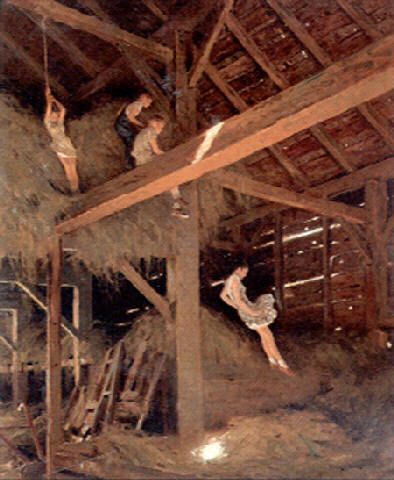
Jumping into loose hay is a feeling of being enveloped and cushioned.  The occasional broken bale I find in the loft softens in my hands as I scoop it up–what a delight.  One of the joys of doing chores is breaking the twine on the bales and freeing the hay into flakes as the portions are distributed to each stall.  Would I find carrying pitchforks of loose hay as gratifying?  Perhaps, but harder work indeed and much more lost along the way.

Is each day lived in tightly bound bales or as free-spirit loose hay?  I experience both, stretching against the cords that bind me at times, but needing the ties that keep me from blowing away at the slightest puff of wind.  Life stacks us up, builds us and grows us, but too soon pulls us apart and we are dust again.  We must thrive with our covenant “ties” –the twines that keep together our faith, our relationships, our children.  But we can overdo, sometimes binding too tightly, and not unlike our children who must eventually be free, we must loosen our ties, let them breathe and avoid the “mustiness” that can develop over time if they never are opened up.

It is time to celebrate the hay stack and know that we belong, bound or loose, to the dust from which we arose.

children-playing-in-hay-loft

The Zucchini Chronicles

n707166118_1790323_6542It started innocently enough in April
With two-leaf seedlings labeled green and golden,
Non-descript squash plants harboring
Hidden potential.

By June the plants crept across the ground with vines
Reaching past the beans to greet the cucumbers,
Going where no vine has gone before
To divide and conquer, leaving no dust untouched.

July buds formed blossoms inviting bees deep
Into yellow-throated pollen pools
Thickening within days to elongated flesh:
Fecundity in action before our eyes.

The finger-like projections at first harvested
Too small, but temptation overwhelms patience;
Sauted, grilled with garlic, superb in
Supreme simplicity.

But come back a day later: hose-like vines
Pumping into each squash, progressively inflated like
Balloon-man balloons to be twisted and transformed
But too plump, too distended, too insatiable.

It’s a race to keep up with the pace of production
Eat some, give them away, leave on doorsteps like abandoned kittens,
In boxes in church lobbies, lunch rooms at work,
Food banks posting signs: “No more zucchini please!”

They march in formation in the garden path
As they are yanked swelling from their umbilical cords
And lined up, stacked, multiplying
Like the brooms of the “Sorcerer’s Apprentice”.

Then tossed on to the compost pile, a fresh foundation,
In a scant few months of warm decomposition,
In dead of winter, amidst steam arising,
A seedling, innocent enough, pokes through exploding with potential~

Run for your lives!

Filling Up the Tank

water-hose

This was one of those early September mornings with fog close to the ground yet clear skies and sun above so all appeared shrouded in golden mist. It was only a matter of minutes until the moist air dried and the mist evaporated but I marvelled in the surrounding gilded fog bath in the meantime.

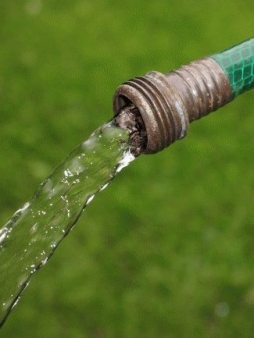
Every morning and every evening I have water barrel filling duty as one of my farm chores. As this is a portable barrel, which goes into whichever field the horses go, we simply fill it using a hose that stretches from the barn, rather than investing in automatic watering systems. It doesn’t sound very efficient but standing with a hose filling a 50 gallon barrel 10 minutes twice a day has its upsides. It is a good time to reflect on the day that is dawning and the day that is wrapping up. It is a good time to scan the fields and trees, survey the fences, and deeply suck in fresh air. In short, it’s a time to fill up my own tank when I’m feeling “dry”. Some weeks bring more to contemplate than others.

Four years ago this week hundreds of thousands of Americans were left homeless, bruised and battered physically and emotionally, and many dead in the Gulf Coast region after a hurricane proved it was far mightier than any disaster planning table top exercise or exhaustive textbook scenario. In the horrific irony of post-storm flooding, people died of dehydration surrounded by water. Their homes and neighborhoods overflowed while they themselves were parched. It was an agony that was impossible for the rest of us to fathom, comfortable as we were in our corner of the world. By simply turning on a faucet, I can watch gallons and gallons of clean fresh water pour out of my barn hose for my horses to drink, and I think about how many people this water barrel could have saved from certain death that fateful week. If only I could have magically transported my deep well, my hose, and my barrel where it was needed, I would have filled it over and over as they quenched their thirst. So many “if onlys” in such a week.

It was also a week where a split second decision that I made while moving horses on my farm, in an effort to save time, resulted in significant injuries to two of my horses. Saving a moment resulted in untold future hours of wrapping wounds, a pile in vet bills, and my own guilty shame in making a poorly planned out decision in haste. So I force myself to stand as I fill up the water barrels and realize that a few saved minutes, a misplaced sense of control over things that are uncontrollable and just plain lack of common sense is never worth the cost to be paid. It is fool’s gold, as transient and blinding as the fog this morning and just as ephemeral.

The “what if’s”, “if onlys”, and “shouldas” in my flawed life can be dehydrating all on their own, causing more long term suffering and untold misery. So I dive into the tank that is filling up in front of me and drink deeply,  bathed, saturated, and washed clean in “what is” and “what will be”, not “what should have been”. The tank will always be full, the invitation is genuine and unlike ever rising gas prices, it is given freely.

mist