Lenten Meditation: Non posse non peccare


Psalm 51: 5

Surely I was sinful at birth,
sinful from the time my mother conceived me.

I had a hard time accepting this notion of Total Depravity when I first started attending Reformed Churches with my husband-to-be thirty years ago.  After all, I grew up Methodist, which is a nice comfortable squishy denomination that truly believes the best of people, that people have great intentions even if they are imperfect in execution, that sweet little babies are…well… sweet little babies.   But the Calvinists were clear: we are born in sin, it is and always has been part of our nature since we chose to not live in harmony in obedience to God.   Non posse non peccare says Augustine — not able to not sin.  I really wasn’t buying it.

Then I became a mother.

Now, our children are truly stellar on the well-behaved scale, and compared to what some parents deal with, very easy to raise.  But it was clear to me very early on that at a very young age, babies have agendas that are completely self-centered over anyone else’s interest and they expect the world to change to adapt to their whims and wants, not the other way around.  It takes hard consistent guidance as a parent to help a child grow to become a compassionate adult who acknowledges their sin, rather than reveling in it.

We owe it to our children to address the sin that is part of every fiber of their being.  Only then can they truly understand the meaning of being set free of that dark prison, through a debt graciously selflessly paid on our behalf.

Lenten Meditation–Against you, you only


Psalm 51:4a

Against you, you only, have I sinned
and done what is evil in your sight

Sin is not a subject of polite conversation in modern society.  After all, we are an open minded, tolerant, nonjudgmental people…aren’t we?  One person’s sin is another person’s “God-given” right to experience pleasure, right?  What is right and wrong becomes relative,  diluted, and rendered meaningless.  What really matters is that we have forgotten that sin is not about others, it is about breaking our covenant with God.

John Piper of http://www.desiringgod.org says it this way:

“Sin, by definition in the Bible, is not wronging another person. It is assaulting the glory of God, rebelling against God. Sin, by definition, is a vertical phenomenon. What makes sin sin is its Godwardness. That’s why the world doesn’t understand how serious hell is, because they don’t understand how serious sin is. And they don’t understand how serious sin is because the only way the world thinks about sin is in terms of “You hurt me and I hurt you, and that shouldn’t be.” And that’s true: we shouldn’t hurt each other. But they don’t even bring God into the picture, and that’s where sin becomes sin.”

The bite of the forbidden apple was not the sin.  The sin was the rebellion against God, dismissing His command to obedience; man and woman wanting to be God when only God can be God.

He is God, and we are not.

Lenten Meditation–my sin is always before me

Psalm 51

2 Wash away all my iniquity
and cleanse me from my sin.

3 For I know my transgressions,
and my sin is always before me.

Sometimes I wish I could just be tipped upside down and washed when I’ve gotten myself completely covered with muck–muddy hands, dirty feet, smudged face, soiled soul.  I look in the mirror and can see everything that desperately needs spiritual soap–now.  It is right there for me to see but I act helpless to do anything about it.

Maybe tomorrow…

Usually people are pretty effective at hiding the problems in their lives, even from themselves.   In the work I do, it isn’t so easy to conceal.  Patients come to detox because they have hit bottom in every way,  so they are forced to confront the troubles that brought them there.   I’ve cared for people who have sold themselves, sold others, abandoned spouses as well as their own children, murdered others and have tried to murder themselves.   They come in so grimy, it is hard to see their skin.   They cry out for cleansing, for forgiveness, for healing.  Sometimes they submit to that wash cycle, and sometimes the scrubbing that is the detox process is just too physically hard and painful despite all my effort to ease it. They can’t handle it and leave before they are clean.

Maybe tomorrow. I grieve when that happens.

Not once must I forget that their sin, ever so much more obvious,  is no greater than mine–we are all tainted goods.  Our only hope is the Lord holding onto us tightly, tipping us upside down in the holy waters and making sure we’re scrubbed until we shine.

Not tomorrow.

Today.

Lenten Meditation–Blot Out My Transgressions

Psalm 51:1

Have mercy on me, O God,
according to your unfailing love;
according to your great compassion
blot out my transgressions.

Every day, as the sun goes down,  I’m reminded how often I messed up that day, in big and small ways.  My mistakes seem illuminated, weighing down my heart, and impossible to forget.   Yet, as I pray like the Psalmist for mercy, there follows a peacefulness at the end of the day, as my errors are blotted out, covered over by the descent of the night.   The slate, one more time, is wiped clean.

I remember, once again, as the morning dawns, there is renewal, there is cleansing brightness, a promise provided within each new day.  I am given another chance to get it right.

Lenten Meditation–Grace Be With You

Our pastor has just finished a very illuminating evening study of Paul’s Epistle to the Colossians, which ends with a few concise words in 4:18, the final verse.

I, Paul, write this greeting in my own hand. Remember my chains. Grace be with you.

The Apostle shares remarkable humanity with his Christian brothers and sisters in these words that deserve deeper exploration over the next several days.  What initially caught my attention was the interesting contrast between the last line of the letter compared to the opening line in verse at the very beginning of the letter:

Grace and peace to you from God our Father.

What is the difference here in the greeting “Grace and peace to you” at the beginning and “Grace be with you” at the end?

The following explanation is proposed by Dr. John Piper (www.desiringgod.org)  in his book Future Grace:

“Paul has in mind that the letter itself is a channel of God’s grace to the readers. Grace is about to flow ‘from God’ through Paul’s writing to the Christians. So he says, ‘Grace to you.’ That is, grace is now active and is about to flow from God through my inspired writing to you as you read – ‘grace [be] to you.’ But as the end of the letter approaches, Paul realizes that the reading is almost finished and the question rises, ‘What becomes of the grace that has been flowing to the readers through the reading of the inspired letter?’ He answers with a blessing at the end of every letter: ‘Grace [be] with you.’ With you as you put the letter away and leave the church. With you as you go home to deal with a sick child and an unaffectionate spouse. With you as you go to work and face the temptations of anger and dishonesty and lust. With you as you muster courage to speak up for Christ over lunch. . . . [Thus] we learn that grace is ready to flow to us every time we take up the inspired Scriptures to read them. And we learn that grace will abide with us when we lay the Bible down and go about our daily living” (Future Grace, 66-67).

This is what it is like each Sunday, as I enter Wiser Lake Chapel, and am filled with the Word from Pastor Bert’s inspired teaching.  The spirit flows from our Pastor’s study of the Word, to accompany each of us as we go about our week.  Grace to, and then with us.

Just as Paul intended for his brothers and sisters.  We are deeply blessed.

Lenten Meditation–Great Compassion

Another part of my Gombe saga–my work as a research assistant in Tanzania in 1975, studying wild chimpanzees for Dr. Jane Goodall

Several metal buildings were scattered along the shore at Gombe National Park, having been built over the years since Jane Goodall and her mother Vanne arrived on the bare beach in 1960.   From the very beginning, one of the most powerful connections between these two British women and the Tanzanian villagers who lived up and down Lake Tanganyika was their provision of basic medical supplies and services when needed.  Initially, under the cover of the camp tents, they tended to wounds, provided a few medications, and assisted whenever they were needed for help.  Later, an actual dispensary was built as part of the park buildings, with storage for first aid supplies and medications, many of which were traditional Chinese medications, in little boxes with Chinese characters, and no translation.  All we had was a sheet of paper explaining if a medication was to be used for headaches, fevers,  bleeding problems or infections.

There were “open” times in the dispensary and each of the research assistants took turns to see villagers as they came by to be seen for medical issues.  We saw injuries that had never healed properly, some people with permanently crippled limbs,  centipede bites that swelled legs,   babies that weren’t gaining weight,  malarial fevers.

It felt like so little to offer.  None of us had medical training beyond first aid and CPR, but what small service we could provide was met with incredible gratitude.  We were even called to attend a difficult birth in a village up the lake a few miles away but arrived after the baby had been safely delivered by the village midwife.  For this, we (and undoubtedly the mother and the midwife) were incredibly grateful as none of us had even seen a human birth before.

So it wasn’t a surprise when a villager arrived one afternoon, running and out of breath, asking that we come right away to help.   There had been a terrible accident up the beach when a water taxi engine exploded while transporting a number of villagers, with their provisions, along with some goats and chickens.  The people rushed to get away from the engine fire and the boat overturned, with people trapped among the boxes unable to escape.  Even more tragic, Tanzanians were never taught to swim, so no one on shore could help in the rescue effort.

We dropped everything and six of us ran up the beach for a mile, and could see an overturned water taxi just off shore.  The best swimmers went out and started searching for people who had been too long in the water.  They began to pull the bloated bodies to shore, one by one, the lake water pouring from lifeless mouths and noses.    All we could do was line them up side by side on the beach, trying to keep the biting flies from covering them,  trying to make sense of the senseless.  There were eight children of various ages, including two small babies, several older women, one pregnant woman, the rest men of all ages–twenty four in all, not a single survivor.

Although in my work as a nurses’ aide at home, I had cared for the dying and cleaned and cared for their bodies after death, I had never before seen so much death in one place.   Within an hour, relatives started arriving, their grief-stricken wails of loss filling the air of this remote central African lakeshore.  Husbands and wives wept, keening over a spouse, children crouched, in shock, by a dead parent.  Grandmothers clutched their dead children and grandchildren and would not let go.  It was a horrifying scene.

We had saved no one.   We had no power to bring them back to life.    All we could provide that day was our compassion for neighbors who had come to depend on us to help.  It was not enough, and never would be enough.  It became even clearer to me, in a way I had never understood before, how deep was our dependency on the mercy and compassion of the Lord who was our only comfort in the midst of our great need.

I would not ever forget what was lost that day and and because of that, the knowledge I gained.

Psalm 51:

“Have mercy on me, O God…
according to your great compassion…”

Lenten Meditation–Unfailing Love

from speak2it.files.wordpress.com

Psalm 51:1

Have mercy on me, O God,
according to your unfailing love;

I’m not sure what it would be like to be “unfailing” as I fail regularly, in large and small ways, daily.  The promise of mercy for my failings and flaws, because of the Lord’s love that never fails is of immeasurable comfort. No matter how I may mess up,  there is His merciful and healing balm offered up freely to restore me.  It is certain, it can be trusted, it will always be there.  When I fail, He will not.

Lenten Meditation–Repentance


He wasn’t just any drunk.  He was a mean drunk.  Surly, cursing, prone to throwing things and people.

My grandmother used to say he learned to drink in the logging camps and I suspect that is true.  He started working as a logger before he was fully grown, dropping out of school around age sixteen and heading up to the hills where real money could be made.  He learned more than how to cut down huge old growth Douglas Fir trees, skid them down the hills using a team of horses, and then roll them onto waiting wagons to be hauled to the mills.  He learned how to live with a group of men who surfaced once or twice a month from the hills to take a bath and maybe go to church with their womenfolk. Mostly he learned how to curse and drink.

He returned to the home farm with muscles and attitude a few years later, and started the process of felling trees there, creating a “stump farm” that was a challenge to work because huge stumps dotted the fields and hills.  He slowly worked at blasting them out of the ground so the land could be tilled.  It proved more than he had strength and motivation to do, so his fields were never very fruitful, mostly growing hay for his own animals.  He went to work in the local saw mill to make ends meet.

He cleaned up some when he met my grandmother, who at eighteen was twelve years younger, and eager to escape her role as chief cook and bottle washer for her widowed father and younger brother.   She was full of energy and talked constantly while he, especially when sober, preferred to let others do the talking.  It was an unusual match but he liked her cooking and she was ready to be wooed.

It was a marriage in a rush with a baby born a bit earlier than the calendar would have predicted.  They settled on the stump farm and began raising a family, trying to eke out what living they could from the land, from the sporadic work he found at the saw mill, and every Sunday, took the wagon a mile down the road to the Summit Park Bible Church where they both sang with gusto.

He still drank when he had the money, blowing his pay in the local tavern, and stumbling in the back door roaring and burping, falling into bed with his shoes on.  Grandma was a teetotaler and yelled into his ruddy face about the wrath of God anytime he drank, their four children hiding when the dishes started to fly, and when he would whip off his belt to hit anyone who looked sideways at him.

When their eldest daughter, the reason for their getting married in the first place, took sick and died quickly of cancer despite the little doctoring that was available, Grandpa got sober for awhile.  He saw it as punishment from God, or at least, that is what Grandma told him through her sobs as she struggled to cope with her loss.

Over the years, he relapsed many times, losing fingers in his work at the mill, and losing the respect of his wife, his children and the people in the community.  Grandma left with the kids for several months to cook in a boarding house in a neighboring town, simply to be able to feed her family while Grandpa squandered what he had on drink.

Grandpa sobered up for good while his boy fought in the war overseas, striking a bargain with God that his boy would come home safe as long as Grandpa left the booze alone.  It stuck and he stayed sober.  His boy came home.  Grandpa felt forgiven and became an elder in his Bible Church, taught Sunday School and gave his extra cash to the church rather than the tavern.

Sitting in a Christmas Sunday School program one Christmas Eve, Grandpa leaned toward Grandma and she noticed his face broken out in sweat, his face ashen.

“Phew, it’s hot in here, “ he said and collapsed in her lap.    He was gone, just like that, in church, sober as can be,  on the day before Christmas.

He was home at last.

Lenten Meditation–Ash Wednesday

End of Carnival
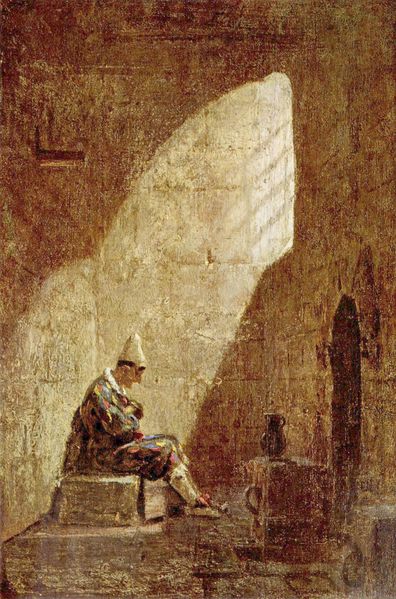
End of Carnival by Carl Spitzweg

I did not grow up observing Ash Wednesday.  Even as a child in a mainline Protestant denomination, I had only a fleeting awareness of the significance of the days leading up to Resurrection Sunday. When my new middle school friend, a Catholic, wore the cross of ashes on her forehead to remind her of her mortality and her need for repentance, it marked me as well:

I will be ashes someday.  That is a given.  There is no drawing of the first breath without knowing there will be a last breath.  That awareness changes everything in between.

Salvation from the ash heap is only through the sacrifice and gracious gift of the Risen Savior.   I cannot save myself.

The party may be over, but there is plenty left to celebrate.    This is only the beginning.