Caritas

written originally in early March 2007

aktuell

We are all waiting for winter to be finished with us.  Instead it is snowing and blowing, ruining our dreams of spring and reminding us once again we have no control over the elements.  Cars were upside down in the ditches yesterday morning following a night of snow and freezing rain, and trying to accelerate up hill after a red stop light turned green was an exercise in futility.  I could have made it to work faster by hiking.

Not only the blustery out of doors has us in a strangle hold.  There are the winter viruses controlling everything inside our skin.  Workload at my clinic has doubled during influenza season, so I’m relegated to seeing patients in 10 minute slots to try to see everyone who is triaged.  There is little opportunity to provide much more than very basic assessment and advice and a moment of eye contact, a hand on the shoulder and reassurance that “this too will pass”.   After all, there is not much else a physician can do for the influenza patients who drag themselves out of bed finally on the third day of their illness, wondering what hit them like a truck.  We can only commiserate and advocate for signing up for next season’s flu vaccine 9 months from now.  Am I really doing much of value?  Some days I’m not so sure.  Yet I return each day to my work because I am needed by others, whether I make a difference that day or not.  It is what I am called to do– this caritas of the spirit.

When work load off the farm is this heavy, there is little that happens at home except basic daily maintenance.  The kitchen floor gets mopped less frequently, the laundry pile grows higher and the vacuum stays idle, but the barn chores continue unchanged.  It is my cherished routine to head to the barn in the dark of a winter’s morning and turn on the lights, and 7 pairs of Haflinger eyes blink and 7 Haflinger voices rumble greetings.  I am truly anticipated and appreciated and I have a clear task that I do that will make a difference.  Last summer’s hay bales are broken open and the fragrance of the clover and timothy fields is as grand as my morning cup of coffee.  I cradle the hay flakes to each expectant horse and they nod and bow in gratitude when I open their door.  Their buckets are filled with fresh clean water and they drink gratefully and deeply.  I share with each horse a moment of eye contact, a scratch on the wither and the reassurance that I will return at the end of the day to repeat our ritual and prepare their beds for the night.  And then I am gone, leaving the radio to play “oldies” to them while the weather rages outside.  I am needed and it is what I am called to do–this horse keeping.

Remarkably, the crocuses are up through the snow, the snowdrops are flourishing and the orchard trees are beginning to swell their buds.  Bird song is plentiful in the frozen mornings, with far more variety than a month ago.  There will be a spring coming soon, despite how things feel to me now.   This exhaustion will be replaced by renewal and the fresh air will be filled soon with the sweetness of cherry and apple blossoms.  The fields will grow lush and soft  and the sun will be warm on my horses’ withers once again.  And I will celebrate the defeat of winter once again.

Tied in Knots

n707166118_2259849_2297

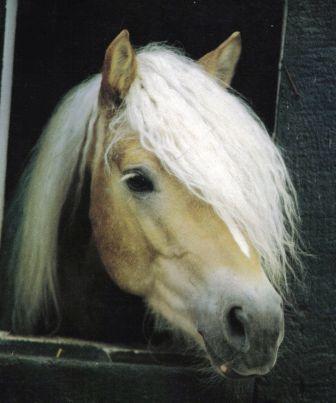
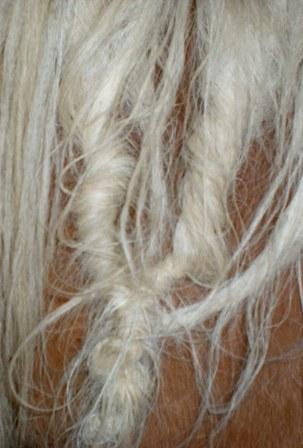
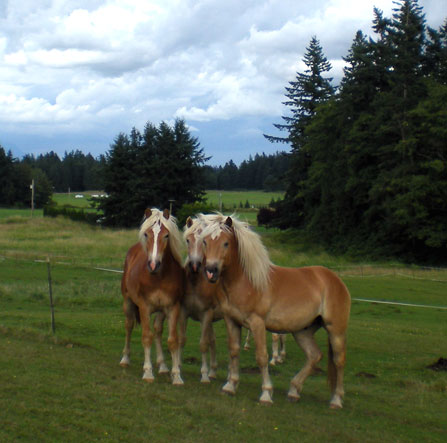
One of my favorite things about my Haflinger horses is their long lovely manes–the whiter, and wavier, the better. I enjoy everything about that long hair — except sometimes the maintenance involved. It usually doesn’t take a lot of fuss, but this time of year, when the air is moist and there is frequent rainfall, I find that those long manes come in from the fields all a-tangle and frequently in elaborate tight knots. Not just uncombed dreadlocks, but tight, cinched up and truly snarled knots.

I have two theories about how these knots and tangles happen: Most likely, I suspect the Haflingers tend to toss their heads and shake their necks more in the rain, to shower off the raindrops that are dripping down their faces. There is something about this repetitive movement that causes the long mane strands to knot and then flop and fold back into themselves with each neck shake, so that there are sometimes three, four or five successive knots tied in a collection of strands. A second theory involves one very agile Haflinger mouth, tying knots in her unsuspecting pasture mates’ manes. I haven’t witnessed this personally, but this theory is suggested by the fact that I have several horses who always come in with knotted manes and one who never does. The “knotter” and the “knottees?” Perhaps….

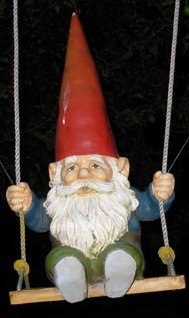
My Scandinavian friends tell me there is a little gnome named Tomten in a gray coat and red cap who lives in the barn and ties knots in pony manes as a way to show how much he is caring for the farm. I haven’t seen him at work, as my little Tomten gnome swings on a swing in our back yard and I have yet to see him do anything except smile and make me happy when I look at him. But I like the thought that he may be responsible for these tangles.

So these wet evenings, I find myself working down the barn aisle, releasing all these knots that have formed during the day. This can be a bit time consuming and not a little aggravating, but necessary if I hope to keep these three and four foot manes intact and growing. So far I’ve not had to take scissors to any, but that is only because in matters of Haflinger mane, I’m extremely motivated and patient. Long white flowing wavy manes are part of the “fairy tale” that Haflingers embody. They are sadly being lost in some of the modern bloodlines, as the trend is toward a lighter weight hair that is more easily hunter braided and thinned, more like a warmblood type sporthorse’s minimal mane. True, all the long Haflinger mane can get tangled in the reins or the lines and represent a hazard, and though there is always the question of just how much a Haflinger can actually see through all that forelock, nevertheless, I want the hair to stay, and it kills me to even cut a bridle path.

What is the good of all that hair besides aesthetics? It surely is an outer protective layer in the harsh weather conditions to which Haflingers had to adapt long ago, and it is amazingly effective at keeping the head and neck warm and dry. The double manes are incredible umbrellas, allowing the rain to drip down that top oily layer of hair and drop to the ground, never touching the fur and skin underneath. But what a sauna it creates in the heat of summer!

There are times I wish I wore such a “veil” myself–able to hide my face when I need to, and impervious to the harshness sometimes flung my way– the “slings and arrows” of every day life. But when things heat up, it can be quite a liability with the heaviness and uncompromising barrier it creates.This is a difficult trade off for the potential comfort of privacy and protection risking smothering, knotting and tangling. Like the Haflingers, I can only hope that when I’m all tied up in knots, someone will care enough to untangle me gently, smooth me out, and braid me up so I feel relief in the midst of the heat, respecting me enough to not destroy something that helps define me.

So I keep caring for those manes, knowing their loveliness has its downside, and recognizing they are part of what makes my horses “Haflingers”, the fairy tale horses that dance in my dreams, which are part of what makes me who I am.

n707166118_2259850_9280

Ark Building

viewphp

I’ve got a bad case of the drearies. Rain has fallen heavily for just four days, with balmy temperatures up to 50 degrees, right after three weeks of freezing temperatures, ice and multiple feet of snow. As a result we have a state of emergency in our county with flooding in places that have not been flooded in decades, if ever. There are many people unable to leave their homes due to roads that have become rivers and some have had to sadly abandon their flooded homes. The drive time to work has been tripled because the detours are zigzagging all over the county.

Even those of us who are natives become overwhelmed by rain and moisture that clings to everything and everyone, blocking daylight so thoroughly that we leave for work in the dark and return in the dark despite lengthening days. The continuing rain is not predicted to end anytime soon, so I wonder about hitting the proverbial 40 days of rain. Indeed, it’s time to build an ark. Otherwise we may be left treading water as it rises around us.

Along with the local rivers and streams overflowing their banks, there is a new lake in our lower field. We have this little problem with our barn, located strategically at the bottom of a hillside. Four of our twelve stalls have standing water, so the Haflingers are bunking in the remainder, happy to be out of the wet, but insulted at prolonged confinement as there is no place to go outside without mud and mire. Regular flakes of hay bribe them into complacency. Things can’t be too bad when the best part of the day involves eating…

Ah, but it takes it’s toll on our psyches. Wet cold dankness without reprieve can be hard on man and beast. We are all waiting, waiting, wishing for something different, wanting relief. The Haflingers wait for their freedom from confinement and desire the sun on their backs once again, but settle for the memory of the sun and pastures as it is tossed in the form of flakes of dried field grass under their noses. I imagine they breathe deeply into that hay and reminisce about those warm lazy days in the pasture with every mouthful.

What do I wait for? I am discontent, antsy and eager for a respite from this. No one tosses a flake of hay to me to keep me from complaining, though it just might work if it was served with hot chocolate with whipped cream topping.

Actually, the waiting, the anticipation is for something beyond the temporary satisfaction of hunger or thirst. It is a far deeper need, and a greater want and desire. Our longing for light in our deepest darkest times can urge us forward, to prepare us for what comes next.

And it can come from the most unlikely source. It can come from a barn, bedded in hay, tucked in a manger. That baby whose birth we celebrated two weeks ago is the ark that keeps us afloat in the flood.

In our dreariest of moments, we must wait and prepare. The sun will return, surround us, dry us out and warm us, and we will be ready. In the mean time, I’ll crawl into the manger and tuck myself in and breathe deeply of the hay, pondering the promise of summer.

So I don’t plan to build an ark after all. I’m buoyed,  held up and here to stay: soppy, saturated, and drenched with the showering of life.

crossingthedelaware1

Treading on Thin Ice

runsinsnowOur colder than customary winter in the Pacific Northwest has defied global warming trends worldwide.  We still have piles of snow drifts lying unmelted from our pre-Christmas storm, and day time temperatures only rose above freezing over the last 24 hours.  What that means is that we have superficial thawing during the day with rain showers, and then under a cover of fog and frost during the night, all is iced up again in the morning, making roads especially deceptive and treacherous.
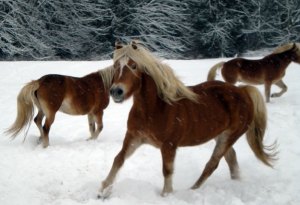
Our barnyard is no different.  The slabs around our barn have the same coating of black ice in the morning as the roads do.  In particular, the slab behind our hillside horse barn is the source from run off of rain and ground water from the fields sloping above it, streaming to the fields that lie below.  The slab can be a veritable river most rainy winter days, and it has been flowing actively over the last several warmer days.  However, it froze hard during the night, and became a sheet of very slippery ice by this morning.

This is a challenge for the Haflingers as they are allowed out for some fresh air in the fields while we clean their stalls.  All year they are accustomed to going from barn aisle to open gate without considering the footing over the slab, focused only on the green grass beyond rather than the journey required to get there, but mornings like this are a whole other story.

I know better than to try to lead a horse across the ice like this as my ability to stay upright is seriously compromised if I’m pushed off balance.  So the horses must navigate this 10 yards untethered to me and with only my verbal cautions as a guide.  I certainly fear a horse falling on the ice and being injured, especially my mares who are in late pregnancy.  Some of them listen and learn better than others.

Our 25 year old gelding is always cautious and careful.  He’s seen enough unpredictable situations over the years and knows to check things out before committing himself, so takes it easy over the slab and has no difficulty.  Our yearling colt is also wary as he does not always know what to expect from the world yet, so he stops, sniffs the ice, tentatively puts a foot out as a test run and minces his way across, skittering as his smaller hooves give him little traction but he remains on his feet.

Our two pregnant mares, normally impatient about getting to any source of food, are heavy bellied and move awkwardly in the best of circumstances these days, so they are not eager to take chances either.  They seem to know they are more vulnerable and move deliberately and ponderously, safely carrying themselves and their unborn foals over the hazardous footing with an air of great responsibility and I breathe much easier when they reach the field.

Not so cautious is our younger mare.  She is unencumbered by pregnancy, full of pent up energy from lack of steady work in winter, and fueled by hormones.  Nothing seems to really penetrate her brain aside from her own desires and urges–all that matters is what she wants right now!–so she rushes too fast once beyond the barn, does a little skating across the slab and woomph! lands butt first as her feet go out from under her.  Getting up isn’t easy when you have newly trimmed smooth hooves, so she gathers up what is left of her dignity and balance, and gets upright again, stands still for a moment assessing how to proceed and then with great care, full of  grace she lacked a few moments before, walks the rest of the distance to the gate.  A painful lesson in impulsivity and selfish desire.

I’m certainly at a more cautious time of my life myself.  I’ve been through more impulsive, selfish and impatient stages in my younger years and remember all too well disregarding the admonitions and cautions from wiser people than myself.  I had to land hard a few times to “get it”.  I still lapse now and then and find myself treading too fast on “thin ice” but it seems less often as I grow older and perhaps a bit wiser myself.  I find that I’m trying now to guide not just my horses across the ice, but certainly my children and my patients as they navigate the hazards in their lives.  A fall now and then is inevitable and through grace we are picked back up.  That teaches far more effectively than my words of caution ever can.

Nevertheless here is the advice I have, given my own slips and slides on the thin ice of life:

Proceed forward with courage and boldness, anticipating each step as new and unfamiliar.  Remember you carry more than just yourself–you carry your past, your future and indeed that present moment itself–as precious as the moment just past and the moment yet to come.  And when you may think you have “arrived”, you’ll find yet another journey, perhaps just as filled with the unknown,  is about to begin.  Tread lightly within that knowledge, rejoicing in the journey itself and the destination will take care of you when you finally find yourself safe on the other side.

snowplay2

Do Not Be Afraid

131218shepherds-watch-their-flocks-under-the-light-from-a-distant-star-near-bethlehem-israel-posters1

We’ve had a very blustery week of chilly snowy weather, with strong winds from the north, blowing branches off trees and anything not tied down. Our horses were out in their winter paddocks yesterday, as usual, and due to the fullness of the day’s activities, we didn’t get out to do chores until after dark to bring them in one by one.

The wind definitely changes everything once it is dark out, for us and for the horses. The familiar walk along the dark path from the paddocks to the barn, past several buildings, suddenly becomes spooky and more epic adventure than evening stroll. The wind whistles between the buildings, so everything sounds different than usual, and the blowing branches and goodness knows what else can appear threatening and menacing.

The horses’ eyes are big and bright with white as we walk in, and they jig and trot, glancing this way and that, clearly unnerved by the familiar becoming unfamiliar. They are uneasy and frightened, breathing hard and fast, and the younger ones are frankly terrified when a branch blows across their path, coming out of nowhere in the dark, and disappearing just as quickly. I talk to the horses as we walk, reassuring them, telling them there is no reason to be afraid, that there is nothing out here that will eat them or chase them, and they cock their ears back and forth, listening to me, then back to listening for that unknown “thing” out there that just might be ready to get them. If they had their ‘druthers, they’d be racing for the safety of the barn at full tilt, but that is not acceptable behavior, so they cope with being asked to stay close and walk alongside me.

Once in the barn, with muzzles into the feeders and eating their evening meal, their eyes soften again, and they relax, settling, knowing that they are safe and cared for and protected. A roll in the fresh shavings, a good shake and a huge snort of relief, and all is well. I can be easily unnerved too by the familiar suddenly becoming unfamiliar. I like to think I cope well with the unexpected, but it isn’t always the case, so I often need plenty of reassurance, and a steady voice beside me so I don’t get catastrophic in my fear.

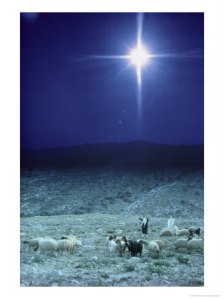
Sometimes, as a president so wisely implied years ago, our own fear becomes the thing we fear the most. And it need not be.This type of fear in the face of the unexpected happened years and years ago, to people who were society’s cast-offs, relegated to tending flocks as they had no other skill of value. They were the forgotten and the least of men. Yet what they saw and heard that Christmas night put them first, allowed them access that no one else had. Within the familiarity of their fields and flocks came this most unexpected and frightening experience, terrifying in its sheer “other worldliness”, and blinding in its grandeur. They must have been flattened with fear and terror.

And so the reassurance came: “Be not afraid”.

In the same way we whisper to our frightened horses and hold them close to us, so these shepherds were picked up, dusted off and sent on their way to the safety and familiar security of a barn, to see with their own eyes what they could not imagine. A baby born in so primitive a place, yet celebrated from the heavens. The least becomes first, and the first becomes the least.

Sometimes, in these dark times, our terror is for good reason, and we need to know where to seek our reassurance. It is there for us and always has been, walking beside us, speaking to us from a manger bed, feeding us when we are hungry and tending to us when we need it.

Merry Christmas and do not be afraid.

Listening to the Lullaby

The best moment in the barn is in the evening just following the hay feeding, as the animals are settling down to some serious chewing. I linger in the center aisle, listening to the rhythmic sounds coming from each of 12 stalls. It is a most soothing contented cadence, first their lips picking up the grass, then the chew chew chew chew and a pause and it starts again. It’s even better in the dark, with the lights off.

I’ve always enjoyed listening to the eating sounds at night from the remote vantage point of my bedroom TV monitor system set up to watch my very pregnant mares before foaling. A peculiar lullaby of sorts, strange as that seems, but when all my farm animals are chewing and happy, I am at peace and sleep better.

It reminds me of those dark deep nights of feeding my own newborns, rocking back and forth with the rhythm of their sucking. It is a moment of being completely present and peaceful, and knowing at that moment, nothing else matters–nothing else at all. That must be a little bit how Mary felt cradling her newborn son in a barn so many years ago. We are told she “pondered these things in her heart”, knowing more, much more, was to come…

If I am very fortunate, each day I live has a rhythm that is reassuring and steady, like the sounds of hay chewing, or rocking a baby. I wake knowing where the next step will bring me, and try to live in each moment fully, without distraction by the worry of the unknown.

But the reality is:
life’s rhythms are often out of sync, the cadence is jarring, the sounds are discordant, and sometimes I’m the one being chewed on, so pain replaces peacefulness. Maybe that is why those moments in the barn~~that sanctuary~~are so treasured. They bring me home to that doubting center of myself that needs reminding that pain is fleeting, and peace, however elusive now, is forever. I always know where to find it for a few minutes at the end of every day, in a pastoral symphony of sorts.

Someday my hope for heaven will be angel choruses of glorious praise, augmenting a hay-chewing lullaby.

So simple yet so grand.