Stolen Anthem

dove-feathers

Rousing from sleep in dawn of mid-winter gray
No usual mournful morning greeting
From the dove house.

Approach and where are the perfect
Slender birds whose low-throated songs
Soothe the night, and ballast waking?

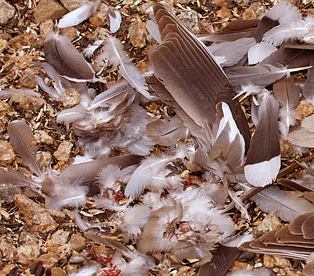
Look closely and tiny feathers float
Above the ground, chaotic
Signs of futile struggle.

Not taken up in rapture,
But tortured in the night
Bloodied and abandoned.

Inside, tucked and nested
His partner sets unaware
Warming five pearl smooth eggs.

What thief would steal
Through some narrow crevice
To leave behind such devastation?

Cry indeed for stolen song,
The gentle soulful sounds
Of peace

And await the wakening of a new dawn:
Restored anthem, hatching soon
Beneath a downy breast.

Barnstorm

haybarn3

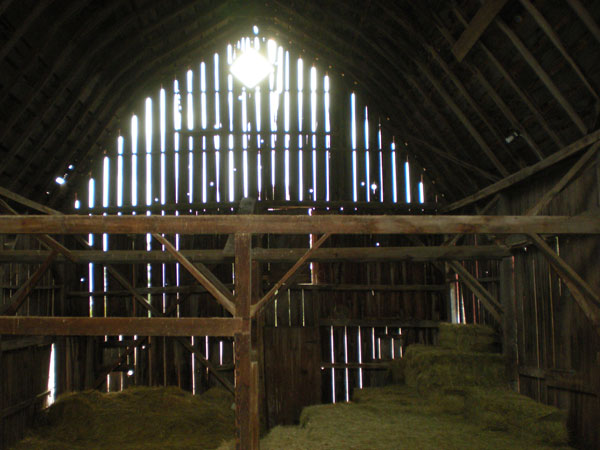
Most of my life, a barn has stood a few dozen yards from my back door. As a small child, I learned to ride a tricycle on the wooden planks of the chicken coop, sat on the bony back of a Guernsey cow while my father milked by hand, found new litters of kittens in cobweb-filled hideaways, and leaped with abandon into stacks of loose hay in a massive loft.

As a young girl, I preferred to clean stalls rather than my bedroom. The acoustics in the barn were first rate for singing loud and the horses and cows never covered their ears, although the dog would usually howl. A hay loft was the perfect spot for hiding a writing journal and reading books. It was a place for quiet contemplation and sometimes fervent prayer when I was worried: a sanctuary for turbulent adolescence.

Through college and medical training, I managed to live over twelve years in the city without access to a barn or the critters that lived inside. I searched for plenty of surrogate retreats: the library stacks, empty chapels within the hospitals I worked, even a remote mountainous wildlife refuge in central Africa.

It is hard to ignore one’s genetic destiny to struggle as a steward of the land through the challenges of economics and weather. My blood runs with DNA of wheat and lentil growers, loggers, cattle ranchers, dairy farmers, work horse teamsters, and flower and vegetable gardeners. A farm eventually called me to come back home and so I heeded, bringing along a husband (from a dairy farming background himself), and eventually there followed three children.

It hasn’t always been pastoral and sublime on the farm. It’s a lot like life itself.

Recently, a sudden southerly wind hit our farm one winter night, powerfully gusting up to 60 miles an hour and slamming the house with drenching rain as we prepared to go to bed. Chores in the barn had been finished hours before, but as we had not been expecting a storm, the north/south center aisle doors were still open, banging and rattling as they were buffeted in the wind. I quickly dressed to go latch the doors for the night, but the tempest had already done its damage. Hay, empty buckets, horse blankets, tack and cat food had flown down the aisle, while the horses stood wide-eyed and fretful in their stalls. A storm was blowing inside the barn as well as outside. This was not the safe haven a barn was meant to be. It took all my strength to roll the doors shut, latch them tight, take a deep breath and then survey the damage.

It took some time to clean up the mess. The wind continued to bash at the doors, but it no longer could touch anything inside. The horses relaxed and got back to their evening meal though the noise coming from outside was deafening. I headed back to the house and slept fitfully listening to the wind blow all night, wondering if the barn roof might pull off in a gust, exposing everything within.

Yet in daylight the following morning, all was calm. The barn was still there, the roof still on, the horses where they belong and all inside was even tidier than before the barnstorm. Or so it appeared.

Like my sturdily built barn, I’m buffeted by the sudden gales of mid-life. My doors have been flung open wide, my roof pulled off, at times everything blown away, leaving me reeling. More and more often, I need restoration, renewal and reconciliation. And so I set to work to fix up my life with all the skill I can muster: setting things right where they’ve been upended, painting a fresh coat where chipped and dulled, shoring up rotted foundations. If only I can get it done well enough, with sufficient perseverance, I surely will recover from the latest blow.

But my hard work and determination is not enough. It is never enough. I am never finished.

The only true sanctuary isn’t found in a weather-beaten barn of rough-hewn old growth timbers vulnerable to the winds of life.

The barnstorming happens within me, in the depths of my soul, comforted only by the encompassing and salvaging arms of God. There I am held, transformed and restored, grateful beyond measure.

barn31

And Grace Will Lead Him Home

amazing-grace

Nothing was helping.  Everything had been tried for a week of the most intensive critical care possible.  A twenty year old man, completely healthy only two weeks previously, was dying and nothing could stop it.

The battle against a sudden MRSA pneumonia precipitated by a routine seasonal influenza had been lost.   Despite aggressive hemodynamic, antibiotic and ventilator management, he was becoming more hypoxic and his renal function was deteriorating.   He had been unresponsive for most of the week.

The intensivist looked weary and defeated. The nurses were staring at their laps, unable to look up, their eyes tearing. The hospital chaplain reached out to hold this young man’s mother’s shaking hands.

After a week of heroic effort and treatment, there was now clarity about the next step.

Two hours later, a group gathered in the waiting room outside the ICU doors. The average age was about 21; they assisted each other in tying on the gowns over their clothing, distributed gloves and masks. Together, holding each other up, they waited for the signal to come in after the ventilator had been removed and he was breathing without assistance. They entered his room and gathered around his bed.

He was ravaged by this sudden illness, his strong body beaten and giving up. His breathing was now ragged and irregular, sedation preventing response but not necessarily preventing awareness. He was surrounded by silence as each individual who had known and loved him struggled with the knowledge that this was the final goodbye.

His father approached the head of the bed and put his hands on his boy’s forehead and cheek.  He held this young man’s face tenderly, bowing in silent prayer and then murmuring words of comfort. It was okay to let go. It was okay to leave us now. We will see you again. We’ll meet again.  We’ll know where you will be.

His mother stood alongside, rubbing her son’s arms, gazing into his face as he slowly slowly slipped away. His father began humming, indistinguishable notes initially, just low sounds coming from a deep well of anguish and loss.

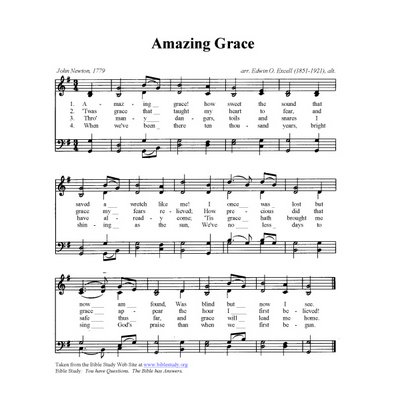
As the son’s breaths spaced farther apart, his dad’s hummed song became recognizable as the hymn of praise by John Newton, Amazing Grace.  The words started to form around the notes. At first his dad was singing alone, giving this gift to his son as he passed, and then his mom joined in as well. His sisters wept. His friends didn’t know all the words but tried to sing through their tears. The chaplain helped when we stumbled, not knowing if we were getting it right, not ever having done anything like this before.

Amazing Grace, how sweet the sound,
That saved a wretch like me.
I once was lost but now am found,
Was blind, but now I see.

Through many dangers, toils and snares
I have already come;
‘Tis Grace that brought me safe thus far
and Grace will lead me home.

Yea, when this flesh and heart shall fail,
And mortal life shall cease,
I shall possess within the veil,
A life of joy and peace.

When we’ve been here ten thousand years
Bright shining as the sun.
We’ve no less days to sing God’s praise
Than when we’ve first begun.

And he left us.

His mom hugged each sobbing person there–the young friends, the nurses, the doctors humbled by a powerful pathogen. She thanked each one for being present for his death, for their vigil kept through the week in the hospital.

This young man, now lost to this life, had profoundly touched people in a way he could not have ever predicted or expected. His parents’ grief, so gracious and giving to the young people who had never confronted death before, remains unforgettable.

This was their sacred gift to their son so Grace can lead us home.

Rest Assured

rise6

(originally written New Year’s Day 2007 and adapted for today, which is starting out far more peacefully–at least so far…)

A split instant can change everything. We all know this, but to truly understand it is another thing. I think I must have been due for the lesson.

Things have been a bit busy on the farm during this past holiday week, in addition to our routine chores and work responsibilities. Add in family gatherings and potlucks with friends, more than usual church events, and the natural expected holiday increase in my hospital work in the drug and alcohol unit, and I have been feeling a bit stretched.

On New Year’s Eve I was at church helping get dinner ready for about four dozen people who were going to stay after worship service to see in the New Year together. I was late to get to the sanctuary to play piano for hymn singing and was hurrying in the dark between buildings when I took a misstep off the edge of the sidewalk and fell forward, crashing right into the concrete steps up to the church. I cracked my forehead a good one. I didn’t get knocked out, but my forehead bore an impressive dent. I had the impending sense of “I’m in trouble now” and fully expected to pass out, but I didn’t. My second thought was “I guess I won’t be playing piano because I’d bleed all over the keys” and then the third thought was “the emergency room doctors are going to think I was falling down drunk on New Year’s Eve.” Nope, stone cold sober~~ just incredibly klutzy. Thankfully I had help right away. My husband took me to the hospital where I got stitched up with some 30 sutures and no evidence of a skull fracture. The ER staff who I know very well because they call me regularly to care for their detox patients, teased me relentlessly about “one of the deepest forehead lacs seen yet on New Year’s Eve”. Needless to say today I have quite a headache and will have a pretty nasty scar that will add a few new lines to my forehead but am grateful that I didn’t do more damage to myself.

Once I got home from ER, thinking the worst was over, my husband and two out of three kids started in with vomiting and diarrhea during the night. I have to say this is impeccable timing for the stomach virus that has been passing through our community to hit our family and they are all still miserably sick. I sit here wondering when my turn is coming. Happy New Year!

Times like this require a sense of humor and some perspective about the potential reasons why I needed a knock on the head:

This incident has proven that I am as hard headed as people regularly describe me. Concrete did not win against this noggin. I’m ashamed to say I’ll be even prouder now about my thick skull.

The plastic surgeon told me he’d need to stretch my skin on my forehead a bit to create an even wound closure, so when I raise my eyebrows or furrow my brow, I won’t have the same number of symmetric wrinkles once it is healed. Ah, too bad. He offered to stretch up the other side too while he was at it and I turned him down flat. In fact he told me to not furrow or raise my eyebrow while it is healing–hah, try that for a day under these circumstances!

I knew there was a reason I still wear bangs at age 52. Now I have justification.

This proves that it doesn’t take being under the influence to do something this stupid, unless the “influence” is congenital awkwardness.

Okay, I can try to make light of it but it is not always possible to understand how a split second can change a life, or even take a life. I am just not able to wrap my brain, protected as it is by my thick skull, around how bad things can happen to us when we least expect them. I do know that my travails are puny and pitiful compared to what some people face every day. My sister’s husband died instantly falling off a ladder last August. A good friend was hit from behind while biking home from work, and is now, months later, only beginning to walk again.

I got off easily with a bruised swollen face.

My son Nate showed me lyrics to a song his college choir sung in concert recently, written by a perfectly healthy 24 year old high school music director, Layton DeVries, from Lansing, Michigan a few weeks before he died as a result of injuries in a car accident. He could never have known what was coming so soon for him, yet he had an understanding far beyond his years. I am grateful to Layton that his words are reassuring to me this morning, the first rather traumatic day of a New Year which is blessed despite all that is happening to me and around me.

“O child, child of God, rest assured, the Lord is with you.
When you wake up in the morning and the sun is shining down, the Lord watches over every step you take.
When the world has knocked you down and you don’t know which way to turn, rest assured, the Lord is with you.
When your friends have turned against you and you feel all alone, the Lord watches over every move you make.
He will always be right there to protect and love his child, rest assured, the Lord is with you.
When darkness drifts around you, and your eyes close in sleep, the Lord watches over every breath you take.
And when death comes near to bring you home, you have no need to fear.
Rest assured, the Lord is with you. “

Treading on Thin Ice

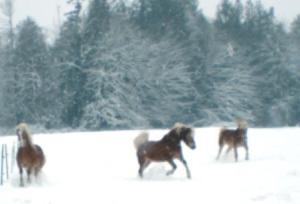
runsinsnowOur colder than customary winter in the Pacific Northwest has defied global warming trends worldwide.  We still have piles of snow drifts lying unmelted from our pre-Christmas storm, and day time temperatures only rose above freezing over the last 24 hours.  What that means is that we have superficial thawing during the day with rain showers, and then under a cover of fog and frost during the night, all is iced up again in the morning, making roads especially deceptive and treacherous.
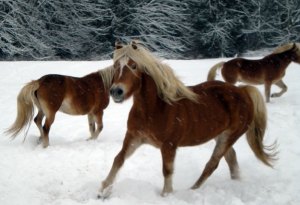
Our barnyard is no different.  The slabs around our barn have the same coating of black ice in the morning as the roads do.  In particular, the slab behind our hillside horse barn is the source from run off of rain and ground water from the fields sloping above it, streaming to the fields that lie below.  The slab can be a veritable river most rainy winter days, and it has been flowing actively over the last several warmer days.  However, it froze hard during the night, and became a sheet of very slippery ice by this morning.

This is a challenge for the Haflingers as they are allowed out for some fresh air in the fields while we clean their stalls.  All year they are accustomed to going from barn aisle to open gate without considering the footing over the slab, focused only on the green grass beyond rather than the journey required to get there, but mornings like this are a whole other story.

I know better than to try to lead a horse across the ice like this as my ability to stay upright is seriously compromised if I’m pushed off balance.  So the horses must navigate this 10 yards untethered to me and with only my verbal cautions as a guide.  I certainly fear a horse falling on the ice and being injured, especially my mares who are in late pregnancy.  Some of them listen and learn better than others.

Our 25 year old gelding is always cautious and careful.  He’s seen enough unpredictable situations over the years and knows to check things out before committing himself, so takes it easy over the slab and has no difficulty.  Our yearling colt is also wary as he does not always know what to expect from the world yet, so he stops, sniffs the ice, tentatively puts a foot out as a test run and minces his way across, skittering as his smaller hooves give him little traction but he remains on his feet.

Our two pregnant mares, normally impatient about getting to any source of food, are heavy bellied and move awkwardly in the best of circumstances these days, so they are not eager to take chances either.  They seem to know they are more vulnerable and move deliberately and ponderously, safely carrying themselves and their unborn foals over the hazardous footing with an air of great responsibility and I breathe much easier when they reach the field.

Not so cautious is our younger mare.  She is unencumbered by pregnancy, full of pent up energy from lack of steady work in winter, and fueled by hormones.  Nothing seems to really penetrate her brain aside from her own desires and urges–all that matters is what she wants right now!–so she rushes too fast once beyond the barn, does a little skating across the slab and woomph! lands butt first as her feet go out from under her.  Getting up isn’t easy when you have newly trimmed smooth hooves, so she gathers up what is left of her dignity and balance, and gets upright again, stands still for a moment assessing how to proceed and then with great care, full of  grace she lacked a few moments before, walks the rest of the distance to the gate.  A painful lesson in impulsivity and selfish desire.

I’m certainly at a more cautious time of my life myself.  I’ve been through more impulsive, selfish and impatient stages in my younger years and remember all too well disregarding the admonitions and cautions from wiser people than myself.  I had to land hard a few times to “get it”.  I still lapse now and then and find myself treading too fast on “thin ice” but it seems less often as I grow older and perhaps a bit wiser myself.  I find that I’m trying now to guide not just my horses across the ice, but certainly my children and my patients as they navigate the hazards in their lives.  A fall now and then is inevitable and through grace we are picked back up.  That teaches far more effectively than my words of caution ever can.

Nevertheless here is the advice I have, given my own slips and slides on the thin ice of life:

Proceed forward with courage and boldness, anticipating each step as new and unfamiliar.  Remember you carry more than just yourself–you carry your past, your future and indeed that present moment itself–as precious as the moment just past and the moment yet to come.  And when you may think you have “arrived”, you’ll find yet another journey, perhaps just as filled with the unknown,  is about to begin.  Tread lightly within that knowledge, rejoicing in the journey itself and the destination will take care of you when you finally find yourself safe on the other side.

snowplay2

Do Not Be Afraid

131218shepherds-watch-their-flocks-under-the-light-from-a-distant-star-near-bethlehem-israel-posters1

We’ve had a very blustery week of chilly snowy weather, with strong winds from the north, blowing branches off trees and anything not tied down. Our horses were out in their winter paddocks yesterday, as usual, and due to the fullness of the day’s activities, we didn’t get out to do chores until after dark to bring them in one by one.

The wind definitely changes everything once it is dark out, for us and for the horses. The familiar walk along the dark path from the paddocks to the barn, past several buildings, suddenly becomes spooky and more epic adventure than evening stroll. The wind whistles between the buildings, so everything sounds different than usual, and the blowing branches and goodness knows what else can appear threatening and menacing.

The horses’ eyes are big and bright with white as we walk in, and they jig and trot, glancing this way and that, clearly unnerved by the familiar becoming unfamiliar. They are uneasy and frightened, breathing hard and fast, and the younger ones are frankly terrified when a branch blows across their path, coming out of nowhere in the dark, and disappearing just as quickly. I talk to the horses as we walk, reassuring them, telling them there is no reason to be afraid, that there is nothing out here that will eat them or chase them, and they cock their ears back and forth, listening to me, then back to listening for that unknown “thing” out there that just might be ready to get them. If they had their ‘druthers, they’d be racing for the safety of the barn at full tilt, but that is not acceptable behavior, so they cope with being asked to stay close and walk alongside me.

Once in the barn, with muzzles into the feeders and eating their evening meal, their eyes soften again, and they relax, settling, knowing that they are safe and cared for and protected. A roll in the fresh shavings, a good shake and a huge snort of relief, and all is well. I can be easily unnerved too by the familiar suddenly becoming unfamiliar. I like to think I cope well with the unexpected, but it isn’t always the case, so I often need plenty of reassurance, and a steady voice beside me so I don’t get catastrophic in my fear.

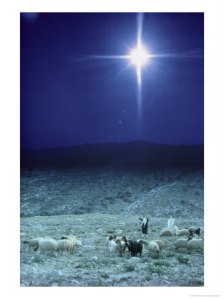
Sometimes, as a president so wisely implied years ago, our own fear becomes the thing we fear the most. And it need not be.This type of fear in the face of the unexpected happened years and years ago, to people who were society’s cast-offs, relegated to tending flocks as they had no other skill of value. They were the forgotten and the least of men. Yet what they saw and heard that Christmas night put them first, allowed them access that no one else had. Within the familiarity of their fields and flocks came this most unexpected and frightening experience, terrifying in its sheer “other worldliness”, and blinding in its grandeur. They must have been flattened with fear and terror.

And so the reassurance came: “Be not afraid”.

In the same way we whisper to our frightened horses and hold them close to us, so these shepherds were picked up, dusted off and sent on their way to the safety and familiar security of a barn, to see with their own eyes what they could not imagine. A baby born in so primitive a place, yet celebrated from the heavens. The least becomes first, and the first becomes the least.

Sometimes, in these dark times, our terror is for good reason, and we need to know where to seek our reassurance. It is there for us and always has been, walking beside us, speaking to us from a manger bed, feeding us when we are hungry and tending to us when we need it.

Merry Christmas and do not be afraid.