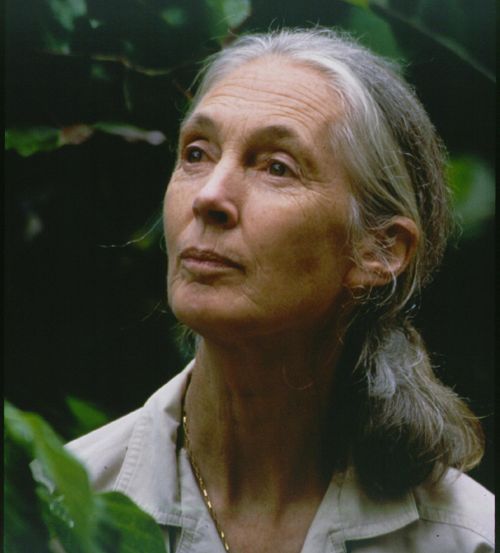
An Unusual Job Interview

goodall-jane

Standing outside a non-descript door in a long dark windowless hallway of offices at the Stanford Medical Center, I took a deep breath and swallowed several times to clear my dry throat. I hoped I had found the correct office, as there was only a number– no nameplate to confirm who was inside.

I was about to meet a childhood hero, someone whose every book I’d read and every TV documentary I had watched. I knocked with what I hoped was the right combination of assertiveness (“I want to be here to talk with you and prove my interest”) and humility (“I hope this is convenient for you as I don’t want to intrude”). I heard a soft voice on the other side say “Come in” so I slowly opened the door.

It was a bit like going through the wardrobe to enter Narnia.  Bright sunlight streamed into the dark hallway as I stepped over the threshold. Squinting, I stepped inside and quickly shut the door behind me as I realized there were at least four birds flying about the room.  They were taking off and landing, hopping about feeding on bird seed on the office floor and on the window sill. The windows were flung wide open with a spring breeze rustling papers on the desk. The birds were very happy occupying the sparsely furnished room, which contained only one desk, two chairs and Dr. Jane Goodall.

She stood up and extended her hand to me, saying, quite unnecessarily, “Hello, I’m Jane” and offered me the other chair when I told her my name. She was slighter than she appeared when speaking up at a lectern, or on film. Sitting back down at her desk, she busied herself reading and marking her papers, seemingly occupied and not to be disturbed.  It was as if I was not there at all.

It was disorienting. In the middle of a bustling urban office complex containing nothing resembling plants or a natural environment, I had unexpectedly stepped into a bird sanctuary instead of sitting down for a job interview. I wasn’t sure what I was supposed to do or say. Jane didn’t really ever look directly at me, yet I was clearly being observed. So I waited, watching the birds making themselves at home in her office, and slowly feeling at home myself. I felt my tight muscles start to relax and I loosened my grip on the arms of the chair.

There was silence except for the twittering of the finches as they flew about our heads.

After awhile she spoke, her eyes still perusing papers: “It is the only way I can tolerate being here for any length of time. They keep me company. But don’t tell anyone; the people here would think this is rather unsanitary.”

I said the only thing I could think of: “I think it is magical.  It reminds me of home.”

Only then did she look at me. “Now tell me why you’d like to come work at Gombe…”

The next day I received a note from her letting me know I was accepted for the research assistantship. I had proven I could sit silently and expectantly, waiting for something, or perhaps nothing at all, to happen.  For a farm girl who never before traveled outside the United States, I was about to embark on an adventure far beyond the barnyard.
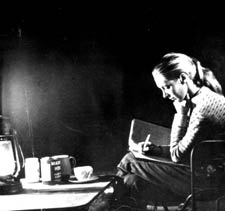
Jane_lantern

Distant Relations

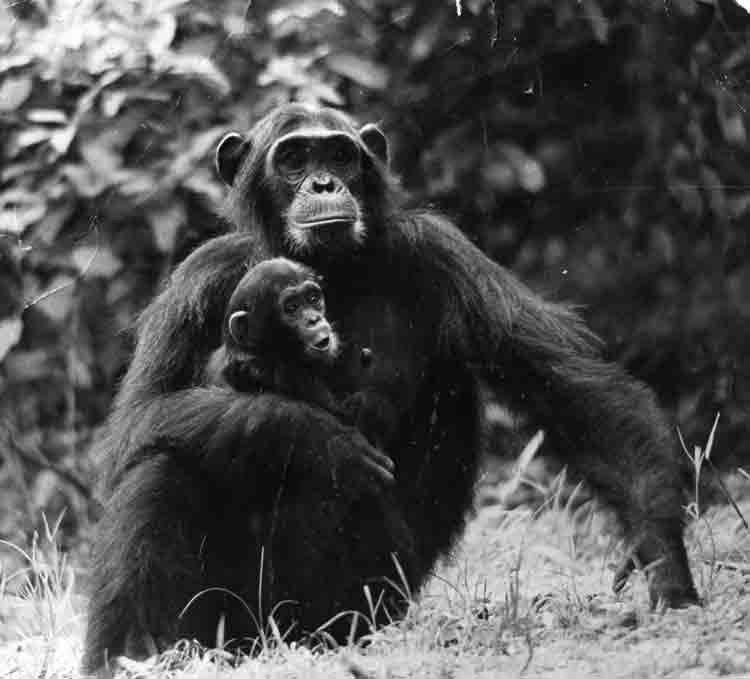
Sparrow and baby Sandi, from original photo by Larry Goldman taken in 1974

It was a routine day in April 1975–as routine as a day spent in central Africa studying wild chimpanzees could be. I awakened before dawn to join up with Rugema, one of the Tanzanian rangers/guides, to follow a chimp mother with her 3 year old and 8 year old offspring on their travels for the day, recording their location and activities every minute on a check sheet and into my tape recorder, to be transcribed later on return to camp in the dark.

Our target chimpanzees were nested high in a tree atop the ridge called “Sleeping Buffalo” a sloping rounded back mountain which rises abruptly from the shore of glistening Lake Tanganyika. Arriving at the nest before the first light of dawn, we sat beneath the tree, waiting for the chimps to stir as the tropical forest awoke before our eyes. It was as if we beheld the dawning of the First Morning. The forest of verdant greens unfurled to the touch of the sun, highlighting spots of brightly colored fruit and flowers. The pungent smell of moist earth mixed with the musk of animal scent and fragrance of foliage.

There is a strong undercurrent of life flowing in such a forest–everywhere there are living creatures above and below, breathing a collective breath, vocalizing in collective voices from the liquid tones of tropical birds to the barking “wahoo” of the baboon. Each individual breath, whisper, song, and call joins the others, until like the rushing streams of Gombe, they form a river of voices, overwhelming to the senses.

As the sunlight filtered through the foliage canopy high above our heads, the three chimpanzees moved in their nests. They rustled in their leafy bed as a chorus of chimpanzee voices was heard across the valley and up the next ridge—a clear invitation from afar.

Our targets raced down the tree and off into the brush to join their comrades. Able to follow only the vocalizations, we plunged after them, occasionally glimpsing the white tuft of hair on the baby’s bottom as he bobbed up and down, jockey-style on his mother’s back. Chimpanzees are expert at traveling through impenetrable thickets, leaving no trace of their whereabouts. I clamored slowly along, listening for the excited voices up the hill, as my shirt caught on countless thorns and vines reached to trip me. About the time I was ready to call it quits, I found myself atop the slope and was rewarded with a sight which made the hard climb well worth the struggle.

Above us and around us were no less than 25 chimpanzees from various interrelated families: brothers, sisters, aunts, uncles, cousins, celebrating an early morning extended family reunion amidst heavily fruited trees with a tremendous din of shrieks and hoots. They jumped from branch to branch, slid fireman style down tree trunks only to race back up again, shaking and breaking off pieces of foliage in their excitement.

As they settled into smaller feeding groups, sitting happily in small circles eating fruit and lazily grooming each other’s fur, I realized how similar their gathering was to the family reunions I attended at home. There would always be lots of hugs and excitement as family members arrive and greet one another, sometimes quite noisily with shouts and claps on the back. Children would run together as reacquainted cousins skirmished and played. The adults would settle into smaller conversational groups to compare lives and reestablish life long bonds, in essence “grooming” each other emotionally as they offered support and advice.

I realized this particular morning in Tanzania was a reunion I could only observe rather than participate in, not being a member of this particular family, although a few of these apes looked awfully similar to people I loved back home. As I pondered that thought, I felt a clunk on the head from behind and realized something or someone had clobbered me with a branch from a tree. I turned around to see a grinning adolescent male chimp, wielding a leafy branch. He was about to wallop me again. At that moment he really did remind me of my brother.

I left that observation out of my written report that night. Months later when I returned home I told my brother I was sure I’d met a distant relation of his in Africa. He reminded me that any relative of his would be a relative of mine. Right.

So it seems we’re all just one big extended happy family.

Train to Kigoma–1975

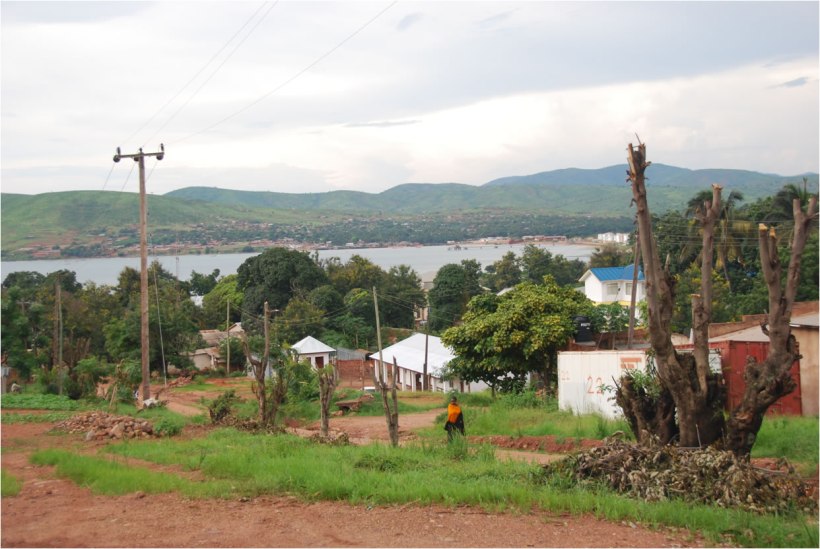
kigoma

view of Kigoma, Tanzania on http://www.fairmarket.com

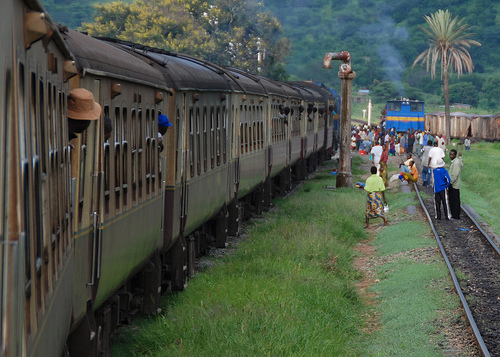
1392777855_c20b88c3a4 www.flickr.com/photos/hansecoloursmay/1392777855

A steam locomotive and passenger cars
Left over from British colonial days
Crosses central Africa daily;
Dar Es Salaam to Kigoma
From Indian Ocean to western shore of Lake Tanganyika
Carrying hundreds of Tanzanians
And four white Americans.

We depart on time, four hours late, whistle blowing,
A party atmosphere in third class.
Rows of benches with families
Spreading cloths, to sit together
Swapping meals and Swahili wisdom,
Singing and clapping
In celebration of easy mobility.

Seated on the outdoor platform
Between cars, I feel the humid air
Lighten and cool in the breeze
As the train makes its way through the plains;
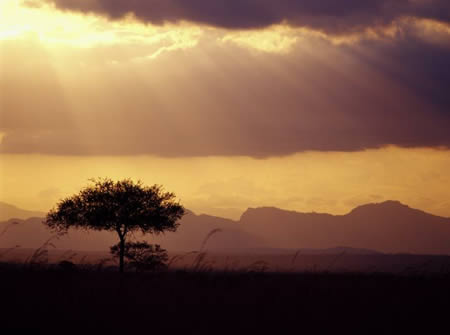
Flat topped trees scattered in silhouette,
Dust clouds camouflage herds of wildebeest
Giraffe move slow motion, stirred to run.

Ujamaa villagers walk alongside the tracks
Women carrying heavy bundles balanced
With perfection upon their heads,
Babies wrapped in slings on their backs.
Men hoe in meager corn rows, stop to
Look up longingly at the passing train.
Children wave and laugh and run alongside.

Stops may be a few metal huts
A smelly latrine hole in the ground
Or a modern station with platform
Waiting room and parking lot.
Dodoma–growing and ambitious
Tabora–vestiges of British rule
Still linger, clinging to the land.

Moving onward to reach Kigoma
A sleepy village on a hillside
Overlooking the world’s deepest lake
Of shining cichlids and snapping crocodiles,
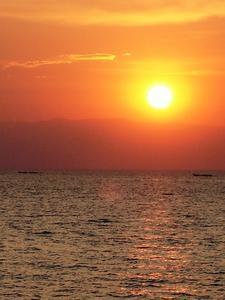
Miracle sunsets, then shimmering fisherman boat lights,
Open markets and cattle herded
Through red dirt main street.

I breathe deeply of Africa
Hearing chiming birdsong of  liquid notes
The smells pungent and moist
Of chimpanzee musk, their tolerant gaze
As Americans stare, dazed, dazzled
At the spectacle of teeming life
In the multi-layered jungle.

It is a garden such as this
Where man began
It is plains such as this
Where man,  nomadic,  trudged, weary
It is land such as this
That blesses and curses,
Reclaiming always what has been taken away.

sunset126928-kigoma-sunset-1

Kigoma sunset found at www.travelblog.org/…/Tanzania/blog-26128.html