Out of the Routine

feather

There is safety in routine–predictable things happening in predictable ways, day after day, week after week, year after year.  Somehow, dull as it may seem, the “norm” is quite comforting, like each breath taken in and let go, each heart beat following the next. We depend on it, take it for granted, forget it until something doesn’t go as it should.

Mornings are very routine for me.  I wake before the alarm, usually by 5:30 AM, fire up the computer and turn the stove on to get my coffee water boiling.  I head down the driveway to fetch the paper, either feeling my way in the dark if it is winter, or squinting at the glare of early morning sunlight if it is not.  I make my morning coffee, check my emails, eat my share of whole grains while reading the paper, climb into my rubber boots and head out for chores.

The same Haflinger voices greet me in the barn every morning, and I let our stallion in from his night outside in the pasture.  He has his rituals too.  We must do them together or nothing is quite right the rest of the day.   He must inspect every corner of the enclosed area between pasture and barn door, marking each spot with urine or manure that he marked just 12 hours previously, 24 hours previously, 36 hours previously.  Same spots, same marking to declare this “his” territory.  He reinspects all of them one more time to make sure they smell just as they should and then content, he’s ready to come into his daytime stall and paddock while the rest of the horses go out for the day.

If I’m in a hurry and try to disrupt or speed up his morning routine, he is gracious about it but clearly it makes him grumpy and out of sorts.  That evening, he’ll take the extra time to check every thing three times because I didn’t allow him his routine two checks in the morning.  He’s truly obsessive compulsive to the point of an empty bladder and no more manure to be had.  He simply goes through the motions, even though he has exhausted his “marking” supply.  I can’t help but chuckle at the futility, but realize that this comforts him, gives him a sense of control and command.  I’m really no different at all, emptying myself out in all kinds of futile rituals to give me a sense of “control”.

The other morning, as I was leading a mare and her colt out to our large outdoor arena for their daytime turnout, I was whistling to the wandering colt as he had his own ideas about where he wanted to be, and it wasn’t where I was leading.  He was bucking the routine that his daddy so treasures, but in his young rebellion, was straying too far away from his mother who also called for him.  50 yards away, he decided he was beyond his comfort zone so whirled around, sped back to his mom and me, and traveling too fast to get the brakes on ended up body slamming her on her right side, putting her off balance and she side stepped toward me, landing one very sizeable Haflinger hoof directly on my rubber booted foot.  Hard.  Oh my.  I said some words I’ll not repeat here.

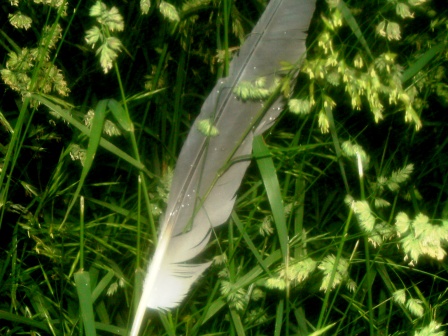
I hobbled my way with them to the arena, let them go, closed the gate and then pulled my boot off to see my very scrunched looking toes, puffing up and throbbing.  I still had more horses to move, so I started to limp back to the barn, biting my lip and thinking “this is no big deal, this is just a little inconvenience, this will feel better in the next few minutes”  but each step suggested otherwise.  I was getting crankier by the second when I passed beneath one of our big evergreen trees near the arena and  noticed something I would not have noticed if I hadn’t been staring down at my poor sore foot.  An eagle feather, dew covered, was lodged in the tall grass beneath the tree, dropped there as a bald eagle had lifted its wings to fly off from the tree top, probably to dive down to grab one of the many wild bunnies that race across the open arena, each vulnerable to the raptors that know this spot as a good place for lunch .  The wing feather lay there glistening, marking the spot, possessing the tree, claiming the land, owning our farm.  It belonged there and I did not–in fact I can’t even legally keep this feather–the law says I’m to leave it where I find it or turn it over to the federal government.

I am simply a visitor on this acreage, too often numbly going through my morning routine, accomplishing my chores for the few years I am here until I’m too old or crippled to continue. The eagles will always be here as long as the trees and potential lunches remain to attract them.

Contemplating my tenure on this earth, my toes don’t hurt much anymore.  I am reminded  that nothing truly is routine about daily life, it is gifted to us as a feather from heaven, floating down to us in ways we could never expect nor deserve.   I’d been body slammed that morning all right, but by the touch of a feather.  Bruised and broken but then built up, carried and sustained.  Even pain brings revelation.  Sometimes it is the only thing that does.
Cast Your Cares

asset_upload_file707_2983-1In late May, on our farm,  there is only a brief period of utter silence during the dark of the night.  Up until about 2 AM, the spring peepers are croaking and chorusing vigorously in our ponds and wetlands, and around 4 AM the diverse bird song begins in the many tall trees surrounding the house and barnyard.
In between those bookend symphonies is stillness–usually.

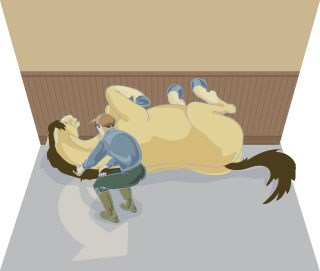
I woke too early this morning aware of something being unstill.  It was an intermittent banging, coming from the barn.  I lay in bed, trying to discern the middle of the night noise that could be a sign of a major problem, like a horse stuck up against a stall wall or “cast” in horseman’s parlance,  or simply one of my water-bucket-banging youngsters who enjoys nocturnal percussion.

This was not sounding like a bucket drum set.  It was emphatic hooves frantically banging against metal walls.

Throwing on sweats and boots, I head out the back door into the mere light of pre-dawn, dewy, with the birds just starting to rouse from sleep, the floral perfume of lingering apple blossoms heavy in the air.  Entering the barn, I throw on the lights and start to count the noses I can see in the stalls as I walk down the aisle~all present and accounted for until I get to the very end of the row.  No nose.   Down in the corner is our eleven year old mare on her side, too close to the wall, her feet askew up against the boards and metal siding.  She nickered low to me, and my entering the stall sent her into a renewed effort to right herself, but all she could do was scrabble against the wall, digging an even bigger hole beneath her body.

This has happened infrequently over our 25 years of owning horses, usually when a horse is rolling to scratch their back and rolls too close to the wall, and becomes lodged there.  Haflingers, who have a fairly round conformation, are a bit prone to being cast.  Our older barn,  with dirt floors, is particularly likely to having this happen, as depressions in the floor where horses have been digging end up becoming deeper and trap a hapless horse that was nonchalantly rolling.  The horse literally is trapped like a turtle on its back.

Righting a 1000 lb. horse that is frantically flailing and struggling is not a particularly easy or safe task.  Thankfully Haflingers tend to be pretty sensible in this situation and will calm when spoken to and reassured.  I looped a rope around each lower leg, and with my tall strong son’s help, we were able to pull her back over and then jump out of the way quickly.  She got up, shook herself off and immediately asked for breakfast–a good sign this was not a horse in distress or colicking with abdominal pain.

So my day started early.

I hope when I find myself trapped in a hole of my own making, when I’ve been careless about watching where I’m heading and find myself helpless and hopeless with no where to turn, someone will hear my struggles and come rescue me.  I promise not to kick out or bite,  but to wait patiently, in gratitude, for such gracious liberation.   My cares will be cast upon my rescuer.

And then please, feed me breakfast.

Back Home and Herd Bound

marlee93002marleemb2marlee95

Marlee came home on May Day.  She had been gone for 5 years, helping “raise” a preteen girl who did beautifully with her but whose family circumstances sadly have changed, so it was our decision to buy Marlee back.  My daughter Lea had the best ride of her life on her this morning;  this mare has such a remarkable work ethic, is “fine-tuned” so perfectly with a sensitivity to cues–Lea said:  “Mom, it’s going to make me such a better rider because I know she pays attention to everything I do with my body–whether my heels are down, whether I’m sitting up straight or not.”  Marlee is, to put it simply,  trained to train her riders.

Marlee M&B came to us as a six month old “runty orphan” baby by the lovely stallion Sterling Silver,  but she was suddenly weaned at three days when her mama Melissa died of sepsis.  She never really weaned from her bottle/bucket feeding humans Stefan and Andrea Bundshuh at M&B Farm in Canada. From them she knew people’s behavior, learned their nonverbal language, and understood human subtleties that most horses never learn. This made her quite a challenge as a youngster as it also meant there was no natural reserve nor natural respect for people. She had no boundaries taught by a mother, so we tried to teach her the proper social cues.

When turned out with the herd as a youngster, she was completely clueless–she’d approach the dominant alpha mare incorrectly, without proper submission, get herself bitten and kicked and was the bottom of the social heap for years, a lonesome little filly with few friends and very few social skills. She had never learned submission with people either, and had to have many remedial lessons on her training path. Once she was a mature working mare, her relationship with people markedly improved as there was structure to her work and predictability for her, and after having her own foals, she picked up cues and signals that helped her keep her foal safe, though she has always been one of our most relaxed “do whatever you need to do” mothers when we handle her foals as she simply never learned that she needed to be concerned.

Over the years, as the herd has changed, Marlee became the alpha mare, largely by default and seniority, so I don’t believe she really trusted her position as “real”. She tended to bully, and react too quickly out of her own insecurity about her inherited position. She was very skilled with her ears but she was also a master at the tail “whip” and the tensed upper lip–no teeth, just a slight wrinkling of the lip.  The herd scattered when they saw her face change.  The irony of it all is that when she was  “on top” of the herd hierarchy, she was more lonely than when she was at the bottom. And I  think a whole lot less happy as she had few grooming partners any more.

The day she started formal under saddle training was when the light bulb went off in her head–this was a job she could do! This was constant communication and interaction with a human being, which she craved! This was what she was meant for! And she thrived under saddle, advancing quickly in her skills, almost too fast, as she wanted so much to please her trainer.

She has had a still unequaled record among North American Haflingers. She was not only regional champion in her beginner novice division of eventing as a pregnant 5 year old, but also received USDF Horse of the Year awards in First and Second Level dressage that year as the highest scoring Haflinger.

She’s had a career of mothering along with intermittent riding work ever since, with 5 foals –Winterstraum, Marquisse, Myst, Wintermond, and Nordstrom—each from different stallions, and each very different from one another.

And now she is back to train another rider, and be part of a Haflinger herd again. I’m curious how she will cope once I turn her out with two mares she previously dominated, but who now have their own little coalition of bonding she must break through.  I think they are curious too, eyeing her across the paddock fence.  When we took her away from them to be ridden, she cried as if we had separated her from her best forever friends.  “Herd bound” now that she is back among a group of golden horses like herself.

Welcome back, Miss Marlee.  We’ve missed your sweet face and the smiles you bring.

n1207615738_30456334_5876983

marleeshow4

marleeshow11

marlee970011

Visitors on a Spring Evening

colorful_hot_air_balloonFingers of twilight shadow
Begin to reach over the hill
Crawling down through the field
Up unto the bank of blackberries
Covering fences along the alder grove.

The Haflingers chew their last
Leaves of clover before
Coming to the barn for night, eyelids heavy,
Relaxed and full, drowsy with spring evening
Peace at hand and hoof.

A sudden change in the air forces
Their heads up and ears forward;
They form a line, staring at the hilltop
Above them, riveted to the spot, alert
To the coming intruder, unfamiliar and foreign.

The roar is intermittent, like a warm wind
Rattling a barn roof, but inconstant;
Then peaking over the crest of the hill
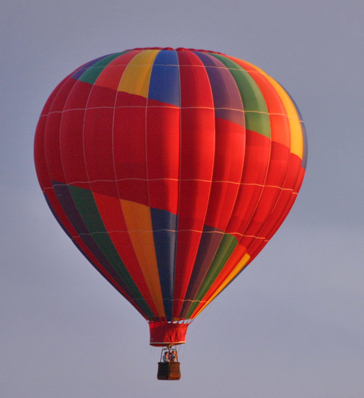
A rounded top of technicolor glory:
The hot air balloon rises.

The horses silenced, baffled, fascinated;
No alpine instinct prepares their response
To this wizard’s act from Oz in their own backyard.
The basket riders wave and laugh at the equine audience below
In formation with golden noses in the air and white manes blowing in the breeze.

The balloon summits the hill, dipping low, almost touchable
Before moving back up to race the sunset,
And search out other pastures, other valleys and hills.
The horses released from the spell
Leap in response, snowy tails high, noses flared-

To race up the hill to catch impending darkness,
Dream mares cavort, float suspended
Until their air is let out, gently, in softening snorts,
To settle down in a shavings bed in the barn
Where night, blissful, becomes ordinary again.

Mountain Lions in the Shadows

meetandgreet

Published in Country Magazine 2007

Chores at our farm are rarely routine since our batch of four male kittens were born 6 months ago. They were delivered unceremoniously in the corner of one of the horse stalls by their young mother whose spontaneous adoption we accepted a mere four weeks before, not realizing we were accepting five kitties, not just one.

They were born under a Haflinger’s nose, and amazingly survived the ordeal and managed to stay safe until the next day when we came in to clean and discovered them warming near a nice fresh pile of poop. What a birthing spot this mama had chosen. Thankfully Haflingers are tolerant about sharing their space as long as you don’t ask for a share of their food too…

We moved them and mama to a safer spot in the barn, away from big Haflinger feet, and they thrived, getting more adventuresome by the week, until they are now in full adolescent glory, mock fighting with each other, scrambling up and down the hay bales, using the shavings as their personal litter box, doing rodent patrol, and most of all, strolling along the shelves that line the stalls, breathing in the Haflinger smell, and rubbing their fur up against Haflinger noses through the wire. They are best of friends with these ponies in the light of day, as after all they were born right in a Haflinger bed.

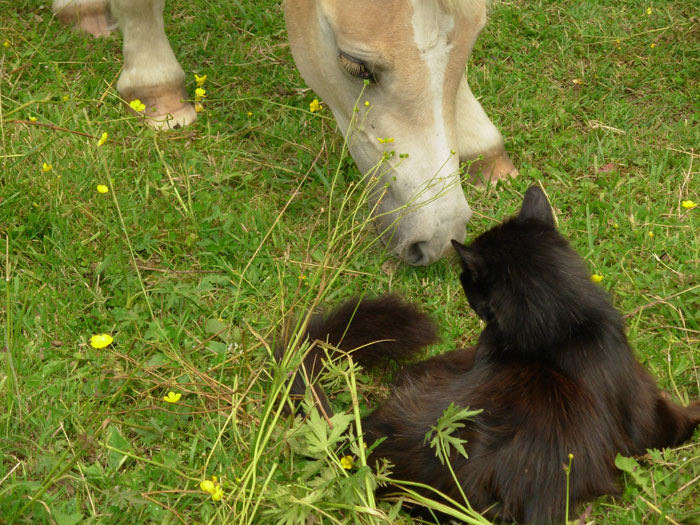
But at night it’s another story. Each evening as I come out to do chores after returning home from work, it is pitch dark and the Haflingers, out in their winter paddocks, must walk with me one by one back to their box stalls for the night. Only this is now far more of an adventure thanks to four cats who glory in stealth attacks in the dark, like mountain lions in the shadows, waiting for their prey to pass by.

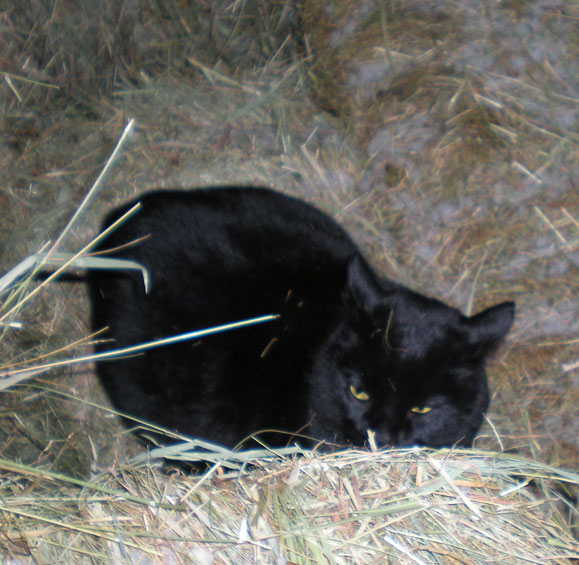
These rascals are two gray tabbies, one black and one gray, perfectly suited to be camouflaged in the northwest dim misty fall evenings along a barely lit pathway between paddocks and barn. They flatten themselves tight on the ground, just inches from where our feet will pass, and suddenly, they spring into the air as we approach, just looking for a reaction from either the horse or myself. It never fails to unnerve me, as I’m always anticipating and fearing the horse’s response to a surprise cat attack. Interestingly, the Haflingers, used to kitten antics all night long in the barn, are completely bored by the whole show, but when the tension from me as I tighten on the lead rope comes through to them, their head goes up and they sense there must be something to fear. Then the dancing on the lead rope begins, only because I’m the one with the fear transmitted like an electric current to the Haflinger. We do this four times along the path to the barn as four kittens lay in wait, one after another, just to torment me. By the end of bringing in eight horses, I’m done in by my own case of nerves.

You’d think I’d learn to stop fearing, and start laughing at these pranksters. They are hilarious in their hiding places, their attempts to “guard” the barn door from intruders, their occasional miscalculations that land them right in front of a hoof about to hit the ground. Why I haven’t had at least one squished kitten by now is beyond my comprehension. Yet they survive to torment me and delight me yet another night. I cuddle them after the horses are all put away, flopping them on their backs in my arms, and tickling their tummies and scolding them for their contribution to my increasing gray hair.

I’m a slow learner. These are like so many of my little daily fears, which seem to hide, blended in to the surroundings of my daily life, ready to spring at me without warning, looking like much bigger scarier things than they really are. I’m a highly skilled catastrophizer in the best of circumstances, and if I have a kitten sized worry, it becomes a mountain lion sized melodrama in no time. Only because I allow it to become so.

Stepping back, taking a deep breath, if I learn to laugh at the small stuff, then it won’t become a “cat”astrophe, now will it? If I can grab those fears, turn them over on their back and tickle their tummies until they purr, then I’m the one enjoying a good time.

I’ll try that the next time I feel that old familiar sensation of “what if?” making my muscles tense and my step quicken. I just might tolerate that walk in the dark a little better, whether it is the scary plane flight, the worry over a loved one’s health, the state of the economy, or the uncertainty of what tomorrow might bring.

I’ll know that behind that mountain lion is a soft loving purring fur ball, granting me relief from the mundane, for which I’m extremely grateful. Life is always an adventure, even if it is just a stroll down a barn lane in the dark wondering what might come at me next on the path.

stalking

Ode to Haflinger Noses

nose3

Not just because of the long wavy mane,
and bushy ringleted tail,
the feathers on the fetlocks,
the blackrimmed deep brown eyes,
topped with long curved lashes,
the glistening copper penny color,
the perfect parallel little ears,
the forelock that almost reaches to the upper lip….

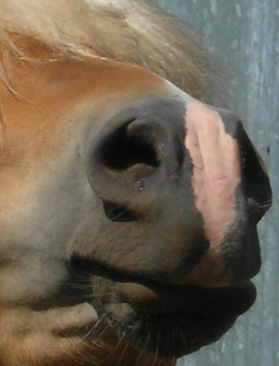
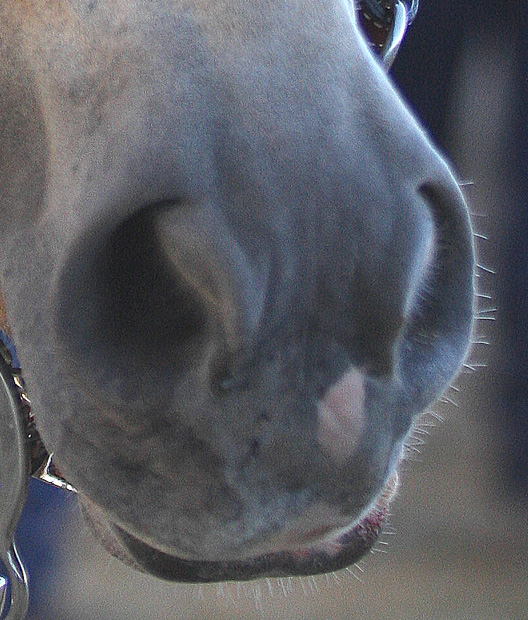
The real reason to have a Haflinger is because of its nose.

Pink noses,
gray noses,
nondescript not-sure-what-color noses,
noses that have white stripes, diamonds,  triangles,
or absolutely none at all.

Hot breath exuding warmth
better than pricey perfume,
lips softer than the most elegant velvet.

Noses reach out in greeting,
blow,
sniff,
nuzzle,
caress,
push,
search,

smudge faces and
shower snot.

Irresistible.

Everyone needs
at least one,
….maybe more…

nose4

Finding Her Way Home

schweisgut5

scweisgut4

Papa had been sick for a week. His cough shook our little house, perched as it was in a clearing a hundred yards from a rocky shelf high in the Tyrolian Alps.

Mama was so worried, her face hollow with lack of sleep. She sponged his face with cool water melted from the snow outside.

“Pieter, we must have medicine for your Papa, “ she murmured as she rubbed his legs with liniment to warm them.

“Mama, I can go to the village to the apothecary and bring back what you need.” I said confidently. “They’ll know what will help him.”

“It is such a hard trip this time of year, Pieter. You are only fourteen and there are storms…”

“I know, Mama, I’ll have Dalia to lead me. She will know the way.”

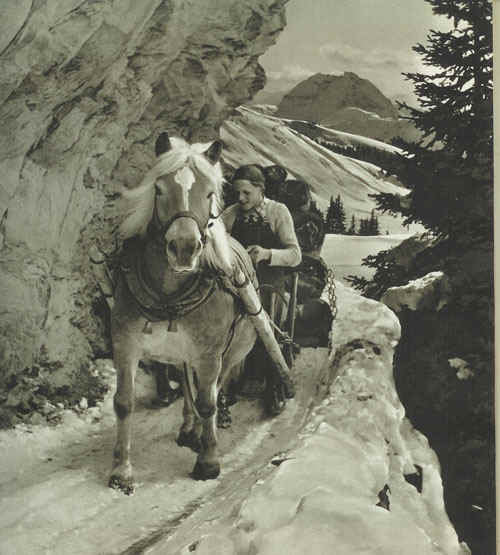
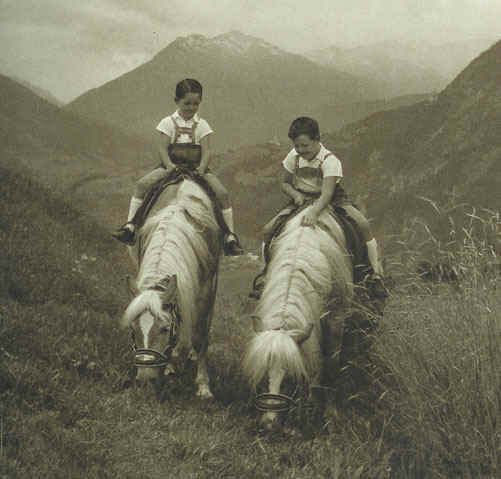
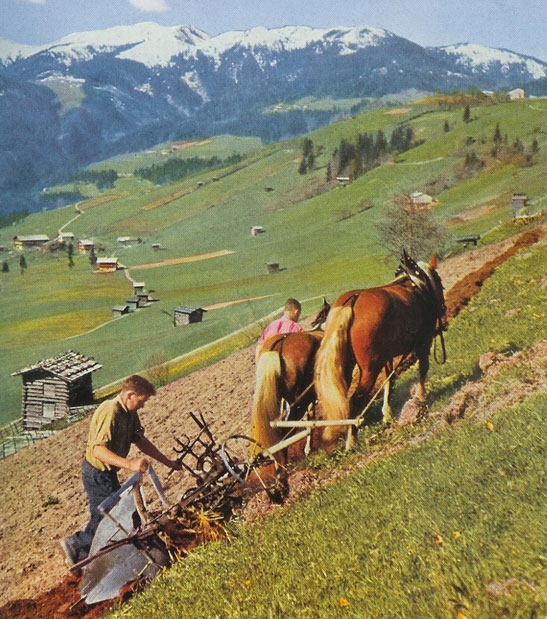
Dalia is our Haflinger mare. She is a sturdy mountain pony, bred in the Alps for just this kind of task– able to pull loads with harness for us, plow the rocky ground, pack with heavy weight on her back, provide warm milk when our cow is dry. Her golden coat glistens in the summer sun, and her heavy wavy white mane and tail are protection against the wintry winds. She is my Papa’s work partner, carrying his wood carvings to the village to sell, and bringing our supplies back on her back. Dalia takes me for rides across the mountain meadows of edelweiss in the spring, and skijoring in the autumn snows.

I harnessed her to the sled and Mama packed a lunch of cheese and bread for me, with a jug of milk. The November day was cloudy, but no new snow had fallen for several days, so we found the trail easily down the mountain path. Dalia picked her way carefully along the ledge, her surefooted amble brisk. I whistled to her and her copper ears flicked back and forth as she listened to my tune.

We reached the village in an hour where our package was quickly assembled and tied onto the sled, and I picked up supplies at the market.

It was time to head back, shortly after noon. I gazed up at the Alpen peaks high above the village, knowing our trip home would take at least twice as long with the steep climb up the trail.

Dalia was eager. She knew the trail home meant returning to her little stall in the snug barn next to the house, and to her 6 month old filly. Dalia leaned into the collar of the harness, pulling the sled up the trail as I sat, reins in hand, not needing to tell her where to go.

The clouds grew heavier and more threatening as we climbed. I urged little Dalia onward, hoping to get home before the snow started. It wasn’t long before the flakes started to fall, first heavy and lazy, and soon blowing wildly around our heads.

“Dalia, walk on!” She tugged harder, willing to try to go faster up the trail.

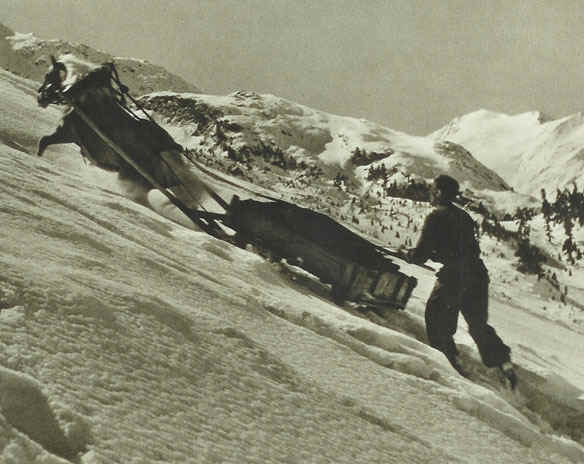
It soon was white everywhere around us and the snow was deepening by the minute, forcing Dalia to wade through up to her knees. I got off the sled and walked beside her. There was no longer a visible trail, and I began to worry we would lose our way in the blinding snow. I had to trust my brave little Haflinger.

She was soon up to her chest in the snow, pushing her way through, lunging at times to cross drifts. I hung onto her side, clinging to the harness leather, praying she would have the strength to go on despite the bite of the wind.

It seemed as if we were making no progress at all. The sun had gone down, the cold so bitter I could no longer feel my hands or feet. Dalia suddenly stopped, her sides heaving hard. She had brought us to the door of our little house, the oil lamp burning bright through the window.

Mama rushed to the door. “Pieter! You made it back! Praise God!”

“Yes, Mama. I’m back. Praise God and praise our Dalia. She found her way home as I would have been lost in the snow.”

I gave Mama the medicine for Papa, and I took Dalia to the barn for warm bran mash and hay from the summer meadows where she and I would someday ride again. And before long Papa will plow, and carve, and harvest again, thanks to our special Haflinger.
photos from Otto Schweisgut’s books “Haflinger Horses”  published in the 1950s and 1960s.

schweisgut1

scweisgut3

schweisgut2

Wanderlust

musk1

Haflingers must have a migration center in their brain that tells them that it is time to move on to other territory, a move based on quality of forage, the seasons, or maybe simply a sudden urge for a change in scenery. I imagine, over hundreds of years of living in the rather sparse Alpen meadows, they needed to move on to another feeding area enmasse on a pretty regular basis, or if the weather was starting to get crummy. Or perhaps the next valley over had a better view, who knows? Trouble is, my Haflingers seem to have the desire to “move to other pastures” even if the grass in their own territory is plentiful and the view is great. And there doesn’t seem to be much in the way of natural or man-made barrier that will discourage them.

I have a trio of yearlings (the “Three Musketeers”) who are particularly afflicted with wanderlust. There is not a field yet that has held them when they decide together that it is time to move on. We are a hotwire and white tape fenced farm–something that has worked fairly well over the years, as it is inexpensive, easily repaired and best of all, easily moved if we need to change the fencing arrangement in our pasture rotation between six different 2 acre pastures. Previous generations of Haflingers have tested the hotwire and learned not to bother it again. No problem. But not the Three Musketeers.

They know when the wire is grounding out somewhere, so the current is low. They know when the weather is so dry that the conduction is poor through the wire. They know when I’ve absent mindedly left the fencer unplugged because I’ve had someone visit and we wanted to climb unshocked through the fences to walk from field to field. These three actually have little conferences out in the field together about this–I’ve seen them huddled together, discussing their strategy, and fifteen minutes later, I’ll look out my kitchen window and they are in another field altogether and the wire and tape is strewn everywhere and there’s not a mark on any of them. Even more mysteriously, often I can’t really tell where they made their escape as they leave no trace–I think one holds up the top wire with his teeth and the others carefully step over the bottom wire. I’m convinced they do this just to make me crazy.

Last night, when I brought them in from a totally different field from where they had started in the morning, they all smirked at me as they marched to their stalls as if to say, “guess what you have waiting for you out there.” It was too dark to survey the damage last night but I got up extra early to check it out this morning before I turned them out again.

Sure enough, in the back corner of the field they had been put in yesterday morning, (which has plenty of grass), the tape had been stretched, but not broken, and the wires popped off their insulators and dragging on the ground and in a huge tangled mass. I enjoyed 45 minutes of Pacific Northwest foggy morning putting it all back together. Then I put them out in the field they had escaped to last night, thinking, “okay, if you like this field so well, this is where you’ll stay”.

Tonight, they were back in the first field where they started out yesterday morning. Just to make me crazy. They are thoroughly enjoying this sport. I’m ready to buy a grand poobah mega-wattage fry-their-whiskers fence charger.

But then, I’d be spoiling their fun and their travels. As long as they stay off the road, out of my flowers, and out of my kitchen, they can have the run of the place. I too remember being adolescent, long long ago, and wanting to see the big wide world, no matter what obstacles had to be overcome or shocks I had to endure to get there. And I got there after all that trouble and effort and realized that home was really where I wanted to be. Now, prying me away from my little corner of the world gets more difficult every year. I hope my yearling trio will eventually decide that staying home is the best thing after all.

must

Caritas

written originally in early March 2007

aktuell

We are all waiting for winter to be finished with us.  Instead it is snowing and blowing, ruining our dreams of spring and reminding us once again we have no control over the elements.  Cars were upside down in the ditches yesterday morning following a night of snow and freezing rain, and trying to accelerate up hill after a red stop light turned green was an exercise in futility.  I could have made it to work faster by hiking.

Not only the blustery out of doors has us in a strangle hold.  There are the winter viruses controlling everything inside our skin.  Workload at my clinic has doubled during influenza season, so I’m relegated to seeing patients in 10 minute slots to try to see everyone who is triaged.  There is little opportunity to provide much more than very basic assessment and advice and a moment of eye contact, a hand on the shoulder and reassurance that “this too will pass”.   After all, there is not much else a physician can do for the influenza patients who drag themselves out of bed finally on the third day of their illness, wondering what hit them like a truck.  We can only commiserate and advocate for signing up for next season’s flu vaccine 9 months from now.  Am I really doing much of value?  Some days I’m not so sure.  Yet I return each day to my work because I am needed by others, whether I make a difference that day or not.  It is what I am called to do– this caritas of the spirit.

When work load off the farm is this heavy, there is little that happens at home except basic daily maintenance.  The kitchen floor gets mopped less frequently, the laundry pile grows higher and the vacuum stays idle, but the barn chores continue unchanged.  It is my cherished routine to head to the barn in the dark of a winter’s morning and turn on the lights, and 7 pairs of Haflinger eyes blink and 7 Haflinger voices rumble greetings.  I am truly anticipated and appreciated and I have a clear task that I do that will make a difference.  Last summer’s hay bales are broken open and the fragrance of the clover and timothy fields is as grand as my morning cup of coffee.  I cradle the hay flakes to each expectant horse and they nod and bow in gratitude when I open their door.  Their buckets are filled with fresh clean water and they drink gratefully and deeply.  I share with each horse a moment of eye contact, a scratch on the wither and the reassurance that I will return at the end of the day to repeat our ritual and prepare their beds for the night.  And then I am gone, leaving the radio to play “oldies” to them while the weather rages outside.  I am needed and it is what I am called to do–this horse keeping.

Remarkably, the crocuses are up through the snow, the snowdrops are flourishing and the orchard trees are beginning to swell their buds.  Bird song is plentiful in the frozen mornings, with far more variety than a month ago.  There will be a spring coming soon, despite how things feel to me now.   This exhaustion will be replaced by renewal and the fresh air will be filled soon with the sweetness of cherry and apple blossoms.  The fields will grow lush and soft  and the sun will be warm on my horses’ withers once again.  And I will celebrate the defeat of winter once again.

Tied in Knots

n707166118_2259849_2297

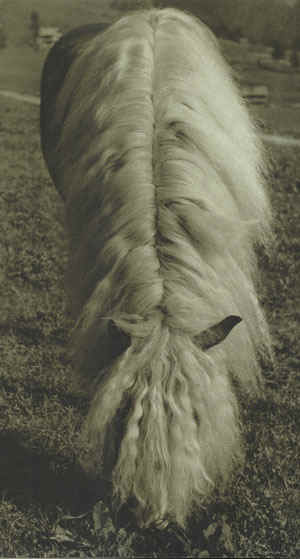
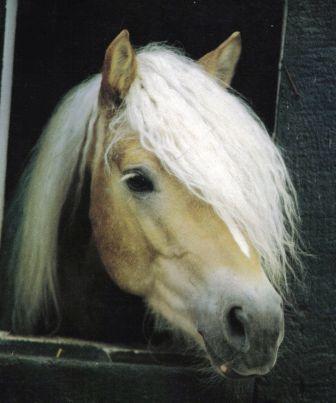
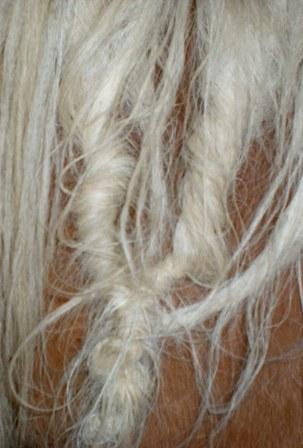
One of my favorite things about my Haflinger horses is their long lovely manes–the whiter, and wavier, the better. I enjoy everything about that long hair — except sometimes the maintenance involved. It usually doesn’t take a lot of fuss, but this time of year, when the air is moist and there is frequent rainfall, I find that those long manes come in from the fields all a-tangle and frequently in elaborate tight knots. Not just uncombed dreadlocks, but tight, cinched up and truly snarled knots.

I have two theories about how these knots and tangles happen: Most likely, I suspect the Haflingers tend to toss their heads and shake their necks more in the rain, to shower off the raindrops that are dripping down their faces. There is something about this repetitive movement that causes the long mane strands to knot and then flop and fold back into themselves with each neck shake, so that there are sometimes three, four or five successive knots tied in a collection of strands. A second theory involves one very agile Haflinger mouth, tying knots in her unsuspecting pasture mates’ manes. I haven’t witnessed this personally, but this theory is suggested by the fact that I have several horses who always come in with knotted manes and one who never does. The “knotter” and the “knottees?” Perhaps….

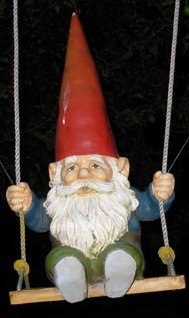
My Scandinavian friends tell me there is a little gnome named Tomten in a gray coat and red cap who lives in the barn and ties knots in pony manes as a way to show how much he is caring for the farm. I haven’t seen him at work, as my little Tomten gnome swings on a swing in our back yard and I have yet to see him do anything except smile and make me happy when I look at him. But I like the thought that he may be responsible for these tangles.

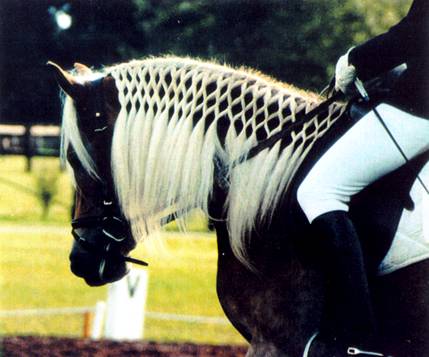
So these wet evenings, I find myself working down the barn aisle, releasing all these knots that have formed during the day. This can be a bit time consuming and not a little aggravating, but necessary if I hope to keep these three and four foot manes intact and growing. So far I’ve not had to take scissors to any, but that is only because in matters of Haflinger mane, I’m extremely motivated and patient. Long white flowing wavy manes are part of the “fairy tale” that Haflingers embody. They are sadly being lost in some of the modern bloodlines, as the trend is toward a lighter weight hair that is more easily hunter braided and thinned, more like a warmblood type sporthorse’s minimal mane. True, all the long Haflinger mane can get tangled in the reins or the lines and represent a hazard, and though there is always the question of just how much a Haflinger can actually see through all that forelock, nevertheless, I want the hair to stay, and it kills me to even cut a bridle path.

What is the good of all that hair besides aesthetics? It surely is an outer protective layer in the harsh weather conditions to which Haflingers had to adapt long ago, and it is amazingly effective at keeping the head and neck warm and dry. The double manes are incredible umbrellas, allowing the rain to drip down that top oily layer of hair and drop to the ground, never touching the fur and skin underneath. But what a sauna it creates in the heat of summer!

There are times I wish I wore such a “veil” myself–able to hide my face when I need to, and impervious to the harshness sometimes flung my way– the “slings and arrows” of every day life. But when things heat up, it can be quite a liability with the heaviness and uncompromising barrier it creates.This is a difficult trade off for the potential comfort of privacy and protection risking smothering, knotting and tangling. Like the Haflingers, I can only hope that when I’m all tied up in knots, someone will care enough to untangle me gently, smooth me out, and braid me up so I feel relief in the midst of the heat, respecting me enough to not destroy something that helps define me.

So I keep caring for those manes, knowing their loveliness has its downside, and recognizing they are part of what makes my horses “Haflingers”, the fairy tale horses that dance in my dreams, which are part of what makes me who I am.

n707166118_2259850_9280