As a physician-in-training in the late 1970’s, I rotated among a variety of inner city public hospitals, learning clinical skills on patients who were grateful to have someone, anyone, care enough to take care of them. There were plenty of street people who needed to be deloused before the “real” doctors would touch them, and there were the alcoholic diabetics whose gangrenous toes would self-amputate as I removed stinking socks. There were people with gun shot wounds and stabbings who had police officers posted at their doors and rape victims who were beaten and poisoned into submission and silence. Someone needed to touch them with compassion when their need was great.
A 25 year old idealistic and naive student, I really believed I could make a difference in the 6 weeks I spent in any particular hospital rotation. That proved far too grandiose and unrealistic, yet there were times I did make a difference, sometimes not so positive, in the few minutes I spent with a patient. As part of the training process, mistakes were inevitable. Lungs collapsed when putting in central lines, medications administered caused anaphylactic shock, pain and bleeding during spinal taps–each error creates a memory that never will allow such a mistake to occur again . It is the price of training a new doctor and the patient always–always– pays the price.
I was finishing my last on call night on my obstetrical rotation at a large military hospital that served an army base. The hospital, built during WWII was a series of far flung one story bunker buildings connected by miles of hallways–if one part were bombed, the rest of the hospital could still function. The wing that contained the delivery rooms was factory medicine at its finest: a large ward of 20 beds for laboring and 5 delivery rooms which were often busy all at once, at all hours. There were a high number of deliveries of teenagers at this hospital. Some were married girls of 14, 15 and 16 whose husbands were stationed in the northwest, transplanting their young wives thousands of miles from their families and support systems. Their bittersweet labors haunted me: children delivering babies they had no idea how to begin to parent.
I had delivered 99 babies during my 6 week rotation. My supervising residents and the nurses on shift had kept me busy on that last day trying to get me to the *100th* delivery as a point of pride and bragging rights; I had already followed and delivered 4 women that night and had fallen into bed in the on call room, exhausted at 3 AM with no women in labor, hoping for two hours of sleep before getting up for morning rounds. Whether I reached the elusive *100* was immaterial to me at the moment.
I was shaken awake at 4:30 AM by a nurse saying I was needed right away. An 18 year old woman had arrived in labor only 30 minutes before and though it was her first baby, she was pushing and ready to deliver. My 100th had arrived. The delivery room lights were blinding; I was barely coherent when I greeted this almost-mother and father as she pushed, with the baby’s head crowning. The nurses were bustling about doing all the preparation for the delivery, setting up the heat lamps over the bassinet, getting the specimen pan for the placenta and suture materials for the episiotomy ready, and when I noticed there were no doctors in the room, I asked where the resident on call was. Still in bed? Time to get him up! Delivery was imminent.
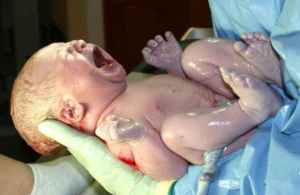
I knew the drill. Gown up, gloves on, sit between her propped up legs, stretch the vulva around the crowning head, thinning and stretching it with massaging fingers to try to avoid tears. I injected anesthetic into the perineum and with scissors cut the episiotomy to allow more room, a truly unnecessary but standard procedure in all too many deliveries. Amniotic fluid and blood dribbled out and splashed on my shoes and the sweet salty smell permeated everything. I was concentrating so hard on doing every step correctly, I didn’t think to notice whether the baby’s heart beat had been monitored with the doppler, or whether a resident had come into the room yet or not. The head crowned, and as I sucked out the baby’s mouth, I thought its skin color looked dusky, so checked quickly for a cord around the neck, thinking it may be tight and compromising. No cord found, so the next push brought the baby out into my lap. Bluish purple, floppy, not responding. I quickly clamped and cut the cord and rubbed the baby vigorously with a towel. Nothing, no response. A nurse swept in and grabbed the baby and ran over to the pediatric heat lamp and bed and started resuscitation. Chaos ensued. The mother and father began to cry, the pediatric and obstetrical residents came running, hair askew, eyes still sleepy, but suddenly shocked awake with the sight of a blue floppy baby.
I sat stunned. I tried to review in my foggy mind what had gone wrong and realized at no time had I heard this baby’s heart beat from the time I entered the room. The nurses started answering questions fired at me by the residents, and no one could remember listening to the baby after the first check when they had arrived in active labor 30 minutes earlier. The heart beat was fine then, and because things happened quickly, it had not been checked again. It was not an excuse, and it was not acceptable. It was a terrible terrible error. This baby had died sometime in the previous 30 minutes. It was not apparent why until the placenta delivered and it was obvious it had partially abrupted–prematurely separated from the uterine wall and so the circulation to the baby had been compromised. Potentially, with continuous fetal monitoring, this would have been detected and the baby delivered in an emergency C section in time. Or perhaps not. The pediatric resident worked for another 20 minutes on the little lifeless baby.
Later, in another room, he made me practice intubating the body so I’d know how to do it on something other than a mannequin. I couldn’t see the vocal cords through my tears but did what I was told, as I always did. In the delivery room, the parents held each other, sobbing, while I sewed up the episiotomy in silence. I had no idea what to say and was mortified and helpless as a witness to such agony. I said I was so sorry, so sad they lost their baby, felt so badly there had been no way to know sooner. There was nothing I could say that could possibly comfort them or relieve their horrible loss. And they had no words of comfort for me as I struggled with my guilt.
Later I cried in the bathroom, selfish. Instead of achieving that “perfect” 100, I learned that death intervenes in life unexpectedly without regard to age or status or wishes or desires. I went on as a family physician to deliver hundreds of babies during my career but could never forget the baby that might have had a chance, if only born at a hospital with adequately trained well rested staff, without a student trying to reach a personal meaningless goal. This baby should be in his 30’s with children of his own, his parents now proud and loving grandparents.
I wonder if I’ll meet him again someday, this little soul that almost was, if I’m ever forgiven enough to share a piece of heaven with innocent babies who never got to draw a breath. Then, maybe then, forgiveness will feel real and grace accepted with the gratitude of the guilty.



 Barnstorming