An Advent Tapestry–The Stars Held Their Breath

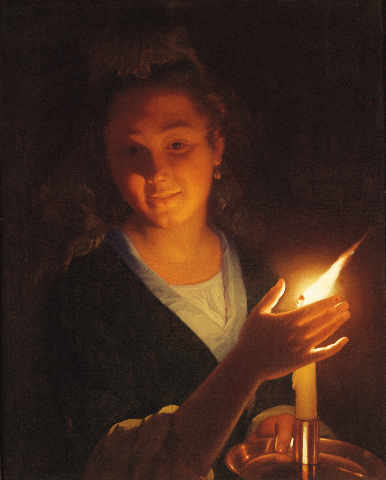
Woman with a Candle--Godfried Schalken

Was there a moment, known only to God, when all the stars held their breath,
when the galaxies paused in their dance for a fraction of a second,
and the Word, who had called it all into being,
went with all his love into the womb of a young girl,
and the universe started to breathe again,
and the ancient harmonies resumed their song,
and the angels clapped their hands for joy?

– Madeline L’Engle from Bright Evening Star

An Advent Tapestry–Fear Not


Adoration of the Shepherds by Charles Lebrun, 1689

Click on this painting for the link to a larger version–it is well worth it!

“How often we look upon God as our last and feeblest resource! We go to Him because we have nowhere else to go. And then we learn that the storms of life have driven us, not upon the rocks, but into the desired haven.”  George MacDonald

Fear often becomes the thing we fear the most. And it need not be. Being afraid in the face of the unexpected happened years and years ago to people who were society’s cast-offs, relegated to tending flocks as they had no other skill of value. They were the forgotten and the least of men. Yet what they saw and heard that Christmas night put them, of all people, first in line to see God in flesh,  allowing them access no one else had.

Within the routine familiarity of their fields and flocks came this most unexpected experience, terrifying in its sheer “other worldliness”, and blinding in its grandeur. They were flattened with fear and dread, “sore” afraid, hurting all over in their terror.

And so the reassurance came: “Be not afraid”.  It is reiterated over and over:  “Fear not!”

The shepherds picked themselves up, dusted themselves off and obediently went on their way to the safety and familiar security of a barn, to see with their own eyes what they could not imagine: a baby born in so primitive a place, yet celebrated from the heavens. The least becomes first, and the first becomes the least.

Sometimes, in these dark times, our terror is for good reason, and we feel driven upon the rocks of life.  But we need to understand where we truly land in those terrifying moments.  It is the safe haven of God’s arms,  as He gazes up at us from a manger bed, walks with us through the valley of our fear, and gathers us in to safe haven when we were sure there was nowhere else to go.


Annunciation_to_the_Shepherds_Abraham_Hondius_1663

click on painting for link to larger version

An Advent Tapestry–Sound of the Silence Itself

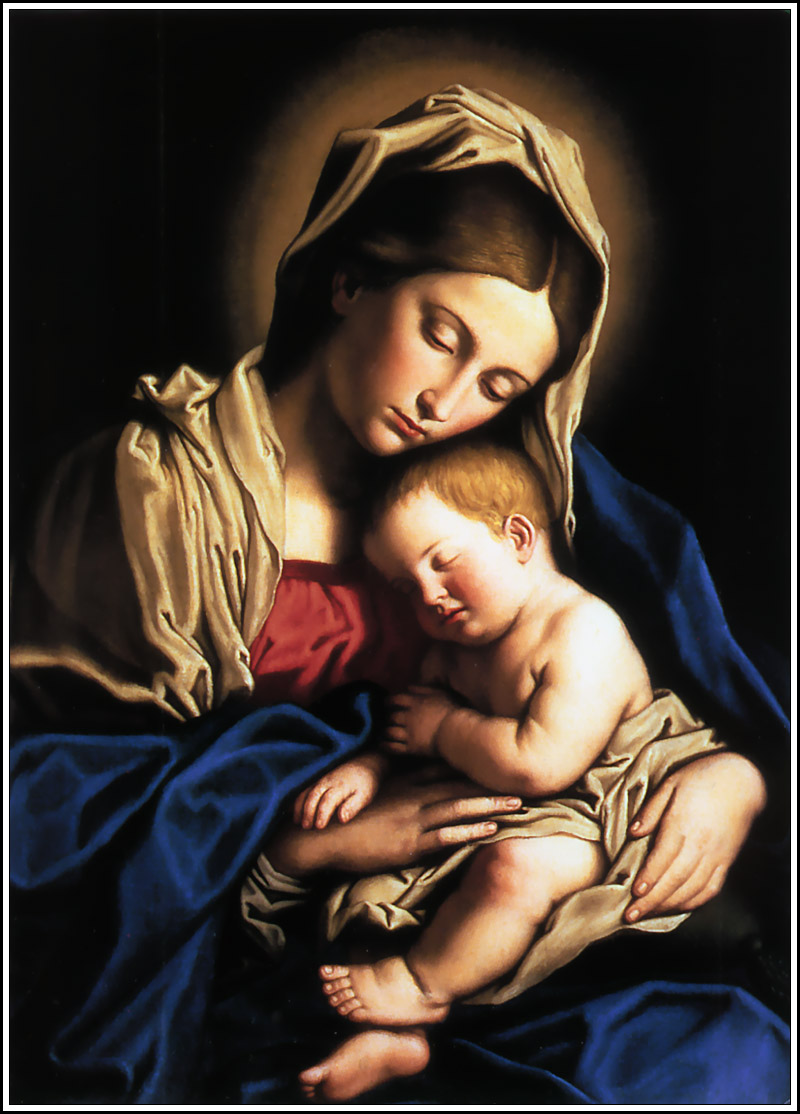
Madonna and Child by Orazio Gentileschi

“The house lights go off and the footlights come on. Even the chattiest stop chattering as they wait in darkness for the curtain to rise. In the orchestra pit, the violin bows are poised. The conductor has raised his baton. In the silence of a midwinter dusk, there is far off in the deeps of it somewhere a sound so faint that for all you can tell it may be only the sound of the silence itself. You hold your breath to listen. You walk up the steps to the front door. The empty windows at either side of it tell you nothing, or almost nothing. For a second you catch a whiff of some fragrance that reminds you of a place you’ve never been and a time you have no words for. You are aware of the beating of your heart…The extraordinary thing that is about to happen is matched only by the extraordinary moment just before it happens. Advent is the name of that moment.”

— Frederick Buechner, Whistling in the Dark

The moment of silent expectation suspended between what we anticipate will happen and what actually does happen is a moment of sweet tension and longing.  Many find Christmas to be an anticlimax to the build up beforehand.  In the true spirit of Advent, that can never be the case.  The preparation for His coming merely foreshadows the joy we feel when holding Him close, seeing His face and knowing He is God in flesh.

He is with us, He is in us and our hearts, jubilant,  beat like His.

An Advent Tapestry–Repugnant Grace

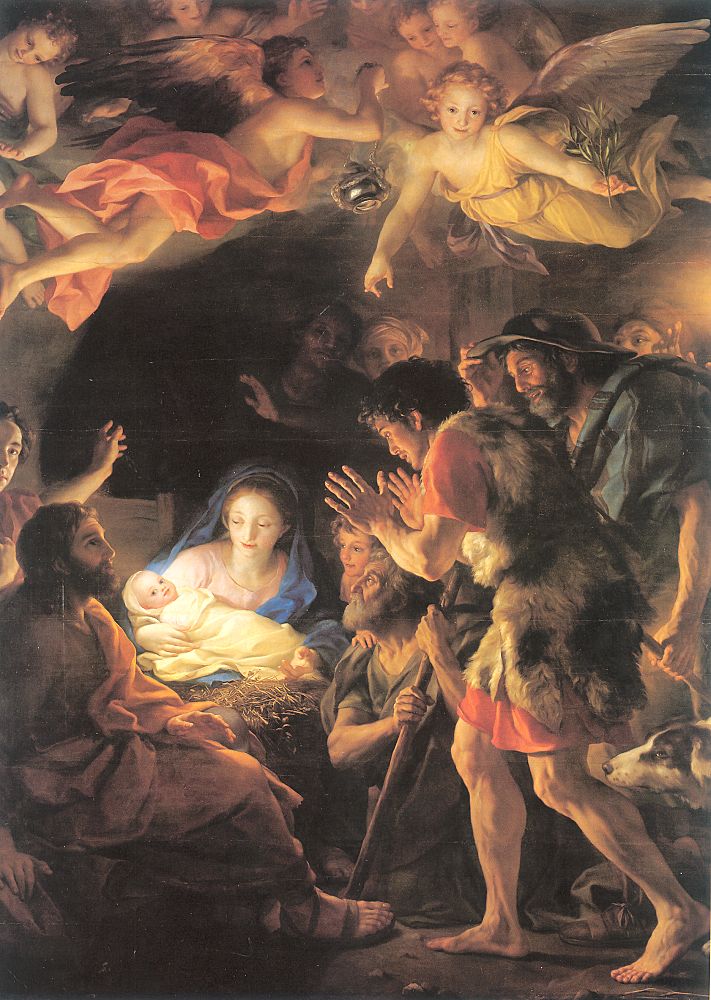
Adoration of the Shepherds by Anton Raphael Mengs

Nothing is more repugnant to capable, reasonable people than grace… John Wesley

I love this particular painting of the Nativity by Bohemian artist Anton Raphael Mengs because everyone–Mary, shepherds, angels, even Joseph with his wondering look of awe at the hubbub this birth has created– looks completely amazed and almost besotted with the new Christ child.  There is an attraction, almost magnetic, toward this gift from God.

Every day capable, reasonable people turn away from this gift, unable to trust that it was truly meant for them, as undeserving as they (we) are.

How can we accept this incredible gift and not respond?  How can we shrug our shoulders and not be truly amazed?

Yet it happened.   A gift beyond our ability to imagine or understand.    The fact we can’t understand should not make the gift of grace repugnant.   We simply, like Joseph, must sit in awe and wonder.

An Advent Tapestry–Lies in Manger Pressed as Hay

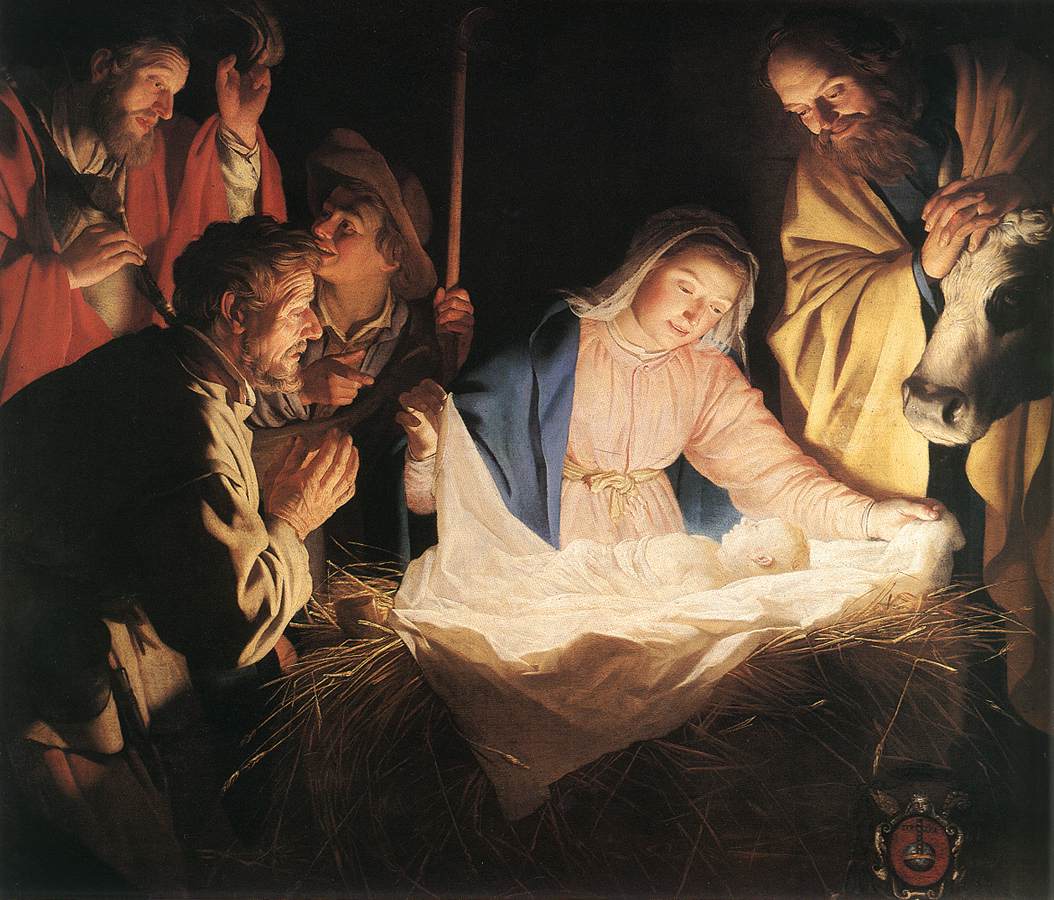
Adoration of the Shepherds by Gerard van Honthorst
Man altered by sin from man to beast;
Beast’s food is hay, hay is all mortal flesh.
Now God is flesh and lies in manger pressed
As hay, the brutish sinner to refresh.
O happy field wherein this fodder grew,
Whose taste doth us from beasts to men renew.
from The Nativity of the Christ  by Robert Southwell, Jesuit poet (1561-1595)
I spent considerable time up in our hay loft today, pulling bales down off the stack, throwing them down to pile up for feed for the horses over the next several days.  This poem by a priest from the 16th century kept resonating in my mind as I remembered the green fields that yielded this hay, gathered by our family and friends on a hot summer’s evening, and placed in the barn so I could do just what I did today.
I have written about hay before, but appreciate Southwell’s concept of God now flesh,  as the hay which forms His bed, refreshes and renews the sinner to righteousness:
Hay crew
Remembered on
Frosty mornings before dawn
When bales are broken for feed
And fragrant summer spills forth.

In the dead of winter
During the darkest blowing icy nights
The bales open like a picture book
Illustrating how life once was,
and will be again~

Rainy spring nights hay
Becomes soft bedding
For new foals’ sleep 

To guarantee sunshine
In the barn
On the darkest of days:
Communion.


An Advent Tapestry–Without poverty of spirit there can be no abundance of God

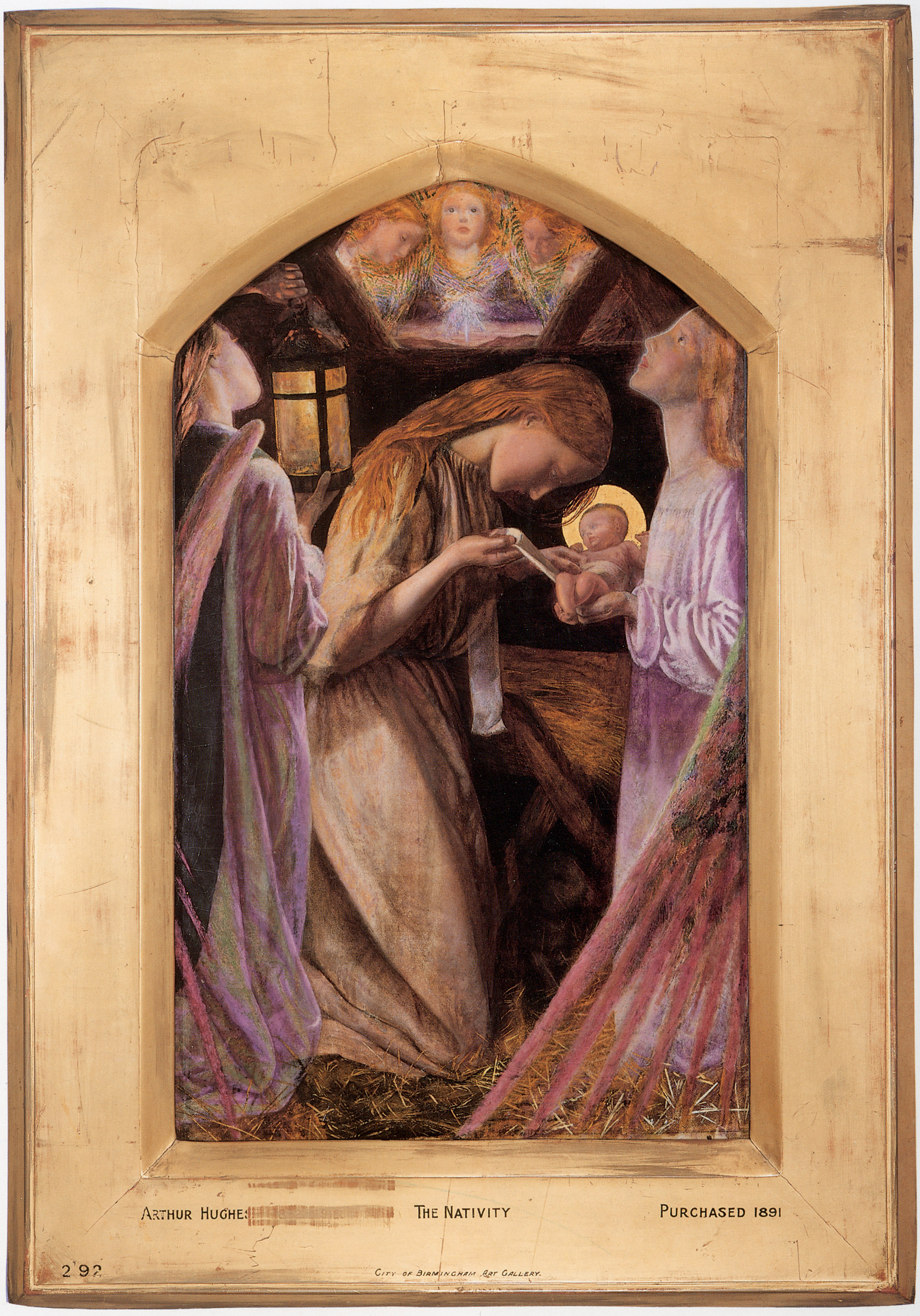
The Nativity by Arthur Hughes

The God We Hardly Knew
by Archbishop Oscar Romero

No one can celebrate
a genuine Christmas
without being truly poor.
The self-sufficient, the proud,
those who, because they have
everything, look down on others,
those who have no need
even of God- for them there
will be no Christmas.
Only the poor, the hungry,
those who need someone
to come on their behalf,
will have that someone.
That someone is God.
Emmanuel. God-with-us.
Without poverty of spirit
there can be no abundance of God.


No one wants to admit to being needy.  It is, after all, allowing someone else to have strength and power to deliver what one is desperate for.  Relinquishing that control is painful but it is more painful to be so poor that one is hungry without food, thirsty without drink, ill without medicine,  cold without shelter,  alone without God.

When we are well fed and hydrated, healed, clothed and safe in our homes, it is difficult to be considered “needy”.  Yet most of us are ultimately bereft and spiritually impoverished, needing God even when we won’t admit it, or reject Him.

Despite the wealth with which we surround ourselves every day, our need is still great; we stand empty and ready to be filled–abundantly.


An Advent Tapestry–O Magnum Mysterium

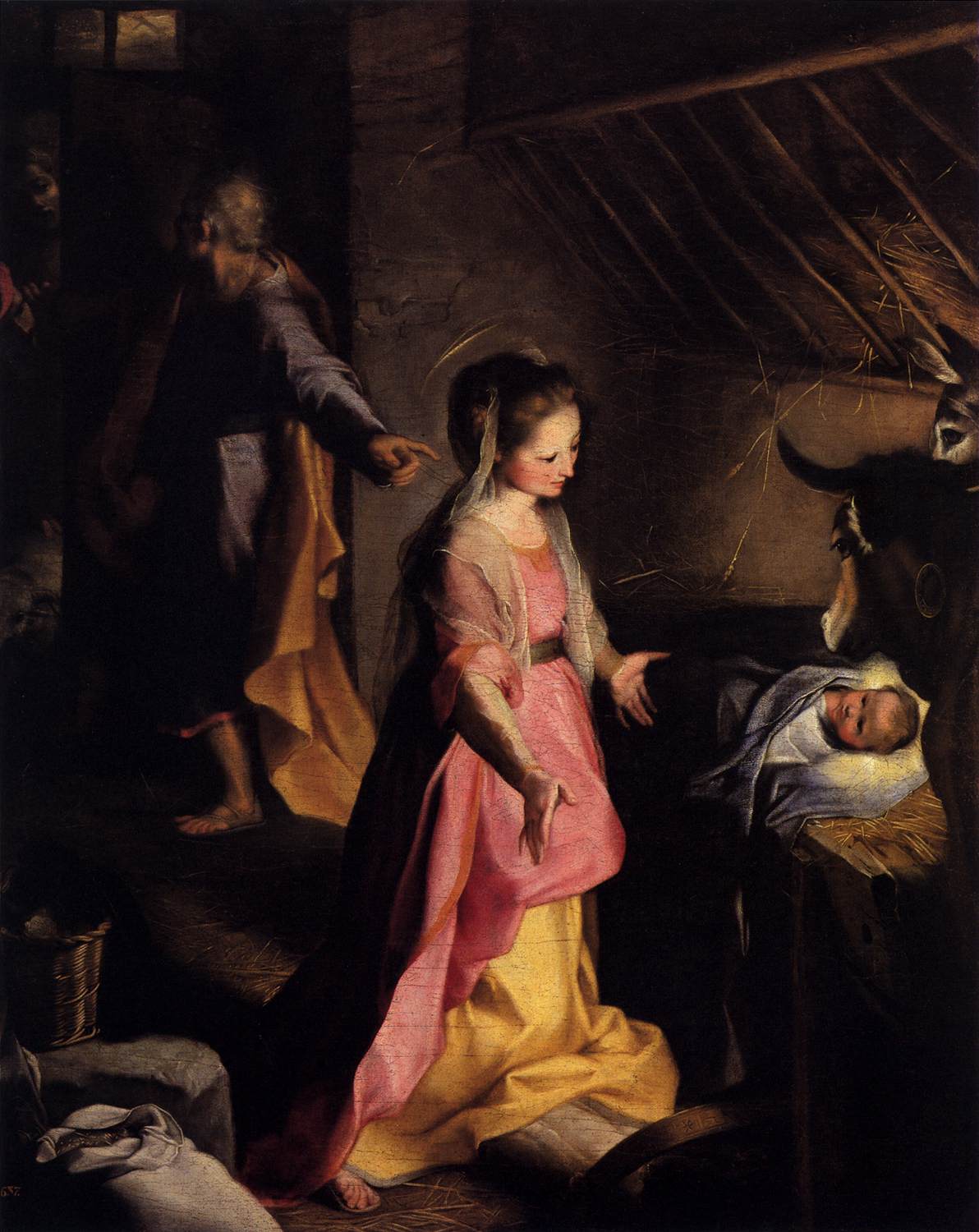
The Nativity by Federico Fiori Barocci

My daughter and I attended the local Bellingham Chamber Chorale Christmas concert tonight, conducted by her choir teacher Ryan Smit.  Among the many beautiful pieces performed were three versions of O Magnum Mysterium, a Catholic Christmas Day Latin responsory that celebrates the humble circumstances of Christ’s birth.  Our favorite, and clearly the crowd’s favorite, was the Morten Lauridsen version.

O magnum mysterium, et admirabile sacramentum, ut animalia viderent Dominum natum, jacentem in praesepio! Beata Virgo, cujus viscera meruerunt portare Dominum Christum. Alleluia!

O great mystery and wondrous sacrament, that animals should see the new-born Lord lying in their Manger! Blessed is the Virgin whose womb was worthy to bear the Lord Jesus Christ. Alleluia!

The Lauridsen version can be heard here

The composer,  Morten Lauridsen, is a Washington state native who was born only a few miles from where my mother grew up in the wheat fields of the Palouse, and now lives in retirement in the San Juan Islands.  He wrote about his inspiration for this piece for the Wall Street Journal, by trying to write something that honored the words as much as the Still Life painted by Zurbaran honored the Virgin Mary.

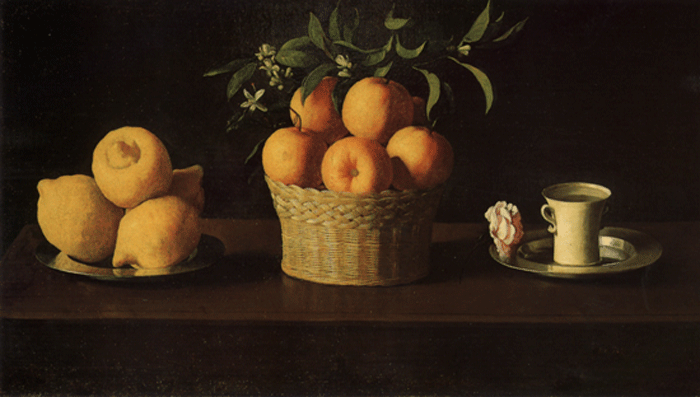
Still Life by Zurbaran

In Lauridsen’s words:

“Zurbarán (1598-1664) is the painter of “Still Life with Lemons, Oranges and a Rose.” The objects in this work are symbolic offerings to the Virgin Mary. Her love, purity and chastity are signified by the rose and the cup of water. The lemons are an Easter fruit that, along with the oranges with blossoms, indicate renewed life. The table is a symbolic altar. The objects on it are set off in sharp contrast to the dark, blurred backdrop and radiate with clarity and luminosity against the shadows.

In composing music to these inspirational words about Christ’s birth and the veneration of the Virgin Mary, I sought to impart, as Zurbarán did before me, a transforming spiritual experience within what I call “a quiet song of profound inner joy.” I wanted this piece to resonate immediately and deeply into the core of the listener, to illumine through sound.

The most challenging part of this piece for me was the second line of text having to do with the Virgin Mary. She above all was chosen to bear the Christ child and then she endured the horror and sorrow of his death on the cross. How can her significance and suffering be portrayed musically?

After exploring several paths, I decided to depict this by a single note. On the word “Virgo,” the altos sing a dissonant appoggiatura G-sharp. It’s the only tone in the entire work that is foreign to the main key of D. That note stands out against a consonant backdrop as if a sonic light has suddenly been focused upon it, edifying its meaning. It is the most important note in the piece.

“O Magnum Mysterium” had its 1994 premiere by the Los Angeles Master Chorale under the baton of Paul Salamunovich. Widely recorded with thousands of performances throughout the world since then, it owes much to its visual model, Zurbarán’s magnificent “Still Life With Lemons, Oranges and a Rose.” ”

I am very grateful to Mr. Lauridsen for his inspiration, his composition, the direction of Mr. Smit and the lovely voices of the Bellingham Chamber Choir who sung tonight.  You did indeed illumine through sound.


An Advent Tapestry–Moonless Darkness

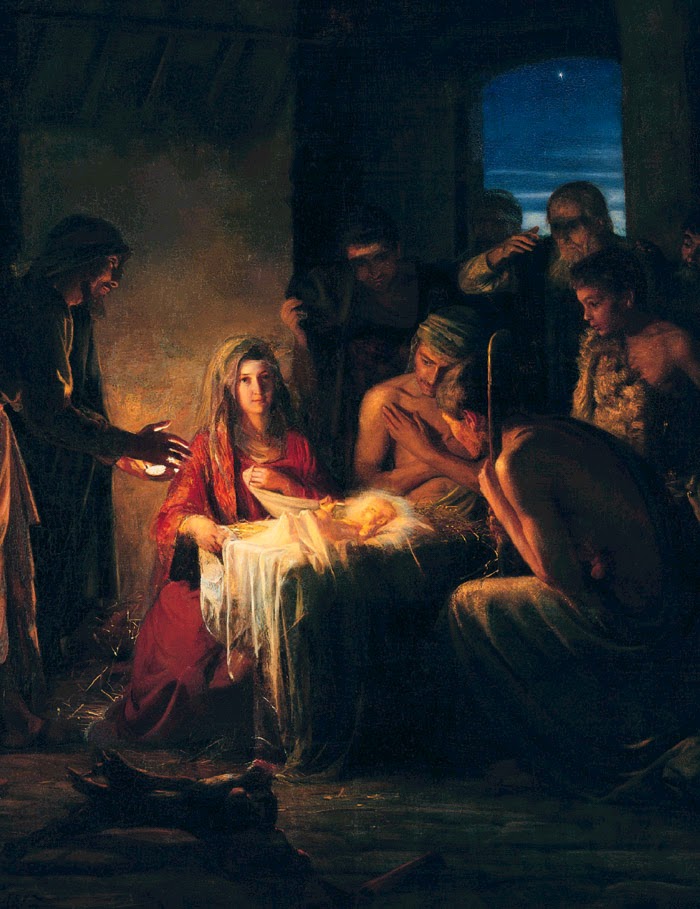
Nativity by Carl Bloch

“Moonless Darkness Stands Between”
by Gerard Manley Hopkins

Moonless darkness stands between.
Past, O Past, no more be seen!
But the Bethlehem star may lead me
To the sight of Him who freed me
From the self that I have been.
Make me pure, Lord: Thou art holy;
Make me meek, Lord: Thou wert lowly;
Now beginning, and alway:
Now begin, on Christmas day.


Between the darkness and the illumination of the star is the beginning of who we are to become.  We are led away from the past to the hope of a new self.  Christmas is the day we all begin again.


Getting Ready for Barn Visitors

Behold The Lamb Of God by Walter Rane

Late autumn heavy rains take a toll on our farm.  Our barns are downhill from the fields, and water does tend to run downhill–at least every time I’ve checked.  The downpours we’ve had this week have resulted in standing water in our stalls, aisle ways and just about anywhere it is not wanted.  I do feel fortunate our house is located uphill, but our horses are weary of wet bedding and there is considerable work in replacing damp shavings with dry on a daily basis.

I definitely got behind in my mucking duties.  The horses’ beds were clean but still squishy some nights.  Tonight deserved a marathon cleaning as I expect visitors to the barn tomorrow and everything needs to look freshened up, fluffed and buffed, and fresh shavings needed to be added everywhere.  Three hours later, it all looks much better, the horses heave a sigh of gratitude as they lower themselves in their dry bedding and roll  and itch for the first time in a week.

Barns are not particularly hygienic or easy to clean.  There are cobwebs and dust everywhere, interesting and rather pungent smells of urine and manure, rat holes and raccoon thieves,  mouse nests and kitty covered piles.  Birds in the rafters drop feathers and things that aren’t so feather-like, and bats swoop in and out silently.  Owls leave their regurgitated pellets of bones and fur.  So when I say I “cleaned the barn”, it is only in a relative sense.  It is never clean, never a place one would consider laying down and taking a nap, and certainly never, ever a place to have a baby.

Yet she did.

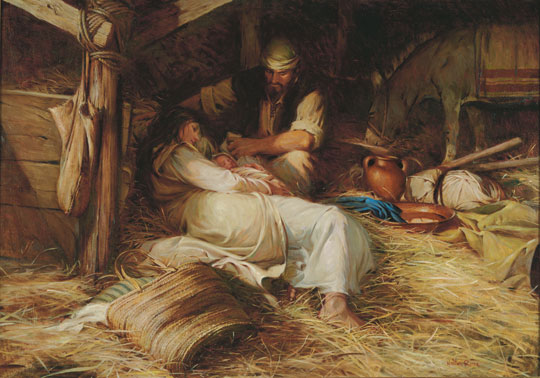
The barn in which they sought shelter couldn’t have been anything like that portrayed in the medieval masterpieces,  with every corner swept spotless, archways with ornate architecture, heavenly light flowing everywhere.  The animals would not have been groomed and shiny.  The stable wasn’t likely filled with cute as a button shepherd boys carrying snowy white sheep, nor surrounded by angels in ornate brocaded clothing and golden wings.  Mary couldn’t possibly have had every hair in place, with her clothing smooth and ironed and Joseph’s beard probably didn’t look neatly trimmed or his face free of worry.   Nothing smelled heavenly there, I’m sure.  The angel voices must have been drowned out by the calling of the donkey, or the lowing of the cow needing milking or the lambs bleating for their mamas.

In other words, that barn contained the messy business of everyday life, down to the grit and grime and cobwebs, and Jesus was born smack dab in the middle of it all.  No one swept things to get ready for him.  He had to make do with it just as it was.  He finds us in similar condition: grungy,  stained, more than ready for a good washing.

So I hope my barn guests, like Joseph and Mary, will be forgiving if things aren’t exactly perfect for their visit tomorrow.  Perfection only exists because He came at all, especially because He was born in a barn.


An Advent Tapestry–Infinity Walled in a Womb

“infinity walled in a womb…”
from “Made flesh,” in Accompanied by Angels: Poems of the Incarnation by Luci Shaw

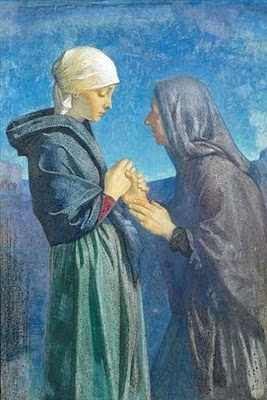
Elizabeth knew without being told as soon as she heard Mary’s voice.  Or rather the baby in old Elizabeth’s womb knew, as he leaped for joy as she was filled with the spirit.  Two intrauterine mysteries meeting each other for the first time, belly to belly.   There is nothing more finite than the space in the womb–it gets crowded in there quickly over a scant few months.  Yet there infinity dwelled within the finite.

As I am no theologian, I’m not capable of discussing the intricacy of the reformational argument of finitum capax infiniti (the finite is capable of the infinite) vs finitum non capax infiniti (the finite is not capable of the infinite) which has to do with Christ’s bodily presence in the Eucharist.  As a mother, I know that finite Mary carried the infinite–“inside her the mind of Christ”…

“…inside her the mind
of Christ, cloaked in blood,
lodges and begins to grow.”
from “Mosaic of the Nativity” by Jane Kenyon

“To see a World in a Grain of Sand
And a Heaven in a Wild Flower,
Hold Infinity in the palm of your hand
And Eternity in an hour.”
from Auguries of Innocence by William Blake