Lenten Meditation: Barnstorming

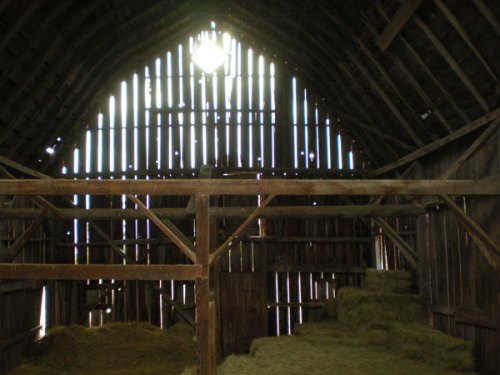
An unexpected southerly wind hit suddenly late last night, gusting up to 40 miles an hour and slamming the house with drenching rain as we prepared to go to bed. Chores in the barn had been done hours before, but as we had not been expecting a storm, the north/south center aisle doors were still open, and I could hear banging and rattling as they were buffeted in the wind. I quickly dressed to go latch the doors for the night, but the tempest had done its damage. Hay, empty buckets, horse blankets, tack and cat food had blown all over, while the Haflingers stood wide-eyed and fretful in their stalls. A storm was blowing inside the barn as well as outside it.

It took some time to tidy up the mess after the doors were secured but all was soon made right. The wind continued to bash at the doors, but it no longer could touch anything inside them. The horses relaxed and got back to their evening meal though the noise coming from outside was deafening. I headed back up to the house and slept fitfully listening to the wind blow all night, wondering if the metal barn roof might pull off in a gust, exposing everything within.

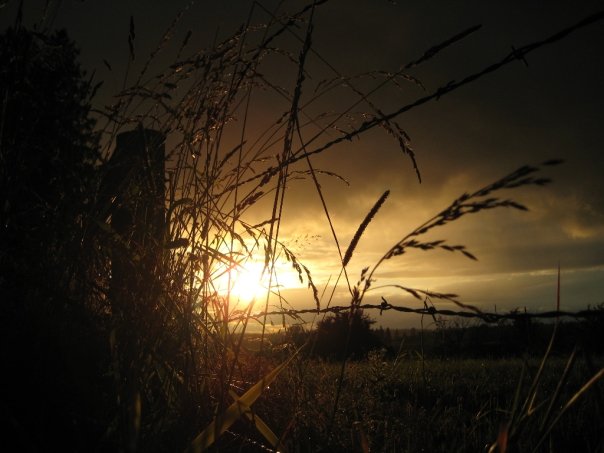
Yet in the new daylight this morning, all is calm. The barn is still there, the roof still on, the horses are where they belong and all seems to be as it was before the barnstorming wind. Or so it appears.

This wind heralds another storm coming this week that hits with such force that I’m knocked off my feet, swept away, and left bruised and breathless. No latches, locks, or barricades are strong enough to protect me from what will come over the next few days.

Yesterday he rode in softly, humbly, and wept. Today, he overturns the tables in fury. On Tuesday he echoes the destruction that is to happen.  Wednesday, he teaches, then rests in anticipation.  On Thursday, he pours water over dusty feet, presides over a simple meal, and then sweats blood in agonized prayer. By Friday, all culminates in a perfect storm, transforming everything in its path, with nothing untouched. The silence on Saturday is deafening. Next Sunday, the Son rises and returns, all is calm, he calls my name, my heart burns within me at his words and I will never be the same again.

Barnstormed to the depths of my soul. Doors flung open wide, the roof pulled off, everything blown away and now replaced, renewed and reconciled.

Alleluia!
Lenten Meditation: If You Had Only Known

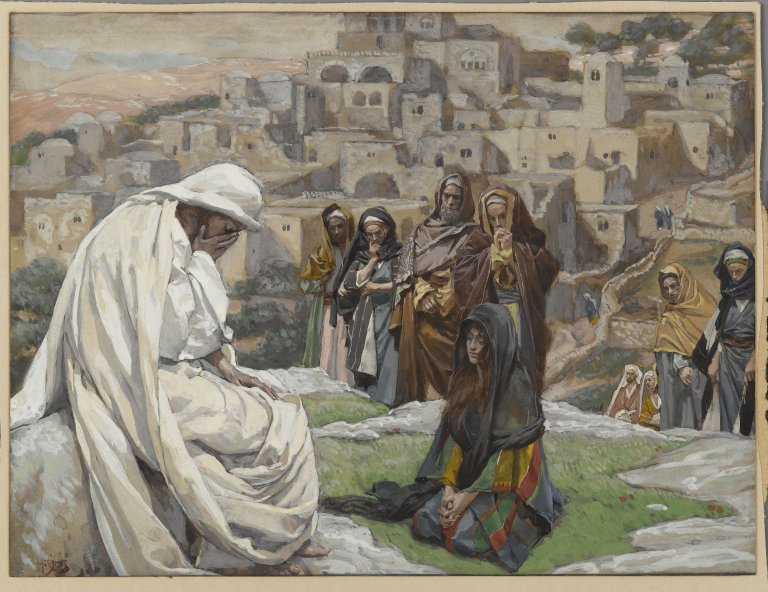
Weeping Over Jerusalem--Tissot

Luke 19:41-44

As he approached Jerusalem and saw the city, he wept over it and said, “If you, even you, had only known on this day what would bring you peace—but now it is hidden from your eyes.

Jesus is reported to have wept only twice in the gospels.  When informed His friend Lazarus was dead, He weeps in response to the grief and lack of faith demonstrated by friends and family even though they knew Jesus’ power to heal and restore.  The second time was on Palm Sunday, as triumphantly He approached Jerusalem and stopping, looked down upon the city, knowing what lay ahead.   This time the stakes were not the loss of one life, but the loss of an entire city due to the unbelief and lack of faith of its people.

Indeed, Jerusalem, still torn between factions, faiths and fanatics, has not really known peace ever since.

I am struck by the compassion shown in those tears.  These are not tears of self-pity, nor anticipation of His own imminent personal suffering, but tears shed over the continued blindness of mankind.  They expected the militant entrance of a victorious king, so were unaware their salvation rode into their midst on a donkey’s colt.

Those sacred tears were never for Himself, but for us.  Human tears rolling down the face of God–Divine tears washing the face of man.

Peace no longer is hidden from us.   Now we know.

Lenten Meditation: She Did What She Could

Mark 14:8-9

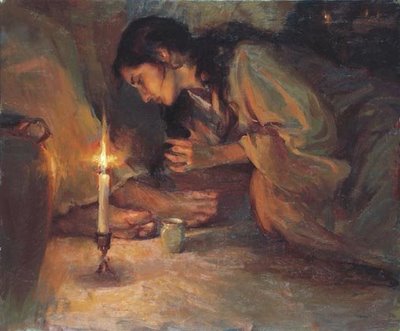
She did what she could. She poured perfume on my body beforehand to prepare for my burial. I tell you the truth, wherever the gospel is preached throughout the world, what she has done will also be told, in memory of her.

We wonder if our actions on this earth are pleasing to God, though we believe our faith, rather than good works, is the key to salvation.   Jesus’ response to Mary’s anointing of His feet the day before He enters Jerusalem is provocative.  However, this story parallels the passion of the coming week:

Mary acts out of faith even when she confronts a painful reality–she acknowledges Jesus’ predictions of His death and burial–she believes what His disciples refused to hear.

Jesus prays a few days later to have the reality of suffering lifted from Him, but in obedience, He perseveres out of faith and love for the Father.

Mary acts out of her steadfast love for the Master–she is showing single-minded devotion in the face of criticism from the disciples.

Jesus, on the cross,  shows forgiveness and love even to the men who deride and execute Him.

Mary acts out of significant personal sacrifice–pouring costly perfume worth a full year’s wages–showing her commitment to Christ.

Jesus willingly gives the ultimate sacrifice of Himself–there is no higher price to pay.

Mary responds to His need–she recognizes that this moment is her opportunity to anoint the living Christ, and His response clearly shows He is deeply moved by her action.

Jesus, as man Himself, recognizes humanity’s need to be saved, and places Himself in our place. We must respond, incredulous,  with gratitude.

Jesus tells Mary (and us),  in response to the disciples’ rebukes, that it is her action that will be told and remembered.   She did what she could at that moment to ease His distress at what He would soon confront.  She did what she could for Him–humbly, beautifully, simply, sacrificially–and He is so grateful that He Himself washes the feet of His disciples a few days later in an act of devotion and servanthood.

And today we remember her as the harbinger of His passion, just as He said we would.

Lenten Meditation: Come and Have Breakfast

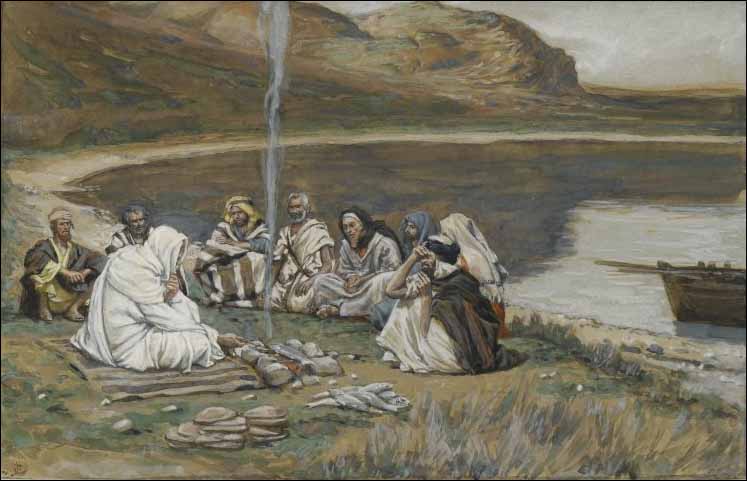
Meal of Our Lord and the Apostles --James Tissot

John 21:12

Jesus said to them, “Come and have breakfast.” None of the disciples dared ask him, “Who are you?” They knew it was the Lord.

After Resurrection Day, Jesus appeared to His followers on several occasions, but was not always immediately recognizable.  The trigger for discerning who He is seems sometimes to be connected to sharing a meal.

This makes entire sense after His Last Supper with the disciples before His death.  He makes it clear how He wants to be remembered, through a symbolic meal of bread and wine.   So when He returns, when He eats together with others, they know they are in the presence of the Lord.

In one instance, when the disciples have had a night of no success catching fish, He directs them to drop their nets yet again and suddenly there are more fish than they can handle.  This is capped by His invitation: “Come and have breakfast”.    He then feeds them, both figuratively and literally.

Accepting the invitation is all that is asked of us.  Who doesn’t want to have breakfast cooked for them?

So come and eat.  Be filled.  And never be hungry again.

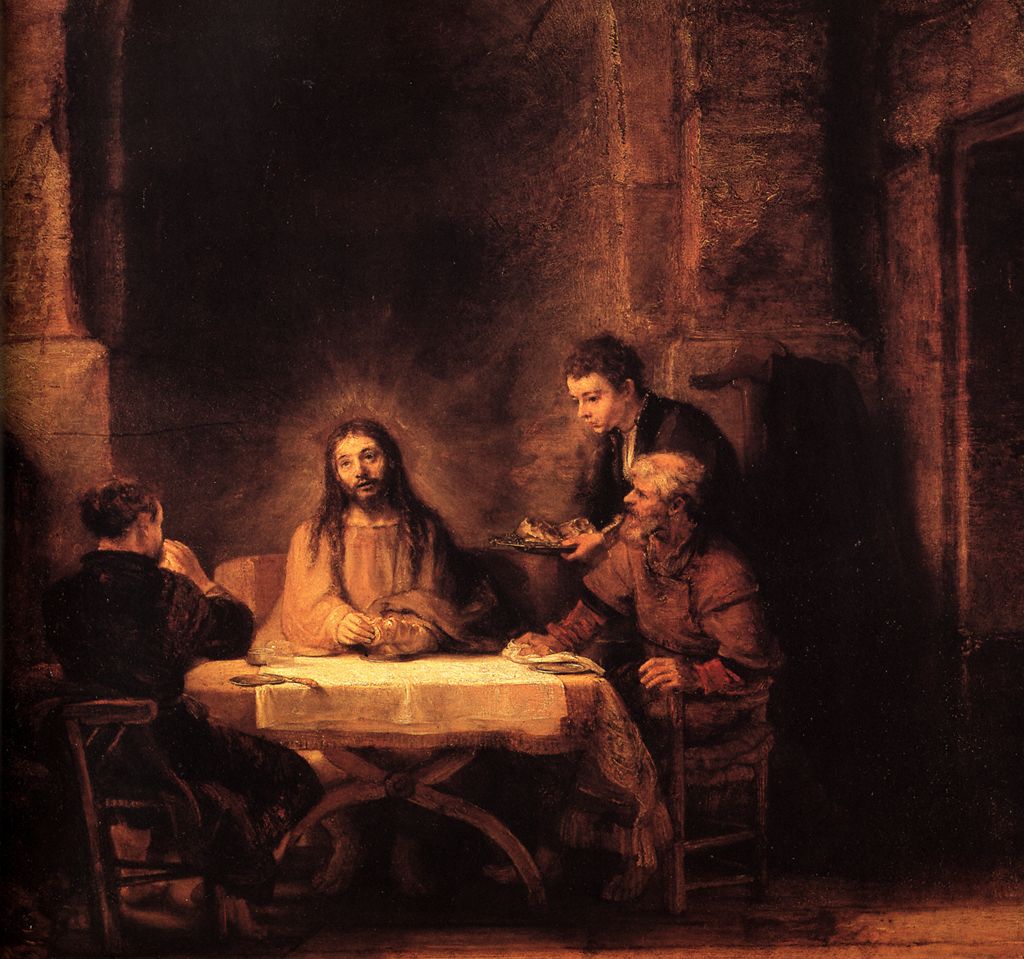
Supper at Emmaus by Rembrandt

Lenten Meditation: The God For Me!

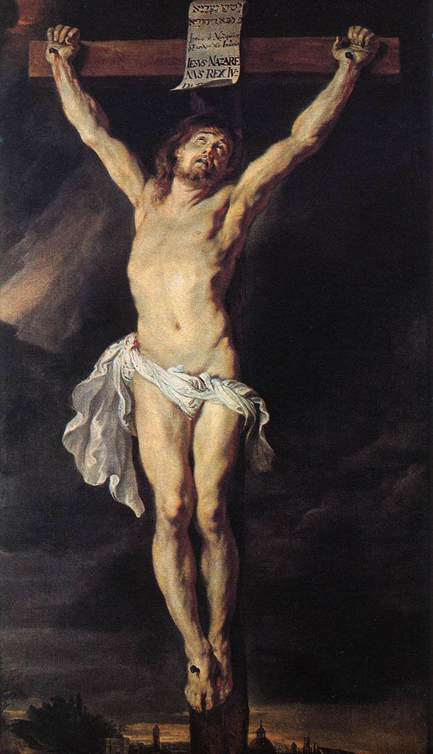
The Crucified Christ by Rubens

“I could never myself believe in God, if it were not for the cross… In the real world of pain, how could one worship a God who was immune to it? I have entered many Buddhist temples in different Asian countries and stood respectfully before the statue of Buddha, his legs crossed, arms folded, eyes closed, the ghost of a smile playing round his mouth, a remote look on his face, detached from the agonies of the world.

But each time after a while I have to turn away. And in imagination I have turned instead to that lonely, twisted, tortured figure on the cross, nails through hands and feet, back lacerated, limbs wrenched, brow bleeding from thorn-pricks, mouth dry and intolerably thirsty, plunged in Godforsaken darkness.

That is the God for me! He laid aside His immunity to pain. He entered our world of flesh and blood, tears and death. He suffered for us. Our sufferings become more manageable in light of His.”

—John Stott, The Cross of Christ

It is interesting to read of Pastor Stott’s turning toward the image of the crucified Christ, away from the smiling but detached Buddha.  As I did not grow up with images of the crucified Christ, I find it very difficult to see paintings, statues, or watch movies depicting the Crucifixion.  I want to turn away in discomfort at the agony portrayed. It is too overwhelming to behold.

But I must turn back and face Him. I cannot look away in horror.

He is not detached.  He is completely and unutterably attached to me–by His grace–by His will–by His giving of Himself–indeed by the nails themselves.   That is my God hanging there.

Lenten Meditation: Before Darkness Overtakes You

John 12:35

Then Jesus told them: You are going to have the light just a little while longer. Walk while you have the light, before darkness overtakes you. The man who walks in the dark does not know where he is going.

Many older people when stressed with illness, while hospitalized or disrupted from their routine, will become disoriented, even confused in the evening, unable to sleep, or be at ease.  It is referred to as “sundowning” by the care providers who must try to keep an older patient safe, calm and oriented to time and place.  It isn’t at all clear what is happening in the brain as the sun goes down, but over the years of watching this happen in my patients, I think it is a very primal fear response to loss of light.  We don’t know where we are in the dark and feel lost.  We don’t know what is out there that may hurt us.

Jesus knew the dangers of the night, both as God and as man.  As the Light of the World, soon to hang from the cross as the sky blackened and the sun was covered over, His illumination will dim and die.  At that moment, man is plunged into darkness like none ever known before.  This is extreme  “sundowning” where all hope is lost, and we can so easily lose our way.

Yet if we stay rooted to the spot, and not leave the cross, we may find comfort in our troubled state, and can put down our heavy burden and rest. We can celebrate the arrival of brilliant light in our lives. Instead of darkness overcoming us, our lives are covered in the glory and grace of Resurrection Day.

The Son settled among us.  Darkness can no longer overtake us, even at death.  The Light will illuminate the path we are meant to take.

“No matter how deep our darkness, He is deeper still.”  Corrie ten Boom in The Hiding Place

Lenten Meditation: If They Keep Quiet

Luke 19:40

“I tell you,” he replied, “if they keep quiet, the stones will cry out.”

The songs from the swamp were faintly detectable in the distance about six weeks ago.  In the middle of winter, due to unduly mild temperatures, the frog chorus had begun in the wetlands surrounding our farm.  It was almost disorienting, along with the daffodils budding in late January and lawns needing mowing in February.  An early March cold snap sent the frogs back into the mud and the evening concerts ceased briefly.  Then suddenly today, along with the sun,  they are back, this time closing in right next to our bedroom window, populating the small fish pond in our front yard.  With voices so numerous, strong and insistent, it feels as though a New York City of Pacific Chorus Frogs moved in next door, and our family is seated in the balcony of Carnegie Hall.  They seem to be directed by an unseen conductor, as their voices rise and fall together and then cut off suddenly with a slice of the baton, plunging into uncomfortable silence at the slightest provocation, as if holding an extended resting fermata for minutes on end.

The frogs’ repertoire is limited but their wind power,  stamina and ability to project their voices impressive.   They are most tenacious at making their presence known to any other peeper within a mile radius. Then when the coyotes are chorusing in the field out back, just a hundred yards away from our other bedroom window, yip-yip-yelping their song at the moon, we are serenaded by the sopranos and altos of the farm’s wild fauna.  There is an occasional percussive beat of a barn owl’s click as he flies overhead, and the intermittent tenor hoohooooo’s back and forth between mates perched in trees around the house.   Add in the deep bass huh-huh-huh-huh of our stallion’s nicker as he talks with our mares through the barn wall, and it makes for a fine evening concert indeed.

Everyone’s welcome to attend the next performance at our farm. Admission is free as long as you are willing to help clean barn the next day.

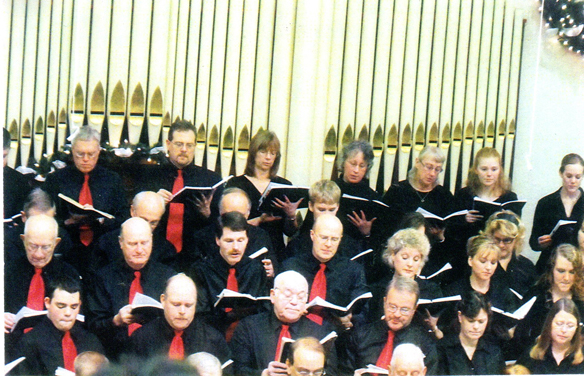
As a relatively new member of a small town choral society, I am discovering choirs of all sorts are joyous groups, a collection of individuals perhaps as disparate as the creatures on our farm, joining together to create a woven musical tapestry.  The Lenten portion of Handel’s Messiah is a challenging work that our group will perform later this week, prior to the beginning of Holy Week, as our faith community prepares for Easter.  As a novice singer,  I am learning to find the right notes, stay on key, pronounce the words correctly, turn the pages at the right time, watch the conductor, know when to start and when to be silent, when to stand up and sit down in unison, and most natural to me, how to actually show the emotion of the words.

If there would be a command to silence, if we are told to keep quiet, if we are somehow prevented from singing this amazing choral work, or even if there is not a cacophony of sounds out our bedroom window every spring evening, I have no doubt the stones themselves would cry out.    It is that important to sing praises loud and clearly, whether it be a choral society, a peeper chorus, a coyote concert or the hosannas shouted during His ride into Jerusalem.

Everyone’s welcome to attend.  Admission is free.  No barn cleaning necessary.  Instead be prepared for washing of your feet and cleansing of the heart.

Lynden Choral Society

Lenten Meditation: The Hem of His Mother’s Robe

“Looking at Stars” by Jane Kenyon from Let Evening Come

The God of curved space, the dry
God, is not going to help us, but the son
whose blood splattered
the hem of his mother’s robe.

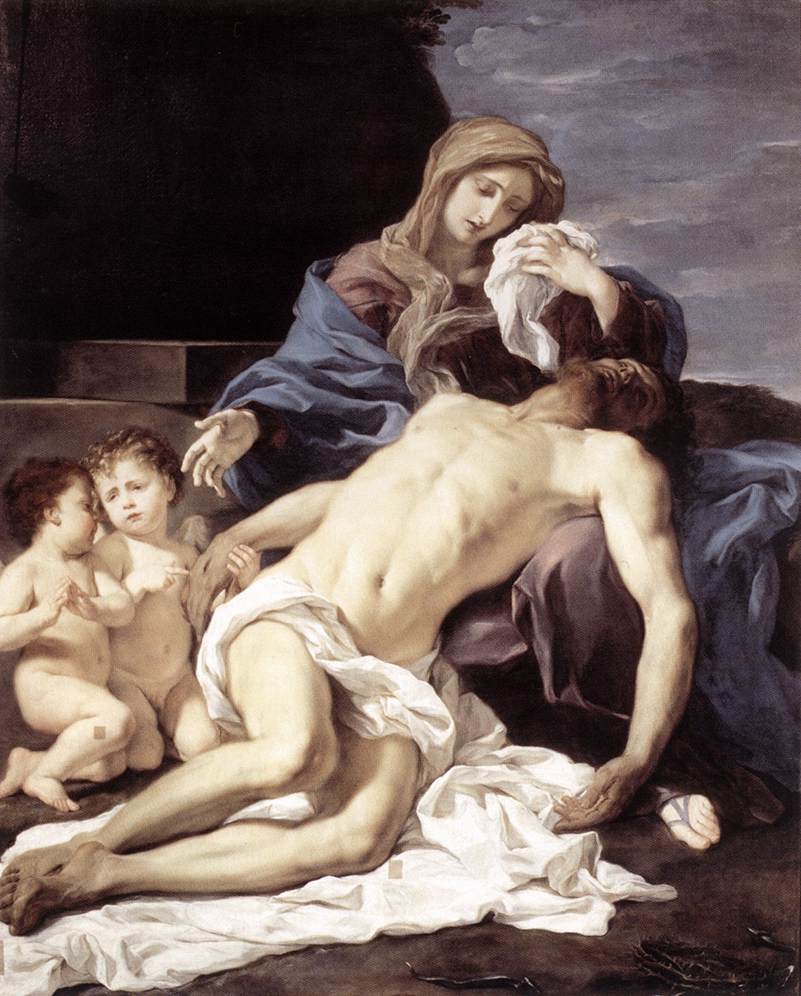
Jane Kenyon, whose work I’ve only recently discovered, wrote much of her spiritual poetry in her forties while dying of leukemia.   This brief poem illustrates her (and humanity’s) need for a bleeding God who lived and died among us, splattering beyond his mother’s robe.  Our help, our only comfort, our desperate need is for God who understands our suffering by dwelling on earth, not just in the heavens.

His blood, shed and shared so graciously and willingly, is on our hands, and pumps everlasting within our hearts.

The Piet by Giovanni Battista Gaulli (Called Baccicio)

Lenten Meditation: Ground Down

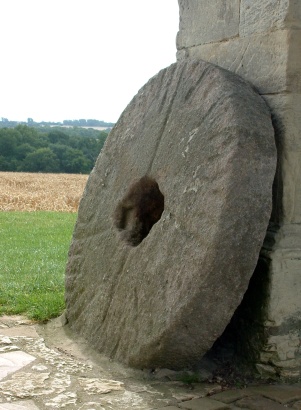
“The grinding power of the plain words of the Gospel story is like the power of millstones; and those who read them…will feel as if rocks had been rolled upon them.”

G.K. Chesterton  in The Everlasting Man

The observance of Lent is a downward trajectory, heavy laden.   The betrayal and denial by His closest friends during that final week in Jerusalem only amplifies His suffering and the sacrifice He was prepared to offer, even when forsaken.  Lent is a disconsolate descent into sadness, sliding into the overwhelming reality of the stone being rolled in place to seal a tomb. That moment effectively cuts man off from God, and it is as if we too are crushed, our breath and life forced from us, by that very stone.  There is nothing darker than a sealed tomb, other than the knowledge of eternal separation from God.

From the vantage point under the stone, there is no way to comprehend the eventual lifting of the impossible weight of sin, the ascent into an unbearable lightness of new life.  As hard shelled kernels ground to remove our useless hull, we will never be the same again.

Nor should we ever wish to be.

Lenten Meditation: Spread Under Foot

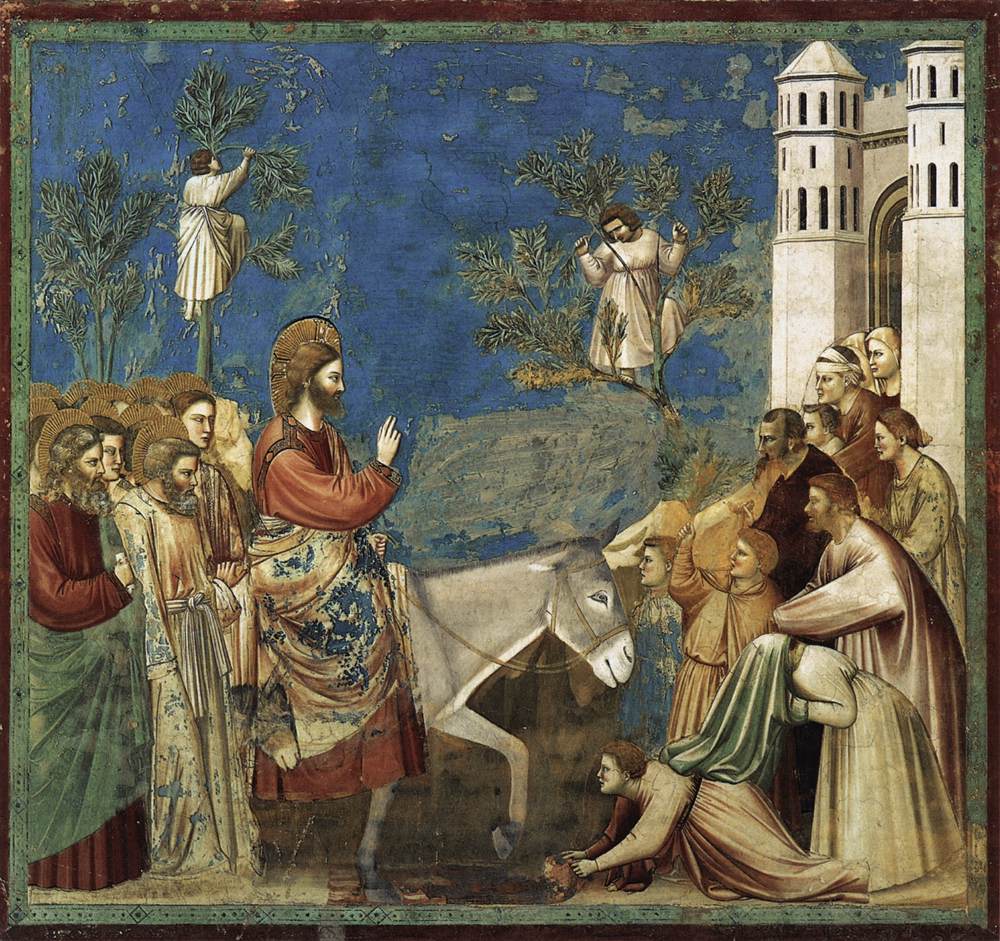
Entry into Jerusalem by by Giotto di Bondone. It is the image of a fresco, created between 1304-06, from Scenes from the Life of Christ at the Arena Chapel (Cappella Scrovegni) in Padua, Italy.

“So it is ourselves that we must spread under Christ’s feet, not coats or lifeless branches or shoots of trees, matter which wastes away and delights the eye only for a few brief hours.  But we have clothed ourselves with Christ’s grace, with the whole Christ–‘for as many of you as were baptized into Christ have clothed yourselves with Christ’—so let us spread ourselves like coats under his feet.”   –8th century bishop Andrew of Crete

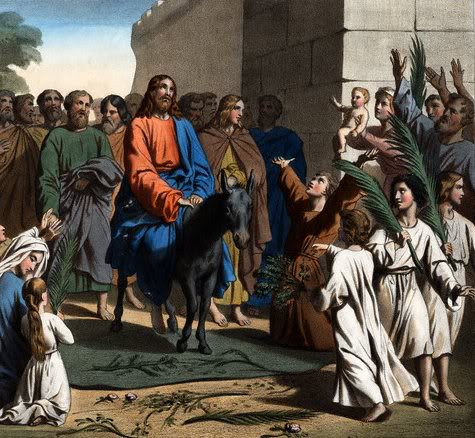
It would have been a spectacle of waving branches stripped from trees and coats being spread in the dirt of the road to Jerusalem.  But it was only spectacle.  Within a few days, it was all forgotten as another reversal takes place: the King of Glory himself was stripped of His clothing and hung upon a tree.

Andrew of Crete points us to the words of Apostle Paul in Galatians:  we must spread ourselves, clothed in His grace, over the dust, under His feet.  We become indistinguishable from the dust, indistinguishable one from another, as His soles leave permanent footprints on our souls.

Galatians 3:27-28

…all of you who were baptized into Christ have clothed yourselves with Christ.  There is neither Jew nor Greek, slave nor free, male nor female, for you are all one in Christ Jesus.