Hill Top Easter Sunrise Service Invitation

2012 Easter Sunrise Service at BriarCroft  — April 8, 2012 at 7 AM
(formerly Walnut Hill Farm)

sunrise view from our hill–see more at our website at http://www.briarcroft.com/easter.htm

When we purchased Walnut Hill Farm from the Morton Lawrence family in 1990, part of the tradition of this farm was a hilltop non-denominational Easter sunrise service held here for the previous 10+ years.  We have continued that tradition, with an open invitation to families from our surrounding rural neighborhood and communities, as well as our church family from Wiser Lake Chapel, to start Easter morning on our hill with a worship service of celebration of the resurrection of Jesus Christ.

At our annual Easter Sunrise Service in Whatcom County, we develop a different Easter theme each year through use of scripture readings and songs, led by Dan Gibson. We sit on hay bales on the hill for the worship service, followed by breakfast of cinnamon rolls, hot chocolate and coffee in our barn.  As many of the people who attend come from some distance from all over the county, we try to conclude by 8 AM so they may have time to get to morning church services.

We invite all to come to our farm to participate in this traditional service of celebration.  Please dress warmly with sturdy shoes as you will be walking through wet grass to reach the hilltop.  Bring heavy blankets or sleeping bags to wrap up in if it is a chilly morning.  In case of rain, we meet in the big red hay barn on the farm, so we never cancel this service.

If you would like more information and directions to our farm at 1613 Central Road, between Hannegan and Noon Road, please email us at emily@briarcroft.com

Dan and Emily Gibson

Lenten Meditation: Ground Down

“The grinding power of the plain words of the Gospel story is like the power of millstones; and those who read them…will feel as if rocks had been rolled upon them.”

G.K. Chesterton  in The Everlasting Man

The observance of Lent is a downward trajectory, heavy laden.   The betrayal and denial by His closest friends during that final week in Jerusalem only amplifies His suffering and the sacrifice He was prepared to offer, even when forsaken.  Lent is a disconsolate descent into sadness, sliding into the overwhelming reality of the stone being rolled in place to seal a tomb. That moment effectively cuts man off from God, and it is as if we too are crushed, our breath and life forced from us, by that very stone.  There is nothing darker than a sealed tomb, other than the knowledge of eternal separation from God.

From the vantage point under the stone, there is no way to comprehend the eventual lifting of the impossible weight of sin, the ascent into an unbearable lightness of new life.  As hard shelled kernels ground to remove our useless hull, we will never be the same again.

Nor should we ever wish to be.

Lenten Meditation: Spread Under Foot

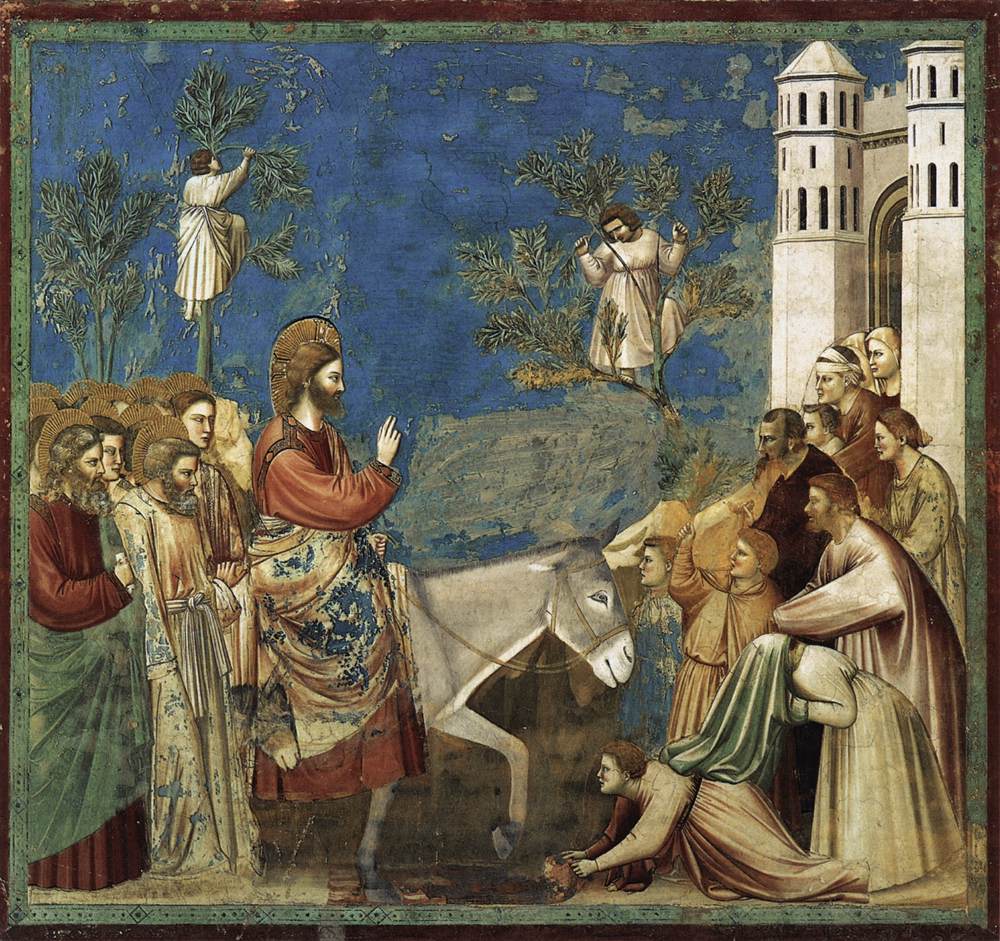
Entry into Jerusalem by by Giotto di Bondone. It is the image of a fresco, created between 1304-06, from Scenes from the Life of Christ at the Arena Chapel (Cappella Scrovegni) in Padua, Italy.

“So it is ourselves that we must spread under Christ’s feet, not coats or lifeless branches or shoots of trees, matter which wastes away and delights the eye only for a few brief hours.  But we have clothed ourselves with Christ’s grace, with the whole Christ–‘for as many of you as were baptized into Christ have clothed yourselves with Christ’—so let us spread ourselves like coats under his feet.”   –8th century bishop Andrew of Crete

It would have been a spectacle of waving branches stripped from trees and coats being spread in the dirt of the road to Jerusalem.  But it was only spectacle.  Within a few days, it was all forgotten as another reversal takes place: the King of Glory himself was stripped of His clothing and hung upon a tree.

Andrew of Crete points us to the words of Apostle Paul in Galatians:  we must spread ourselves, clothed in His grace, over the dust, under His feet.  We become indistinguishable from the dust, indistinguishable one from another, as His soles leave permanent footprints on our souls.

Galatians 3:27-28

…all of you who were baptized into Christ have clothed yourselves with Christ.  There is neither Jew nor Greek, slave nor free, male nor female, for you are all one in Christ Jesus.


Lenten Meditation: Lost and Now Is Found

Return of the Prodigal Son --Bartolome Esteban Murillo

Luke 32: 15

this brother of yours was dead and is alive again; he was lost and is found.

There is a unique aspect to the “Prodigal” story that is not always apparent on first reading/hearing.  It is, on the surface, a warm and tender story of a loving father welcoming his wayward son back to the fold after squandering all, and realizing his life would be better working as one of his father’s servants than literally wallowing in a pig sty.  Instead,  his father greets him home with utter joy, bringing him the best of all he possesses to celebrate.   It is the ultimate story of grace and forgiveness.

It is told by Jesus in the context of a warning to the Pharisees and keepers of the Jewish law.  It is actually a parable far more about the older brother–the obedient  “nose to the grindstone”  guy– who is resentful and angry that his father lavishes such special attention on the younger brother returned home from a life of sin.   The father “pleads” with his older son to participate in the celebration, reminding him:  “You are always with me and everything I have is yours, but we had to celebrate and be glad because this brother of yours was dead and is alive again; he was lost and is found.”  We don’t know what the older brother decided to do, and whether he could ever get over his resentment of his brother and his anger at his father.  Jesus leaves that part of the story open-ended, just as our own decisions are open-ended.

It is clear what we must do.   We cannot have expectations for what we feel is owed us because of our “good” behavior, our hard work, or our obedient nature.  We deserve nothing.

Yet our Father hears our righteous anger, sees our self-absorbed resentment and instead entreats us, with all the power of His love,
“You are always with me; everything I have is yours.”

What can be greater than that?   As we are lost in our selfish judgment, He reminds us how firmly He holds us.  We are meant to be found resting, living, breathing in Him.

And so, it is not only the prodigal who lives again.

Lenten Meditation: A Broken Spirit

Psalm 51: 17

The sacrifices of God are a broken spirit;
a broken and contrite heart…

When we are at our most tender and vulnerable, hurting and barely able to breathe–that is when we gift ourselves to God, and He welcomes us with open arms, knowing the sacrifice we make.   He was once just like us.

No longer burnt offerings, nor money, but He asks for a sacrifice of us, broken and yielding, ready for healing, begging for wholeness.  He becomes our glue to shore up our shattered pieces.

An old Shaker hymn says it better than I:

I will bow and be simple,
I will bow and be free,
I will bow and be humble,
Yea, bow like the willow tree.

I will bow, this is the token,
I will wear the easy yoke,
I will bow and will be broken,
Yea, I'll fall upon the rock.

Lenten Meditation: Resting in the Yoke

Matthew 11:28-30

Come to me, all you who are weary and burdened, and I will give you rest. 29Take my yoke upon you and learn from me, for I am gentle and humble in heart, and you will find rest for your souls. 30For my yoke is easy and my burden is light.

There doesn’t appear to be anything remotely restful about a yoke.  It represents hard sweaty pulling work no matter what.   Why would taking on a yoke be “easy”, and the “burden light”?

It is the shared load that makes the work easier.  Although single yokes can be used, the efficiency is far greater when two pull together under the same yoke.  Jesus is clearly saying, “come walk alongside me, share my yoke and I’ll pull you through whatever you need to go through.”    Together, it will be easier, the load less heavy, the relief profound.

I can actually imagine happiness in wearing such a harness when the pulling partner is not only gentle and humble in heart, but encouraging and reassuring every step of the way.

I will never cast off this yoke.  I am bound in joy.

The Forchemers in Leavenworth

Lenten Meditation: The Eye of God

The Prayer of St. Teresa of Avila (1515-1582)

Let nothing disturb you, nothing frighten you, all things are passing.  God never changes.  Patience obtains all things.  Whoever has God lacks nothing.  God is enough.

These words were sung last night to a packed church by the Dordt College Choir (my husband and son’s alma mater) now on their spring tour.  It was a touching and beautiful evening of wonderful choral music by a group of students who clearly care deeply about sharing their faith, led by a talented and dedicated conductor who grew up in our town of Lynden, Dr. Ben Kornelis.

As the University where I work winds down to the end of a tough and wearing winter quarter this week, it struck me how hazardous being a college student is these days.   This quarter we had one completed suicide and five additional serious attempts.  A disturbing New York Times article today highlights the cluster of suicides of students at Cornell University in upstate New York.

This is a generation with seemingly little grounding in the preciousness of life, with less spiritual foundation for hope and inner peace, with broken and fragmented family support when the inevitable rough days happen.  These young adults give themselves up to their desperation and some tell me the pain of living is simply not worth sustaining, no matter how temporary the misery may be.

The words of St. Teresa are a reminder of God’s constancy always, through all things.  Like the helix nebula dubbed “The Eye of God”, He patiently watches over us, never changing, lacking nothing, being sufficient for all our needs.  Do not be afraid.  Do not despair.  He is here.

Lenten Meditation: All We Like Sheep

Isaiah 53:6

We all, like sheep, have gone astray, each of us has turned to his own way; and the LORD has laid on him the iniquity of us all.

I am privileged to be learning Handel’s Messiah with a group of really wonderful folks in my small town, readying ourselves for our twice yearly performances.   The “All We Like Sheep”  chorus is one of the most challenging of all, simply because the melody lines intertwine in seemingly random fashion, as if our choir were sixty some individual sheep running amok, each in a different direction.    Sheep are skilled  at ignoring boundaries, running over anything in their way, doubling back and retracing their steps and giving in to whim rather than doing what is right and orderly.

It is brilliantly organized musical chaos, as only Handel can create, until the final Adagio, like a shepherd of sorts,  brings all the voices together in one powerful final lament:  the Lord lifts from us the burden of our depravity and takes it upon Himself in the ultimate sacrifice.  We are absolved, sheared of our heavy burden, though unworthy as only a herd of dumb sheep can be.

We are sheep in desperate need of a Shepherd who knows what it is to be the Paschal Lamb.   Worthy is that Lamb.

Lenten Meditation: Watch With Me

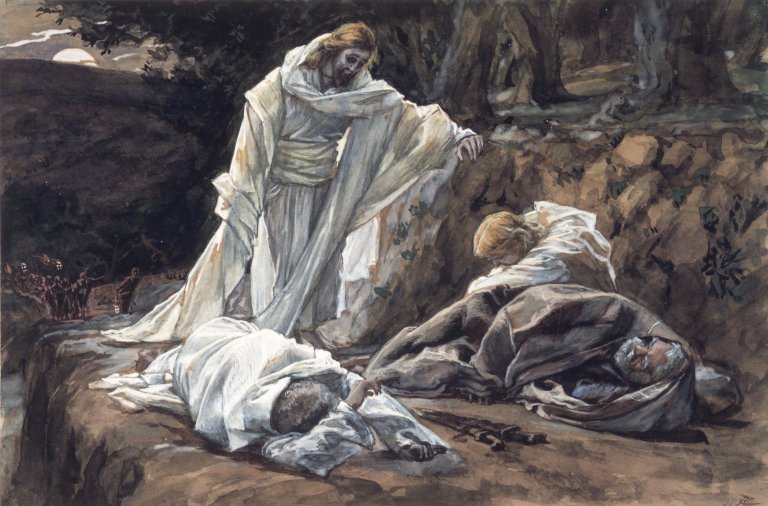
You could not watch one hour with me--James Tissot

Matthew 26:40

Then he returned to his disciples and found them sleeping. “Could you men not keep watch with me for one hour?” he asked Peter.

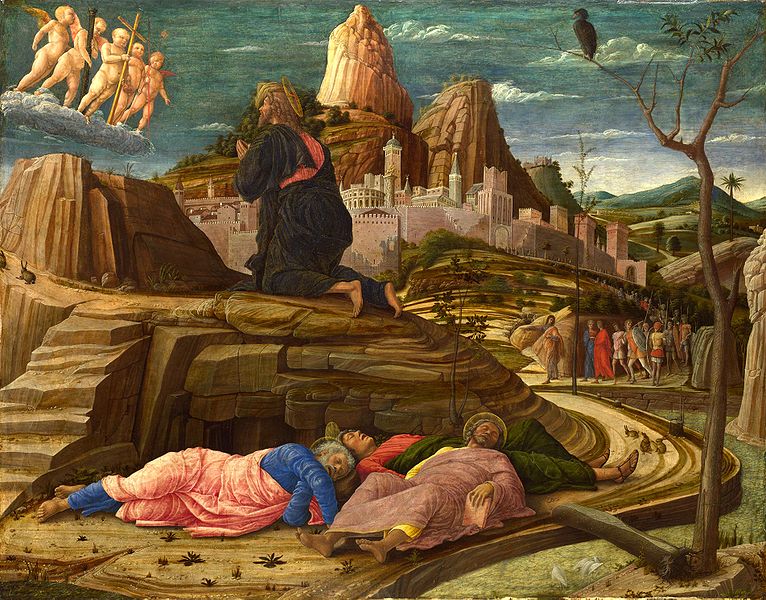
Every time I read of this scene in Gethsemane, I am convicted yet again of my own drowsing faith and how inadequate it is when the pressure is on.  “Gethsemane” means “oil press”  so it becomes an appropriate setting among the olive trees for the pressure to be turned up high, on the disciples, as well as Jesus.

The disciples are expected, indeed commanded, to keep watch by the Master, to be filled with prayer, to avoid the temptation thrown at them at every turn.  But they fail pressure testing and fall apart.  And so too, we are lulled by the complacency of our modern times, by an over-indulged satiety for material comforts that do not truly fill hunger or quench thirst,   by an expectation that being called a disciple of Jesus is enough.

It is not enough.

We sleep through His anguish.  We dream, oblivious, while He sweats blood.  We deny we know Him when the pressure is turned up,  yet incredibly He loves us anyway.

So, like the disciples who walked alongside Him, we must pray: to remain watchful, to be faithful under stress, to be forgiven for falling asleep when He needs us most.

Andrea Mantegna: Agony in the Garden, circa 1460

Lenten Meditation: Wash Me

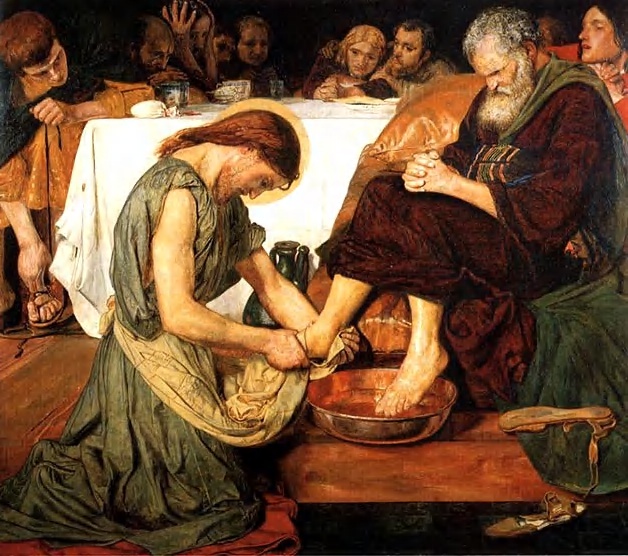
Christ Washing Peter's Feet by Ford Madox Brown

Psalm 51: 7

Cleanse me with hyssop, and I will be clean;  wash me.

It had to have been mortifying.  The Master, with a towel wrapped around His waist like a slave,  kneeling to wash His disciples’ dirty smelly feet covered with the dust of Jerusalem.  Though Peter protested, he was rebuked to submit, to comprehend the symbolism of the act.

It was this reversal that carried Him to the cross, the ultimate cleansing coming not just from His hands, but from His wounds, from His suffering, from His blood.

So He continues to wash off our everyday grime and gently, tenderly wipes us clean, knowing, realizing we will only get soiled again.

What wondrous love is this?