In our medical school lecture hall, George always sat on the edge of his seat in the front row. That way, he could be closest to the professor and not miss any detail of the slides projected on the screen, the nuances of the overhead projector diagrams, or the patients paraded into the lecture hall with memorable symptoms. From the first day, it was clear George would be the go-to person if one of us missed a lecture, as he kept the most accurate notes of any medical student in tiny neat almost verbatim script. To read his notes was almost as good as being there and he was willing, with coaxing, to share what he knew. He was, to put it simply, the best and the brightest among us.
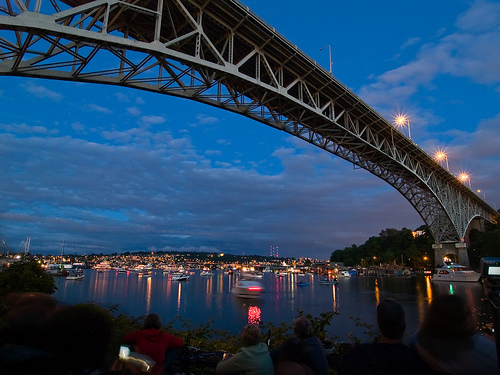
Working on a double Ph.D/M.D. degree, he hoped one day to be a physician laboratory researcher in a teaching hospital, although getting that much personal information from him took much coaxing. He was a first generation college graduate in his immigrant family and their hopes and dreams were riding on his success. It was clear he was their bridge to success in their new home and new life. He rarely socialized with other students after class, nor did he join in study groups. At the end of the day, he would cram every book into his huge back pack, sling it over his slight frame and head out for the city bus to return home to his parents’ house located near the north end of Seattle’s Aurora Bridge.
My opportunity to work with George came during our first clinical experience in our first year of classes, working in pairs to interview patients in hospitals, practicing our skills at taking histories. When we divided up the questions beforehand, George was more than willing to let me ask about our patients’ family and spiritual support systems, their interpersonal relationships and sexual history, and their struggles with depression or other mental illness. He was much more interested in the detail of their illness and physical symptoms, so we made a good team documenting excellent patient medical histories. George admitted to me that talking to people was a challenge for him. His passion for healing was in the lab, in his future research and in his hope for discovery of new treatments for disease. He knew his best work would not be at the bedside.
Once our class started full time clinical rotations in hospitals in our third year, students were assigned in small groups together, working under attending physicians, residents and interns in the traditional teaching hospital hierarchy. Medical students do the grunt work for the medical team, with most of the patient contact being the duty of the medical student.
Despite his quiet nature, George excelled in the clinical work of his internal medicine rotation, and then went on to his 6 week surgical rotation. He was assigned to a particularly difficult chief resident who had a reputation for grilling students over the operating table about anatomy and being very picky about how his patients were cared for. George was always ready for the questions in the OR, never missing a one, and worked beyond the 36 hours on, 12 hours off schedule to make sure all his work was complete. He was barely getting home to sleep, just to turn around to catch the bus in the early dawn to head back to the hospital. One morning, in his exhaustion, he overslept by an hour, and rushed to arrive barely in time for 6 AM rounds at the hospital. He was unable to gather his patients’ lab results or organize information for the chief resident. When it was clear George was not prepared, the chief resident, irritated, told him to leave and not bother to return.
George grabbed his heavy back pack, caught the city bus and in morning rush hour, got off on the south end of Aurora Bridge and started walking toward home. He stopped in the middle of the bridge, set down his back pack on the sidewalk, climbed over the rail and standing briefly on the edge, staring at the water below, he jumped.
At his funeral, his pastor shared the following with his stricken family, instructors and classmates:
“George worked very hard to reach the goals he had set, in his hope to cure diseases. What we must remember is that to reach our goals we must pass over the deepest valleys of our lives. The darkest pit can appear to swallow us up. The Lord is there to bridge that gap as the firm foundation under our feet, ready to hold us up when we teeter on the edge. Don’t ever lose sight of the other side, where the valley will be no more.”
I hope, –no, I know—George is waiting for us there.
 Barnstorming